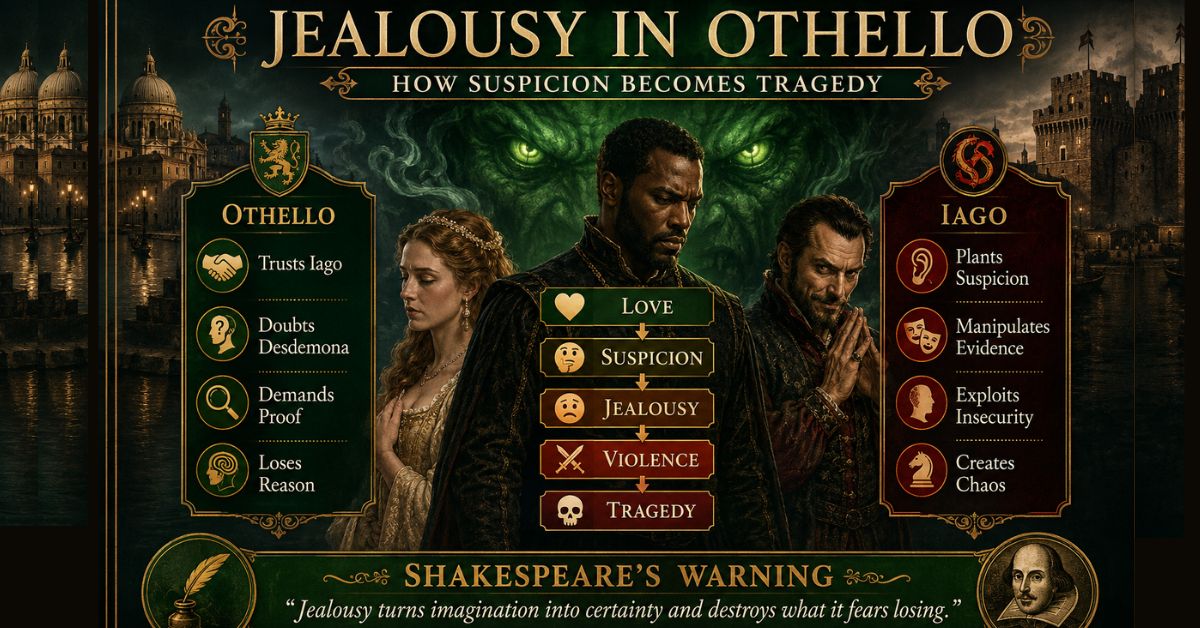
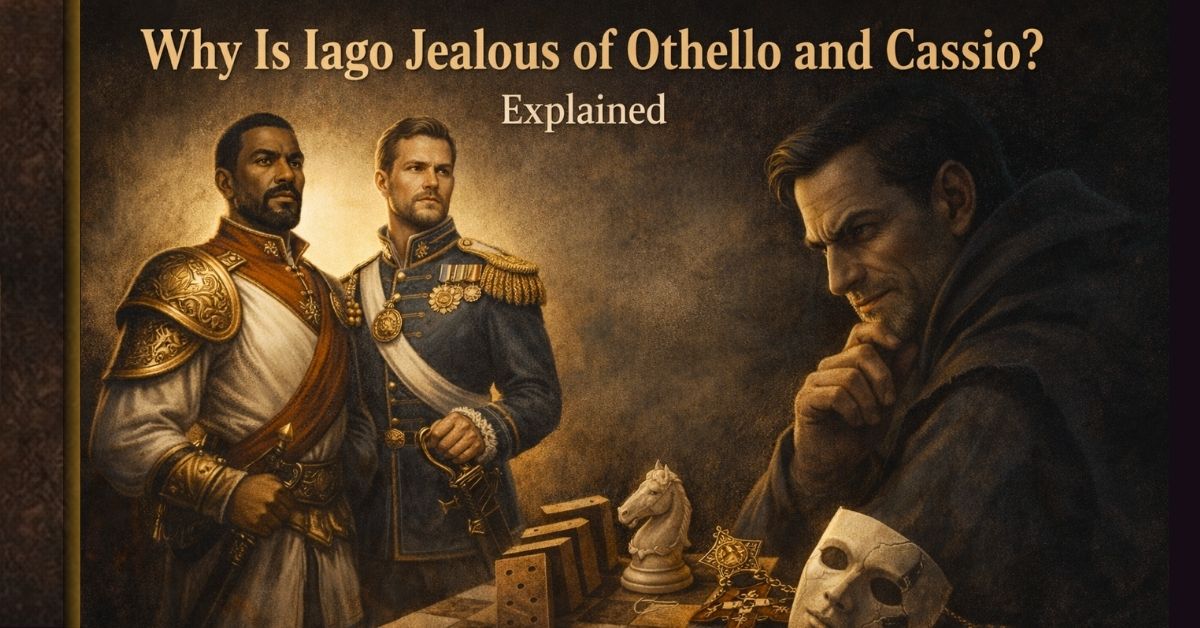
The characters in Othello are far more than figures who simply move the plot forward. Each one embodies a particular way of thinking about love, power, loyalty, race, ambition, or justice, which is why the play continues to feel deeply human centuries after its first performance.
Some influence events through courage or compassion, while others allow jealousy, pride, or deception to guide their decisions. Together, these Shakespearean characters create a world where personal choices carry devastating consequences.
When I teach Othello, I remind my students that every important character serves a dramatic purpose. Some introduce conflict, some deepen it, and others help us understand why the tragedy becomes unavoidable.
This guide goes beyond simple character summaries. It examines each figure’s role, relationships, motivations, and dramatic importance. In doing so, it shows how every major and minor character contributes to the play’s emotional and moral impact.
Table of Contents

Main Characters in Othello
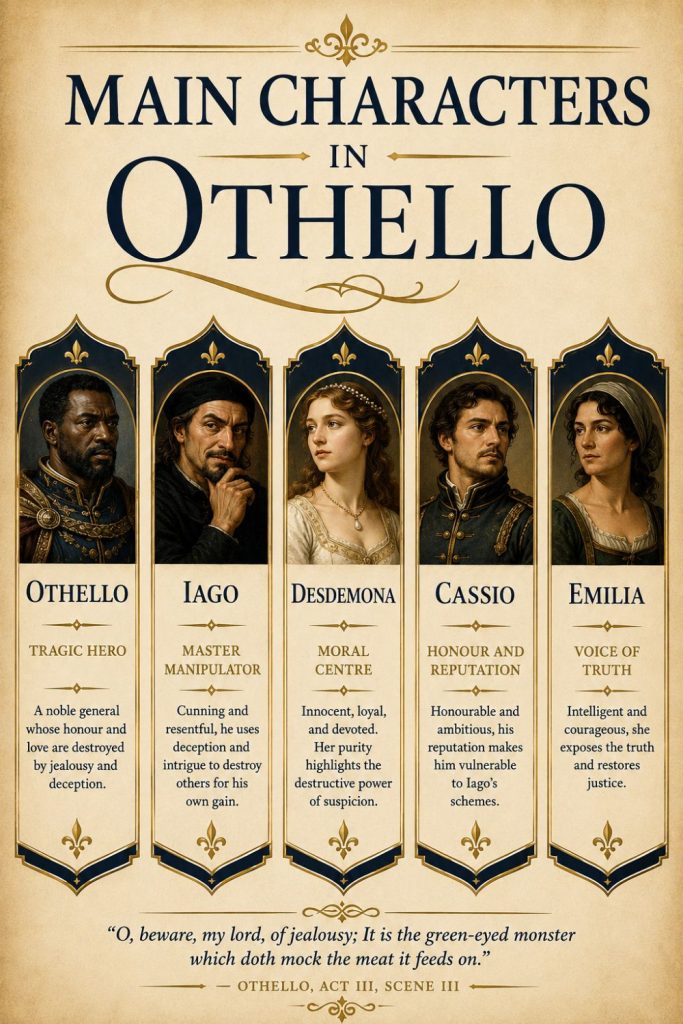
The main characters in Othello shape every major turning point in the tragedy. At its centre stand five unforgettable figures: Othello, Iago, Desdemona, Cassio, and Emilia. Each represents a distinct human quality- love, ambition, loyalty, deceit, or moral courage- and together their choices drive the play towards its devastating conclusion.
| Character | Role in the Play | Why the Character Matters |
| Othello | Protagonist | A respected Moorish general whose growing jealousy leads to his downfall. |
| Iago | Antagonist | Othello’s ensign, whose calculated schemes drive almost every major event. |
| Desdemona | Heroine | Othello’s devoted wife, whose innocence highlights the destructive power of suspicion. |
| Michael Cassio | Major supporting character | Othello’s trusted lieutenant, whose promotion acts as the starting point of Iago’s revenge. |
| Emilia | Major supporting character | Iago’s wife, whose courage finally uncovers the truth and restores moral clarity. |
As I explain in class, these five characters are best understood collectively rather than in isolation. Othello’s downfall depends upon Iago’s deception, Desdemona’s unwavering devotion, Cassio’s honour, and Emilia’s decision to speak the truth despite the cost.
If you want a fuller understanding of their personalities, motivations, relationships, symbolism, and memorable quotations, explore the detailed character guides linked throughout this page.
Minor Characters in Othello
Although the central figures receive most of the attention, the minor characters quietly shape many of the play’s decisive moments. These supporting figures deepen the play in different ways. Some introduce conflict, others expose hidden tensions, while a few quietly influence crucial decisions.
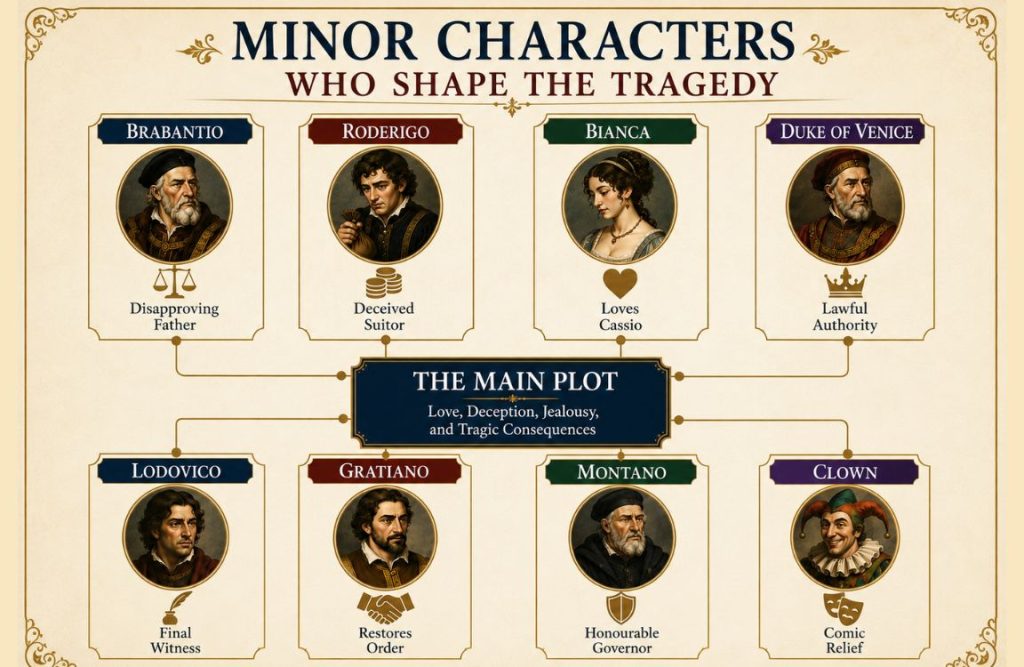
- Brabantio begins the conflict over Othello’s marriage and leaves behind a warning that later fuels Othello’s insecurity.
- Roderigo, Iago’s easiest victim, supplies both money and opportunities for his schemes.
- Bianca provides a valuable contrast to the noblewomen and suffers unjust suspicion despite her sincere affection for Cassio.
- The Duke of Venice settles the dispute over the marriage and places public duty above personal prejudice.
- Lodovico, who witnesses Othello’s final collapse, serves as an impartial observer of the tragedy.
- Gratiano in Othello confirms Brabantio’s death and helps restore order after the violence.
- Montano, the former Governor of Cyprus, serves as an innocent casualty of Iago’s plotting.
- The Clown, though appearing only briefly, offers a welcome moment of humour before the atmosphere grows darker.
Taken as a whole, these supporting figures remind us that even characters with limited stage time can influence the direction of an entire tragedy.
Othello Character List at a Glance with Role, Relationship & Importance
The table below offers a quick reference to the most important characters in Othello, outlining their roles, relationships, and contributions to the story.
| Character | Role | Relationship | Importance |
| Othello | Moorish general of Venice | Husband of Desdemona | Tragic hero whose downfall drives the play |
| Iago | Ensign | Othello’s subordinate | Principal antagonist whose schemes shape the action |
| Desdemona | Venetian noblewoman | Wife of Othello | Represents love, innocence, and fidelity |
| Michael Cassio | Lieutenant | Trusted officer of Othello | His promotion triggers Iago’s resentment |
| Emilia | Lady-in-waiting | Wife of Iago | Exposes the deception and restores the truth |
| Brabantio | Venetian senator | Desdemona’s father | Initiates the central conflict |
| Roderigo | Wealthy gentleman | Follower of Iago | Finances and assists Iago’s plans |
| Bianca | Courtesan | Loves Cassio | Illustrates the play’s social double standards |
| Duke of Venice | Ruler | Supports Othello | Represents lawful authority |
| Lodovico | Venetian nobleman | Desdemona’s cousin | Witnesses the final catastrophe |
| Gratiano | Venetian nobleman | Brabantio’s brother | Helps re-establish order |
| Montano | Former Governor of Cyprus | Ally of Othello | Becomes caught in Iago’s conspiracy |
| Clown | Servant | Cassio’s attendant | Provides brief comic relief |
Character Relationships in Othello
Understanding the character relationships in Othello makes the story much easier to follow because every important event grows from love, trust, ambition, jealousy, or deception. A simple character map also shows how closely each person’s fate gets connected to everyone else’s.
Othello ❤️ Desdemona
│
manipulated by
│
Iago
↙ ↘
manipulates envies
Roderigo Cassio
│
supported by
│
Desdemona
Emilia ───── wife of ───── Iago
│
uncovers the truth
Brabantio
│
disapproves of
▼
Othello and Desdemona’s marriage
Bianca ───── loves ─────► Cassio
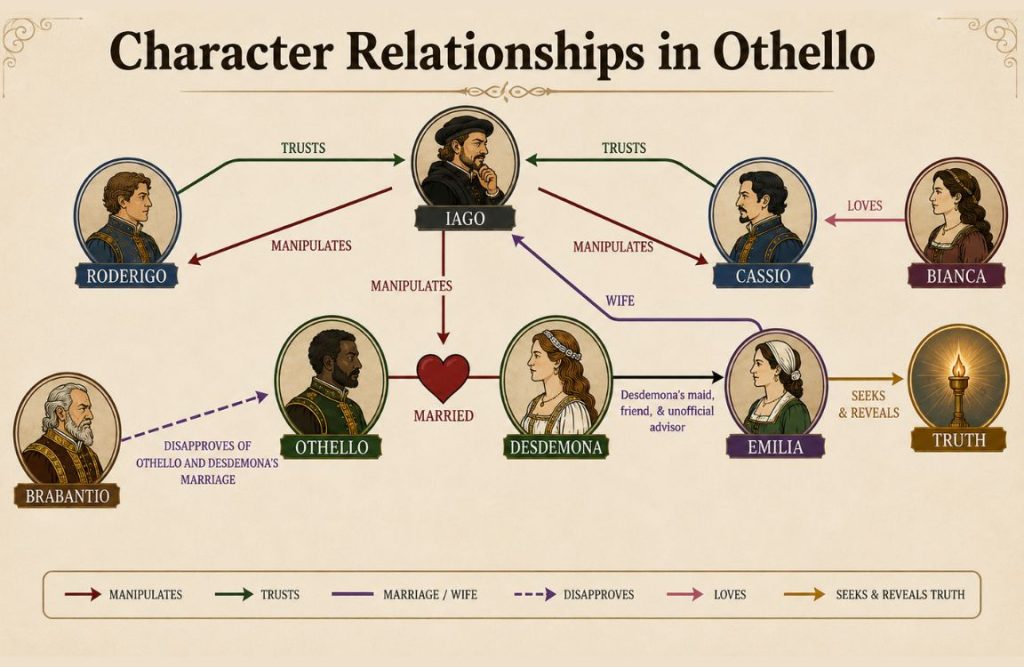
At the centre of the play stands the marriage between Othello and Desdemona, a relationship founded on genuine love but gradually destroyed by suspicion. As Desdemona tells the Senate, “I saw Othello’s visage in his mind,” revealing that she values his character rather than his appearance.
Around this marriage stands Iago, the architect of the tragedy. Othello, Michael Cassio, and Roderigo all trust him, allowing him to manipulate each of them for his own purposes. He exploits Othello’s confidence, deceives Roderigo into serving his schemes, and uses Cassio as an unwitting pawn in his revenge.
Emilia occupies a crucial position between loyalty and justice. As Iago’s wife, she initially obeys him, but her conscience ultimately outweighs her marital loyalty. By revealing the truth about the handkerchief and Iago’s deception, she exposes the villain and transforms the final act of the play.
Other relationships also deepen the tragedy. Brabantio openly disapproves of Othello and Desdemona’s marriage. It foreshadows the conflicts that follow, while Bianca’s sincere love for Cassio provides a striking contrast to the jealousy and manipulation surrounding the other characters.
When I examine these connections together, I see that Shakespeare constructs an intricate web in which every relationship affects another. Trust enables manipulation, love gives way to jealousy, and one carefully planned deception ultimately destroys nearly every major character, giving Othello its remarkable dramatic unity.
Major Character Analysis
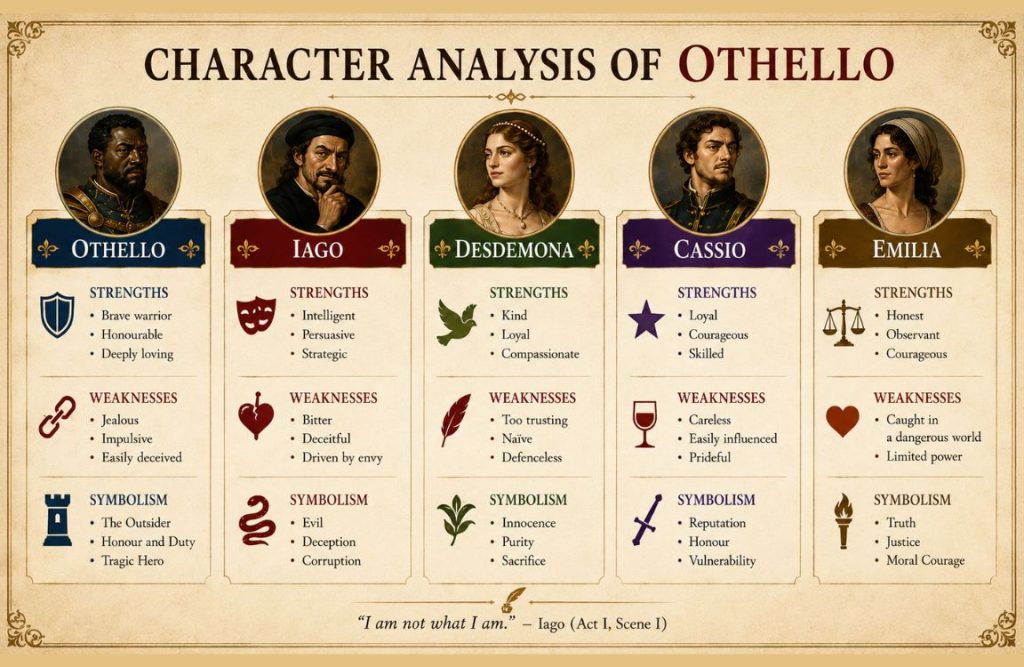
While teaching Othello, I encourage students to look beyond the plot. Every character explores a different side of human nature, showing how individual strengths, personal flaws, and moral choices gradually shape the play’s tragic outcome.
Othello
Many students first admire Othello because he is brave, respected, and honourable. But I invite them to look beyond his heroism. His tragedy begins not with jealousy alone but with his decision to trust Iago’s words more readily than Desdemona’s character.
After Iago’s manipulation takes hold, Othello mourns the loss of his inner peace, declaring, “Farewell the tranquil mind!” His downfall reminds us that even great leaders can be destroyed when suspicion replaces judgement.
Iago
Iago possesses remarkable intelligence, patience, and psychological insight. Instead of using those gifts wisely, he turns them into instruments of revenge and personal gain.
He personifies calculated evil, as Iago chillingly admits, “I am not what I am,” a line that captures his entire method of deception. It demonstrates that hidden malice often causes greater destruction than open hostility.
Desdemona
Many readers see Desdemona only as a helpless victim. One of the first questions I put to my students is whether that judgement is really fair.
Defying her father to marry Othello requires remarkable independence, and throughout the play, she remains steadfast, even when confronted with suspicion and cruelty.
Her courage is evident when she tells the Duke, “I do perceive here a divided duty,” calmly affirming both her love for Othello and her new responsibilities as his wife.
Michael Cassio
Cassio is honourable, disciplined, and respected as a soldier, yet his concern for reputation leaves him vulnerable to Iago’s schemes. His temporary disgrace acts as the opening Iago needs to undermine Othello’s confidence.
Many readers assume Cassio is merely Iago’s victim. I disagree. His concern for reputation also makes him easier to manipulate, reminding us that even admirable people possess weaknesses.
Emilia
Emilia begins as a practical wife who accepts her husband’s authority, yet her moral awareness gradually becomes stronger than her obedience.
By exposing the truth, she transforms from a seemingly minor figure into the play’s moral conscience. Her final actions restore justice, even though they cost her life.
Emilia’s courage reaches its peak when she refuses to remain silent, insisting, “I will speak as liberal as the north.”
One thing my students quickly discover is that none of these characters is included by accident. Everyone contributes a different perspective on human behaviour and moral choice.
Character Comparison
One of the play’s most effective dramatic techniques is the use of foil characters. By placing contrasting personalities side by side, the playwright invites us to compare different responses to similar situations.
- Othello vs Iago: Othello values honour and trust, while Iago thrives on deceit, resentment, and suspicion.
- Cassio vs Iago: Cassio earns promotion through ability and discipline, whereas Iago pursues advancement through jealousy and calculated deception.
- Desdemona vs Emilia: Desdemona represents idealistic devotion, whereas Emilia develops a practical understanding of marriage before choosing truth over silence.
- Brabantio vs Othello: Brabantio judges people through race and social convention, while Othello initially values merit above birth or status.
These contrasts deepen our understanding of every character by showing how different values and decisions shape the outcome of the play.
Character Development
Not every character changes in Othello, but those who do experience some of the most memorable transformations in Shakespearean tragedy.
Othello moves from calm confidence to overwhelming suspicion before recognising the terrible cost of his mistake. By the final act, he recognises his tragic error and describes himself as one who “loved not wisely but too well.” His emotional decline forms the tragic centre of the play.
Emilia develops from an obedient and overlooked wife into the courageous voice of truth, choosing justice even though she knows the personal danger.
Roderigo begins as a foolish admirer blinded by desire. Only near the end does he realise he has been exploited, but that discovery arrives too late to change his fate.
These journeys remind us that great tragedies grow through a series of small decisions, each carrying consequences that become impossible to reverse.
Themes Revealed Through the Characters
I always encourage my students to begin with the characters because Shakespeare develops his themes through people, not abstract ideas. When they understand the characters, the themes become much easier to recognise.
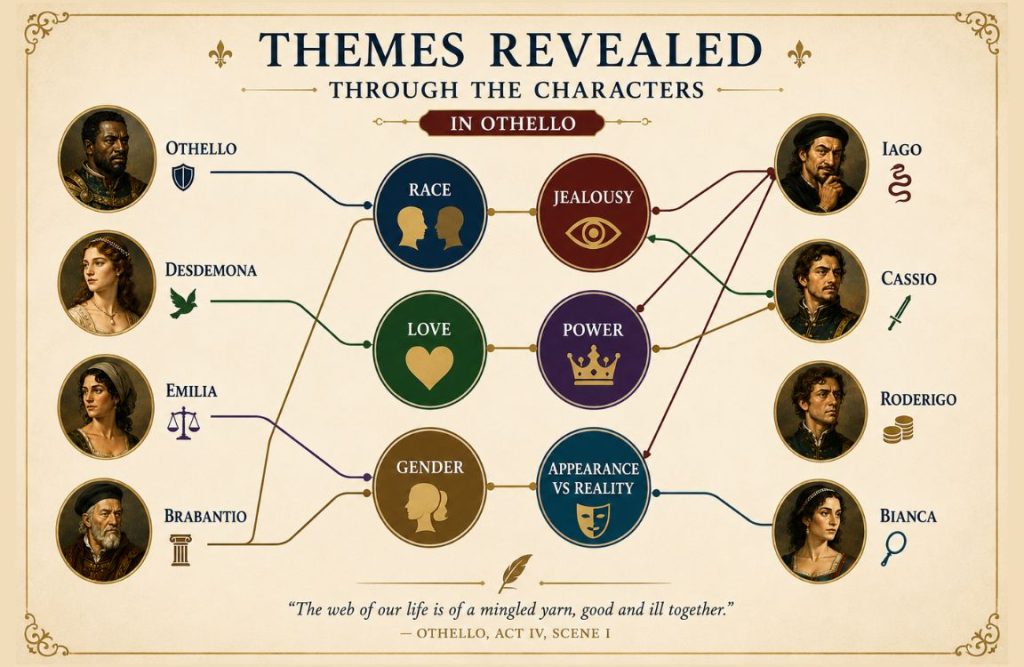
- Race in Othello emerges through Othello’s experience and Brabantio’s prejudice.
- Jealousy destroys Othello while fuelling Iago’s revenge.
- Love appears in Desdemona’s devotion but gets corrupted by fear and mistrust.
- Power influences relationships between husbands and wives, commanders and soldiers, masters and servants.
- Gender is explored through the contrasting experiences of Desdemona, Emilia, and Bianca.
- Appearance vs Reality shapes the entire play as honest people are doubted while the true villain wins everyone’s confidence. This deception is perfectly summed up by Iago’s confession, “I am not what I am.”
For this reason, studying the characters of Othello is also the best way to understand the play’s larger ideas.
Why Shakespeare’s Characters Still Matter
Experience has taught me that great literature endures because it speaks to every generation. The play’s characters confront problems that remain part of everyday life, like leadership, manipulation, prejudice, trust, and personal integrity.
Othello’s misplaced confidence, Iago’s calculated influence, and Emilia’s moral courage show that our choices shape our destiny. Even Othello’s painful cry, “One that loved not wisely but too well,” reflects an emotional struggle that still feels familiar to modern readers.
Although the story is set in Renaissance Venice, the questions it raises about human behaviour feel just as relevant today.
FAQs:
Which character is the most tragic in Othello?
Othello is generally considered the most tragic character because his noble qualities are gradually destroyed by manipulation, jealousy, and misplaced trust. His downfall transforms a respected leader into Shakespeare’s unforgettable tragic hero.
Why does Iago succeed in manipulating almost everyone?
Iago succeeds because he understands people’s fears, ambitions, and weaknesses. By appearing trustworthy while hiding his true intentions, he persuades others to doubt themselves long before they begin to doubt him.
Which minor character has the greatest impact on the story?
Brabantio, Roderigo, and Bianca influence key events despite limited stage time. Brabantio plants the first seed of doubt, Roderigo finances and supports Iago’s schemes, and Bianca unintentionally becomes entangled in the plot against Cassio.
Why is understanding the characters important before studying the themes of Othello?
The play’s central ideas become meaningful through its people. Jealousy, race, love, power, prejudice, and deception are understood most clearly by examining each character’s choices, relationships, and moral struggles instead of treating those themes as abstract concepts.
Conclusion:
Whenever I finish teaching Othello, I always tell my students that no character destroys the tragedy alone. One person’s prejudice, another’s ambition, another’s silence, and another’s misplaced trust combine to produce disaster.
That is why these characters continue to reward careful study centuries after the play was written.