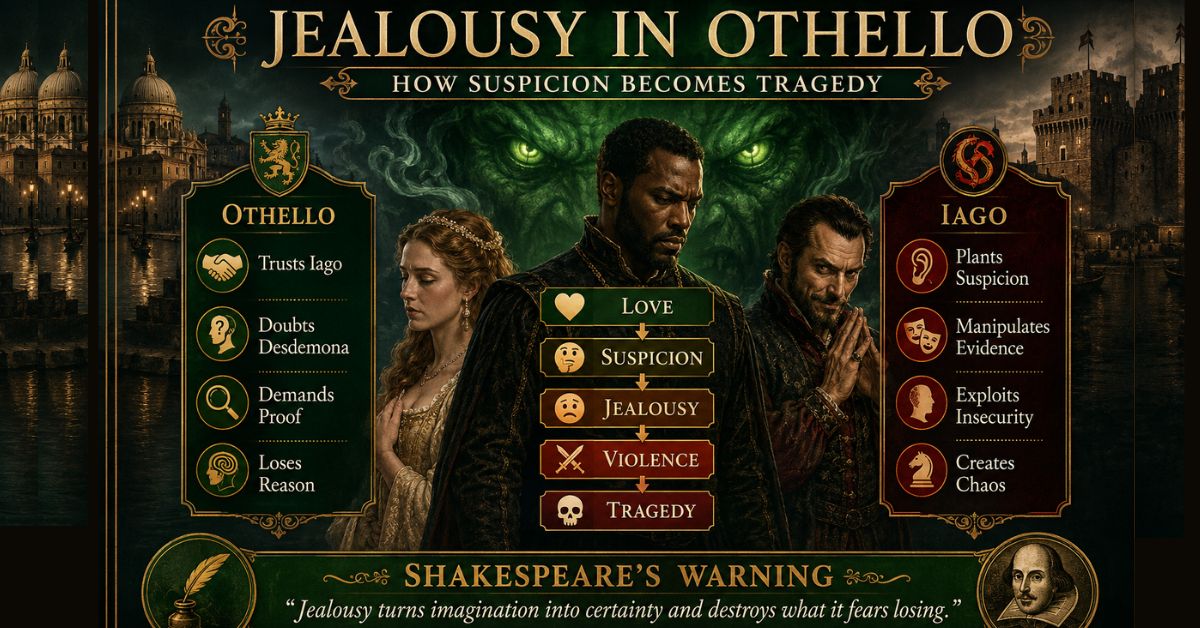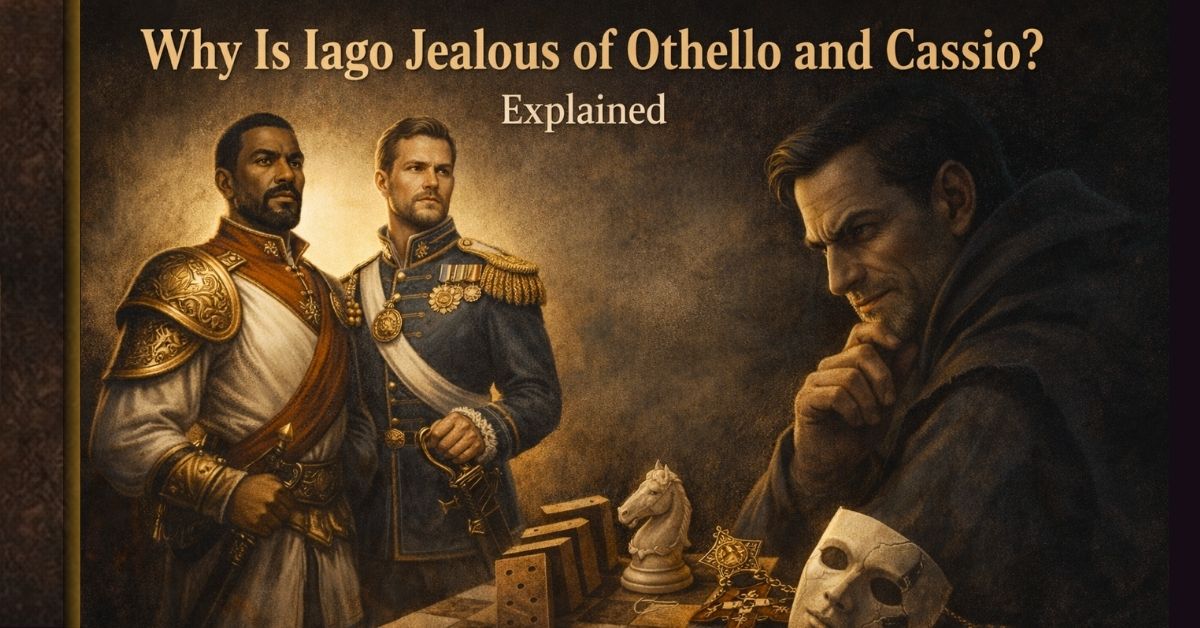
When I teach Othello, students often remember Brabantio simply as Desdemona’s father. Yet Brabantio in Othello deserves far closer attention. As a respected Venetian senator, he shapes the play’s opening conflict, voices fears about race and authority, and unknowingly foreshadows the tragedy that follows.
A thoughtful Brabantio character analysis shows a father torn between love, pride, and prejudice. Understanding his choices helps us see how private family conflict grows into one of Shakespeare’s greatest tragedies.
Who Is Brabantio in Othello?
If you wonder who Desdemona’s father is, the answer is Brabantio, a wealthy Venetian senator whose influence carries considerable weight in Venice. He is respected for his public position, yet his private life changes dramatically when Desdemona secretly marries Othello.
Furious at the marriage, he accuses Othello of using “spells and medicines bought of mountebanks” to win her love and appeals to the Duke for justice.
Although Brabantio appears only in the opening act, his role reaches far beyond those scenes. His accusations shape the audience’s first impression of Othello, while his warning continues to echo long after his final appearance.
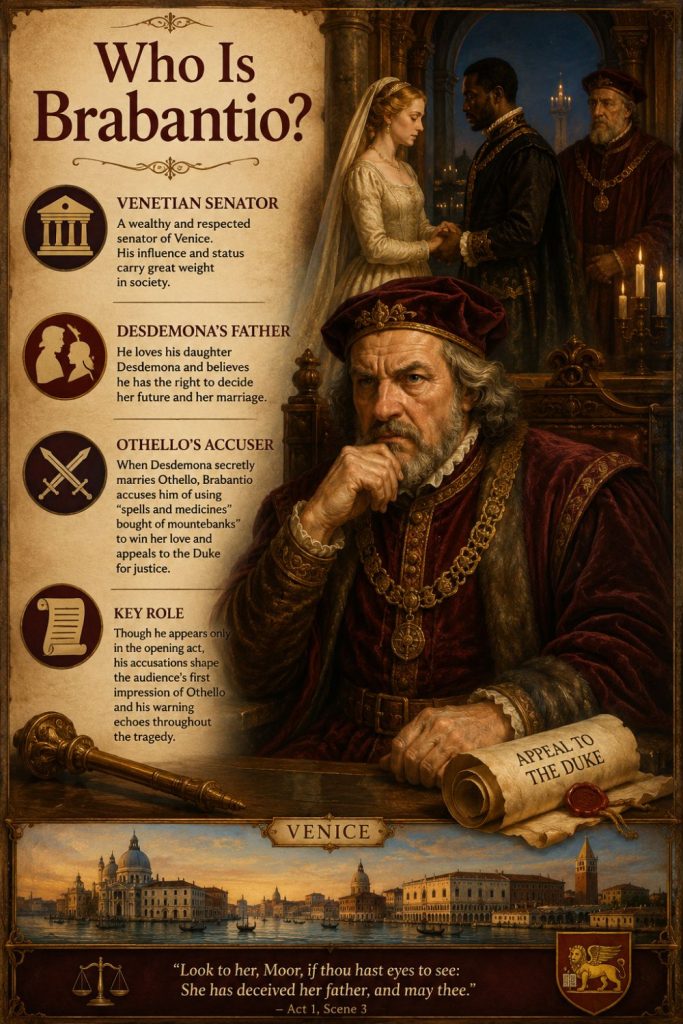
Table of Contents
Brabantio Character Analysis
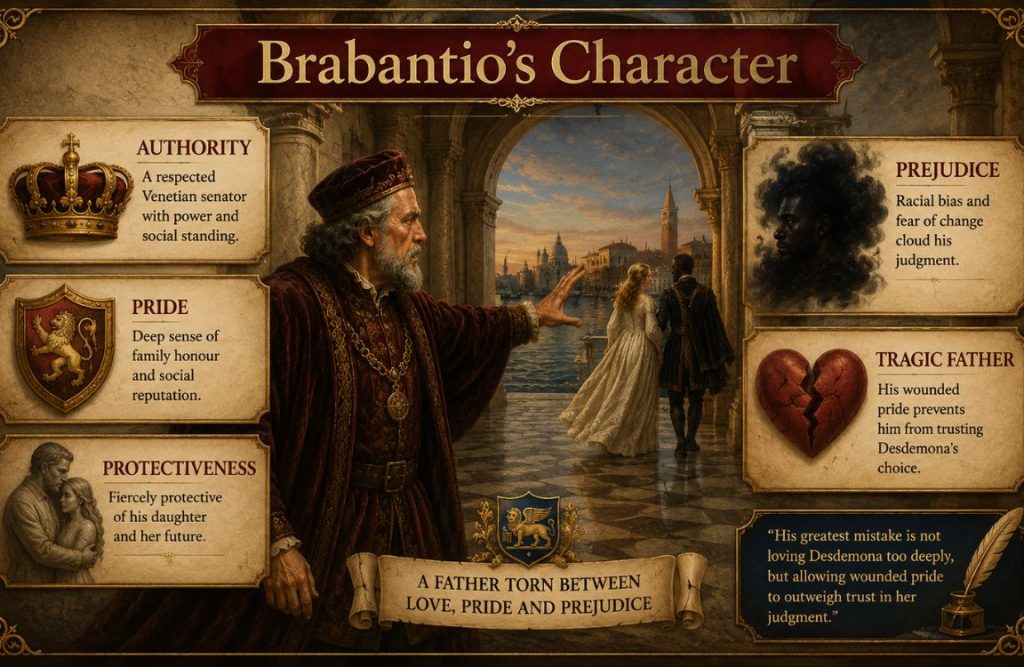
A close character sketch of Brabantio shows that Brabantio’s character traits include authority, pride, protectiveness, and a strong sense of family honour. Together, these qualities create a complex personality whose strengths and flaws shape the opening conflict of Othello.
i)) Brabantio’s Authority:
Brabantio’s authority comes not only from being a respected senator but also from his standing within Venetian society. He expects obedience from both his household and his daughter, believing family honour depends on parental control.
Desdemona’s decision challenges not only his authority as a father but also the social identity he has carefully built throughout his life.
ii) Brabantio’s Prejudice:
Discussions of racism in Othello often begin with Brabantio. His accusations against Othello are shaped by racial prejudice as much as paternal anger.
One of the most striking Brabantio racist quotes describes Othello through images of magic and unnatural influence, suggesting he cannot accept that his daughter freely chose a Black husband.
By denying Desdemona’s own choice, he exposes assumptions rooted in both racial bias and social privilege.
iii) Is Brabantio a Villain or a Tragic Father?
I have never considered Brabantio a straightforward villain. He is better understood as a tragic father whose love for his daughter becomes entangled with pride, fear, and prejudice. That complexity gives the character lasting interest.
As a piece of Brabantio symbolism, he represents a society struggling to accept change while clinging to tradition. His greatest mistake is not loving Desdemona too deeply but allowing wounded pride to outweigh trust in her judgment.
Brabantio’s Relationship with Other Characters
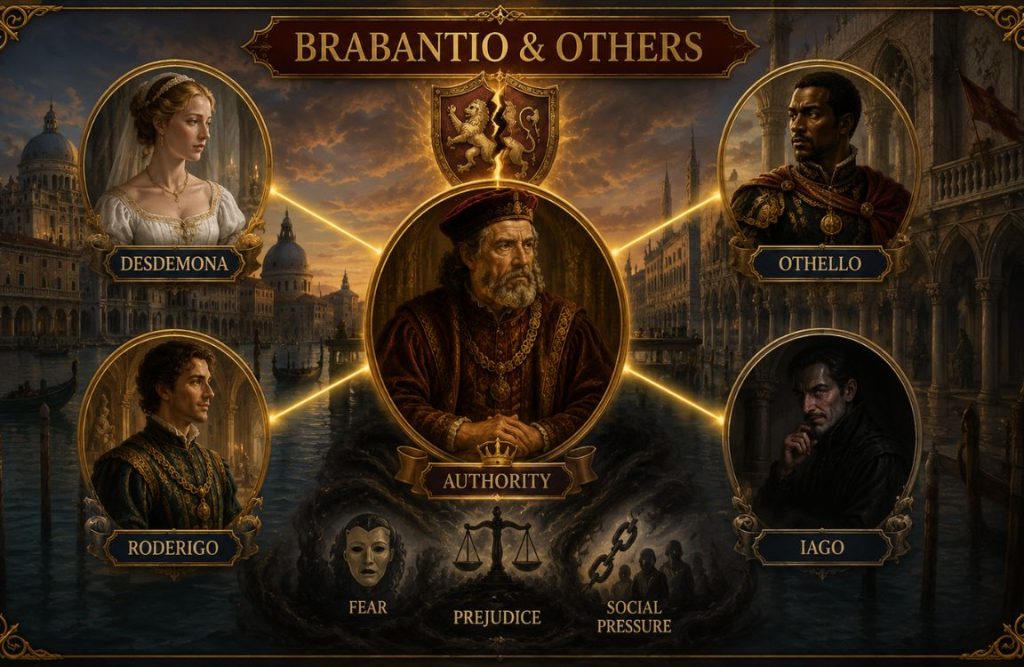
Brabantio’s relationships reveal different sides of his character. Through his interactions with Desdemona, Othello, Roderigo, and Iago, we see a father, senator, and citizen whose decisions quietly influence the entire tragedy.
i) Brabantio and Desdemona
The relationship between Brabantio and Desdemona begins with affection but ends in painful disappointment. He cannot believe his daughter has chosen Othello willingly, so he assumes deception instead of independence.
His inability to recognise her right to choose her own future turns a loving relationship into one of the tragedy’s earliest emotional conflicts.
ii) Brabantio and Othello
Brabantio’s relationship with Othello changes dramatically within a single night. He once welcomed Othello into his home and admired his military achievements, yet that respect disappears after the secret marriage.
Feeling betrayed, he accuses Othello before the Duke and warns him that a daughter who deceives her father may one day deceive her husband.
Although spoken in anger, those words linger in Othello’s memory and later become easier for Iago to exploit.
iii) Brabantio and Roderigo
Brabantio dismisses Roderigo as an unsuitable suitor for Desdemona, yet unknowingly becomes part of Iago’s scheme when Roderigo awakens him during the night.
Their brief encounter triggers the chain of events that drives the opening act, even though their connection soon disappears from the story.
iv) Brabantio and Iago
Brabantio never realises that Iago is manipulating events from the shadows. While he trusts the alarming information he receives, Iago quietly exploits his fears to provoke anger and deepen the conflict surrounding Othello’s marriage.
Their interaction demonstrates how easily personal prejudice can become a weapon in the hands of a skilled manipulator.
Why Does Brabantio Oppose Othello?
Many readers ask why Brabantio becomes angry and accuses Othello. The answer lies in several connected reasons.
First, he cannot accept that Desdemona has chosen her husband without his permission, so his sense of parental authority is deeply wounded.
Second, he believes only witchcraft could persuade her to marry someone he never considered a suitable match.
His accusations also reflect the racism woven into Venetian society, where Othello’s race makes the marriage seem impossible to Brabantio.
Instead of trusting his daughter’s judgment, he searches for unnatural explanations. His reaction grows from wounded pride, racial assumptions, and the loss of parental control, all of which prevent him from accepting the truth that stands before him.
Ironically, this refusal tells us as much about Brabantio himself as it does about the society he represents.
In many ways, Brabantio becomes the first victim of Iago’s world. Although Iago never deceives him for long, Brabantio’s fears prove how easily prejudice can overpower evidence.
Brabantio’s Role in Othello
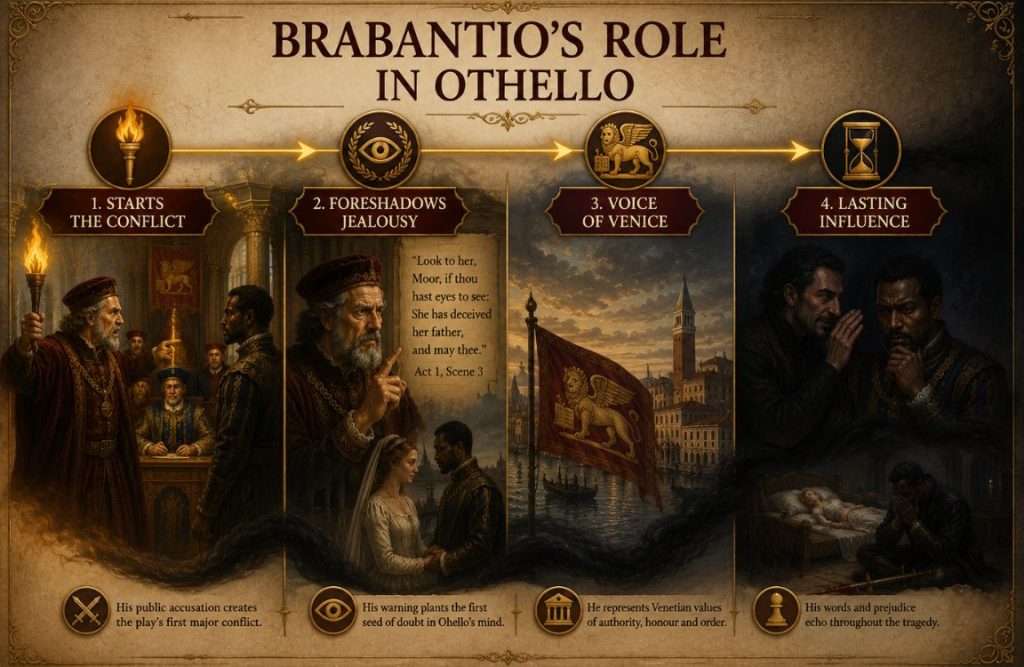
Brabantio’s role extends well beyond the opening act because his actions establish many of the tensions that drive the downfall. His public accusation creates the play’s first major conflict and introduces questions about race, authority, and family loyalty.
His character also represents the values of Venetian society, making his reaction important beyond his own household. From a dramatic perspective, his warning that Desdemona may deceive Othello foreshadows the jealousy that later consumes the hero.
This ironic prediction strengthens the play because the audience knows Desdemona remains completely faithful. Brabantio therefore serves two dramatic purposes: he launches the central conflict and plants the first seed of doubt that Iago later nurtures into destructive jealousy.
His importance lies not in the number of scenes he appears in but in the lasting influence he exerts over the tragedy’s emotional and moral direction.
Best Brabantio Quotes with Analysis
These Brabantio quotes in Othello capture his love for Desdemona, his pride as a father, and his deep mistrust of Othello. Together, they help us understand how fear, prejudice, and wounded honour shape his decisions from the opening conflict to the play’s lasting consequences.
1. “Look to her, Moor, if thou hast eyes to see: / She has deceived her father, and may thee.” Act 1, Scene 3
Perhaps the most famous of all Brabantio quotes, this warning follows Desdemona’s marriage. Believing she betrayed him, Brabantio suggests she could one day betray Othello as well. The tragic irony becomes clear later because Desdemona never breaks her marriage vows, yet Othello eventually accepts the warning as truth.
2. “She is abused, stol’n from me, and corrupted / By spells and medicines bought of mountebanks.” Act 1, Scene 3
Brabantio cannot accept that Desdemona freely chose Othello, so he blames witchcraft instead.
His words expose both wounded pride and racial prejudice, making supernatural explanations easier for him to accept than his daughter’s independent choice.
3. “O thou foul thief, where hast thou stow’d my daughter?” Act 1, Scene 2
Storming into Othello’s lodging, Brabantio compares him to a criminal who has stolen his daughter. By describing marriage as theft, he strips Desdemona of her own agency and refuses to acknowledge that she acted of her own free will.
4. “Bond-slaves and pagans shall our statesmen be.” Act 1, Scene 2
This line reflects Brabantio’s alarm at the thought of interracial marriage. He imagines social order collapsing if Othello’s marriage is accepted. Modern readers often examine the passage as evidence of how racial prejudice shapes both personal attitudes and public values in the play.
5. “Ay, to me; / She is abused, stol’n from me.” Act 1, Scene 3
Before the Duke, Brabantio insists his daughter could never have acted willingly. Instead of allowing Desdemona to speak for herself, he insists on interpreting her decision through his own assumptions. The moment highlights his inability to accept that parental authority has limits.
6. “I here do give thee that with all my heart / Which, but thou hast already, with all my heart / I would keep from thee.” Act 1, Scene 3
These words carry quiet sorrow more than anger. Brabantio reluctantly acknowledges the marriage while admitting that, had it still been possible, he would never have allowed it. His reluctant farewell closes his role on stage, yet the emotional weight of his warning continues to shape everything that follows.
Historical Context: What Does Brabantio Represent?
Brabantio represents the values of Venice, where family honour, social rank, and patriarchy shaped public life. Like many Renaissance fathers, he believed a daughter’s marriage required parental approval.
His reaction to Othello also reflects the racial prejudice that existed in early modern Europe. Viewed within this historical context, Brabantio becomes more than an individual father. He also embodies the social values and anxieties of his age.
Brabantio’s greatest mistake is not loving Desdemona too deeply but allowing wounded pride to outweigh trust in her judgment.
Literary Critics on Brabantio
Literary critics often view Brabantio as more than an angry father. A. C. Bradley argues that his warning becomes one of the play’s great ironies because Othello later believes it without evidence.
Harold Bloom regards Brabantio as an important voice of Venetian culture, whose assumptions continue to shape the play even after his departure.
Ania Loomba, writing on race, explains that his attitudes reflect the racial anxieties surrounding identity, power, and difference in early modern England. Taken together, these readings encourage us to see Brabantio as both a father and a symbol of the society that produced him.
References:
Bloom, Harold. Shakespeare: The Invention of the Human. New York: Riverhead Books, 1998.
Loomba, Ania. Shakespeare, Race, and Colonialism. Oxford University Press, 2002.
Brabantio Compared with Other Shakespeare Fathers
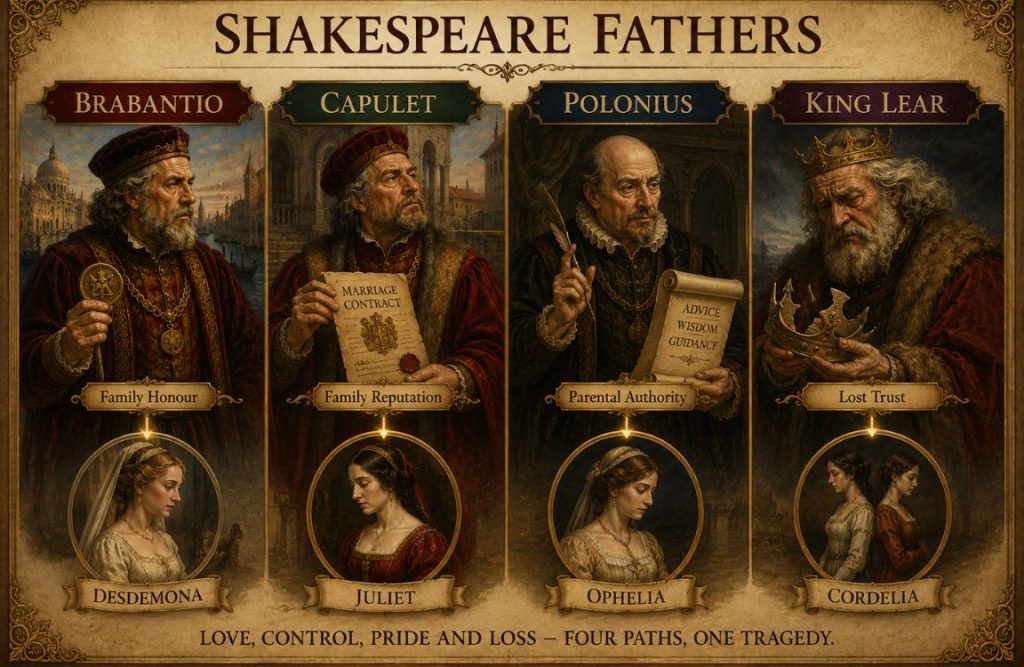
Brabantio shares Capulet’s desire to control his daughter’s future, although his disappointment remains more restrained than Capulet’s open fury. Like Polonius, he believes parental authority should guide a child’s choices, though his influence fades much sooner.
King Lear also suffers through a broken relationship with his daughters, but his tragedy grows from misjudgment after surrendering power.
Brabantio’s downfall begins much earlier, with his inability to trust the daughter he genuinely loves.
Why Brabantio Still Matters Today
Brabantio still feels relevant because his story raises difficult questions about racism, prejudice, parental control, and personal identity. His refusal to trust Desdemona reminds us how fear can silence understanding.
Although society has changed, discrimination and family conflict continue to shape many lives, which makes his struggle feel surprisingly familiar in conversations about identity, acceptance, and generational conflict.
FAQs:
What warning does Brabantio give Othello before leaving Venice?
Brabantio warns Othello that if Desdemona deceived her father, she might also deceive her husband. Although the warning grows from bitterness, it later becomes one of the seeds of doubt that Iago carefully cultivates.
Why does Brabantio accuse Othello of using witchcraft?
Brabantio believes only magic could persuade Desdemona to marry Othello. His accusation grows from wounded pride, parental anger, and racial prejudice, showing that he finds supernatural explanations easier to accept than his daughter’s independent choice.
Does Brabantio forgive Desdemona in Othello?
The play never shows complete forgiveness. Although Brabantio eventually leaves the court after accepting the Duke’s decision, his disappointment remains clear, and father and daughter are never fully reconciled. His silence after Act 1 suggests a relationship that remains painfully unresolved.
What does Brabantio represent in Othello?
Brabantio represents patriarchal authority, social status, and the racial attitudes of Venetian society. Through him, the play explores how fear and prejudice can shape personal relationships while also influencing wider social values.
How does Brabantio’s prejudice influence the tragedy?
Brabantio’s prejudice plants an idea that later grows inside Othello’s mind. His warning about Desdemona’s loyalty becomes easier for Iago to exploit, allowing suspicion to take root before jealousy overwhelms reason.
Conclusion:
Brabantio in Othello occupies only the opening act, yet his influence stretches across the whole play. His choices ignite conflict, his warning foreshadows disaster, and his attitudes deepen the play’s exploration of race and family.
Studying Brabantio reminds us that tragedy often begins long before the final act, through assumptions that go unchallenged and fears left unquestioned.
Enjoyed this analysis? Continue with our complete Othello analysis.