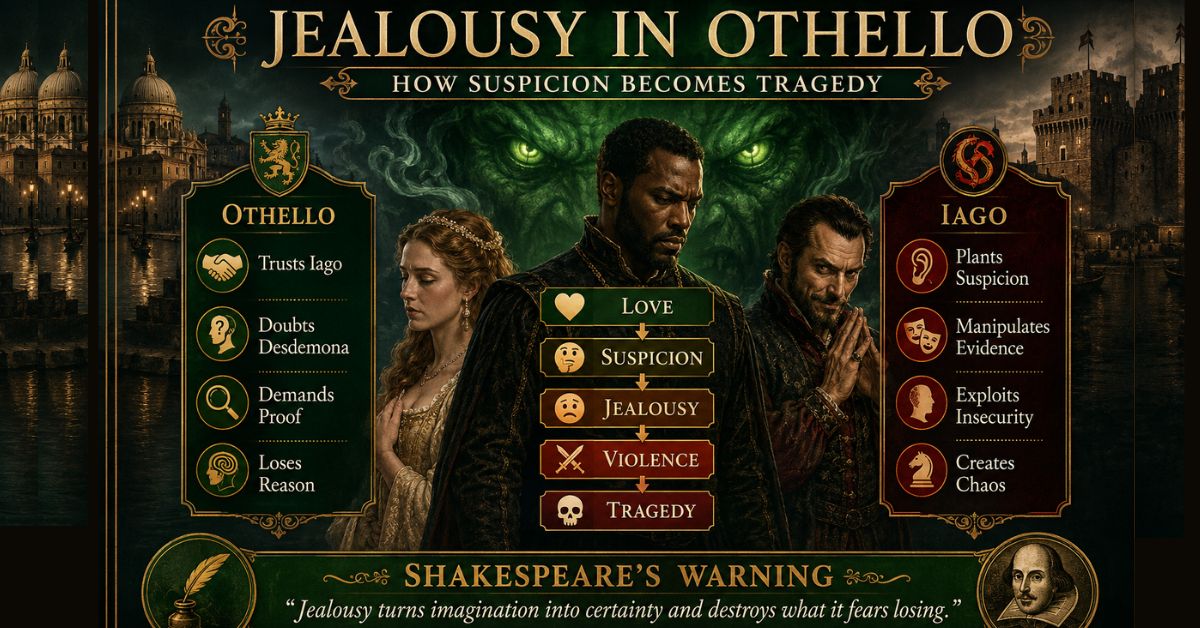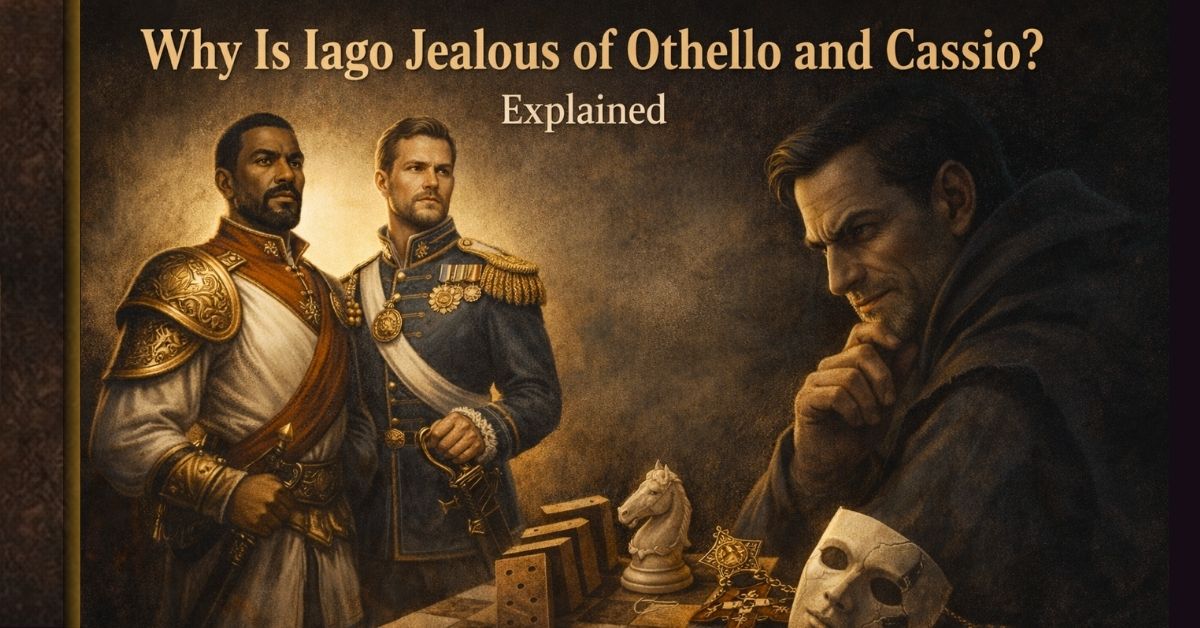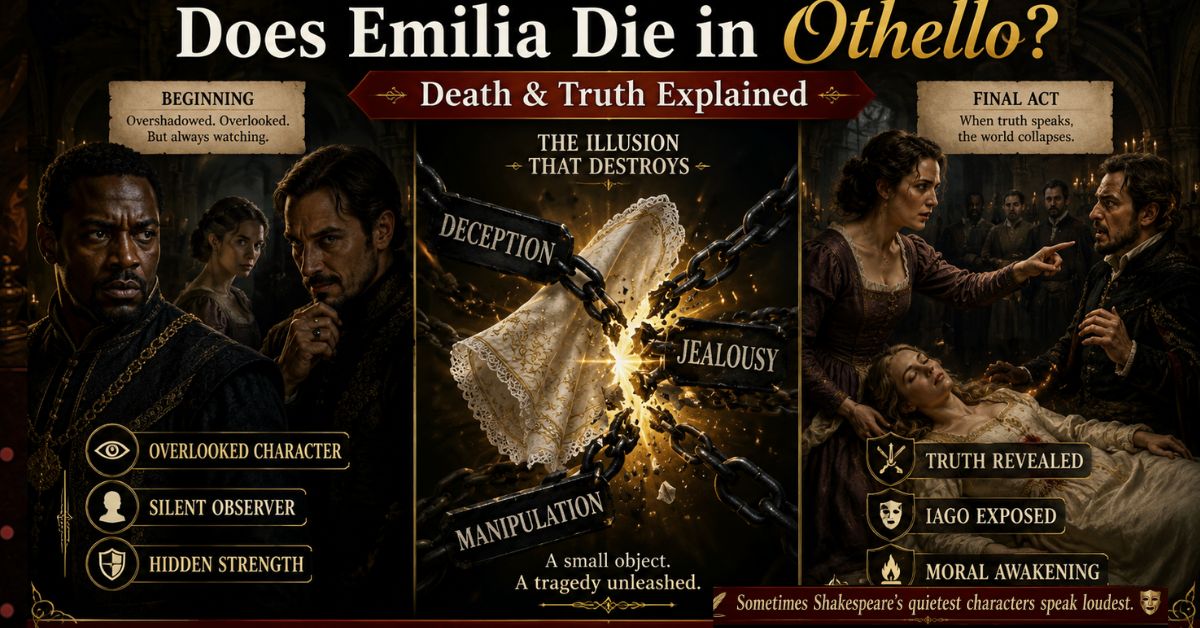
The final scenes of Othello always silence my classroom. Students enter the lesson expecting Othello’s jealousy to dominate the tragedy, yet many leave haunted by Emilia instead. She begins quietly, standing beside louder personalities and larger conflicts.
But Shakespeare loves reversals. Sometimes, the character pushed furthest into the background becomes the one who disrupts the illusion holding the tragedy together.
Then comes the devastating murder scene. Desdemona lies dying, Othello’s world collapses, and Emilia suddenly cuts through manipulation with startling force. In that moment, she transforms from observer into one of the play’s strongest moral voices.
So, does Emilia die in Othello? Yes, she does. Emilia’s death becomes one of Shakespeare’s most painful reminders that moral awakening can arrive bravely, but devastatingly late.
Does Emilia Die in Othello?
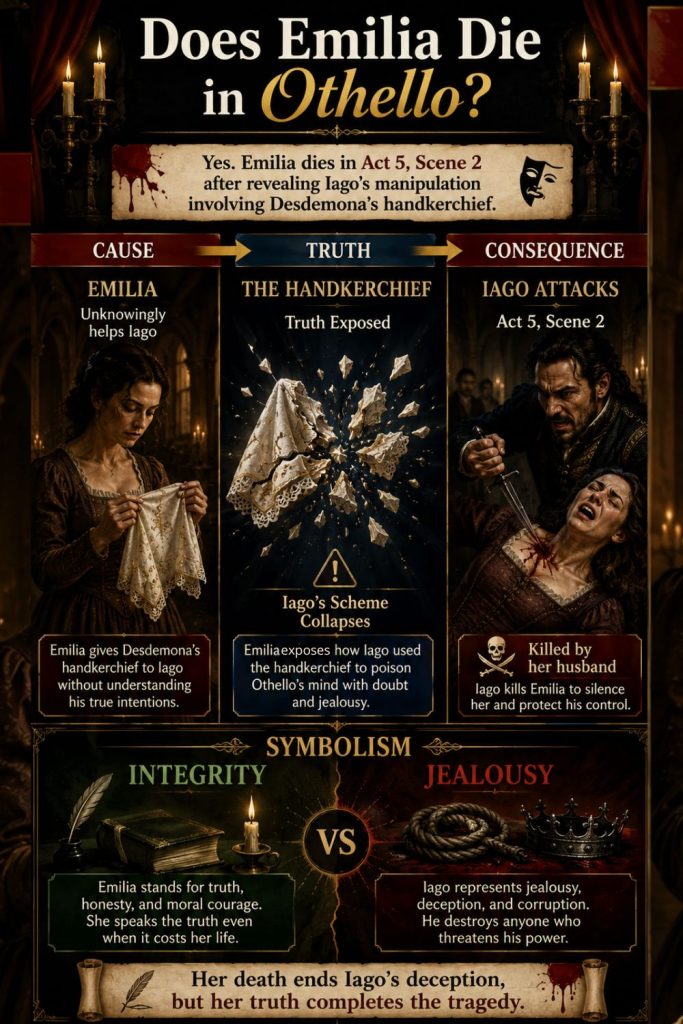
Yes, Emilia dies in Othello. Iago murders Emilia in Act 5, Scene 2, after she uncovers his manipulation involving Desdemona’s handkerchief.
Many students first ask me how Emilia dies in Othello because her death feels sudden, almost shocking. For most of the play, Emilia appears practical, sharp-tongued, and emotionally grounded.
Yet Shakespeare carefully prepares her transformation into the character who finally dismantles Iago’s scheme in public.
Who kills Emilia in Othello? Ironically, the murderer is her own husband, Iago. Once Emilia realizes that Iago used Desdemona’s stolen handkerchief to distort Othello’s judgment, she reveals everything before the entire room. At that moment, Emilia tears apart the false narrative driving the tragedy.
Does Iago kill Emilia simply out of rage? Partly, but also out of fear. Her testimony threatens to destroy the control he maintained throughout the play. Emilia continues speaking despite understanding the danger.
Symbolically, her death represents a final collision between human integrity and the destructive force of jealousy, secrecy, and corruption.
Table of Contents
Who Is Emilia in Othello?
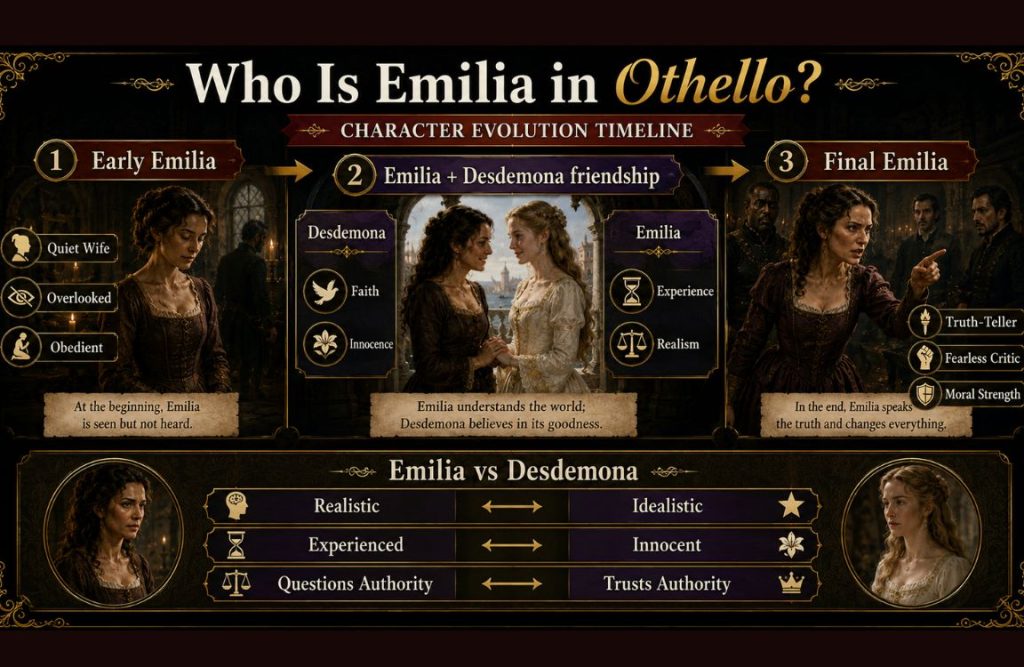
Emilia, Iago’s wife and Desdemona’s companion, first appears minor in Othello, overshadowed by larger conflicts. Gradually, however, Shakespeare reveals her courage, insight, and moral strength. As jealousy and manipulation destroy others, Emilia gradually becomes one of the tragedy’s strongest ethical centers, emerging as one of Shakespeare’s psychologically layered women.
i) Emilia and Desdemona’s Relationship
Emilia and Desdemona’s relationship in Othello evolves from a formal lady-and-attendant bond into one of the play’s most emotionally powerful friendships. Desdemona remains innocent and trusting, while Emilia understands the harsher realities of marriage and male power.
I often tell my students that Desdemona sees love like poetry, but Emilia sees it like unpaid household bills- beautiful sometimes, exhausting most days.
Despite their contrasting worldviews, genuine affection grows between them. Emilia becomes Desdemona’s confidante and protector, though her theft of the handkerchief tragically fuels Iago’s scheme.
In the final act, Emilia fiercely defends Desdemona’s innocence, crying, “O, falsely, falsely murdered!” as she confronts Iago’s corruption. Their friendship ultimately becomes Shakespeare’s powerful symbol of female loyalty and resistance against patriarchal violence.
ii) How Emilia Changes Throughout the Play
Throughout Othello, Emilia changes from a quiet, obedient wife into one of Shakespeare’s bravest truth-tellers.
Early in the play, she appears passive beside Iago’s dominating personality and even steals Desdemona’s handkerchief to please him without understanding the consequences. Yet beneath her silence, Shakespeare hints at intelligence and emotional awareness.
As the tragedy deepens, Emilia sheds her earlier restraint and becomes a fearless critic of male authority. Many readers now see Emilia as a feminist character because she openly attacks men’s double standards and defends women’s dignity.
Her mistakes contribute to the tragedy, yet her later moral awakening becomes equally important.
Although Emilia and Desdemona share deep loyalty toward one another, Shakespeare also builds them as striking contrasts.
Emilia vs Desdemona: Key Differences
| Emilia | Desdemona |
| Realistic | Idealistic |
| Experienced | Innocent |
| Questions authority | Trusts authority |
I always remind my students that Shakespeare almost builds these women as mirrors facing each other. Desdemona approaches love with faith and optimism, while Emilia views relationships through experience and practical understanding. Their differences strengthen the tragedy’s emotional complexity.
Emilia’s journey also raises a difficult question that often sparks debate in my classroom.
Is Emilia Innocent in Othello?
Is Emilia innocent in Othello? Not completely. Emilia does not intend to destroy Desdemona, yet her decision to give Iago the handkerchief helps trigger the tragedy’s devastating events.
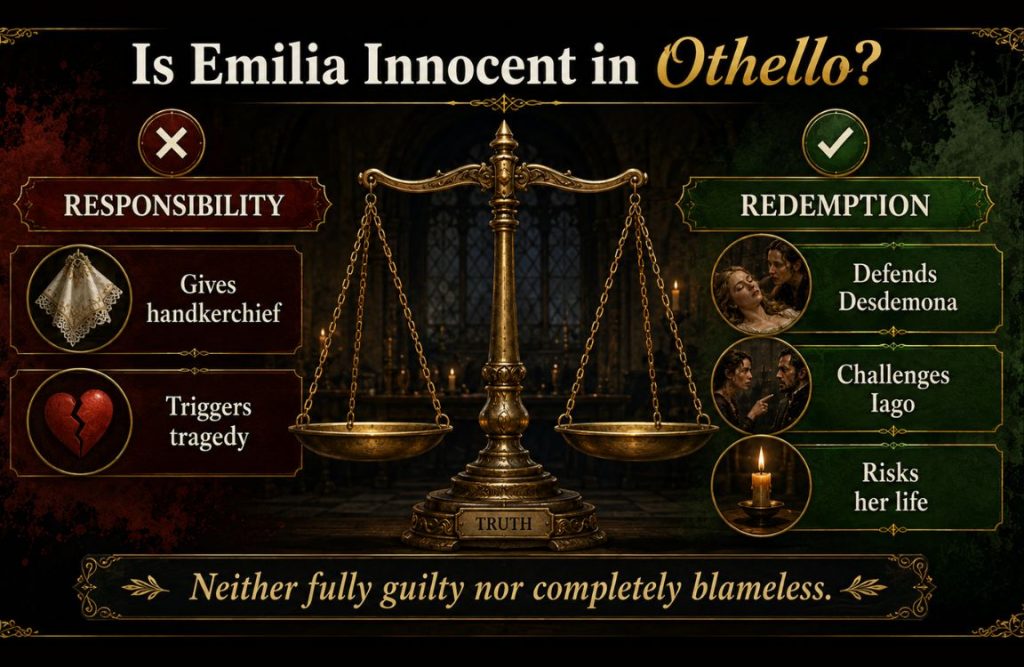
Students sometimes struggle with this question because Emilia exists in a difficult moral space. She is neither entirely guilty nor entirely blameless. Shakespeare creates a character who makes mistakes but later recognizes their consequences.
That recognition matters deeply. Emilia’s final actions reveal moral awakening rather than perfection. She accepts danger, challenges manipulation, and risks her life defending Desdemona, making her one of Shakespeare’s most human characters.
Why Does Iago Kill Emilia?
This section explores why Iago kills Emilia in Othello after she exposes the truth about the handkerchief and destroys his manipulation. It also examines Emilia’s extraordinary courage, final speech, and moral transformation from obedient wife to Shakespeare’s ultimate truth-teller.
i) Emilia Reveals the Truth About the Handkerchief
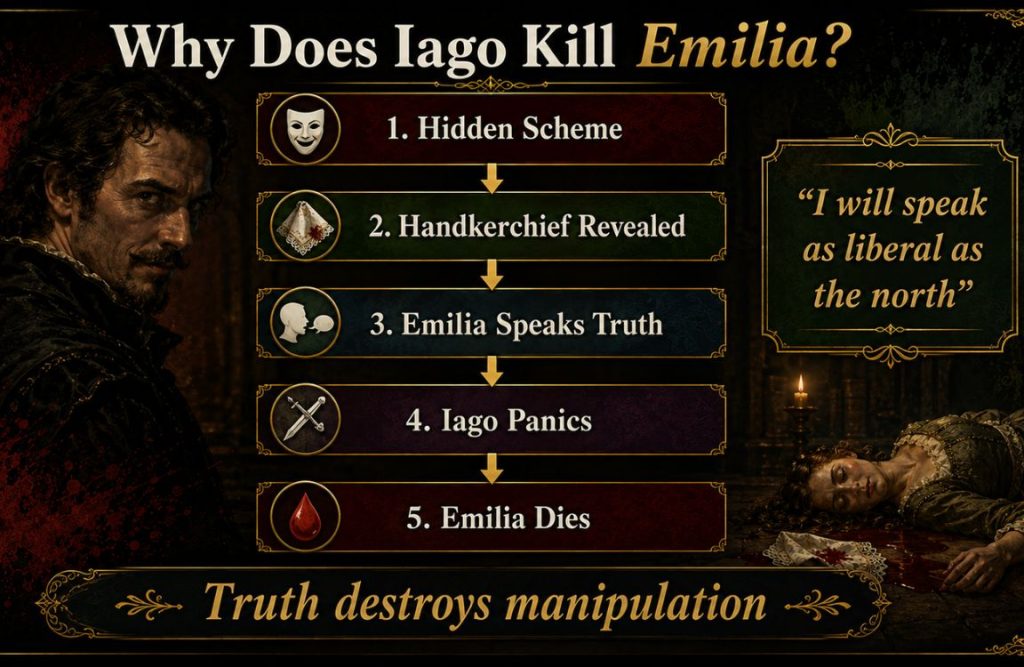
The handkerchief scene in Othello works almost like a ticking bomb hidden inside the story. Earlier, Emilia gave the handkerchief to Iago without understanding his real intentions. Later, in Act 5, Scene 2, she suddenly realizes the horrifying consequences of that small action.
This becomes the moment Emilia breaks down Iago’s scheme publicly. Standing beside Desdemona’s dying body, she publicly explains how Iago used the handkerchief to infect Othello with suspicion and jealousy.
Students often freeze during this scene because Shakespeare delays the revelation until the damage becomes irreversible. Othello finally understands Desdemona’s innocence, but it is too late to save her.
Emilia, not a soldier or nobleman, becomes the person who finally forces the hidden reality into public view while everyone else remains trapped inside fear, pride, or confusion.
ii) Emilia’s Final Speech and Courage
Emilia’s final speech carries extraordinary moral power because she refuses silence even when death stands directly before her. Iago orders her to stay quiet, but Emilia openly defies him in front of everyone, declaring, “I will speak as liberal as the north.” It is one of Shakespeare’s boldest moments of resistance.
During my lectures, I often pause here and ask students: Who is truly stronger, the armed villain or the wounded woman exposing him publicly? The room usually grows very quiet.
Emilia’s death becomes heartbreaking precisely because she chooses integrity over self-protection. In Act 5, Scene 2, her courage changes the entire meaning of the tragedy.
She no longer exists as Iago’s obedient wife. Instead, Emilia dies as the character who finally tears away the mask hiding evil.
How Does Emilia Die in Othello?
Emilia’s death scene turns the final act from a private tragedy into a devastating collective collapse. Until this moment, deception still controls the room. Once Emilia speaks, however, Iago’s carefully maintained illusion cracks apart almost instantly.
i) The Murder Scene in Act 5, Scene 2
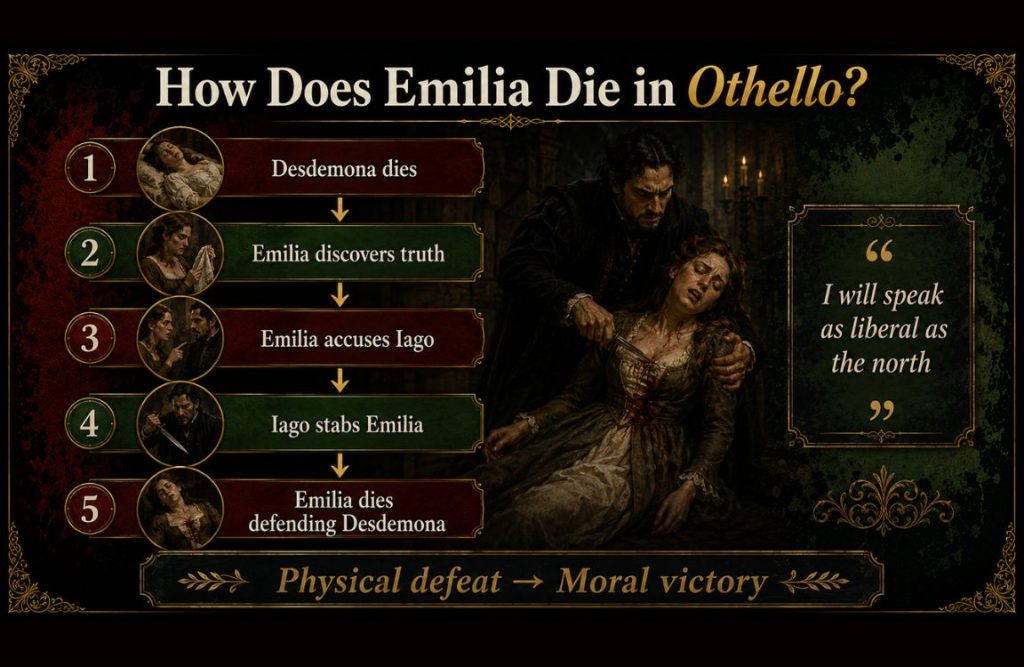
Who killed Emilia in Othello? Iago himself murders her during the chaos following Desdemona’s death. Emilia publicly accuses him after realizing his actions caused the entire tragedy.
In most classroom discussions, students react strongly because Iago kills the one person who is finally brave enough to challenge him openly.
During the analysis of Act 5, Scene 2, Shakespeare presents a room filled with panic, grief, guilt, and exposed secrets. Emilia refuses to retreat despite the danger.
How does Emilia die in Othello? Iago stabs her to stop her accusations. Yet even while dying, Emilia continues defending Desdemona’s innocence. Shakespeare almost turns her final moments into a spiritual victory hidden inside physical defeat.
ii) Why Emilia’s Death Is So Tragic
Emilia dies not for ambition or revenge, but for personal integrity. That is what makes her death especially painful in the tragedy of Othello. Earlier, she remained passive too often. In the end, however, she risks everything rather than withdraw into fear again.
The contrast matters deeply. Shakespeare shows that moral awakening sometimes arrives late, but still carries enormous emotional weight. Emilia’s final choice exposes evil completely.
Her death also reminds readers that manipulation destroys innocent people first, while the guilty struggle desperately to protect themselves.
Emilia’s Role in the Tragic Ending of Othello
In the final act, Emilia changes from a supporting character into one of the tragedy’s strongest moral voices. Shakespeare hands her the dramatic spotlight just as the world around her collapses into chaos and irreversible grief.
i) Emilia as the Voice of Truth
Emilia’s role in the Othello ending becomes unforgettable because she finally demolishes the deception shaping the tragedy. While others remain trapped by jealousy or manipulation, Emilia speaks with brutal honesty.
The painful irony is that recognition arrives too late. Desdemona is already dying, and Othello has already destroyed the person he loved most. Shakespeare uses this delay masterfully. Irony in Othello often works like poison dripping slowly until the final collapse. Emilia’s final actions combine tragic irony with the play’s recurring conflict between appearance and reality.
When discussing what happens at the end of Othello, I remind students that Emilia becomes the character who forces reality back into the room. Without her courage, Iago’s deception might have survived completely unchallenged.
ii) Emilia’s Death Changes Othello
Emilia’s accusations shatter Othello emotionally. For the first time, he fully understands Desdemona’s innocence and realizes how completely Iago engineered his downfall. That realization destroys him internally long before his physical death arrives.
How does Othello die? Overwhelmed by guilt, horror, and grief, he eventually kills himself beside Desdemona’s body. Emilia’s revelations directly push him toward that collapse.
In many ways, this moment forms the true climax of Othello. Not the murder itself, but the unbearable recognition afterward. Shakespeare teaches something terrifying here: jealousy blinds people first, then forces them to examine the damage clearly when it is already too late.
Is Emilia a Feminist Character in Othello?
Modern readers often admire Emilia because she speaks openly about ideas that other characters avoid. Living in a male-dominated world shaped by control and suspicion, she gradually moves beyond silence and begins challenging authority directly.
Emilia, as a feminist character, becomes especially important when she criticizes the unequal treatment of women and rejects blind obedience as a virtue. Speaking about marriage and gender expectations, she boldly states, “Let husbands know / Their wives have sense like them.”
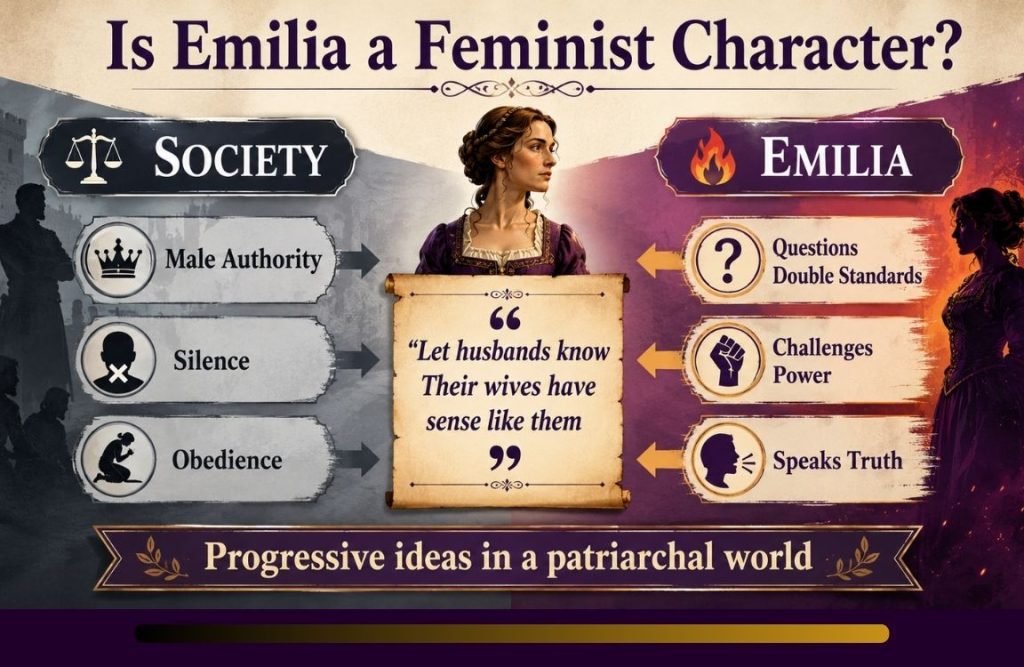
Those words remain striking because they insist that women possess the same intelligence, emotions, and judgment as men.
Emilia does not speak as a modern feminist in the contemporary sense, but Shakespeare gives her ideas about gender and power that many modern readers find remarkably progressive.
While many characters hide behind appearances, Emilia confronts difficult truths about power, loyalty, and marriage with unusual honesty.
During the final scenes, she refuses to obey Iago even when threatened. Shakespeare uses Emilia’s courage to challenge not only Iago himself but also the wider social system that repeatedly pushes women into the background. Shakespeare reinforces Emilia’s ideas through some of the play’s most memorable lines.
Emilia’s Famous Quotes in Othello
Students often remember Emilia because Shakespeare gives her some of the play’s most striking lines. Earlier in the tragedy, she challenges gender expectations by declaring, “Let husbands know / Their wives have sense like them.”
The statement feels surprisingly modern because Emilia argues that women possess the same emotional and intellectual capacity as men.
Later, during the devastating final scenes, Emilia refuses silence and announces, “I will speak as liberal as the north.” I sometimes tell students that these lines work almost like milestones in her journey.
The first question is about patriarchy; the second embraces moral courage completely. Together, they transform Emilia from a supporting character into one of Shakespeare’s most memorable voices of resistance.
Key Takeaways
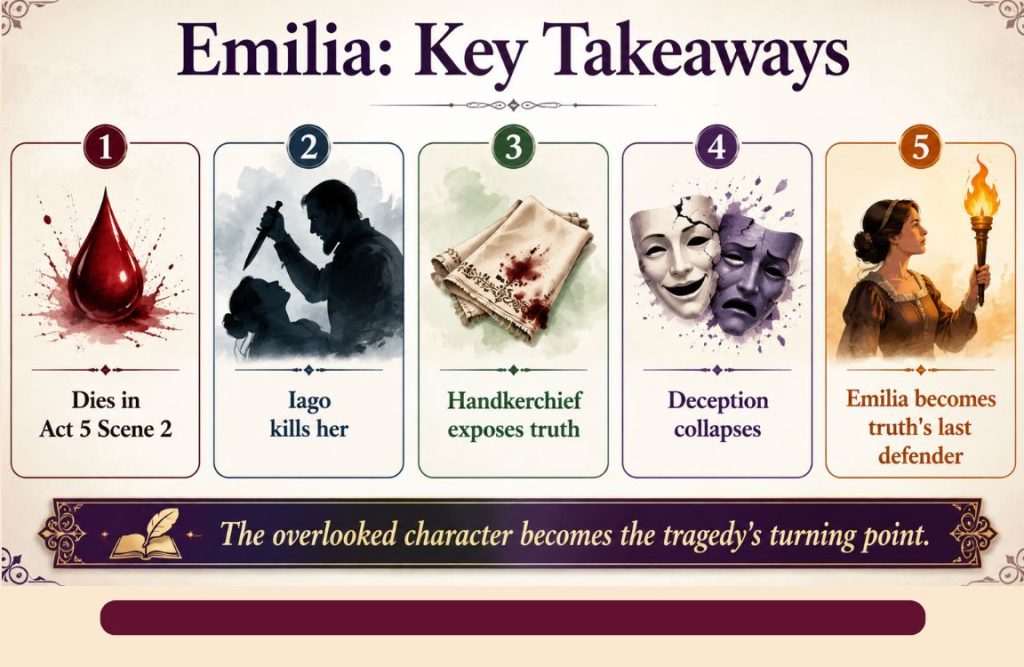
- Emilia dies in Act 5, Scene 2 of Othello.
- Iago kills Emilia after she uncovers his manipulation.
- The handkerchief revelation destroys Iago’s control.
- Emilia’s death completes the tragedy.
- Emilia becomes truth’s last defender.
FAQs:
Did Emilia know Iago was evil before the ending?
No, Emilia suspects Iago’s behavior at times, but she does not fully understand his scheme until the final act.
Why is Emilia important in Othello?
Emilia is important in Othello because she breaks apart Iago’s manipulation, restores Desdemona’s reputation, and forces Othello to confront the consequences of jealousy.
Does Emilia defend Desdemona before dying?
Yes, Emilia fiercely defends Desdemona and publicly accuses both Othello and Iago after discovering what really happened.
What is Emilia’s most famous speech in Othello?
One of Emilia’s most famous speeches begins, “Let husbands know / Their wives have sense like them,” where she criticizes unequal treatment and argues that women possess intelligence and emotional depth equal to men.
Who survives at the end of Othello?
Cassio, Lodovico, and several others survive, while Othello, Desdemona, Emilia, and Roderigo die tragically.
Conclusion:
So, does Emilia die in Othello? Yes, but Shakespeare makes her death far more meaningful than a tragic side event. In the final act, Emilia becomes the character who finally tears apart the illusion controlling everyone around her. Her revelations destroy Iago’s carefully constructed performance and force Othello to confront reality without jealousy distorting it.
What happens to Emilia is not simply a shocking death scene. Throughout most of the play, she seems overshadowed by stronger personalities and larger conflicts. Yet by the ending, Emilia becomes the agent of dramatic reversal.
In many ways, Emilia achieves something no other character fully does: she exposes the truth even when truth offers no safety, reward, or escape. That choice transforms a seemingly secondary character into one of the most unforgettable figures in Othello.
Want more simple but deep Shakespeare explanations? Explore more guides and literary analyses of Othello.