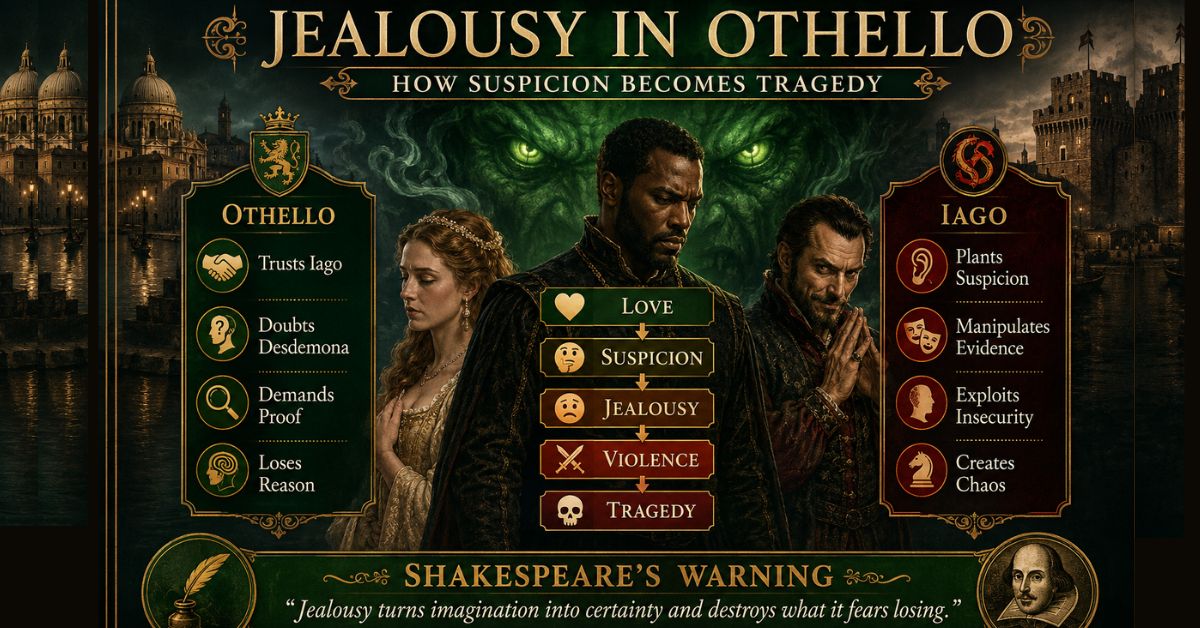
What destroys Othello is not a sword, a war, or even a villain. It’s a feeling. Shakespeare’s Othello shows how jealousy can transform love into suspicion, trust into doubt, and honour into violence.
The theme of jealousy in Othello reveals how unchecked suspicion corrupts judgment and ultimately causes tragedy.
Rather than presenting jealousy as a brief emotional reaction, Shakespeare portrays it as a corrosive influence that gradually turns ordinary conversations into suspicion and innocent actions into apparent betrayals.
By the final act, nearly every important choice can be traced back to that single emotion.
While teaching this play, I often describe jealousy as an invisible playwright working behind the scenes. It never appears on stage, yet it controls almost every major event. Through Othello and Iago, Shakespeare explores jealousy as a destructive force capable of ruining both love and character.
What Is the Theme of Jealousy in Othello?
The theme of jealousy in Othello explores how suspicion and insecurity can corrupt judgment, destroy relationships, and lead to tragedy. The theme is central to Shakespeare’s tragedy because nearly every major conflict grows from jealousy, whether romantic, professional, or personal.
At its core, jealousy is not simply the fear of losing someone. Shakespeare presents it as a state of mind that encourages people to believe their worst fears and act upon them.
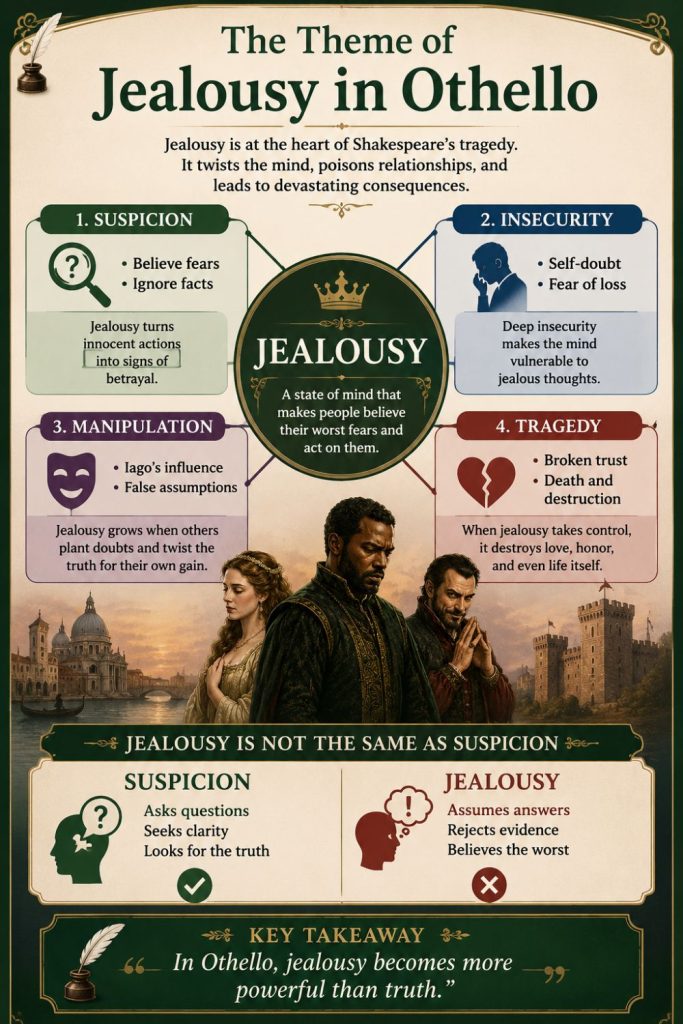
The role of jealousy in Othello is crucial because it drives the action of the entire tragedy. Without it, Iago’s schemes would fail, Othello would trust Desdemona, and the play would have no catastrophic ending. Every major turning point in the play depends on someone believing a fear rather than a fact. It differs from ordinary suspicion.
Suspicion asks questions. Jealousy assumes answers. Once jealousy takes hold, facts begin losing their authority. Characters begin interpreting innocent actions as signs of betrayal.
Shakespeare does not confine jealousy to Othello alone. The emotion spreads through the play and affects almost everyone around him.
Othello experiences romantic jealousy, Iago suffers from professional resentment and envy, while others become trapped in the atmosphere of distrust these emotions create.
Shakespeare suggests that jealousy rarely appears alone. It often grows from insecurity, wounded pride, or manipulation by others. In this play, those hidden weaknesses allow jealousy to flourish until it becomes impossible to control.
How Does Shakespeare Present Jealousy in Othello?
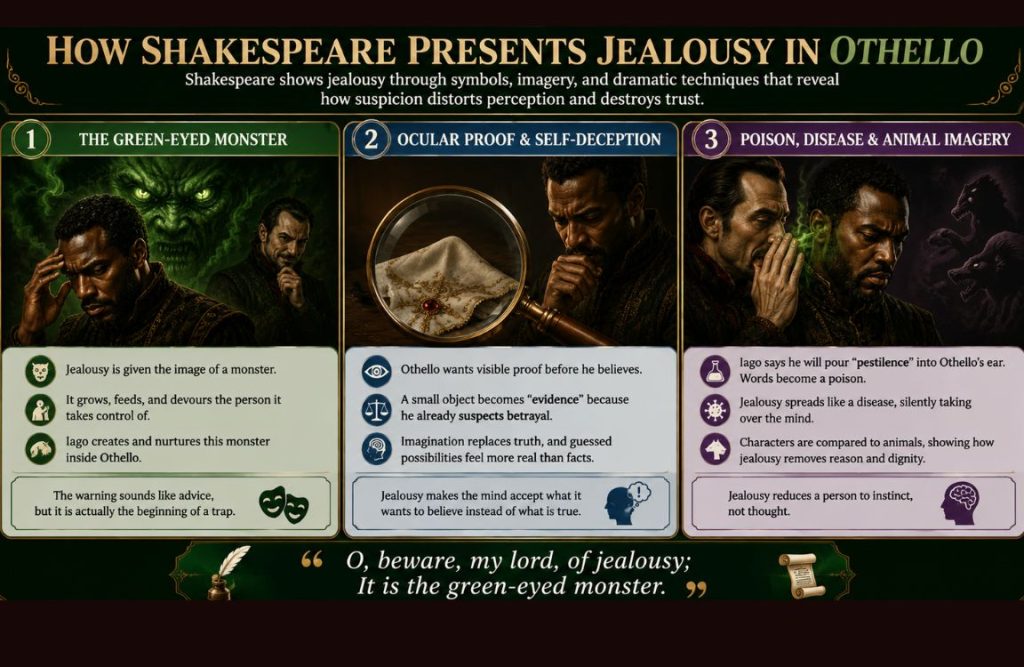
Shakespeare presents jealousy in Othello through vivid imagery, powerful symbols, dramatic irony, and psychological manipulation. Rather than describing the emotion directly, he gives it shape and voice, allowing audiences to witness how suspicion changes the way characters interpret what they see and how they respond to it.
i) The Green-Eyed Monster
One of Shakespeare’s most famous images appears when Iago warns Othello, “O, beware, my lord, of jealousy; It is the green-eyed monster.” The phrase immediately personifies jealousy, transforming an emotion into a living creature capable of attacking its victim.
In class, I always ask my students why Shakespeare chose a monster rather than a disease or weapon. A monster suggests unpredictability. It thinks, feeds, and grows. More importantly, it consumes the person it inhabits.
The irony is deliciously cruel. The man who utters the warning is also manufacturing the danger. Iago knows that jealousy is the green-eyed monster in Othello because he is carefully raising it himself. His caution sounds wise, but it’s actually the opening move in a psychological trap.
ii) Ocular Proof and Self-Deception
As jealousy deepens, Othello demands what he calls “ocular proof.” On the surface, this sounds reasonable. A military commander wants evidence before reaching a conclusion. Yet Shakespeare exposes a dangerous contradiction. Othello claims to seek proof while becoming increasingly willing to accept weak evidence.
The handkerchief becomes the clearest example of jealousy and appearance vs reality. A simple object acquires enormous significance because Othello already suspects betrayal. Instead of questioning how it appeared in Cassio’s possession, he treats it as confirmation.
One reason jealousy becomes so powerful is that it relies on imagination. Ironically, Othello’s greatest enemy is not what he sees but what he imagines he sees. Othello begins seeing possibilities rather than realities, and those imagined betrayals soon feel more convincing than the truth itself.
Among the most striking examples of jealousy in Othello, this episode reveals how emotional certainty can make false evidence appear convincing.
iii) Poison, Disease, and Animal Imagery
Another way Shakespeare develops the symbolism of jealousy in Othello is through images of poison, illness, and animals. Iago promises to pour “this pestilence into his ear,” turning language itself into a contagious substance. No blade is drawn. No physical attack occurs. Instead, words become the carrier of destruction.
The disease imagery suggests that jealousy spreads quietly before its symptoms become visible. Like an infection, it begins beneath the surface and slowly takes control of the mind. By the time Othello recognises its effects, the damage is already severe.
Animal imagery reinforces this loss of control. Throughout the play, characters are compared to creatures driven by instinct rather than reason. Such comparisons strip away dignity and rationality, suggesting that jealousy reduces human beings to their most primitive impulses.
When students ask how Shakespeare presents jealousy in Othello, I point them here. These recurring images emphasise the destructive power of jealousy and reveal how it slowly teaches Othello to act on impulse rather than conscience.
Othello’s Jealousy and Tragic Downfall
To understand the tragedy fully, we must examine Othello himself. Shakespeare does not portray him as naturally jealous. Instead, the play traces how personal vulnerabilities are exploited until a respected husband becomes convinced that lies are facts.
i) What Causes Othello’s Jealousy?
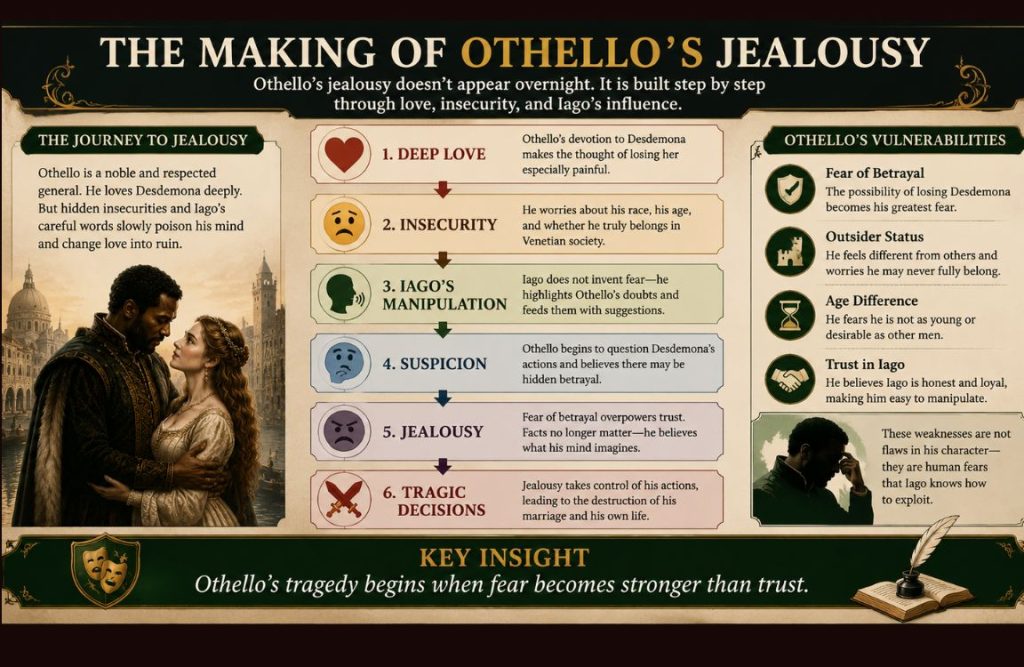
Othello’s jealousy develops through a combination of deep love, personal insecurity, and Iago’s manipulation, all of which make him vulnerable to believing false accusations.
Othello and jealousy become inseparable because several pressures converge at the same moment. The first is love. His devotion to Desdemona is sincere and profound, which makes the possibility of losing her especially painful.
Shakespeare also hints at deeper insecurities. Othello is conscious of being different from many around him. He worries about his race, his age, and whether he truly belongs within Venetian society. These concerns remain largely contained until Iago learns how to exploit them.
A memorable classroom discussion often begins with a simple question: Does Iago create jealousy or uncover it? My answer is usually both. He does not invent Othello’s fears, but he directs attention toward them repeatedly.
The possibility that Desdemona has deceived him eventually outweighs everything Othello once knew about Desdemona. As jealousy grows, Othello becomes increasingly suspicious, impulsive, and thus unable to judge situations completely.
Every suggestion, pause, and carefully planted doubt encourages Othello to see hidden betrayal where none exists. The tragedy is not that Othello sees too little, but that he begins seeing things that are not there.
ii) Why Does Othello Trust Iago?
One of Shakespeare’s greatest ironies is that Othello’s strength becomes his weakness. He values loyalty and honesty, so he naturally places confidence in those who appear trustworthy. Few characters enjoy a stronger reputation than “Honest Iago.”
When teaching this scene, I often ask students whether trust is always a virtue. The answer surprises them. Trust becomes dangerous when it replaces independent judgment. Othello accepts Iago’s interpretations without demanding reliable verification, and thus allows another man to shape his understanding of events.
This relationship reveals one of the play’s cruellest ironies: as Othello loses faith in his wife, he places even greater faith in the man deceiving him.
Ultimately, jealousy becomes Othello’s tragic flaw and pushes him toward decisions that destroy both his marriage and his future. Once jealousy begins guiding his decisions, it teaches Othello to treat guesses as facts, and the path toward catastrophe becomes increasingly difficult to escape.
Iago’s Jealousy and Manipulation
If Othello shows the effects of jealousy, Iago reveals its source and strategy. Understanding his motives and methods helps explain how one bitter man can turn friends against each other and push an entire household toward disaster.
i) Why Is Iago Jealous of Othello?
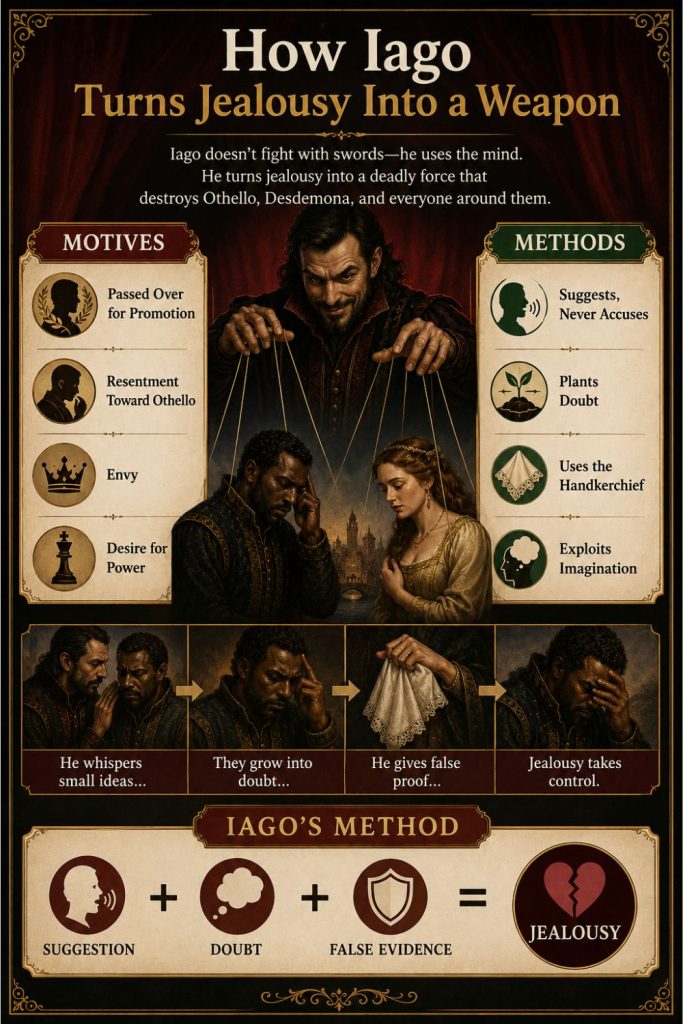
Iago’s jealousy in Othello stems from a mixture of wounded ambition and personal resentment. He is furious when Cassio receives a promotion he believes he deserves, and views the decision as an insult to his experience and abilities. Othello’s authority and success further intensify his bitterness.
More importantly, Iago cannot tolerate seeing another man receive the respect he believes he deserves. He also hints at suspicions involving Emilia and Othello, though the truth remains uncertain.
Remember, envy and jealousy are not identical. Envy wants what another person possesses. Jealousy fears being displaced. Iago suffers from both, which makes him especially dangerous.
ii) How Does Iago Use Jealousy as a Weapon?
Unlike a straightforward villain, Iago rarely makes direct accusations. Instead, he plants suggestions and allows others to draw their own conclusions. This technique makes his lies appear self-discovered rather than imposed.
In discussions about jealousy and manipulation in Othello, I often compare him to a gardener of doubt. He never forces growth. He simply creates the conditions.
The handkerchief becomes his most effective tool because it transforms coincidence into apparent proof. He also manipulates appearances to ensure innocent events seem suspicious.
Most importantly, he understands that uncertainty is often more powerful than certainty. By leaving questions unanswered, he encourages Othello’s imagination to complete the deception for him.
How Jealousy Causes the Tragedy in Othello
Jealousy causes the tragedy in Othello by destroying trust, corrupting Othello’s judgment, and leading him to murder Desdemona before discovering the truth.
The tragedy of Othello unfolds through a clear chain of consequences. First, trust begins to fracture. Once suspicion enters the marriage, honest communication becomes increasingly difficult. Questions go unasked, explanations go unheard, and every conversation becomes more difficult than the last.
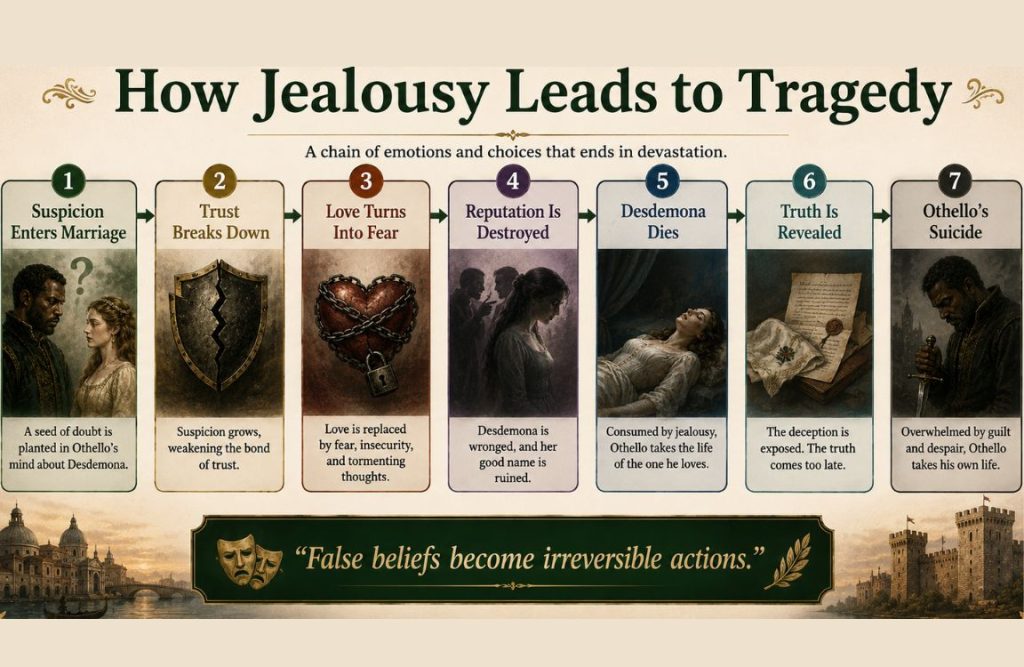
Love in Othello is the next casualty. What once appeared to be one of Shakespeare’s strongest relationships gradually becomes defined by fear and accusation. The emotional bond between Othello and Desdemona cannot survive the constant pressure of doubt.
The damage of jealousy extends beyond personal relationships and reaches public reputation as well.
Desdemona’s innocence is questioned, Cassio’s honour is attacked, and Othello’s image as a rational leader slowly collapses. The damage extends far beyond one relationship.
The final consequences are devastating. Convinced that he is acting justly, Othello murders Desdemona. Only after her death does he discover the truth behind Iago’s deception. Faced with the reality of his actions, he takes his own life.
The destructive power of jealousy in Othello lies in its ability to turn false beliefs into irreversible actions. Shakespeare presents jealousy and tragedy in Othello as inseparable forces, each feeding the other until destruction becomes unavoidable.
Key Jealousy Quotes in Othello (With Analysis)
The following quotations capture different stages of jealousy’s development. Together, they reveal how suspicion begins, how it gains authority, and how it ultimately transforms thought into action throughout Shakespeare’s tragedy.
“O, Beware, My Lord, of Jealousy”
Among the most famous quotes in Othello about jealousy, this warning is deeply ironic. Iago presents himself as a concerned friend while secretly creating the danger he describes.
The audience understands the deception, but Othello does not. That gap in knowledge makes the scene especially painful to watch. The image of jealousy as a monster suggests that it is not easily controlled once unleashed.
“Trifles Light as Air”
This line reveals Iago’s genius for manipulation rather than Othello’s weakness. He understands that a carefully planted hint can be more persuasive than a direct accusation. A small piece of evidence becomes treated as an undeniable truth, and shows how expertly Iago guides Othello toward the conclusion he wants him to reach.
“But Jealous Souls Will Not Be Answered So”
Emilia emerges as one of the wisest voices in the play. While others become trapped by suspicion and deception, she recognises an uncomfortable truth: jealousy often feeds on itself.
People consumed by it rarely accept reassurance because their fears come from within. Her insight allows her to understand the emotion more clearly than Othello ever does.
“Give Me the Ocular Proof”
The dramatic irony here is striking. Othello demands certainty at the very moment the audience knows he is being misled. His request sounds rational and fair, yet readers and viewers can already see that the evidence he seeks will be manufactured. Shakespeare turns a search for truth into a step toward disaster.
“Yet She Must Die”
This is no longer the language of a loving husband but the language of a man who believes he is carrying out a duty. The tragedy lies in the fact that Othello thinks he is acting justly. Shakespeare shows how jealousy can so completely corrupt a person that murder begins to appear righteous.
Why Is Jealousy Important in Othello?
The theme of jealousy in Othello remains powerful because Shakespeare examines an emotion that continues to affect human relationships today. His warning is not simply that jealousy harms others. More importantly, it damages the person who embraces it. Long before lives are lost, people stop listening, stop questioning, and start believing the worst about those they love.
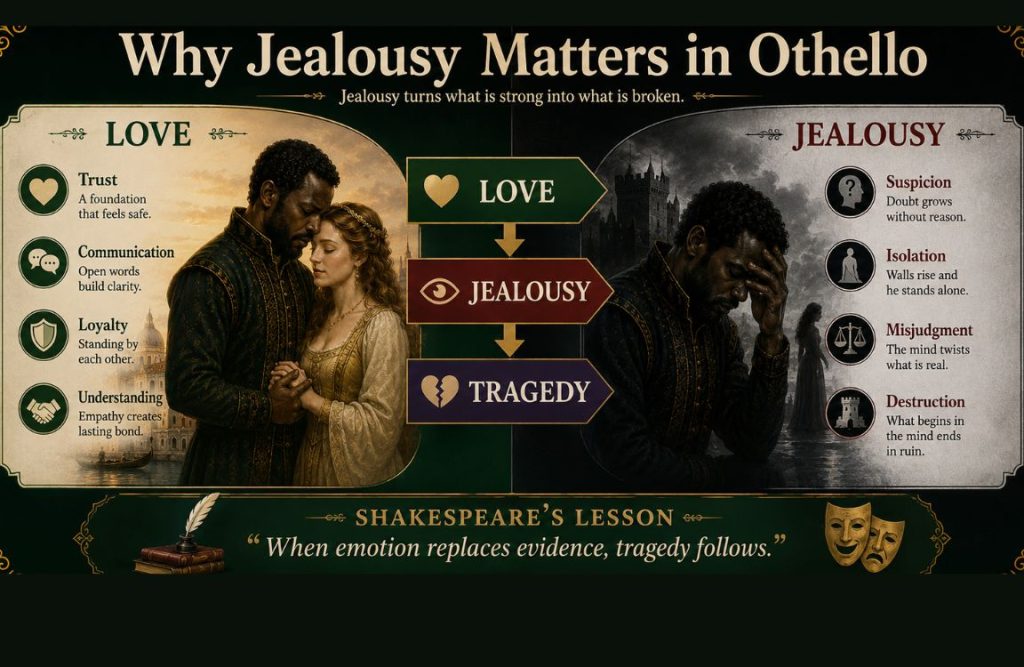
What makes the play enduring is its realism. Few people become victims of jealousy overnight. Like Othello, they often move gradually from uncertainty to belief, convinced that their conclusions are justified. Shakespeare shows how dangerous that process can be when emotion replaces careful thought.
Shakespeare could have built his tragedy around hatred, revenge, or ambition. Instead, he chooses jealousy because it grows inside love itself, making it far more difficult to recognise and resist.
The lasting power of the theme lies in Shakespeare’s ability to show how a loving marriage can collapse under beliefs that were never true.
A devoted husband begins treating his faithful wife as an enemy, and a happy marriage collapses under accusations that were never true.
In the end, Othello defeats himself. No enemy army destroys him, and no rival overpowers him. The tragedy unfolds because he allows suspicion to become more persuasive than truth.
Want to explore more of Shakespeare’s major themes? Read our detailed analyses of reputation, race, and manipulation in Othello.
FAQs:
Is jealousy Othello’s tragic flaw?
Yes, jealousy is widely regarded as Othello’s tragic flaw because it causes him to abandon reason and trust false appearances. Although he possesses many admirable qualities, his inability to resist jealousy makes him vulnerable to manipulation and ultimately contributes to his downfall.
What is the meaning of the green-eyed monster in Othello?
The green-eyed monster symbolises jealousy as a destructive force that consumes its victim. Through this metaphor, Shakespeare suggests that jealousy grows stronger the more it is fed, eventually becoming difficult to control.
How does jealousy affect Othello’s judgment?
Jealousy changes how Othello interprets evidence and behaviour. Instead of evaluating situations objectively, he begins viewing events through suspicion, which leads him to accept false conclusions and make tragic decisions.
Why does Shakespeare link jealousy with poison and disease?
Poison and disease imagery emphasise how jealousy spreads gradually and invisibly. The comparison suggests that destructive emotions can infect the mind and weaken reason before the victim fully recognises the danger.
What lesson does Shakespeare teach about jealousy in Othello?
Shakespeare teaches that unchecked jealousy narrows Othello’s emotional world until only suspicion remains and destroys meaningful relationships. The play encourages audiences to pause, ask questions, and examine the facts before accepting their fears as truth.