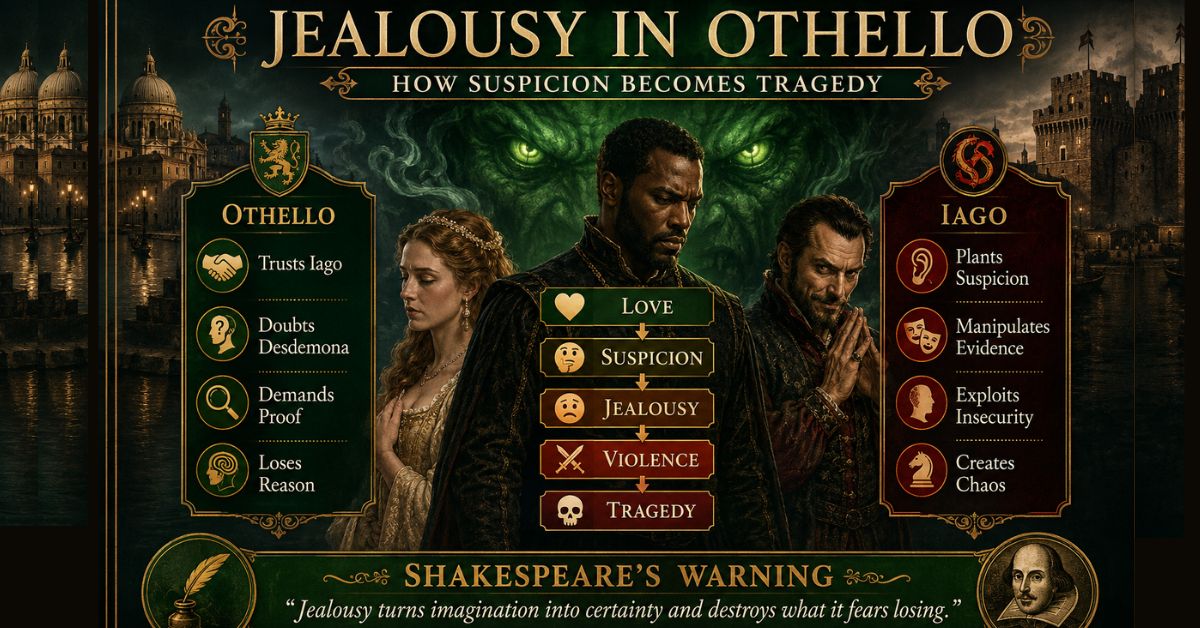
When people think of Othello, they usually remember jealousy, betrayal, and murder. Yet Shakespeare builds the tragedy on something far more powerful: love. Without love, Iago’s schemes would have no force, and Othello’s downfall would carry little emotional weight.
In Othello, nearly every major conflict grows out of love rather than hatred, revealing how trust can be broken, how prejudice can influence relationships, and how manipulation can distort genuine affection.
In this guide, I’ll show you how Shakespeare presents love in Othello through its different forms, key quotations, and a deeper message about why trust matters, how identity shapes relationships, and what Shakespeare believes about human nature.
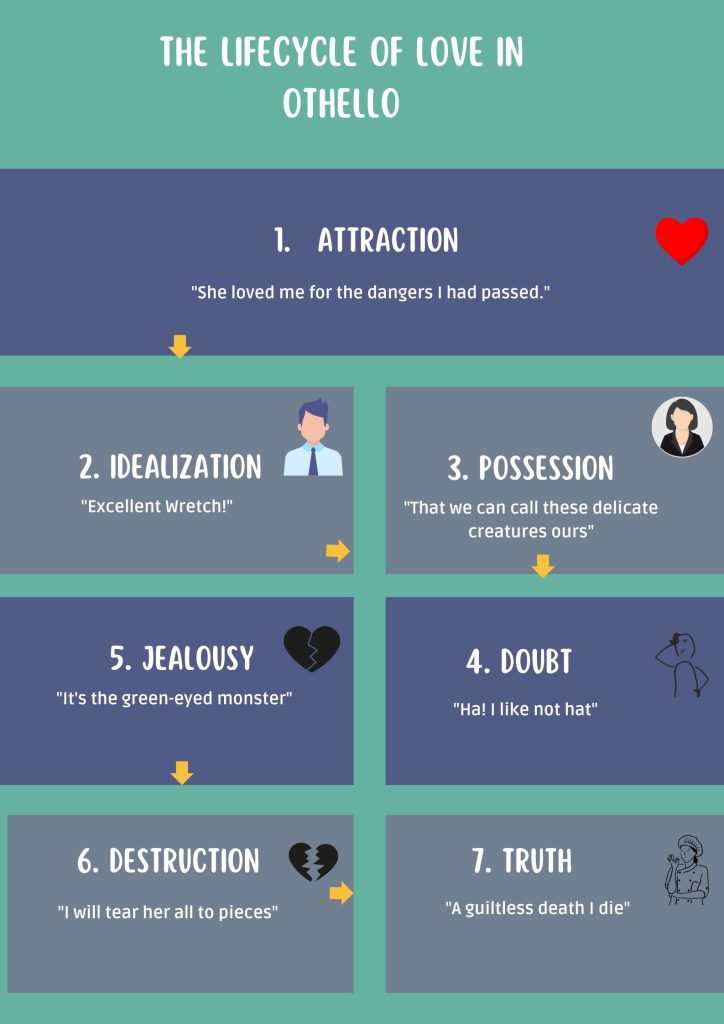
Table of Contents
Theme of Love in Othello: An Overview
I always tell my students that love in Othello reaches far beyond a romantic feeling between two people. Throughout Othello, love emerges as a complex human experience that inspires loyalty, courage, sacrifice, and hope, yet also leaves people vulnerable to fear and deception.
His presentation of love in Othello extends beyond romance to include marriage, friendship, family bonds, and unreturned affection. These different relationships and examples of love in Othello work together to show that love is never simple.
Instead, relationships flourish when both people trust one another, but begin to fail when that trust slowly disappears.
Types of Love in Othello
Shakespeare explores several forms of love in Othello. Each type reveals a different aspect of human nature. Together, they show that love can inspire loyalty and courage, yet become fragile when confidence, open communication, and emotional maturity give way to fear and deception.
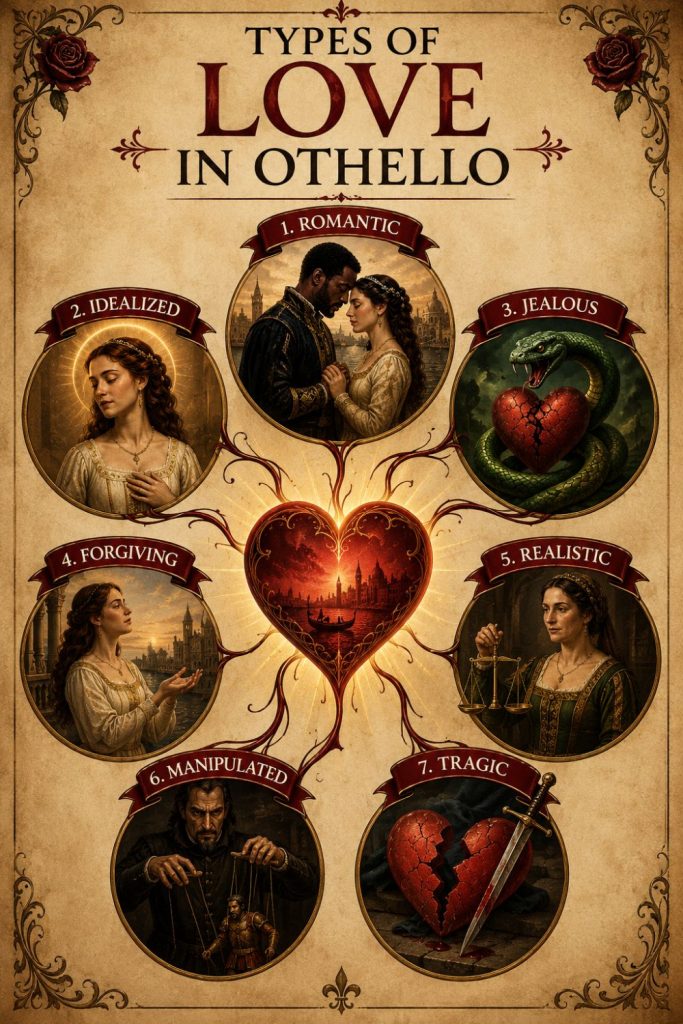
i) Romantic Love
The romantic love in Othello grows from shared experience rather than physical attraction. The Othello and Desdemona relationship develops through honest storytelling and mutual understanding.
Their respect for one another challenges a society that values status and race over emotional connection.
Why Does Desdemona Fall in Love with Othello?
Desdemona falls in love with Othello because she admires the man behind the soldier. What attracts Desdemona to Othello is not his military reputation but his honesty, resilience, and extraordinary life experiences.
His remarkable life experiences awaken her compassion, while his honesty earns her respect.
Her love grows from empathy rather than appearance or social status. To me, their relationship proves that genuine affection begins with character before attraction.
How Did Othello Win Desdemona’s Love?
Othello wins Desdemona’s love not through wealth, status, or physical appearance, but by sharing the extraordinary story of his life.
His accounts of his travels, captivity, and many dangers awaken her compassion and admiration.
As he explains before the Venetian Senate, Desdemona “loved me for the dangers I had passed.”
The play ultimately argues that emotional honesty and shared experience create a deeper foundation for love than outward beauty or social rank.
ii) Idealized Love
I often remind my students that true love in Othello is also tested by idealized love. Othello sees Desdemona as almost perfect and places her beyond ordinary human flaws.
Once that ideal image begins to crack, love built on perfection struggles to survive the first serious doubt.
iii) Jealous Love
The relationship between love and jealousy in Othello reveals how easily confidence can collapse. Iago carefully feeds Othello’s suspicions until jealousy replaces reason.
What destroys Othello is not love itself but his decision to accept fear as evidence instead of seeking the truth.
iv) Forgiving Love
Desdemona represents unconditional love through her loyalty, compassion, and willingness to forgive. Even when she suffers unjust treatment, she refuses to abandon the man she loves.
To me, her quiet resilience shows that forgiveness demands far greater strength than revenge.
v) Realistic Love
Through Emilia, I see Shakespeare offering a practical view of love and marriage in Othello. She understands that lasting relationships require honesty, equality, and mutual respect rather than unrealistic expectations.
Her clear-eyed perspective balances Desdemona’s idealism with experience gained from an imperfect marriage.
vi) Manipulated Love
The greatest example of manipulation in Othello is Iago’s ability to poison love without attacking it directly. Through deception and carefully planted doubts, he transforms affection into suspicion.
This connection between love and betrayal in Othello reminds us that relationships rarely collapse because of a single lie but through repeated acts of deception.
vii) Tragic Love
The tragic love in Othello teaches that sincere affection alone cannot protect a relationship. Othello’s downfall comes when insecurity overpowers trust and love gives way to destructive judgment.
As I tell my students, the tragedy begins not when Othello stops loving Desdemona, but when he believes Iago’s voice more than hers.
Types of Love in Othello at a Glance
If you’re revising for an exam, this quick comparison summarises the major forms of love in Othello. Each type shapes a character’s choices and contributes to the play’s tragic outcome.
| Type of Love | Main Character(s) | What It Reveals | Outcome |
| Romantic | Othello & Desdemona | Love based on admiration, trust, and shared experience | Marriage that ends in tragedy |
| Idealized | Othello | Perfect love cannot survive doubt | Disillusionment |
| Jealous | Othello | Fear replaces reason and evidence | Tragedy |
| Forgiving | Desdemona | Love remains loyal despite suffering | Moral victory |
| Realistic | Emilia | Marriage requires honesty and equality | Truth is revealed |
| Manipulated | Iago, Othello | Deception corrupts genuine affection | Betrayal |
| Obsessive | Roderigo | Desire without mutual love invites exploitation | Manipulation and death |
As I remind my students, these contrasting forms of love reveal that the same emotion can inspire loyalty, forgiveness, or destruction depending on whether it is strengthened by trust or poisoned by deception.
Common Exam Questions About Love in Othello
| Question | Short Answer |
| Is love the main theme in Othello? | Love is one of the central themes, closely connected with jealousy, racial prejudice, and deception. |
| Why does Desdemona fall in love with Othello? | She admires his courage, honesty, and life experiences rather than his appearance or social position. |
| How did Othello win Desdemona’s love? | By sharing the story of his life, his hardships, and his adventures, he earned her compassion and admiration. |
| How does Iago destroy Othello’s love? | He manipulates Othello through lies, false evidence, and emotional manipulation until jealousy replaces trust. |
| Why is Desdemona’s love significant? | It challenges racial prejudice and remains loyal even after Othello begins to mistrust her. |
| What does Shakespeare say about love in Othello? | The play suggests that love survives only when it is supported by honesty, wisdom, and mutual respect. |
Love Beyond Romance in Othello
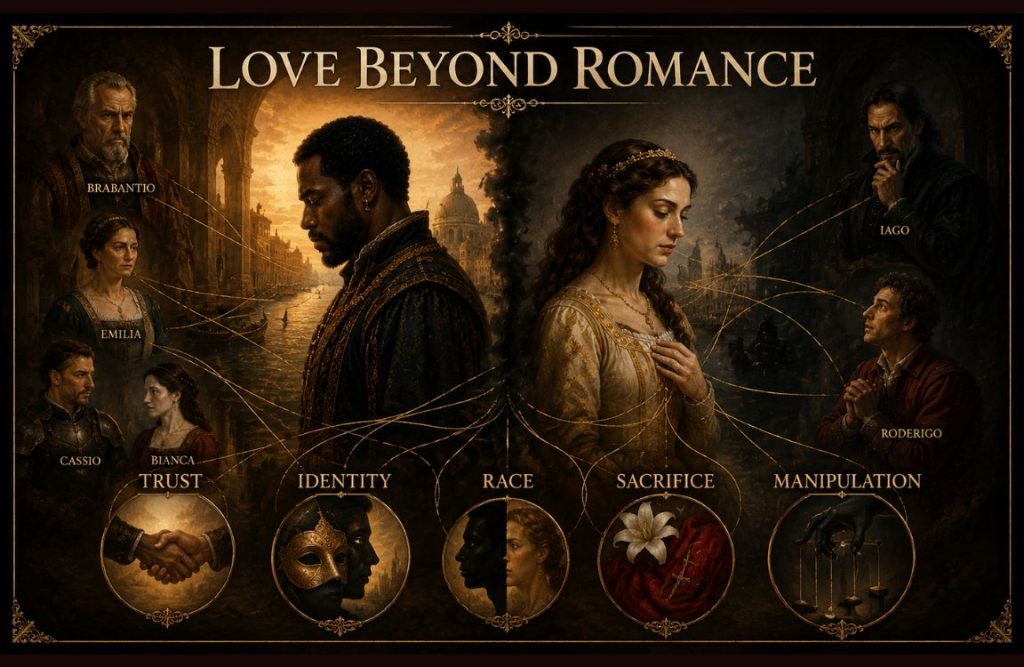
In Othello, love reaches far beyond a romantic relationship between husband and wife. It can inspire trust, strengthen identity, invite sacrifice, or become distorted by fear, prejudice, and manipulation. These contrasting forms of love reveal why the tragedy is driven as much by human relationships as by jealousy.
i) Love as Possession vs Freedom
One of the clearest contrasts in the love as possession in Othello theme appears between Othello and Desdemona. Their marriage begins with mutual respect and free choice, yet Othello gradually mistakes love for ownership.
Instead of protecting love as freedom, Othello gradually begins to treat Desdemona as someone to control rather than someone to trust, and that change marks the beginning of their tragic downfall.
ii) Love, Race, and Identity
The theme of love and race in Othello shows that genuine affection struggles against social prejudice. As an outsider, Othello carries deep insecurities that make him vulnerable to doubt.
Iago exploits these fears until trust in Othello gives way to suspicion. More importantly, prejudice wounds not only relationships but also a person’s sense of identity.
iii) Other Forms of Love
Beyond the central marriage, I encourage my students to notice several types of love in Othello.
Who does Roderigo love in Othello? He obsessively pursues Desdemona.
Who does Cassio love in Othello? No romantic devotion defines him, though Bianca sincerely loves him.
Brabantio’s protective love becomes controlling, Emilia’s loyal love proves courageous, and Othello and Iago’s relationship exposes false friendship disguised as devotion.
Key Love Quotes in Othello
These Othello love quotes reveal how Shakespeare develops love across the tragedy. Together, they trace a journey from trust and happiness to suspicion, suffering, and painful self-awareness, making them essential for literary analysis and examination answers.
1. “She loved me for the dangers I had passed, / And I loved her that she did pity them.” (Act 1, Scene 3)
Othello explains to the Venetian Senate how his marriage began. Desdemona admired his adventurous life, while Othello cherished her compassion rather than her appearance.
While discussing one of the finest quotes about love in Othello, I ask my students to notice the contrast between “dangers” and “pity”: their relationship grows from shared emotional experience rather than physical attraction.
2. “My life upon her faith!” (Act 1, Scene 3)
When Desdemona asks to accompany Othello to Cyprus, Othello confidently guarantees her loyalty. His brief declaration expresses complete confidence in her honesty and devotion.
The line is deeply ironic because the certainty he expresses here is precisely what Iago later destroys through calculated manipulation.
3. “If it were now to die, / ‘Twere now to be most happy.” (Act 2, Scene 1)
After arriving safely in Cyprus, Othello reunites with Desdemona and feels that his happiness has reached its highest point. He believes nothing could surpass this joyful moment.
This joyful declaration comes immediately before suspicion enters the marriage, making its eventual collapse even more heartbreaking.
4. “Excellent wretch! Perdition catch my soul / But I do love thee!” (Act 3, Scene 3)
Othello speaks these words while his love remains genuine, even as Iago has already begun planting suspicion in his mind. The emotional intensity reveals both deep devotion and dangerous dependence.
As I explain in class, love has not disappeared here; instead, it has become dangerously vulnerable to manipulation.
5. “His unkindness may defeat my life, / But never taint my love.” (Act 4, Scene 2)
After Othello wrongly accuses and humiliates her, Desdemona refuses to answer cruelty with hatred. She separates his harsh behaviour from her own faithful love.
To me, these words reveal moral courage rather than weakness. It shows that forgiveness can endure even when justice seems absent.
6. “Then must you speak / Of one that loved not wisely but too well.” (Act 5, Scene 2)
In his final speech, Othello reflects on the terrible consequences of his actions. He admits that his love was sincere but lacked wisdom because he allowed jealousy and manipulation to overcome reason.
Othello’s final words leave us with a tragic reminder that love without sound judgment and self-control can destroy what it values most.
What Does Shakespeare Say About Love in Othello?
While reading the play with my students, I see Shakespeare’s presentation of love as both powerful and fragile. Love alone cannot sustain a relationship. It also requires trust, emotional freedom, and confidence in one’s own identity.
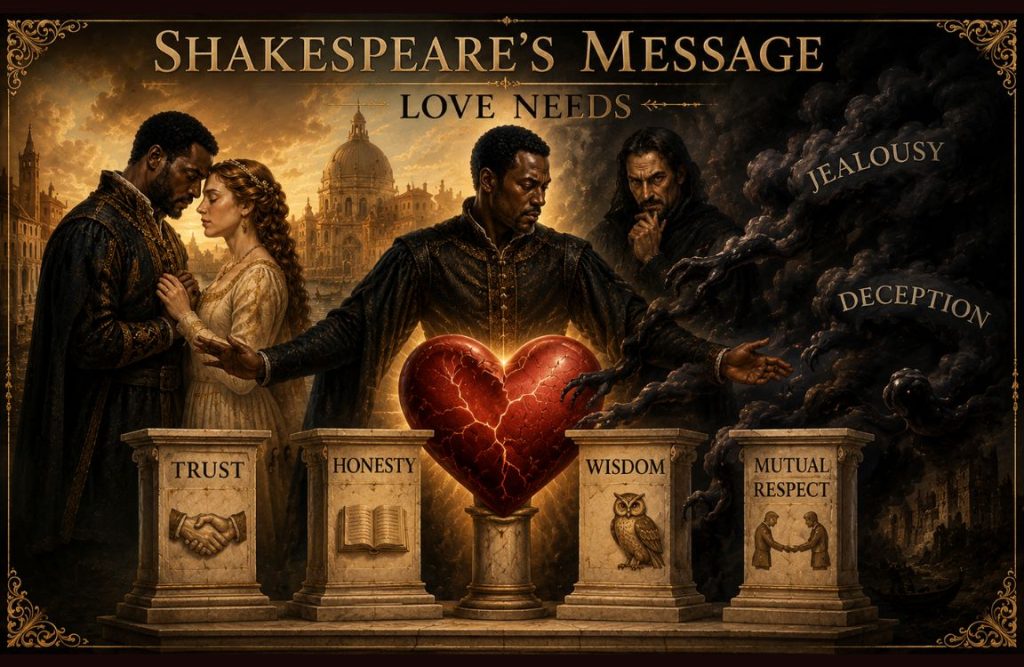
When jealousy replaces reliance and manipulation replaces honest communication, even sincere devotion becomes vulnerable. Race and social prejudice deepen Othello’s insecurity, which makes him easier to deceive.
Ultimately, the tragedy shows that love survives only when guided by wisdom, mutual respect, and the courage to resist fear.
Why Love Is the Heart of Othello
Love lies at the centre of Othello because every major conflict grows from it. The romance between Othello and Desdemona challenges racial prejudice, yet their happiness depends on trust rather than passion alone.
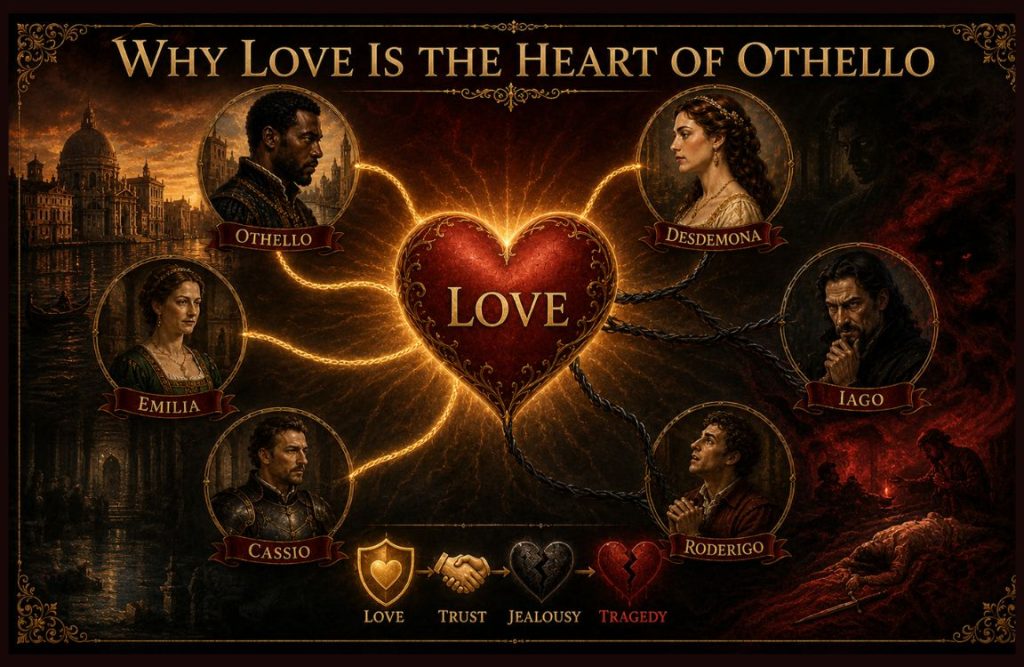
Iago understands this and attacks their relationship through manipulation instead of open force. As suspicion replaces confidence, love becomes the very source of tragedy.
To me, Shakespeare’s greatest insight is that genuine love remains at risk unless it is protected by honesty, wisdom, and mutual understanding.
FAQs:
Why is love important in Othello?
Love drives every major conflict in Othello. Shakespeare shows that genuine love can inspire courage and sacrifice, but without trust, it can give way to doubt, jealousy, and manipulation, ultimately leading to tragedy.
Is Othello a love story or a tragedy?
Othello is both. It begins as a sincere love story between Othello and Desdemona, but gradually transforms into a tragedy as deception destroys their faith in one another and their relationship.
How does Shakespeare present love in Othello?
Love is presented as both powerful and easily corrupted by jealousy and deception. Through romantic love, forgiving, jealous, and manipulated relationships, the play shows that lasting love depends on trust and honesty.
What is Shakespeare’s message about love in Othello?
Shakespeare suggests that affection without trust cannot endure. Without mutual respect, honest communication, and sound judgment, even genuine love can be destroyed by jealousy, fear, and deception.
Conclusion:
Love in Othello begins as a force of hope, trust, and freedom but ends in devastating tragedy as those qualities are gradually eroded by jealousy, manipulation, and fear.
As I tell my students, Othello’s greatest mistake is not that he stops loving Desdemona, but that he believes deception over truth.
The play reminds us that love survives not through passion alone but through honesty and self-knowledge to resist deception. That is why Othello remains one of Shakespeare’s most enduring tragedies.
Enjoyed this analysis? Explore our complete Othello Study Guide for character analysis, themes, important quotes, and exam-ready explanations.