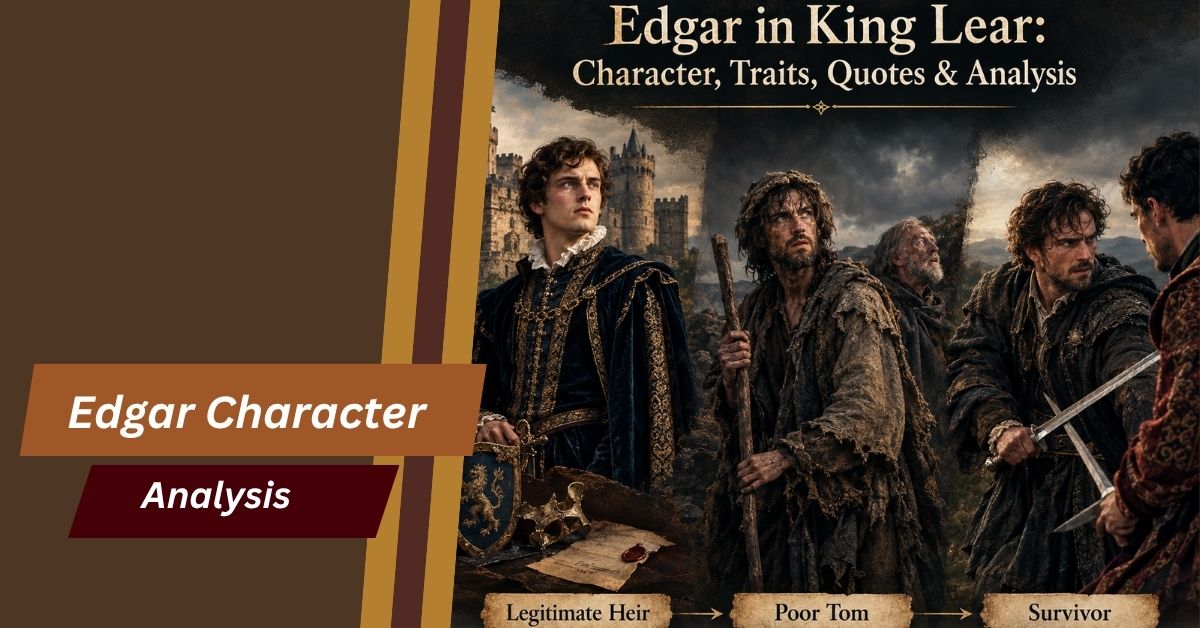
Edgar in King Lear begins as Gloucester’s legitimate heir, who is protected by social status. Edmund’s deception destroys that security, forcing him to flee and abandon his noble identity.
As Poor Tom, he enters a world far removed from his former identity, living in poverty and pretending to be mad. By the end, Edgar defeats Edmund and survives the tragedy, left to face its aftermath.
Who Is Edgar in King Lear?
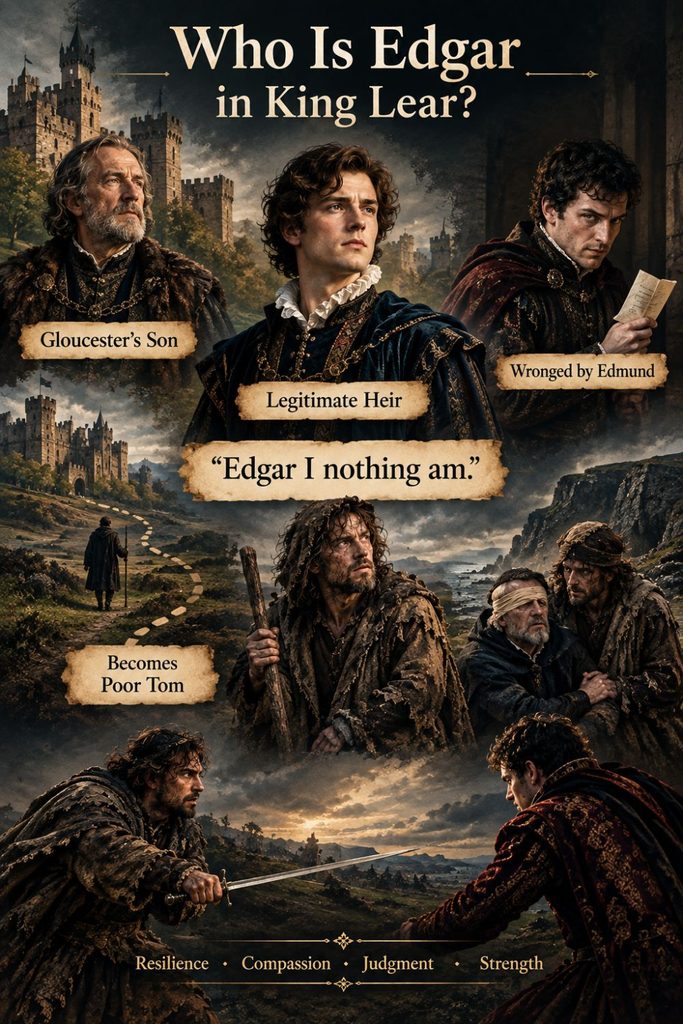
Edgar is the son of the Earl of Gloucester and Edmund’s half-brother. As Gloucester’s heir, he possesses the position Edmund envies. Edmund deceives their father into believing that Edgar intends to betray him.
Edgar initially trusts his brother and follows his warning to escape. Before disguising himself as Poor Tom, he declares,
“Edgar I nothing am.”
In disguise, he remains close to the events destroying his family. He later helps Gloucester and confronts Edmund. Thus, Edgar in King Lear is a wronged heir who discovers strength.
Edgar’s Character in King Lear
The character of Edgar in King Lear initially appears trusting and sheltered, but exile reveals his ability to adapt without losing compassion. His early weakness is his trust in Edmund. He recognizes the deception only when his life is in danger.
Exile makes Edgar resourceful. He chooses to
“take the basest and most poorest shape”
to survive, abandoning the appearance of a nobleman. Yet hardship does not make him cruel. After Gloucester is blinded, Edgar stays near his father despite Gloucester’s rejection.
Edgar is admirable because suffering does not determine his moral character. His courage grows from early innocence and vulnerability.
Edgar’s Character Development in King Lear
Edgar’s character development is marked by a loss of certainty. As Gloucester’s heir, he assumes family and social position will protect him. Edmund’s plot destroys that assumption and forces him to judge situations for himself.
His disguise becomes a turning point. Edgar must live without the privileges that defined his place in society and begins to see suffering from an aristocratic outsider’s position.
His treatment of Gloucester shows the biggest change. Instead of seeking revenge after his father rejects him, Edgar protects him. At Dover, he stages an imaginary fall to stop Gloucester’s suicide. The deception is morally complicated, but it reveals his ability to respond intelligently to despair.
By the final confrontation with Edmund, Edgar is no longer the passive heir. He can confront danger and accept responsibility. His development is a movement from innocence toward judgment.
Poor Tom in King Lear: Edgar’s Disguise and Madness
Edgar becomes Poor Tom because Edmund falsely accuses him of plotting against Gloucester and tries to draw him into the conspiracy. This makes Edgar a hunted man. His apparent madness is a deliberate performance, shaped by the language and appearance associated with Bedlam beggars. He is not genuinely mad.
The disguise does more than hide Edgar. It places him outside the social world that protected him. His encounter with Lear is significant because Lear, too, has lost much of his authority. Their meeting connects Edgar’s disguise with the play’s concern with lost status.
Poor Tom also creates dramatic irony in the Gloucester plot. Gloucester believes Edgar is a dangerous traitor while unknowingly depending on him for protection. The audience understands the truth, making Edgar’s disguise both a survival strategy and a powerful dramatic device.
Edmund and Edgar in King Lear: Brothers and Rivals
Edmund and Edgar are brothers in King Lear, but they occupy sharply different positions within Gloucester’s family. Edgar is legitimate and inherits the privileges attached to that status. Edmund, born outside marriage, resents the social system that restricts his inheritance and recognition.
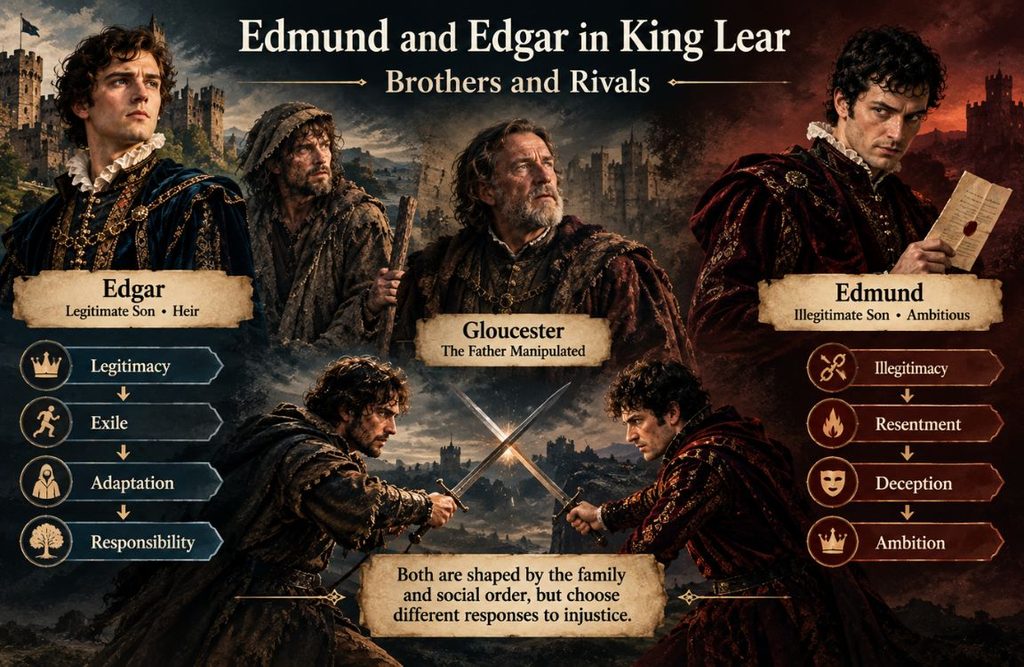
The brothers become foils because their responses to injustice differ sharply. Edmund turns resentment into calculated deception. Edgar develops greater awareness of vulnerability and responsibility.
Their final combat brings the rivalry to its climax. Edgar defeats Edmund, but too late to prevent the deaths caused by his schemes. Their contrast is more than good versus evil: both are shaped by the family and social order, yet choose different responses.
Edgar and Gloucester in King Lear
Gloucester’s rejection of Edgar creates one of the tragedy’s most painful father-son relationships. Deceived by Edmund, Gloucester condemns the innocent son and trusts the one who betrays him.
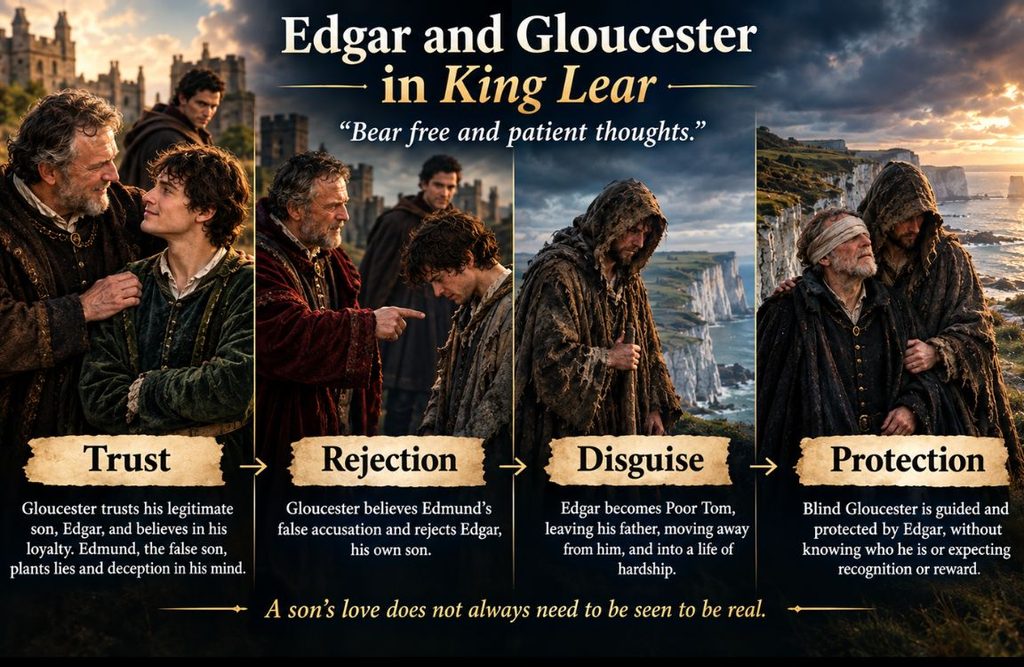
After Gloucester is blinded, Edgar remains beside him in disguise. Gloucester cannot recognize his son, creating dramatic irony. At Dover, Edgar tries to save him from despair and tells him to “Bear free and patient thoughts.”
His loyalty survives the loss of inheritance and his father’s rejection. Edgar helps Gloucester without demanding recognition or reward. His actions are not merely sentimental: he uses disguise and deception to keep his father alive.
Their relationship reveals Edgar’s moral independence. He is no longer the son protected by Gloucester’s status. He becomes capable of protecting Gloucester when that status has failed.
Role of Edgar in King Lear
The role of Edgar in King Lear extends beyond his survival. He is the central figure in Gloucester’s family plot and the character who connects that subplot with Lear’s larger tragedy.
His disguise brings him into contact with Lear and suffering hidden beneath social rank. His care for Gloucester exposes Edmund’s betrayal, while his final encounter with Edmund brings the family conflict to its conclusion.
Edgar matters because he remains when central characters do not. Lear, Cordelia, Gloucester, and Edmund are dead, leaving him to confront the aftermath. His survival does not restore order. It places responsibility on a character who has witnessed the destruction from several perspectives.
Edgar’s Quotes from King Lear: Famous Lines & Meanings
Here are important quotes of Edgar in King Lear:
| Quote | Act & Scene | Meaning |
| “Edgar I nothing am.” | 2.3 | He rejects his former social identity as he prepares to become Poor Tom. |
| “The gods are just.” | 5.3 | Edgar tries to interpret suffering through an idea of moral consequence. |
| “Ripeness is all.” | 5.2 | The line expresses acceptance of human limits and mortality. |
| “Men must endure / Their going hence, even as their coming hither.” | 5.2 | Human beings must accept death as part of the natural order. |
“Edgar I nothing am” belongs to the moment when Edgar loses the identity that once gave him security. By contrast, “Ripeness is all” and “Men must endure” come from a character who has witnessed death. Together, these lines trace his movement from heir to reflective survivor.
What Happens to Edgar at the End of King Lear?
At the end of King Lear, Edgar fights Edmund and defeats him. Edmund admits that he ordered Lear and Cordelia’s deaths and then tries to stop the execution, but too late. Edgar survives while Lear, Cordelia, Gloucester, and Edmund lie dead.
The ending requires textual caution. In the Folio, Edgar delivers the final speech, while the Quarto attributes the closing lines to Albany. For that reason, it is safer to describe Edgar as a leading survivor than to state simply that he becomes king.
FAQs:
Why is Edgar called “legitimate” in King Lear?
Edgar is legitimate because he is Gloucester’s son born within marriage and is therefore his acknowledged heir. Edmund’s illegitimacy places him at a social disadvantage.
Why does Edgar call himself “Nothing am”?
“Edgar I nothing am” expresses the loss of his former social identity. By becoming Poor Tom, he hides his noble status so Edmund’s agents cannot find him.
What does “Ripeness is all” mean in King Lear?
“Ripeness is all” suggests that human beings cannot control every condition of life and death. Edgar’s experience gives the line force because he has witnessed loss.
Is Edgar’s disguise as Poor Tom only a way to escape Edmund?
No. The disguise protects Edgar, places him outside aristocratic privilege, connects him with Lear, creates dramatic irony, and keeps him near Gloucester.
What does Edgar’s survival mean at the end of King Lear?
Edgar’s survival is not a simple happy ending. He remains after the deaths of Lear, Cordelia, Gloucester, and Edmund, carrying responsibility for its aftermath.
Conclusion:
Edgar’s journey is not simply a story of a good heir defeating a wicked brother. Exile strips away his protected position, Poor Tom exposes him to a social reality, and Gloucester’s suffering tests his loyalty.
When Edgar defeats Edmund, he has gained judgment but not escaped loss. His survival gives the ending a difficult forward-looking quality.
He cannot restore the dead or undo what happened. He must live with the tragedy and face whatever comes after it.