
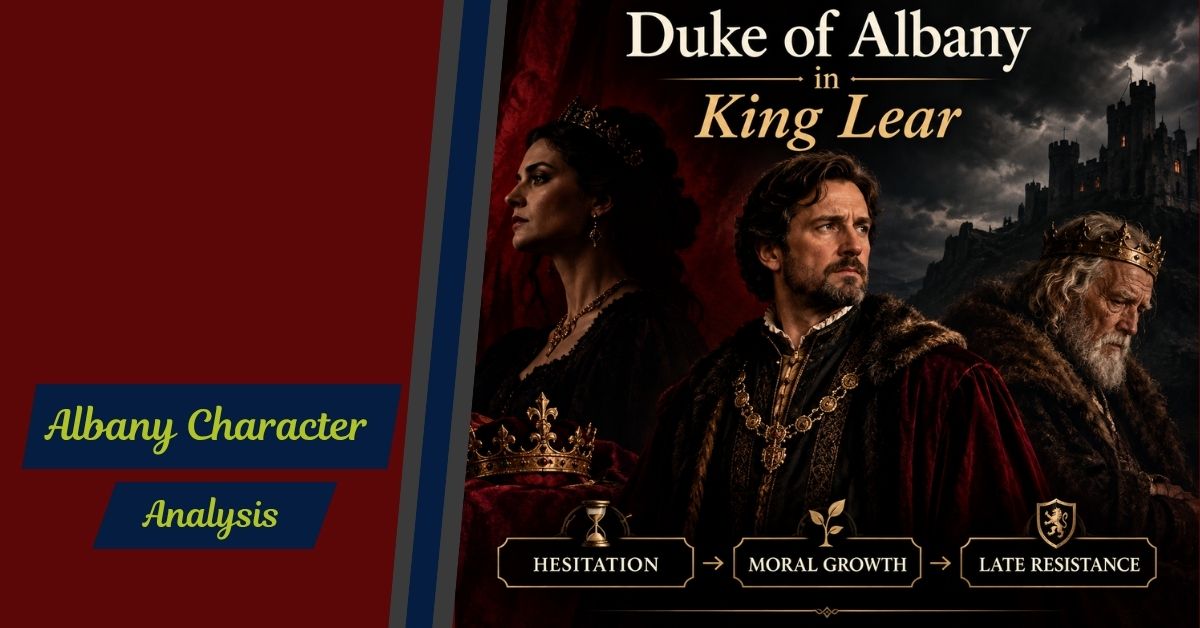
Albany enters King Lear almost in Goneril’s shadow. As her husband, he initially seems too passive to challenge her treatment of Lear.
Yet as the kingdom descends into violence, he begins to question the abuse of power around him. He learns that moral judgment must become action.
The Duke of Albany in King Lear is neither a flawless hero nor a simple coward. His hesitation makes his later opposition to cruelty more meaningful.
Who Is the Duke of Albany in King Lear?
Albany is a nobleman, Goneril’s husband, and Lear’s son-in-law. When Lear divides his kingdom, Albany receives political authority alongside Cornwall, Regan’s husband.
The Royal Shakespeare Company describes Albany as loyal to Lear and notes that he does not share Goneril’s complaints about Lear’s hundred knights. His hesitation prevents him from challenging her decisively.
I often tell my students that Albany should not be labelled simply a “good man”: Shakespeare gives him limitations before showing his moral growth.
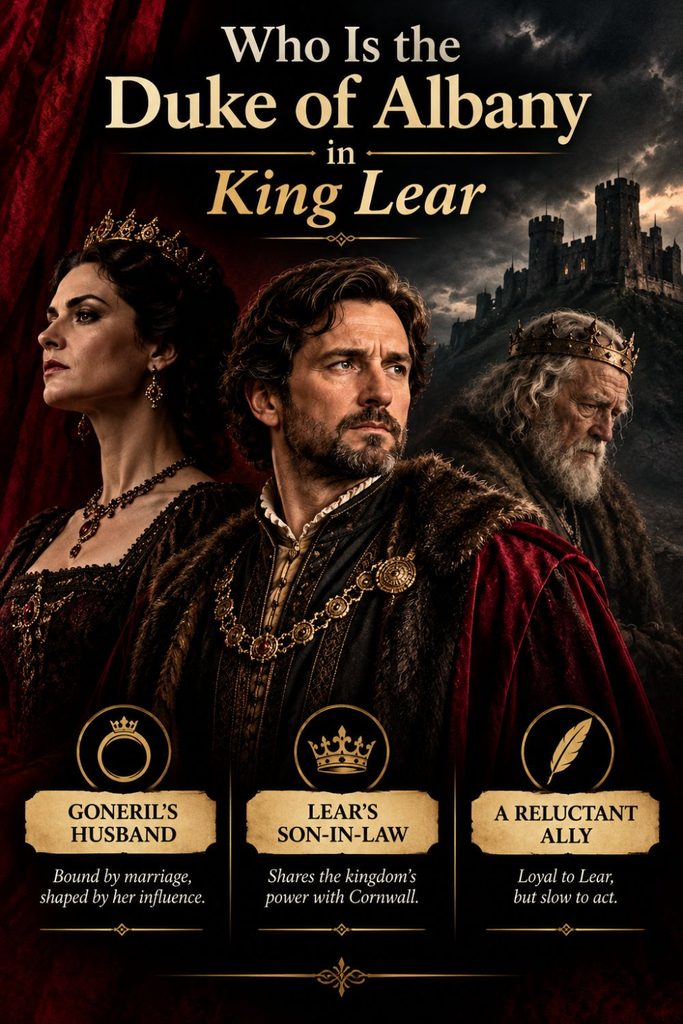
Table of Contents
Albany and Goneril in King Lear
Albany’s marriage becomes strained as Goneril expects him to support her treatment of Lear. He eventually condemns her directly:
“You are not worth the dust which the rude wind / Blows in your face.”
His anger signals a serious break between them. Goneril calls him a “milk-livered man,” using the insult to present restraint as weakness.
The exchange reveals her belief that strength means control. Albany’s growing resistance challenges that belief, although he has not always acted on his doubts.
Albany’s Character Traits
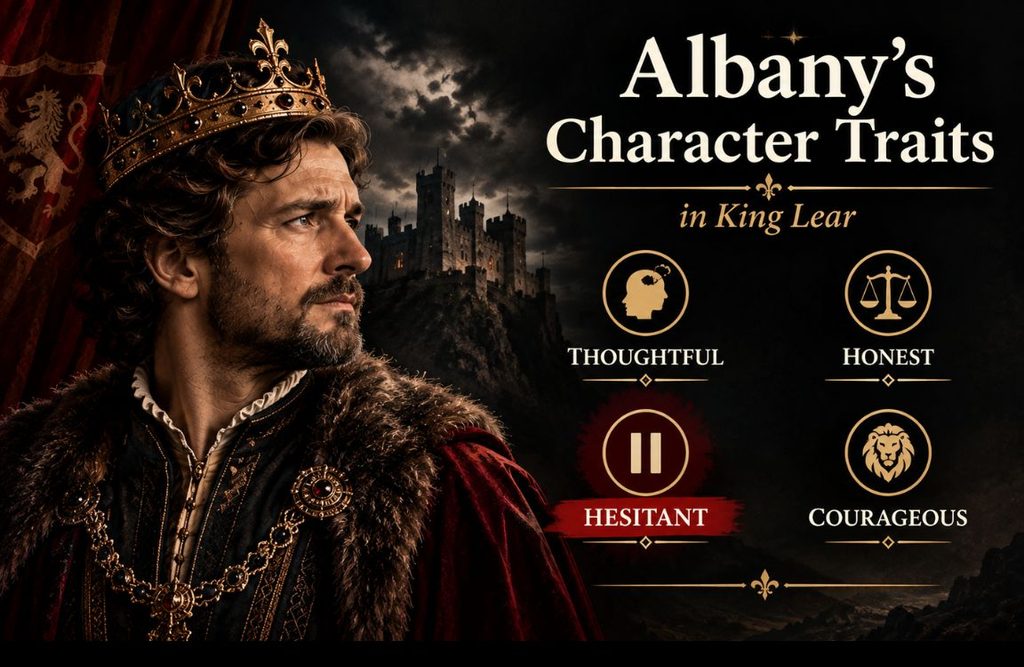
Albany is thoughtful and capable of moral judgment, but he hesitates when action could bring conflict. That weakness matters: Goneril can mistreat Lear while her husband’s disapproval remains largely private.
Albany explains his understanding of honour:
“Where I could not be honest, / I never yet was valiant.”
The line links courage with honesty. For Albany, bravery cannot be separated from the principles guiding it.
Yet Shakespeare also invites us to test this claim against his conduct. A man may speak sincerely about honour and still fail to defend someone who needs help.
Albany’s Moral Development
Albany’s change takes place through events that make passive disapproval harder to maintain. At first, he objects to Goneril’s behaviour without stopping it. His failure is not that he lacks all moral sense; it is that he delays acting on it.
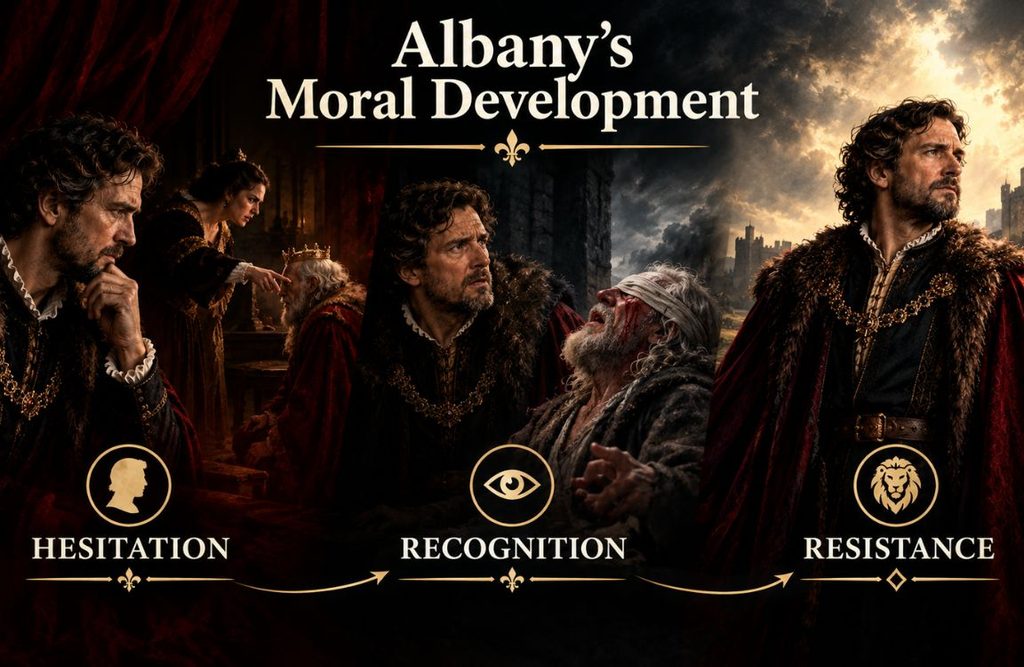
News of Gloucester’s blinding shocks Albany. He recognises the punishment as cruelty committed under political authority, not lawful justice.
The French invasion complicates his position. Albany helps defend Britain, yet he acknowledges that Lear and his supporters have risen for “most just and heavy causes.”
He does not treat military duty as proof that the rulers are right. Instead, he recognises that the government’s own conduct has helped provoke resistance.
By the final act, Albany directly challenges Goneril and Edmund. His opposition matters, but it comes after suffering has spread through the kingdom. Shakespeare does not let his late courage cancel his earlier passivity.
Albany vs Cornwall: Two Sons-in-Law
Albany and Cornwall show how differently rulers can use authority.
| Albany | Cornwall |
| Delays before confronting Goneril. | Supports Regan’s harsh treatment of Lear. |
| Objects to cruelty as the play develops. | Takes part in Gloucester’s blinding. |
| Challenges Edmund’s claim to command. | Uses political power to enforce violence. |
| Eventually opposes wrongdoing. | Becomes an active agent of oppression. |
Cornwall turns authority into a means of punishment. Albany is slower to resist, but he eventually uses his position to challenge abuses.
Their contrast is not simply between a good man and a bad one. It asks whether holding power brings a duty to oppose injustice, even when the offender is a family member.
Albany and Edmund in King Lear
Edmund exploits the crisis and arranges for Lear and Cordelia to be killed after the battle. Albany challenges Edmund’s claim over the forces raised in Albany’s name:
“All levied in my name, have in my name / Took their discharge.”
Albany withdraws the authority Edmund has been using. Edgar then arrives, accuses Edmund of treachery, and defeats him in combat. This distinction matters: Albany helps expose Edmund’s unlawful control, but Edgar is the man who defeats him.
Duke of Albany in King Lear: Key Quotes
| Quote | Significance |
| “Striving to better, oft we mar what’s well.” | Warns that efforts to improve matters can make them worse. |
| “Wisdom and goodness to the vile seem vile.” | Suggests that corrupt people may fail to recognise goodness. |
| “Where I could not be honest, / I never yet was valiant.” | Connects courage with honesty. |
| “For us, we will resign, / During the life of this old Majesty, / To him our absolute power.” | Promises to return authority to Lear while he lives. |
These lines reveal Albany’s judgments and his intended response to Lear’s loss of power. Still, his promise comes late, and events prevent him from carrying it out.
Does the Duke of Albany Die in King Lear?
No. Albany survives, while Lear, Cordelia, Goneril, Regan, and Edmund die. Albany offers to restore authority to Lear, but Lear dies before the promise can be fulfilled.
Albany and Edgar remain to face the political aftermath. Shakespeare does not explicitly settle who will become king, so it is safer not to describe Albany’s succession as certain.
FAQs:
Does Albany become king at the end of King Lear?
The play does not formally declare Albany king. He and Edgar survive and have responsibilities after the deaths, but the future arrangement of power remains uncertain.
Why does Albany fight Cordelia’s army?
He sees the French invasion as a threat to Britain and helps defend the country. Nevertheless, he admits that Lear’s supporters have serious reasons to resist the rulers.
Why does Goneril call Albany a “milk-livered man”?
She uses the phrase to accuse him of cowardice. Their argument exposes her preference for force and her contempt for restraint.
Conclusion:
Albany’s story is not a simple transformation from weakness to virtue. He sees Goneril’s cruelty before he firmly opposes it, and that delay makes him partly responsible for the unchecked abuse around him.
His later resistance shows moral growth, but it cannot undo the damage. Through Albany in King Lear, Shakespeare asks readers to consider not only whether people recognise injustice, but whether they are prepared to challenge it when doing so becomes difficult.