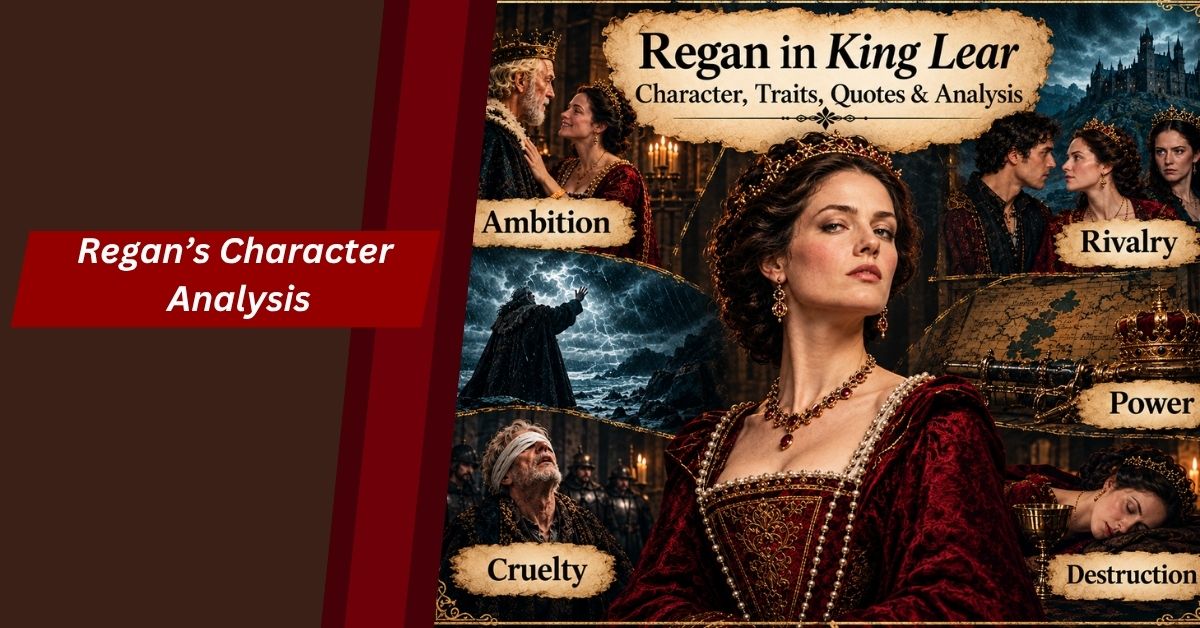
Regan in King Lear first presents herself as a devoted daughter. During Lear’s love test, she gives an elaborate declaration of affection. Yet her later actions reveal a striking gap between her words and behaviour.
She helps strip Lear of his authority, supports Gloucester’s punishment, and turns against Goneril over Edmund. Regan represents ambition, cruelty, and the desire for control.
This guide examines Regan’s role, character traits, relationships, important quotes, and development throughout Shakespeare’s tragedy.
Who Is Regan in King Lear?
Regan is King Lear’s second daughter, the sister of Goneril and Cordelia, and the wife of the Duke of Cornwall. When Lear divides his kingdom, Regan receives part of his territory and political authority. Lear still expects to retain the title of king and his knights.
At first, Regan appears respectful toward her father. After the division, she joins Goneril in reducing his privileges, supports Gloucester’s punishment, and competes with her sister for Edmund.
Regan eventually dies after Goneril poisons her. Her story moves from flattering declarations of love to political ruthlessness and finally to self-destruction.
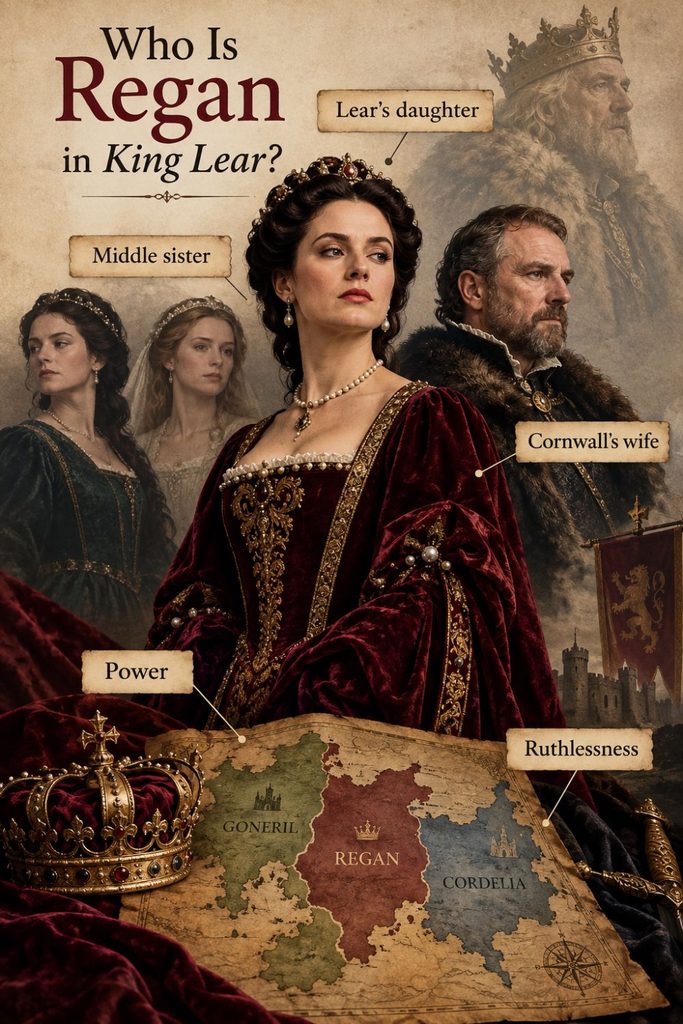
Table of Contents
Regan’s Character Traits in King Lear
Regan’s behaviour reveals several qualities.
i) Deceptive and Calculating
Regan presents her love in exaggerated terms, but her later treatment of Lear makes those declarations difficult to accept as sincere. Shakespeare creates a contrast between what she says and what she does.
ii) Ambitious
Regan protects her position after Lear divides the kingdom. Her ambition becomes clearer when she limits Lear’s authority and later competes with Goneril for Edmund.
iii) Ruthless
Her treatment of Gloucester provides the clearest evidence of her cruelty. She demands that he be hanged. When a servant tries to stop Cornwall’s attack, Regan kills him, then orders the blinded Gloucester away.
iv) Competitive
Regan cooperates with Goneril when their interests are shared, but that alliance has limits. Once Edmund becomes the object of their desire, the sisters become rivals.
Regan and Lear: From Flattery to Rejection
Regan’s relationship with Lear exposes the difference between spoken loyalty and genuine devotion. During the love test, she gives Lear the praise he wants. Once his political power weakens, however, she helps restrict his followers and refuses to preserve the authority he believes should remain his.
As I teach this scene, I often point out that Shakespeare questions whether love can be measured through public declarations. Lear wants love expressed as a performance, while Regan’s actions reveal the danger of treating public declarations as reliable proof of love.
Her rejection becomes especially harsh when she joins Goneril in reducing Lear’s retinue. Their treatment transforms family conflict into political crisis.
Regan and Goneril in King Lear: Sisters, Allies, Rivals
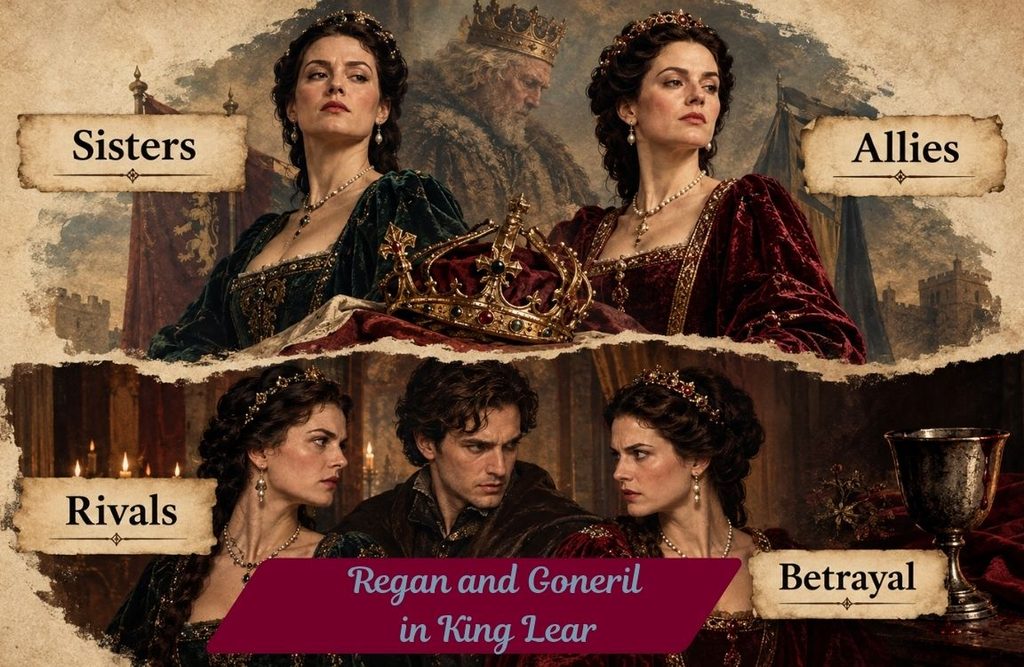
Regan and Goneril begin as competitors during Lear’s love test, but their shared interest in controlling their father makes them allies. Together, they reduce Lear’s authority and drive him toward the storm.
Their cooperation is based more on common interests than affection. Edmund exposes the weakness of their alliance because both sisters desire him.
Regan challenges Goneril’s claim on Edmund, turning their partnership into rivalry. Goneril eventually poisons Regan, moving the sisters from cooperation to betrayal.
Regan and Gloucester: The Darkest Side of Her Character
Regan’s treatment of Gloucester reveals the darkest side of her character. Gloucester’s loyalty to Lear makes him an enemy in Regan and Cornwall’s eyes.
When Gloucester is brought before them, Regan commands,
“Hang him instantly.”
Later, after Cornwall blinds him, she orders,
“Go thrust him out at gates.”
Her language is cold because Gloucester is treated as an obstacle rather than a suffering human being.
A servant attempts to stop the violence against Gloucester and wounds Cornwall. Regan kills the servant, making her cruelty physical rather than merely verbal.
Gloucester’s suffering reflects the collapse of moral order when political loyalty becomes more important than mercy and justice.
Regan and Edmund Relationship: Desire, Power, and Rivalry
After Cornwall’s death, Regan makes her claim on Edmund clear. She says that he is “more convenient” for her than for Goneril.
The word “convenient” suggests suitability as well as attraction. Edmund is both a man Regan desires and a powerful figure in the struggle for influence.
Her interest creates rivalry with Goneril, and Edmund benefits from their competition. Regan openly asserts her claim.
Shakespeare explores Regan’s psychology less deeply than Lear’s or Edmund’s. We understand her mainly through actions and relationships.
Regan’s Most Important Quotes in King Lear
| Quote | Meaning and Analysis |
| “I am made / Of the selfsame mettle that my sister is.” | Regan aligns herself with Goneril during the love test to present herself as equally devoted while strengthening their shared position. |
| “’Tis the infirmity of his age.” | Regan explains Lear’s behaviour as a weakness of old age, revealing her growing impatience and lack of sympathy. |
| “O, sir, to wilful men…” | Regan presents Lear as responsible for his own suffering, using his supposed stubbornness to justify her treatment of him. |
| “Hang him instantly.” | Her command during Gloucester’s punishment reveals her willingness to support extreme violence against someone loyal to Lear. |
| “Go thrust him out at gates…” | Regan orders the blinded Gloucester to be driven away, which demonstrates the severity of her treatment of Lear’s supporters. |
| “More convenient is he for my hand / Than for your lady’s.” | Regan openly claims Edmund over Goneril, which turns their alliance into personal rivalry. |
How Does Regan Die in King Lear?
Regan dies after Goneril poisons her because of their rivalry over Edmund. Her death occurs in the final act, when the sisters’ struggle for Edmund and political influence reaches its destructive conclusion.
Regan’s death completes the play’s pattern of destructive rivalry: the sisters who unite against Lear ultimately become victims of the conflict they helped create.
Regan vs. Cordelia: Two Different Daughters
Regan and Cordelia provide one of the play’s clearest contrasts. Regan uses an elaborate public declaration to secure Lear’s favour, while Cordelia refuses to exaggerate her feelings. Regan gains political power, whereas Cordelia loses Lear’s approval.
The deeper contrast is between public language and private loyalty. Regan turns filial language into political advantage, while Cordelia refuses to make love a performance. Later, Cordelia returns to help Lear, whereas Regan helps reject him.
Their stories challenge the idea that loyalty can be measured by eloquence.
What Does Regan Represent in King Lear?
Regan represents authority without compassion or moral restraint. Her flattering language shows how ambition can hide behind filial devotion. Her treatment of Gloucester shows what happens when power outweighs justice.
She also mirrors Lear. Although Regan rejects his authority, she expects obedience and responds harshly to resistance. Unlike Lear, she shows little moral transformation.
Through Regan, Shakespeare connects family conflict with political disorder as trust and compassion disappear.
FAQs:
Is Regan older than Cordelia?
Yes. Regan is Lear’s middle daughter, while Cordelia is his youngest.
Does Regan love Edmund?
Regan clearly desires Edmund. Her attraction is personal but also connected to his political position.
Why does Regan support Gloucester’s punishment?
Regan regards Gloucester as an enemy because he remains loyal to Lear. Her response shows how strongly she places political loyalty above mercy. She and Cornwall participate in the brutal punishment that leaves Gloucester blinded.
Is Regan a villain or a tragic character?
Regan functions as an antagonist because her actions contribute to Lear’s suffering and Gloucester’s punishment. Yet Shakespeare also uses her to explore ambition, authority, family conflict, and destructive desire.
Conclusion:
Regan in King Lear begins by speaking the language of love but ends as a victim of the power struggle she helps create. I see her as important because she shows how false loyalty can develop into political ambition and destructive violence.
Her treatment of Lear and Gloucester reveals her ruthlessness, while her rivalry with Goneril over Edmund exposes the instability of relationships shaped by power and desire. Regan ultimately shows that authority without compassion or restraint can destroy those who seek it.