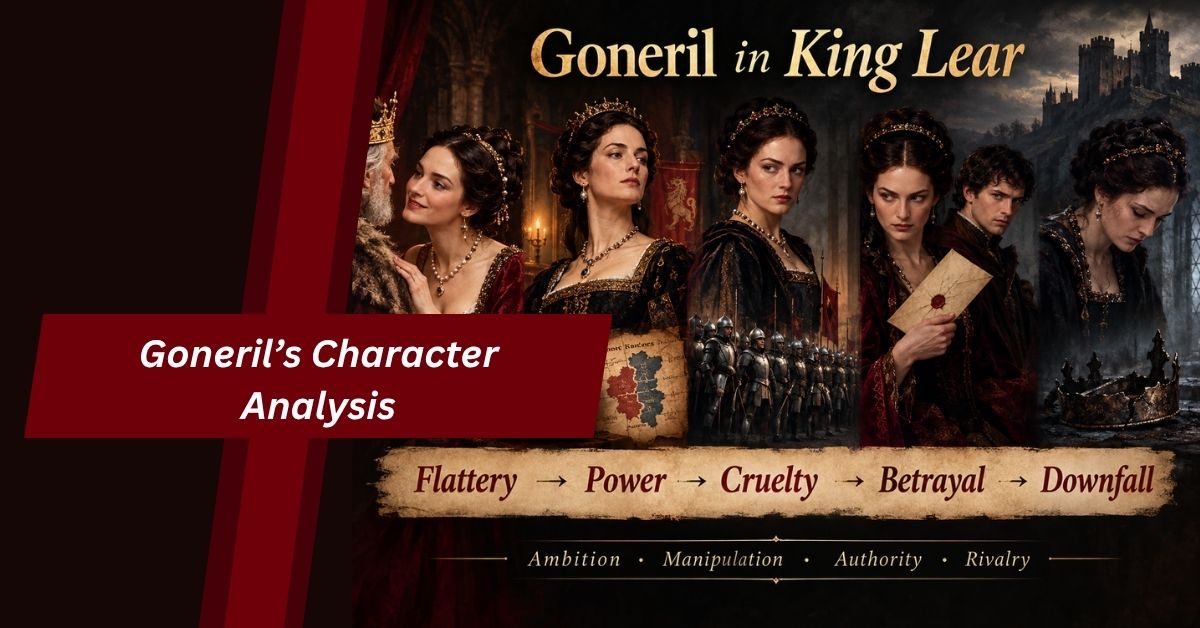
Goneril in King Lear first appears as a daughter who knows exactly what Lear wants to hear. Her exaggerated declaration of love wins her a share of his kingdom and gives her political power.
As her authority grows, her relationship with Lear deteriorates, and ambition hardens into cruelty. Goneril is therefore more than a cruel daughter: her character shows what ambition can become when moral restraint disappears.
Who Is Goneril in King Lear?
Goneril is King Lear’s eldest daughter, the sister of Regan and Cordelia, and the wife of the Duke of Albany. In Act 1, Scene 1, Lear asks his daughters to express their love for him before dividing his kingdom.
I always tell my students what a foolish king Lear is! Is this really a sensible way for a king to judge love?
Look, this foolish judgment is part of Lear’s tragic flaw: his lack of self-knowledge.
Goneril responds with elaborate praise, claiming that she loves him “more than word can wield the matter,” and Lear rewards her with a portion of his realm.
Lear divides his kingdom among his daughters while retaining the title of king and a hundred knights. Goneril soon challenges his behaviour, particularly his large retinue.
Her steward, Oswald, carries out her orders and becomes an important agent in her conflict with Lear. Later, Goneril becomes involved with Edmund and turns against Albany. Her growing ambition and ruthless actions eventually lead to suicide.
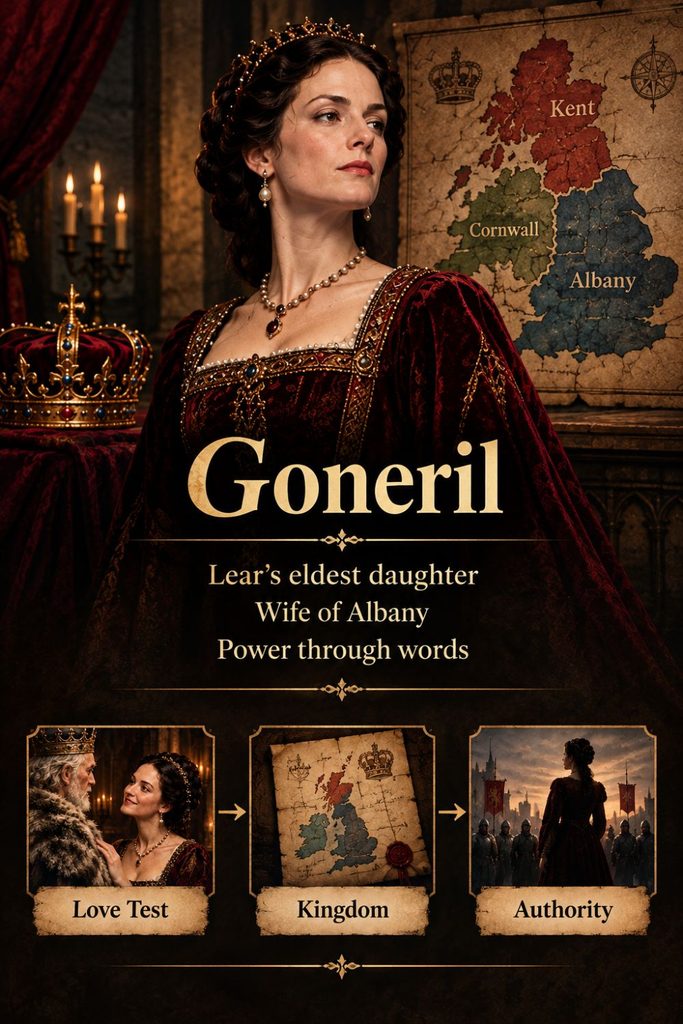
Table of Contents
Goneril Character Analysis
On closer observation, Goneril’s character is shaped by a dangerous connection between language and authority: she learns to use words to gain power, then becomes increasingly willing to use that power without moral restraint.
i) Goneril’s Ambition and Hunger for Power
Goneril’s ambition goes beyond receiving her inheritance. The love test shows her that language can produce political advantage: she knows what Lear wants to hear and receives land in return.
Once she gains authority, she seeks greater control over Lear and his household. Her desire for power becomes increasingly difficult to separate from her desire to control those around her.
ii) Goneril’s Intelligence and Manipulation
Goneril is dangerous because she is calculating by instinct rather than merely impulsive.
She understands Lear’s vanity and adjusts her language accordingly. Her opening speech functions as a performance that wins approval, while her later speeches openly challenge his authority.
I find this combination of intelligence and calculation more revealing than simply calling her evil: she repeatedly knows what she is doing.
iii) Goneril’s Cruelty and Moral Decline
Goneril’s actions move from defiance to humiliating Lear and finally to outright betrayal. Her complaint about Lear’s knights is not entirely unreasonable. It’s true, his followers create disorder, and Lear expects privileges associated with kingship despite surrendering much of his political authority.
This distinction matters: he has already handed over much of his authority to Goneril and Regan while still expecting the privileges of a king.
Goneril, however, goes beyond practical correction. When she declares,
“Old fools are babes again,”
she reduces her father to someone she believes can be controlled.
iv) Goneril’s Deception, Desire and Betrayal
The contrast between Goneril’s opening praise and her later conduct makes deception central to her character. Her attraction to Edmund adds personal desire to her political ambition.
She begins imagining a future without Albany, allowing private passion to interfere with family and political loyalty. Her relationship with Edmund therefore becomes another part of her struggle for control.
Goneril and Lear
Goneril’s relationship with her father, Lear, follows a disturbing pattern: she begins with flattery but gradually turns against him. During the love test, she gives Lear an exaggerated declaration of devotion. He accepts her words as proof of love and rewards her with land and political authority.
Yet after transferring political authority, he still expects the privileges and retinue associated with kingship.
Goneril objects to the hundred knights and the disorder surrounding them. Her complaint has a practical basis, but her response becomes excessive. Instead of managing the conflict with restraint, she strips Lear of comfort and respect.
I would teach this scene as a clash between two forms of authority: Lear expects the respect of a king without fully accepting his reduced political position, while Goneril treats his remaining authority as an obstacle.
The tragedy grows from more than hatred: Lear’s poor judgment and Goneril’s ambition turn a legitimate conflict into destructive isolation.
Goneril and Cordelia
Goneril and Cordelia provide opposite responses to Lear’s demand for public declarations of love. Goneril gives him the performance he wants, while Cordelia refuses to exaggerate her feelings because she will not turn genuine love into a public performance.
Goneril is rewarded with land and status. Cordelia is banished and disinherited by Lear. Lear consequently reverses the moral order of the family. He treats flattering language as evidence of love and honest restraint as disobedience.
Goneril uses words to gain political advantage, while Cordelia accepts personal loss rather than speak falsely. Their contrast highlights the play’s concern with appearance and reality.
Goneril and Regan
Goneril and Regan initially share the same political interest. They cooperate because Lear’s division of the kingdom benefits them both. Their shared ambition creates a temporary alliance, but their relationship becomes competitive once Edmund enters the conflict.
Both sisters pursue Edmund, and Goneril eventually poisons Regan to remove the sister who has become her rival. Their relationship exposes the instability of alliances based on ambition. Once power and desire become more important than family loyalty, Goneril and Regan turn against one another.
Goneril Monologue in King Lear
Goneril’s most important extended speech occurs in Act 1, Scene 3, after Lear has gone to stay with her. Because Oswald is present, it is not a formal soliloquy, but the passage gives Goneril an extended opportunity to express her anger.
She complains about Lear’s behaviour and his knights, expressing feelings hidden beneath her earlier performance of love.
Her speech becomes especially revealing beside her Act 1, Scene 1 declaration. There, she says,
“Sir, I love you more than word can wield the matter.”
Here, her language is openly hostile. Her remark that
“Old fools are babes again”
reduces Lear from king and father to someone she believes can be managed. I see this contrast as one of the clearest signs that Goneril’s earlier affection was at least partly strategic.
Goneril, Albany and Edmund
Goneril’s marriage to Albany becomes increasingly strained because he opposes her conduct. He condemns the cruelty she shows toward Lear and others. His moral resistance exposes how far Goneril has changed.
Edmund represents a more dangerous stage of her ambition. Goneril is attracted to him and imagines replacing Albany with a man she considers more suitable to her desires. She tells Edmund, “I love thee,” while her marriage is still intact.
She also seeks Albany’s removal and sends Edmund a letter plotting his death. Her desire for Edmund becomes closely connected with her political ambition and betrayal of Albany.
Goneril Quotes in King Lear: Key Lines & Meanings
| Goneril quote | Act/Scene | Context | What it reveals |
| “Sir, I love you more than word can wield the matter.” | 1.1 | Love test | Flattery and political calculation |
| “By day and night he wrongs me.” | 1.3 | Complaint about Lear | Resentment and frustration |
| “Old fools are babes again.” | 1.3 | Her attitude toward Lear | Contempt and desire for control |
| “Welcome, my lord. I marvel our mild husband.” | 4.2 | Meeting Edmund | Desire and dissatisfaction with Albany |
| “The laws are mine, not thine.” | 5.3 | Confrontation with Albany | Defiance and abuse of authority |
Together, these quotations trace a change from performed affection to open hostility and defiance. The progression matters more than any quotation in isolation.
Goneril’s Role in King Lear
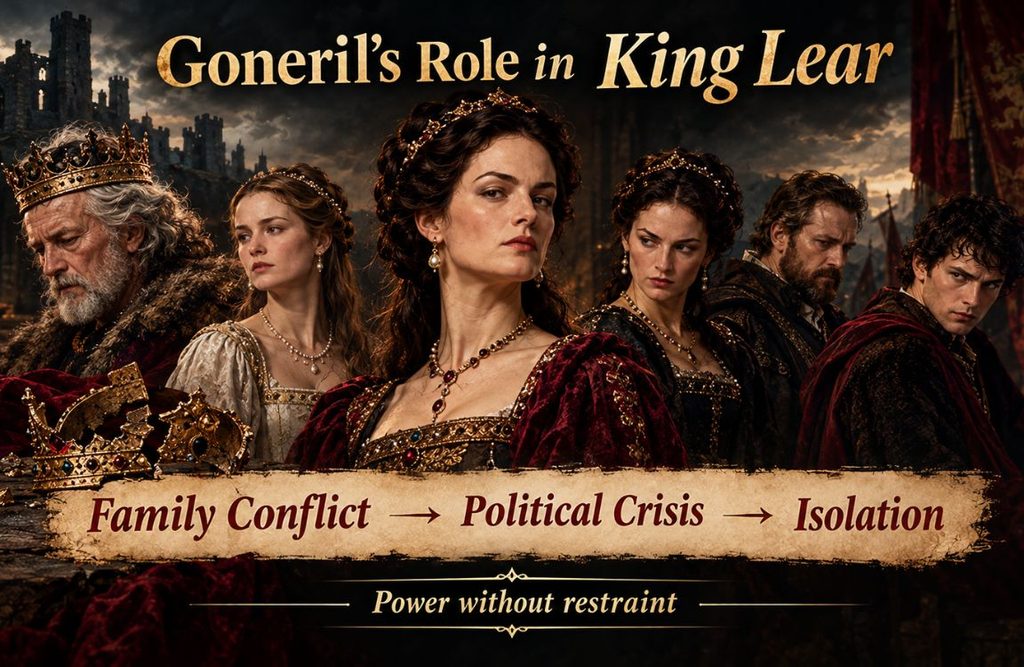
Goneril helps transform a family conflict into a wider political and moral crisis. She exposes the danger of confusing political authority with personal entitlement.
Her conflict with Lear damages family bonds, her rivalry with Regan turns sisterhood into competition, and her attraction to Edmund joins desire with political calculation.
Goneril does not simply lose power. She destroys the relationships that might have helped her preserve it. The authority she seeks ultimately leaves her isolated.
How Does Goneril Die in King Lear?
Goneril dies by suicide after her political and personal plans collapse. She poisons Regan, but Edmund’s defeat and Albany’s opposition destroy her hopes.
When her plot against Albany is exposed, she has no way to preserve her position. She then takes her own life.
No one kills Goneril in King Lear. She kills herself. Her suicide completes a downfall driven by the same ambition that helped her gain power.
She dies without reconciliation, having destroyed her family relationships and political future.
FAQs:
How old is Goneril in King Lear?
Shakespeare does not give Goneril’s exact age.
Is Goneril older than Regan?
Yes. Goneril is Lear’s eldest daughter, while Regan is his second daughter.
Does Goneril have children in King Lear?
The play does not identify any children belonging to Goneril.
Who is Goneril married to in King Lear?
Goneril is married to the Duke of Albany. Their marriage becomes increasingly strained because Albany opposes her cruelty and political actions.
Conclusion:
Goneril’s journey begins with calculated flattery and ends in self-destruction. Between these two points, her pursuit of authority gradually destroys her relationships and moral restraint.
Her character shows how the pursuit of power can corrupt family relationships when ambition replaces loyalty and restraint.
By the end, Goneril in King Lear has gained authority but lost the human connections that could have given that authority meaning.