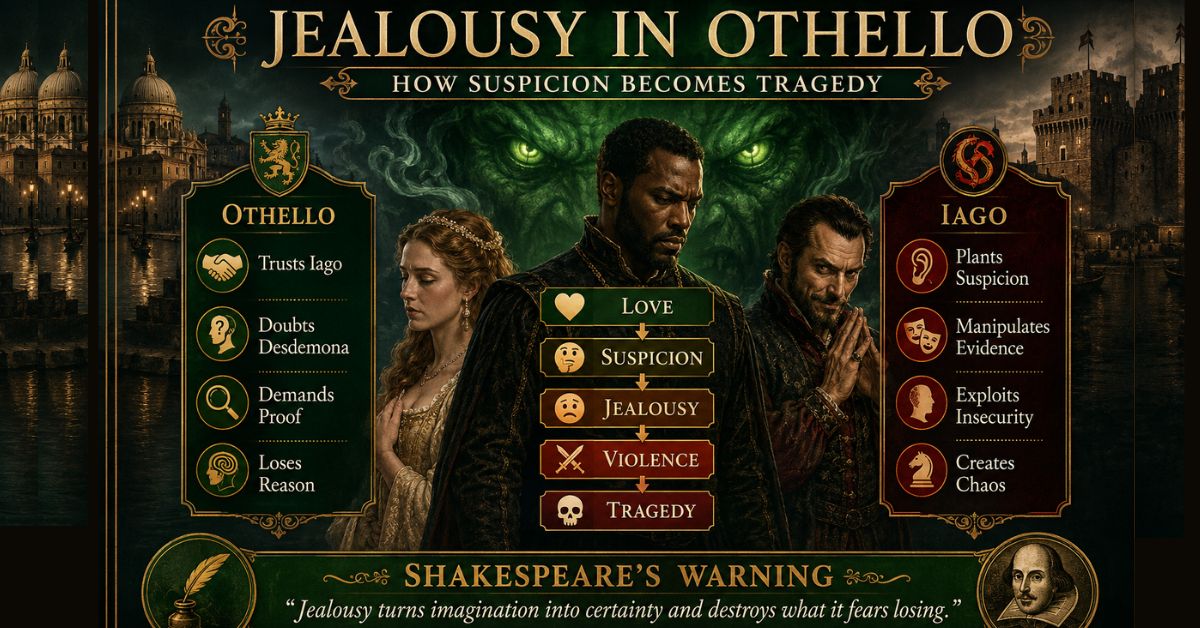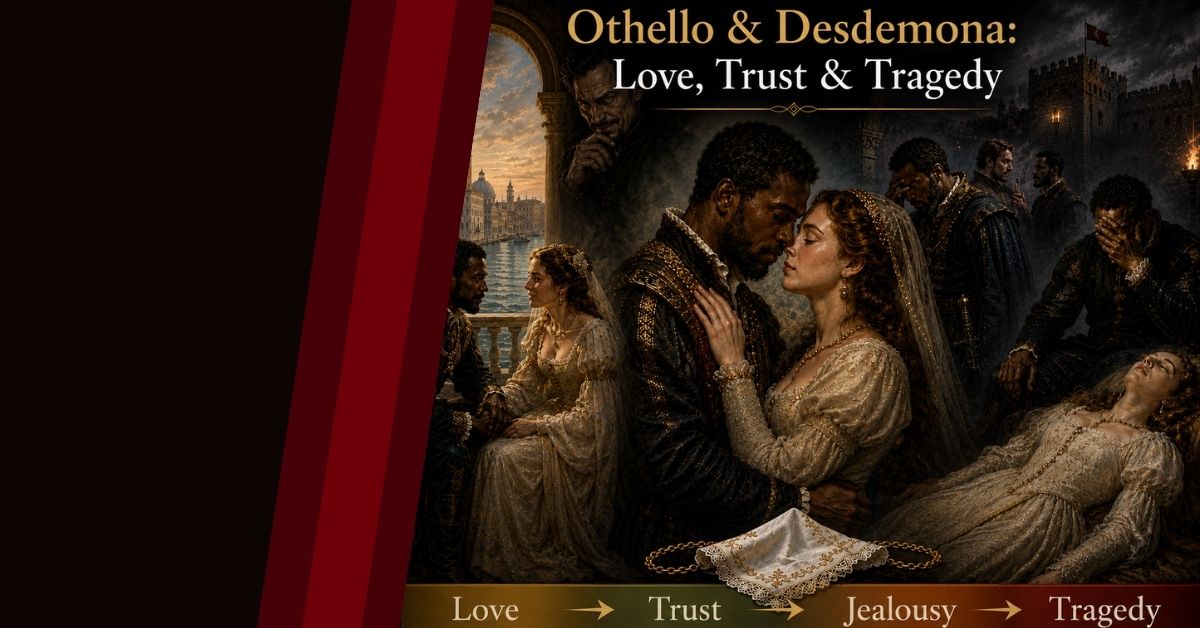
How can a marriage built on genuine love collapse so completely? The Othello and Desdemona relationship begins with admiration, sympathy, and trust, but that bond becomes fragile when Othello begins to doubt the woman he once knew so well.
Their marriage crosses racial, social, and family boundaries, yet it cannot survive the suspicion Iago gradually creates. Their love is genuine, but Othello slowly stops trusting what he knows about Desdemona. Suspicion becomes more powerful than his own experience of her character.
Their story reveals something deeply unsettling about jealousy: it can change the meaning of everything we see.
Table of Contents
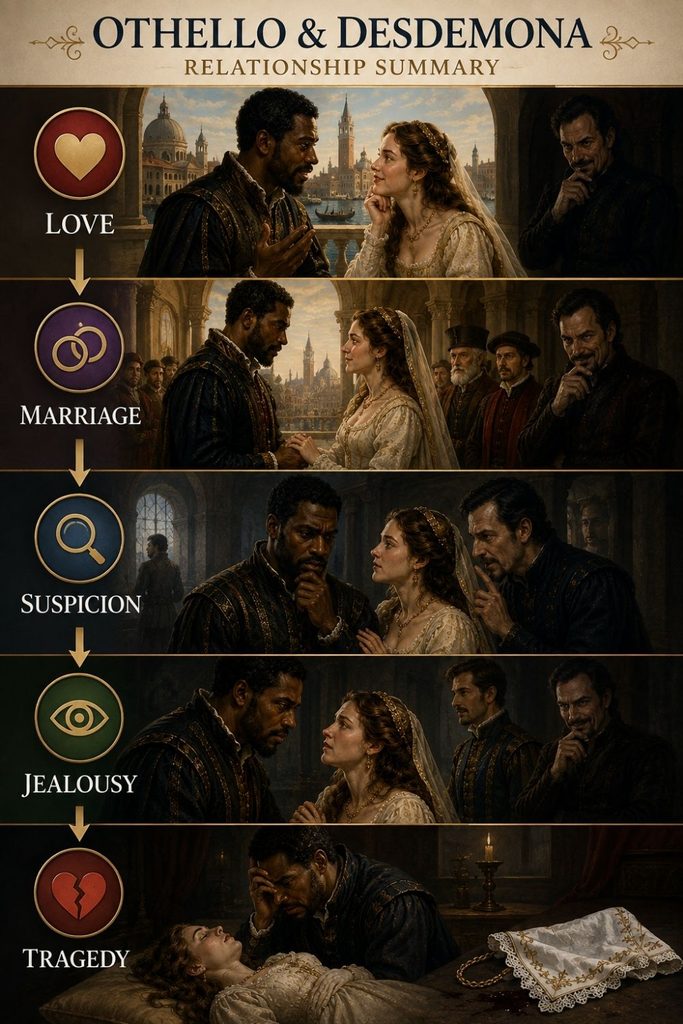
Othello and Desdemona Relationship: A Quick Summary
Othello and Desdemona fall in love through storytelling and sympathy. Desdemona listens to Othello’s accounts of travel, danger, and suffering, while he is moved by her compassion. She chooses him despite her father’s opposition and publicly defends their marriage before the Venetian Senate.
Their happiness changes after they arrive in Cyprus. Iago recognizes Othello’s vulnerability and begins suggesting that Cassio may be more than a friend to Desdemona. Her innocent efforts to help Cassio gradually acquire a different meaning in Othello’s mind.
The relationship finally collapses when Othello trusts suspicion more than his knowledge of Desdemona’s character.
How Did Othello and Desdemona Fall in Love?
Desdemona falls in love with Othello through the stories he tells about his life. Their relationship grows through conversation, sympathy, emotional connection, and trust. Othello describes the dangers and hardships he has experienced, and Desdemona listens with deep interest. He later explains their courtship:
“She loved me for the dangers I had passed.”
Desdemona is not simply fascinated by the image of a heroic soldier. She responds to the experiences behind that image and develops sympathy for the man who endured them. Othello, in turn, values the compassion she offers him.
Through these exchanges, Desdemona comes to know Othello beyond his public identity. This helps explain how Othello won Desdemona’s love. Their connection begins with emotional openness and mutual understanding rather than a conventional courtship arranged by their families.
Why Is Othello and Desdemona’s Marriage Important?
Their marriage challenges the racial, social, and family expectations of Venetian society. Desdemona does not passively accept a husband chosen for her. She chooses Othello herself and defends that choice before the Senate.
Her decision gives the marriage a strong sense of personal agency. Yet their union exists within a patriarchal society in which Othello has considerable authority as a military leader, while Desdemona must explain and defend her decision to marry him.
Their interracial marriage also exposes the prejudice surrounding Othello’s identity as a Moor. Brabantio’s reaction shows that their union is not viewed as an ordinary marriage.
Their relationship therefore brings together people separated by racial and social boundaries. Desdemona’s choice initially seems strong enough to withstand those pressures. Later, however, Othello’s authority begins to shape how he judges his wife.
How Does Othello and Desdemona’s Relationship Change?
The most important change occurs in Othello’s way of interpreting Desdemona.
Early in the play, Othello trusts her completely. His confidence appears in the words:
“My life upon her faith.”
He knows Desdemona through experience, so her actions are initially understood within the context of their marriage.
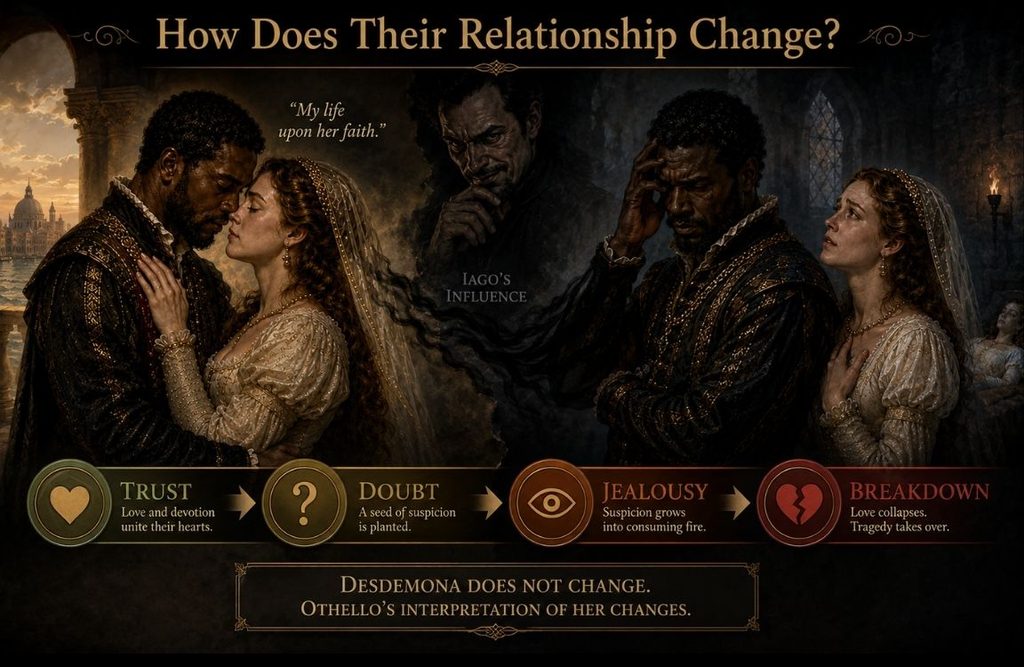
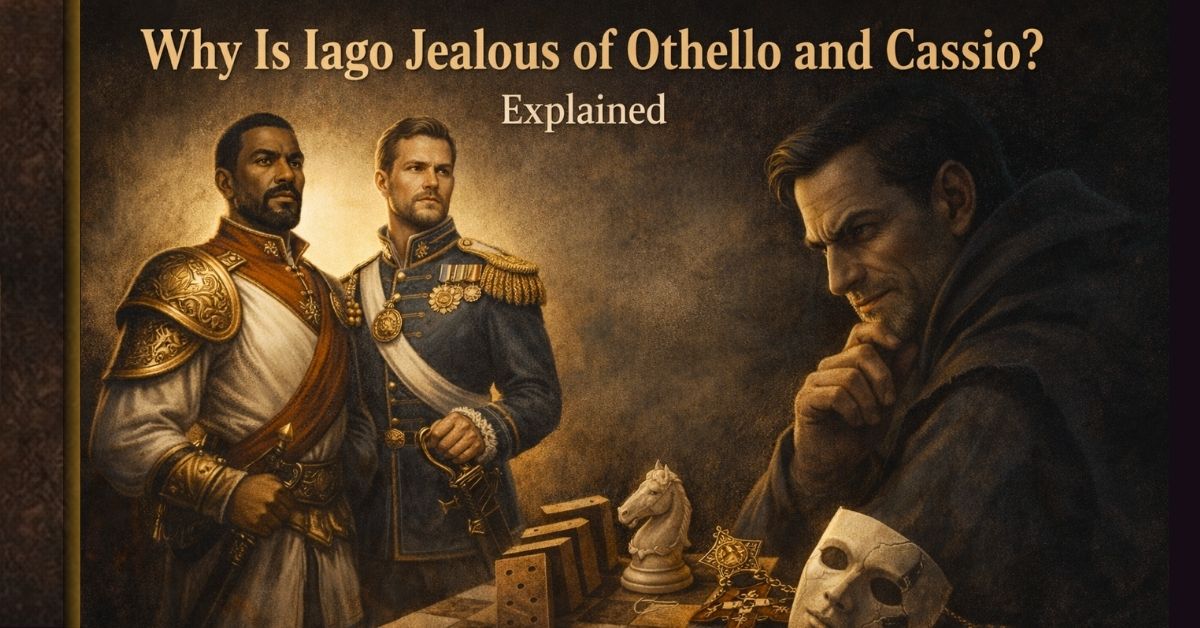
Iago gradually disrupts that confidence. Once Cassio becomes a possible rival, Desdemona’s concern for him no longer appears harmless to Othello. A request to restore Cassio’s position can suddenly look like evidence of secret affection.
When I teach this relationship, I emphasize one crucial point: Othello does not discover a new Desdemona. He begins to interpret the same Desdemona differently.
His certainty gradually gives way to doubt. Eventually, he demands proof for suspicions that he once would have dismissed and treats misleading signs as confirmation of betrayal.
Desdemona remains innocent throughout this process. The dramatic change happens inside Othello’s mind, making the tragedy all the more painful.
How Does Iago Destroy Their Relationship?
Iago’s method of manipulation is gradual. He does not simply tell Othello that Desdemona is unfaithful and expect him to believe it. Instead, he uses hints, questions, and carefully chosen suggestions about Cassio.
His warning,
“O, beware, my lord, of jealousy!”
sounds like friendly advice while actually encouraging the emotion he claims to fear.
Iago understands that Othello wants certainty. Rather than giving him reliable evidence, he teaches Othello to search for signs. Once that happens, ordinary events can be made to look suspicious.
Yet Iago does not create Othello’s vulnerability from nothing. He recognizes existing fears and exploits them. Iago supplies the story, but Othello eventually gives that story more authority than Desdemona’s own words.
The marriage begins to collapse when Othello stops judging Desdemona from his own experience and starts judging her through Iago’s interpretation. Learn more from my tutorial below:
What Does the Handkerchief Symbolize in Their Relationship?
The handkerchief becomes powerful because its meaning changes along with Othello’s understanding of his marriage.
At first, it is associated with love and marital intimacy. Later, it becomes connected to Othello’s fears about Desdemona’s fidelity. Iago exploits that change by turning the handkerchief into supposed evidence.
When Othello demands “ocular proof,” he wants something visible to settle his doubts. But the handkerchief cannot prove that Desdemona has been unfaithful. Its meaning comes from the story Othello has already accepted.
An object related to love is therefore transformed into evidence of betrayal.
Othello ultimately gives greater weight to the handkerchief and Iago’s interpretation than to Desdemona’s own testimony. The object has not changed. Its meaning has changed in Othello’s mind.
For a deeper understanding of the handkerchief’s role, you can watch my tutorial below:
Is Othello and Desdemona’s Love Genuine?
Yes. The play gives strong evidence that their love is genuine.
Desdemona chooses Othello despite her father’s objections, defends their marriage publicly, and remains emotionally committed to him even after his behavior becomes cruel. Othello also speaks of their relationship with genuine affection before jealousy takes control.
But their love is not equally secure throughout the play. Desdemona’s commitment remains remarkably consistent, while Othello’s love becomes entangled with fear, honor, possession, and anxiety about sexual betrayal.
Their marriage does not collapse because love was absent. It collapses because Othello allows suspicion to reshape the meaning of that love. He eventually accepts Iago’s version of Desdemona over his own experience of the woman he married.
Desdemona and Othello Relationship Quotes
These quotations trace important stages in their relationship:
- “She loved me for the dangers I had passed.” — Othello explains how Desdemona became drawn to his stories and experiences.
- “My life upon her faith.” — Othello expresses his early confidence in Desdemona’s loyalty.
- “O, beware, my lord, of jealousy!” — Iago disguises manipulation as concern and begins feeding Othello’s suspicion.
- “I saw Othello’s visage in his mind.” — Desdemona explains that she responded to Othello’s character and the story of his life.
Together, these quotations trace their movement from intimacy and trust to suspicion and tragedy.
FAQs:
Did Desdemona cheat on Othello?
No. Desdemona never has an affair with Cassio. Iago creates the appearance of infidelity by turning innocent events into misleading evidence.
Why does Othello stop trusting Desdemona?
Iago gradually feeds Othello’s insecurity with suggestions about Cassio. As suspicion grows, Othello interprets Desdemona’s innocent actions as signs of betrayal.
Why does Desdemona continue loving Othello after he turns against her?
Desdemona’s feelings do not disappear when Othello’s attitude changes. She remains loyal to the husband she chose and struggles to understand his hostility toward her.
Why does Desdemona try to help Cassio?
Desdemona believes Cassio has been treated unfairly and wants Othello to restore him to his position. Her efforts are innocent, but Iago makes them appear suspicious.
What role does Cassio play in their relationship?
Cassio becomes the imagined rival in Othello’s mind. Iago uses Desdemona’s efforts on Cassio’s behalf as supposed evidence of an affair, transforming ordinary friendship into suspicion.
Conclusion:
The Othello and Desdemona relationship is tragic because genuine love is gradually undermined by a failure of trust. Othello begins the play knowing Desdemona through personal experience, but Iago persuades him to interpret her through suspicion instead.
The handkerchief gives that suspicion a false appearance of certainty. Yet Desdemona never becomes the unfaithful woman Othello imagines her to be. The tragedy of Othello lies in the widening gap between who she is and who Othello believes she is.
Iago creates the deception, but Othello ultimately chooses to trust his version of events over his own knowledge of his wife.
The point I want students to remember is simple: jealousy does not always change the person we love. Sometimes, it changes the way we see that person. That is what makes Othello and Desdemona’s story so devastating.