Moments before Desdemona dies, she still loves the man preparing to kill her. Shakespeare turns love into tragedy through jealousy and deception. Every year when I teach this scene, the classroom suddenly grows quiet because students realize something painful: Desdemona is innocent, but innocence alone cannot stop disaster.
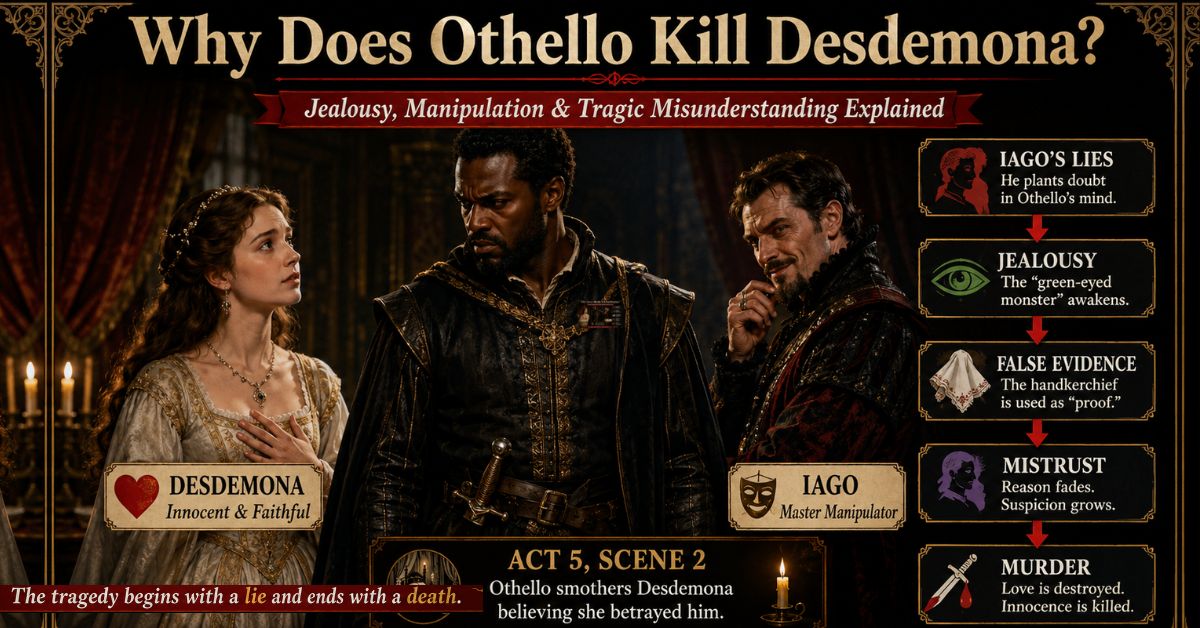
The quick answer to why does Othello kill Desdemona is this: Othello mistakenly believes Desdemona has betrayed him with Cassio after Iago carefully poisons his mind with lies, manipulation, and false evidence.
So, how does Othello kill Desdemona? In Act 5, Scene 2, he smothers her in their bedroom, believing he is delivering justice rather than committing murder.
That is the cruel tragedy behind his fatal decision. Shakespeare presents a respected and honorable man acting on a false belief. By the time Othello decides to kill Desdemona, he has accepted suspicion as truth and lost the ability to judge her fairly.
Why Does Othello Kill Desdemona?
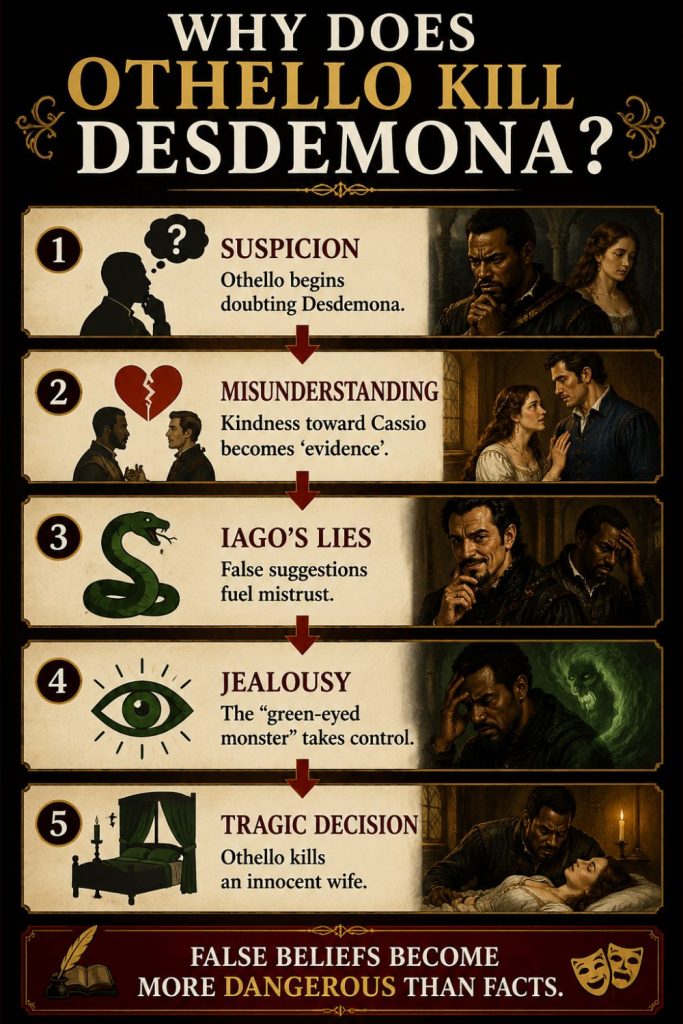
To understand why Othello commits this terrible act, my suggestion to my students is to look beyond the murder itself. Shakespeare slowly builds the downfall through suspicion, misunderstanding, and emotional weakness, showing how false beliefs and unchecked jealousy can turn deep love into devastating destruction.
i) Othello Believes Desdemona Betrayed Him
What drives Othello toward murdering the woman he loves? The answer begins with a lie disguised as truth. Othello becomes convinced that Desdemona secretly loves Cassio and has betrayed their marriage.
While discussing this scene in class, I often ask a simple question: Does Desdemona ever give Othello real evidence of betrayal? The answer is always the same. No.
Does Desdemona cheat on Othello? Absolutely not.
Yet the play shows how easily assumptions can replace evidence. Othello misreads innocent actions and sees guilt where none exists. When Desdemona innocently pleads for Cassio’s reinstatement, Othello begins treating her kindness as a hidden desire rather than compassion.
His growing suspicion appears in the painful question, “Was this fair paper, this most goodly book, / Made to write ‘whore’ upon?” He stops judging events rationally and begins interpreting everything through mistrust.
ii) Jealousy Becomes Othello’s Fatal Flaw
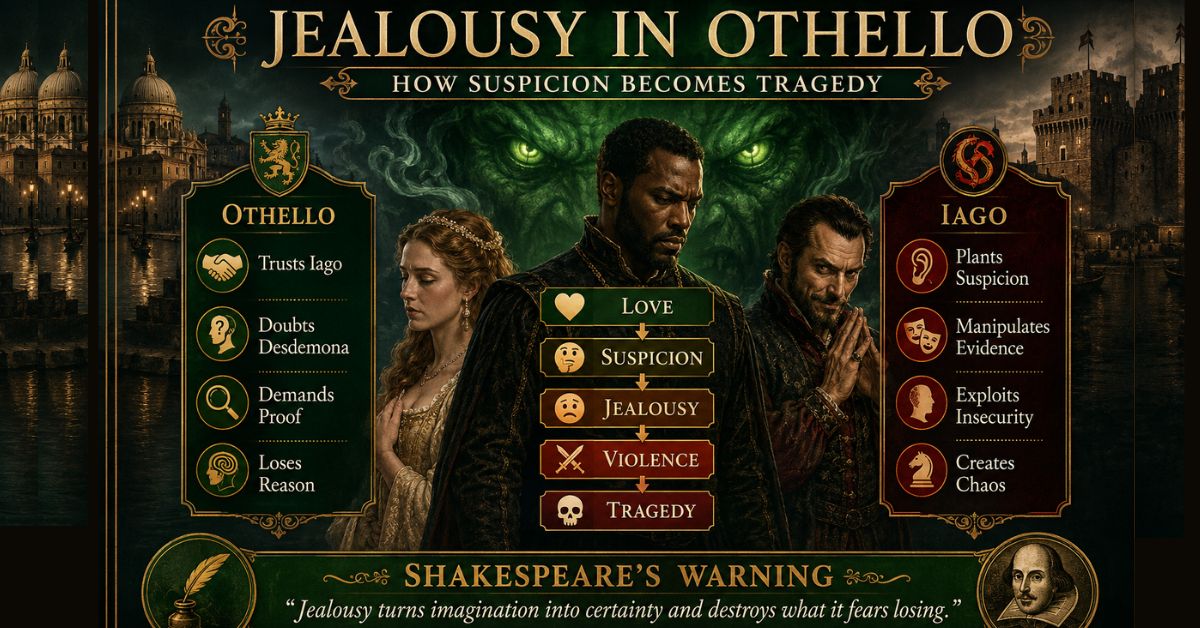
Shakespeare presents jealousy in Othello as a force that develops gradually. Iago himself calls it the “green-eyed monster,” and the image remains powerful because jealousy grows long before its consequences become visible.
Othello’s tragic flaw is his inability to control suspicion once it takes hold of his mind.
What makes jealousy so dangerous in this play is not simply its intensity but its ability to reshape perception. Facts that once seemed harmless begin to look suspicious. Reasonable explanations no longer satisfy him.
As Othello’s emotions grow stronger, his judgment weakens. He no longer evaluates evidence carefully and begins treating doubt as truth. By this stage, he is no longer asking whether something is true. He is searching for confirmation of what he already fears.
How Does Iago Manipulate Othello Into Killing Desdemona?
Before the murder happens, Shakespeare carefully stages a psychological trap. Iago never forces Othello to act. Instead, he shapes the way Othello thinks, proving how easily perception can be manipulated when trust goes unquestioned.
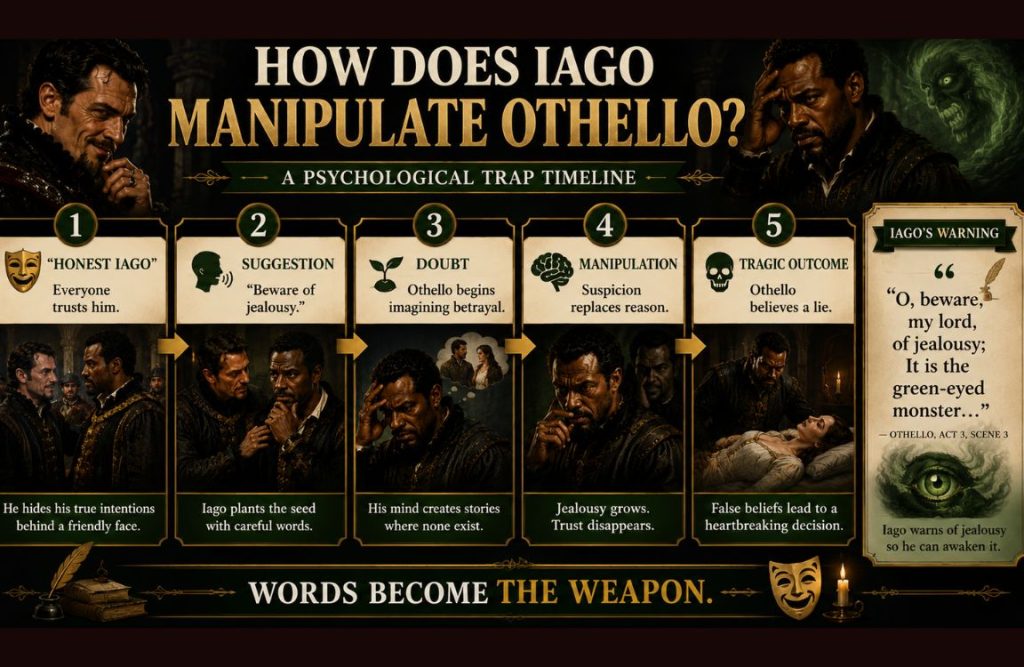
i) “Honest Iago” and Psychological Manipulation
One of Shakespeare’s cleverest tricks is making everyone call him “honest Iago.” Whenever I reach this part of the play, students immediately recognize the irony because Shakespeare makes Iago’s dishonesty obvious to the audience.
Yet the characters in Othello miss it completely. Iago rarely accuses Desdemona directly. Instead, he plants small suggestions and lets Othello’s imagination do the dangerous work. His psychological control works gradually, encouraging Othello to interpret uncertainty as proof.
A perfect example appears when Iago casually warns, “O, beware, my lord, of jealousy; / It is the green-eyed monster…” On the surface, the line sounds protective and sincere. In reality, Iago is carefully planting jealousy inside Othello while pretending to caution him against it. The manipulation succeeds because it sounds like friendly advice rather than an accusation.
Why Othello trusts Iago becomes a fascinating question because that trust prevents him from questioning Iago’s motives. Othello respects Iago as a loyal companion, which makes the deception far more effective.
ii) The Handkerchief Becomes False Evidence
Among Shakespeare’s most famous props sits a surprisingly ordinary object: a handkerchief. Students sometimes expect a sword, a crown, or something grand and dramatic. Instead, Shakespeare chooses fabric. That choice matters.
The handkerchief symbolism in Othello transforms it into a symbol of love, trust, and marital loyalty between Othello and Desdemona. After it falls into the wrong hands, its meaning changes completely in Othello’s mind.
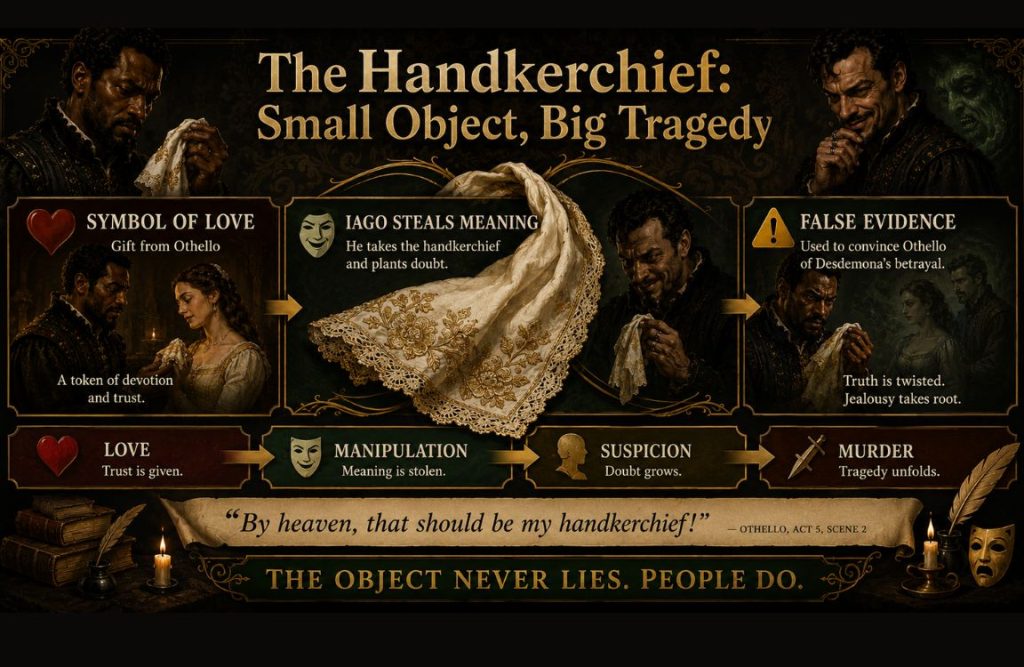
A crucial moment arrives when Othello demands to see the handkerchief, and Desdemona cannot produce it. Her confusion becomes suspicious in Othello’s eyes because Iago has already poisoned the meaning of the object.
Later, Othello declares, “By heaven, that should be my handkerchief!” as though the object alone can prove betrayal.
This is where appearance vs reality in Othello suddenly takes center stage. The handkerchief becomes fake proof supporting a false story. Othello stops asking whether evidence is reliable and starts treating it like absolute truth.
What fascinates me is how little the object actually proves. The handkerchief never speaks for itself. Meaning is imposed upon it, and that imposed meaning becomes deadly.
How Does Othello Kill Desdemona in Act 5, Scene 2?
Act 5, Scene 2, marks the tragic climax of the play as Othello smothers Desdemona while believing Iago’s lies. Silence and dramatic irony intensify the scene because readers already know Desdemona is completely innocent.
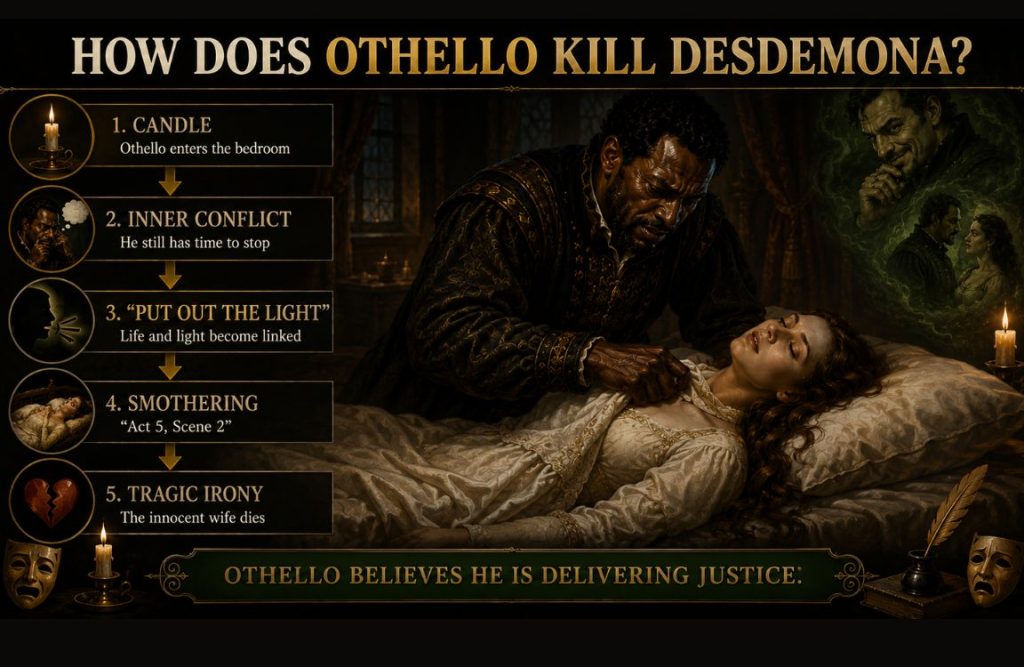
i) Othello Enters with the Candle
In Othello Act 5 Scene 2, Shakespeare creates a haunting image before any violence begins. Othello enters Desdemona’s bedroom carrying a candle and speaking through Othello’s soliloquy.
The scene feels intimate because Othello arrives quietly and deliberately. He is still thinking through his decision, which makes the moment more disturbing for the audience.
What strikes many readers, and also me, is that Shakespeare repeatedly slows the action down. Othello is given opportunities to hesitate, reflect, and reconsider. Yet he continues moving toward the choice that will destroy him.
ii) “Put out the light” Symbolism
“Put out the light, and then put out the light” becomes one of Shakespeare’s most chilling lines. The first light refers to the candle in Othello’s hand, while the second symbolizes Desdemona’s life itself.
Light imagery usually suggests hope, reality, and life. Here, Shakespeare twists that expectation.
The line is unsettling because Othello speaks with calm certainty. He treats the murder as a necessary act, even though the audience already knows he is tragically mistaken.
ii) Othello Smothers Desdemona
One disturbing question dominates the final scene: how is Desdemona murdered? She is smothered by Othello with a pillow in her bed during Act 5, Scene 2.
Othello believes he is punishing betrayal, though his wife remains completely faithful.
The scene becomes even more heartbreaking because Desdemona’s final words carry loyalty rather than anger. She pleads for life and still refuses to condemn the man hurting her. Students are often struck by her compassion, especially when they realize she remains devoted to Othello even in her final moments.
The tragedy reaches its peak here. The woman Othello believes deserves punishment is actually the person who has been loyal to him throughout the play.
Who Is Really Responsible for Desdemona’s Death?
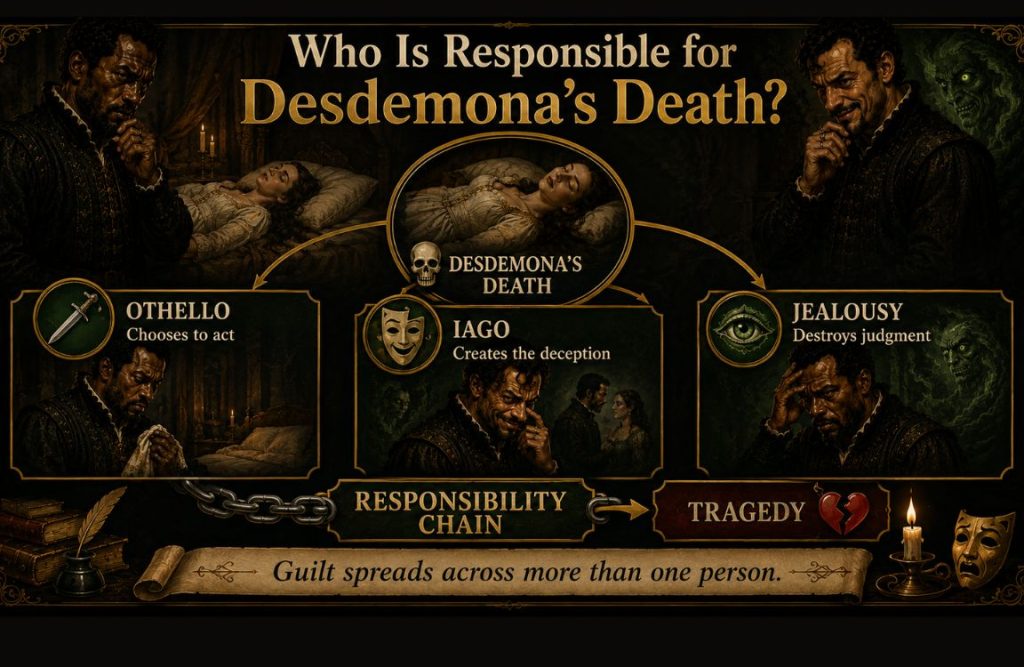
To answer this question, I encourage students to resist looking for a single person to blame. Shakespeare presents the tragedy as the result of several interconnected choices. Deception matters, but so do trust, judgment, and personal responsibility.
i) Othello’s Personal Responsibility
Students often ask, “Who killed Desdemona?” The direct answer is Othello. His hands carry out the act, and Shakespeare never allows him to escape personal responsibility.
This often leads to an important discussion in class. Although Othello is manipulated, manipulation does not remove accountability. He receives false information, but he still chooses to believe it and act upon it.
Even before the murder, his language darkens when he declares, “I’ll tear her all to pieces!” revealing how completely suspicion has overtaken reason.
One way to understand Shakespeare’s point is to separate influence from decision-making. Iago influences Othello, but Othello makes the final judgments for himself.
Shakespeare refuses to excuse Othello completely because tragedy grows when human beings surrender judgment and hand responsibility to emotion instead.
ii) Iago as the Hidden Murderer
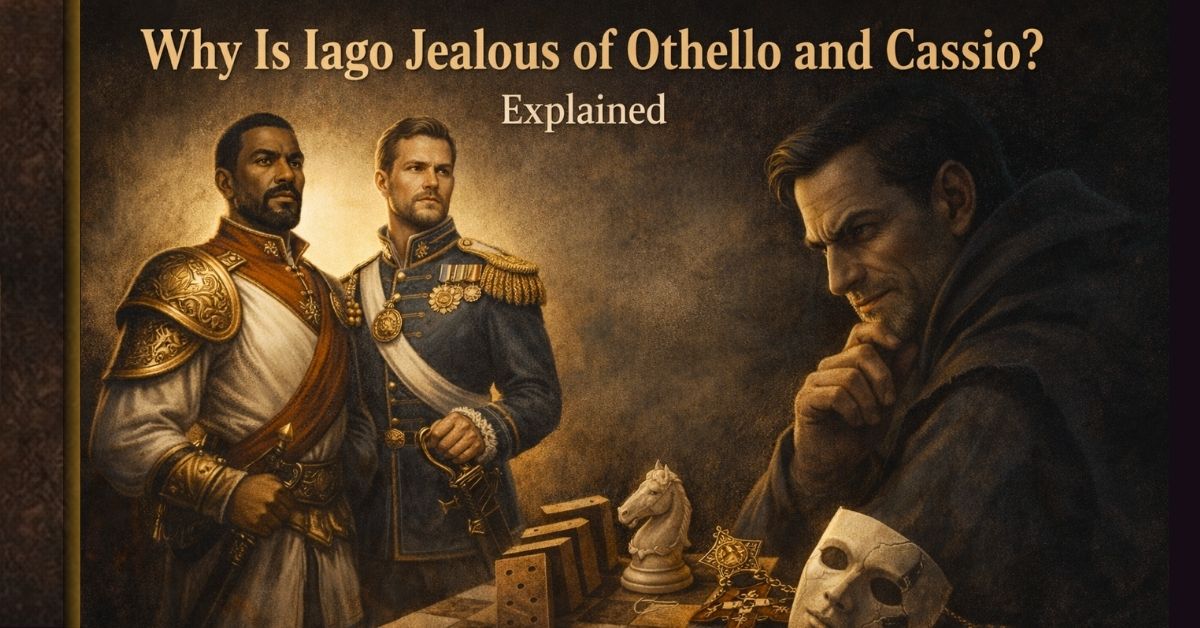
Who is responsible for Desdemona’s death? At the same time, it would be impossible to ignore Iago’s role in the tragedy. While Othello commits the murder, Iago carefully creates the circumstances that make it possible.
He never places a weapon against Desdemona directly, yet his manipulation creates the conditions for destruction. His chilling declaration, “I am not what I am,” quietly announces the dangerous gap between appearance and reality that drives the entire tragedy.
When discussing this character, I often point out that Iago rarely relies on direct lies alone. His real skill lies in suggestion. He knows how to exploit insecurity, encourage suspicion, and make others draw the conclusions he wants them to reach.
That is what makes him such a disturbing villain. He damages lives largely through conversation and manipulation rather than physical force.
The catastrophe of Othello reminds us that psychological control can create consequences far beyond words, especially when people stop questioning the stories they are being told.
iii) Shakespeare’s Larger Message
The tragedy in Othello reaches beyond one marriage or one murder. Shakespeare explores how trust, jealousy, and deception interact with one another and gradually distort human judgment.
When trust is given without scrutiny, people become vulnerable to manipulation. When jealousy takes control, evidence often matters less than emotion. The warning echoes through Iago’s famous image of the “green-eyed monster,” a creature feeding upon the emotions it destroys.
During class discussions, students often notice something unsettling: nobody dies because of the truth. People suffer because of distorted truth.
Perhaps that is one reason the play remains so relevant. The greatest danger in Othello is not ignorance but misplaced certainty. Characters become convinced they know the truth when, in reality, they understand very little.
What Happens After Desdemona Dies?
After Desdemona dies, the hidden reality about Iago’s manipulation finally emerges. Shakespeare rapidly transforms silence into revelation as the characters recognize their tragic mistakes, but the emotional devastation deepens because innocence has already been permanently destroyed.
i) Emilia Reveals the Truth
Who told the truth about Iago? Emilia becomes the unexpected hero in the final act. She bravely exposes Iago’s deception and reveals the reality about the handkerchief.
Students are often surprised by Emilia’s importance in the ending because she spends much of the play in the background. Yet when the truth finally emerges, she becomes one of the most courageous characters on the stage.
Her courage becomes even more striking when she openly defies her own husband, crying, “You told a lie, an odious, damned lie.” In that instant, Emilia chooses conscience over fear, even though the decision places her in terrible danger.
Her actions remind us that honesty can require tremendous courage, especially when telling the truth comes at a personal cost.
ii) Othello Realizes His Mistake
The end of Othello becomes devastating because understanding arrives too late. Othello suddenly sees reality with painful clarity and realizes Desdemona never betrayed him.
For much of the play, he interprets events through suspicion. In the final act, that suspicion collapses, and he is forced to confront what he has actually done.
One heartbreaking moment comes when he looks upon Desdemona after learning the truth and finally understands the innocence he destroyed with his own hands. His grief erupts in the anguished cry, “O fool! fool! Fool!”, a brief line carrying the full weight of horror and self-condemnation.
The tragedy becomes especially painful because the truth arrives at the exact moment when it can no longer change the outcome.
iii) Why Does Othello Kill Himself?
Othello kills himself because guilt crashes into him with full force after he realizes he destroyed the person who loved him most deeply. His final speech becomes an attempt to explain himself and reclaim some dignity before death.
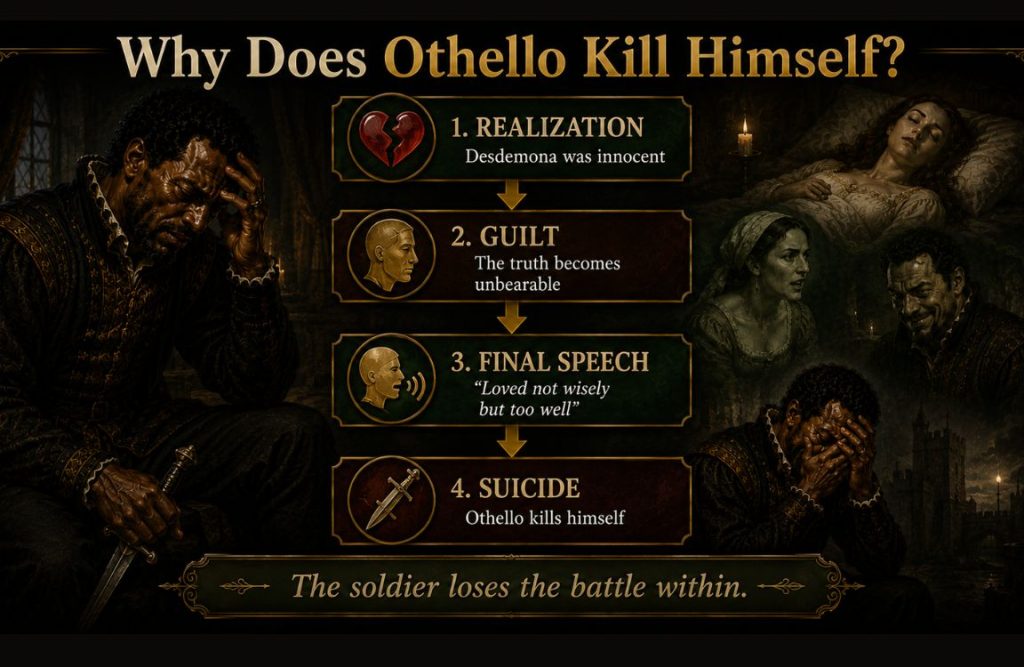
Reflecting on his downfall, he pleads to be remembered as one who “loved not wisely but too well,” a line that reveals both self-awareness and lingering tragedy.
Readers often debate whether this speech is an apology, a justification, or a mixture of both. What is clear is that Othello finally recognizes the consequences of his actions.
His death brings the story to an end, but it does not erase the damage that has been done. Shakespeare leaves the audience with the consequences of jealousy, misplaced trust, and irreversible choices.
FAQs:
Why does Desdemona forgive Othello before she dies?
Desdemona forgives Othello because her love remains loyal despite his violence. Shakespeare highlights her compassion and innocence through her final actions, making her death more tragic while exposing Othello’s devastating misunderstanding and misplaced jealousy.
What does “Put out the light” symbolize in Othello?
“Put out the light” symbolizes both extinguishing a candle and ending Desdemona’s life. Shakespeare connects light with truth, innocence, and life, making Othello’s calm words deeply haunting as he prepares to commit irreversible violence.
Is Desdemona actually unfaithful in Othello?
No, Desdemona remains completely faithful throughout Othello. She never betrays her husband or loves Cassio romantically. Shakespeare builds the tragedy around false suspicion, showing how manipulation and obsession can transform innocence into imagined guilt.
Why does Shakespeare make Iago stay alive at the end?
Shakespeare leaves Iago alive to deny him an easy escape through death. His silence and punishment create an unsettling ending, suggesting that evil cannot always be neatly resolved or emotionally satisfied through simple justice.
How does Othello fit Aristotle’s tragic hero model?
Othello fits Aristotle’s tragic hero model because he is noble yet destroyed by a fatal flaw. His courage and leadership inspire admiration, while jealousy and misplaced trust lead to tragedy, creating Aristotle’s emotions of pity and fear.
Conclusion:
Desdemona dies because Othello stops trusting love and starts trusting suspicion. That single shift destroys everything. Othello murders Desdemona because jealousy overwhelms his judgment, and false appearances replace reality.
How does Othello carry out the act? He smothers her while believing he is defending justice, though he is actually serving deception. The tragedy emerges because of how easily lies can wear the truth’s face.
I often remind students that villains do not always arrive carrying swords. Sometimes they arrive carrying whispers. The most dangerous battles in literature happen inside the mind long before they happen on the stage.