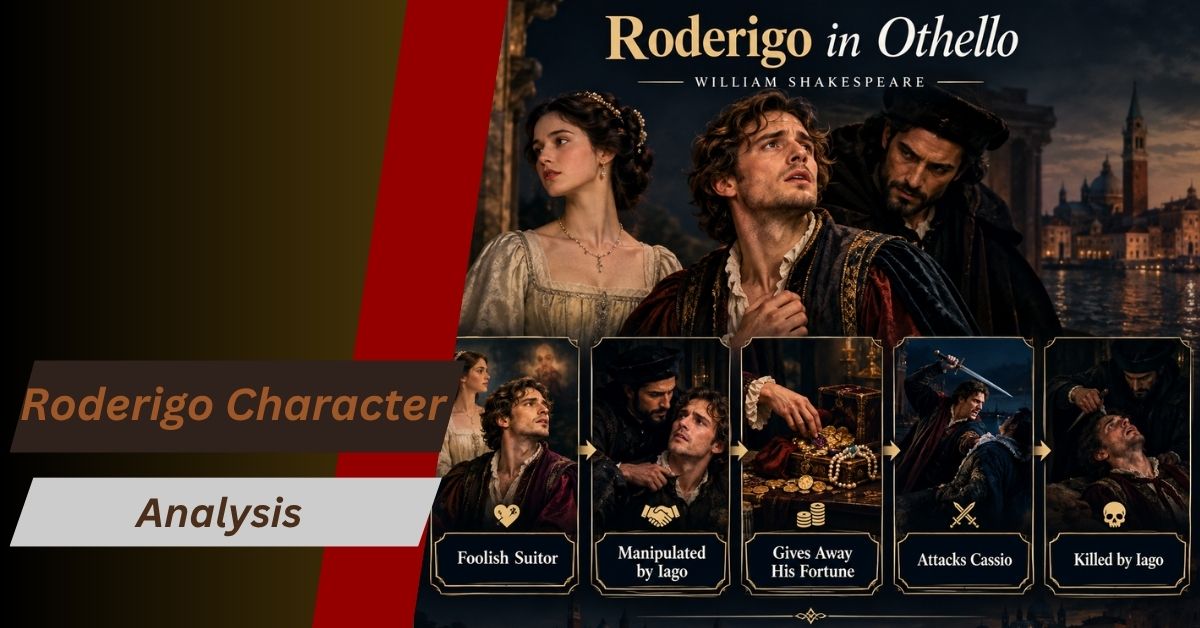
Roderigo in Othello is often remembered as a foolish and easily manipulated suitor, but Shakespeare gives him a more important role than that label suggests. He is a wealthy Venetian gentleman who desperately wants Desdemona and cannot accept her marriage to Othello. His desire makes him an easy target for Iago.
Roderigo spends his fortune, follows Iago’s advice, and eventually takes part in a violent plot against Cassio. Through him, Shakespeare explores how desire and misplaced trust can damage judgment. He is both a participant in the tragedy and one of its victims.
Who Is Roderigo in Othello?
Roderigo is a wealthy Venetian gentleman who is obsessed with Desdemona. When she secretly marries Othello, he becomes desperate to win her back. Instead of accepting her decision, he turns to Iago for help.
Iago quickly recognizes an opportunity. He encourages Roderigo to believe that Desdemona may eventually leave Othello while taking money and jewels from him. Roderigo continues to trust him even when his promises repeatedly fail.
His frustration eventually becomes part of Iago’s larger plot. In Act 5, Iago persuades him to attack Cassio. Cassio wounds Roderigo, and Iago later kills him to prevent him from exposing their dealings.
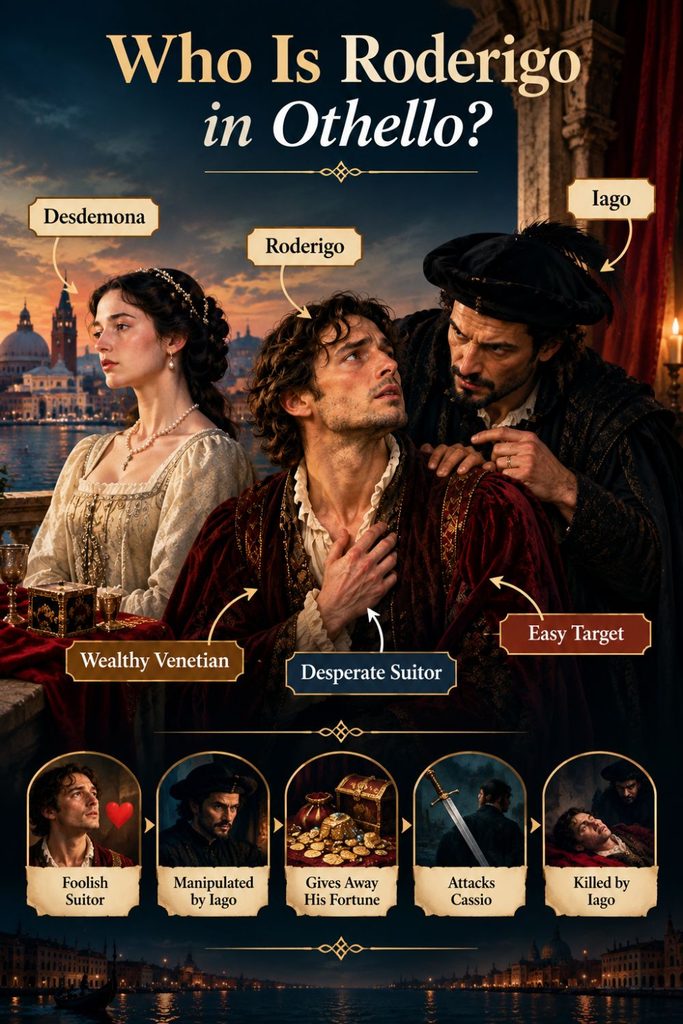
Table of Contents
Roderigo’s Character Traits in Othello
Roderigo is foolish, but Shakespeare gives reasons for his foolishness. His main weaknesses are gullibility, obsession, and dependence on Iago.
i) Gullible
Roderigo repeatedly believes Iago’s promises, even when events give him reasons to doubt them. His hope of winning Desdemona prevents him from recognizing that he is being used.
ii) Obsessive
His desire for Desdemona controls much of his behavior. He refuses to accept her marriage to Othello and continues pursuing her despite having no genuine relationship with her.
iii) Dependent
Roderigo allows Iago to interpret events for him. Instead of making independent judgments, he repeatedly relies on Iago to tell him what to believe and what to do.
iv) Impulsive
His emotions quickly turn into action. Early in the play, he threatens to drown himself because of Desdemona. Later, Iago persuades him to take up his sword against Cassio.
When I teach Roderigo, I tell students not to stop at the word “foolish.” The more useful question is why he behaves foolishly. His obsession, dependence, and inability to judge Iago independently explain his actions.
For an exam answer, gullible, obsessive, and dependent are useful choices.
Roderigo’s Role and Significance in Othello
Roderigo is more than a comic fool or rejected lover. He helps Iago move important parts of the plot forward.
First, his money becomes a resource for Iago. Roderigo repeatedly gives him money and jewels because he believes they will help him win Desdemona.
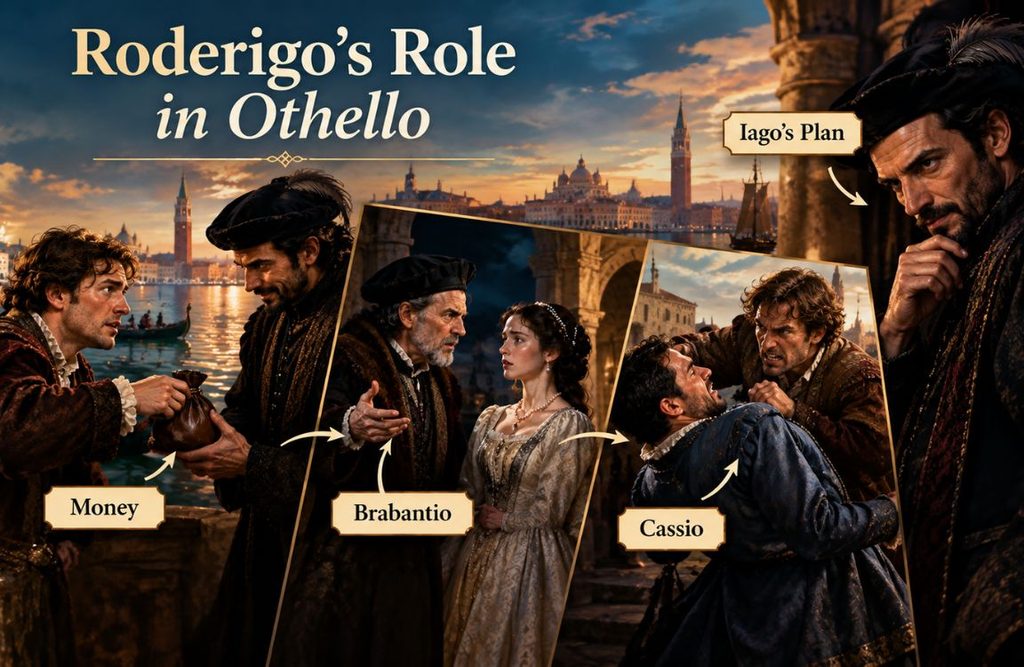
Second, Roderigo helps bring Brabantio into the conflict surrounding Desdemona’s secret marriage. His anger and knowledge of the marriage give Iago another way to disturb the situation.
Third, Roderigo becomes an instrument in Iago’s attack on Cassio. He attacks Cassio in Act 5, is wounded, and is later killed by Iago.
Roderigo also provides an interesting contrast with Othello. Both men are manipulated by Iago, but their weaknesses differ. Roderigo is controlled by his attachment to Desdemona, while Othello is gradually poisoned by suspicion and insecurity.
In this sense, Roderigo gives the audience an early glimpse of Iago’s method: he finds a weakness, encourages it, and turns it into action.
How Does Iago Manipulate Roderigo?
Iago’s relationship with Roderigo is based on exploitation. He understands that Roderigo desperately wants Desdemona and uses that desire to control him.
Roderigo has exactly what Iago needs: money and a strong emotional attachment to Desdemona, along with resentment toward Othello and a willingness to act. Iago therefore turns his victim’s private desire into practical obedience.
Iago does not usually rely on one enormous lie. Instead, he keeps Roderigo hopeful. When one plan fails, he offers another explanation and another opportunity. Roderigo wants to believe that Desdemona may still become his, so he treats disappointment as a temporary setback rather than evidence of deception.
The pattern is clear:
Desire → Hope → Money → Disappointment → New Promise → Obedience
Roderigo finally begins to question Iago in Act 4. He complains that he has wasted his money and considers demanding his jewels back. Iago responds by offering another plan: attack Cassio.
In my reading of the play, this is one of Shakespeare’s clearest demonstrations of psychological manipulation. Iago does not create Roderigo’s desire. He discovers it, repeatedly feeds it, and eventually turns it into violence.
Roderigo, Desdemona, and Othello
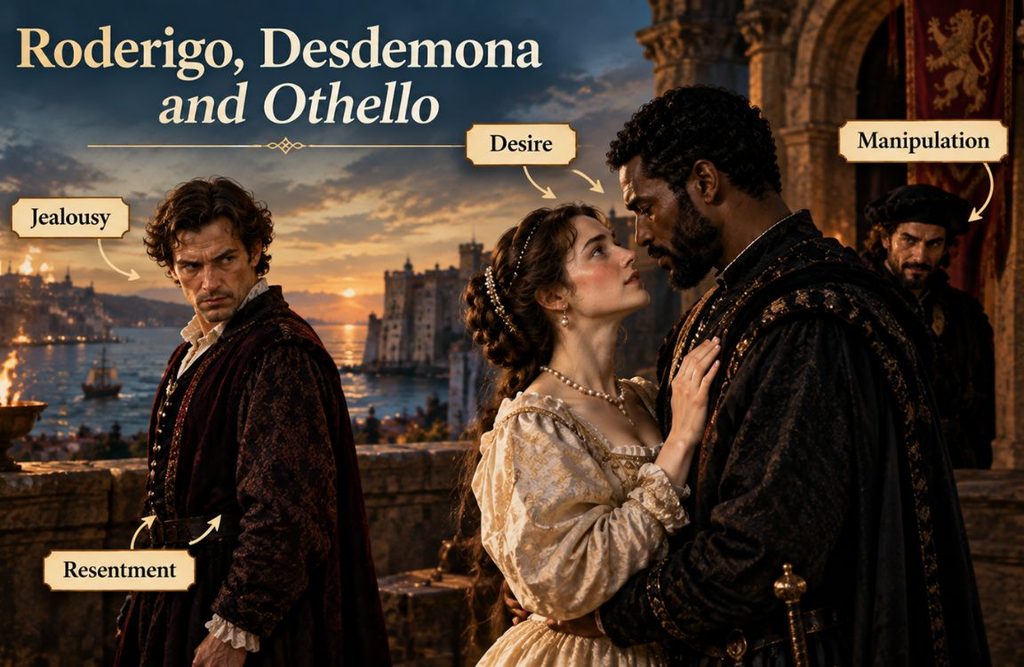
Roderigo believes he loves Desdemona, but his behavior is largely possessive. He wants her even after she has chosen Othello and cannot accept her decision.
Her rejection makes Othello appear to him as a rival who has taken away what he wants. Romantic frustration therefore develops into jealousy and hostility.
Race also influences Roderigo’s attitude toward Othello, but it should not be treated as his only motivation. His jealousy and resentment also shape his hostility.
The crucial point is that Roderigo does not examine his assumptions carefully. Iago gives him a simple story: Othello stands between Roderigo and Desdemona, so Othello must be removed.
Roderigo accepts that story because it agrees with what he already wants to believe.
How Does Roderigo Die in Othello?
Roderigo dies in Act 5, Scene 1, after Iago persuades him to attack Cassio.
Iago tells him that Cassio must be removed because Othello and Desdemona are preparing to leave Cyprus. Roderigo admits that he has little desire to commit the deed, but Iago gives him enough encouragement to act.
When Cassio appears, Roderigo attacks him, but Cassio wounds him. Later, when Roderigo calls for help, Iago approaches and secretly stabs him.
Before dying, Roderigo realizes the truth:
“O damned Iago! O inhuman dog!”
The line marks his final recognition of Iago’s betrayal. Unfortunately, his understanding comes too late.
Who Kills Roderigo?
Iago kills Roderigo. Cassio first wounds him during the attack, but Iago delivers the fatal blow to silence him and protect his scheme. He also wants to keep the gold and jewels he has taken from Roderigo.
Roderigo’s death completes the transformation from hopeful suitor into a disposable instrument of Iago’s plot.
Important Roderigo Quotes in Othello
| Roderigo quote | What it reveals |
| “That thou, Iago, who hast had my purse…” | His financial dependence on Iago |
| “I will incontinently drown myself.” | His emotional desperation |
| “I will sell all my land.” | His willingness to sacrifice his fortune |
| “I have no great devotion to the deed.” | His hesitation before violence |
| “I have wasted myself out of my means.” | The financial cost of his obsession |
| “O damned Iago! O inhuman dog!” | His final recognition of Iago’s betrayal |
These quotations trace Roderigo’s movement from desperate desire to financial sacrifice, doubt, violence, and finally recognition.
Is Roderigo a Villain?
Roderigo is not the principal villain in Othello. That role belongs to Iago.
However, Roderigo is not completely innocent. He agrees to attack Cassio and is willing to participate in a violent plan. His dependence on Iago does not remove his personal responsibility.
For this reason, Roderigo is best described as a manipulated accomplice who becomes a tragic victim. He makes morally wrong choices, but he lacks Iago’s deliberate control and long-term purpose.
His position between victim and accomplice makes him more interesting than the simple label of “fool” suggests.
FAQs:
Is Roderigo a tragic character?
Roderigo can be viewed as a tragic character in a limited sense, but he is not the tragic hero of Othello. His story follows a smaller arc from desire to error, recognition, and death.
Why does Roderigo give Iago his money?
Roderigo gives Iago money and jewels because he believes Iago can help him win Desdemona. His continued investment also makes it harder for him to admit that he has been deceived.
What does Roderigo represent in Othello?
Roderigo represents the danger of surrendering personal judgment to another person. His story shows how uncontrolled desire can make someone vulnerable to manipulation.
Is Roderigo racist in Othello?
Roderigo expresses racial prejudice toward Othello, but his hostility has more than one source. Jealousy and personal frustration also contribute to his hatred of Othello.
What is Roderigo’s relationship with Brabantio?
Roderigo knows Brabantio and joins Iago in revealing that Desdemona has secretly married Othello. Their connection is mainly linked to Roderigo’s desire for Desdemona and his attempt to disrupt her marriage.
Conclusion:
Roderigo in Othello is important because Shakespeare uses his story to show how uncontrolled desire can weaken personal judgment. His obsession with Desdemona leads him to surrender his money, trust Iago, and eventually participate in violence.
Yet Roderigo is more than a foolish suitor. He represents what can happen when a person allows someone else to shape his thoughts and actions. Iago exploits his desire until Roderigo becomes useful to the plot, and kills him when he becomes a threat.
His final recognition comes too late. By then, his fortune, freedom, and future are gone.