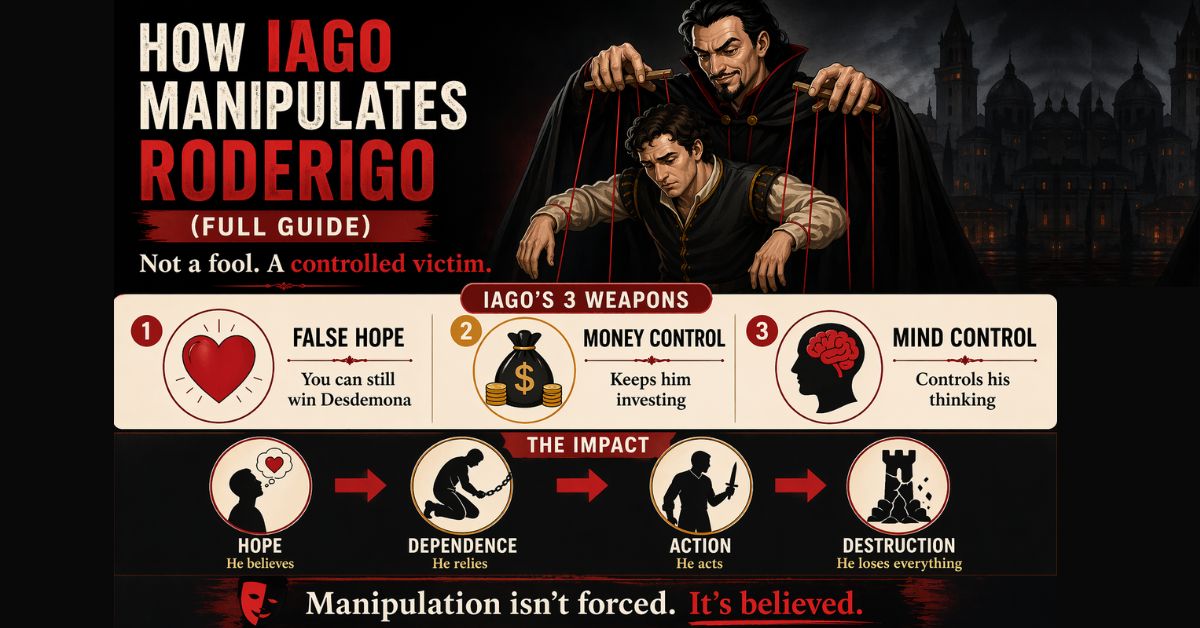
I often point out: Roderigo in Othello isn’t just a fool. He’s a carefully crafted victim. When we ask how does Iago manipulate Roderigo, the answer is unsettlingly simple: through false promises, emotional exploitation, and financial control.
Iago studies Roderigo’s deepest weakness, his obsession with Desdemona, and turns it into a leash. Repeatedly, he urges him, “Put money in thy purse,” draining his wealth while feeding him hope.
Here’s the twist I love pointing out in class: Roderigo believes he is making choices, taking action, pursuing love. But in reality, he is being quietly directed, almost like an actor following a script he cannot see.
That’s the genius of how Iago manipulates Roderigo. He doesn’t command. He convinces. And once Roderigo believes the illusion, he becomes not just a victim, but an instrument of Iago’s destructive design.
Table of Contents
What Is Iago and Roderigo Relationship?
When I explore the Iago and Rodrigo relationship with my students, I ask a simple question: Is this friendship, or is it a strategy? The answer, quite clearly, is the latter.
On the surface, Iago appears to be a loyal advisor, someone Roderigo trusts deeply as he pursues Desdemona. However, this trust is carefully engineered.
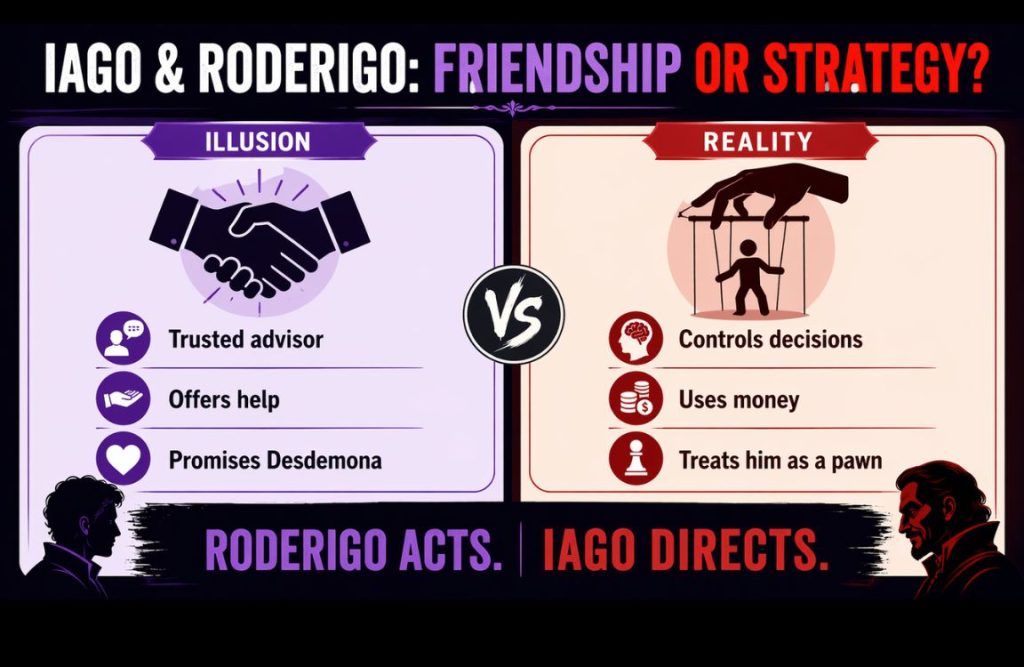
Iago studies Roderigo’s weaknesses, his jealousy, his desperation, and turns them into tools.
He repeatedly urges him to invest more money, exploiting him financially while promising false hope. Roderigo, blinded by love, becomes dependent, following Iago’s guidance without question.
What makes this relationship striking is its imbalance. Iago leads; Roderigo obeys. One controls, the other is controlled. Even their actions reveal this dynamic, whether stirring Brabantio or plotting against Cassio, Roderigo acts, but Iago directs.
Ultimately, Iago treats Roderigo not as a friend but as a disposable pawn. When he outlives his usefulness, Iago ensures his death, completing the cycle of exploitation.
Why Is Roderigo Easy to Manipulate?
When students ask me why Roderigo is easy to manipulate, I usually respond with a question of my own: What happens when desire becomes stronger than judgment? That is where Roderigo lives.
His obsession with Desdemona is not gentle admiration. It’s consuming. He measures every action, every decision, against the hope of winning her. And Iago knows this. He doesn’t need to invent a weakness. He simply amplifies what is already there.
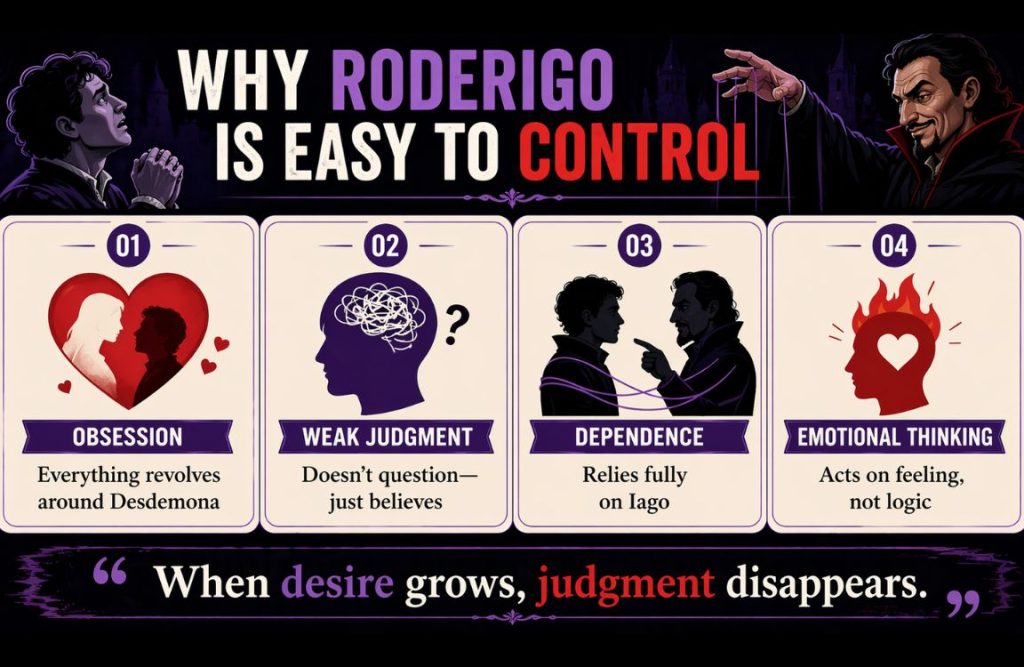
Roderigo’s emotional desperation makes him reactive rather than thoughtful. Instead of questioning Iago, he clings to him, hoping for direction. This reliance becomes the turning point. Iago becomes not just a guide, but the voice Roderigo trusts without doubt.
Another key factor is his lack of critical thinking. He rarely pauses to ask, “Is this true?” Instead, he asks, “Will this help me get Desdemona?” That shift blinds him completely, which is dangerous. Even when financially drained, he continues to trust Iago’s promises.
Iago also manipulates his insecurities, pushing him to prove himself through reckless action. In the end, Roderigo is easy to control because he is driven by emotion, limited in judgment, and increasingly reliant on Iago.
So, why does Roderigo trust Iago? Because Iago offers clarity in a moment of emotional confusion. And here’s the teaching point: when desire overrides judgment, manipulation becomes easy.
How Does Iago Manipulate Roderigo Step by Step?
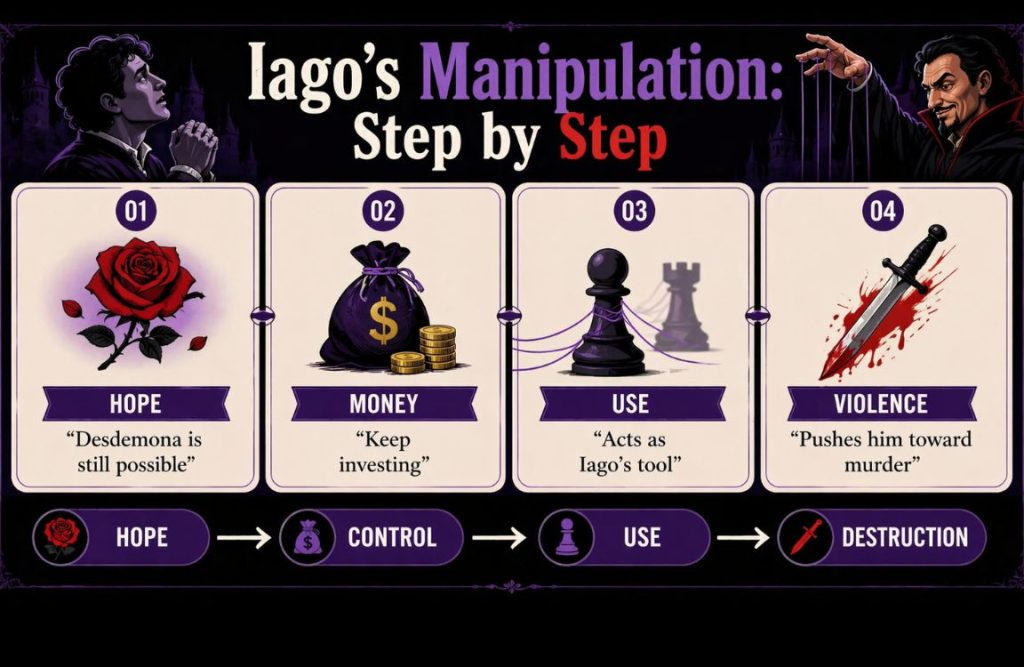
In this section, I’ll break down how does Iago manipulate Roderigo step by step, revealing the techniques Iago uses to manipulate Roderigo through false hope, financial control, strategic use, and ultimately, pushing him toward dangerous action.
Step 1: Promise Desdemona
I always tell my students: Iago begins with hope. He convinces Roderigo that Desdemona can still be won, even after her marriage. This promise is never realistic, but it is powerful.
Roderigo doesn’t need truth. He needs a possibility. Iago feeds that desire carefully, keeping it alive just enough to control him. This false hope becomes the foundation of everything that follows, anchoring Roderigo’s trust in illusion rather than reality.
Step 2: Control Through Money
Then comes the most practical form of manipulation, money. Iago repeatedly insists, “Put money in thy purse,” turning Roderigo into a financial resource. I often describe this as an emotional investment becoming a literal investment.
Roderigo believes he is funding his future happiness, but in reality, he is funding Iago’s schemes. This financial control deepens dependency. The more Roderigo spends, the harder it becomes for him to walk away from the illusion.
Step 3: Use Roderigo as a Pawn
Once trust and dependency are secured, Iago begins to use Roderigo actively. In the Brabantio scene, he provokes chaos, using Roderigo as a voice while staying hidden.
Later, in Cyprus, he positions Roderigo within the plot against Cassio, causing chaos that leads to Cassio’s disgrace. Iago prefers indirect control, working through others rather than acting himself.
Roderigo becomes a convenient instrument, visible, expendable, and entirely controlled by someone else’s design.
Step 4: Push Toward Violence
Finally, Iago escalates the manipulation by pushing Roderigo toward violence. He convinces him that killing Cassio is the only path to Desdemona.
Notice the shift. Hope turns into desperation. Iago narrows Roderigo’s choices until violence seems logical. This is the final stage of manipulation: when the victim not only obeys, but believes the action is necessary.
How Does Iago Manipulate Roderigo in Act 1?
In Act 1 of Othello, Iago manipulates Roderigo by exploiting his love for Desdemona, using racist imagery to provoke Brabantio, and convincing Roderigo to fund his schemes, what I often call the “recruitment phase” of manipulation.
Let me tell you how I explain this in class: Act 1 is where Iago “recruits his investor.” And yes, poor Roderigo is both emotionally exposed and financially useful.
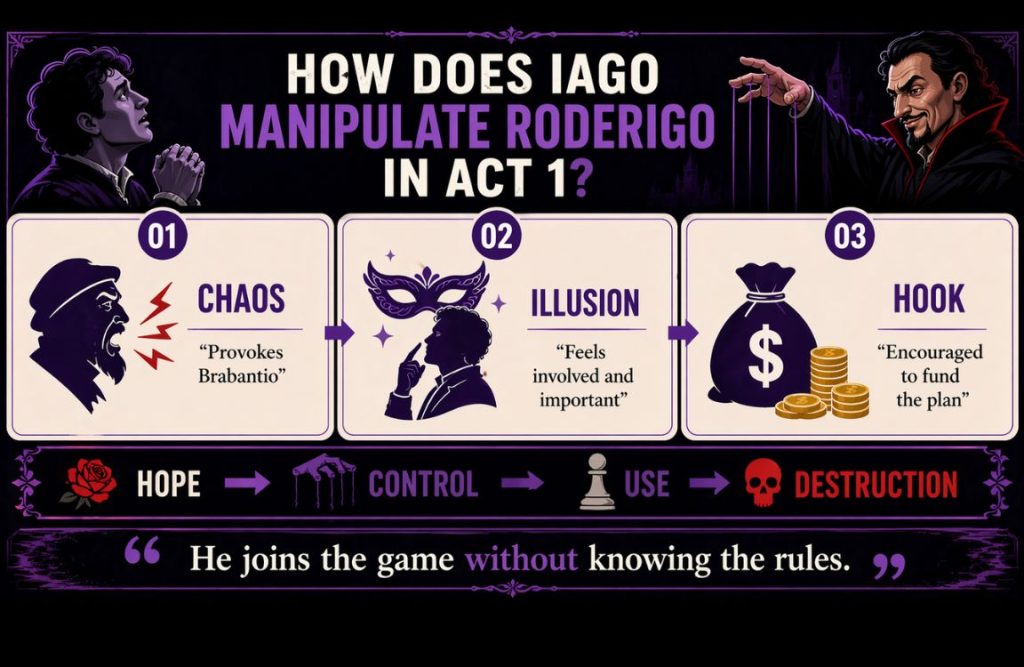
Iago begins by stirring chaos, waking Brabantio with shocking, animalistic, racist imagery about Othello. But notice, this isn’t just cruelty. It’s a strategy. Iago knows Roderigo will feel involved, even empowered, as if he’s fighting for Desdemona’s honor.
Then comes the real hook: MONEY.
Iago persuades Roderigo to keep funding his plans, a moment I always pause on in class.
Why?
Because it sounds like advice, but it’s actually a command disguised as hope. Iago sells an illusion: Desdemona can still be won.
Here’s the truth I tell my students: Roderigo isn’t just deceived. He wants to be deceived. And Iago, like a master puppeteer, simply pulls the strings he’s been handed.
How Does Iago Manipulate Roderigo in Act 2?
In Act 2, Iago manipulates Roderigo by keeping his hope alive about Desdemona and carefully controlling his emotions, pushing him toward reckless actions.
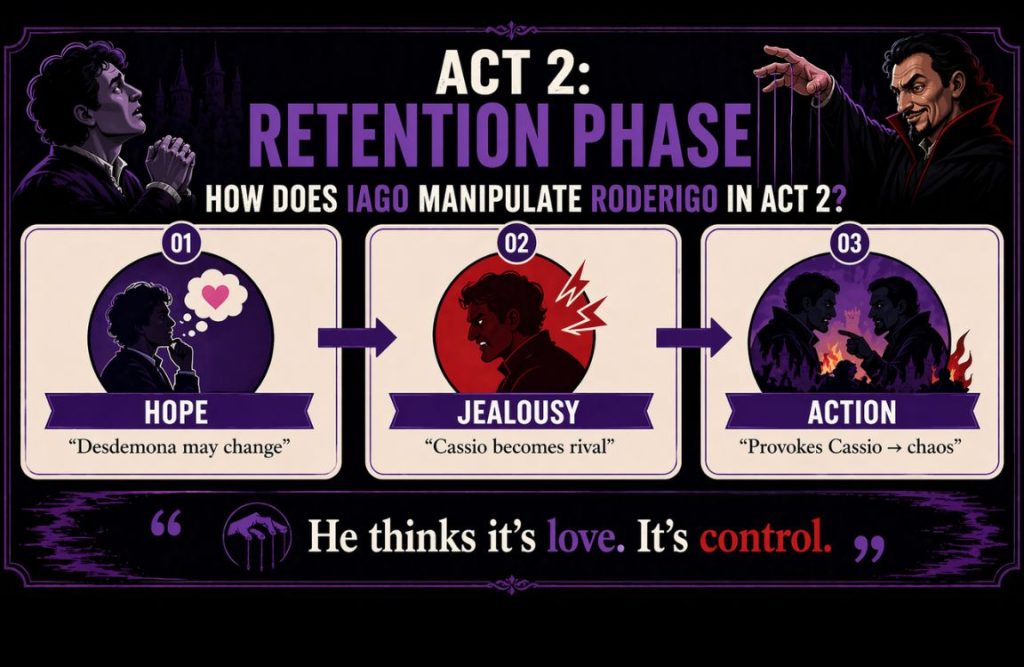
Now, if Act 1 was recruitment, Act 2 is retention. Iago doesn’t need to convince Roderigo anymore. He needs to sustain him.
And how does he do that? With emotional bait.
I often tell my students: Iago becomes a kind of toxic life coach here. He feeds Roderigo just enough hope to keep him going.
He suggests that Desdemona will soon grow tired of Othello and turn to Cassio. Suddenly, Roderigo has a new rival and a new mission.
Notice the shift: hope turns into jealousy.
Iago carefully stirs Roderigo’s emotions, like adjusting the flame under a boiling pot, just enough to keep him simmering.
He then directs him to provoke Cassio in Act 2, Scene 3, triggering the drunken brawl that leads to Cassio’s disgrace. All the while, he continues exploiting Roderigo financially.
And here’s the brilliance: Roderigo thinks he’s acting on love. But in reality, he’s acting on Iago’s script.
How Does Iago Convince Roderigo to Kill Cassio?
Iago convinces Roderigo to kill Cassio by exploiting his desperation, creating false urgency, and applying intense emotional pressure, making murder seem like his only solution.
This is the moment I lean forward in class and say, “Now watch Iago turn manipulation into near-murder.” By now, Roderigo is exhausted, financially drained and emotionally broken. That vulnerability is exactly what Iago needs.
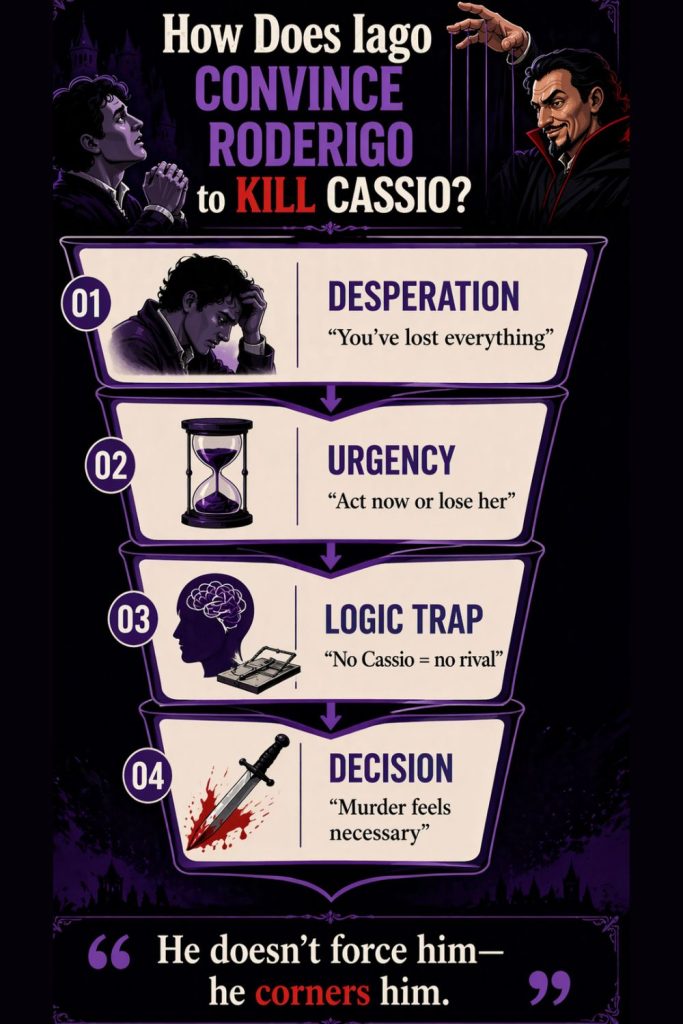
First, he deepens desperation. He reminds Roderigo of everything he has already lost: money, time, dignity, and suggests it will all be wasted unless he acts immediately.
Then comes false urgency. Iago claims Othello may soon leave Cyprus with Desdemona, leaving Cassio behind as her protector. Suddenly, time feels limited.
Next, he reframes murder as a necessity. If Cassio is removed, the rival disappears. If the rival disappears, Desdemona becomes attainable. The logic is chillingly simple.
Iago also intensifies jealousy, presenting Cassio as both a romantic threat and an obstacle. Step by step, he corners Roderigo emotionally, leaving no space for reason.
And here’s the tragic irony: Roderigo, who once only wanted love, is now ready to commit murder, believing it is hope.
That’s Iago’s genius, and his horror. He doesn’t change people. He pushes them to the darkest edge of themselves.
Why Does Iago Kill Roderigo?
Iago kills Roderigo because he becomes a liability and a dangerous loose end who could expose his schemes.
Let me put it bluntly, just as I do in class: Roderigo outlives his usefulness.
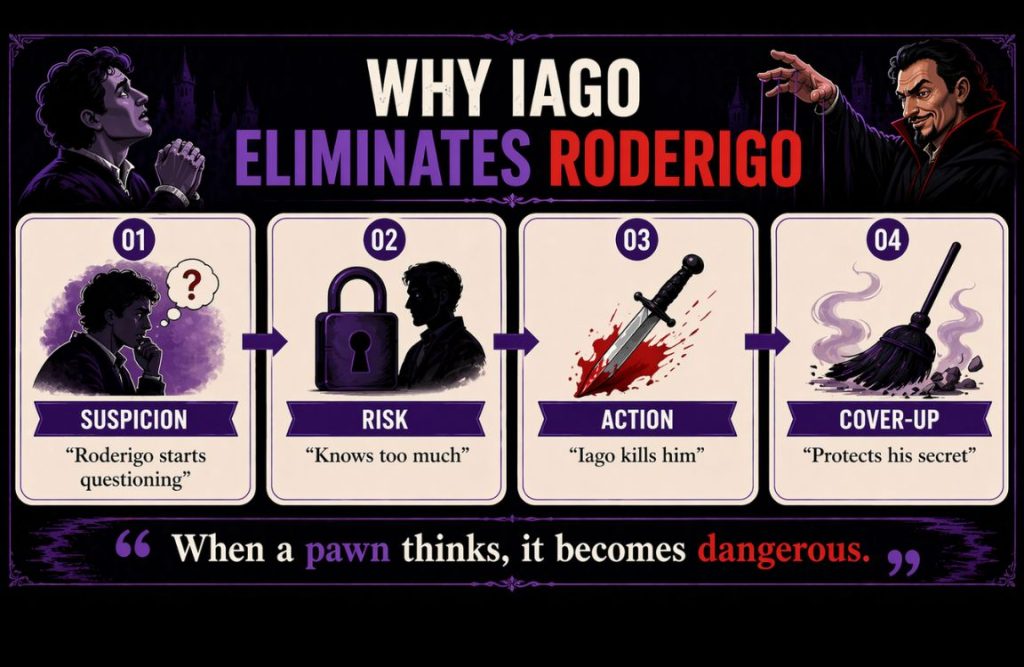
By the final act, he is no longer a puppet but a problem. He begins to question Iago, suspecting where his money and jewels have gone. And in a world built on deception, suspicion is fatal.
Iago cannot risk exposure. When Roderigo is wounded after the failed attack on Cassio, Iago makes a swift, calculated decision. He kills him. This is not anger; it is strategy.
I often call this “cleaning the crime scene.” Roderigo knows too much and could reveal both the manipulation and the financial exploitation.
To protect himself further, Iago even frames the act as loyalty, pretending to punish a criminal.
And that, my students, is the final lesson: in Iago’s world, people are tools. Once broken, or worse, aware. They are discarded.
Key Quotes on Iago Manipulating Roderigo
Key quotes that reveal Iago manipulating Roderigo include “Put money in thy purse” and “Thus do I ever make my fool my purse,” exposing financial exploitation and calculated deceit.
When I teach this, I always tell my students: if you want to catch manipulation, follow the language. Take “Put money in thy purse.” Iago repeats it like a catchy slogan– almost hypnotic.
It sounds practical, even helpful. But listen closely: it reduces Roderigo’s love to a transaction. Love becomes investment; Desdemona becomes a prize. Roderigo becomes the investor.
Now contrast that with Iago’s private confession: “Thus do I ever make my fool my purse.” That line chills the room when I read it aloud.
Why?
Because we suddenly see the truth, Roderigo never hears. He is not a friend, but a walking wallet.
Other lines deepen this pattern. “I follow him to serve my turn upon him” shows Iago’s false loyalty, while Roderigo’s later protest, “Every day thou daffest me,” reveals growing suspicion.
And finally, his cry, “O damned Iago!” marks tragic awareness.
The key insight: Iago speaks in two voices: promises to others and truth to himself. And Shakespeare lets us hear both.
Is Roderigo a Victim of Iago?
Roderigo is both a victim of Iago and a foolish participant, as his blind desire makes him vulnerable, yet he still bears moral responsibility for his choices.
Now, this is where I challenge my students: do we pity Roderigo, or judge him?
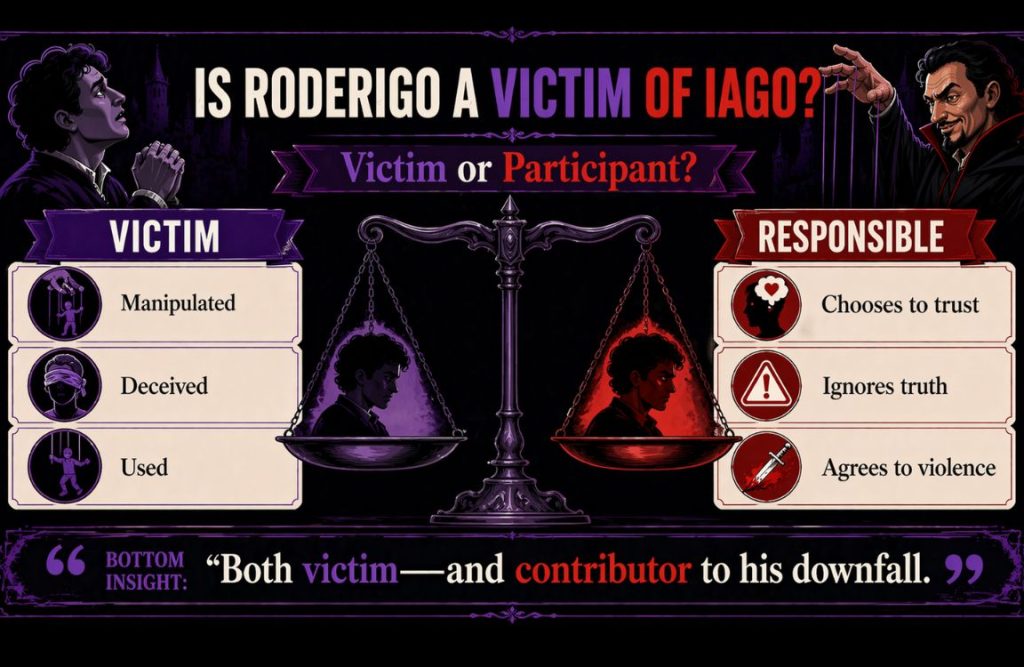
On one hand, he is clearly manipulated. Iago exploits his obsessive love for Desdemona, draining his money and treating him as a “purse” and a pawn. He deceives him, controls him, and ultimately kills him to silence the truth.
But here’s the pause, Roderigo is not entirely innocent. He chooses to trust Iago. He chooses to chase Desdemona despite reality. He even agrees to violent plans, including the attack on Cassio.
That matters.
So, I remind my class: Roderigo is a tragic blend, a victim, YES, but also complicit in his own downfall. His late realization only deepens the tragedy.
FAQs:
Does Roderigo ever realize Iago is manipulating him?
Yes, Roderigo begins to suspect Iago near the end, questioning lost money and failed promises. However, this realization comes too late, making his awareness tragically ineffective.
Why does Roderigo keep trusting Iago despite failure?
Roderigo’s trust in Iago grows from blind hope and emotional dependency. His obsession with Desdemona clouds his judgment, while Iago continually renews false promises, keeping him psychologically trapped and unable to break free.
Is Roderigo completely innocent in the play?
No, Roderigo is not completely innocent. Although manipulated, he willingly engages in immoral actions, including attempted violence. His character reflects moral complexity rather than pure victimhood within Shakespeare’s tragic framework.
How does money influence Iago’s control over Roderigo?
Money becomes Iago’s primary tool of control. By convincing Roderigo to fund his plans, he creates dependency, ensuring Roderigo remains invested, financially and emotionally, in a false hope that never materializes.
What does Roderigo represent in Othello?
Roderigo represents blind desire and the dangers of emotional obsession. His character symbolizes how unchecked passion, combined with manipulation, can lead individuals to lose reason, agency, and ultimately, their lives.
Conclusion:
So, how does Iago manipulate Roderigo? I tell my students. It’s a three-layered trap.
First, emotional: he feeds Roderigo’s love and jealousy. Second, financial: he drains his wealth under false promises. Third, psychological: he controls how Roderigo thinks, feels, and acts.
This is not simple deception. It is complete psychological control.
And at the heart of it lies a painful truth: blind desire makes us easy to control. Roderigo doesn’t just lose money. He loses judgment, dignity, and ultimately, his life.
That’s the tragedy.
If this analysis sparked your curiosity, don’t stop here.
👉 Explore more Othello analysis and deepen your understanding.