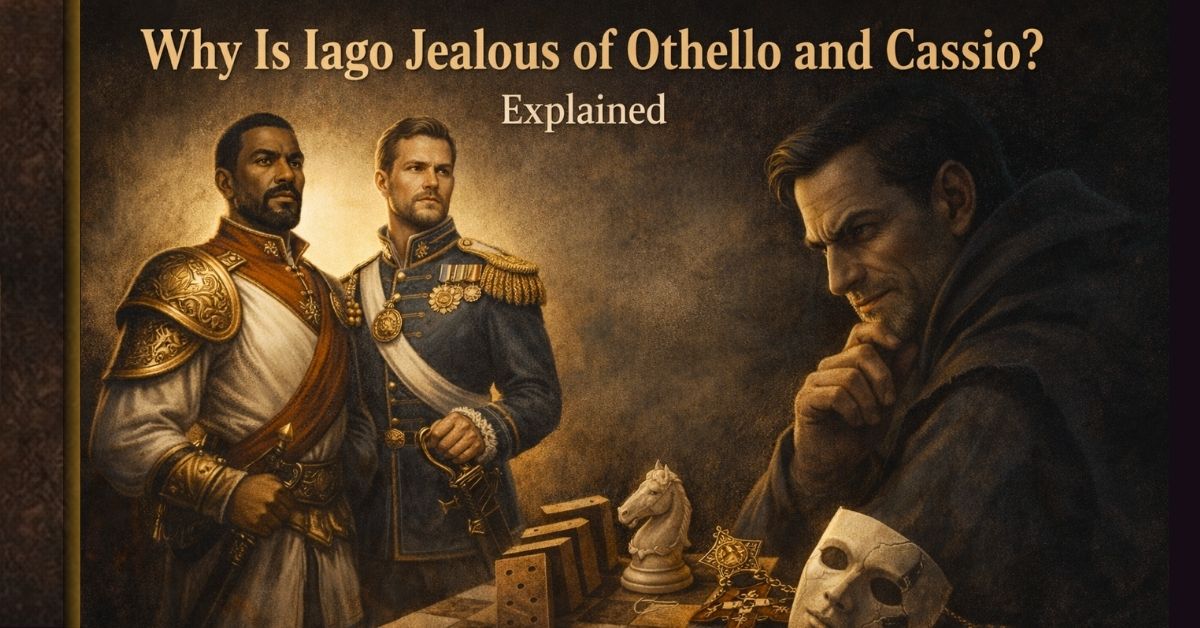
In Othello, Iago does not rely on violence. He works through influence, timing, and psychological insight. When students ask me how does Iago manipulate Cassio in Othello, I direct them to Act 2, Scene 3, where his method becomes clear.
Cassio is not weak. He is disciplined, polite, and deeply concerned with reputation. Yet these qualities make him predictable. Iago studies this carefully and builds situations that lead Cassio toward error without direct force.
He encourages drinking during celebration, provokes conflict with others, and later offers advice that appears sincere but carries hidden consequences. Each step feels natural to Cassio, which is why he never suspects danger.
This is what makes the manipulation so effective: Iago does not command actions. He designs circumstances. In doing so, he turns Cassio’s strengths into the very cause of his downfall.
Why Does Iago Target Cassio in Othello?
To understand Iago’s strategy, we must ask a simple but dangerous question: why Cassio? In my classroom, this is where students begin to see that manipulation always starts with motive, and Iago’s motive is deeply personal.
i) Why does Iago Hate Cassio?
I always pause and ask my students: Is Cassio actually guilty of anything? The answer is No, and that’s the tragedy.
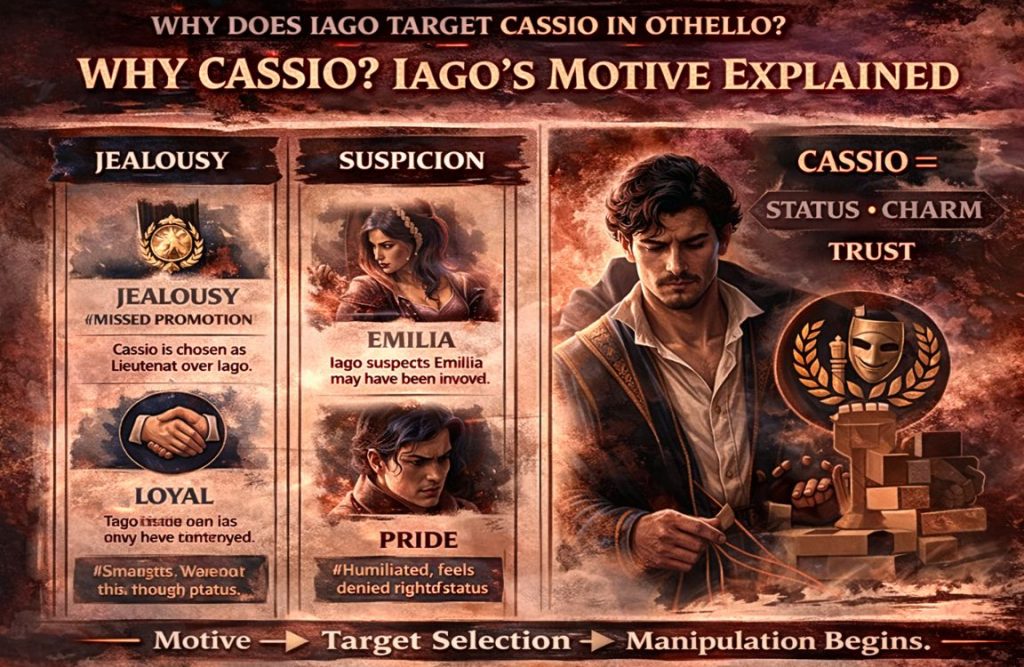
So, why does Iago hate Cassio? Primarily, it is professional jealousy. Cassio is promoted to lieutenant over Iago, despite being, in Iago’s eyes, a “bookish” theorist with little battlefield experience. This feels like a personal insult.
But it goes deeper. Iago’s pride turns into resentment and even suspicion. He briefly imagines Cassio may have been involved with Emilia, though without proof.
Cassio represents everything Iago feels denied: status, charm, and recognition.
And here’s the irony: Cassio trusts Iago completely, which makes his downfall not just planned, but painfully inevitable.
ii) What is Iago’s Plan in Othello?
Now let me explain this as I would in class. Iago’s plan is not chaotic. It is beautifully structured, almost like a chess game.
When we ask what Iago’s plan in Othello is, we must see Cassio as a tool. Iago first removes Cassio from his position, then pushes him toward Desdemona, turning innocent contact into suspicion.
At the same time, he manipulates Othello’s trust, planting jealousy through suggestion and false evidence, especially the handkerchief.
He also uses Roderigo as a pawn to create conflict.
This is a classic Iago strategy. He builds a story before the characters even realize they are part of it.
And before anyone realizes it, Othello believes the lie, and tragedy becomes inevitable.
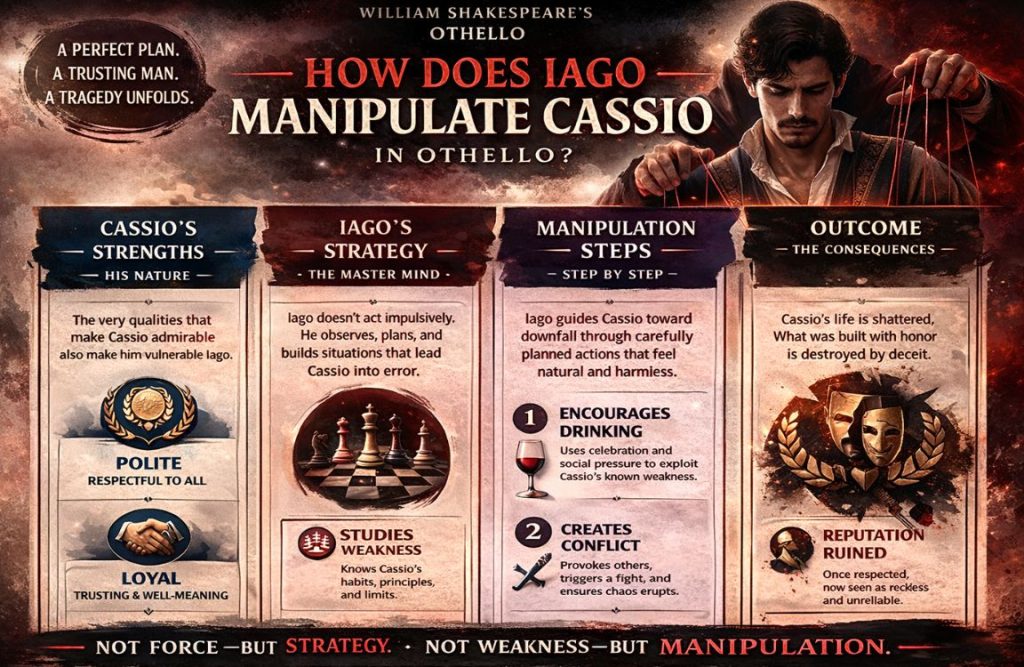
Table of Contents
How Does Iago Manipulate Cassio in Act 2, Scene 3?
Ah, Act 2, Scene 3, the heart of the scheme. I often tell my students: if you understand this scene, you understand Iago. Every move here is deliberate, like a carefully staged performance.
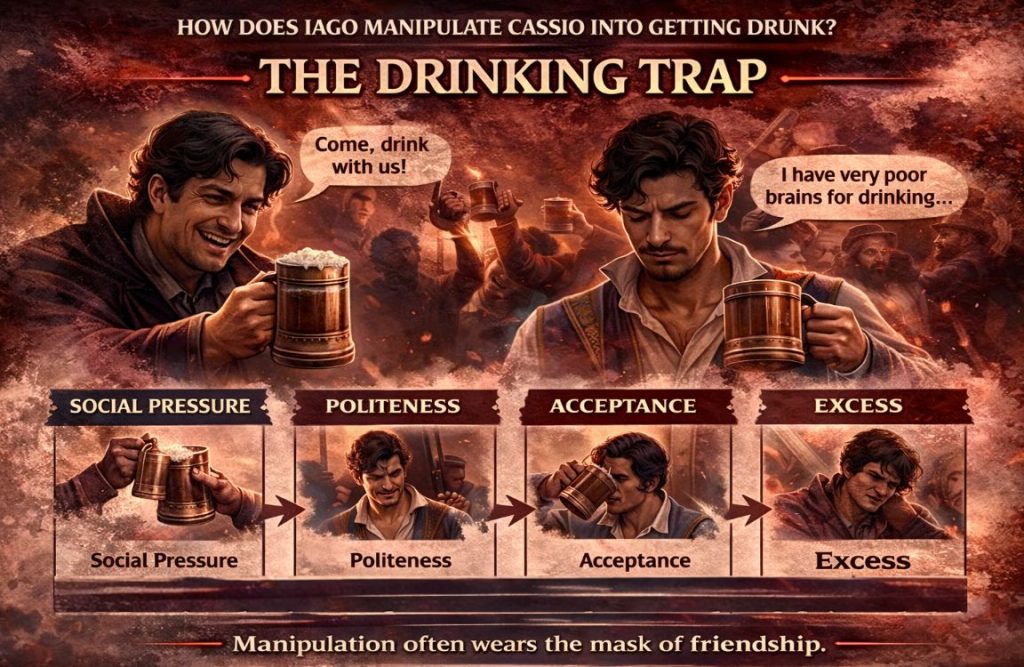
i) How does Iago manipulate Cassio into Getting Drunk?
Let me paint the scene for you. In Othello, Cassio admits he has “very poor and unhappy brains for drinking.” He knows his weakness, yet Iago persists.
So, how does Iago get Cassio drunk? Not by force, but through social pressure. During the Cyprus celebration in Act 2, Scene 3, Iago encourages drinking, sings songs, and involves others, making refusal feel impolite. And Cassio, ever courteous, gives in.
This is where I pause in class and say: Notice this carefully, manipulation often disguises itself as friendship.
Iago understands Cassio’s nature, polite, honorable, and eager to please, and uses it against him. One drink becomes many, and slowly, Cassio loses control, not just of his senses, but of his fate.
ii) How does Iago Trick Cassio into Fighting?
Now comes the second move, far more dangerous. A drunk man is not enough; Iago needs chaos.
So how does Iago trick Cassio into fighting? In Act 2, Scene 3, he plants conflict step by step. First, he ensures Cassio is intoxicated, then sends Roderigo to provoke him. When Montano intervenes, the situation escalates into a violent brawl.
I tell my students to picture a domino effect. Iago pushes the first piece, and the rest fall naturally.
Cassio, drunk and disoriented, reacts impulsively. Meanwhile, Iago cleverly shifts blame, appearing honest.
The fight is not accidental. It is engineered, controlled, and perfectly timed.
Here lies Iago’s brilliance: he never appears responsible. The scene unfolds as if by chance, but every moment is carefully orchestrated behind the curtain.
iii) How does Cassio lose his Position?
And now, the decisive moment.
When Othello enters the scene, he is not a husband, but a general enforcing order. He sees chaos, hears of violence, and acts immediately. Cassio is stripped of his rank.
What matters here is not just the mistake, but the context. Here, I always remind my students, in a military structure, discipline defines identity. Cassio’s failure is not private. It is public and professional.
This is what makes the moment so tragic: the judgment is fair based on appearance, but entirely manipulated beneath the surface.
How Does Iago Ruin Cassio’s Reputation?
If Act 2, Scene 3 removes Cassio’s position, the next phase targets something deeper, his public identity. Reputation in this play is not decoration. It is survival. And Iago understands exactly how to manipulate it.
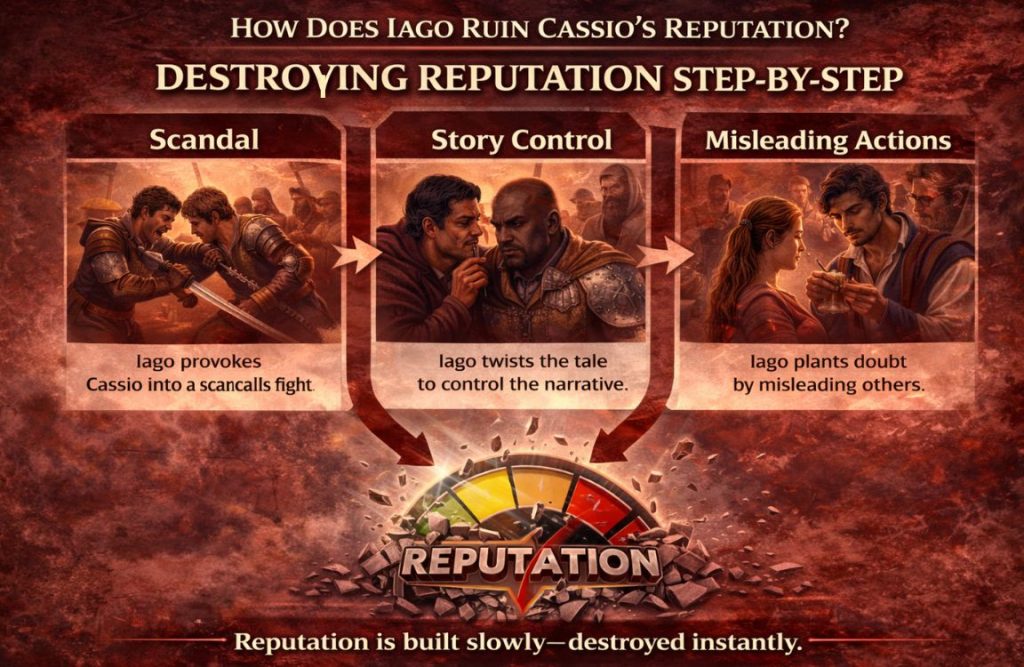
i) Iago’s Method of Damaging Reputation
Let me put it simply to my students: Iago doesn’t attack directly. He reframes events.
- First, he creates a visible scandal (the drunken fight)
- Then, he reinforces it through selective storytelling
- Finally, he guides Cassio toward Desdemona
That last step is crucial.
On the surface, it looks like support. In reality, it creates a pattern of behavior that can be misread from the outside.
So, Cassio’s downfall is not just caused. It is carefully framed and reinforced.
ii) Cassio’s Obsession with Reputation
This is one of those moments where I always slow down in class.
When Cassio cries, “Reputation, reputation, reputation!”, we see how deeply his identity depends on public perception.
He calls it the “immortal part” of himself.
So when it is damaged, the loss is not just professional. It feels personal.
And this is exactly where Iago succeeds, not by attacking Cassio, but by influencing how others see him.
Once perception shifts, everything else follows.
Iago’s Method of Exploiting Cassio’s Weakness
In Othello, Iago does not invent flaws. He discovers them. Cassio’s courtesy, trust, and innocence become entry points. This is where manipulation turns subtle, psychological, and, frankly, frighteningly effective.
i) How does Iago exploit Cassio’s Weakness?
Here’s something I always tell my students. Cassio’s vulnerability lies in the consistency of his character.
He is polite, trusting, and genuinely committed to doing what is right. Iago does not try to break these qualities. Instead, he studies them and uses them as predictable patterns.
He places Cassio in situations where his virtues begin to work against him:
- His courtesy makes it difficult to refuse social pressure
- His trust leads him to accept guidance without suspicion
- His desire to restore honor pushes him into risky decisions
What makes this manipulation so effective is its subtlety. Iago does not force Cassio to act; he creates conditions where Cassio chooses actions that lead to his own downfall.
ii) How Does Iago Manipulate Cassio for His Own Advantage?
This is where Iago’s plan becomes truly dangerous. He advises Cassio to seek Desdemona’s help, and on the surface, it seems like honest, friendly guidance. Cassio believes he is simply trying to restore his reputation in a respectful way.
But the situation works differently from the outside. When Othello sees Cassio repeatedly speaking with Desdemona, it begins to look suspicious. Iago understands this perfectly. He doesn’t create false actions. He allows real, innocent actions to be misunderstood.
Cassio never questions the advice because it feels reasonable. Meanwhile, Othello starts forming doubts based on what he observes.
This is Iago’s true skill: he doesn’t control people directly. He shapes how their actions are seen and judged.
Key Quotes on Iago Manipulating Cassio
In Othello, quotes are not just evidence. They reveal the mechanics of manipulation. When I guide my students through Iago’s language, I ask them to notice two things: how Iago thinks, and what his words do to others. These lines uncover both his strategy and its consequences.
i) Iago’s Manipulation Quotes (His Mindset)
Let us begin with Iago’s mindset. His words show a man who plans, predicts, and controls. When he says, “If I can fasten but one cup upon him…,” we see calculation, not impulse. He is already designing Cassio’s fall.
Then, “He’ll be as full of quarrel and offence…” reveals something more dangerous. Iago predicts behavior before it happens.
Add to this, “I am not what I am,” which exposes his core philosophy of deception, and “I’ll pour this pestilence into his ear,” which shows how he spreads influence subtly.
I often remind students: Iago does not react to events. He scripts them. His language reflects a mind that studies human weakness and uses it with precision.
ii) Othello Manipulation Quotes Related to Cassio (Effect on Others)
Now shift focus to the impact of Iago’s words. Cassio’s lament, “I have lost the immortal part of myself,” reveals the emotional damage. His identity is shaken. Iago does not challenge this despair. Instead, he deepens it by advising, “Confess yourself freely to her.”
This advice appears sincere, yet it places Cassio in a position that can be misinterpreted. At the same time, Othello begins to read these actions as signs of guilt.
Here lies Iago’s real power: he uses truthful situations to create false beliefs. His manipulation is not in what he invents, but in how he makes others interpret reality.
Cassio and Iago’s Relationship Explained
The Cassio and Iago relationship is one of Shakespeare’s finest examples of dramatic irony. Cassio sees Iago as “honest Iago”, a phrase that always makes my students smile knowingly.
But we, as readers, see the truth. This is not friendship. It is performance.
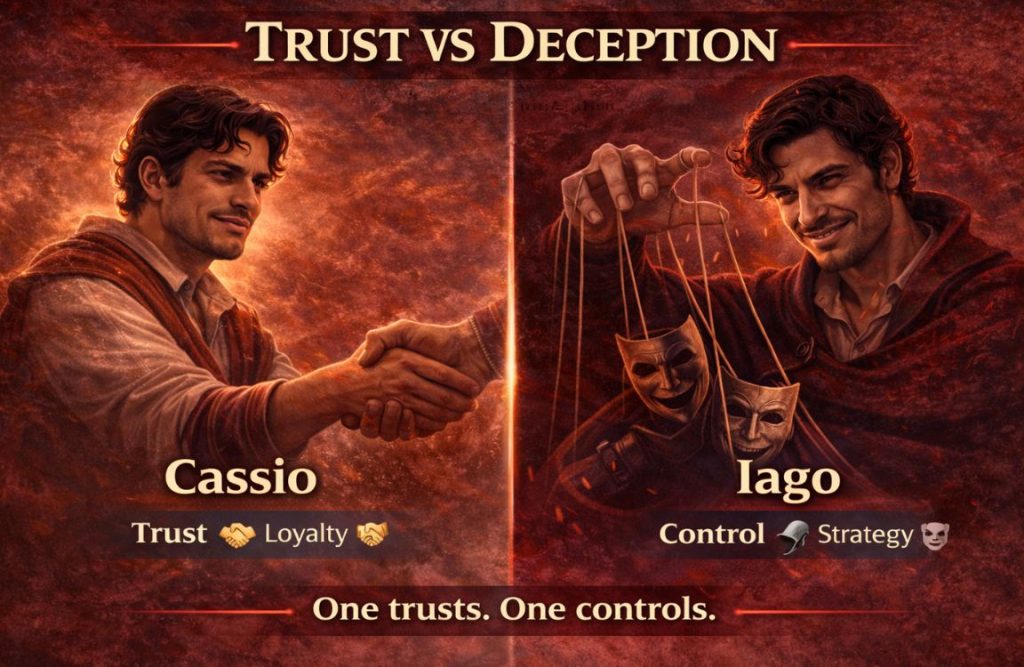
Iago envies Cassio’s promotion and refined character, viewing him as a perfect pawn. He plays advisor and protector, while secretly engineering Cassio’s downfall through drink, reputation, and Desdemona. Cassio, trusting and courteous, never suspects.
I like to tell my students: Cassio reads a script of friendship, while Iago writes a script of destruction.
That imbalance, trust on one side, manipulation on the other, drives the tragedy. Iago exploits virtue, turning charm into suspicion and honesty into weakness in Othello, where relationships become instruments of control.
FAQs:
Why does Cassio trust Iago so easily in Othello?
Cassio trusts Iago because he embodies honesty and loyalty in appearance. In a structured military world, Cassio expects integrity. He cannot imagine deception at that level, which makes Iago’s manipulation even more effective and believable.
What role does alcohol play in Iago’s manipulation strategy?
Alcohol acts as a catalyst in Iago’s plan. It weakens Cassio’s judgment and self-control, making him vulnerable to provocation. Iago uses it not as a weapon, but as a trigger for chaos.
Could Cassio have avoided Iago’s trap?
Yes, but only with self-awareness. If Cassio had resisted social pressure or recognized his limits, he might have avoided the situation. However, his personality makes such resistance difficult, which Iago skillfully exploits.
How does Cassio’s character contrast with Iago’s?
Cassio represents order, honor, and sincerity, while Iago embodies chaos, deception, and calculation. This contrast highlights the moral imbalance in the play, making Cassio an easy target for manipulation.
What does Cassio’s downfall reveal about reputation in Othello?
Cassio’s downfall shows that reputation is fragile and socially constructed. One mistake can erase years of honor. Shakespeare suggests that identity based on public perception is dangerously unstable and easily manipulated.
Conclusion:
So, how does Iago manipulate Cassio? By reading him accurately and placing him in the wrong situations at the right time.
This is what I want my students to remember: manipulation in Othello works quietly, through influence rather than control.
Cassio falls not because he lacks virtue, but because his virtues are used against him.
And that is what makes the tragedy so powerful.