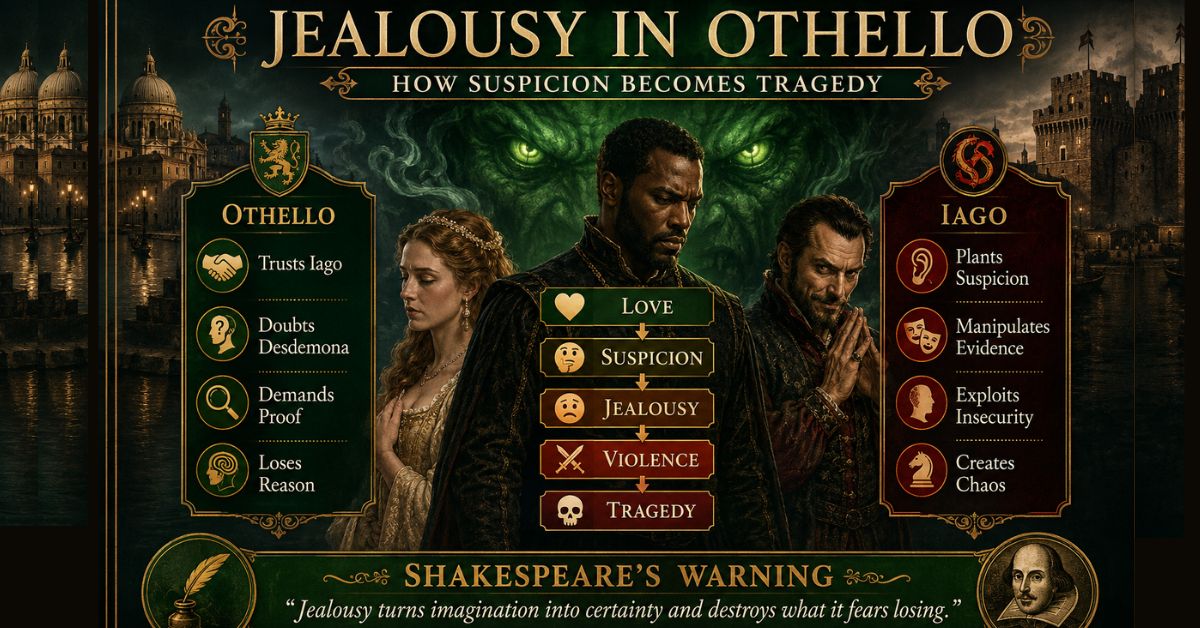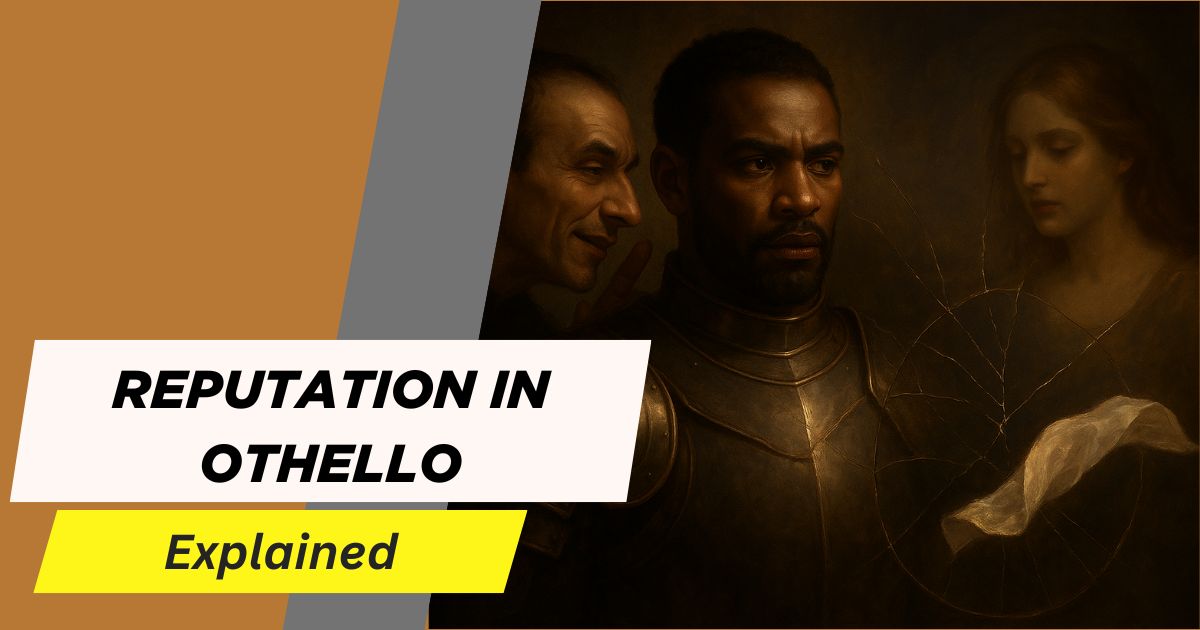
Imagine waking up one morning to discover that everyone believes a lie about you. Your friends avoid you. Your colleagues doubt you. Even those who love you begin to hesitate. How would you prove your innocence when your name has already been stained?
Every time I ask my students this question, the classroom grows surprisingly quiet because that nightmare sits at the heart of reputation in Othello.
In this tragedy, reputation is far more than popularity. It is a person’s public identity, a measure of honour, trust, and social worth. Once suspicion replaces truth, lives begin to unravel.
From Othello’s respected status to Cassio’s shattered confidence and Iago’s carefully cultivated image, every major conflict grows from the theme of reputation. The play warns that appearances often overpower reality, leaving honesty struggling against deception.
What Is Reputation in Othello?
Reputation in Othello is the public perception of a person’s character, honour, and social standing. Shakespeare shows that a good name may take years to build but only moments to destroy, making reputation one of the tragedy’s central concerns.
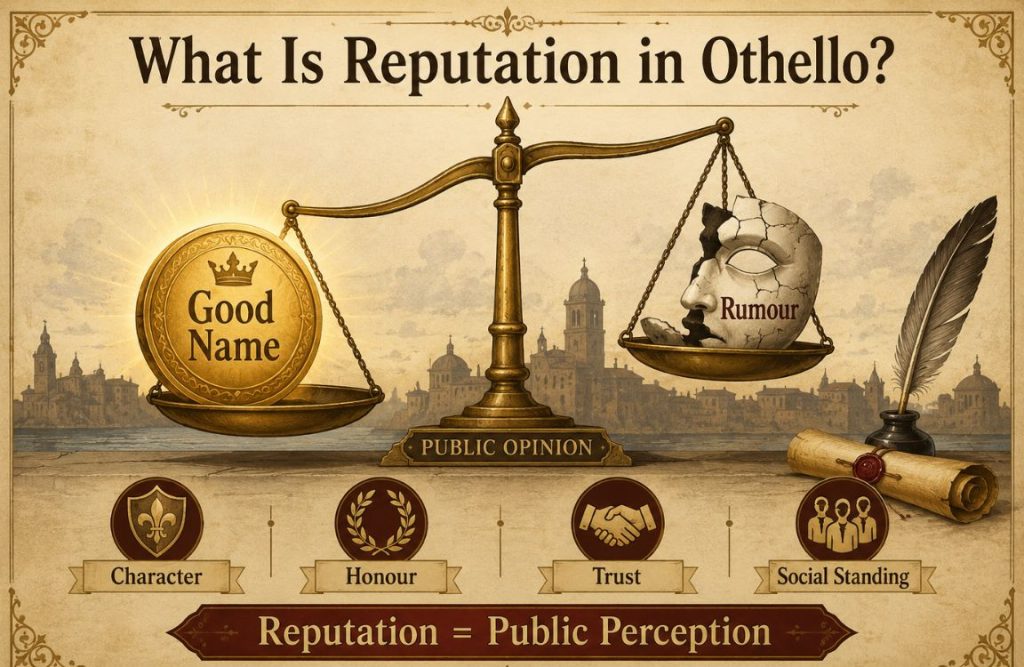
Society judges individuals by what it believes, not always by what actually happens. That tension between perception and reality drives much of the play’s conflict.
As I explain in class, reputation functions almost like invisible currency. Once lost, it is painfully difficult to recover, even when innocence remains intact. This idea lies at the heart of the reputation theme in Othello, where trust can disappear after a single accusation or rumour.
The play also reflects an honour-based culture in which public respect influences relationships, careers, and personal identity.
Through this lens, the importance of reputation in Othello extends beyond individual characters and becomes a broader reflection on how societies value a good name over verified truth.
Takeaway: In Othello, reputation survives on public belief, not always on reality.
Table of Contents
Reputation and Honour in Othello
Although many readers treat them as identical, reputation and honour are not quite the same. Honour grows from personal integrity and moral conduct, whereas reputation depends on how other people judge those qualities. One belongs to the conscience; the other belongs to society.
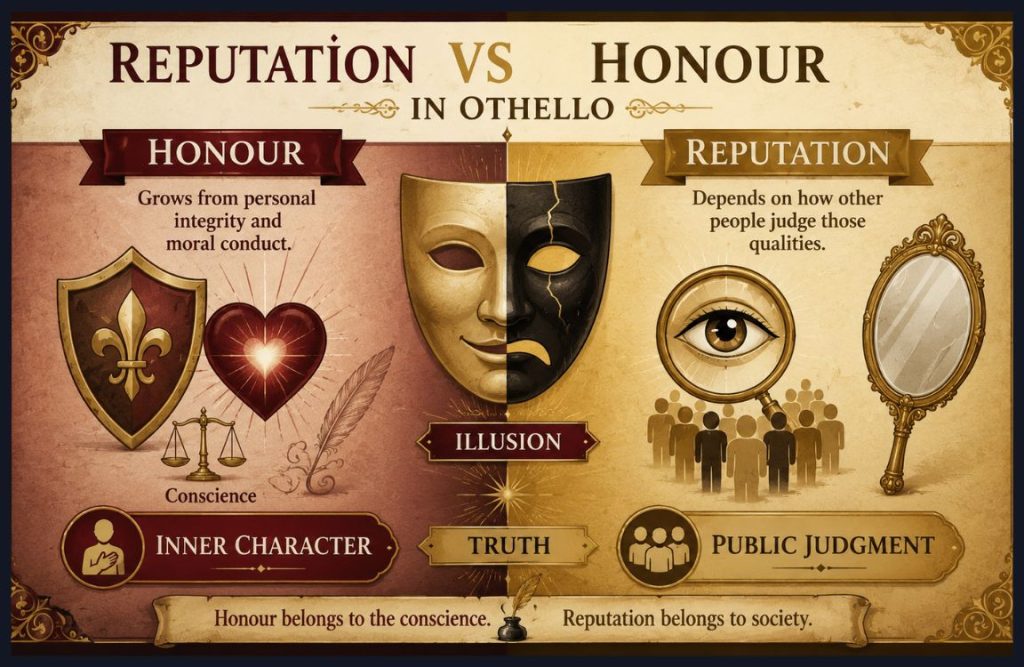
This distinction gives the honour in Othello remarkable complexity. A person may act with integrity yet still suffer disgrace because appearances outweigh facts.
Conversely, someone lacking moral principles may enjoy widespread admiration if outward behaviour remains persuasive.
Shakespeare intensifies this tension through dramatic irony, as the audience recognises facts that the characters themselves cannot see.
Students often assume honour automatically creates a good reputation, yet the play challenges that assumption. Its exploration of illusion and truth reveals how carefully crafted performances frequently overshadow genuine virtue.
By deliberately blurring reputation vs. honour, Shakespeare invites us to question whether society values genuine virtue or simply rewards convincing appearances. The answer remains unsettling because collective opinion proves surprisingly easy to manipulate.
Character Reputation in Othello
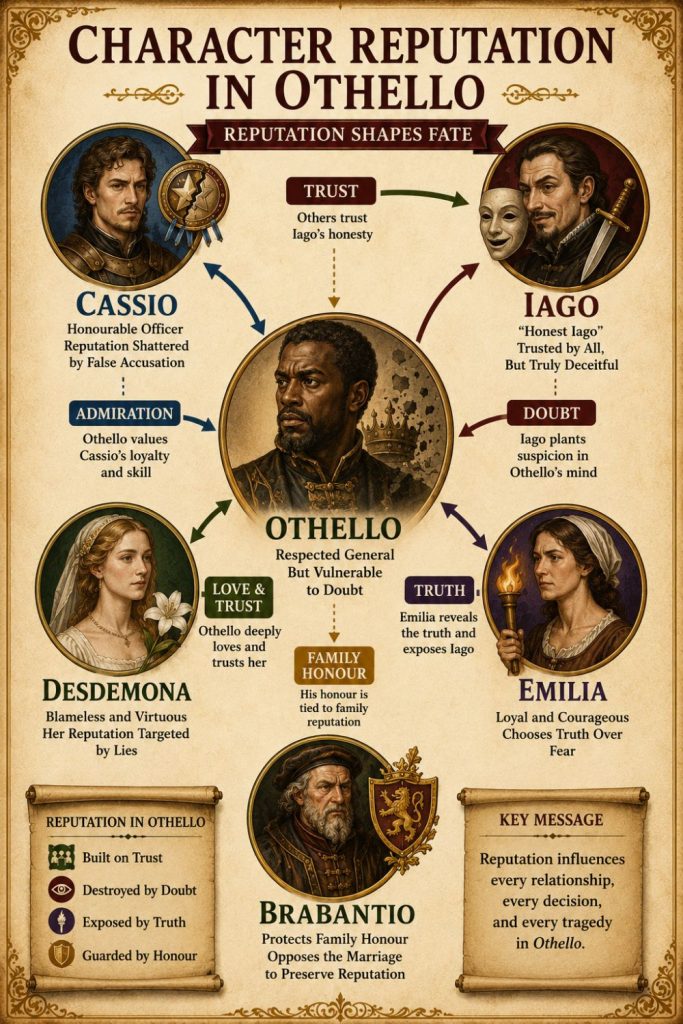
Each major figure experiences reputation differently. Their contrasting experiences demonstrate how social perception shapes ambition, relationships, authority, and ultimately determines who gains trust, loses dignity, or faces destruction.
i) Othello’s Reputation
At the beginning, Othello’s reputation rests upon military excellence, discipline, and courageous leadership. Yet admiration never completely erases his position as an outsider within Venetian society. That quiet vulnerability makes his hard-earned reputation more fragile than it first appears.
Once doubt enters his mind, confidence collapses alongside the esteem he has spent years building. His tragedy illustrates how years of respect can disappear when suspicion replaces certainty.
ii) Cassio’s Reputation
No character values reputation more openly than Cassio. His cry, “Reputation, reputation, reputation!” captures genuine panic because losing his social standing feels like losing himself.
Cassio’s reputation in Othello represents professional honour, social acceptance, and personal identity all at once. His distress reminds readers that a damaged name can wound more deeply than physical injury, especially within a culture where dignity depends heavily upon how others judge one’s character.
iii) Iago’s Reputation
The greatest irony surrounds Iago’s view on reputation. While declaring, “I am not what I am,” he openly admits that appearances can deceive. Everyone praises “Honest Iago,” which gives him unquestioned credibility.
Shakespeare employs dramatic irony brilliantly here: the audience knows Iago’s true nature while every other character mistakes him for the most trustworthy man in Venice.
That carefully maintained image becomes his most dangerous weapon, which allows manipulation to flourish in Othello because people trust appearances instead of examining the man beneath them.
iv) Emilia and Desdemona’s Reputation
Desdemona’s reputation depends upon ideals of female honour, obedience, and chastity, which makes false accusations especially destructive.
Emilia’s story offers a different perspective. She chooses truth over silence to protect Desdemona’s honour even though she knows defying Iago could have deadly consequences.
It proves that moral courage ultimately carries greater weight than unquestioning loyalty.
v) Brabantio’s View
For Brabantio, family honour outweighs personal happiness. His opposition to his daughter’s marriage grows from the fear that public respect has been damaged.
Through this response, marriage becomes not merely a private relationship but a public measure of family identity, status, and inherited honour.
Famous Reputation Quotes in Othello Explained
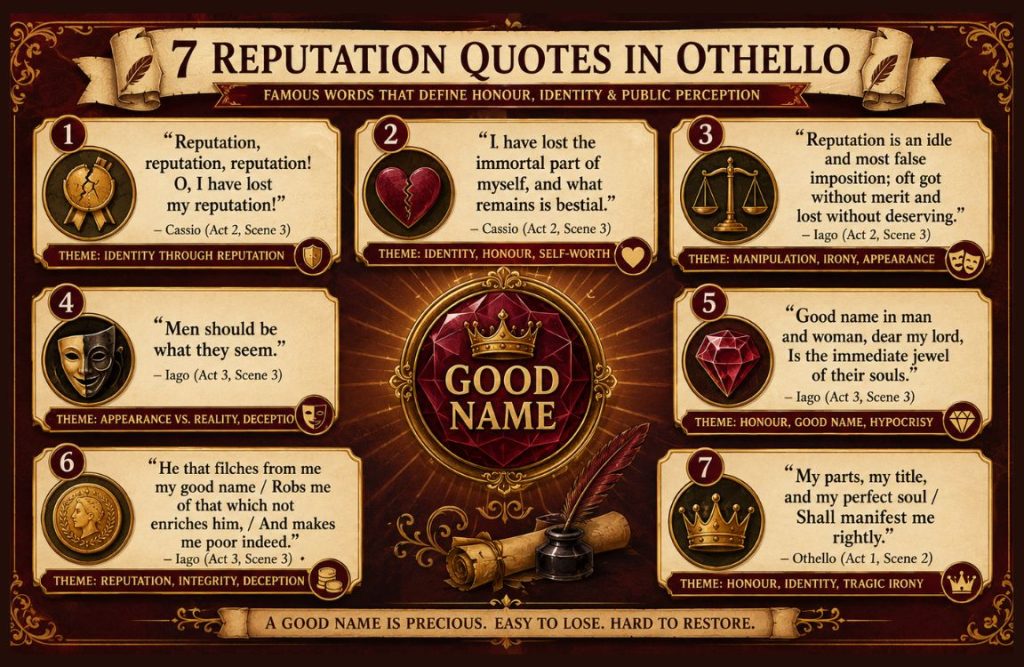
These seven carefully chosen Othello reputation quotes best illustrate the theme of reputation in Othello. Together, they show how honour, identity, trust, and public perception shape every stage of the tragedy.
| Quote | Speaker | Meaning | Theme |
| “Reputation, reputation, reputation! O, I have lost my reputation!” (Act 2, Scene 3) | Cassio | Cassio’s famous lament shows that reputation is far more than social approval. It forms the core of his identity and self-respect. Once disgraced, he feels he has lost not merely a military post but the dignity that gives purpose to his life. | Identity through reputation |
| “I have lost the immortal part of myself, and what remains is bestial.” (Cassio, 2.3) | Cassio | Although the quotation does not mention reputation directly, Cassio connects the loss of his honour with the loss of his moral identity. Read alongside his famous “Reputation, reputation, reputation!” speech, it shows that public disgrace feels like a loss of self. | Identity, honour, self-worth |
| “Reputation is an idle and most false imposition; oft got without merit and lost without deserving.” (Act 2, Scene 3) | Iago | Ironically, Iago argues that reputation is unreliable while secretly exploiting its influence throughout the play. His contradictory advice exposes one of the tragedy’s deepest ironies: the man who calls reputation worthless destroys others by manipulating it. | Manipulation, irony, appearance |
| “Men should be what they seem.” (Act 3, Scene 3) | Iago | Here Iago sounds like a champion of honesty, yet he hides behind a false image of integrity. The statement creates powerful dramatic irony and reinforces the conflict between outward image and inner truth, revealing how easily reputation can deceive. | Appearance vs. reality, deception |
| “Good name in man and woman, dear my lord, / Is the immediate jewel of their souls.” (Act 3, Scene 3) | Iago | This celebrated quotation compares a person’s good name to a priceless jewel. Its impact lies in the speaker’s hypocrisy: Iago praises honour while deliberately destroying the good names of those who trust him. | Honour, good name, hypocrisy |
| “He that filches from me my good name / Robs me of that which not enriches him, / And makes me poor indeed.” (Act 3, Scene 3) | Iago | Here, reputation becomes a form of wealth that cannot simply be replaced once stolen. Although Iago speaks wisely, his actions contradict every word. His hypocrisy proves that moral truths can become dangerous when voiced by a skilled deceiver. | Reputation, integrity, deception |
| “My parts, my title, and my perfect soul / Shall manifest me rightly.” (Act 1, Scene 2) | Othello | Early in the play, Othello confidently believes that his achievements and integrity will protect his good name. His confidence makes his later collapse especially tragic, which demonstrates how fragile even the strongest reputation can become. | Honour, identity, tragic irony |
Shakespeare’s Message About Reputation
Shakespeare’s treatment of reputation in Othello remains powerful because appearances repeatedly overshadow truth before truth is finally restored. Throughout the tragedy, jealousy grows because suspicion spreads more quickly than evidence, while manipulation succeeds because people trust convincing performances instead of questioning them.
Through dramatic irony and psychological conflict, Shakespeare reveals how easily perception can overpower reality. The conflict between public perception and evidence grows increasingly destructive as illusion gradually replaces sound judgment.
Fear of a damaged reputation also fuels jealousy in Othello, as damaged trust can transform affection into suspicion and dignity into violence.
Although written more than four centuries ago, the play feels remarkably modern. Today, reputations can still rise or collapse overnight through rumours, misinformation, disinformation, and social media.
Its lasting lesson is simple: integrity deserves greater value than appearances, and truth should never be sacrificed to public opinion.
FAQs:
Why does reputation seem more important than truth in Othello?
Social perception in Othello carries greater influence than factual evidence. Once suspicion takes hold, false impressions begin to replace evidence, so rumours and deception shape decisions with devastating consequences.
How does reputation contribute to Othello’s tragic downfall?
Othello believes his honour depends upon his public image as both husband and general. When Iago convinces him that this reputation has been damaged, jealousy overwhelms reason and drives his tragic choices.
Why does Cassio value his reputation so highly?
Cassio views reputation as the foundation of his honour, career, and personal identity. Losing his good name after the drunken fight feels worse than losing his position because it threatens his entire sense of worth.
How does Iago use his reputation to deceive others?
Iago carefully cultivates the image of “Honest Iago,” earning unquestioned trust from those around him. That respected reputation allows him to manipulate conversations, spread suspicion, and hide his true intentions until it is too late.
What does Shakespeare teach about reputation in Othello?
The play teaches that reputation can be valuable yet dangerously unstable. Although deception may shape public opinion for a time, truth ultimately exposes false appearances, reminding us that integrity matters more than outward image.
Conclusion:
Reputation shapes every turning point in Othello, since it influences love, honour, trust, and tragedy from beginning to end. A respected name can open doors, yet it can also become dangerously fragile when appearances outweigh reality.
More than four centuries later, Shakespeare’s warning remains strikingly relevant because public opinion still shapes how people judge character, success, and even innocence.
As you reread Othello, don’t simply ask who tells the truth. Ask how reputations are built, manipulated, and ultimately judged. That question leads to one of Shakespeare’s deepest insights: appearances may deceive for a time, but Shakespeare ultimately shows that truth emerges, even if it arrives too late to prevent tragedy.
If you’re preparing for exams or exploring the play in greater depth, continue with our guides to Othello’s themes, characters, and famous quotations.