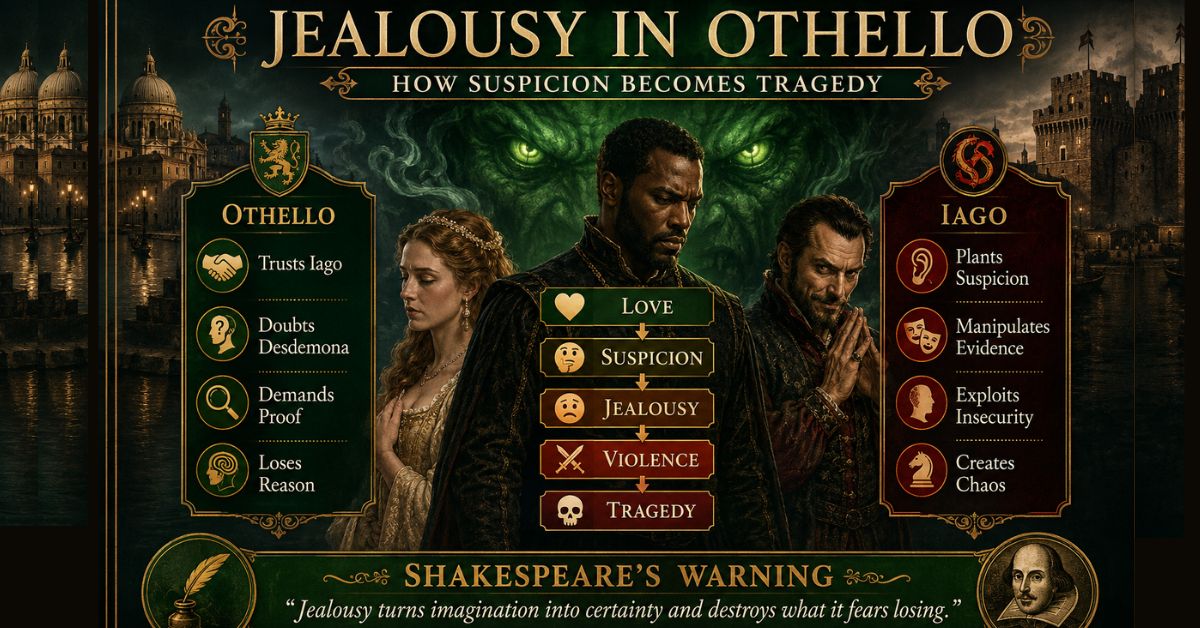
What if Shakespeare’s most dangerous villain never needed a sword? Iago in Othello destroys lives not through physical strength but through carefully chosen words. His lies travel faster than any weapon, and once they take root, even the noblest characters struggle to distinguish truth from suspicion. That is why Iago quotes remain among the play’s most studied lines.
Whenever I teach this play, students are often surprised by one fact: Iago rarely forces anyone to act. Instead, he persuades others to destroy themselves. His real power lies in shaping how people interpret reality.
The best quotes by Iago expose not only his hatred but also his remarkable understanding of fear, pride, jealousy, and human weakness.
In this guide, we’ll examine famous Iago quotes from Othello to explore their meanings, themes, literary techniques, and lasting significance within the tragedy.
Table of Contents
Most Famous Iago Quotes from Othello
If you’re looking for the key Iago quotes, these five lines capture the essence of his character and appear frequently in essays, examinations, and literary discussions. Each reflects a different aspect of his manipulation and philosophy.
- “I am not what I am.” (Act 1, Scene 1)
- “I hate the Moor.” (Act 1, Scene 3)
- “Put money in thy purse.” (Act 1, Scene 3)
- “O, beware, my lord, of jealousy: It is the green-eyed monster…” (Act 3, Scene 3)
- “Men should be what they seem.” (Act 3, Scene 3)
Taken together, these famous lines reveal a villain who weaponizes trust, disguises his intentions, and understands exactly how words can reshape another person’s reality.
Iago Quotes at a Glance: Act, Theme, and Meaning
Need a quick reference before diving into the detailed analysis? This table highlights Iago’s most important quotes, where they appear in the play, the ideas they explore, and their dramatic significance.
| Quote | Act/Scene | Main Theme | One-Line Meaning |
| “I am not what I am.” | 1.1 | Identity, False Appearance | Iago admits that his public image hides his true character, establishing deception as his defining trait. |
| “I hate the Moor.” | 1.3 | Revenge, Resentment | This blunt confession reveals the personal hatred fueling his destructive scheme against Othello. |
| “Put money in thy purse.” | 1.3 | Exploitation, Greed | By repeating this advice, he manipulates Roderigo into funding and advancing his plans. |
| “I’ll pour this pestilence into his ear.” | 2.3 | Psychological Poison | Lies are compared to a deadly infection that slowly corrupts Othello’s judgment. |
| “Reputation is an idle and most false imposition…” | 2.3 | Reputation, Irony | He belittles reputation even as he systematically destroys the good names of others. |
| “Men should be what they seem.” | 3.3 | Appearance vs. Reality | The play’s greatest deceiver disguises himself as a champion of honesty. |
| “Look to your wife; observe her well with Cassio.” | 3.3 | Suspicion, Psychological Manipulation | A carefully planted suggestion begins to erode Othello’s trust in Desdemona. |
| “Trifles light as air / Are to the jealous confirmations strong / As proofs of holy writ.” | 3.3 | Jealousy, Confirmation Bias | He understands that jealousy transforms even the smallest details into unquestioned proof. |
| “O, beware, my lord, of jealousy: It is the green-eyed monster…” | 3.3 | Jealousy, Strategic Deceit | By pretending to caution Othello, he quietly feeds the very emotion he condemns. |
| “An old black ram is tupping your white ewe.” | 1.1 | Racial Prejudice, Provocation | Crude animal imagery is used to inflame Brabantio’s fear, anger, and racial bias. |
| “Demand me nothing: what you know, you know.” | 5.2 | Silence, Enigma | His final refusal to explain himself leaves his motives unresolved and his villainy hauntingly mysterious. |
Iago Quotes About Deception and Identity
No theme defines Iago more completely than deception. These quotations show how he deliberately creates a false identity, speaks in contradictions, and earns trust by pretending to value honesty. Shakespeare invites us to watch a master performer who manipulates appearance as carefully as language.
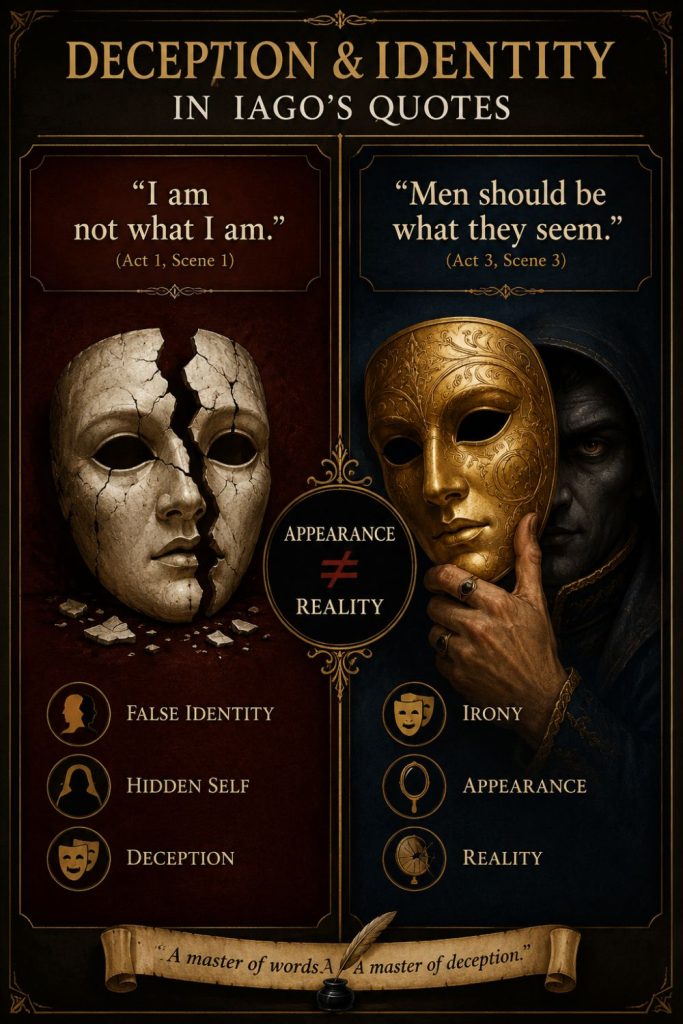
1) “I am not what I am.” (Act 1, Scene 1)
A few Shakespearean lines announce villainy so boldly. Iago twists the biblical declaration “I am that I am,” replacing divine truth with deliberate falsehood.
I always tell my students this is more than a confession. It is a manifesto.
He defines himself through contradiction, which makes appearance and reality unstable long before Othello begins to doubt what he sees. More importantly, his identity depends not on who he is, but on who others believe him to be.
2) “Men should be what they seem.” (Act 3, Scene 3)
The irony is almost painful. Shakespeare allows the play’s greatest liar to lecture others about honesty, and everyone believes him. This hypocrisy strengthens Iago’s disguise because moral language makes him appear trustworthy.
The audience, however, recognizes the gap between his words and his character, which creates powerful dramatic irony.
Iago’s Manipulation Quotes in Othello
Iago’s greatest talent is psychological engineering rather than physical violence. These quotes show how he plants doubt, exploits human weakness, and turns others into agents of their own downfall.
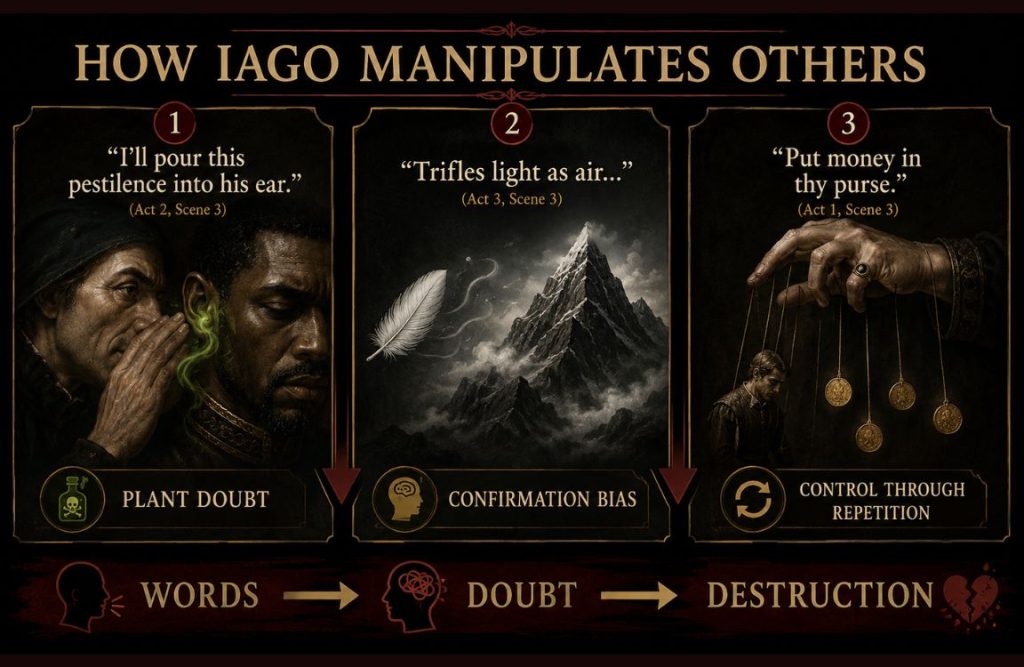
3) “I’ll pour this pestilence into his ear.” (Act 2, Scene 3)
The image of poison entering the ear captures Iago’s method with chilling precision. He rarely begins with obvious lies.
Instead, he lets suspicion spread gradually, like an invisible infection. The metaphor transforms conversation into contamination, suggesting that destructive ideas can corrupt the mind just as disease corrupts the body.
Corruption begins not with action but with interpretation. Once a destructive belief takes root, it can reshape how a person understands everything around them.
4) “Trifles light as air / Are to the jealous confirmations strong / As proofs of holy writ.” (Act 3, Scene 3)
This observation reaches beyond the plot into human psychology. Iago understands that jealousy changes the way people interpret evidence. Once suspicion takes hold, insignificant details suddenly appear undeniable.
Modern readers might recognize this as confirmation bias. An uncomfortable truth about human nature emerges from the quotation: people often search for evidence that supports what they already fear.
5) “Put money in thy purse.” (Act 1, Scene 3)
Iago repeats this command until Roderigo stops thinking critically and starts obeying automatically. The repetition itself becomes persuasive. Rather than offering genuine advice, he exploits Roderigo’s loneliness and obsession with Desdemona for financial gain.
While discussing this quotation with my students, they’re often surprised by how little logic Iago actually uses. Familiar phrases can gradually replace critical thinking, especially when they appeal to powerful desires.
Iago Quotes About Othello, Cassio, and Desdemona
Iago rarely describes other characters honestly. Instead, he chooses language that provokes fear, prejudice, or suspicion. His remarks about Othello, Cassio, and Desdemona illustrate how carefully he adapts his words to each listener, which turns personal relationships into opportunities for deception.
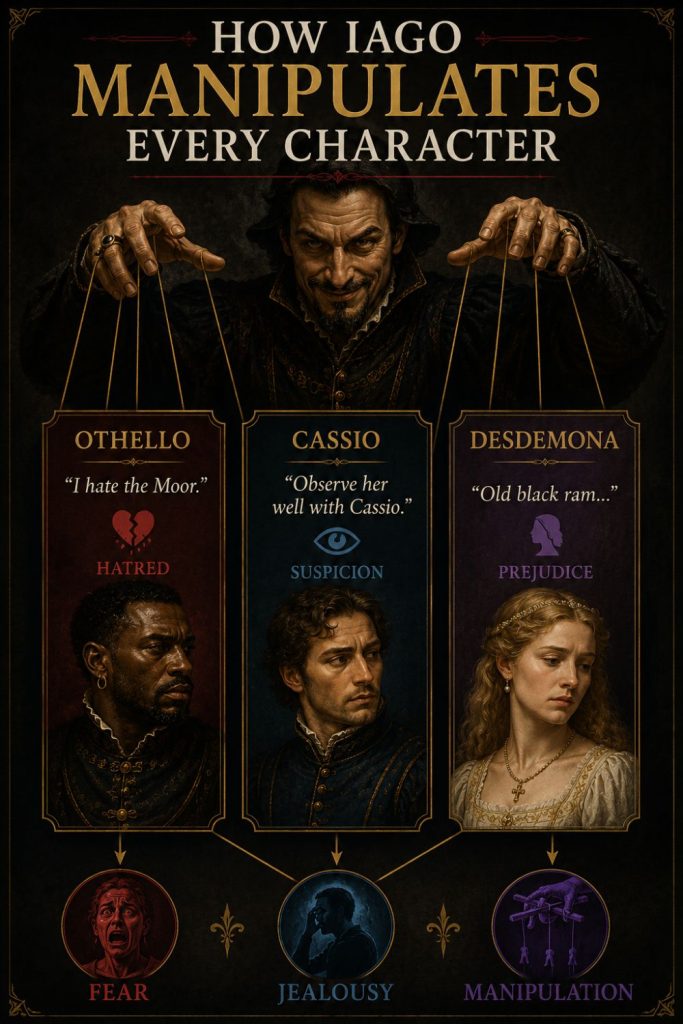
6) “I hate the Moor.” (Act 1, Scene 3)
The bluntness of this declaration is striking because Iago never settles on a single reason for his hatred. Professional jealousy, wounded pride, racial prejudice, and imagined betrayal all surface at different moments. I encourage students not to search for one motive alone.
The play deliberately leaves Iago’s motives unstable and makes him difficult to explain and therefore difficult to contain. The uncertainty surrounding his hatred remains one of the tragedy’s most disturbing features.
7) “An old black ram is tupping your white ewe.” (Act 1, Scene 1)
This crude image is designed to shock Brabantio before it informs him. Iago replaces human beings with animals and exploits racial prejudice through violent visual language.
The line tells us very little about Othello or Desdemona. It tells us a great deal about Iago, who understands that fear often spreads faster than reason.
8) “Look to your wife; observe her well with Cassio.” (Act 3, Scene 3)
Notice that Iago never directly accuses Desdemona of infidelity. He merely encourages Othello to “observe.” That single suggestion is enough. From this point onward, Othello begins interpreting innocent actions as evidence of betrayal.
I often remind students that Iago provides almost no evidence here. Instead, he encourages Othello to become his own investigator. The quotation reveals how easily people can mistake interpretation for proof.
Once Othello begins searching for signs of betrayal, he starts finding confirmation everywhere, whether it exists or not.
Iago Quotes About Jealousy, Reputation, and Power
Some of Iago’s most memorable lines explore abstract ideas rather than individual characters. Jealousy, reputation, and authority become tools in his hands. Shakespeare uses these speeches to show how language can reshape emotions, influence judgment, and ultimately determine the course of the tragedy.
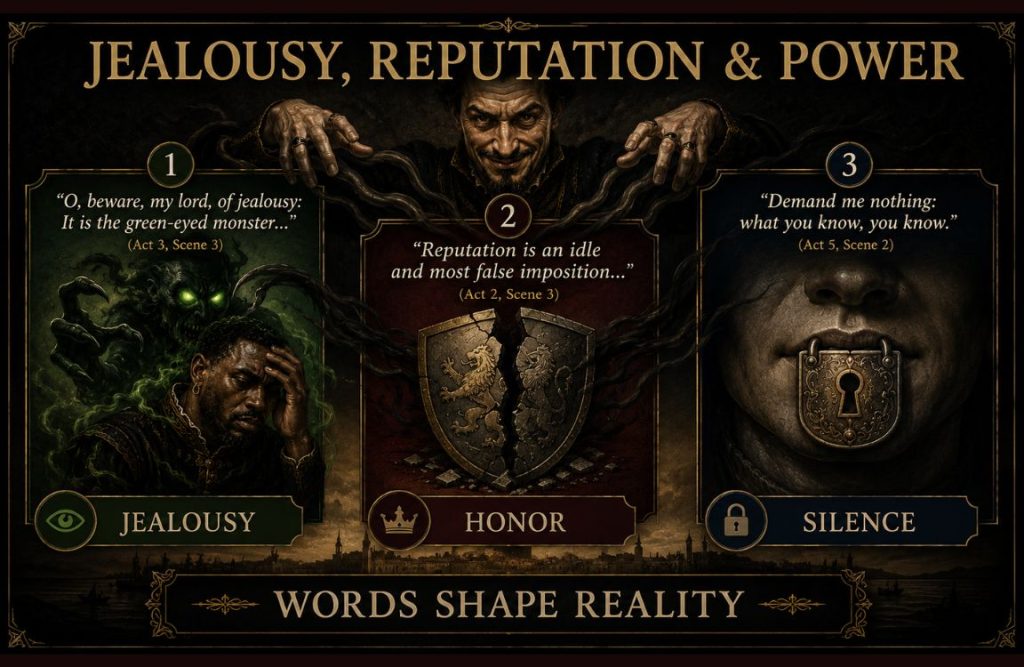
9) “O, beware, my lord, of jealousy: It is the green-eyed monster…” (Act 3, Scene 3)
Perhaps no metaphor in Othello is more famous than the “green-eyed monster.” The cruel irony is that Iago warns Othello against jealousy while secretly cultivating it.
Whenever I teach this line, students are often surprised by how little actual evidence Iago provides. Rather than providing evidence, he simply encourages Othello to imagine possibilities, which allows suspicion to do the rest.
The speech succeeds because it sounds protective rather than threatening. Trust can make persuasive advice far more dangerous than open hostility.
10) “Reputation is an idle and most false imposition…” (Act 2, Scene 3)
Iago portrays reputation as less significant than Cassio believes after Cassio loses his position. The advice sounds comforting, yet it is deeply ironic because Iago spends the entire play destroying other people’s reputations.
Here, Iago treats truth as flexible and morality as situational. His arguments shift according to circumstance, to display a character with no stable ethical centre.
11) “Demand me nothing: what you know, you know.” (Act 5, Scene 2)
Iago’s final words deny both the characters and the audience the explanation they expect. Rather than defending himself or expressing remorse, he chooses silence as his last act of control.
I often remind students that Shakespeare refuses to solve Iago’s mystery. His silence preserves the unsettling ambiguity that has fascinated readers and critics for centuries.
Why Iago’s Quotes Matter in Othello
Iago’s speeches remain unforgettable because they do far more than uncover his personality. They move the action forward, shape other characters’ decisions, and pull the audience into uncomfortable questions about trust and perception.
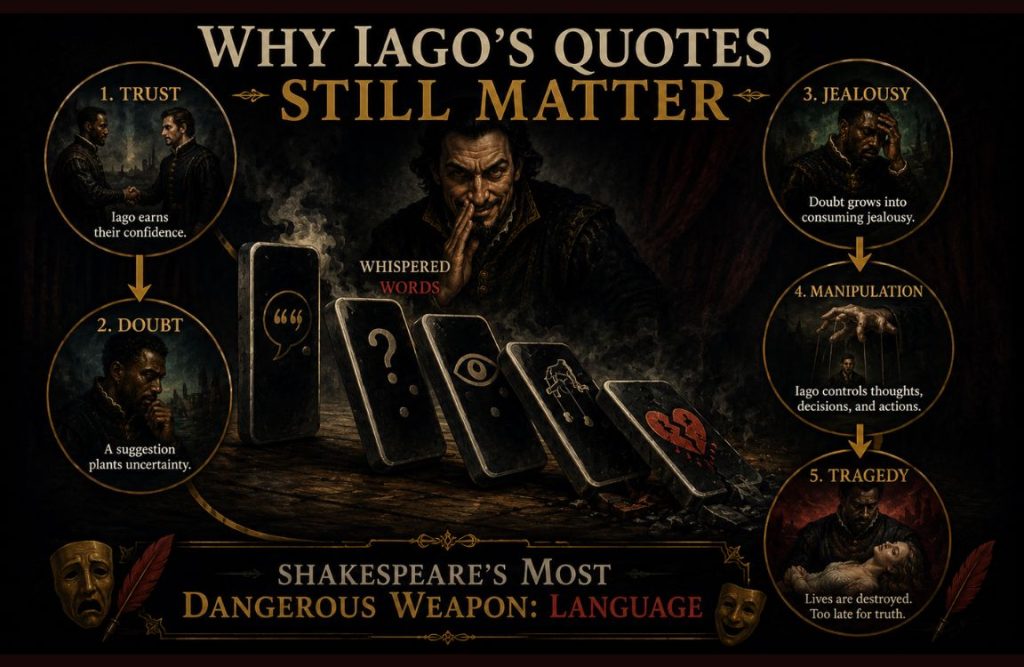
His greatest influence lies in controlling how others understand events. By shaping how other characters understand events, he gradually reshapes relationships, decisions, and ultimately the course of the tragedy itself.
I often remind students that Othello’s tragedy is driven less by physical violence than by conversation. Nearly every turning point begins with a carefully chosen phrase, a half-truth, or an insinuation.
That is why Iago’s quotations deserve close study. They show how assumptions, once accepted as truth, can transform ordinary doubts into an irreversible catastrophe.
What Makes Iago Shakespeare’s Most Disturbing Villain?
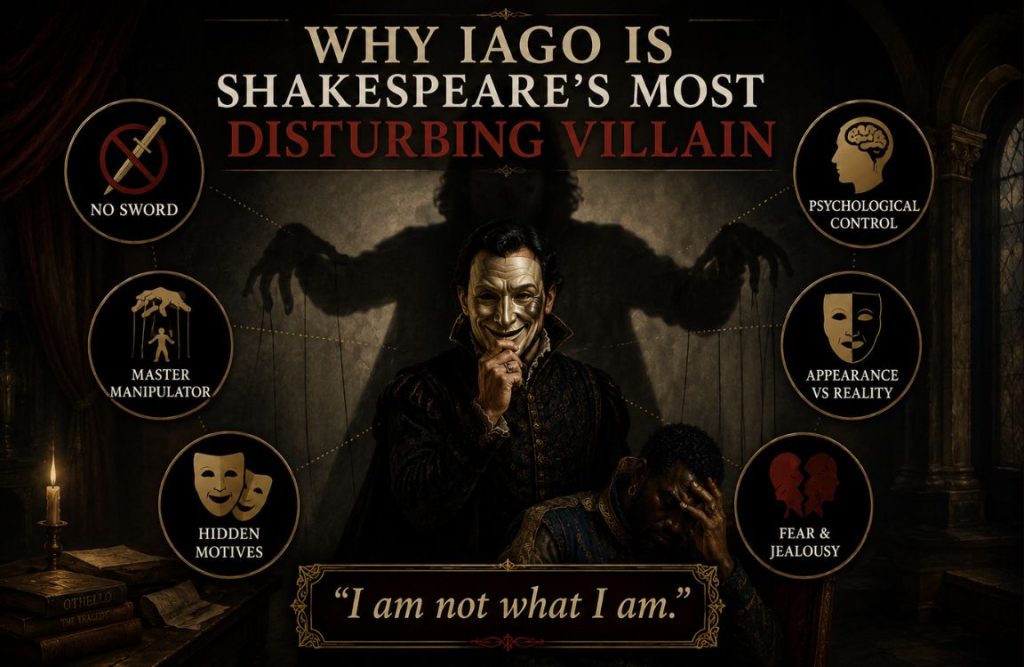
Unlike many Shakespearean villains, Iago does not seek a kingdom, political power, or public glory. His influence comes almost entirely through conversation. Shakespeare creates a character whose greatest power lies in shaping perception.
In my class, while teaching Othello, students often expect a clear explanation for Iago’s cruelty. Instead, Shakespeare leaves his motives frustratingly incomplete. That uncertainty is part of what makes him so unsettling.
By controlling how others interpret events, Iago demonstrates that perception can be more dangerous than reality. His quotes highlight a character who understands human weakness with frightening precision, and help explain why readers continue to find him fascinating centuries later.
FAQs:
Why does Iago speak directly to the audience?
Iago speaks directly to the audience through soliloquies and asides because the playwright wants us to understand his schemes before the other characters do. This creates dramatic irony, which helps us to recognize the truth long before the other characters, to make their downfall even more tragic.
Which Iago quote best shows dramatic irony?
“Men should be what they seem” is often considered the best example of dramatic irony in Othello. Because the audience already knows Iago is dishonest, his statement about honesty becomes deeply ironic and reinforces the theme of appearance versus reality.
Are Iago’s quotes useful for essay analysis?
Absolutely. The key Iago quotes support discussions of appearance versus reality, manipulation, jealousy, race, reputation, dramatic irony, and the use of persuasive language. Strong essays explain not only the quotations themselves but also their dramatic impact.
What literary devices appear most often in Iago’s quotes?
Many of Shakespeare’s Iago quotes rely on metaphor, irony, symbolism, animal imagery, repetition, biblical allusion, and persuasive rhetoric. These techniques allow Iago to influence other characters; at the same time, they reveal his own calculating intelligence to the audience.
Conclusion:
The most memorable Iago quotes reveal a character who understands people almost as well as Shakespeare understands them. Again and again, Iago succeeds not because he possesses extraordinary power, but because he recognizes the fears, desires, and insecurities that already exist within others.
His words expose one of Othello’s most unsettling truths: the greatest dangers often come not from what we know, but from what we are persuaded to believe.
Which Iago quote do you find most disturbing? Share your thoughts in the comments, and explore our related Othello quote guides for deeper literary analysis.