Characters in Othello: Main, Minor, Male & Female Roles

Characters in othello

When I begin teaching characters in Othello and their roles, I warn my students that this play isn’t driven by swords or battles. It’s driven by people. Shakespeare builds tragedy from the inside out, where choices, flaws, and hidden motives do the real damage. Miss the characters, and the play slips right through your fingers.

Othello is a character-driven tragedy. Othello’s trust, Iago’s cunning, Desdemona’s integrity, Emilia’s awakening- each personality pushes the plot like hidden hands on a chessboard. 

While guiding my students, I often say the action doesn’t move. The characters shove it forward. Once you understand how they think, the play stops feeling confusing and starts feeling inevitable. Exams love this too- Shakespeare tests insight, not memory.

That’s why this Othello characters analysis guide breaks everything down clearly: main and minor characters, male and female voices, and the roles they play in shaping the tragedy. Read on, and let the characters of Othello reveal how disaster is built- one decision at a time.

List of Characters in Othello

When students ask for a shortcut through Othello, I say, “Start with the people.” Every name matters. This clean character list works like a seating chart for tragedy- no analysis, just clarity that makes the play (and exams) suddenly click.

List of characters in othello

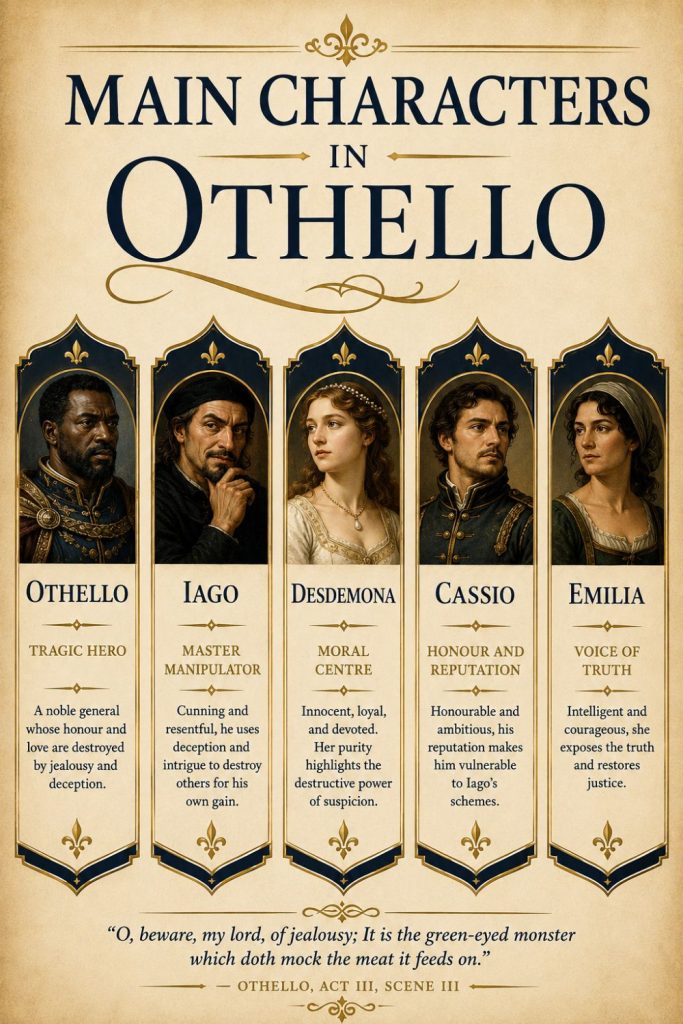
Main Characters in Othello

  • Othello: A Moorish general in the Venetian army
  • Desdemona: Othello’s wife
  • Iago: Othello’s ensign
  • Emilia: Iago’s wife
  • Cassio: Othello’s lieutenant

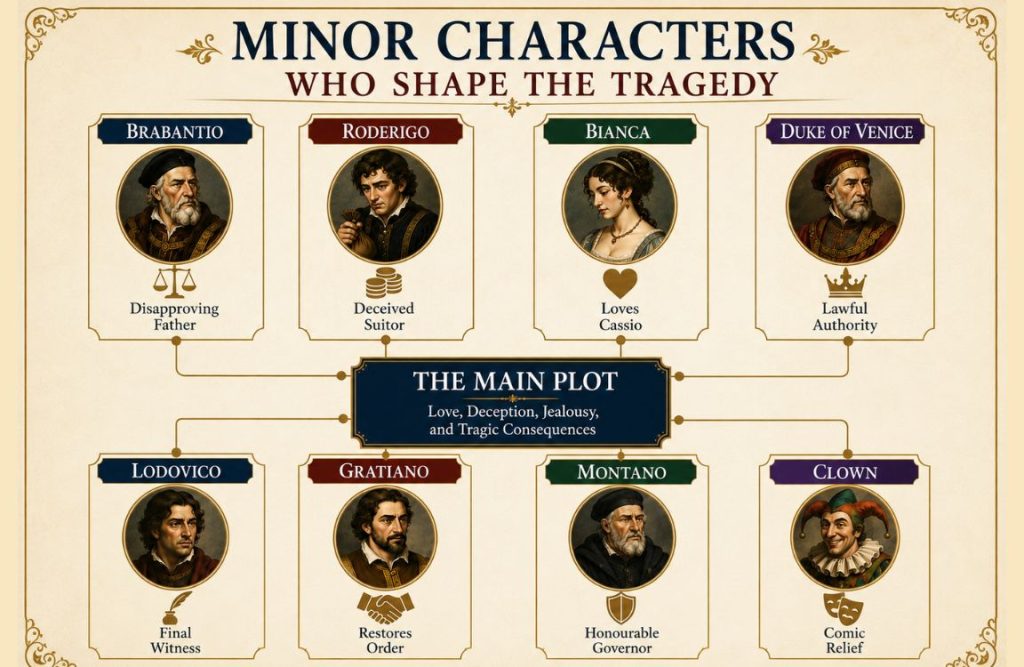
Minor/Supporting Characters in Othello

  • Roderigo: A wealthy Venetian gentleman
  • Brabantio: Desdemona’s father
  • Duke of Venice: Authority figure of Venice
  • Montano: Governor of Cyprus
  • Lodovico: Venetian nobleman
  • Gratiano: Brabantio’s kinsman
  • Bianca: Cassio’s lover
  • Clown: Servant providing comic relief

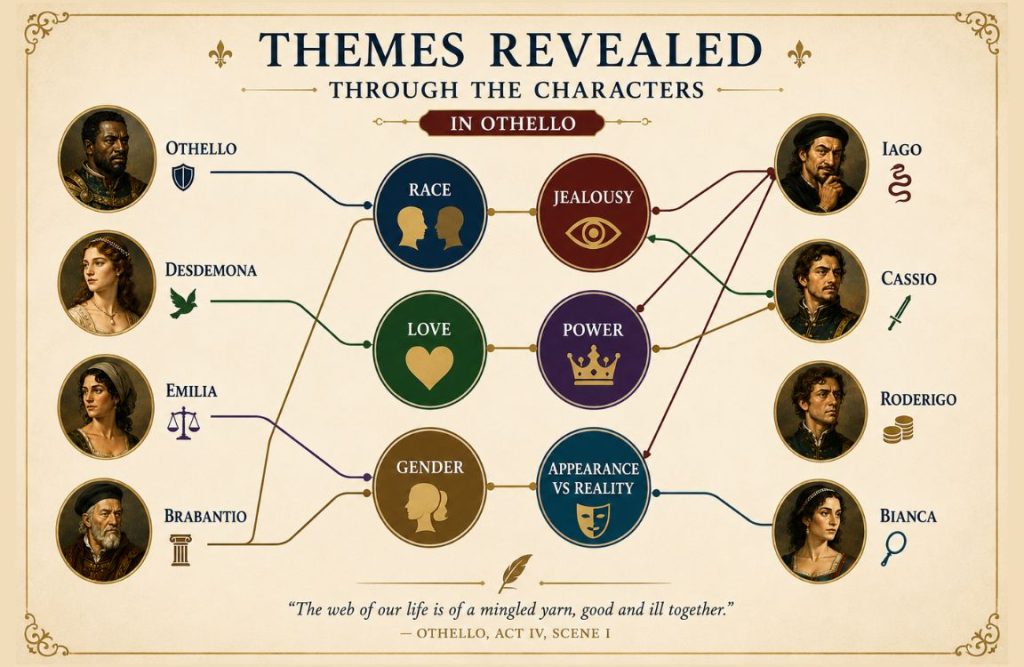
This list includes all characters in Othello by name. For deeper insight into roles, motives, and relationships, keep reading. This is just the roll call before the tragedy begins.

Main Characters in Othello Explained

When I guide students through Othello, I explain that a “main” character isn’t just someone with many lines. These are the figures whose decisions bend the story, whose flaws create momentum, and whose choices carry consequences. Understanding the important characters in Othello turns confusion into clarity and analysis into confidence. Let’s begin where Shakespeare wants us to begin: with Othello himself.

Main chracters in othello role map

Othello: The Protagonist

Othello stands at the emotional center of Shakespeare’s tragedy, a heroic Moorish general, also a tragic hero, whose honor, eloquence, and authority collapse under insecurity, manipulation, and misplaced trust, turning personal decisions into the engine of devastating tragic action.

i) Othello’s Role as the Protagonist:

When I tell students that Othello doesn’t simply appear in the play but powers it, I usually see a few surprised faces. Yet, every turning point comes from his reactions. 

In Act I, he calmly defends his marriage, claiming he won Desdemona “by being honest, just telling his story.”  Later, that same calm mind begins outsourcing judgment to fear. As his trust fractures, so does the world around him. 

Shakespeare structures the play like a mirror: Othello’s inner collapse pulls the entire tragedy down with it.

ii) Othello’s Identity as a Moorish General:

Before judging Othello’s fall, I ask students to meet the man standing tall. He is a Moorish general promoted by ability, not birth. Venice depends on his military brilliance, but unfortunately, it never fully embraces him. 

Respected, yet never quite belonging- that tension quietly hums beneath every later doubt throughout the play.

Othello’s Character Traits: Honour, Insecurity, and Blind Trust

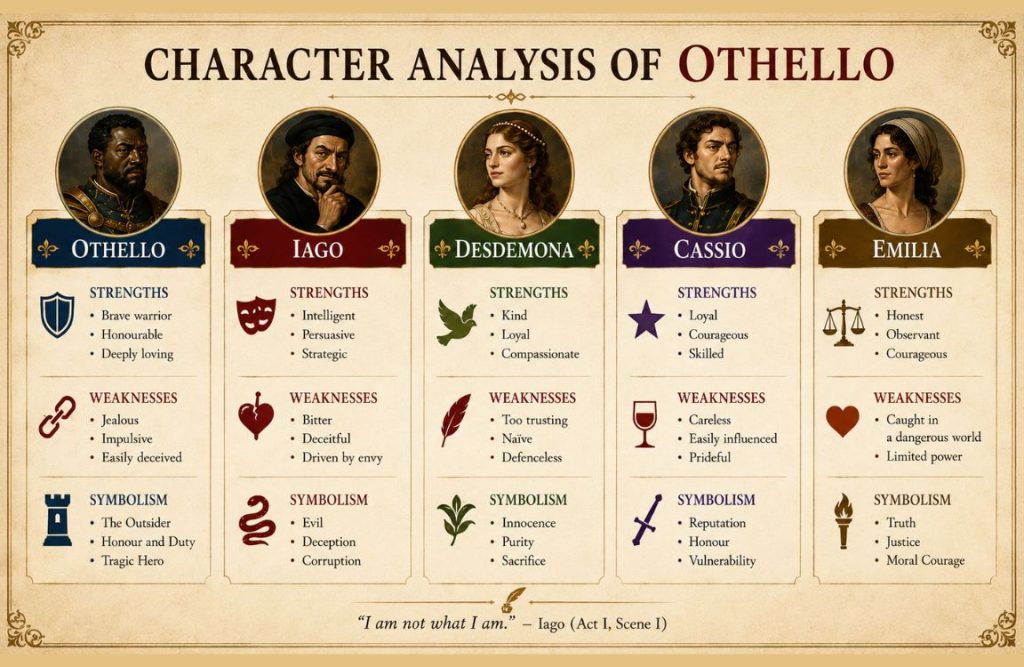
Othello’s character is shaped by powerful contradictions. He is honourable, disciplined, and deeply committed to justice, yet beneath that strength lies a quiet insecurity born from not fully belonging. This mixture makes him dangerously open to blind trust. He believes loyalty is proven through obedience, not questioning, and in Iago’s world, that belief becomes fatal.

Othello's character traits infographic

i) The Eloquent Storyteller:

Look, Othello first conquers everything, everybody, not with swords, but with stories. He speaks of battles, captivity, survival, and Desdemona feels pity for his struggle and finally falls in love listening. This matters. 

He is poetic, measured, and persuasive. His voice carries authority until jealousy turns eloquence into fragments, confidence into echoes.

ii) Othello’s Core Personality Traits: Built for Battle

Othello is not foolish or reckless by nature. He is disciplined, honorable, and trained to command his soldiers. One metaphor I use sticks with my students: Othello is built for open battle, not psychological warfare. 

He believes words should mean what they say, and in a world of whispers, that belief becomes absolutely dangerous.

iii) Noble, Honorable, Yet Insecure:

Within the play, we notice that honor does not erase his insecurity. Venice values Othello’s service, not his identity at all. 

So, when Iago hints that Desdemona might prefer “her own clime, complexion, and degree,” he awakens a fear that had long waited silently for language.

iv) Othello’s Tragic Flaw or Hamartia:

Here’s the moment I underline on the board. Othello’s flaw isn’t jealousy alone. It’s his blind trust without testing, sharpened by his pride and emotional intensity. He demands “ocular proof,” yet accepts a handkerchief as certainty. Strength collapses when belief replaces scrutiny.

These Othello character profiles- honour, insecurity, eloquence, and blind trust- form the backbone of his tragic downfall.

v) Othello’s Role in the Tragic Action:

As the appointed general, Othello brings Desdemona to Cyprus. Iago, his ensign, cunningly feeds him lies and false evidence, pushing him toward obsession. And thus, consumed by jealousy, Othello smothers Desdemona, convinced he is delivering justice. But we, the audiences, know the truth. Othello is completely wrong. 

When the truth finally comes to light, the realization is unbearable for Othello. That’s why his suicide is a final act of remorse- a tragic attempt to reclaim honor after destroying what he loved most.

That is why Othello remains unforgettable: not a villain, but a great man ruined by trusting the wrong voice.

For a closer look, see my In-depth guide on Othello as a Tragic Hero and Tragic Play

Iago: The Antagonist

When students meet Iago in my class, I warn them not to look for horns or a villain’s cape. He enters smiling, joking, blending in, dangerous precisely because he looks ordinary, familiar, and painfully reasonable.

i) Role of Iago in Othello as Antagonist:

In class, I often describe Iago as the engine hidden under the stage. He doesn’t shout commands or swing swords. He only nudges. As the antagonist, his power lies in his power of influence, not authority. 

He rarely acts directly, yet nothing happens without his fingerprints somewhere nearby. That quiet control makes him far more unsettling than a loud villain ever could.

For a deeper look, you can read the complete guide on “Who is the Villain in Othello? Iago, Othello, or Both?”

ii) Iago’s Relationship with Othello:

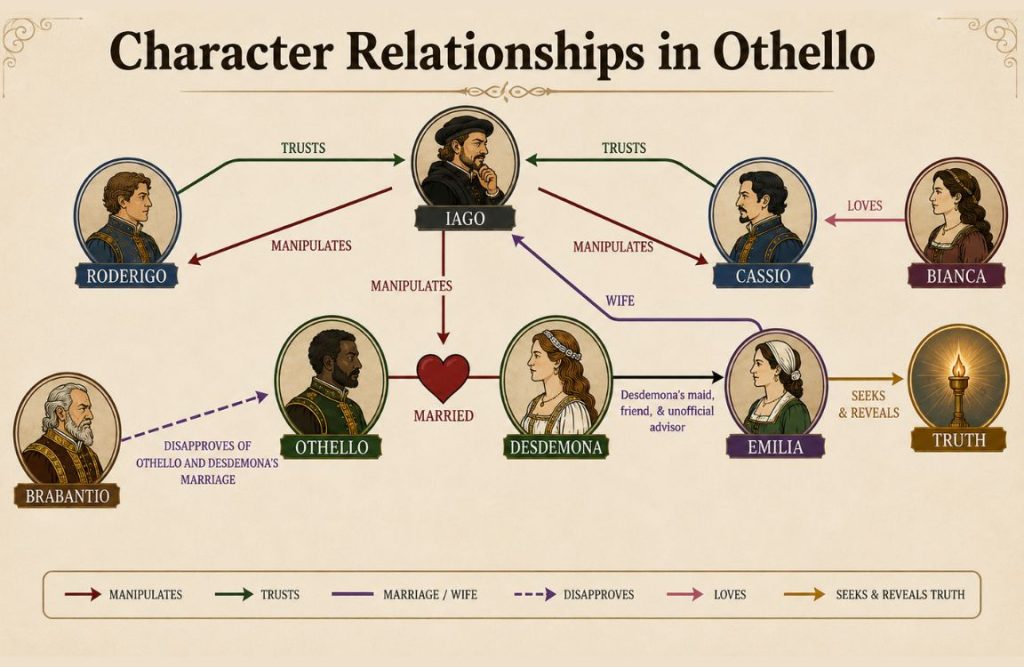
Here’s a live teaching moment I pause on: Iago never attacks Othello openly. Instead, he plays the role of loyal companion, an honest ensign as Othello firmly believes- the man who seems to care just enough. 

He positions himself as a trusted mirror, reflecting Othello’s fears back at him until those fears feel like facts. What unsettles students most is this: Othello doesn’t trust Iago because he’s weak, but because Iago understands how trust works. 

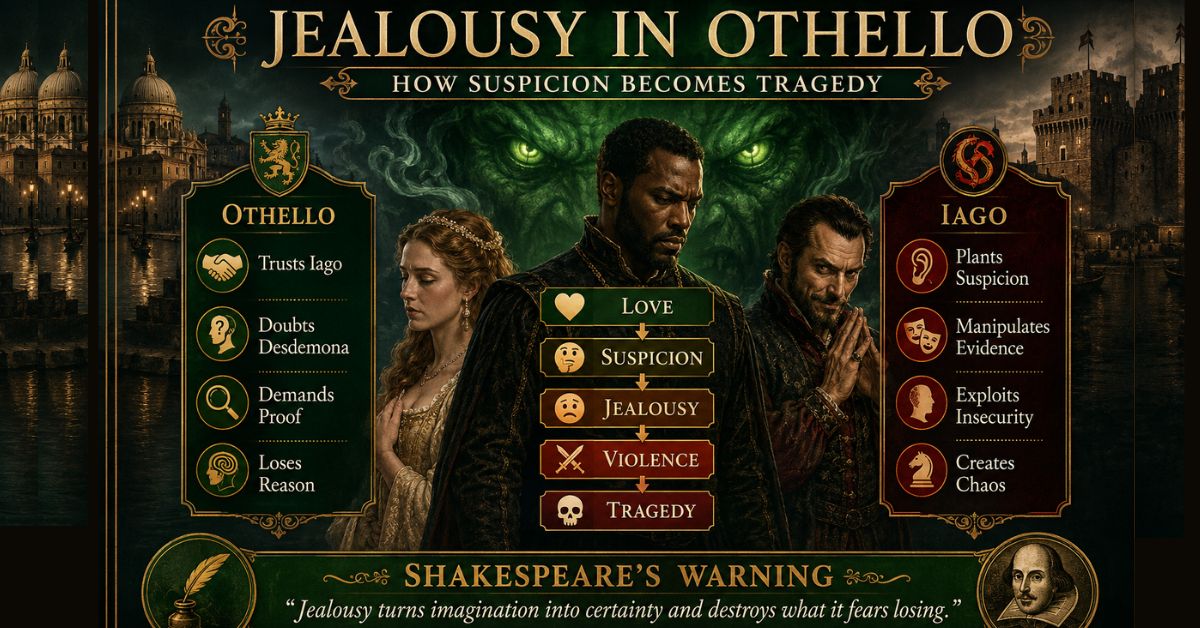
Iago skillfully and cunningly uses Othello’s insecurities to plant the seeds of jealousy, which could convince him that Desdemona is unfaithful. And that planted jealousy smoothly leads Othello to his tragic downfall and the murder of Desdemona. 

Iago Character Traits: Manipulation, Intelligence, and Moral Emptiness

The character of Iago in Othello is defined less by passion and more by precision. He is intelligent, observant, and emotionally detached, able to read people without ever revealing himself. What makes him truly dangerous is his lack of moral hesitation. He understands how fear, prejudice, and doubt work, and uses that knowledge calmly, patiently, and without remorse.

Iago Character Traits

i) Manipulative Intelligence:

Iago’s intelligence is sharp, cold, and emotionally precise. He studies people the way others study maps, noting insecurities, habits, and blind spots. It’s his power. 

I tell my students to imagine him as a skilled puppeteer who never appears on stage; only the strings do. He doesn’t invent emotions. He redirects the emotions craftfully. That’s what makes Iago terrifying. 

His mind turns honesty into a weapon and silence into a strategy, proving that the most dangerous characters are often the ones who seem helpful, reasonable, and calm but are plotting in the shadows. 

ii) Use of Racism & Misogyny as Psychological Weapons:

This is the moment I remind my students that Iago doesn’t create prejudice within the drama, Othello. He simply exploits what already exists. He understands that Othello lives in a society ready to doubt him because of his race, and he quietly presses on that pressure point. By hinting rather than accusing, one of the most cunning characteristics of Iago, Iago lets Venetian racism do the heavy lifting.

At the same time, his view of women is relentlessly cynical. He reduces Desdemona to stereotypes- unfaithful, deceptive, easily swayed- not because he believes them deeply, but because he knows others will. Misogyny becomes his shortcut: if women are presumed false, then suspicion feels logical rather than cruel.

What chills the classroom is this realization: Iago’s greatest weapon isn’t his hatred. It’s a familiar prejudice. He borrows society’s ugliest assumptions and hands them back wrapped as “common sense.” 

And that, I remind my students, is why his manipulation works so efficiently and so quietly that no characters can see or notice it.

Why Iago Is the Most Dangerous Character in Othello?

Iago is the most dangerous character in Othello because he never needs force. He lifts no sword and enters no battles. Instead, he studies people, circles their weaknesses, feeds their fears, and lets them destroy themselves. 

He sounds reasonable, trustworthy, even helpful, until jealousy takes over and the damage is already done.

Iago chararcter analysis infographic

I explore this more deeply in my analysis of Iago’s jealousy

Desdemona: Embodies Innocence

Desdemona often surprises my students in the classroom: gentle yet brave, obedient yet principled. The character of Desdemona in Othello and her character-defining qualities reveal a quiet strength that resists noise, reminding us that moral courage doesn’t always shout. It endures, listens, and speaks when it matters most.

Desdemona Character Traits: Innocence, Moral Strength, and Quiet Courage

Desdemona often looks innocent, but that innocence is not weakness. I tell my students to notice her moral strength. She speaks honestly, loves deeply, and stands by truth even when it costs her. Her courage is quiet, not loud or dramatic, yet it takes real bravery to remain gentle in a violent, suspicious world.

Desdemona character traits infographic

i) Desdemona’s Role as Othello’s Wife:

As Othello’s wife, Desdemona is far more than a romantic figure caught in a tragic storm. I urge my students to watch how she loves Othello: openly, confidently, and without any calculation. She chooses Othello publicly and stands by that choice even when it costs her comfort and safety. 

In marriage, she becomes a steady emotional anchor, offering trust where suspicion grows. Ironically, the more loyal she remains to Othello, the more threatening her honesty becomes in a world addicted to doubt. 

Shakespeare makes her devotion calm and consistent- like a clear note in a room filling with static.

ii)  Desdemona’s Moral Strength vs Social Obedience:

Here’s a moment I pause on in my class: Desdemona obeys social rules, but she never surrenders her conscience. She respects her father, honors her husband, and still speaks up when injustice appears before her. 

That balance is her moral strength. She doesn’t rebel loudly, yet she questions quietly, especially when defending Cassio. 

I often say she walks a tightrope- obedience below, integrity above- and never slips. In a society that expects silence from women, her honesty becomes a subtle act of courage and rebellion 

iii)  Desdemona’s Contrast with Male Characters:

Desdemona’s contrast with the male characters is striking. While men rely on reputation, rank, and control, she relies on truth and empathy. 

Othello demands proof. In exchange, Desdemona offers trust. Iago manipulates language. And she uses it plainly. The men shout certainty while drowning in fear, but Desdemona remains emotionally clear even as danger closes in. 

I remind students: in Shakespeare’s tragedy, Othello, the loudest voices are the least honest, and the quietest one sees the truth first.

iv)  Desdemona’s Downfall: Trapped Between Iago’s Manipulation and Othello’s Jealousy

This is where I ask my students to pause and feel the injustice of Desdemona’s fate. She does not fall because she is flawed, but because she is too honest for a world trained to distrust by cunning Iago. 

Iago never needs to touch her directly. He works on the men around her, poisoning interpretation rather than actions. And Desdemona becomes the victim of a story written without her voice, as Othello never tries to listen to or question her.

Othello’s jealousy completes the trap. His hunger for ocular proof turns love into surveillance, and Desdemona’s openness, once her strength, begins to look like guilt in his distorted vision. 

I tell the class: tragedy strikes not when love disappears, but when love in Othello stops listening.

v)  Desdemona’s Final Moments: Silence, Forgiveness, and Tragic Innocence

Desdemona’s final moments are among the quietest and most devastating in the play. Even as she is wronged beyond measure, she refuses to accuse Othello or anybody. Her last instinct is protection, not self-defense. She shields Othello with her silence and names herself the cause of her own death as she says, “Nobody; I myself.”

In class, this is where the room goes still. Her innocence does not shatter under the violence. Rather, it endures. 

Shakespeare denies us a dramatic outcry and gives us something far more unsettling: a woman whose love remains selfless even at the edge of her death. And Desdemona dies as she lived- faithful, forgiving, and tragically unheard.

Emilia in Othello: Loyal but Brave Feminist

Emilia often arrives quietly during my class, then refuses to stay silent. Emilia’s character analysis and her psychological makeup reveal a woman shaped by marriage, bruised by experience, and awakened by truth, making her one of the most morally significant figures in Othello.

Emilia Character Traits: Loyalty, Moral Awakening, and Courage

Emilia begins the play loyal out of habit rather than love, shaped by marriage and survival. For much of Othello, she endures rather than resists. But suffering sharpens her insight. When truth becomes impossible to ignore, loyalty gives way to courage. Her final stand proves that moral awakening often arrives late, but when it does, it speaks without fear.

Emilia character traits infographic

i) Emilia’s Role as Iago’s wife:

As Iago’s wife, Emilia, lives close to manipulation without fully seeing it, at least at first. I point out to my students to notice how practical she is, not foolish. She views marriage as a means of survival, not romance. 

When she retrieves the handkerchief, she doesn’t plot evil. She seeks approval in a relationship that withholds it. So, complying with Iago’s demand, she picks up Desdemona’s unconsciously dropped handkerchief and hands it to Iago. And it unknowingly feeds Iago’s plot.   

That moment matters. Living beside Iago dulls her trust in men and sharpens her awareness of power. Emilia’s marriage teaches her how authority can silence honesty- until silence becomes unbearable.

ii) Emilia’s Growth Across the Play:

While teaching this moment, I always pause on: Emilia’s growth is slow, believable, and earned. Early on, she jokes cynically about love and fidelity, sounding almost resigned. At this stage, she is an obedient wife of Iago, shaped by habit and hierarchy. Gradually, however, she undergoes a profound transformation.

By the final act, resignation turns into resistance. When truth demands a voice, Emilia chooses it- loudly and bravely. She exposes Iago’s plot despite fear, threats, and fully knowing the cost to her own life.

I pause here to explain to my students that her courage arrives late, but it arrives fully formed. Unlike others, Emilia learns from suffering instead of spreading it.

iii) Emilia’s Significance among Female Characters:

Emilia’s importance in Othello is seen in her transformation from an obedient wife to a brave woman in the final act. Among the female characters, Emilia stands apart as the truth-teller. Desdemona embodies innocence. Bianca shows vulnerability. Emilia brings insight. She understands how men excuse betrayal while condemning women for imagined faults.

When she exposes Iago, she doesn’t just solve the plot. She confronts a system. I remind students: Emilia’s final stand proves that moral clarity can emerge from the margins, and when it does, it shakes the entire tragedy.

Cassio in Othello: The Perfectionist

When Michael Cassio, Othello’s lieutenant, walks into my classroom discussion, students often label him “the good one” and move on. I stop them there. Cassio is goodness under pressure- polished, fragile, and fascinating- making his moral profile and deeper character analysis far more interesting than they first appear.

Cassio Character Traits: Honour, Reputation, and Moral Blindness

Cassio is honourable, courteous, and deeply invested in reputation. He believes good conduct guarantees moral clarity. Yet that belief becomes his blind spot. While he treats women politely, he fails to see how easily his charm harms Bianca. Cassio isn’t cruel, but he is careless, an example of how goodness, unexamined, can still cause quiet damage.

Cassio character traits infographic

i) Cassio’s Role in Othello as Lieutenant:

As Othello’s lieutenant, Cassio represents order, professionalism, and military discipline. He earns his position through reputation, not battlefield brutality. In the play Othello, Cassio is the officer who believes rank comes from merit and manners- an idea that sounds noble until jealousy enters the room and flips the desk.

ii) Strengths, Flaws, and Cassio’s Blind Spot with Bianca:

Here’s where I pause mid-lesson and deliberately bring Bianca into the room- because Cassio’s charm, his polished manners and military skill, only look harmless until you ask who pays the price for it. He is courteous, educated, and deeply loyal, and he speaks of women with respect. 

Yet his treatment of Bianca quietly exposes his flaw. He enjoys her affection but distances himself from her publicly, extremely anxious about his reputation and status. When she appears, he dismisses her too quickly. When she suffers, he barely notices her. 

Shakespeare makes this discomforting on purpose. Cassio doesn’t intend cruelty, but his politeness masks a shallow blindness. His tragedy isn’t malice. It’s the ease with which a “good” man can benefit from affection without responsibility, all while believing himself honourable.

iii) Why Cassio Matters to the Plot:

Cassio matters because he is the first domino Iago tips. His charm, promotion, and respected position make him the perfect pawn. Cassio’s rise fuels Iago’s resentment, while his later demotion ignites Othello’s jealousy and traps Desdemona in suspicion.

Without Cassio’s fall, the tragedy never gains momentum. He proves that in Shakespeare’s world, even the decent can be dangerously easy to manipulate.

Roderigo in Othello: Iago’s Perfect Pawn

Roderigo is the student everyone feels sorry for- until they realise Shakespeare wants us uneasy, not sympathetic. When I introduce him, I call him desire without direction: noisy, needy, and tragically easy to steer off a cliff.

Roderigo Character Traits: Insecurity, Obsession, and Foolish Hope

Roderigo’s role in Othello is driven by insecurity masked as devotion. He mistakes obsession for love and hope for courage. Desperate to be chosen, he clings to Iago’s promises even as evidence piles up against them. 

In class, I describe him as desire without direction- a man so hungry for certainty that he hands his judgment to someone who profits from his confusion.

Roderigo character traits infographic

i) Roderigo’s Function as a Pawn:

In the drama Othello, Roderigo is a wealthy Venetian gentleman who is easily manipulated and painfully foolish. His main job is simple and brutal: he is money, movement, and muscle. Iago doesn’t need Roderigo to think. He needs him to act, repeatedly urging him, “Put money in thy purse.”

Roderigo funds schemes, carries messages, and creates chaos at exactly the wrong moments. He is the chess piece that moves forward because it is pushed, not because it understands the board.

ii) Roderigo’s Personality Weaknesses:

This is where I stumble and ask my students, “What makes someone manipulable?” Roderigo answers immediately: insecurity, obsession, and entitlement. He believes love is like a transaction, believing desire should earn reward.

Rejection doesn’t teach him restraint. It fuels delusion. Add impatience and emotional immaturity, and you get a man who mistakes persistence for passion and foolish hope for courage.

iii) How Roderigo Advances Iago’s Plans:

Roderigo’s role in Othello is to do the dirty work Iago won’t risk himself. He wakes Brabantio, provokes Cassio, stalks Desdemona, and attempts murder- each step nudged by promises that never materialise. 

Watching this unfold feels like a live lesson in manipulation: Iago whispers. Roderigo lunges. His downfall isn’t sudden. It’s the slow, painful cost of outsourcing your thinking to someone who profits from your desperation.

Minor Characters in Othello & Their Roles: Explained

When I tell students to watch the edges of the stage, they look confused- until the minor characters in Othello start quietly steering the tragedy. These supporting characters in Othello don’t shout, but they tilt the moral compass, sharpen the stakes, and reveal truths the heroes miss.

i) Brabantio, Desdemona’s Father: 

Brabantio in Othello, a Venetian senator, represents the proud, authoritative Venetian father whose jealousy and racial prejudice blind him to love and choice, placing tradition in direct conflict with change in Othello.

I often describe Brabantio as an authority losing its grip. He loves Desdemona fiercely, but only on his terms, keeping her under patriarchal control. 

When he cries, “O thou foul thief,” it sounds less like reasoned anger and more like panic. He cannot imagine his daughter choosing freely, so he reaches for witchcraft. That word alone tells my students everything.

Brabantio’s view of Othello is soaked in wounded pride, racism, prejudice, and fear disguised as morality. Traditional, protective, and a little temperamental, which are Brabantio’s key character traits, he clings to old rules while the world moves on.

Though he exits early, his warning, “She has deceived her father,” lodges in Othello’s mind like a splinter, planting the first seed of doubt before Iago ever speaks.

ii) Lodovico, Venetian Nobleman:

Lodovico in Othello is a Venetian nobleman, Brabantio’s relative, and Desdemona’s cousin, who restores order in Othello, representing reason, authority, and moral judgment after emotional chaos.

When my students ask, “Why does Lodovico appear so late?”, I smile, because that timing is the point. Lodovico arrives in Cyprus with a message from the Duke of Venice, when passions have burned everything down. 

Calm, controlled, and unmistakably authoritative, which reflect Lodovico’s key character profiles, he watches Othello strike Desdemona and asks the question we’re all thinking: “Is this the noble Moor?” One line, and the hero collapses.

Unlike Othello or Iago, Lodovico is a man of order, not impulse. He doesn’t shout. He observes. He takes custody of Iago, appoints Cassio as governor, and quietly restores Venetian law. 

Think of him as the school administrator who enters after the classroom has exploded- clipboard in hand, voice steady. Lodovico doesn’t feel the tragedy. He measures it, records it, and makes sure chaos does not get the final word.

iii) Montano in Othello:

Montano is the former governor of Cyprus in Othello, representing calm leadership, civic order, and reason- qualities undone when trust replaces caution.

I advise my students to watch Montano closely. He’s the adult in the room. Calm, rational, and deeply loyal to Venetian law, Montano cares more about public safety than personal pride. 

When Cassio stumbles drunk, Montano doesn’t attack. He questions. That’s leadership. Yet, here’s the twist: his trust becomes his flaw. Iago feeds him half-truths, and Montano listens.

This makes for a powerful teaching time- reason collapses the moment it stops verifying facts. Montano is a responsible leader who values stability, but once passion enters, order bleeds, literally. Injured while trying to protect public order in Cyprus by stepping in to stop Cassio’s drunken violence, he becomes proof that even good governance is fragile.

Montano stands for civic order, and Shakespeare quietly reminds us how easily it can fall when reason is overruled by emotion.

iv) Bianca in Othello:

Bianca, a courtesan, Cassio’s mistress, a foil to Desdemona and Emilia, is deeply in love with Cassio and hopes to marry him, but unfortunately, she is considered a prostitute by all.  She is a marginalized, yet emotionally honest woman in Othello whose loyalty and anger expose double standards and deepen the handkerchief plot.

When Bianca appears, I always pause the class, because Shakespeare hides something important in her small role. Bianca is a courtesan, yes, but more importantly, she’s tender, loyal, and painfully misjudged. 

Cassio enjoys her affection, then flinches when she asks for honesty. When she confronts him over the handkerchief, “This is some token from a newer friend,” her anger isn’t jealousy. It’s her self-respect waking up.

Here’s the teaching twist: Bianca sees the truth sooner than most men on stage. In a feminist reading, she represents the woman society labels and then silences. Emotionally insecure, bold, and deeply affectionate, Bianca becomes an easy target in Iago’s plot. 

Yet, she refuses to disappear quietly. Like a voice from the margins, Bianca reminds us that being underestimated doesn’t mean being wrong.

v) Gratiano in Othello:

Gratiano, Desdemona’s uncle and Brabantio’s kinsman, in the play Othello, a Venetian noble who arrives late but bears witness to the final chaos, voicing truth and inheriting the tragedy’s aftermath.

I make sure my students notice that Gratiano arrives when the damage is already done. He comes to Cyprus with Lodovico, carrying news of Brabantio’s death from Venice, and grief close behind. His presence sharpens the horror. While others rage or collapse, Gratiano states the obvious. When Iago is unmasked, his shock mirrors ours.

This is where the classroom goes quiet because Gratiano doesn’t drive the plot. He frames it. He tends to Cassio, names the villainy, and absorbs the emotional wreckage. 

In the end, he inherits Othello’s wealth as he is the only surviving relative, a cold reminder that tragedy leaves paperwork behind. Like a witness reading the final report, Gratiano helps close the play- quietly, painfully, and with clarity.

vi) Duke of Venice in Othello:

The Duke of Venice in Othello is the fair and rational ruler who judges by merit, supports Othello’s worth and military power, makes crucial decisions, and sets the tragedy in motion by sending him to Cyprus.

When the Duke enters Act 1, I remind the class: Order has arrived. Calm, authoritative, and refreshingly reasonable, the Duke listens before he judges. Faced with Brabantio’s outrage, he values evidence over prejudice and calls Othello “valiant.” That single word matters. It signals Venice’s reliance on skill- even when the commander is foreign.

This is the moment when I pause the lesson. The Duke acts like a surrogate father to Desdemona, gently advising Brabantio to accept her choice. Then, with the cool efficiency of a statesman, he sends Othello to Cyprus, prioritizing state security. 

Problem solved, or so it seems. Brief onstage but powerful, the Duke represents justice at its best, standing in sharp contrast to Iago’s deceit and reminding us how easily order can be undone once it leaves the room. 

Female Characters in Othello

The women in Othello– Desdemona, Emilia, and Bianca- reveal how female voices are ignored, controlled, and finally punished in a deeply patriarchal society.

When I teach this play, I remind students that the tragedy doesn’t just destroy men. Desdemona, Emilia, and Bianca stand at different social levels, yet all pay the same price for speaking, or loving, too freely.

i) Desdemona, wife of Othello and daughter of Brabantio, is noble, obedient, and brave enough to choose love, yet her innocence makes her vulnerable. 

ii) Emilia, Desdemona’s loyal attendant and Iago’s wife, sharper and more worldly, questions marriage and exposes injustice, declaring, “They are all but stomachs,” long before modern feminism had a name. 

iii) Bianca, a courtesan and Cassio’s lover, is dismissed as disposable, yet she shows genuine love for Cassio and emotional honesty.

Here’s the teaching twist: social rank changes, moral insight doesn’t. High-born or marginalized, these women see truth more clearly than the men who rule them. Together, they expose how reputation silences women, and how truth finally fights back, even when it costs everything.

Male Characters in Othello

The male characters of Othello- Othello, Iago, Cassio, Roderigo, and the Venetian senators- reveal how power, reputation, and hierarchy collapse when jealousy and ambition take control. They operate inside a rigid, male-dominated world where status is everything and emotion is a dangerous liability. 

i) Othello: Othello stands at the top of this hierarchy: a celebrated Moorish general in the Venetian army, fearless in war, yet painfully uncertain in private life. His authority looks unshakable, but his trust is brittle- like a fortress with one invisible crack that brings the whole structure down.

ii) Iago: Below Othello lurks Iago. I always point out to the class that if Othello is a lion, Iago is a spider- small, patient, and deadly villain. He holds no grand title, just Othello’s ensign, yet his words do the real damage. Power, as this play keeps reminding us, doesn’t always roar; sometimes it murmurs, “I am not what I am.”

iii) Cassio: Cassio represents reputation at its most fragile. Young, articulate, admired, and handsome lieutenant- until one drunken night erases everything. 

iv) Roderigo: Roderigo, meanwhile, is wealthy without wisdom. This gullible Venetian nobleman is continuously paying Iago to win Desdemona, but finally becomes the pawn of cunning Iago. Around these men stand Venice’s guardians of order- 

  • Brabantio, Desdemona’s father and a Venetian senator. 
  • Lodovico, Desdemona’s cousin and Brabantio’s kinsman, comes to Cyprus with a message. 
  • Gratiano, a noble Venetian who is Desdemona’s uncle and Brabantio’s kinsman.  
  • Montano, the governor of Cyprus, but before Othello’s arrival. 
  • And Clown, Othello’s servant.  

On paper, they symbolize law, tradition, and stability. In reality, they expose how easily masculine authority unravels. 

Brabantio’s outrage is wounded pride masquerading as moral law. Lodovico’s horror at Othello’s fall proves how quickly honor can collapse in public. Montano shows how swiftly rank shifts when control is lost. Together, these men reveal an unsettling truth: male power appears solid- until jealousy enters the room.

FAQ:

How many characters are in Othello?

Othello has around 13 named characters, including Othello, Iago, Desdemona, Emilia, Cassio, Roderigo, Bianca, Brabantio, Montano, Lodovico, Gratiano, the Duke of Venice, and the Clown, alongside several minor, unnamed roles.

How many female characters are in Othello?

There are three female characters in Othello: Desdemona, Emilia, and Bianca, who carry clarity, conscience, and truth in a world where men talk loudly and listen poorly.

How many male characters are in Othello?

Othello includes around ten male characters, filling the stage with soldiers, senators, and schemers. The male voices dominate power, yet their unchecked emotions are exactly what drive the tragedy off course.

Why is Emilia important in Othello?

Emilia matters because she grows. She begins obedient and ends fearless, choosing truth over survival. I tell students: Emilia proves moral courage can arrive late, but when it does, it shakes everything.

Who is the most jealous character in Othello?

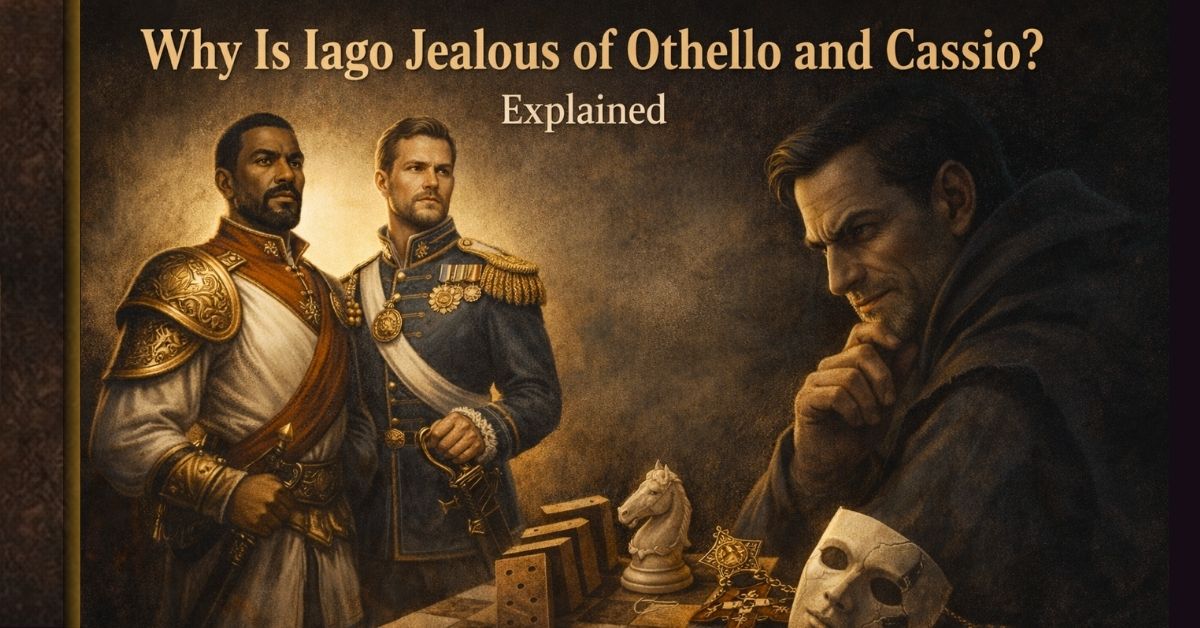
Students often say Othello, and they’re right, eventually. But I point out to you earlier: Iago is jealous first. His envy of Cassio’s promotion ignites the plot, while Othello’s jealousy is the fire that finishes what Iago starts.

Who is the most tragic character in Othello?

I argue it’s Othello. Not because he suffers most, but because he understands too late. His tragedy lies in realising the truth only after destroying the person who loved him completely.

Who was the first woman in Othello?

Desdemona is the first woman introduced in Othello, and that matters. She enters the play already chosen, by herself. Shakespeare gives her agency before tragedy steals her voice, making her later silence even more painful.

Is Othello a feminist play?

No, Othello isn’t feminist, but it’s sharply aware and offers the ground for feminist critique. Shakespeare exposes how women are silenced, judged, and punished. Through Emilia, Desdemona, and Bianca, the play critiques patriarchy even while showing its devastating grip.

Is Desdemona a virgin in Othello?

Yes, Shakespeare presents Desdemona as sexually faithful and chaste. I stress this because the tragedy hurts more when we know the truth. Her purity contrasts cruelly with the filthy accusations that destroy her, revealing how suspicion poisons love.

Is Iago Desdemona’s dad?

No, and this question always makes me laugh. Desdemona’s father is Brabantio, a Venetian senator. 

Is Iago in love with Desdemona?

No, Iago doesn’t love Desdemona. Rather, he uses her to take revenge against Othello. His language is obsession, not affection. 

Who is the most important character in Othello?

Othello is the most important character, because the tragedy lives inside him. Iago pushes, but Othello chooses. The play turns on his trust, his doubt, and the moment he stops questioning the wrong voice.

Who are the foil characters in Othello?

Shakespeare loves contrast. Othello and Iago foil trust and deceit. Desdemona and Emilia foil innocence and experience. Cassio and Iago foil honor and manipulation. I tell students: foils don’t just highlight traits. They sharpen the tragedy.

Which characters die in Othello?

Four characters die on stage in Othello: Desdemona (killed by Othello), Emilia (killed by Iago), Roderigo (killed by Iago), and Othello (dies by suicide). Brabantio is reported to have died offstage, likely from grief.

Conclusion:

When I finally close Othello with my students, I remind them that characters in Othello are not just names on a list. Every character, major or minor, is a pressure, a choice, and a consequence in motion. 

This tragedy isn’t powered by fate or swords, but by people trusting the wrong voices. Othello’s faith, Iago’s manipulation, Desdemona’s honesty, Emilia’s awakening, even Montano’s injured reason- all reveal how fragile order can be. 

Once you truly understand all characters of Othello and how they think, the play stops feeling chaotic and starts feeling inevitable, like dominoes falling exactly as designed. Shakespeare isn’t testing memory. He’s testing insight. He wants us to see how jealousy grows, how silence spreads, and how belief can be weaponized. 

That’s the final teaching moment I leave behind: if words can destroy this much on stage, imagine what they can do off it.

Read also “Ending of Othello Analysis: Death, Betrayal, and Lessons

Leave a Comment

Your email address will not be published. Required fields are marked *

Scroll to Top