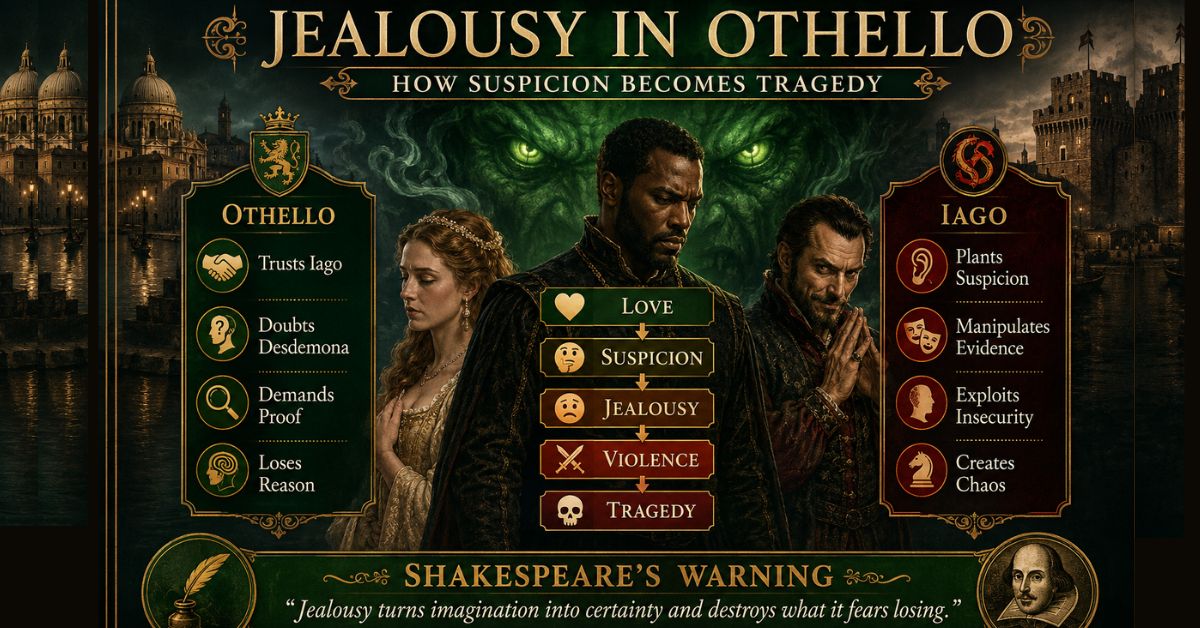
The ending of Othello always leaves my students emotionally shaken. One moment, the stage is crowded with suspicion and rage; the next, the play descends rapidly into violence and death
In that chaos, many readers suddenly ask: Does Cassio die in Othello, too? Honestly, Shakespeare designs Act 5 like a dark maze where nobody feels safe for long.
The confusion grows during Iago’s secret ambush in the street. Cassio is attacked at night, swords flash in the dark, and panic spreads everywhere. At first glance, it almost feels certain that he is doomed. After all, betrayal in Othello moves faster than truth.
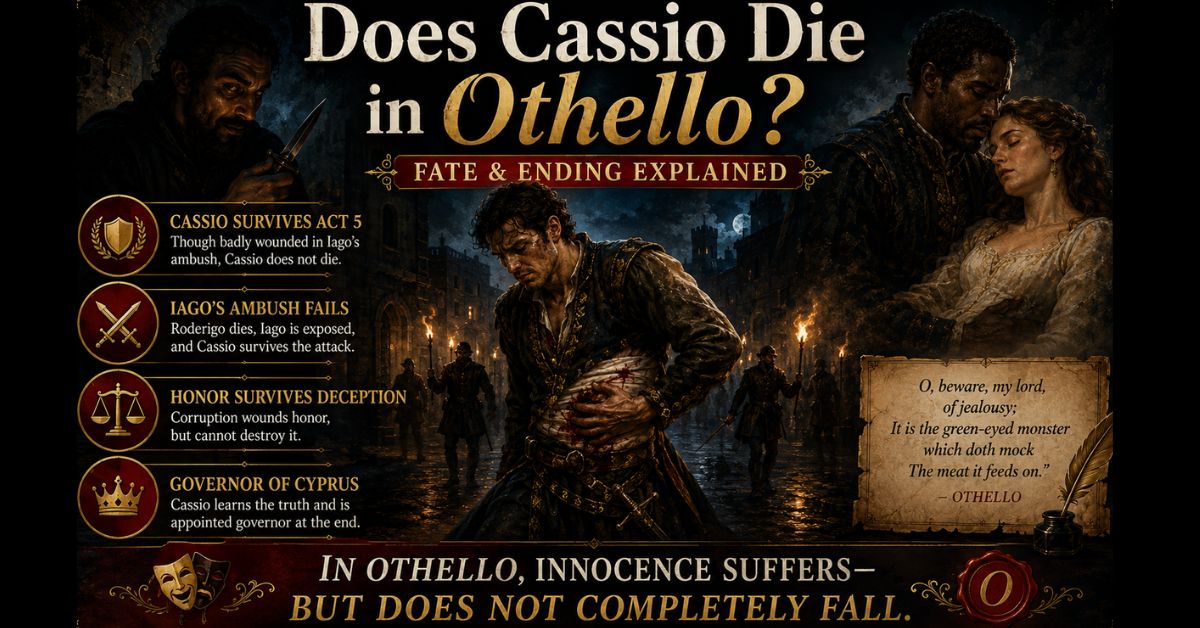
But here comes Shakespeare’s twist: although Cassio is badly wounded, he does not die. In fact, his survival becomes one of the final ironic turns in the tragic Othello ending.
Does Cassio Die in Othello?
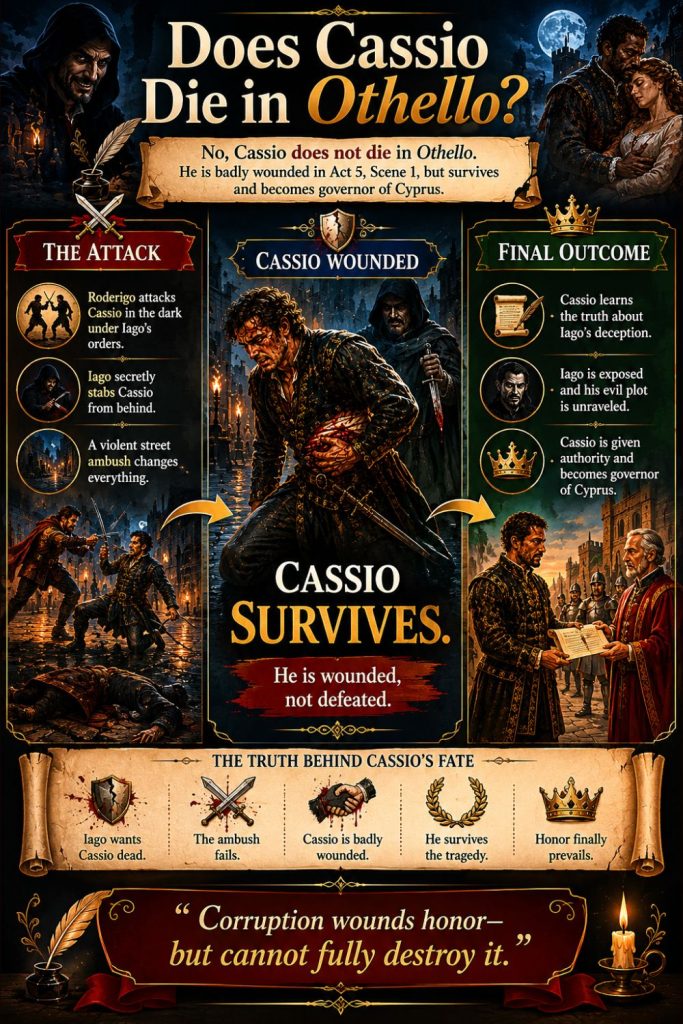
No, Cassio does not die in Othello. Although he is seriously wounded during Iago’s attack in Act 5, Scene 1, he survives and becomes governor of Cyprus at the end of the play.
Many students ask me, “Did Michael Cassio die in Othello, or did Shakespeare spare him for a reason?” The answer matters because Cassio’s fate in Othello reflects the play’s final moral balance. Iago wants him dead because Cassio’s honesty threatens the entire deception.
In Act 5, Roderigo attacks Cassio in the dark under Iago’s orders. Cassio fights back bravely, but Iago secretly wounds him from behind. Meanwhile, Roderigo dies instead after Iago murders him to hide the truth. It is a chilling moment where evil tries to erase its own footprints.
Yet Cassio survives in Othello. By the play’s end, he learns the truth about Iago and receives authority over Cyprus. Shakespeare almost whispers to us here: corruption may wound honor, but it cannot completely destroy it.
Table of Contents
Who Is Cassio in Othello?
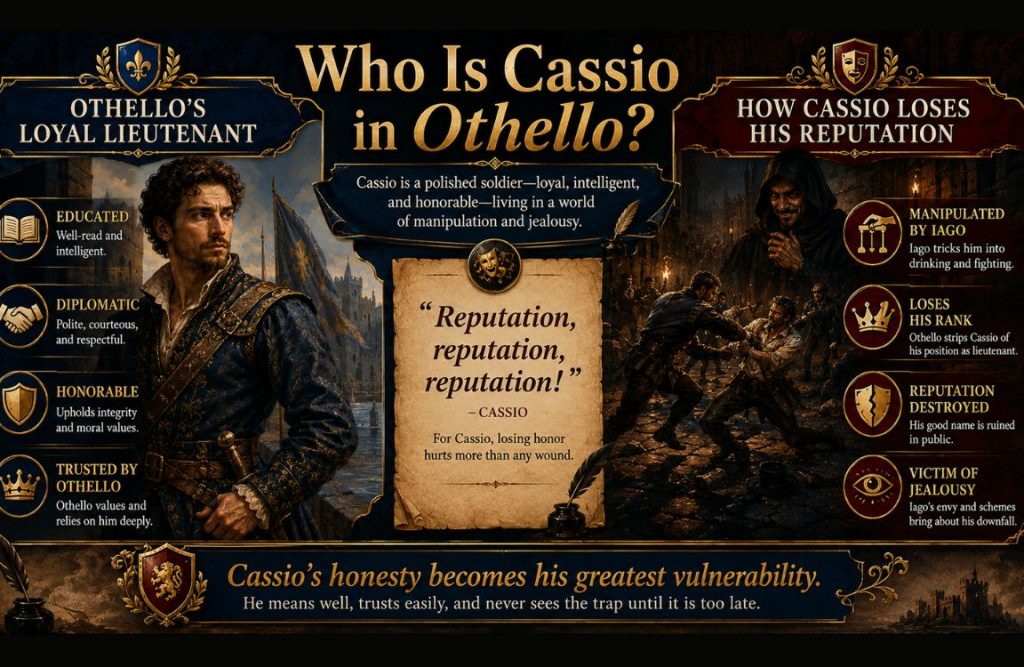
Whenever I teach Cassio in Othello, I describe him as the polished soldier trapped inside a world of manipulation and jealousy. He is intelligent, courteous, and tragically unaware that Iago watches him like a spider watching a fly.
i) Cassio as Othello’s Loyal Lieutenant
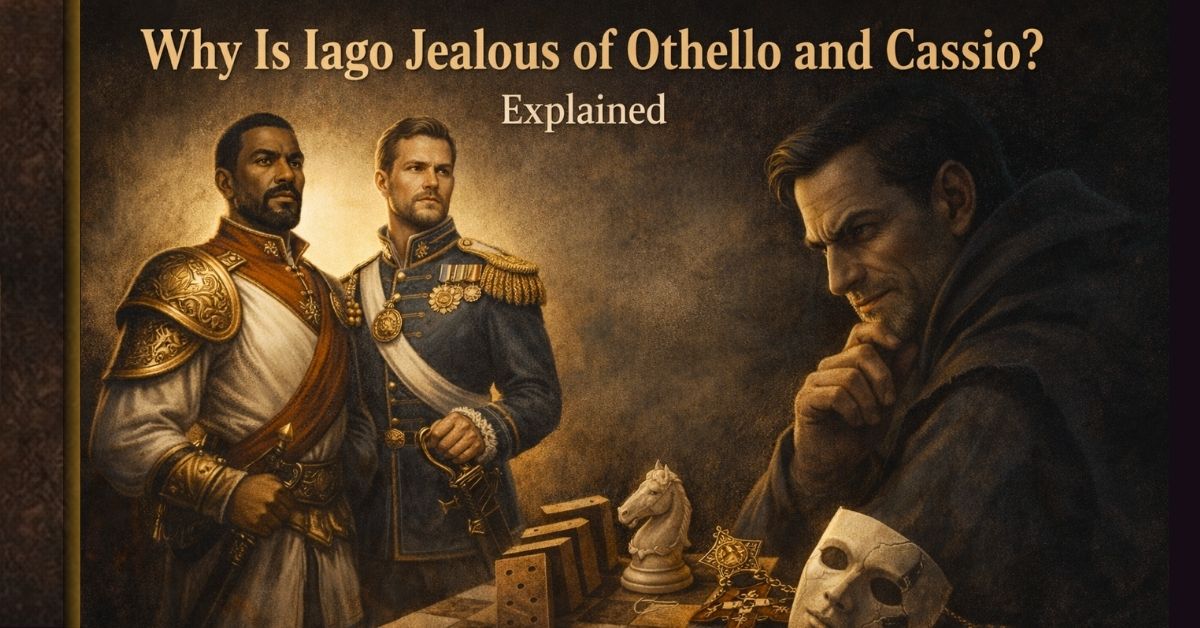
Cassio serves as Othello’s loyal lieutenant, the military rank he holds before Othello strips it from him after the drunken brawl. Unlike rough battlefield veterans, Cassio is refined, educated, and diplomatic. Othello deeply trusts him, which immediately sparks Iago’s jealousy.
I often tell students that Iago sees Cassio the way a resentful employee sees the coworker who got promoted first. The envy burns quietly but dangerously. To Iago, Cassio represents everything he lacks: charm, reputation, and authority.
Even worse for Iago, Cassio earns success honestly. That honesty becomes his weakness in a play where manipulation wears the mask of friendship. Shakespeare cleverly places Cassio at the center of Iago’s destructive scheme, showing how innocence can suffer in a world ruled by deception and envy.
ii) How Cassio Loses His Reputation
Cassio loses his reputation after Iago tricks him into drinking too much and provoking a violent street fight. Othello, furious at the disorder, removes him from his position as lieutenant. For Cassio, the punishment feels worse than a physical wound.
His famous cry still echoes in literature classrooms: “Reputation, reputation, reputation!” At that moment, students suddenly realize how deeply honor matters to him. Unlike Iago, Cassio values his public image and moral dignity.
What makes the scene painful is that Cassio never understands the trap. Iago and Cassio appear friendly on the surface, yet Iago quietly engineers his downfall like a director controlling a tragedy from backstage.
Why Does Iago Attack Cassio in Act 5?
By Act 5, Iago behaves less like a man and more like a desperate criminal covering evidence. Cassio remains alive, respected, and dangerous to Iago’s lies. That is why the attack becomes inevitable in Shakespeare’s tragic machinery.
i) Iago’s Plan to Remove Cassio
Iago attacks Cassio because Cassio threatens to expose his entire scheme. As long as Cassio lives, the truth can still surface. So, Iago manipulates Roderigo into murdering him by promising that Desdemona will become available afterward.
I sometimes joke with students that Roderigo is the easiest victim in Shakespeare’s universe. He follows Iago so blindly that he walks straight into disaster, carrying the knife himself.
But Iago never truly trusts Roderigo either. The moment the attack fails, Iago kills Roderigo in Othello to silence him forever. It is a brutal reminder that villains often destroy their own allies first when fear takes control.
ii) What Happens in Act 5, Scene 1 of Othello?
In Othello Act 5 Scene 1, the streets of Cyprus become dark, tense, and frightening. Roderigo attacks Cassio at night, hoping to kill him quickly. However, Cassio defends himself fiercely and wounds Roderigo instead.
Then Shakespeare adds another twist to the scene. While Cassio struggles in confusion, Iago secretly stabs him from behind and escapes unnoticed. Cassio is wounded in Othello, but he survives the ambush. His injury creates panic, yet it does not end his life.
Meanwhile, Iago murders Roderigo to hide the truth about the conspiracy.
This scene feels almost cinematic when taught aloud in class: shadows, betrayal, hidden weapons, and characters collapsing in darkness. Through this violent chaos, Shakespeare proves how deception eventually consumes everyone connected to it.
What Happens to Cassio at the End of Othello?
At the end of Othello, Cassio stands among the few survivors left to face the wreckage created by jealousy and manipulation. His survival gives the tragedy a faint sense of order after overwhelming destruction.
i) Cassio Survives the Tragedy
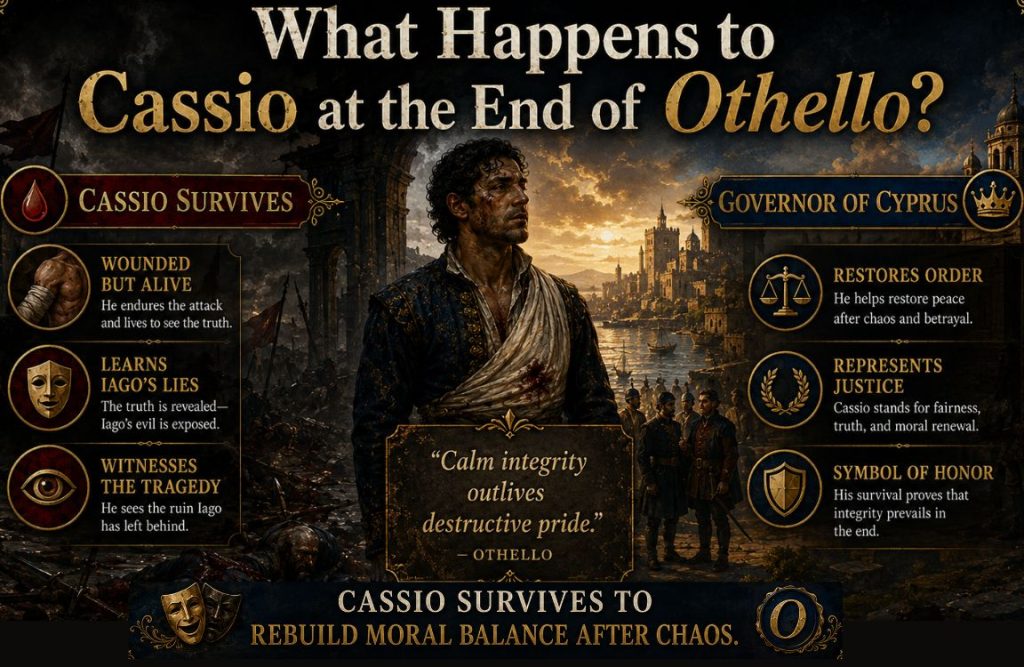
Does Cassio die at the end of Othello? No, he survives the tragedy despite his injuries. By the final scenes, Cassio finally learns how deeply Iago deceived everyone around him.
I always tell my students that Cassio’s survival carries symbolic meaning. Shakespeare allows at least one honorable character to remain standing after evil collapses. In a play filled with lies, Cassio becomes proof that innocence can suffer without being completely destroyed.
There is also painful irony here. Cassio never seeks power aggressively, yet he survives while stronger and more passionate characters fall. Shakespeare quietly suggests that calm integrity sometimes outlives destructive pride and uncontrolled emotion.
ii) Cassio Becomes Governor of Cyprus
In the final scene of Othello, Lodovico gives authority to Cassio and appoints him governor of Cyprus. This political restoration matters because the play desperately needs stability after so much bloodshed and betrayal.
Othello’s downfall contrasts sharply with Cassio’s rise. Earlier, Othello trusted Iago’s poisonous lies and lost everything: his marriage, honor, and life. Cassio, however, survives long enough to witness the truth exposed publicly.
When teaching this moment, I often describe it as Shakespeare rebuilding order from broken ruins. Cassio becomes governor of Cyprus not because he is perfect, but because he remains fundamentally honorable. That difference matters enormously in the final scene of Othello.
So, what happened to Cassio in Othello? He suffered manipulation, humiliation, and violence, yet ultimately survived to help restore justice after tragedy consumed nearly everyone else.
Who Dies in Othello?
By the final act of Othello, the stage feels less like a courtroom and more like a graveyard built from jealousy, pride, and manipulation. Shakespeare does not simply kill characters; he tears apart relationships, trust, and innocence. Almost every major figure falls before the curtain closes.

i) Death of Desdemona
Who killed Desdemona in Othello? Tragically, Othello himself murders her. Believing Iago’s poisonous lies, he smothers Desdemona in bed during one of Shakespeare’s most heartbreaking scenes. When students ask how Desdemona dies in Othello, I remind them that her death is not caused by betrayal alone, but by misplaced trust. Even in her final moments, Desdemona remains painfully loyal.
ii) Death of Roderigo and Emilia
Does Roderigo die in Othello? Yes, Iago secretly kills him after the failed attack on Cassio. Poor Roderigo spends the entire play chasing love and ends up chasing death instead. Shakespeare almost uses him as a warning about blind obsession.
Does Emilia die in Othello, too? Sadly, yes. After courageously exposing Iago’s lies, Emilia is murdered by her own husband. Why does Iago kill Emilia? Because truth finally corners him. In a cruel twist, the woman ignored throughout the play becomes the voice that destroys his deception.
iii) Othello’s Death
How does Othello die? Once the truth about Desdemona emerges, Othello collapses under guilt and horror. He realizes too late that he has destroyed the innocent woman he loved most deeply.
Does Othello kill himself? Yes. Othello’s death comes by his own hand as he stabs himself beside Desdemona’s body. No enemy kills Othello physically; his jealousy does. That is Shakespeare’s cruel genius. The real murderer throughout the tragedy is manipulation disguised as honesty.
Why Does Shakespeare Keep Cassio Alive?
Whenever this question appears in class, students usually pause. After so much bloodshed, why does Shakespeare allow Cassio to survive? The answer reveals something important about justice, order, and the tragic end of Othello.
i) Cassio as the Symbol of Order and Honor
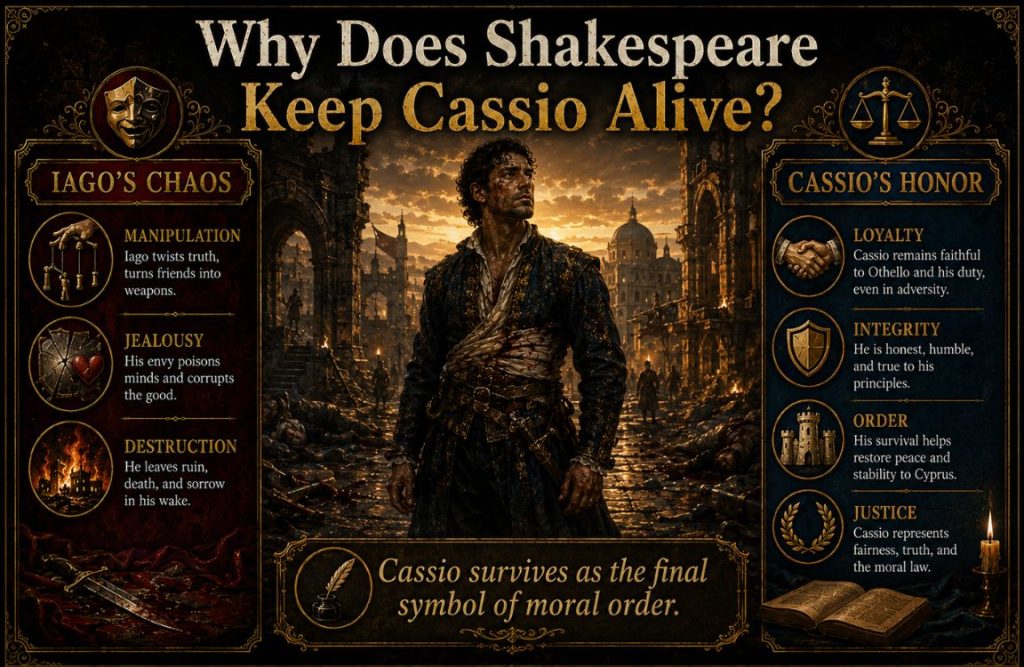
In any Michael Cassio character analysis, one truth stands out clearly: Cassio contrasts sharply with Iago. While Iago represents manipulation and chaos, Cassio symbolizes loyalty, discipline, and civilized order. He makes mistakes, certainly, but never acts from cruelty.
I often compare Cassio to the final candle still burning after a violent storm. Shakespeare keeps him alive to preserve a final sense of justice after the chaos. Someone must remain to rebuild moral balance.
Othello’s tragic ending becomes more powerful through Cassio’s survival. Evil wounds him physically, yet cannot corrupt him spiritually. That moral survival matters more than victory in battle.
ii) Cassio’s Survival Strengthens the Tragic Ending
The ending of Othello hurts more because Cassio survives to witness the destruction around him. He becomes one of the few characters left standing among shattered lives and broken trust.
Shakespeare’s tragic structure often leaves a survivor behind to restore order after the climax. Here, Cassio fulfills that role. When students ask who survives in Othello, the answer carries emotional weight because survival itself becomes a burden.
Cassio’s presence in the final scene reminds readers that jealousy destroys nearly everyone it touches, even when justice eventually returns.
FAQs:
Does Cassio know Iago is evil?
No. Cassio trusts Iago for most of the play and only learns the truth near the end.
Is Cassio responsible for Othello’s jealousy?
Not intentionally. Cassio remains innocent and never has a romantic relationship with Desdemona.
Why is Cassio important in Othello?
Cassio is important because he represents honor, loyalty, and the innocent victim of Iago’s manipulation.
Conclusion:
So, does Cassio die in Othello? No, he survives, though Shakespeare certainly drags him through fear, violence, and manipulation before allowing him peace. By the play’s end, nearly every major character falls: Desdemona is murdered, Emilia is silenced for telling the truth, Roderigo is discarded by the villain he trusted, and Othello destroys himself through jealousy.
What happens to Cassio at the end of Othello is deeply significant. His survival represents stability returning after chaos. Shakespeare seems to warn us that unchecked suspicion can poison love faster than any weapon.
That is why Othello still feels painfully modern today.
Want deeper Shakespeare explanations in simple language? Explore more literary guides and analyses of Othello.