Motifs in Othello are not decorative extras. They are the quiet echoes that make the tragedy inevitable. Every year, when I ask my students why the play feels so suffocating by Act V, someone says, “Because jealousy wins.” True, but jealousy in Othello travels through patterns.
A motif is a recurring image or idea that keeps resurfacing, shaping meaning beneath the dialogue. In Othello, those patterns include animal imagery (“old black ram”), sight versus blindness, hellish and demonic language, poison and disease, the symbolic handkerchief, gardening metaphors (“our bodies are our gardens”), and the contrast between light and darkness.
The analysis of important motifs and patterns in Othello shows how these repetitions intensify manipulation, racism, and moral decay. When we examine the themes and motifs in Othello, we see that tragedy here isn’t sudden. It is cultivated, poisoned, and carefully constructed until the final breath feels terrifyingly inevitable.
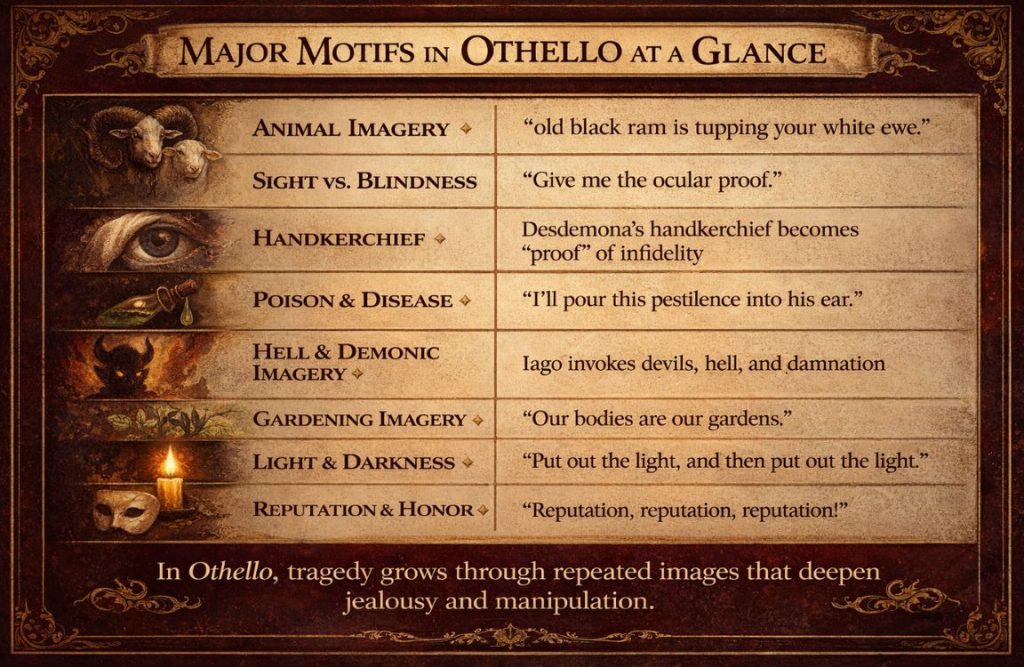
Major Motifs in Othello at a Glance (With Examples)
Before we dive into deeper analysis, here’s a quick summary of motifs in Othello. When I introduce these patterns to my students, I show them how Shakespeare repeats certain images throughout the play to quietly reinforce its central themes.
| Motif | Example from the Play | What It Reveals |
| Animal Imagery | “Old black ram is tupping your white ewe.” | Dehumanizing language that fuels racism and reduces love to crude animal lust. |
| Sight vs. Blindness | “Give me the ocular proof.” | Othello trusts visible evidence, yet becomes morally blind as he believes Iago’s lies. |
| The Handkerchief | Desdemona’s handkerchief becomes “proof” of infidelity. | A love token that turns into false evidence, driving the tragedy. |
| Poison and Disease | “I’ll pour this pestilence into his ear.” | Jealousy spreads like an infection, corrupting trust and judgment. |
| Hell and Demonic Imagery | Iago invokes devils, hell, and damnation. | Frames Iago as a devilish manipulator tied to moral corruption. |
| Gardening and Plants | “Our bodies are our gardens.” | Suggests character can be cultivated- ironically, Iago plants jealousy instead. |
| Light and Darkness | “Put out the light, and then put out the light.” | Light suggests truth and life, while darkness hides deception. |
| Reputation and Honor | “Reputation, reputation, reputation!” | Shows how fragile public honor is and how easily it can be manipulated. |
When we explore these key motifs in Othello, we see something chilling: Shakespeare doesn’t let tragedy explode suddenly. He plants it, waters it, infects it, blinds it, and only then lets it bloom. And that, I remind my students, is why the play feels inevitable rather than accidental.
Motifs and Symbols in Othello: What’s the Difference?
Students often mix up motifs and symbols in Othello, and honestly, I don’t blame them. Shakespeare weaves both so tightly that they feel inseparable. But once we separate pattern from object, repetition from representation, the tragedy becomes sharper and far more deliberate.
i) Motif vs Symbol in Othello
In Othello, a symbol is a specific object that carries layered meaning (like the handkerchief in Othello), while a motif is a recurring image or pattern (like animal imagery or “honest”) that reinforces major themes throughout the play.
Here’s how I explain it in class. A symbol is one solid object loaded with meaning. A motif is a pattern that keeps resurfacing. Think of a symbol as a candle; a motif is the same flickering light appearing in every room.
Take the handkerchief in Othello. It begins as a token of love and fidelity, making it one of the most important symbols in Othello. Yet when Othello demands “ocular proof,” it transforms into evidence of betrayal. The object remains. Its meaning shifts.
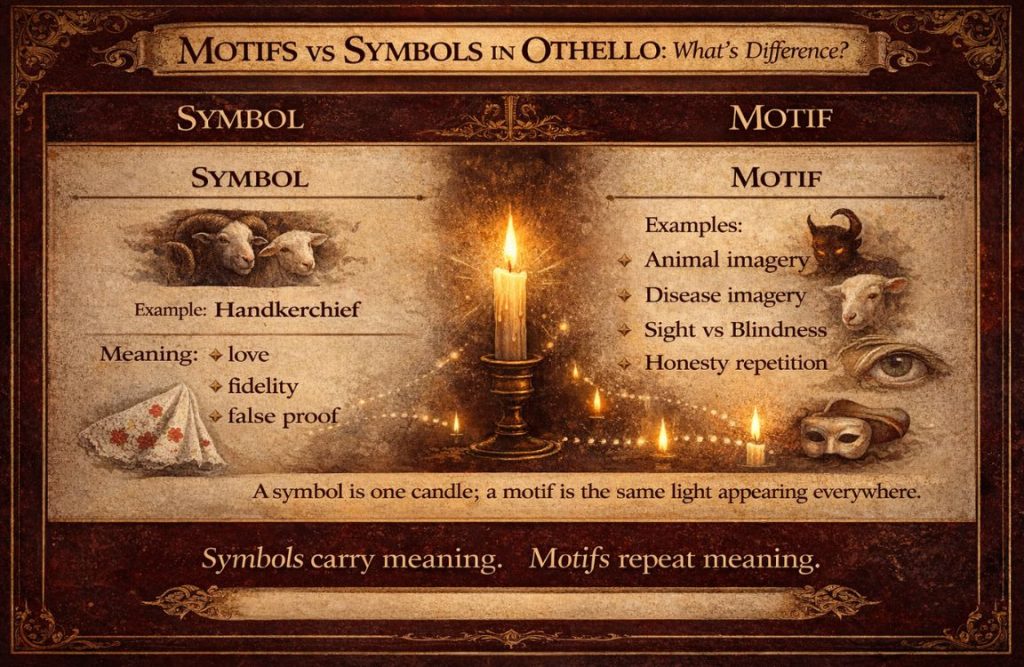
Now look at animal imagery, “old black ram,” “Barbary horse.” That’s not one object but a repeated pattern of dehumanization. Add to this the infection imagery (“pouring pestilence”) and the obsessive repetition of “honest.” These motifs create an atmosphere of corruption.
So yes, the handkerchief recurs, but at its core, it is a symbol. The pattern around it? That’s the motif at work.
ii) How Shakespeare Blends Symbols and Motifs
Shakespeare blends motifs and symbols in Othello by allowing recurring images (motifs) to shape the meaning of key objects (symbols), creating a psychological pattern that drives Othello’s downfall.
What fascinates me is that Shakespeare never keeps these categories separate. The handkerchief begins as a symbol of love, yet it gains force because it is entangled in larger motifs- sight, proof, infection, and jealousy. Iago “pours pestilence” into Othello’s ear. The repeated disease imagery prepares us to see the handkerchief as contaminated evidence.
Even the candle in the final scene works this way: a simple object becomes symbolic only because the light/dark motif has been burning all along.
This interplay of motifs and symbols in Othello turns jealousy into architecture- built slowly, layer by layer, until everything collapses.
The Handkerchief Symbolism and Motif in Othello
Every year, when I reach the handkerchief scene, I tell my students, “This tiny square of fabric causes more destruction than any sword in the play.” The Othello handkerchief symbolism is not decorative. It is devastating. Watch closely, and you’ll see how Shakespeare turns intimacy into evidence, and evidence into tragedy.
i) What Does the Handkerchief Symbolize in Othello?
In Othello, the handkerchief symbolizes love, fidelity, trust, and Othello’s emotional heritage, yet through Iago’s manipulation, it transforms into false proof of infidelity and becomes the catalyst for tragedy.
So, what does the handkerchief symbolize in Othello? At first, it is Othello’s “first gift” to Desdemona– a token of devotion embroidered with strawberries and wrapped in myth. He ties it to his mother, an Egyptian sibyl, and the preservation of marital faith. That origin elevates it from cloth to sacred heirloom.
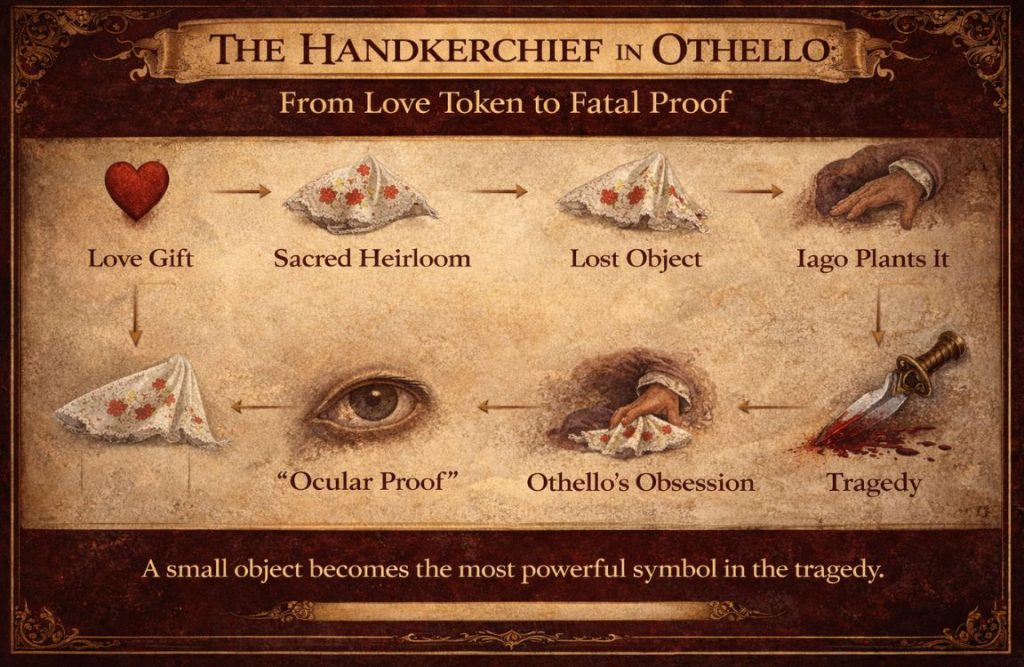
But symbols in Shakespeare rarely remain stable. As the handkerchief passes from Desdemona to Emilia to Iago to Cassio, its meaning darkens. What once embodied trust becomes “ocular proof.” Its loss does not just misplace fabric. It unravels a marriage.
ii) Why Is the Handkerchief Important in Othello?
The handkerchief is important in Othello because it becomes the false “ocular proof” of Desdemona’s infidelity, transforming a symbol of love and marriage into the key instrument of Iago’s manipulation and the catalyst for tragedy.
If you’re wondering why the handkerchief is important in Othello, here’s the truth: it gives jealousy something to hold. Once Emilia takes it and Iago plants it in Cassio’s room, suspicion gains a body.
Did it prove anything? No. Yet to Othello, its presence outweighs Desdemona’s honesty. The strawberries stitched on white silk, once symbols of love, become stains of imagined betrayal. Without it, Iago has words. With it, he has evidence.
iii) How the Handkerchief Develops as a Motif
In Othello, the handkerchief develops as a motif through repeated references that shift its meaning from love token to “ocular proof,” intensifying themes of sight, misinterpretation, jealousy, and death.
Now here’s where it gets interesting. Though primarily a symbol, the handkerchief operates within the larger motif of proof and perception. Each time it reappears, tension rises.
Love Token → Sacred Inheritance → Lost Object → “Ocular Proof” → Obsession → Death.
Notice what changes: not the cloth, but Othello’s belief. What begins as private intimacy becomes public evidence. The strawberries, once suggesting purity, are rewritten as stains of betrayal. By the final act, the bedroom feels like a courtroom, and the handkerchief stands as a silent witness.
It never speaks. Yet through repetition, it gathers weight- until suspicion hardens into murder.
Animal Imagery Motif in Othello
When I teach Othello, I warn my students: “Brace yourselves. The language is about to get ugly.” The Othello animal imagery motif is not a poetic decoration. It is verbal violence. Shakespeare loads the opening scenes with bestial metaphors to show how language itself can wound, dehumanize, and manipulate.
i) Animal Imagery in Othello Quotes
Animal imagery in Othello dehumanizes characters through repeated references to beasts, linking race, sexuality, and jealousy to a pattern of moral and psychological decline.
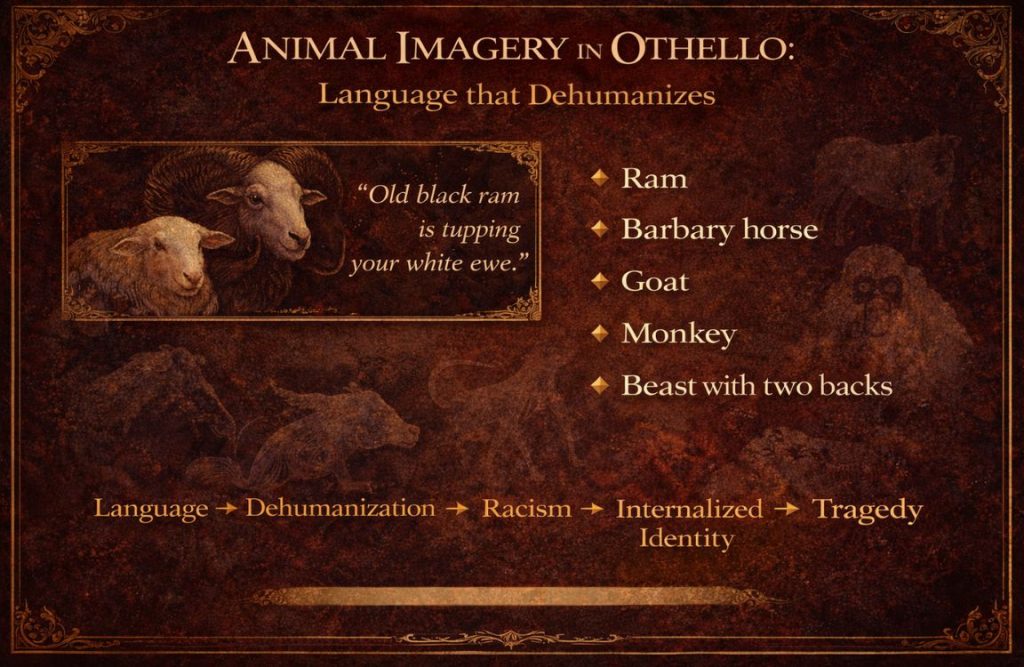
Let’s begin with the infamous lines. Iago shouts, “an old black ram / Is tupping your white ewe,” followed by the “Barbary horse” insult. In seconds, Othello is reduced from general to breeding animal. The imagery is racial, sexual, and cultural all at once.
But notice what happens next. The language spreads. We hear of the “beast with two backs,” of “goats and monkeys,” and Othello himself later wishes he were a “toad.” The degradation becomes contagious.
I often ask: Why begin a tragedy in the barnyard? Because Shakespeare shows us that Othello’s fall will start with language. Before he is destroyed physically, he is rewritten verbally, from man to monster.
ii) What Does the Barbary Horse Mean?
The “Barbary horse” in Othello refers to a prized North African breed known for strength and speed, but Iago uses the term as a racist metaphor to dehumanize Othello and portray him as a savage outsider.
Historically, the Barbary horse was admired for endurance and courage. That’s precisely what makes Iago’s insult so sharp. He takes a noble image and corrupts it.
By calling Othello a “Barbary horse,” Iago reduces a respected general to exotic livestock- defined not by intellect or honor, but by race and raw physicality. In one phrase, admiration becomes accusation.
And that, I tell my students, is how prejudice rewrites identity.
iii) How Animal Imagery Dehumanizes Othello
Animal imagery dehumanizes Othello by repeatedly associating him with beasts, framing his marriage as lustful and unnatural, and ultimately leading him to internalize this language until he sees himself as less than human.
The cumulative effect of this motif is chilling. When Othello is called a “black ram” or “Barbary horse,” his identity shifts from noble general to hypersexualized outsider. Language reshapes perception.
But the real tragedy is internalization. As jealousy spreads, Othello echoes the imagery, “goats and monkeys,” and finally condemns himself as a “circumcisèd dog.” The insult becomes self-definition.
As I tell my students, first, he is named a beast. Then he is treated like one. Finally, he believes it.
The Motif of Sight, Blindness, and “Ocular Proof”
Every year, I ask my students a simple question: “Who sees clearly in Othello?” The room goes quiet. Because in this play, sight is slippery. Shakespeare turns vision into illusion, proof into performance, and certainty into catastrophe.
i) Imagery of Seeing in Othello
The imagery of seeing in Othello- eyes, light, blindness, and “ocular proof”- reveals how characters in Othello mistake appearance for truth, allowing deception and jealousy to distort reality. Just as importantly, this pattern shapes the language, where vision becomes one of the dominant metaphors in Othello for certainty.
In Othello, the imagery constantly circles around sight. Brabantio demands proof. Othello insists on “ocular proof.” Iago pretends that truth can simply be shown. Everyone trusts their eyes, and the language in Othello reinforces that obsession with visible evidence.
Yet Shakespeare quietly undermines that trust. Desdemona once claims she “saw Othello’s visage in his mind”- a deeper kind of vision. Later, Othello relies only on surfaces: the handkerchief, Cassio’s gestures, staged spectacles.
Darkness frames crucial scenes, and the candle he extinguishes before killing Desdemona becomes the final visual irony. The play obsesses over seeing, but true insight is what no one possesses.
ii) Ocular Proof and the Illusion of Certainty in Othello
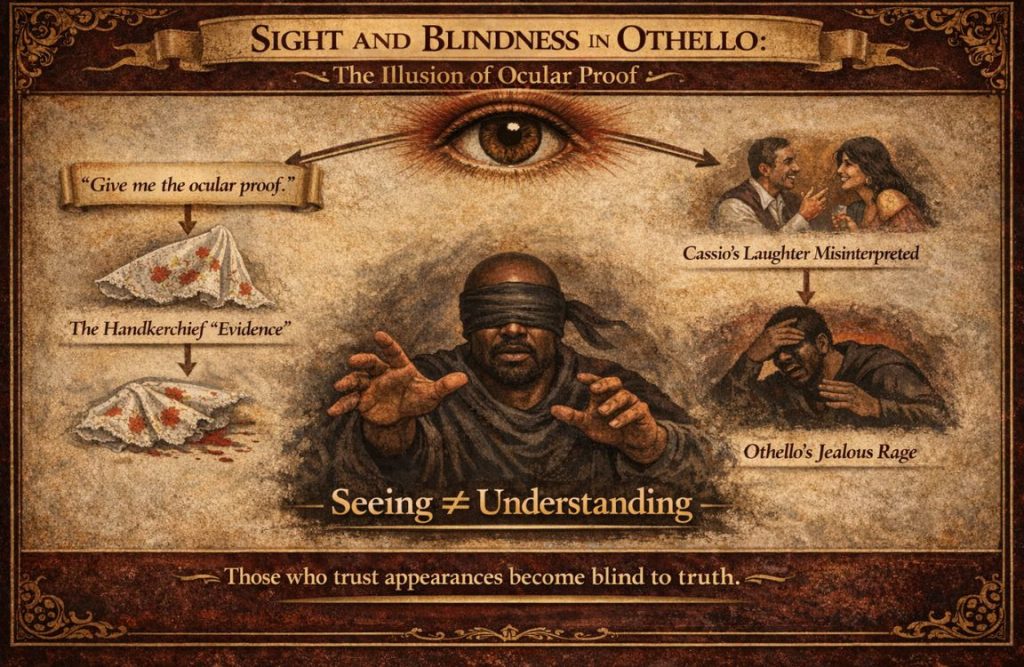
In Othello, “ocular proof” represents the illusion that visible evidence guarantees truth. Othello demands certainty, but the proof he receives, the handkerchief, is staged, revealing how perception can be manipulated by jealousy and suggestion.
Then we arrive at the famous demand: “Give me the ocular proof.” Othello wants something visible, undeniable, “Make me to see’t.” Who wouldn’t?
Yet Shakespeare turns that desire into tragedy. Iago offers no direct evidence, only fragments: overheard laughter, suggestive pauses, and a planted handkerchief. “Trifles light as air” become “proofs of holy writ.” Othello believes he is seeing the truth, but he is really seeing what Iago frames.
I ask my students: Was there ever proof, or only interpretation?
This irony in Othello is devastating. The audience knows the evidence is false. The hero who trusts sight becomes blind, mistaking appearance for certainty, and suspicion for justice.
Poison, Disease, and Corruption as Motifs in Othello
Poison, disease, and corruption in Othello function as recurring motifs that portray jealousy as a psychological infection. Iago’s words act as venom, gradually corrupting Othello’s mind until trust, reason, and love collapse.
If sight is the spark, poison is the spread. Iago vows to “pour this pestilence” into Othello’s ear. Notice the metaphor. Words become liquid venom. He speaks of jealousy as a “poisonous mineral” and promises it will “burn like the mines of sulphur.” Corruption is not sudden. It seeps.
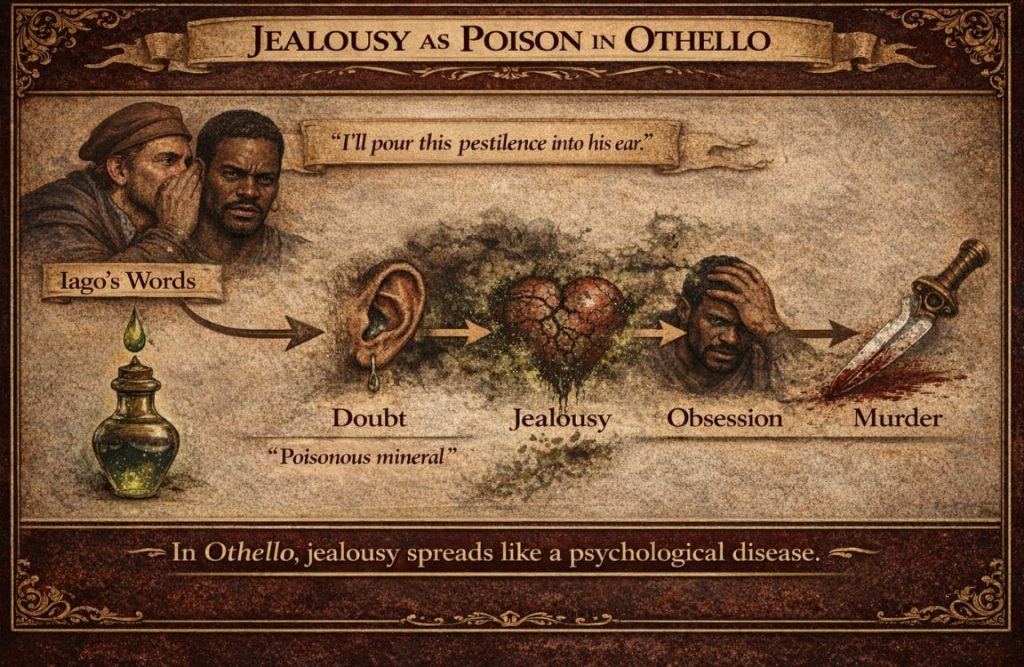
I often tell my students: Iago fights no physical battle. He infects. A doubt becomes a fever. A suggestion becomes a symptom. Even virtue is contaminated. He will “turn her virtue into pitch.”
The cruel irony? Othello later asks for literal poison to kill Desdemona. Yet no vial is needed. The real toxin has already done its work.
By the final act, language itself has poisoned sight, love, and judgment. Shakespeare’s warning is chilling: corruption rarely shouts. It whispers and waits.
The Motif of Honesty and Reputation
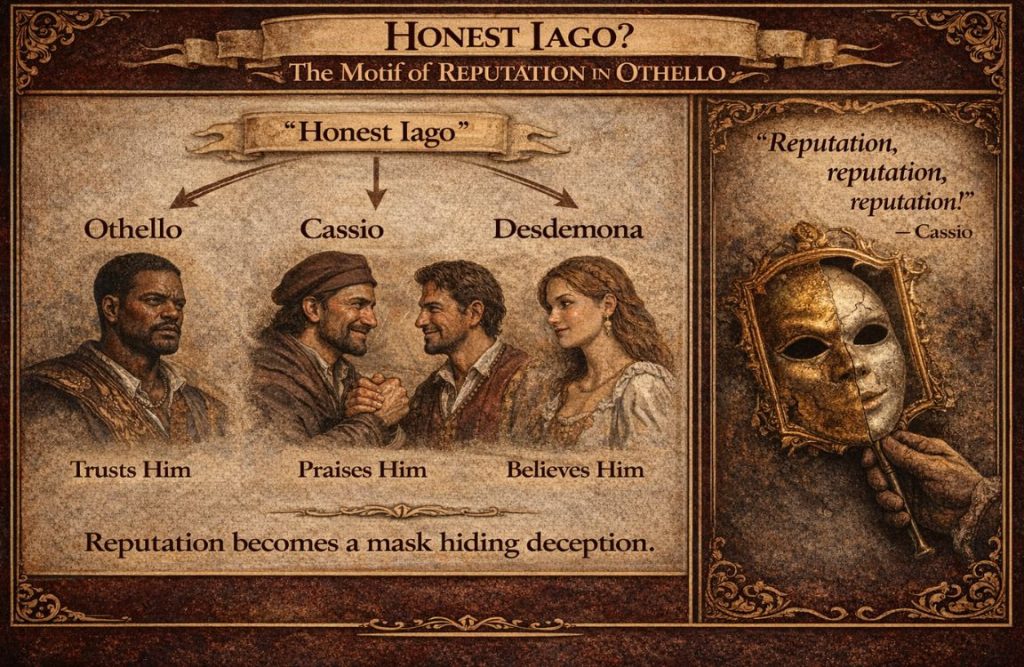
The motif of honesty and reputation in Othello works through repetition- especially the ironic phrase “Honest Iago.” Shakespeare uses this word-pattern motif to expose how easily public image replaces truth, turning reputation into both shield and weapon.
Every year, I ask my students: Who is the most “honest” character in Othello? They laugh. Of course, it’s Iago, at least by title. The phrase “Honest Iago” echoes obsessively throughout the play. Othello calls him “a man of honesty and trust.” Cassio praises his integrity. Even Desdemona believes him reliable. The repetition becomes hypnotic.
And that’s the trap.
This is one of the sharpest themes and motifs in Othello. Honesty is not proven. It is performed. The more the word is repeated, the less we question it. Shakespeare turns “honest” into a verbal costume. I sometimes tell my class: if you call someone honest often enough, people stop checking.
Reputation, too, trembles at the center of the tragedy. Cassio cries, “Reputation, reputation, reputation!” His triple repetition reveals panic. In this world, public image feels more solid than private truth. Lose your name, and you lose yourself.
Here’s where it becomes chilling. Iago understands that reputation is fragile currency. He destroys Othello not by attacking him physically, but by infecting his perception of Desdemona’s honor. Once her reputation cracks, love collapses.
When we study these examples of motifs in Othello, this word-pattern motif stands out. “Honest” becomes ironic. “Reputation” becomes an obsession. And by the end, I tell my students quietly: the villain wins not because he lies, but because everyone believes the label.
Gardening Imagery Motif in Othello
The gardening imagery motif in Othello appears in Iago’s line, “Our bodies are our gardens.” It suggests that human character grows from the seeds people choose to plant- virtue, jealousy, or deception- revealing how manipulation gradually cultivates tragedy.
It appears briefly, but it carries surprising philosophical weight. When I teach this moment, I pause at Iago’s famous metaphor. In Act 1, Scene 3, William Shakespeare lets him declare, “Our bodies are our gardens, to the which our wills are gardeners.”
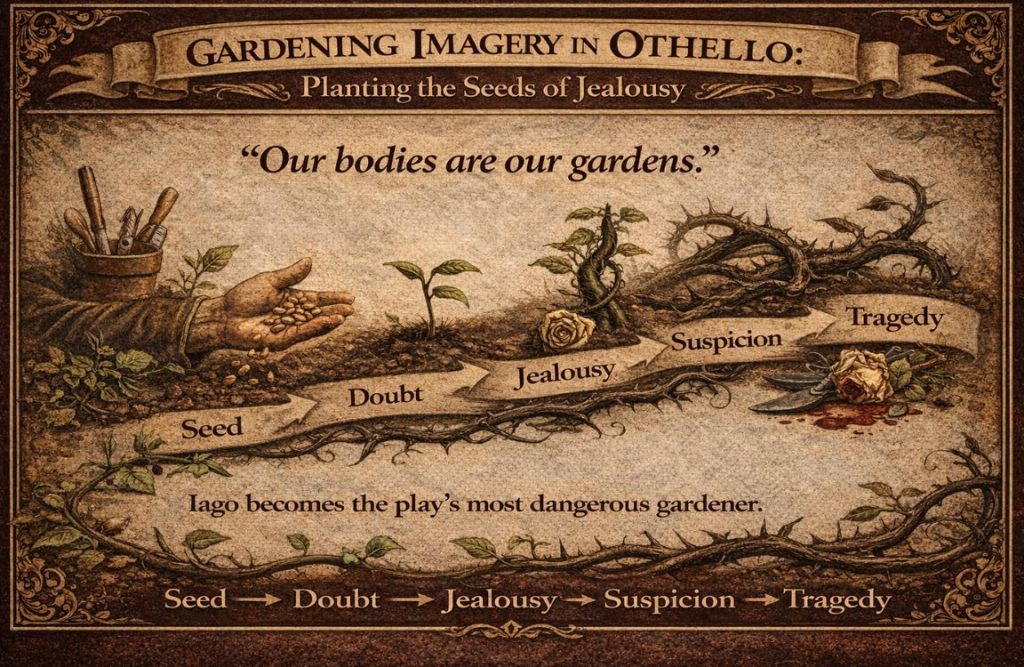
I ask my students: Is Iago suddenly offering life advice? In theory, yes. His metaphor suggests that human character is something we cultivate. Virtue, discipline, jealousy, and desire. These are the plants we choose to grow.
But here lies the irony. Iago becomes the play’s darkest gardener. Instead of planting virtue, he sows seeds of suspicion in Othello’s imagination. Those tiny suggestions take root, grow into jealousy, and slowly poison trust- proving that in Shakespeare’s tragedy, even a single planted doubt can destroy a life.
Light and Darkness as Recurring Motifs
Light and darkness in Othello operate as recurring motifs that shape meaning beyond setting. Shakespeare uses this imagery in Othello to blur truth and deception, while overlapping with racial symbolism and the tragic final bedroom scene.
When I teach this motif, I dim the classroom lights and ask, What happens in the dark? Secrets grow. Assumptions multiply. Fear sharpens.
From the opening scenes, much of the action unfolds at night. Brabantio is awakened in darkness; accusations emerge in shadows. Light traditionally symbolizes truth, yet in this play, clarity never fully arrives. That tension fuels the symbolism in Othello.
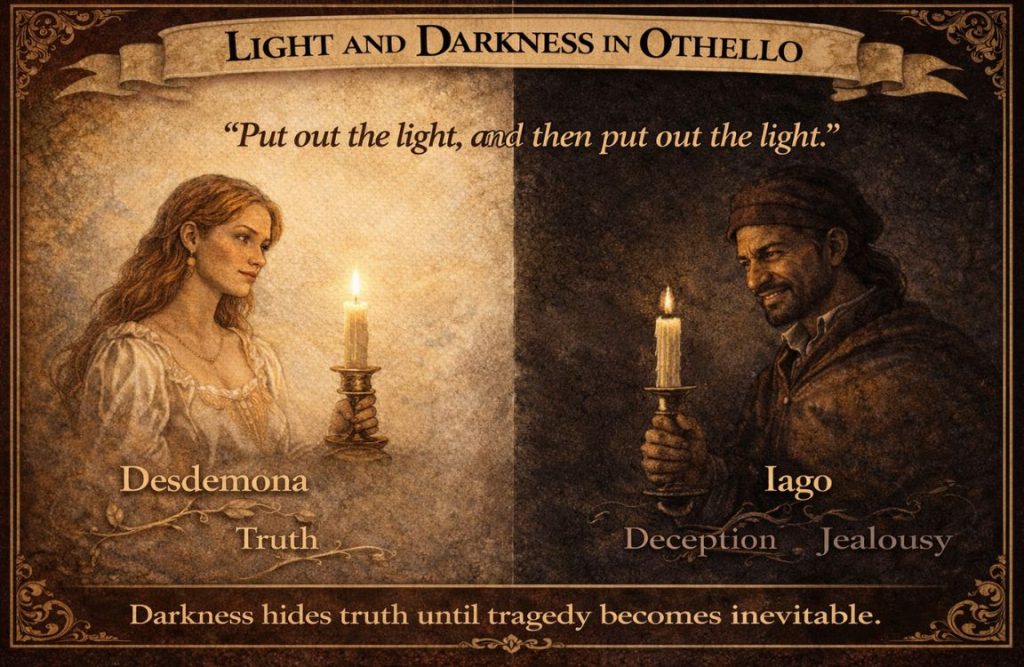
And yes, race in Othello complicates everything. Othello is repeatedly associated with “blackness,” while Desdemona is framed as “fair.” But Shakespeare refuses simplicity. Darkness does not equal evil. Deception comes from Iago, who operates in moral darkness despite his “honest” mask. I tell my students: the most dangerous shadows are not on skin, but in intention.
Then we reach the final bedroom scene. Othello enters with a candle. “Put out the light, and then put out the light.” I pause every time. Is he extinguishing a flame, or a life? The image is unbearable.
In this imagery, light becomes fragile, and darkness suffocates. And by the end, we realize the tragedy was not born from color, but from the blindness that mistook shadow for truth.
How Shakespeare Uses Motifs to Build Tragedy
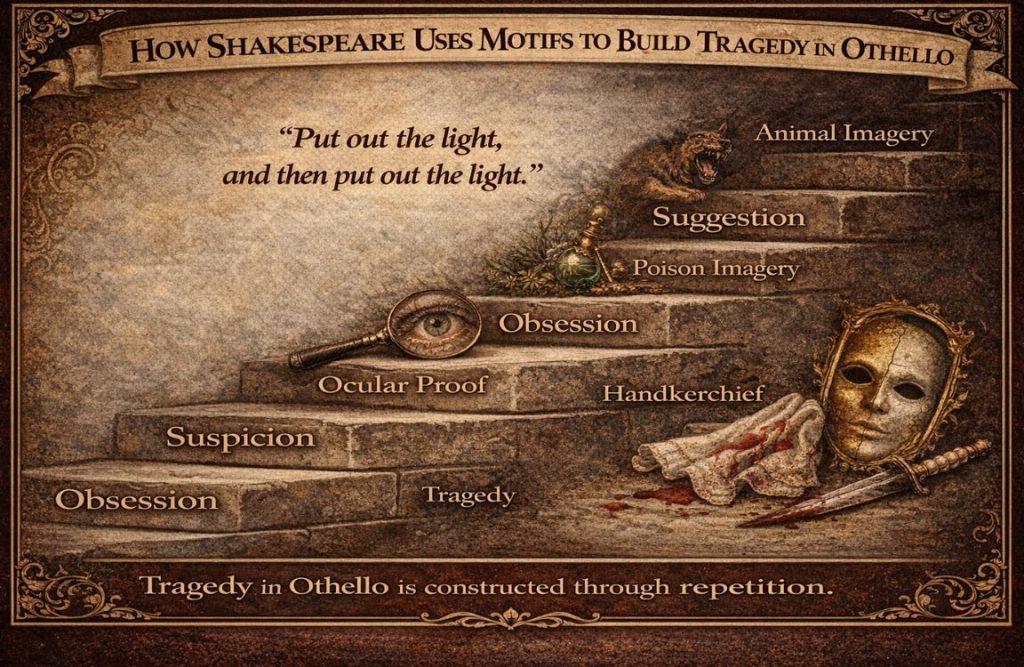
Shakespeare uses motifs in Othello by repeating and evolving key images- sight, poison, animals, light, reputation- so that each recurrence deepens tension. This structured repetition transforms suspicion into certainty and builds tragedy step by step.
When I explain Shakespeare’s use of motifs in Othello, I tell my students: Shakespeare doesn’t drop tragedy from the sky. He plants it. Then he waters it with repetition.
Look closely at the structure of the play. In Act I, animal imagery shocks us. By Act III, it infects Othello’s own language. Early references to “honesty” sound harmless. Later, they drip with irony. The handkerchief begins as love, becomes doubt, and ends as death. Motifs evolve.
This is why strong Othello motifs analysis always traces development, not just definition. Repetition intensifies emotion. Each time Othello demands “ocular proof,” the irony sharpens. Each mention of poison makes jealousy feel more physical. The pattern tightens like a noose.
I sometimes draw a staircase on the board:
Suggestion → Suspicion → Obsession → Violence.
The motifs used in Othello climb that staircase with terrifying precision. By Act V, nothing feels sudden. The tragedy feels earned- constructed brick by brick through recurring images.
And that’s Shakespeare’s genius. He doesn’t surprise us with disaster. He prepares us for it so thoroughly that when it arrives, we realize it was growing all along.
FAQs:
What is the motif of water in Othello?
When I discuss the water motif with my students, I point to Cyprus, the sea voyage, and storm imagery. Water suggests emotional turbulence. Like waves, Othello’s mind shifts from calm love to violent jealousy, showing how fragile human judgment can become.
What is the motif of the soul in Othello?
In class, I ask students to notice how often characters speak of the “soul.” Othello fears Desdemona’s betrayal will damn his soul, even vowing he would not “kill thy soul.” Tragically, protecting imagined purity leads him to destroy innocent love.
What is the religious motif in Othello?
I tell my students that religion in the play works like a moral mirror. Words such as “heaven,” “devil,” and “damnation” echo constantly. Ironically, Iago speaks like a preacher of lies, while Othello believes he performs divine justice, revealing tragic moral blindness.
How should I write about motifs in exams?
Define the motif, trace its repetition, and explain how it develops a theme. Use short quotes like “green-eyed monster” or “put out the light.” Examiners reward analysis of evolution, not just identification.
Conclusion:
The tragedy of Othello is not sudden. It is constructed through recurring motifs that evolve across the play. Shakespeare’s careful repetition of imagery and symbols transforms doubt into destruction.
When I step back and look at the motifs in Othello, I see architecture, not accident. Animal imagery begins as an insult and ends as an internalized identity. Sight becomes blindness. The handkerchief shifts from love to “proof.” Each pattern grows darker.
This is the brilliance in Shakespeare’s use of motifs in Othello. Repetition is not decorative. It is psychological. The imagery of poison, darkness, and reputation slowly erodes Othello’s stability. By the time he says, “Put out the light,” the emotional groundwork has already been laid.
Strong analysis of Othello motifs always traces that evolution. Motifs merge with symbolism in Othello, tightening the tragic structure scene by scene.
And here’s what I tell my students before the exam: Othello is not destroyed in one moment of rage. He is undone by patterns he fails to recognize.
Shakespeare’s tragedy grows through repetition until belief itself becomes fatal.