The most important monologues in Othello include major speeches by Othello, Iago, Desdemona, and Emilia that reveal identity, jealousy, deception, love, and moral conflict. These extended speeches also mark important turning points in Shakespeare’s tragedy.
In class, I ask one question: What does this speech reveal that the character’s actions cannot? That question often takes students straight to the heart of the play.
This guide examines 10 key monologues from Othello, with their speakers, Act and Scene, memorable quotations, meanings, and dramatic importance. I use “monologue” broadly, while noting when a passage is technically a soliloquy or part of dialogue.
What Are the Most Important Monologues in Othello?
Here are the 10 key monologues and extended speeches covered in this guide:
| Key Speech/Passage | Speaker | Act/Scene | Main Idea |
| “Her father loved me” | Othello | 1.3 | Self-presentation and storytelling |
| “Like to the Pontic sea” | Othello | 3.3 | Jealousy and collapse |
| “Was this fair paper?” | Othello | 4.2 | Honour and humiliation |
| “Speak of me as I am” | Othello | 5.2 | Identity and remorse |
| “I am not what I am” | Iago | 1.1 | Deception |
| “I hate the Moor” | Iago | 1.3 | Revenge and suspicion |
| “That Cassio loves her” | Iago | 2.1 | Jealousy and manipulation |
| “Divinity of hell” | Iago | 2.3 | Deception disguised as advice |
| “O good Iago” | Desdemona | 4.2 | Trust and vulnerability |
| “Their husbands’ faults” | Emilia | 4.3 | Gender inequality |
Want the full selected texts? [Download the Free Monologues and Key Speeches in Othello Ebook]
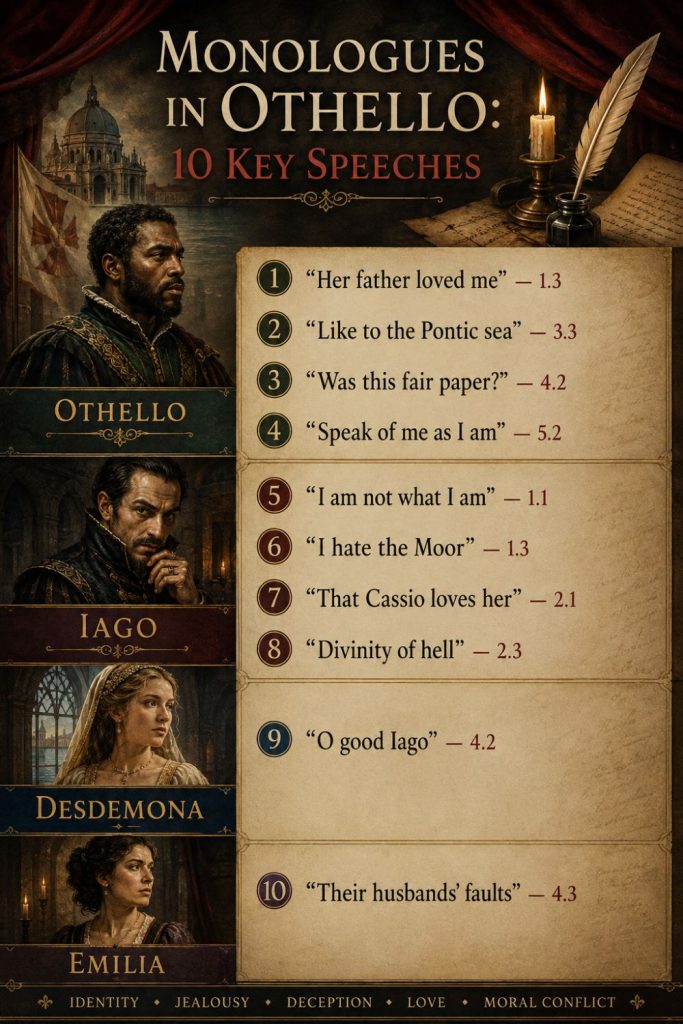
Table of Contents
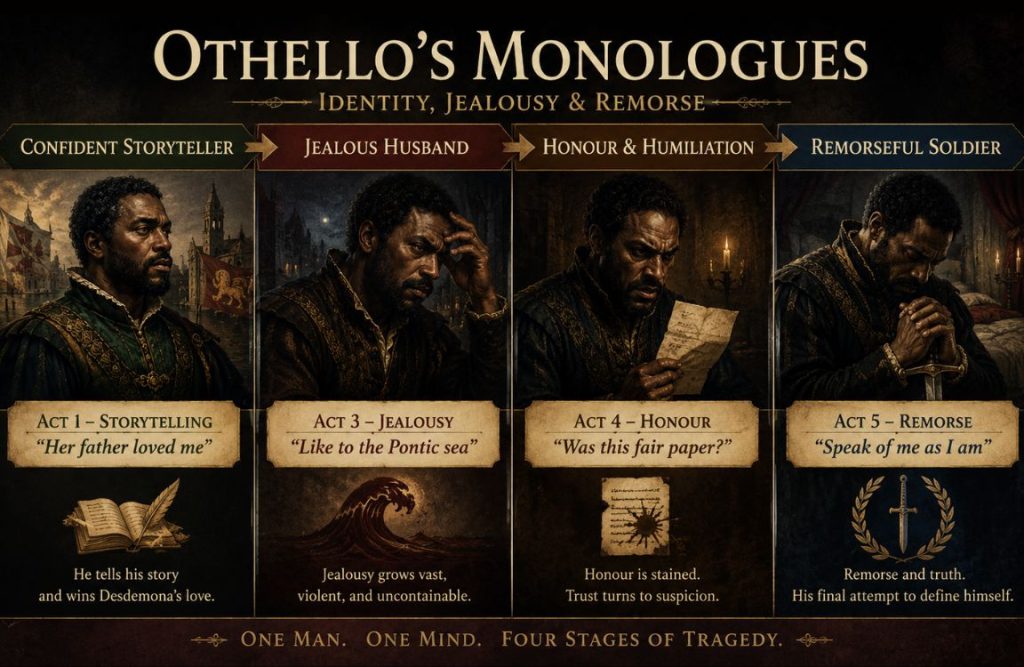
Othello’s Monologues: Identity, Jealousy & Remorse
Othello’s speeches trace a remarkable movement: confident storyteller → jealous husband → remorseful soldier. His changing language allows us to hear his transformation rather than simply being told about it.
“Her Father Loved Me”: Othello’s Monologue, Act 1, Scene 3
Before the Venetian Senate, Othello tells how his battles, travels, captivity, and suffering shaped his life. His story fascinates Desdemona and helps explain her love for him.
The irony is striking: Othello wins her through storytelling, then loses her by believing Iago’s story. At first, Othello controls his own narrative; later, Iago controls how he interprets his wife.
“Like to the Pontic Sea”: Act 3, Scene 3
By Act 3, Scene 3, the controlled speaker of the Senate has become overwhelmed by jealousy. The “Pontic sea” suggests a jealousy that has become vast, violent, and impossible for Othello to contain.
We can hear Othello’s psychological decline in his increasingly extreme language. His fall is gradual: suspicion grows, certainty hardens, and emotional control begins to disappear.
“Was This Fair Paper?”: Act 4, Scene 2
Othello now believes Desdemona has betrayed him. His “fair paper” and “goodly book” images suggest that someone beautiful has been marked as corrupt.
The metaphor exposes how completely Iago has changed Othello’s perception. Because Othello connects marital fidelity with personal honour, imagined betrayal feels like an attack on his sense of self as well as his marriage.
“Speak of Me as I Am”: Act 5, Scene 2
In his final address, Othello tries to shape how others will remember him after recognising the horror of his actions.
The speech returns to the play’s concern with self-image and reputation: he once told his life story to win Desdemona, but now tells the story of his downfall. His closing words unite love, honour, guilt, and remorse, while showing that understanding has arrived too late.
Iago’s Monologues: Deception, Suspicion & Manipulation
Iago’s speeches work differently from Othello’s. They let the audience see the plan behind events while other characters remain trapped inside Iago’s deception.
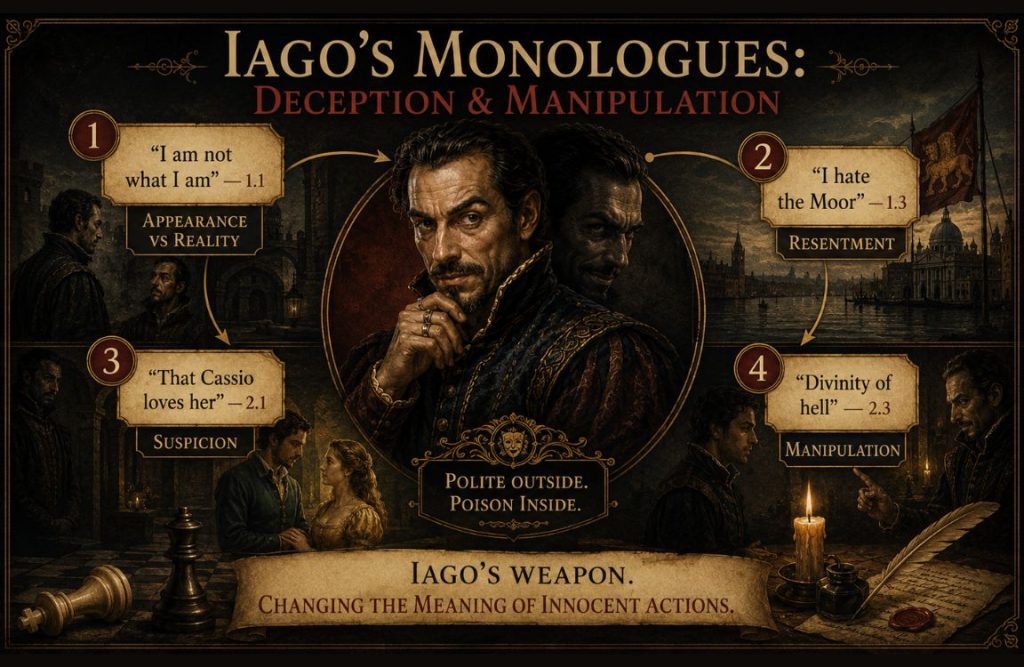
“I Am Not What I Am”: Act 1, Scene 1
The famous line “I am not what I am” captures Iago’s deliberate split between appearance and reality. He tells Roderigo that his loyalty to Othello is only a performance.
Because Roderigo is present, this is technically an extended speech within dialogue, not a soliloquy. Yet its dramatic function is crucial: the audience knows Iago’s intentions while Othello trusts his false appearance. Iago’s real skill is performing honesty.
“I Hate the Moor”: Act 1, Scene 3
After Roderigo leaves, Iago reveals his private thoughts and suspects that Othello has slept with Emilia, without proof
He turns suspicion into justification and begins planning how to exploit Othello’s trusting nature. This genuine soliloquy marks a turning point: Iago moves from personal grievance to deliberate psychological warfare.
“That Cassio Loves Her”: Act 2, Scene 1
Iago imagines that Cassio and Desdemona may love each other and sees a way to exploit Othello’s trust. His weapon is not evidence but interpretation.
He plans to make ordinary interactions appear suspicious until Othello begins drawing his own conclusions. The passage turns Iago’s earlier resentment into a specific plan for destroying Othello through jealousy.
“Divinity of Hell”: Act 2, Scene 3
Iago explains how apparently helpful advice can serve an evil purpose. He encourages Cassio to seek Desdemona’s help, knowing Othello may later interpret her kindness as sexual interest.
His key idea is:
“So will I turn her virtue into pitch”
Iago does not need to invent every event. He changes the meaning of real ones. Desdemona’s goodness becomes suspicious, and her attempt to help Cassio becomes part of the trap. His greatest skill is making innocent behaviour look guilty.
Desdemona and Emilia: Loyalty, Vulnerability & Resistance
Desdemona and Emilia give the tragedy another perspective. Desdemona’s words reveal loyalty and vulnerability, while Emilia’s words gradually challenge the unequal expectations placed on wives. Their speeches also show how differently the same situation can be understood.
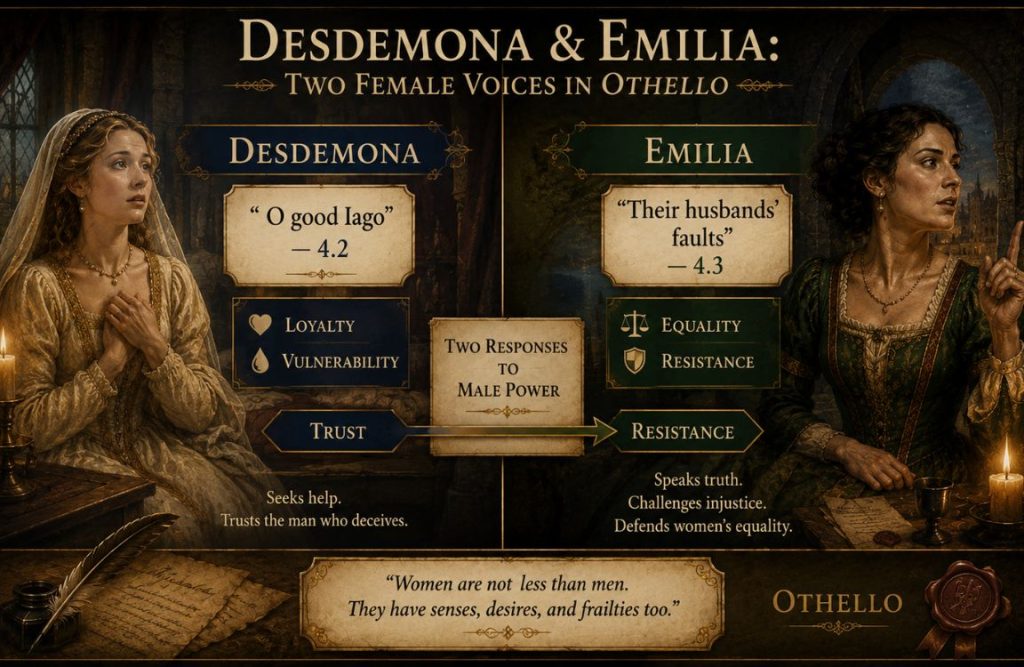
“O Good Iago”: Act 4, Scene 2
After Othello accuses her of infidelity, Desdemona turns to Iago for help. She still sees him as an honest friend, unaware that he has helped cause her suffering.
Her question, “What shall I do to win my lord again?”, reveals confusion and devotion. Rather than seeking revenge, she wants to restore her marriage, making her misplaced trust especially tragic.
“But I Do Think It Is Their Husbands’ Faults”: Act 4, Scene 3
Emilia challenges the double standard that gives husbands freedoms while judging wives more harshly.
She argues that women possess the same emotions, desires, senses, and weaknesses as men. Her speech moves from marriage to gender inequality, preparing us for the courage she later shows when confronting Iago and exposing his deception.
Her later confrontation with Iago makes this earlier conversation more significant: Emilia’s private criticism of male privilege eventually becomes public resistance.
Monologue vs Soliloquy in Othello
Students often treat monologue and soliloquy as synonyms, but there is a useful distinction.
A monologue is an extended speech by one character. A soliloquy reveals private thoughts, usually while the character is alone or unheard.
Thus, Iago’s “I am not what I am” is spoken to Roderigo, while “I hate the Moor” functions as a soliloquy after Roderigo leaves.
For this guide, I use monologues in Othello broadly because that is the term students commonly search for when looking for important extended speeches. What matters is identifying the speaker, audience, situation, and dramatic purpose accurately.
How to Analyse a Monologue in Othello?
When I teach students to analyse a speech, I ask four simple questions:
- What is being said? Find the central idea, emotion, or argument.
- Why is it being said? Identify the speaker’s purpose.
- Who is listening? A Senate speech has a different purpose from a private revelation.
- What does it change? Consider its effect on character, conflict, or plot.
A strong analysis connects language, character, emotion, and dramatic purpose instead of merely translating Shakespeare’s words.
Why Are Monologues Important in Othello?
Monologues in Othello bring private conflicts into the action. Othello’s speeches chart his movement from confident storyteller to jealous husband and remorseful soldier.
Iago’s speeches create dramatic irony because the audience knows his plans while others remain deceived. Desdemona’s words reveal how innocence can be misread, while Emilia challenges marital inequality from a different moral perspective.
Most importantly, Shakespeare shows that language can alter perception. Iago often needs no false events. He only makes a real one appear guilty. That shift helps drive the tragedy.
FAQs:
What are the most famous monologues in Othello?
Important speeches include Othello’s “Her Father Loved Me” and “Speak of Me as I Am,” and Iago’s “I Am Not What I Am.” They are memorable because they reveal identity, deception, and the tragedy’s central conflicts.
What is Othello’s final monologue?
Othello’s final monologue, beginning “Speak of me as I am,” appears in Act 5, Scene 2. He reflects on his actions, accepts responsibility, and expresses remorse before taking his own life.
Which Othello monologue is best for an audition?
Iago’s monologues are strong choices for exploring deception and control. Othello’s final monologue offers emotional depth through guilt and remorse, while Emilia’s Act 4, Scene 3 speech gives performers a chance to explore moral courage and social criticism.
Which Othello monologue is easiest for students to analyse?
Othello’s “Speak of Me as I Am” and Iago’s “I Am Not What I Am” are useful choices because both offer clear ideas about public image and deception. Students can also explore Emilia’s Act 4, Scene 3 speech for gender inequality and moral courage.
Are Iago’s speeches monologues or soliloquies?
They can be either. A speech delivered to another character is a monologue or extended speech within dialogue, while a private revelation can function as a soliloquy. The dramatic situation determines the more precise term.
[Download the Free Monologues and Key Speeches in Othello Ebook]
Conclusion:
Monologues in Othello turn speech into dramatic action. Othello uses language to construct and question his public image; Iago uses it to create suspicion; Desdemona uses it to defend love; and Emilia uses it to challenge injustice.
Words do not simply describe the tragedy in Othello. They help create it.