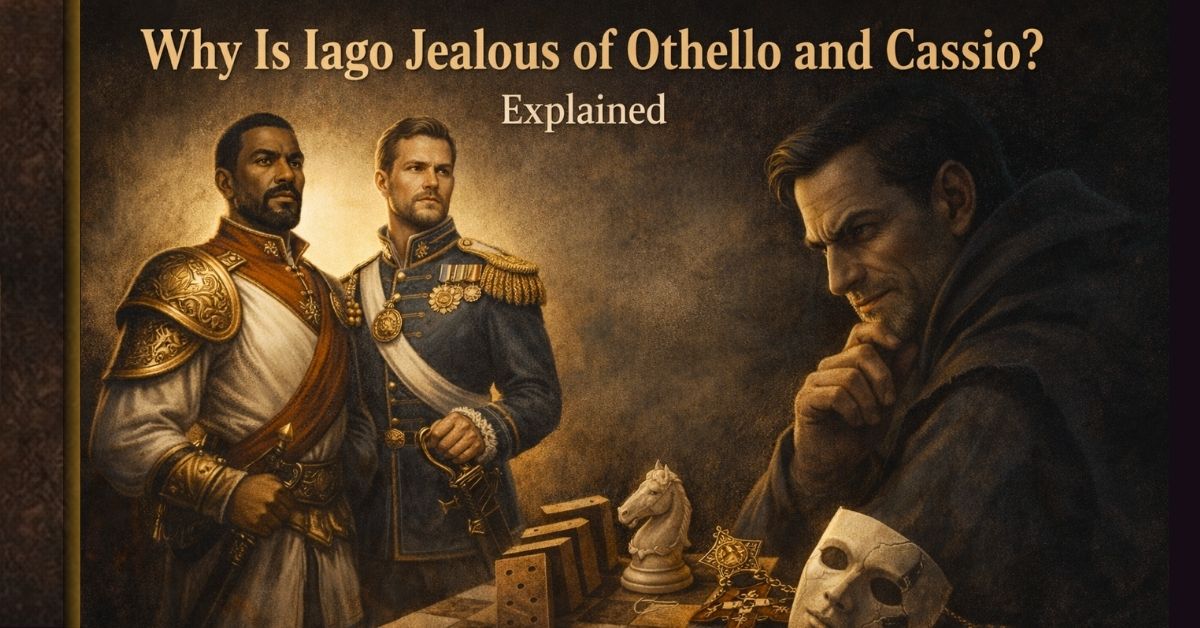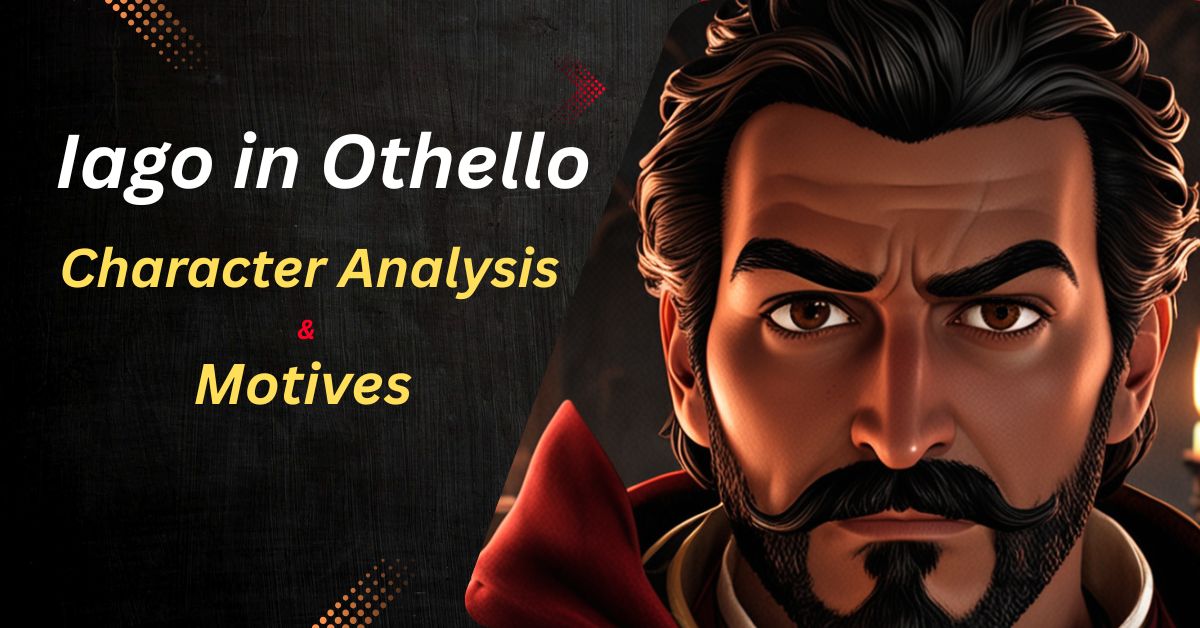
Every time I teach Othello, I tell my students that Iago is the kind of character who could walk into a room, smile politely, and quietly set the entire place on fire- without ever striking a match. He doesn’t need swords or storms. He uses something far more dangerous: words.
As Othello’s ensign, he looks like the ideal soldier, but underneath that crisp uniform is a mind that studies human weakness the way a botanist studies rare plants- patiently, obsessively, and with unsettling precision. Iago is the consummate villain in Othello.
Iago in Othello fascinates me because he understands people a little too well. He knows which insecurities to tap, which doubts to whisper, and which emotions to twist until they snap. And he does it all so calmly that half the characters thank him while he ruins them.
In this guide, I’ll walk you through Iago’s character analysis, his essential traits, his motives, his manipulation strategies, his key relationships, and the quotes you absolutely need for analysis. If you’ve ever wondered how one quiet voice can unravel an entire tragedy, let’s step into Iago’s world together- carefully. He’s always listening, and that is the mark of a true villain.
Who Is Iago in Othello?
Whenever a student asks me, “Who is Iago, really?” I always smile, because the question is far trickier than it looks. On paper, he’s easy to define: Iago is Othello’s Ancient– or Ensign- the man who carries the flag into battle. He’s technically the lowest-ranking officer among the leadership, the one expected to obey, observe, and quietly blend into the background. But of course, Iago is the last person in the play interested in staying in the background.
Iago’s job in Othello may sound simple, but I remind my students that an Ensign sees everything. He hears conversations he shouldn’t, watches tensions rise, and understands the fragile egos that hold a military hierarchy together. If Othello’s army were a classroom, Iago would be the student who quietly sits in the corner, notices every single micro-expression, and then uses that information to orchestrate the group project disaster of the semester.
And here’s where things get interesting: while Iago is officially “just” an Ensign, the plot of Othello would collapse without him. He’s the thread that ties every tragedy together- the whisper behind Othello’s doubts, the nudge behind Cassio’s downfall, the spark behind Roderigo’s foolish decisions. If Shakespeare were assembling a machine, Iago would be the hidden gear turning all the visible wheels.
What fascinates me most is how Shakespeare positions him. Othello is the general, Cassio the polished lieutenant, Desdemona the noble wife- but Iago stands slightly outside these social circles, both inside the system and resentfully looking in. That liminal space gives him power.
Students often forget that in a military world built on trust, loyalty, and honor, the person with the least honor often has the most freedom. And Iago knows it.
This is why he becomes the true engine of the play. Not because of his rank, but because of his access- emotional, social, and psychological. By the time the characters realize he is the villain in Othello, it’s far too late. He has already rewired the emotional architecture of the entire story.
So, who exactly is Iago in Othello? He’s the man in the lowest seat at the table… who somehow manages to flip the whole table over.
Table of Contents
Iago in Othello: A Quick Summary
Whenever I give my students a rapid-fire overview of Iago’s journey through the play, I warn them: “Blink, and you’ll miss one of his schemes.” Because once Othello begins, Iago moves through the plot like a chess player who already knows every move his opponents will make. He doesn’t wait for opportunities. He manufactures them.
Across the play, we watch him pull off a disturbing checklist of sabotage: he convinces Roderigo to bankroll his plans, nudges Cassio into a drunken brawl, plants the infamous handkerchief, and slowly steers Othello from confidence to collapse. None of it is loud or dramatic at first. In fact, it’s the quiet precision that unsettles me most whenever I revisit the text with my classes.
If I had to give you an Iago character overview in one breath, he’s the observer who becomes the puppeteer, the confidant who becomes the destroyer, the soldier who becomes the architect of tragedy.
In every scene, he adapts like water- filling whatever emotional container the other characters give him. And that ability to shift shape is what makes tracking him both thrilling and terrifying.
My students often ask for simple words to describe Iago, and I smile because simplicity is the one thing he refuses to offer. Still, if I had to narrow him down to a handful, I’d choose:
- Calculating
- Persuasive
- Cold
- Strategic
- Charming
- Ruthless
- And unreadable
These aren’t just traits. They’re tools. Shakespeare gives him the emotional equivalent of a surgeon’s kit, and he uses every piece with chilling skill. What makes him unforgettable is not just what he does, but how he moves through the play- always one step ahead, always smiling, always pretending he’s simply helping someone along.
So, if you’re looking for the shortest possible summary of Iago: he is the quiet force that cracks the foundation of the tragedy… long before anyone realizes the ground is shaking.

Iago Character Analysis in Othello
Understanding Iago means tracking shadows, not speeches. He’s Shakespeare’s quiet storm- subtle, persuasive, devastating. You don’t meet Iago. You uncover him: layer by layer, lie by lie, a psychological excavation hiding in plain sight.
Iago’s Character Traits
Before we explore his personality, let’s lay out the central characteristics of Iago– the ones that make him Shakespeare’s most psychologically explosive villain. Iago is like a human chessboard: every square looks harmless until he’s already cornered you.
1. Manipulative:
Iago doesn’t lie the way ordinary people do. He crafts each deception the way a skilled tailor fits armor- shaped perfectly to the wearer’s weakness.
When he boasts, “With as little a web as this will I ensnare as great a fly as Cassio” (2.1), I always pause in class and say, “There you go- he doesn’t push people. He lets them walk willingly into the trap he built.”
2. Intelligent & Strategic:
What fascinates me most is his calculating intelligence. Iago doesn’t rush. He assembles. When he mutters, “How? how? let’s see,” you can almost hear the gears turning. Each lie connects to another like a chain reaction, and before anyone realizes what happened, the ground has shifted beneath them.
3. Jealous & Resentful:
His jealousy burns quietly but powerfully. Passed over for promotion, overshadowed by Othello, irritated by Cassio. He nurses every slight like a wound only he can see. When he declares, “I know my price” (1.1), that bitterness becomes the engine of everything he does.
4. Deceptive & Two-Faced:
The cruelest irony? Everyone trusts him. His motto, “I am not what I am,” is the clearest warning label in Shakespeare… yet no one reads it. His deception works because it feels friendly, helpful, obvious- exactly the kind of advice you’d thank him for before it destroys you.
Iago’s Personality:
A student once asked me, “Sir, does Iago actually feel anything?” And honestly, trying to answer that feels like checking a stone for a pulse. That emotional stillness is the core of Iago’s personality- calm, precise, frighteningly self-contained.
Iago moves through crises like a surgeon: steady hands, no tremor. While others break down, he observes, calculates, and converts emotions into instruments. He doesn’t empathize. He analyzes. When he watches Othello’s insecurities or Cassio’s guilt, he isn’t moved. He’s mapping pressure points.
This emotional detachment blends perfectly with his narcissism. He genuinely believes he’s the smartest man in the room. I sometimes joke that if Iago had a social media bio, it would simply read: Smarter than you. Ask me how.
What truly defines his personality, though, is performance. “Honest Iago” is his favorite mask, and he wears it with the confidence of an award-winning actor. He shifts personas effortlessly- concerned friend, humble advisor, loyal servant- each chosen to manipulate the moment.
In essence, Iago’s personality is a chilling blend of emotional vacancy, weaponized intelligence, and polished performance. He reminds my students (and all of us) that the most dangerous villains aren’t loud. They’re quietly taking notes in the corner, planning the ruin of everyone else.
Iago’s Tactics Table:
| Iago’s Tactic | Victim | Result |
| Fake friendship | Roderigo | Blind loyalty, financial manipulation |
| “Honest advice” | Cassio | Reputation destroyed |
| Suggestive questioning | Othello | Jealousy planted and watered |
| Handkerchief setup | Desdemona | Trust shattered |
| Lies layered as truth | Everyone | Venice, consumed by chaos |
Iago’s Motives in Othello:
I tell my students Iago’s motives aren’t tidy: professional resentment, personal jealousy, racial prejudice, hunger for control, and sometimes sheer relish in causing harm. Each layer reveals a different reason, and none fully explains why he delights in destruction and cruelty.
1. Professional Resentment:
Ah, yes- the motive every teenager understands immediately. Iago wanted the promotion. He believed he deserved it. And when Othello chose Cassio, the “book-smart” soldier with charm but no battle scars. Iago snapped.
I once told my students, “Imagine training the whole team all year, and then the coach gives the captain’s badge to the kid who just figured out which direction the field is.” The groans I heard? That’s Iago’s bitterness being born.
This is the root of his revenge motive, but only the beginning.
2. Cassio-Directed Envy:
Let’s be honest: Iago doesn’t just envy Cassio’s job. He envies Cassio’s youth, looks, social ease, education, and effortless charm– all qualities Iago knows he lacks.
This isn’t professional jealousy. It’s personal jealousy. Cassio represents a version of masculinity that exposes Iago’s insecurity. That stings, and Shakespeare knew it.
3. Sexual Jealousy:
Here’s where the classroom leans forward. Iago whispers that Othello slept with Emilia, “I do suspect the lusty Moor hath leap’d into my seat.”
Does he believe it? Probably not. But he wants to.
Because in a culture obsessed with male honor, imagining himself a cuckold scratches at his deepest insecurity. His mind becomes a storm of imagined betrayals, feeding his jealousy spiral.
4. Racism & Colonial Prejudice:
When Iago calls Othello “an old black ram,” the room always goes silent. This isn’t casual racism. This is racism sharpened into a weapon.
Othello’s success threatens the hierarchy Iago wants to preserve. So, he uses racial fear to poison others, making his hatred both personal and political.
5. Desire for Control:
Some of my students often ask, “Sir, why does Iago manipulate everyone?”
It’s simple. He loves it.
Iago enjoys power. He enjoys puppeteering emotions. Every whisper, every scheme, every “I’ll pour this pestilence into his ear” gives him a rush. For him, control is the motive.
6. Motiveless Malignity:
Coleridge called it “motiveless malignity”- evil for the thrill of evil. When Iago murmurs, “How? How? Let’s see…” he sounds excited, not angry.
Some people light fires because the flames fascinate them.
7. So What Really Drives Iago?
Everything. Nothing. A blend of revenge, racism, jealousy, insecurity, envy, and pure love of chaos.
Shakespeare didn’t create Iago to be solved. He created him to haunt us. And four centuries later, we’re still asking the same question my students ask every year: Why?
How Iago Manipulates Each Character in Othello
Whenever I teach Iago’s manipulation in Othello, I always tell my students this: Iago doesn’t have one strategy. He has four. He studies people the way a locksmith studies doors, finding the exact weakness that lets him slip inside.
i) How Does Iago Manipulate Cassio?
Here’s the thing I always point out when we hit the Cassio scenes: Cassio never sees the attack coming because Iago never looks like he’s attacking him. Instead, he plays the role of helpful coworker- the guy who leans over your desk and says, “Hey, I just want you to succeed,” while quietly deleting your project file.
Cassio’s soft spot isn’t jealousy or lust. It’s his reputation. The man treats honor the way modern students treat their phone battery. If it drops even slightly, panic sets in.
So, Iago uses that. He nudges Cassio into one drink… then another… then another. And by the time Cassio blurts out, “I have very poor and unhappy brains for drinking,” it’s too late.
He’s already stepped into the trap. One drunken brawl later, Cassio is demoted, devastated, and desperate for guidance. And guess who strolls in, hands clasped like a benevolent mentor? Iago, the same man who orchestrated the whole thing.
I always pause here and tell my class: Manipulators don’t force you off the cliff. They convince you to jump.
ii) How Does Iago Manipulate Othello?
Whenever I revisit these scenes with my students, I swear you can feel the room tighten. Othello is a brilliant general, but emotionally? He’s standing on a fault line. His vulnerability is his insecurity- not about love, but about belonging. Venetian society praises him publicly and whispers about him privately, and Iago knows exactly how to weaponize that.
He doesn’t begin with accusations; that would be too loud, too clumsy. Instead, he whispers questions- small, delicate seeds: “Think, my lord…” “Look to your wife…” “I would not have your free and noble nature… misled.”
It’s psychological acupuncture. Iago never says, “Desdemona is unfaithful.” He simply creates a silence where Othello’s imagination rushes in to finish the sentence.
And then there’s the handkerchief. Shakespeare’s most dangerous square inch of fabric. Iago plants it like an emotional landmine, knowing it will explode the moment Othello steps on it.
What amazes my students- and me, every year- is how Othello goes from serene poet to volcanic storm without Iago ever raising his voice. That’s the sinister magic here: Iago doesn’t overpower Othello. He overwrites him.
iii) How Does Iago Manipulate Roderigo?
Oh, Roderigo. Every year, at least one student looks at me and says, “Why is he even in this play?” And I respond, “Because Shakespeare needed someone to demonstrate how fast a manipulator can drain a person who wants something too desperately.”
Roderigo’s weakness is simple: desire– wild, unfiltered, self-destructive desire for Desdemona. Iago slips into the role of “relationship coach,” except this coach is the kind who charges your credit card, steals your shoes, and tells you losing is part of the program.
He drains Roderigo financially, morally, and emotionally while dangling false hope like a carrot tied to a stick.
Every time Roderigo starts to realize he’s being used, Iago hits him with a fresh dream: “Wait, wait- just one more plan, and Desdemona will be yours.” It’s astonishing how easily Roderigo hands over his money, his sense, and eventually his life.
I tell my class: if Cassio is manipulated through honor and Othello through insecurity, Roderigo is manipulated through pure, reckless longing.
iv) How Does Iago Manipulate Desdemona?
Desdemona always breaks my heart- not because she’s naïve, but because she’s good. And goodness is something Iago can’t mimic, only corrupt from the outside. He never truly “manipulates” her directly.
Instead, he manipulates the world around her until she can’t step anywhere without falling into someone else’s suspicion.
Her weakness, if we even call it that, is her innocence– her belief that honesty fixes everything. So, when Cassio asks for help, she agrees wholeheartedly, unaware that she’s walking straight into Iago’s narrative. She doesn’t see the storm until it’s swallowing her. I often tell my students, “Desdemona is the only character Iago doesn’t trick. He traps her.”
He uses her kindness to provoke Othello’s jealousy, turning every warm gesture into “evidence.” She becomes guilty not of betrayal, but of being exactly who she has always been. And that’s the tragedy: Iago destroys her not by twisting her mind, but by twisting everyone else’s perception of her.
v) How Does Iago Manipulate Emilia?
Let me tell you a little classroom secret: the students who seem the most harmless are sometimes the ones quietly rearranging the entire seating chart of chaos. Emilia lives with that energy every day.
I always picture her as the woman just trying to survive married life with a man who treats honesty like it’s a contagious disease. And Iago knows exactly how to use that dynamic.
What makes his manipulation so chilling is its simplicity. He doesn’t threaten or charm her. He exhausts her. He wears her down with snide remarks, cold dismissals, and a marriage built on emotional starvation.
When he wants something, like Desdemona’s handkerchief, he doesn’t even ask with warmth. He tosses out a command wrapped in indifference. Emilia, desperate for scraps of approval, bends. Not because she’s weak, but because she’s human.
And Iago weaponizes that humanity until she unknowingly becomes an accomplice to destruction.
vii) How Does Iago Manipulate Brabantio?
Every time I teach the opening of Othello, I tell my students: Iago doesn’t just manipulate Brabantio. He detonates him. It’s like watching someone pull a fire alarm, not to escape danger, but just to enjoy the chaos of the stampede.
Brabantio in Othello is a wealthy Venetian senator, a man who believes he controls the narrative of his daughter’s life. And Iago knows that belief is his soft spot.
So, Iago strikes there first. He uses racial fear, social panic, and parental ego as his weapons. Notice how he storms into Brabantio’s world at night, shouting alarming phrases designed to bypass logic and hit straight at instinct. It’s emotional ambush warfare.
By the time Brabantio is fully awake, fully furious, and fully convinced that Othello has wronged him, Iago has already slipped back into the shadows- mission accomplished.
Iago’s Jealousy in Othello: Racism & Revenge
Jealousy is the engine that keeps Iago’s schemes running, and when you mix it with racial prejudice, you get a villain who burns hotter than reason can contain.
i) Why is Iago Jealous of Othello?
When my students ask why Iago hates Othello, I always pause, because this is where we step into the deeper, darker current underneath the play. Othello isn’t just a general. He’s a man whose presence commands rooms, earns admiration, and unsettles people who never imagined a Moor could rise so powerfully in a Venetian world. And that… eats at Iago.
For Iago, Othello represents a threat wrapped in dignity. Think about it: a Black man achieves military greatness, marries a noblewoman, and does it all with a kind of calm authority that makes everyone else look slightly smaller in his shadow. Iago can’t stand that contrast. His own insecurities sharpen whenever Othello speaks with confidence or carries himself with that quiet steadiness Shakespeare gives him.
It’s not just professional success. It’s an identity. Othello embodies everything Iago secretly wishes he could be: respected, admired, chosen. Even loved. And because Iago can’t match that, he tears it down.
I once told my class, “Some people don’t want to climb higher. They just want to pull the ladder out from under the person above them.” They nodded, because that’s Iago. His jealousy becomes the fuel that keeps him whispering, twisting, and poisoning until Othello’s ruin feels like a victory carved out of spite.
This version of Iago’s jealousy is the kind that doesn’t fade with logic. It grows quietly, then roars when it finds an opening.
ii) Why is Iago Jealous of Cassio?
Now, when we shift the conversation to why Iago hates Cassio, the room always gets a little louder, because this type of jealousy feels almost painfully relatable. Cassio in Othello is the kind of person who walks into a room and accidentally steals attention without even meaning to. He’s polished, charming, educated, and socially graceful in all the ways Iago is not.
And let’s be real. Shakespeare makes Cassio glow. He’s young. He’s handsome. He’s articulate. He wins people over without trying. He even talks about his own drinking problems with a kind of poetic self-awareness that makes students laugh and say, “He’s dramatic, but in a lovable way.”
So, imagine being Iago, perpetually overlooked, rough around the edges, and painfully aware of it. Cassio becomes a mirror, reflecting Iago’s insecurities right back at him.
I often tell my class, “We all know a Cassio. The person who doesn’t study, shows up late, and still gets the A.” That student who got the promotion, not because of hard work, but because of charm?
That’s Cassio. And for Iago, charm is the most unforgivable form of power, because it can’t be earned, only possessed.
So, Iago’s jealousy of Cassio is personal. It’s about identity. It’s about pride. And most dangerously, it’s about feeling inferior in a world where status depends so much on how others see you.
And once that jealousy sinks in? Every smile Cassio gives becomes another spark for Iago’s vengeance.
iii) Is Iago Jealous of Desdemona?
The short answer is Iago isn’t jealous of Desdemona romantically. Shakespeare leaves that door closed, but emotionally?
Absolutely.
Desdemona in Othello represents a world Iago cannot touch: innocence, goodness, admiration, love freely given. She sees beauty in Othello, loyalty in Cassio, and humanity even in people like Emilia. That purity irritates Iago the way sunlight irritates someone who’s lived too long underground.
There’s a moment I describe to my students like this: Desdemona is the kind of person whose kindness makes cruel people uncomfortable. When she speaks, others soften. When she defends Cassio, her sincerity glows. And Iago knows he can never inspire that kind of devotion, only fear.
So in a twisted way, Iago’s jealousy extends even to her. Not because he wants her, but because he wants what she gives so effortlessly: trust, affection, and moral clarity.
And the tragedy?
He destroys what he envies- simply because he can’t become it.
How Iago’s Jealousy Leads to Manipulation, Deception & Tragedy
When I walk my students through Iago’s quotes, I always start with this truth: the tragedy of Othello doesn’t explode out of nowhere. It unfolds like a slow-motion chain reaction.
Jealousy is the first spark, a private bitterness Iago refuses to confront. From there, jealousy mutates into manipulation, his sharpest weapon. He tugs at people’s insecurities like puppet strings, making them dance to music they never hear. But manipulation alone can’t destroy a whole world. So, he wraps it in deception- the mask of “Honest Iago,” the performance of innocence, the soft voice dripping poison.
Put all three together, and the play collapses under the weight of its own trust. Othello loses truth, Desdemona loses safety, Cassio loses honor, Roderigo loses money (and eventually his life)… and Iago?
He loses nothing because he never cared about anything to begin with.
This chain: jealousy → manipulation → deception — is the engine driving the entire tragedy. And every quote above is one more bolt tightening that engine toward disaster.
Iago’s Relationships in Othello
Iago’s relationships in Othello are defined by psychological control, emotional exploitation, and calculated manipulation of every person around him. Now let me walk you through how I teach this in class- chalk in one hand, dramatic Shakespeare voice in the other.
i) Iago and Othello’s Relationship:
Every semester, I tell my students: if trust were a currency, Othello gives it out like a Black Friday sale. Iago sees this, smiles internally, and starts his work. Their “relationship” begins as professional loyalty on Othello’s side and silent calculation on Iago’s.
Here’s the heartbreak: Othello speaks to Iago more than anyone else in the play. Not because he loves Iago, but because he believes in Iago. That belief becomes a doorway Iago strolls through, wiping his feet on Othello’s peace of mind. Watching this unfold, I can practically hear Shakespeare whispering, “Never hand your fears to a man who enjoys rearranging them.”
Iago never forces Othello to act. He suggests. Every hint feels harmless. Every pause feels thoughtful. But each one drops a seed of doubt, and I’ve watched students gasp when they realize: Iago doesn’t destroy Othello with lies. He destroys him with questions.
Othello supplies the tragedy. Iago simply supplies the spark.
ii) Iago and Cassio’s Relationship:
Cassio enters like one of those students who alphabetizes their notes for fun– polite, hopeful, well-meaning. Iago looks at him the way a cat looks at a glass bowl sitting at the very edge of a table: “I could knock that over.”
Cassio’s flaw isn’t vice. It is a virtue. He’s too good to suspect malice. When I teach this scene, I reenact Iago casually handing Cassio a drink like he’s offering lemonade, while internally marking the countdown to disaster: three, two, one… chaos.
Iago studies Cassio’s weaknesses with almost scientific joy. His inability to handle alcohol? Check. His obsession with honor? Perfect. His belief in people’s goodness? Tragic.
Cassio never becomes Iago’s enemy. He becomes Iago’s favorite tool. And the most astonishing part? Cassio keeps asking Iago for help after Iago ruins his life. That moment always earns groans (and a few forehead slaps) from my classroom.
iii) Iago and Roderigo’s Relationship:
Roderigo in Othello is a walking cautionary tale: romantic desperation plus gullibility equals Shakespearean disaster. When I show students their early interactions, someone always says, “Oh no. This is not going to end well.”
Roderigo believes they have a partnership. Iago believes he has a subscription service: Unlimited Funding, No Refunds.
The tragic humor is in the pattern:
- Roderigo doubts him
- Iago reassures him
- Roderigo complains
- Iago invents new lies
- Roderigo tries to quit
- Iago offers one more hope
My personal favorite student comment: “Roderigo needs a blocking feature.” Yes. Immediately.
And yet, here’s the twist that breaks hearts every time. Roderigo is the only character who momentarily sees through Iago… seconds before dying. Shakespeare clearly said, “You’re right, but too late.”
iv) Iago and Emilia’s Relationship:
If cruelty had a quiet setting, this marriage is it. Emilia tries to be loved. Iago tries not to care. The emotional neglect here is so loud you can practically hear silence echoing in their scenes together.
The handkerchief- the most famous scrap of cloth in English literature- doesn’t pass through Emilia’s hands because she’s malicious. She just wants attention. She wants to be noticed, to matter, to be useful to her husband. And Iago uses that desire like a lockpick.
What I love teaching most is the reversal:
- Emilia begins silently and obediently.
- By the end, she becomes the voice that exposes everything.
When she speaks the truth, Iago panics, not because the truth exists, but because someone finally refuses to stay quiet around him. Emilia’s courage terrifies him more than Othello’s sword ever could.
v) Iago and Desdemona’s Relationship:
I tell my students: this is the relationship of corrosion versus purity. Desdemona never wrongs Iago. She doesn’t insult him, oppose him, or threaten him. She simply exists, and that’s enough to bother him.
Why?
Because she represents everything he lacks- empathy, honesty, loyalty, and grace.
Iago doesn’t manipulate Desdemona directly. He manipulates the context around her. He turns her virtues into evidence, her kindness into suspicion, her compassion into guilt.
Desdemona thinks she’s talking to a friend. She laughs at his jokes, asks for his advice, and never once imagines he’s burning the ground beneath her feet. I watch student faces fall when they realize: Iago doesn’t kill Desdemona. He convinces the world to doubt her.
That’s a different kind of violence.
vi) Power Dynamics:
Let’s zoom out, because this is where the real lesson lands.
Iago doesn’t dominate through force. He dominates through knowledge. He studies people the way a musician studies chords: listen long enough, and you can play anyone.
His power flows through vulnerabilities:
- Othello’s insecurity
- Cassio’s reputation
- Roderigo’s desire
- Emilia’s loneliness
- And Desdemona’s innocence
Everyone thinks they’re engaged in relationships. Iago thinks he’s designing experiments. And he hides the rules so well that no one ever realizes they’re playing his game.
The most dangerous person in a room isn’t the one holding the weapon. It’s the one holding the narrative.
And Iago?
He writes everyone else’s story… until it destroys them all.
Iago’s Language in Othello: Strategy & Stagecraft
Iago’s language, strategy, and stagecraft show how a character can control an entire tragedy through speech, suggestion, and performance. Now, let me take you into my classroom, where I love teaching this part because it’s not just literary analysis. It’s psychological detective work.
i) Iago’s Soliloquies in Othello:
I always tell my students that Iago’s soliloquies are Shakespeare’s backstage pass to villainy. Unlike Hamlet’s emotional outpourings, these are operational briefings- carefully measured, terrifyingly calm, and designed to draw us into his schemes.
In Act 1, Scene 3, for example, he confesses, “I hate the Moor,” revealing the depth of his hatred for Othello and hinting at the revenge plot brewing over Cassio’s promotion and his own wounded pride.
Through his soliloquies, Iago turns the audience into conspirators. In Act 2, Scene 3, he boasts, “I’ll pour this pestilence into his ear,” showing how he plans to manipulate Othello’s mind using Desdemona’s supposed affection for Cassio. These moments expose the contrast between the “honest Iago” everyone trusts and the calculating mastermind plotting chaos behind the scenes.
I love pointing out in class how he weaponizes pronouns, “I think… I fear…” making others do the mental dirty work for him. Calm, precise, and unnervingly clever, Iago’s soliloquies give us chilling insight into the mind of a true literary predator.
i) Iago’s Monologues in Othello:
I always tell my students that Iago’s monologues aren’t speeches—they’re tools. When he talks to Cassio, Othello, or Roderigo, he speaks in soft commands disguised as kindness: “Look to your wife,” “Observe her well,” “Go, make after him.” These tiny commands move characters like chess pieces, and the audience sees the invisible hand shaping the chaos.
Through these monologues, Shakespeare gives us direct access to Iago’s mind. He confesses his envy of Cassio, hatred for Othello, and suspicion of his wife, all while maintaining the mask of “honest Iago.”
Animal imagery, devilish metaphors, and rhetorical finesse reveal him as a calculating, psychopathic manipulator who delights in others’ suffering. His words “poison” Othello’s mind, showing how language can be a weapon.
The ultimate twist?
In Act V, Iago goes silent. After orchestrating four acts of verbal havoc, his refusal to speak becomes the cruelest line, leaving us haunted. Calm, precise, and terrifyingly clever, his monologues are our window into a villain who controls the stage and our attention, completely.
Iago as a Villain in Othello
When I introduce Iago as a villain in class, I tell my students he’s the kind of character who doesn’t just enter a story. He breaks it open from the inside, smiling while he does it.
i) Iago as a Machiavellian Villain:
Whenever we talk about Iago as a Machiavellian villain, I watch my students lean back with that “Oh, this is going to be juicy” expression. And they’re right. Iago is practically Shakespeare’s masterclass in cold, strategic manipulation.
Machiavelli said rulers should be feared, not loved, and Iago takes that idea, sharpens it like a blade, and slides it into every conversation he has.
What makes his style so chilling is how reasonable he sounds. He doesn’t cackle like a cartoon villain. He whispers like a colleague who “just wants to give you friendly advice.” He calculates before he strikes, studies people the way a chess player studies the board, and moves them into disaster one quiet step at a time.
In class, I call him “the friend who offers you a ride and then drives you off a cliff.” Students laugh, but they get it: Iago is dangerous because he’s subtle, strategic, and utterly unburdened by conscience.
ii) Why Iago Is the Perfect Villain?
I once told my students, “A perfect villain doesn’t chase you with a sword. He hands you the sword and convinces you to stab yourself.” And that, in every sense, is Iago. He’s the bad guy in Othello who never lifts a weapon, yet leaves the stage littered with emotional wreckage.
What makes him “perfect” isn’t that he’s strong. It’s that he’s invisible. He blends into the background like the quiet kid in class who you later discover was planning everything. His genius lies in his ability to make people trust him, even admire him, while he quietly rewrites their futures behind their backs.
Students often say, “But why does no one see it?” And I tell them, “Because he doesn’t look like a villain. He looks like a friend.” That’s the kind of antagonist who lingers in our minds long after the play ends.
iii) Why is Iago So Evil?
Whenever someone asks me why Iago is evil, I take a dramatic pause- mostly because I enjoy the suspense, but also because the answer is complicated.
Shakespeare never gives us a moment where Iago stands under a spotlight and declares a tragic backstory. No childhood trauma, no curse, no villain origin monologue. And that’s exactly what makes him terrifying.
His evil feels ordinary. Rooted in tiny, almost mundane impulses: insecurity, envy, pride, boredom. He destroys people the way some people tear paper when they’re restless. And there’s something unsettling about that.
Students often expect villains to have a “reason.” But Iago teaches them that sometimes people do terrible things not because they’re broken, but because they enjoy breaking others. His evil is a choice, repeated again and again with a kind of chilling enthusiasm. Shakespeare gives us no excuse to comfort ourselves with, and that’s the point.
iv) Presentation of Iago on Stage
Discussing how Iago should be presented on stage is one of my favorite classroom debates. Should he be charming? Cold? Darkly funny?
I tell my students that the best Iagos are the ones who make the audience lean in instead of pull back. After all, his power comes from how ordinary he seems.
Directors often choose to make him warm, disarmingly warm, so that every whispered lie feels like a secret between friends. I once saw a production where Iago smiled through every scene, even the horrific ones. The smile didn’t slip once, and by the end, the audience wasn’t sure if they were watching a man or a mask.
That’s the beauty of staging Iago’s villainy/ Iago as a villain: he forces actors to balance sincerity and deception like a coin spinning in midair.
The stage reveals something the text hints at: his performance never stops. Even his honesty is a costume. And that, perhaps, is his most frightening trick of all.
Iago in Othello: Quotes & Analysis
I always tell my students that the quickest way to decode Iago is to follow his words. Every line he speaks peels back another layer of jealousy, strategy, and calculated cruelty- revealing a villain who hides in plain sight.
Iago Jealousy Quotes:
Jealousy doesn’t just motivate Iago. It leaks out of him like a slow poison. These lines show where that venom begins.
1. “I know my price, I am worth no worse a place.” (Act 1, Scene 1)
This line is Iago’s jealousy in its purest form. He’s angry that Othello gave Cassio the promotion he believes he deserved. His pride has been bruised, and instead of dealing with that insecurity, he turns it outward, letting envy become the spark that ignites his entire revenge plot.
2. “I do suspect the lusty Moor hath leap’d into my seat.” (Act 2, Scene 1)
Here, Iago invents the idea that Othello slept with his wife, Emilia. There’s no proof- only his jealousy creating a story he can cling to. This imagined betrayal becomes another excuse to justify his growing hatred, revealing how jealousy distorts his sense of reality.
3. “He hath not yet made wanton the night with her.” (Act 1, Scene 2)
Iago’s fixation on Othello and Desdemona’s marriage is unsettling. He talks about their intimacy with a disturbing level of fascination. This isn’t just a casual observation. It’s jealous curiosity, a sign that Iago isn’t simply angry at Othello’s success but deeply resentful of his private happiness.
4. “I’ll pour this pestilence into his ear.” (Act 2, Scene 3)
Though this is often read as manipulation, look closer: the “pestilence” comes from Iago’s own jealousy. He’s so consumed by the idea that Othello has something he doesn’t- power, love, respect- that he decides to infect Othello’s mind with the same corrosive emotion.
Iago Manipulation Quotes
When Iago manipulates, he doesn’t twist arms. He twists minds. These lines show his psychological puppetry in action.
1. “Thus do I ever make my fool my purse.” (Act 1, Scene 3)
This line lays bare Iago’s attitude toward Roderigo- a tool, a wallet, a fool to be squeezed dry. He doesn’t feel guilt or hesitation. He enjoys the manipulation. This casual cruelty reminds students that Iago treats people as instruments, not individuals.
2. “When devils will the blackest sins put on, they do suggest at first with heavenly shows.” (Act 2, Scene 3)
Here, Iago explains his strategy for manipulation: look holy, act hellish. He weaponizes charm, politeness, and honesty- turning goodness into a disguise. I always tell students: this line is practically a thesis statement for his entire personality.
3. “Men should be what they seem.” (Act 3, Scene 3)
The irony is delicious. Iago preaches honesty while being the most dishonest person on stage. He manipulates Othello by pretending to value transparency, making Othello trust him more. It’s emotional bait, and Othello swallows it whole.
Iago Deception Quotes:
If manipulation is Iago pulling the strings, deception is how he hides the strings altogether. These lines reveal his talent for masks, disguises, and half-truths.
1. “I am not what I am.” (Act 1, Scene 1)
If Shakespeare wrote villains with mission statements, this would be Iago’s. He is a walking contradiction- pretending to be loyal, honest, and helpful, while secretly plotting everyone’s downfall. This is deception in its raw, chilling form.
2. “O, sir, content you. I follow him to serve my turn upon him.” (Act 1, Scene 1)
Iago admits that his service to Othello is an act. He follows Othello not out of duty but convenience. This confession shows how deception is built into his everyday behavior- even loyalty becomes a mask he wears.
3. “This honest creature doubtless sees and knows more, much more, than he unfolds.” (Act 3, Scene 3)
This quote isn’t spoken by Iago, but it is the most devastating example of his deception. Othello believes Iago is honest- the very lie Iago needs him to believe. Shakespeare doesn’t just show Iago lying; he shows the world believing the lie.
What Happens to Iago at the End of Othello?
Whenever I walk my students through Iago’s ending, I tell them Shakespeare doesn’t give us a neat moral bow. He gives us a villain who survives, silent and terrifying, forcing us to wrestle with the aftermath.
i) Does Iago Die?
This is always the first question students shout: “Does Iago die?”
And I smile and answer, “No, and that’s precisely why it haunts us.” Shakespeare lets him live, not out of mercy, but as a punishment far colder than death.
ii) Who Punishes Iago?
Students often expect Othello to strike the final blow, but the tragedy twists differently. It’s Lodovico- calm, stern, lawful Lodovico- who sentences Iago. He strips him of power, orders torture, and demands justice in a controlled, almost clinical tone.
The message? Chaos meets structure. Emotion meets law. And Iago, who once puppeteered everyone else, becomes the captive at the center of a punishment he cannot manipulate.
iii) Iago’s Last Words
I still remember the silence in my classroom the first time we read his line aloud: “From this time forth I never will speak word.”
Those are Iago’s last words, and they’re brilliant. Not remorseful. Not explanatory. Just defiant silence. It’s his final power grab- his refusal to give closure, confession, or clarity. Some villains die loudly. Iago ends quietly, choosing silence as his last weapon.
iv) Why Iago Kills Roderigo?
Whenever we reach this moment, I ask my students, “Have you ever seen someone panic and start deleting messages?” They laugh, and then they understand. Iago kills Roderigo because he’s cleaning up loose ends.
Roderigo knows too much. He’s the only person who can expose the truth behind the lies, the manipulation, the staged fights, the planted evidence.
Iago senses the plan unraveling and does what he always does: eliminates the person who threatens him. It’s not personal. It’s strategic. Roderigo becomes another stepping stone on the path Iago thinks he can still control.
But this murder reveals something essential about Iago’s fate at the end of Othello: he’s no longer the clever puppeteer. He’s desperate, improvising, choosing violence where cunning used to be enough. It’s the collapse of a mind that once felt untouchable.
v) Why Iago Kills Emilia?
The classroom always gets quiet here, and rightly so. Emilia is the first person who truly stands up to Iago, not just with anger, but with moral courage. She exposes the truth about the handkerchief, ruins Iago’s entire scheme, and speaks with a fire that cuts through the tragedy.
So why does Iago kill Emilia? Because she does the one thing he cannot tolerate: she tells the truth he built his identity on avoiding.
In that moment, Emilia becomes the voice of justice, disrupting the darkness he crafted. His murder of her is pure panic- a brutal attempt to silence honesty, loyalty, and love.
But Emilia’s death also marks the beginning of Iago’s downfall. Her courage triggers his capture, his exposure, and ultimately the merciless fate Shakespeare leaves him to face. And that’s the chilling irony of Iago’s last moment in Othello: he silences others until the moment truth silences him.
FAQ:
What does Iago symbolize?
To me, Iago symbolizes the quiet danger of hidden motives. He stands for the kind of evil that smiles, nods, and blends in- until it slips the knife between the ribs of trust.
How old is Iago?
Iago tells us his age himself. He’s 28. In Act 1, Scene 3, he admits he’s “looked upon the world for four times seven years,” making him a surprisingly young villain with disturbingly sharp instincts.
Is Iago the main villain?
Absolutely. Iago is the villain who doesn’t need magic, power, or prophecy- just words. He’s the puppet master twisting everyone else’s strings while pretending he’s simply “honest Iago” helping out.
Is Iago racist?
Yes, deeply. His language toward Othello is laced with animal imagery and xenophobic jabs. Iago uses racism like a weapon, aiming it precisely where it will wound Othello’s confidence and the world’s perception of him.
Is Iago psychopathic or sociopathic?
I wouldn’t hand him a diagnostic sheet, but I’ll tell my students this: Iago shows chilling emotional detachment, zero remorse, and manipulative brilliance- traits often aligned with psychopathy far more than everyday jealousy or insecurity.
What is Iago’s fatal flaw?
Iago’s fatal flaw is his consuming need to control every narrative. He believes he’s the smartest person in the room- until his own overconfidence snaps the trap shut on himself instead.
Conclusion:
Every time I wrap up teaching Iago in Othello, I feel like I’ve just guided my students through a masterclass in human unpredictability. Shakespeare didn’t craft a simple villain. He built a psychological maze, and we’re still wandering inside it.
When I break down this character with my class, it feels less like literature and more like a live X-ray of modern manipulation- an Iago character analysis that still hits uncomfortably close.
And here’s the twist I always share: Iago lasts because his strategies last. His controlled silence, his imitation of honesty, his talent for mirroring people’s fears. These are the same red flags we warn students about in real-world relationships, friendships, and even online spaces.
That’s why he still matters. Because long after the curtain falls, Iago reminds us how quietly harm can begin, and how loudly it can end.