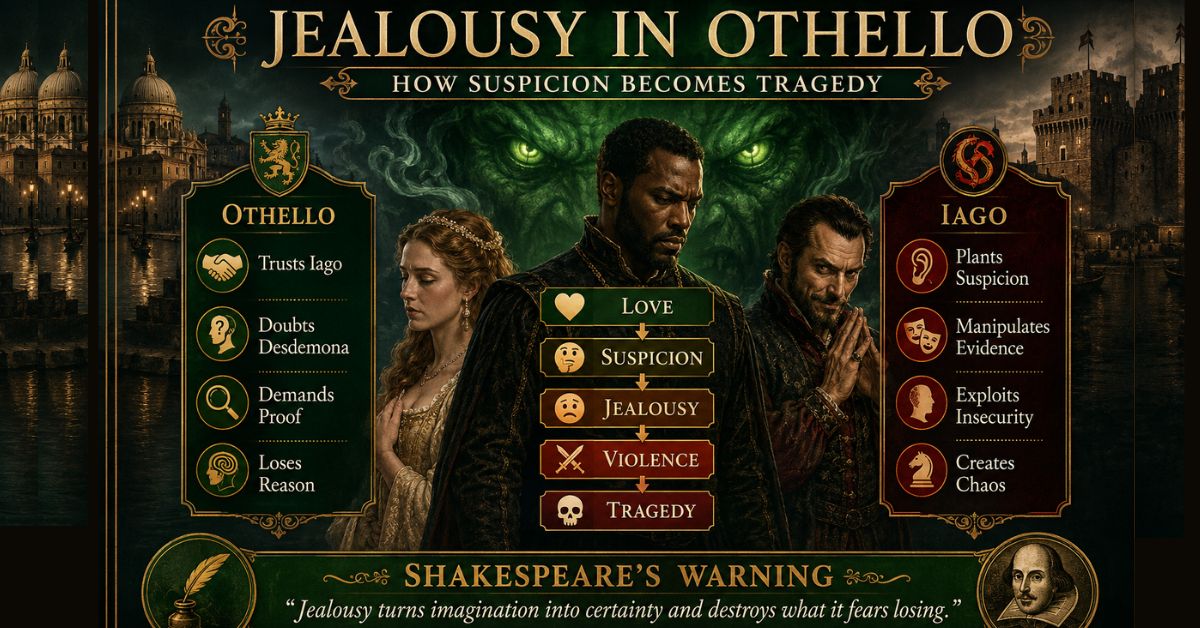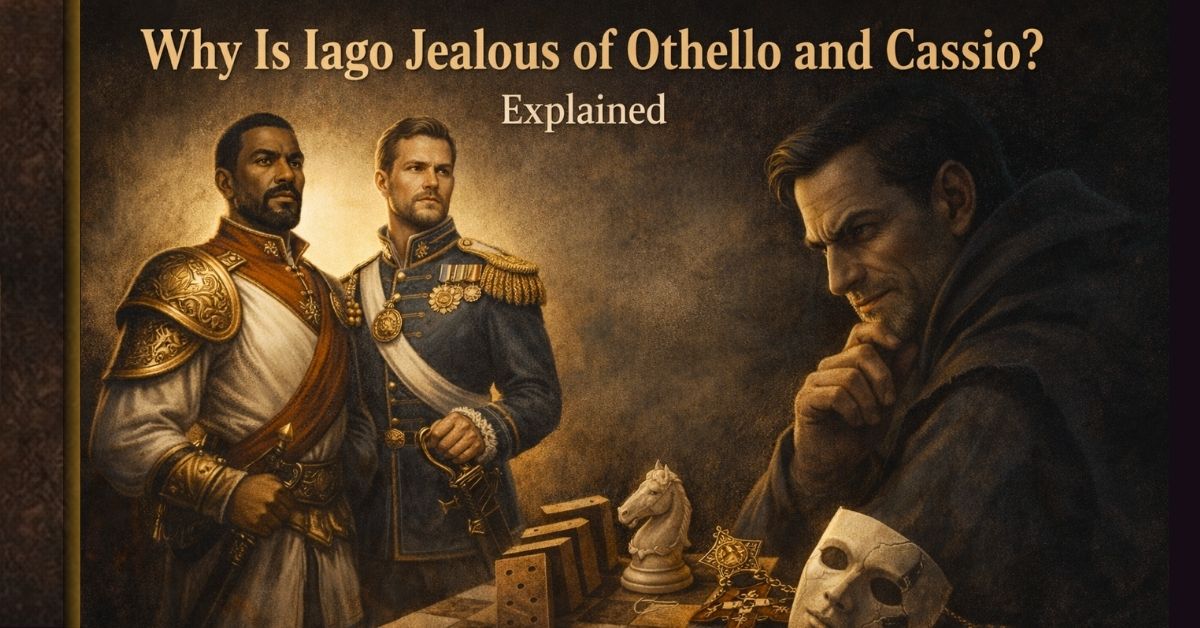
Does Iago really manipulate Desdemona, or is something more subtle happening beneath the surface of Othello? When I ask this in class, students often say, “YES, of course. He manipulates everyone.” But that confident answer usually hides a misunderstanding.
Here’s the twist: Iago’s manipulation of Desdemona is not direct manipulation at all. Unlike Othello or Roderigo, she is never psychologically controlled by him. Instead, something far more disturbing happens.
Iago studies her goodness, her honesty, her loyalty, her kindness, and quietly turns those virtues into weapons. It is not Desdemona who is manipulated. It is Othello’s perception of her that is carefully poisoned.
So when we ask, how does Iago manipulate Desdemona in Othello, we must reframe the question. In the wider pattern of manipulation in Othello, Desdemona becomes not a target but a tool.
And that is where the real tragedy begins.
Table of Contents
How Does Iago Manipulate Desdemona?
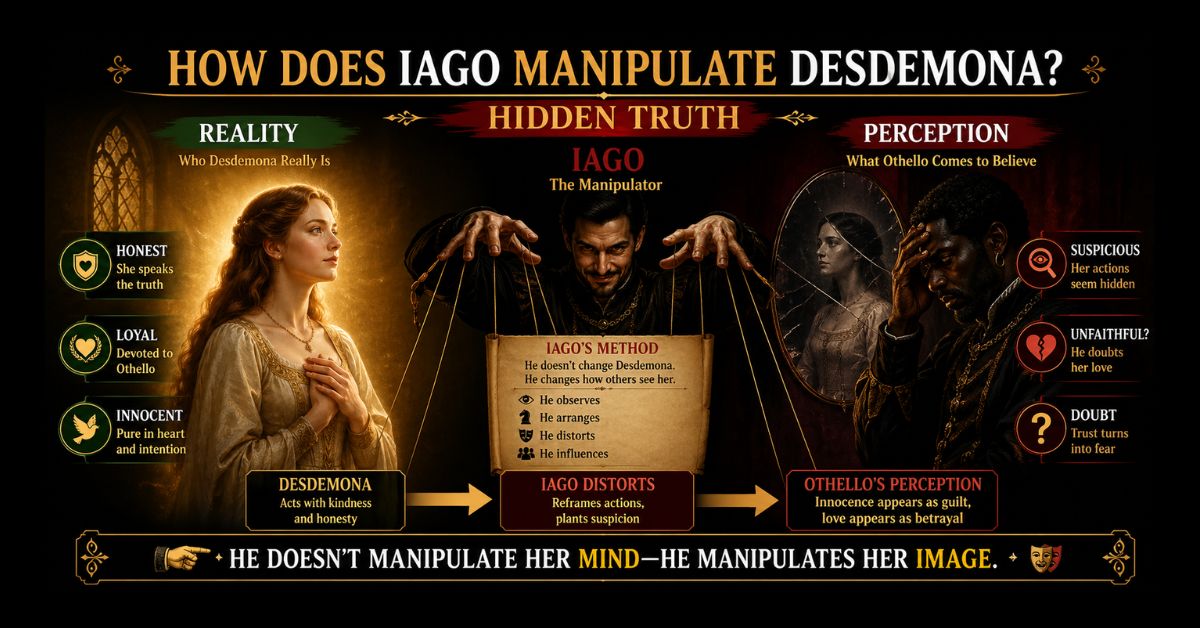
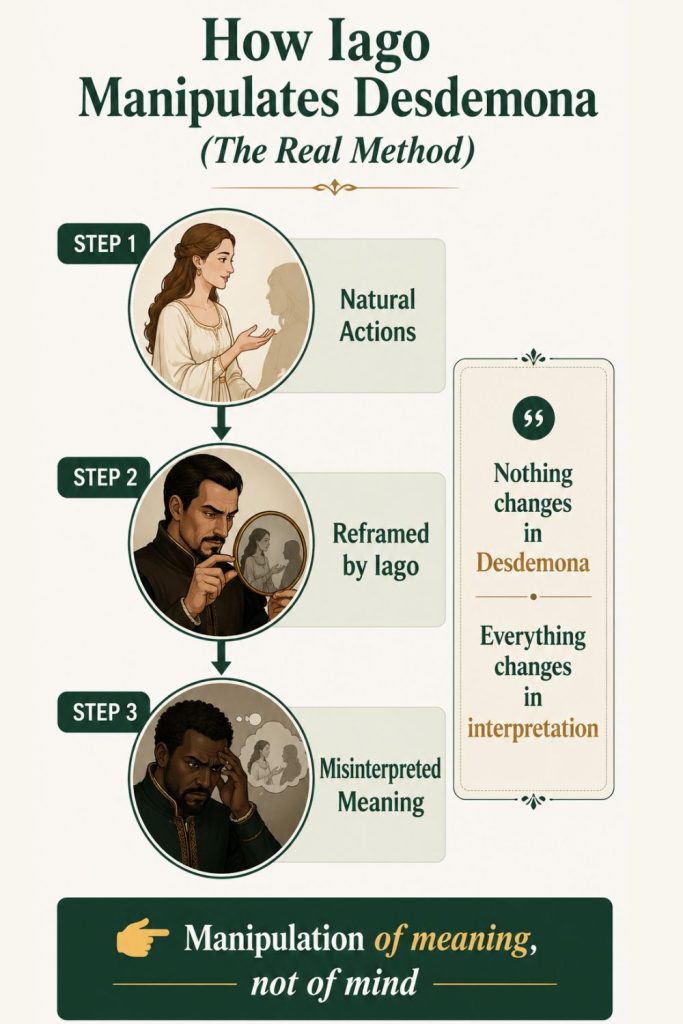
When students ask me how Iago manipulates Desdemona, I give a precise answer: he engineers how her actions are read, not how she thinks or behaves. He sets up situations where her natural responses: speaking, helping, and insisting, can be interpreted in damaging ways. Nothing about her changes; the frame around her actions does.
This is manipulation by design, not by direct influence. Iago arranges people, timing, and perspective so that meaning shifts without altering reality. Desdemona remains sincere, yet her sincerity becomes ambiguous under pressure.
So the real question is not whether he controls her, but how he uses her actions to shape Othello’s belief.
Does Iago Manipulate Desdemona Directly?
Does Iago talk to Desdemona directly to manipulate her? Surprisingly, NO, at least not in the way he manipulates others. If we look closely at the play, the evidence is clear: Iago does not engage Desdemona in any sustained attempt at psychological control. Instead, he operates around her, not through her.
Let’s approach this like a classroom insight. When we examine the Iago and Desdemona relationship, it’s strikingly distant. Iago never delivers persuasive speeches to her, nor does he attempt to reshape her thinking as he does with Othello or Roderigo. That absence is not accidental. It is strategic.
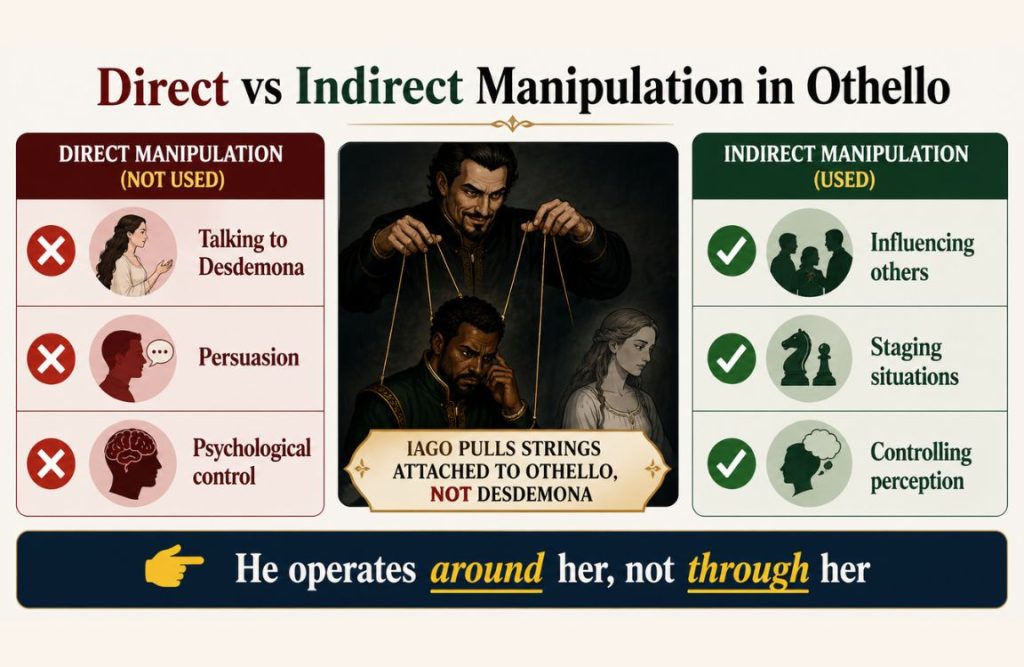
Here’s the crucial point: Iago doesn’t need to influence Desdemona’s mind because her behavior already serves his design. He sets events in motion, encouraging Cassio to seek her help and arranging moments where her actions can be closely observed, so that others, especially Othello, will misinterpret them.
Then comes the infamous handkerchief plot, engineered through Emilia, which turns a private token into public “proof.” Once again, Desdemona remains unchanged; only the meaning attached to her shifts.
So, does Iago talk to Desdemona directly to manipulate her? Not really. Instead, he constructs a narrative around her.
In essence:
- Iago never controls Desdemona’s thoughts
- He controls how she appears in Othello’s mind
And that distinction is crucial, not just for exams, but for truly understanding the depth of this tragedy.
How Does Iago Use Desdemona to Manipulate Othello?
To understand how Iago manipulates Desdemona in Othello, we must examine how he transforms her into ‘evidence,’ shaping Othello’s beliefs through suggestion, false proof, and emotional pressure.
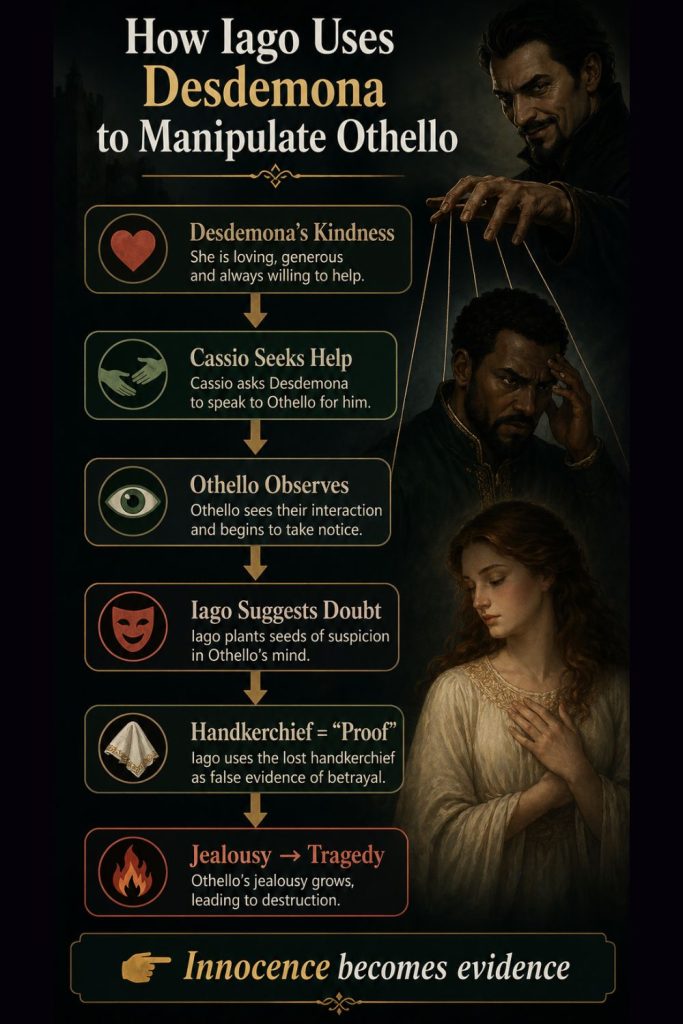
i) How Does Iago Manipulate Othello into Believing Desdemona Is Unfaithful?
Iago’s manipulation of Othello works not through blunt accusation but through suggestion, staged evidence, and the careful exploitation of his insecurities.
When students ask how Iago makes Othello believe Desdemona is unfaithful, I point to his method: he builds trust as “Honest Iago,” then speaks in hints and pauses. Questions like “Did Cassio know of your love?” invite Othello to complete the suspicion himself.
Next, Iago manufactures proof: the handkerchief becomes false evidence, supported by tales of Cassio’s dreams and Desdemona’s past deception. Slowly, Othello begins to interpret everything through Iago’s lens; innocence appears as guilt, love appears as deceit.
This is the brilliance of Iago’s manipulation of Othello: he never states the lie directly. He makes Othello believe it himself entirely.
In this way, Iago rewrites reality itself, turning ordinary gestures into signs of betrayal and guiding Othello toward a conclusion that feels painfully, convincingly his own.
ii) How Does Iago Use Desdemona Against Othello?
Iago’s manipulation of Othello and Desdemona works through strategic distortion, turning virtue into suspicion. When students ask how Iago uses Desdemona against Othello, I point to her kindness.
She pleads for Cassio persistently and sincerely, yet Iago reframes this, urging Othello to “observe her well,” making innocence appear calculated. Here lies his brilliance: he weaponizes goodness. Desdemona’s loyalty becomes “evidence,” her honesty becomes doubt.
Then comes the handkerchief plot. Stolen through Emilia and planted with Cassio, it transforms into false proof of infidelity.
At the same time, Iago quietly feeds Othello’s insecurities about love and trust, even reminding him she once deceived her father.
I often compare Iago to a director: Desdemona plays her role truthfully, but he rewrites the script Othello reads. The tragedy is not her change. It is Othello’s vision, reshaped until he sees only what Iago wants.
Desdemona’s Role in Iago’s Plan
Here, we will examine how Desdemona’s character, her innocence, loyalty, and honesty, fit into Iago’s scheme, not as an active participant, but as an unwitting figure whose virtues are turned into tragic liabilities.
i) Desdemona’s Innocence in Othello
Desdemona’s innocence in Othello is not weakness. It is purity without suspicion. She loves openly, trusts completely, and cannot imagine betrayal. In another story, these would be strengths. Here, they become dangerous. When she defends Cassio, her intentions are entirely genuine, yet this honesty makes her vulnerable.
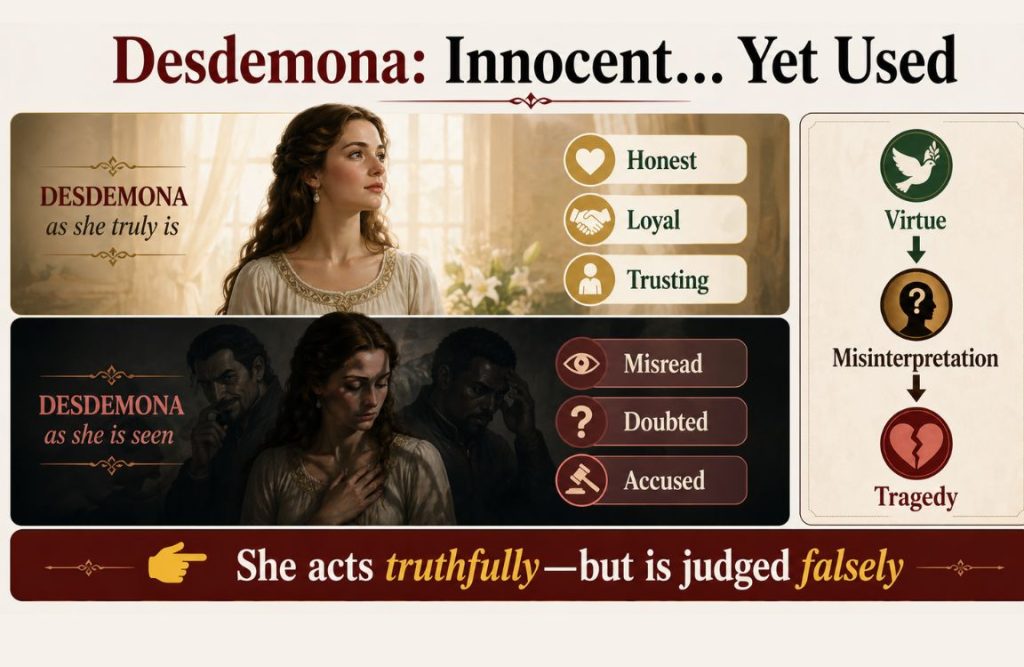
In class, I often explain it this way: she lives in a moral world, while Iago operates in a strategic one, and that gap proves fatal.
Her innocence does not fail morally. It fails to recognize deception. Even as Othello turns cruel, her love remains constant, and in her final moments, she refuses to blame him, almost accepting guilt herself.
This is the tragedy: her innocence is active, not passive, but it blinds her to manipulation. In a cruel twist, the very qualities that make her admirable also make her defenseless, turning her into a deeply tragic martyr.
ii) How Is Desdemona Used by Iago?
Desdemona’s role in Iago’s plan is not to act, but to be interpreted. Iago never controls her actions. He controls what they mean. Her honesty appears suspicious, her loyalty excessive, her love deceptive.
I often tell students: This is the cruel brilliance of his method. He weaponizes her goodness, encouraging her to help Cassio, then reframing it as betrayal. The handkerchief, planted as “ocular proof,” seals the illusion.
This defines Desdemona’s role in Iago’s plan. She becomes living evidence without ever intending to be. The tragedy lies in dramatic irony: we see her innocence, but Othello does not.
Desdemona speaks truth, yet once trust is broken, truth loses power, and even innocence cannot protect her from the devastating consequences of Iago’s manipulation.
Is Desdemona a Victim or a Contributor?
Is Desdemona a victim in Othello, or does she contribute to her own downfall? This question always sparks debate in my classroom. At first glance, she is undeniably a victim, manipulated by Iago, falsely accused, and destroyed by Othello’s jealousy. She remains loyal, loving, and truthful, even to her final breath.
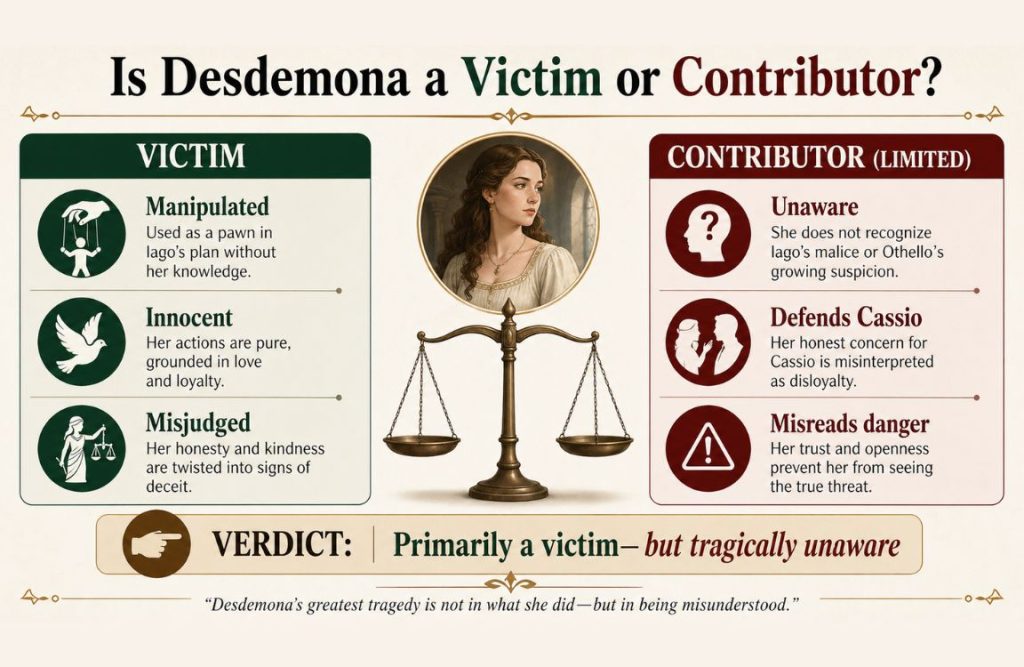
Yet, when we ask, is Desdemona responsible for her death, the answer becomes more layered. Her innocence, though admirable, leaves her unaware of the danger around her. She insists on Cassio’s case, not realizing how it appears to Othello. She even lies about the handkerchief to protect herself, unintentionally strengthening suspicion.
We must also consider the world she inhabits, a patriarchal society where her defiance, from marrying Othello to speaking assertively, makes her vulnerable.
Still, this is not guilt but tragic innocence. She does not act wrongly; she acts honestly in a dishonest world.
👉 She is primarily a victim
👉 Yet her lack of awareness deepens the tragedy
And that tension is what makes her story so painfully human.
Iago’s Manipulation Techniques in Othello
This section explores the methods behind Iago’s success: his psychological strategies, subtle suggestions, and calculated silence, which reveal how he controls others without direct lies, making his manipulation both invisible and devastatingly effective.
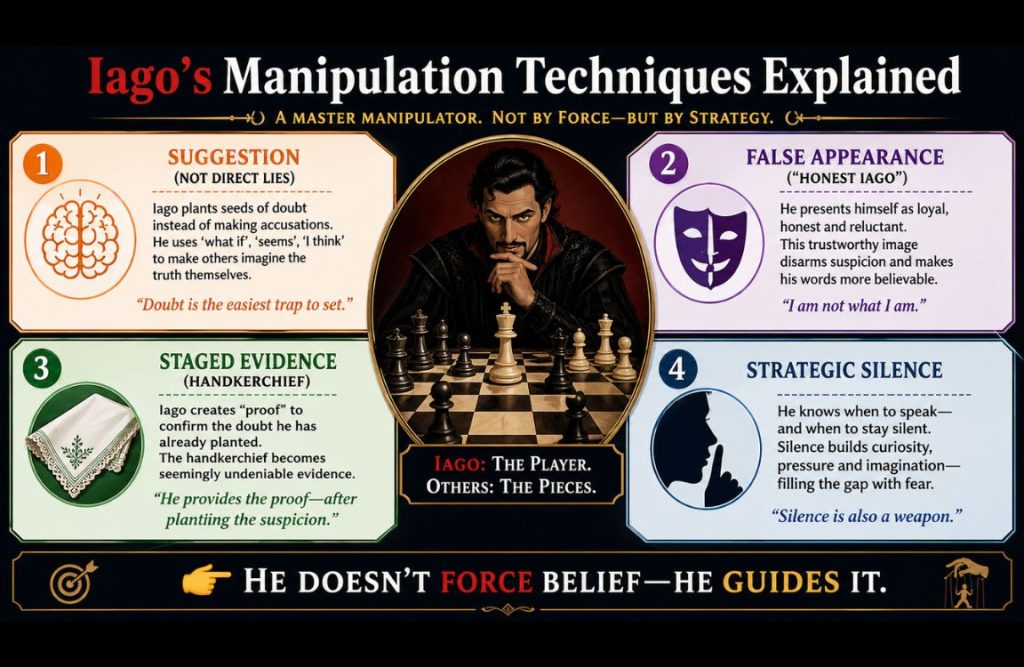
i) Iago as a Master Manipulator
To understand Iago as a master manipulator, we must look beyond his actions and examine his method. He rarely commands. He suggests. He rarely accuses. He implies.
This is what makes him dangerous. As “Honest Iago,” he builds trust, then exploits it, guiding others to believe they think independently.
I often describe him as a chess player: every move planned, every weakness studied, Othello’s insecurity, Roderigo’s desire, Cassio’s reputation.
He weaponizes virtue, turning Desdemona’s kindness into suspicion, and uses others as pawns, even Emilia, to execute his plans. His power lies not in force, but in influence.
And by the time his victims see the truth, his carefully orchestrated game is already won and irreversible.
ii) Examples of Iago’s Manipulation in Othello
Looking at examples of Iago’s manipulation in Othello, clear patterns emerge. His most powerful tool is psychological suggestion. He plants ideas without proving them, especially in Act 3, Scene 3, where Othello begins to imagine betrayal himself. This reflects Iago’s psychological manipulation techniques at their finest.
He also uses early “gaslighting,” making Othello doubt his own judgment, while silence and pauses allow suspicion to grow. Alongside this, he fabricates evidence: the handkerchief becomes “ocular proof,” and Cassio’s downfall is engineered through drink and chaos.
Even Roderigo is used as a pawn, funding and advancing his schemes. Iago does not create emotions. He redirects them. And that is what makes his manipulation so terrifyingly effective.
Themes of Manipulation in Othello
When we explore the themes of manipulation in Othello, three ideas quietly control the tragedy: appearance vs reality, trust vs deception, and dramatic irony. I often tell students, this play is not about lies alone, but about believable lies shaped through language and perception.
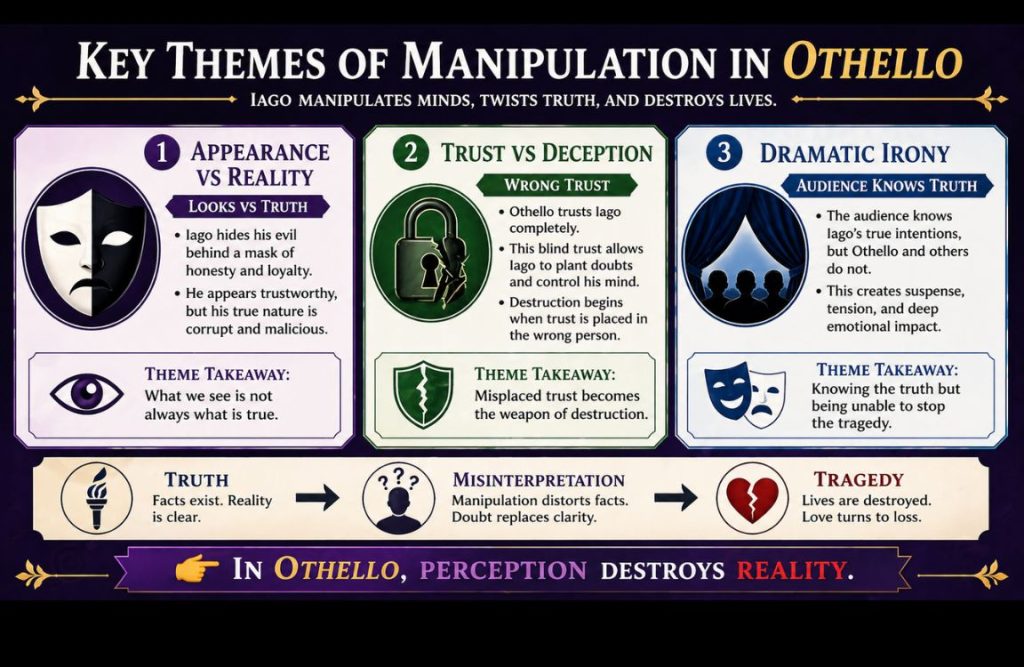
Appearance vs reality works like a mask. Iago seems honest. Desdemona appears guilty. Reality, of course, is the reverse.
Then comes trust vs deception: Othello trusts the wrong man and doubts the right woman, showing how trust becomes vulnerability in the wrong hands. Iago deepens this by exploiting Othello’s insecurities and controlling how he interprets events, even fabricating “ocular proof.”
But the most painful layer is the dramatic irony in Othello’s manipulation. We know Desdemona is innocent, yet we watch truth misread at every step. The result is devastating: love turns to jealousy, trust to fear, and relationships collapse, leading the tragedy to its inevitable, heartbreaking end.
FAQs:
Why doesn’t Iago manipulate Desdemona directly?
Iago avoids manipulating Desdemona directly because she offers no psychological weakness to exploit. Instead, he targets those who can be influenced easily, using Desdemona’s visible actions to reshape others’ perceptions without confronting her directly.
What makes Desdemona an easy target in Othello?
Desdemona becomes an easy target because of her openness and trust. She acts honestly in a dishonest environment, unaware that her actions can be misinterpreted, making her vulnerable to being used within Iago’s manipulative scheme.
How does dramatic irony increase Desdemona’s tragedy?
Dramatic irony intensifies tragedy because the audience knows Desdemona is innocent while Othello believes otherwise. This gap creates emotional tension, as every truthful action she takes pushes her closer to destruction instead of saving her.
What role does the handkerchief play in Iago’s plan?
The handkerchief serves as false evidence in Iago’s plan. Though meaningless in reality, it becomes a powerful symbol of betrayal in Othello’s mind, allowing Iago to transform suspicion into certainty without providing real proof.
Could Desdemona have prevented the tragedy?
Desdemona could not realistically prevent the tragedy because she lacks awareness of the deception around her. Her honest nature prevents suspicion, and without understanding Iago’s manipulation, she remains unable to defend herself effectively.
Conclusion:
So, let’s return to the central question: how does Iago manipulate Desdemona? The answer, now, should feel clearer, and perhaps more unsettling.
Iago never manipulates Desdemona directly. He never reshapes her thoughts, controls her actions, or deceives her personally. Instead, his true skill lies in Iago’s manipulation in Othello. He manipulates through her.
He takes her goodness, her honesty, loyalty, and love, and turns them into weapons against her. In a cruel twist, the more sincere she is, the more suspicious she appears.
That is the real tragedy:
👉 Her strength becomes her weakness
As a teacher, I always urge students to look beyond surface actions. Ask not just what happens, but how meaning is created.
If this changed how you see Desdemona, explore further, look at how Iago manipulates Cassio and Othello next. You’ll begin to see a pattern, and perhaps, a warning.