Every year when I teach Othello, I ask my students, “Who here trusts Iago?” A few hands go up. I smile. “Good,” I say. “Now you understand irony in Othello.”
This play is one of the sharpest examples of irony in Shakespeare, where what seems true is dangerously false. Among all the literary devices in Othello, irony is the quiet puppeteer. It drives Othello’s downfall, fuels suspense, and keeps us emotionally tangled in every scene.
The most powerful force? Dramatic irony in Othello. We know Iago’s plan. The characters don’t. And that painful gap between audience knowledge and character blindness creates unbearable tension.
Shakespeare turns appearance vs. reality into a battlefield. Trust becomes deception. A simple handkerchief becomes “proof.”
In this guide, I’ll break down the types of irony in Othello, explore dramatic irony act by act, unpack key quotes, and show how Shakespeare builds tragedy through irony itself.
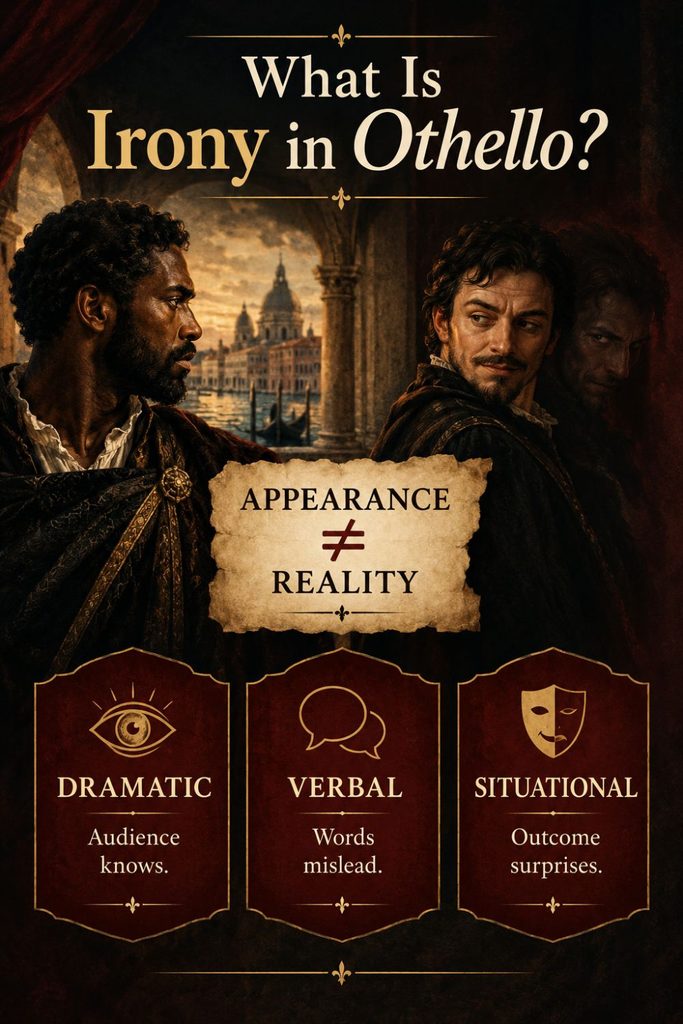
What Is Irony in Othello? A Simple Definition
Irony in Othello is a literary device where words or events mean the opposite of what they appear to mean. Shakespeare uses three main types- dramatic irony (the audience knows more than the characters), verbal irony (characters say one thing but mean another), and situational irony (outcomes are the reverse of expectations). These forms of irony drive the tragedy.

Now, let me tell you how I explain this in class.
I write one line on the board: “I am not what I am.” Then I turn to my students and say, “If that doesn’t make you nervous, it should.” That single line captures irony in Shakespeare at its finest. We hear the truth disguised as a lie.
Among the literary devices in Othello, irony is the most dangerous. Dramatic irony makes us watch helplessly as Othello trusts the wrong man. Verbal irony drips from Iago’s tongue while everyone calls him “honest.” Situational irony crushes us when a man seeking justice commits murder instead.
Why does Shakespeare love irony so much? Because it mirrors life. We misjudge. We assume. We trust appearances.
And in Othello, those misjudgments become fatal. That’s where our deeper exploration of irony in Othello truly begins.
Table of Contents
Types of Irony in Othello
The types of irony in Othello include dramatic irony, verbal irony, and situational irony. Each one deepens the tragedy- but dramatic irony dominates the play, shaping suspense, character downfall, and the painful gap between truth and perception.
i) Dramatic Irony in Othello
In Othello, dramatic irony occurs when the audience knows Iago’s evil plan while the other characters, especially Othello, believe he is honest. This gap between audience awareness and character ignorance creates intense suspense and deepens the tragedy.
Now, let me take you into my classroom for a moment.
I ask my students, “Who knows Iago is lying?” Every hand goes up. Then I ask, “Who does Othello trust?” Silence. That silence is dramatic irony in action.
From Act 1, we are insiders. We hear Iago confess his hatred. We know he plans to “abuse Othello’s ear.” Yet Othello calls him “honest Iago.” That painful contrast between appearance and reality is one of the clearest examples of dramatic irony in Othello.
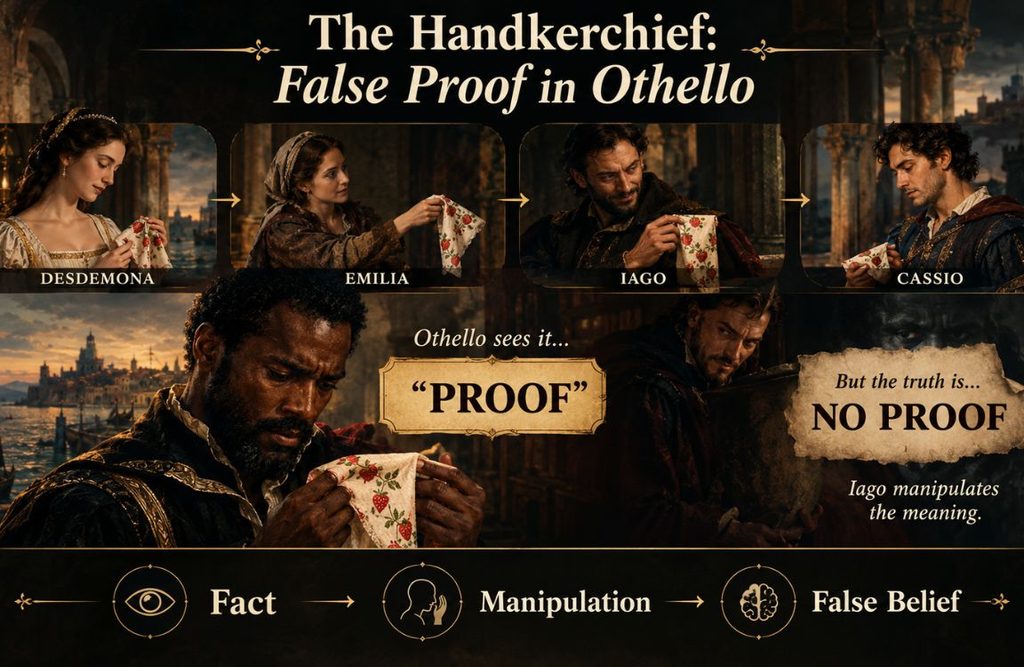
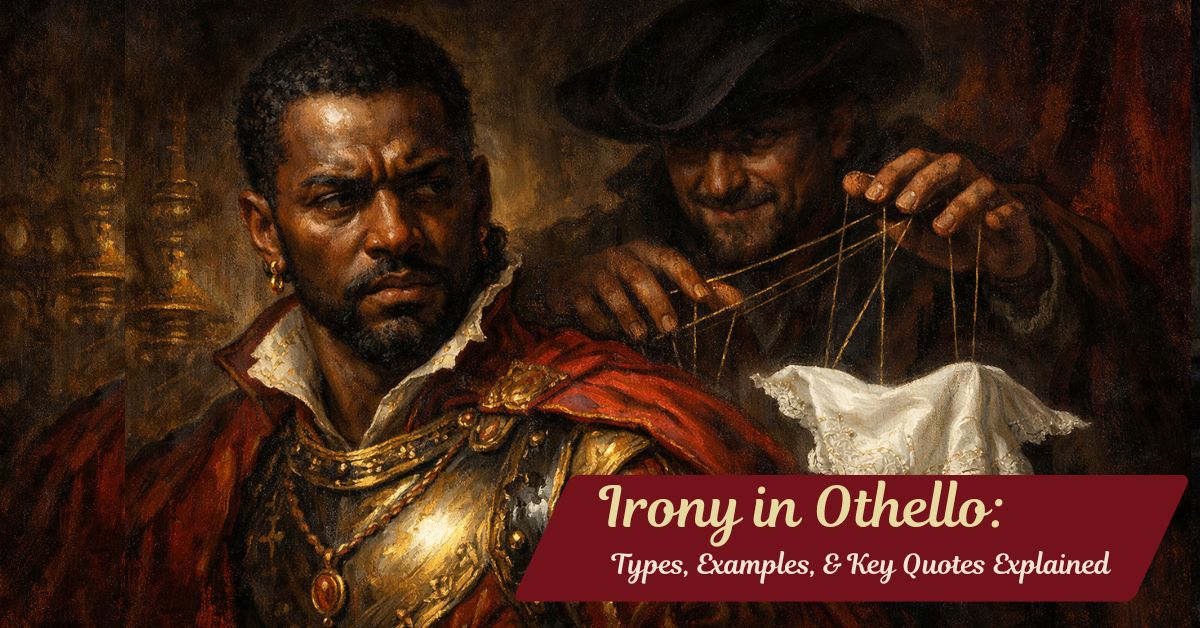
And then comes the handkerchief- just a piece of embroidered cloth. To us, it is planted evidence. To Othello, it becomes “ocular proof.” Even Cassio’s attempt to regain his job becomes fuel for suspicion because we already see the trap forming.
I tell my students, “Shakespeare turns fabric into a loaded weapon.” That’s how Shakespeare uses dramatic irony in Othello. He lets us watch the trap close slowly.
Shakespeare lets us stand above the storm while Othello walks into it. That cruel awareness builds tension, sympathy, and psychological tragedy- making the downfall not sudden, but devastatingly inevitable.
ii) Verbal Irony in Othello
Verbal irony in Othello occurs when a character says something that directly contradicts the truth, most powerfully through Iago, whose words disguise his malicious intentions while appearing loyal and honest.
While teaching this, I write on the board: “I am not what I am.” Then I turn to my students and say, “That’s not a confession. That’s camouflage.” This line flips the biblical “I am that I am” on its head.
In Othello, Iago constantly speaks in double meanings. He warns Othello, “Beware… of jealousy: It is the green-eyed monster,” while secretly feeding that very monster. I pause and ask, “Is he protecting Othello, or poisoning him?” The class knows.
Then comes the repeated title: “Honest Iago.” Every time Othello says it, the irony deepens. After engineering Cassio’s drunken fight, Iago claims loyalty and regret. He even says he loves Cassio– while ruining him.
I remind my students: Iago’s language is velvet wrapped around a dagger. His words sparkle with loyalty but cut with deception. That is Shakespeare’s brilliance- verbal irony that sounds sincere, yet destroys from within.
iii) Situational Irony in Othello
Situational irony in Othello occurs when events turn out the opposite of what characters expect. Othello seeks justice but commits injustice, Desdemona remains loyal yet is punished, and truth arrives only after irreversible tragedy.
Here’s how I frame it for my students: “Othello believes he is restoring order. In reality, he is destroying innocence.” That reversal, that cruel twist, is situational irony in Othello at its most devastating.
Early in the play, Othello declares “My life upon her faith,” pledging total trust in Desdemona. Yet that same faith, twisted by lies, leads him to kill her. He thinks he acts as a righteous judge; he becomes an executioner of the innocent.
Iago schemes to replace Cassio, but his plotting spirals beyond ambition into catastrophe. Emilia, the least suspected voice, exposes the truth, but only after the damage is done.
I often say, tragedy in this play feels like a staircase built backward. Each step meant to rise toward justice descends into chaos. That reversal, that moral collapse, is Shakespeare’s tragic architecture. The ending hurts because justice comes, but too late. Innocence pays the price.
Dramatic Irony in Othello Act-by-Act
To understand the tragedy fully, we must trace dramatic irony step by step. Act by act, Shakespeare lets us see the trap forming long before the characters feel the snap.
i) Dramatic Irony in Othello Act 1
In Othello Act 1, Dramatic irony begins when the audience hears Iago confess his hatred and deception, while other characters trust him as “honest.” This contrast between audience knowledge and character ignorance establishes tension and foreshadows tragedy.
Each year, when we arrive at Act 1 of Othello, I point out to my students, “We are recruited into Iago’s secret club.” From the opening scene, he confesses, “I follow him to serve my turn upon him,” and chillingly declares, “I am not what I am.” That is our backstage pass to his villainy.
Yet Othello calls him “honest Iago.” That’s the sting.
We watch Iago manipulate Roderigo for money and stir Brabantio with crude imagery. When Brabantio warns, “She did deceive her father,” we know the real deceiver stands beside him.
I take a pause and ask my students, “Who sees clearly in Act 1?” Not the characters. Only us.
That painful awareness, the sight of poison being poured while others drink willingly, is how Shakespeare plants tragedy from the very first act.
ii) Dramatic Irony in Othello Act 2
In Act 2 of Othello, Dramatic irony emerges when the audience knows Iago is orchestrating Cassio’s downfall, while others believe the chaos is accidental. This gap intensifies tension beneath the play’s temporary calm.
Act 2 opens with a celebration, but I often remind my class, “When Shakespeare gives you music, listen for a crack in the rhythm.”
In Othello, Iago privately outlines his scheme, then publicly plays the loyal friend. He pressures Cassio to drink, whispers doubts to Montano, and stages concern like an actor in uniform.
We see the trap. Cassio does not. When the fight erupts, and Cassio is stripped of rank, Othello sees disorder. We see design.
That’s the chilling brilliance: reputation in Othello collapses not by accident, but by arrangement, and only the audience recognizes the architect.
iii) Dramatic Irony in Othello Act 3
The strongest examples of dramatic irony in Othello Act 3 occur in the “temptation scene” (Act 3, Scene 3), where the audience knows Iago is lying about Desdemona while Othello begins to believe him. The handkerchief deception and misinterpreted conversations intensify the tragic transformation.
When I arrive at Act 3 in Othello, I tell my students, “Now the infection spreads.”
In Act 3, Scene 3, Iago doesn’t accuse. He suggests. “Ha! I like not that.” A casual remark. To Othello, it sounds like hesitation. To us, it’s a calculation. I ask my class, “Did you notice? He never states. He insinuates.” Suspicion grows not from evidence, but from implication.
Then the handkerchief falls. Emilia picks it up. We know exactly what will happen next. Othello does not. When he demands “ocular proof,” I take a breath with a pause and say, “The tragedy is not the lack of proof. It’s the illusion of it.”
Act 3, Scene 4, sharpens the cruelty. Othello hides while Cassio jokes about Bianca, believing the laughter is about Desdemona. We watch misunderstanding harden into certainty.
And then, the kneeling. Othello vows revenge beside the very man orchestrating his ruin. That image chills every classroom I’ve taught in.
Here, irony is no longer structural. It is psychological. We witness not just deception, but transformation. Because we see the lie beneath each word, the fall feels inevitable, devastating, and tragically self-sealed.
iv) Dramatic Irony in Othello Acts 4 and 5
In Acts 4 and 5, the role of dramatic irony in the tragedy of Othello reaches its peak because the audience knows Desdemona is innocent while Othello believes she is guilty. Emilia’s late revelation exposes the truth only after an irreversible tragedy.
By Act 4, Othello humiliates Desdemona publicly. She sings the Willow Song, foreshadowing doom, yet remains unaware of her fate. We want to shout, “She’s innocent!” Shakespeare denies us that power.
In Act 5, Othello smothers her, convinced he is delivering justice. We understand the misinterpretation: her tears are not for Cassio, but for the husband about to kill her. Then Emilia speaks. Her revelation finally unmasks Iago, but it’s too late.
I pause with students: “That is the final tragic irony. Notice, the moment truth arrives, nothing can be undone.”
That suffocating awareness, the audience witnessing innocence destroyed while the guilty are trusted, is Shakespeare’s ultimate cruelty. Dramatic irony here is not just structural; it is profoundly emotional, turning clarity into devastation.
Dramatic Irony in Othello Quotes Explained
Some of the most powerful dramatic irony quotes in Othello reveal truth to the audience while deceiving the characters. These lines are not just memorable. They are structural pressure points where Shakespeare tightens the tragic knot.
i) “I am not what I am.”
“I am not what I am” is a key example of dramatic irony used in Othello because it reveals Iago’s duplicitous nature, establishing the theme of appearance versus reality and signaling his deliberate embrace of deception. The line is a dark inversion of the biblical “I am that I am,” suggesting moral corruption and false identity.
Whenever we reach this line in the play, I tell my class, “Shakespeare doesn’t hide the villain in Othello. He introduces him with a confession.”
The biblical echo matters. In Exodus, God declares divine truth. Iago twists that sacred certainty into negation. It’s theological sabotage. By saying “I am not,” he defines himself by deception.
He even admits, “In following him, I follow but myself.” That is pure calculation, loyalty as performance.
Here’s the irony: he tells us exactly who he is. We believe him. Othello doesn’t.
This single paradox shapes the tragedy. Iago is not confused about who he is; he chooses duplicity. And that conscious embrace of deception becomes the engine that drives everything that follows.
ii) “Honest Iago.”
“Honest Iago” is a recurring phrase in Othello that creates powerful dramatic irony because the audience knows Iago is deceitful while other characters trust him completely. The repetition highlights misplaced trust and fuels the tragedy.
In teaching Othello, I sometimes count the phrase aloud. “Honest Iago.” Again. And again. My students groan, and that groan is Shakespeare’s design.
Iago turns his reputation for honesty into a weapon. He builds a persona of blunt loyalty and moral reliability, only to use that trust as camouflage. I tell my class, “He doesn’t break trust. He earns it first.”
Like a Vice figure from morality plays, he orchestrates psychological warfare, exploiting insecurity and pride. The more others praise his integrity, the more dangerous he becomes.
It’s like applauding a puppeteer while your own strings are being pulled.
The tragedy deepens not because deception exists, but because everyone believes in the deceiver.
iii) The Handkerchief Dialogue
The handkerchief dialogue is an example of layered dramatic irony in Othello because the audience knows the handkerchief was planted, while Othello believes it proves Desdemona’s infidelity.
When I teach this scene, I ask, “What is this handkerchief really worth?” At first, it is a “first gift,” a symbol of marital devotion. Othello even gives it a mythical backstory, an heirloom with enchanted origins, tied to loyalty and love.
We see Emilia give it away innocently. We see Iago plant it. Othello sees betrayal.
But notice the shift. The object stops being romantic and becomes judicial. Othello treats it like a legal exhibit. Its loss becomes a verdict.
That’s the brilliance: meaning collapses. A sacred token turns into a test. A misunderstanding turns into certainty.
I often remind my students, “Jealousy doesn’t need truth. It needs an object.”
And Shakespeare gives it one- small enough to hold, powerful enough to destroy everything.
How Does Shakespeare Use Dramatic Irony in Othello?
Shakespeare uses dramatic irony in Othello by giving the audience full access to Iago’s schemes while the other characters trust him completely. This knowledge gap creates unbearable tension, intensifies psychological tragedy, and drives the play’s structure toward inevitable catastrophe.

When students ask me this question, I say: Shakespeare turns us into silent witnesses.
From the beginning, we know Iago is lying. Yet everyone calls him “honest.” That repeated label becomes cruel verbal irony. Othello trusts him. Desdemona defends him. Cassio relies on him. We know better.
We understand the handkerchief is staged. We see Desdemona plead for Cassio out of kindness, while Othello reads it as proof of adultery. We hear Iago’s soliloquies before his traps spring. Every misunderstanding lands harder because we know the truth.
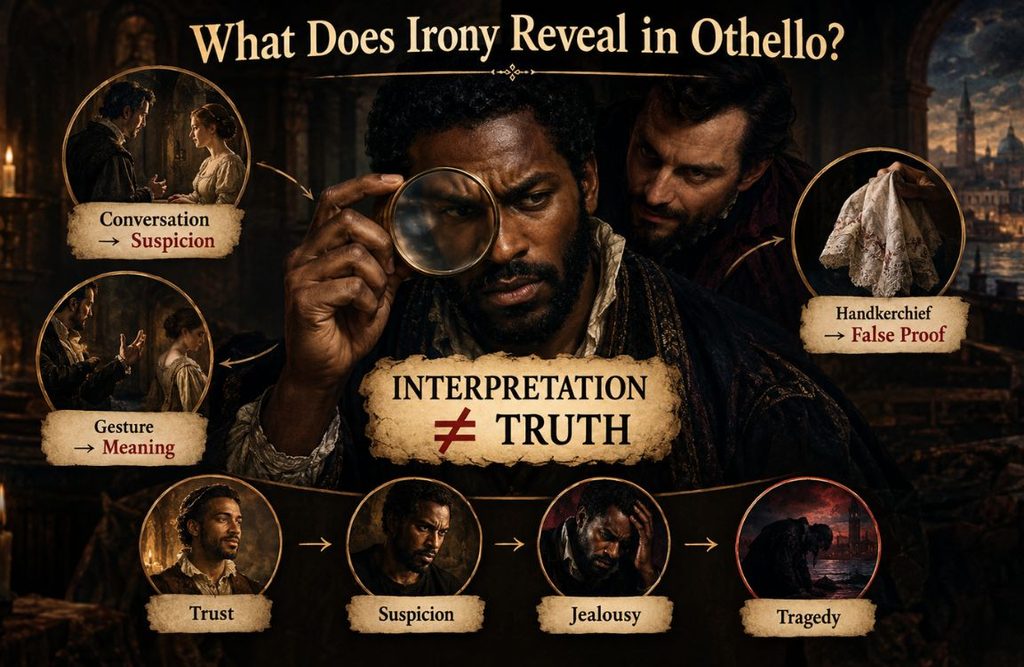
This gap between reality and perception fuels the theme of appearance versus reality. Truth never changes. Othello’s interpretation does.
I tell my class, “Shakespeare builds this tragedy like transparent machinery.” We see every lever being pulled. We understand every manipulation. And that is why the fall feels both preventable and unstoppable.
Dramatic irony here is not decoration. It is a design.
The Impact of Irony in Othello on Theme and Character
Irony in Othello shapes both theme and character by exposing the gap between appearance and reality. It transforms noble figures into tragic ones and turns trust into the very mechanism of destruction.
If I had to define irony in this play in one word, I would say exposure. Irony exposes weakness.
The central theme of appearance versus reality operates through sustained dramatic and verbal irony. Iago appears loyal while acting as what Othello later calls a “demi-devil.” His reputation for honesty becomes the sharpest weapon in the play. The irony is brutal: the least moral man controls the moral narrative.
Character transformation depends on that irony. Othello believes himself rational and just, yet he becomes ruled by jealousy. His trust in “honest Iago” initiates a complete reversal- from composed leader to paranoid husband. Desdemona and Cassio suffer situational irony; their innocent actions are misread as proof of guilt.
Reputation collapses. Jealousy thrives. Reality fractures.
When I ask my students when the tragedy becomes inevitable, I argue it begins the moment Othello chooses appearance over evidence. From there, irony does not simply highlight the fall.
It drives it.

Irony in Othello as a Major Literary Device
Among Othello’s literary devices, irony functions as a central literary device that drives the plot, intensifies suspense, and reshapes meaning. It works alongside symbolism and foreshadowing, but ultimately activates them.
When I unpack literary devices in this play, I tell my students to imagine a web. Irony is the center strand holding everything in tension.
Through dramatic irony, we know Iago’s intentions long before other characters do. His soliloquies establish a truth the audience cannot forget. Verbal irony sharpens that tension, as language itself becomes double-edged. Situational irony ensures that attempts to restore order only deepen chaos.
Even the structure of the play reflects ironic control: early stability gives way to distortion, and clarity returns only after irreversible damage.
Irony is not a decorative technique. It coordinates symbolism, accelerates conflict, and transforms perception.
In this tragedy, irony does not sit in the background.
It governs the design.
Common Misinterpretations of Irony in Othello
Common misinterpretations of irony in Othello include confusing irony with coincidence, assuming only dramatic irony matters, misreading verbal irony as sincerity, and overlooking how characters are falsely blamed due to ironic reversals.
One mistake I see often in exams? Students call every tragic event “irony.” Tragedy alone isn’t irony. Irony requires contrast- between truth and belief, appearance and reality.
And then, coincidence is not irony. The handkerchief falling is a coincidence. Othello interprets it as proof. That’s irony.
Another common error is reducing irony to “we know Iago is evil.” Yes, dramatic irony dominates. But when characters repeat “honest Iago,” that refrain deepens the agony. The audience hears the lie echoing.
Students also misread Othello’s sarcasm as innocence and assume stronger “ocular proof” would have saved Desdemona. That’s the cruel twist. The proof is weak, yet he accepts it.
And no, Desdemona isn’t partially responsible. Her virtue is weaponized against her.
When we separate coincidence from irony and sincerity from sarcasm, Shakespeare’s tragic design becomes devastatingly precise.
FAQs:
Does irony make Iago more powerful than Othello?
Yes, and that’s the uncomfortable truth I tell my students. Iago controls information, and in this play, information is power. Because we hear his plans first, he feels architect-like, directing outcomes while others move unknowingly inside the structure he designs.
Why doesn’t anyone question Iago’s honesty sooner?
No one questions Iago because he performs blunt honesty so convincingly that suspicion feels unreasonable. His plain-spoken soldier persona signals reliability. I often remind students: people mistake cynicism for truth. In Othello’s world, credibility is crafted long before it is tested.
Is the audience meant to feel guilty while watching the tragedy unfold?
Not exactly guilt, but something close. We feel pity and fear, the classic ingredients of tragic catharsis. Yet because we see the deception unfolding, our awareness feels complicit. Shakespeare makes us process devastation safely, but never comfortably.
What is the main irony in Othello?
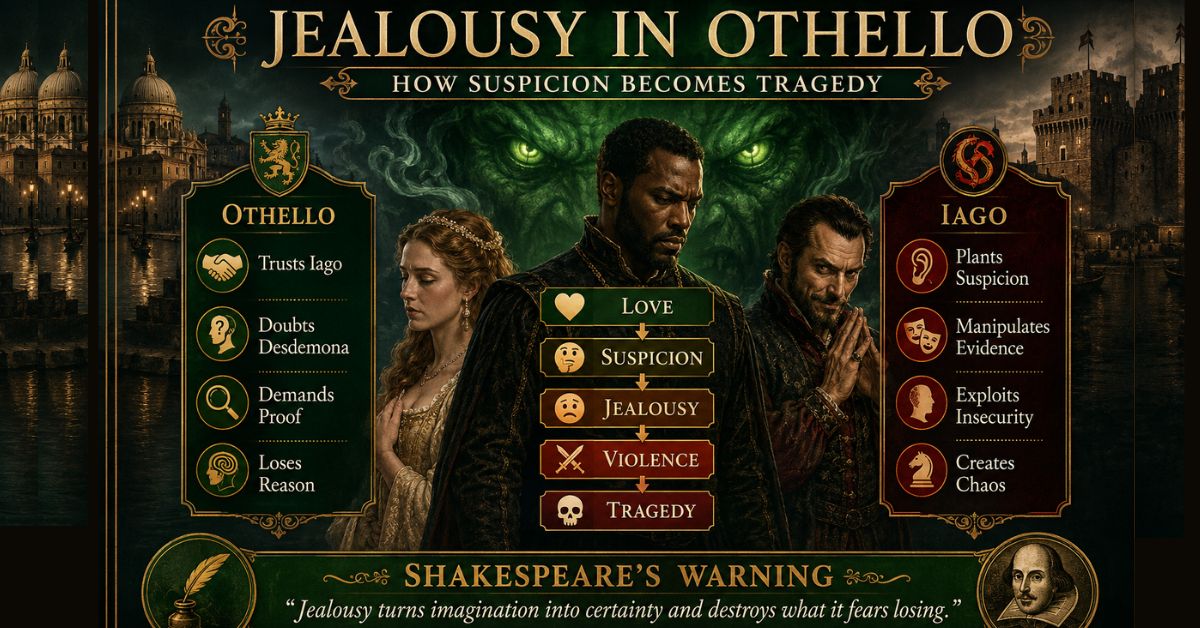
The central irony lies in misplaced trust. Othello believes the deceiver, whom he calls “honest” and condemns the faithful, demanding “ocular proof.” The man who prides himself on judgment misreads both villain and wife, allowing love to curdle into violence built entirely on illusion.
Conclusion:
The tragic impact of irony in Othello lies in the gap between truth and belief: the audience sees reality clearly while the characters act on deception, making the downfall inevitable and emotionally devastating.
When I conclude this play with my students, I remind them- irony is not decoration. It is the engine. Shakespeare’s use of dramatic irony in Othello creates unbearable suspense because we see the manipulation while Othello does not. That awareness intensifies every scene and turns jealousy into psychological collapse.
Across the tragedy, Shakespeare layers dramatic irony (audience knowledge), verbal irony (Iago’s weaponized language), and situational irony (reversals that wound). Together, they expose deception masquerading as loyalty and justice collapsing into injustice.
And irony never works alone. It interlocks with symbolism and foreshadowing, tightening the structure like a fatal design.
We foresee the wreckage long before it happens. Shakespeare does not surprise us. He makes us witness inevitability.
That is how tragedy is engineered, and why it devastates.