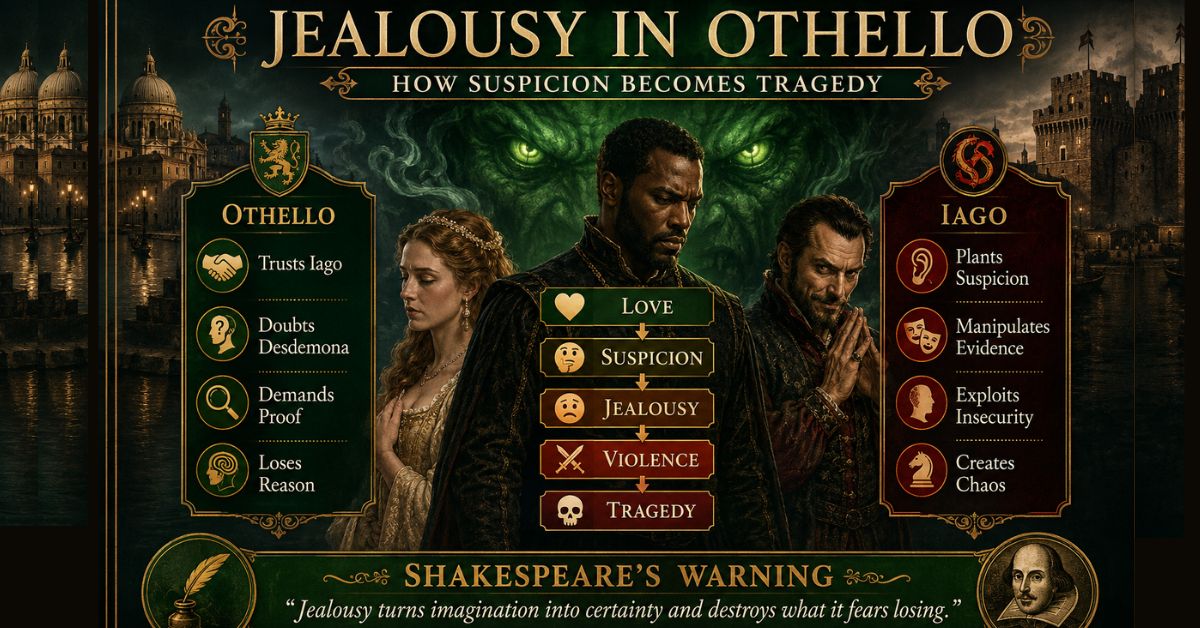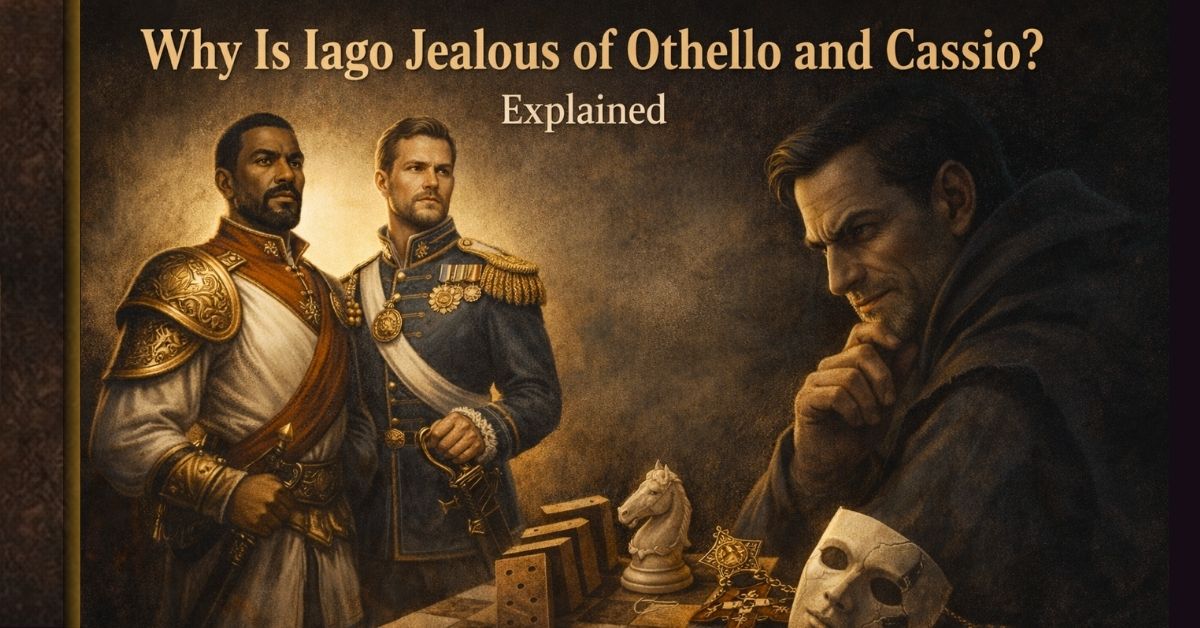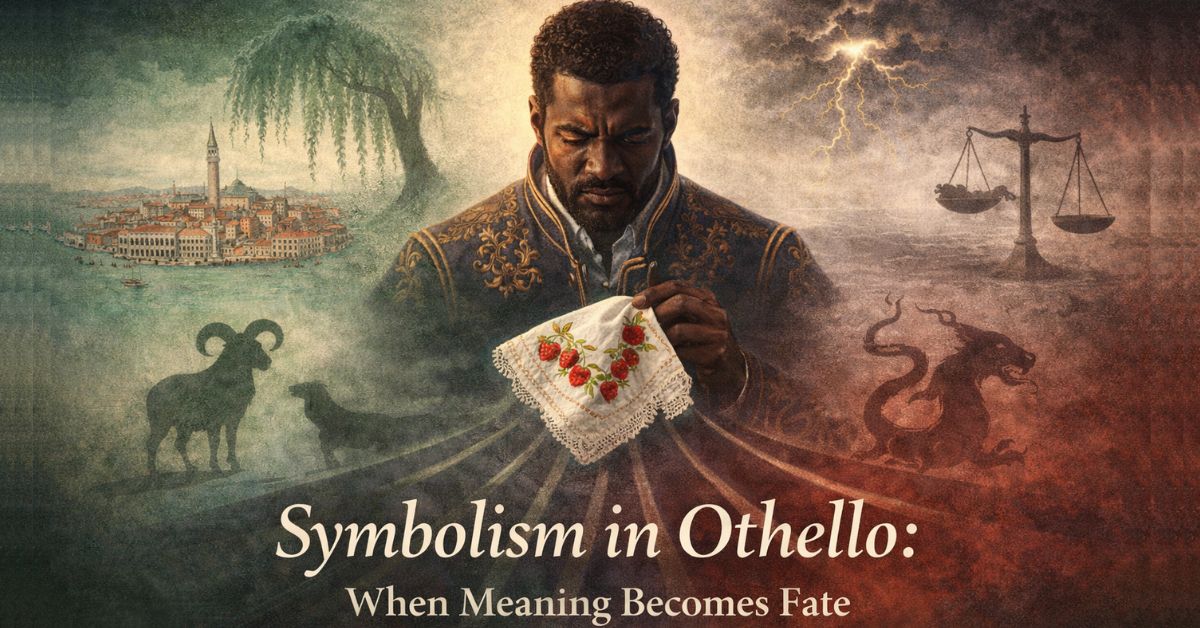
Othello is not destroyed by jealousy alone. Shakespeare gives jealousy objects, images, colors, songs, and settings through which it can grow. The handkerchief becomes evidence, the candle becomes life, and the Willow Song becomes a warning.
These symbols in Othello turn private emotions into visible signs and tragic consequences. In other words, symbolism in Othello helps us see how ordinary things acquire extraordinary power.
The Othello symbols matter because characters act on the meanings they attach to them.
What Do the Symbols in Othello Mean?
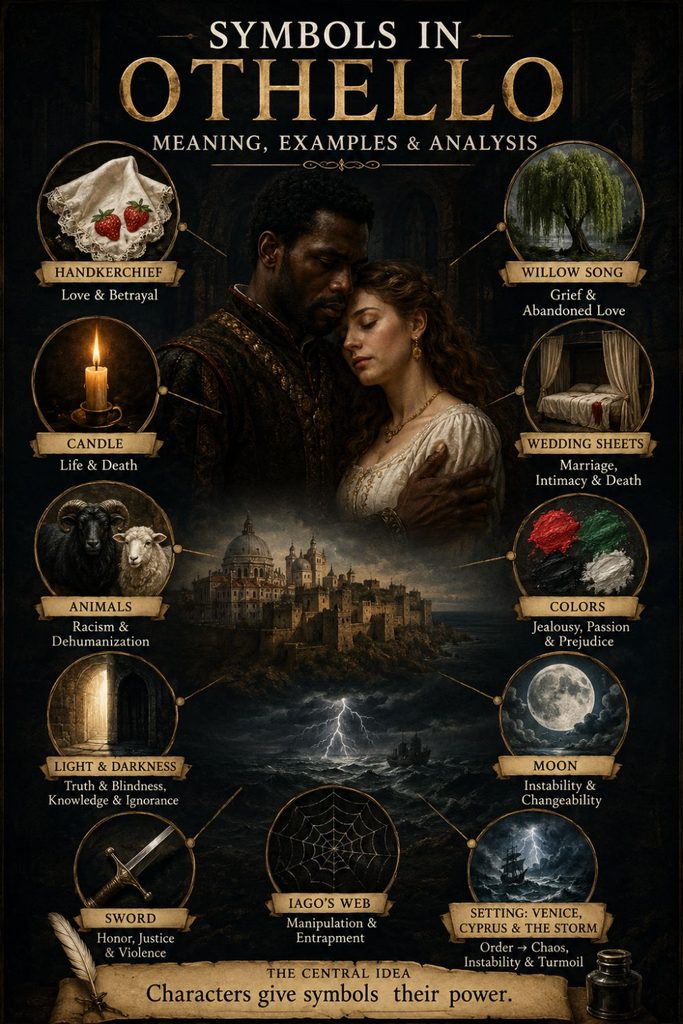
The table gives a quick guide to the major symbols in Othello. Use it as a starting point, then explore the sections below to see how each symbol develops deeper meanings throughout the tragedy.
| Symbol | Main meaning |
| Handkerchief | Love, fidelity, jealousy, false proof |
| Willow Song | Abandoned love and grief |
| Candle | Desdemona’s life |
| Wedding sheets | Marriage, intimacy, death |
| Animals | Racism and dehumanization |
| Colors | Jealousy, passion, prejudice |
| Light/darkness | Knowledge, ignorance, moral blindness |
| Moon | Changeability and instability |
| Sword | Honor, justice, violence |
| Iago’s web | Manipulation and entrapment |
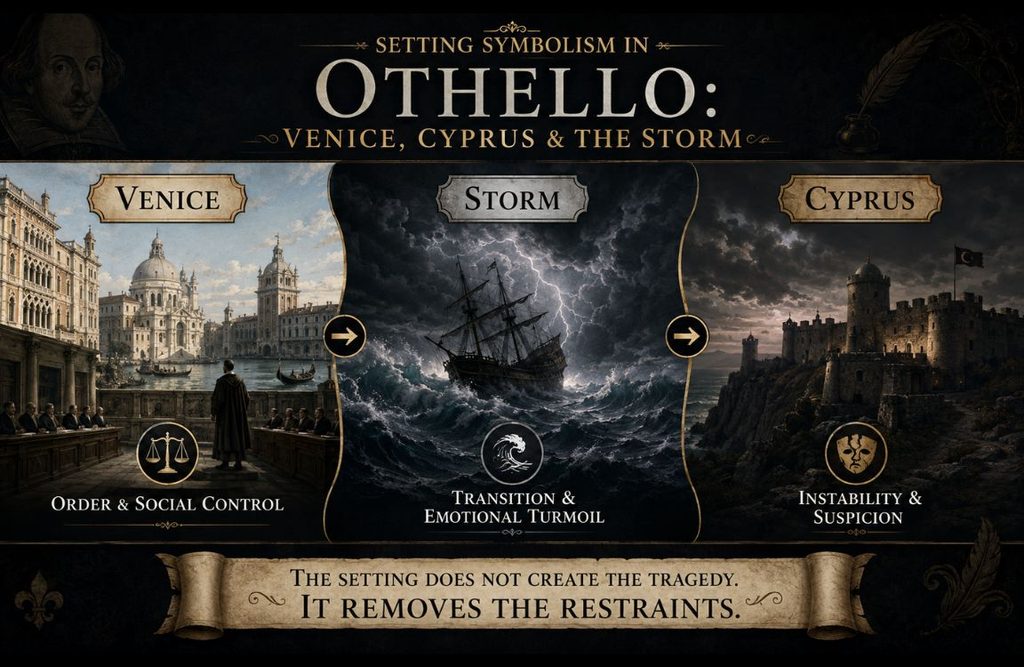
| Setting: Venice, Cyprus & the Storm | Order, instability, emotional turmoil |
Table of Contents
Othello Handkerchief Symbolism
What does the handkerchief symbolize in Othello? Its meaning changes as the tragedy develops: love → fidelity → possession → suspicion → false evidence → betrayal. The cloth stays the same, but Othello’s view of it changes completely.
In my teaching, I find this shift especially important because it shows how jealousy can turn an ordinary object into something frightening.
The significance of the handkerchief in Othello lies in its connection with marital fidelity, love, and the mysterious origin Othello assigns to it. He gives Desdemona the handkerchief as a deeply personal gift, making it a sign of their love.
Its strawberry design has also invited interpretations connected with love, sexuality, blood, virginity, and marital fidelity. Othello’s strange story about its Egyptian origin makes the gift even more powerful in his mind.
Why does Othello care about it so much? He wants something visible to confirm his fears. Iago exploits this need for certainty and turns the handkerchief into supposed “ocular proof.”
Once Othello believes Cassio has possessed it, the object seems to support his suspicions:
“Trifles light as air / Are to the jealous confirmations strong.”
The tragedy is that Othello finally trusts the handkerchief more than Desdemona. A token of love becomes evidence of betrayal. It shows how fear can make interpretation seem stronger than truth.
Willow Song Symbolism in Othello
I often tell my students that the Willow Song carries more than sadness. Its story of abandoned love connects Desdemona’s loneliness with Barbary’s earlier suffering, creating a parallel between the two women.. The recurring image of the willow also gives the scene an atmosphere of grief and loss.
Its greatest dramatic force comes from timing. Desdemona sings about sorrow shortly before her own death. Shakespeare therefore lets the audience hear her tragedy before they see it.
The song becomes an emotional warning, linking female suffering in the past with the catastrophe about to overtake Desdemona.
Candle Symbol in Othello
The candle becomes an image of Desdemona’s life when Othello says, “Put out the light, and then put out the light.” The first “light” refers literally to a candle flame that can be extinguished and relit.
The second carries the weight of human life, which cannot be restored once lost. Othello understands this difference, yet he still chooses to end Desdemona’s life.
The metaphor therefore connects light, life, and death, while revealing the tragic contradiction in his reasoning as he attempts to justify murder.
Symbols of Wedding Sheets in Othello
The wedding sheets carry a symbolic reversal. They begin with associations of marriage, sexual intimacy, purity, and fidelity. Once Othello becomes convinced of Desdemona’s supposed infidelity, the marriage bed takes on a darker significance.
What should represent marital union becomes the setting for destruction. The sheets therefore connect intimacy with imagined sexual corruption and, finally, death. Their significance grows from Othello’s changing view of his marriage, not from the object alone.
Animal Symbols in Othello
Animal imagery repeatedly strips characters of human dignity. Iago’s “black ram” and “white ewe” reduce Othello and Desdemona to racial and sexual stereotypes, while references to a “Barbary horse,” goats, monkeys, and dogs associate human behaviour with instinct and appetite.
The language reflects racism and dehumanization, but its effect goes deeper. Iago’s vocabulary helps shape how relationships are understood.
Othello begins as the target of such degrading language, yet eventually starts viewing Desdemona through similarly brutal assumptions. The imagery therefore becomes part of the psychological process by which prejudice enters his judgment.
Color Symbolism in Othello
Color symbolism in Othello turns emotion and prejudice into visual associations. Green, through Iago’s “green-eyed monster,” becomes linked with jealousy.
Red can suggest passion, sexuality, blood, and the violence growing beneath Othello’s love. The strawberries on the handkerchief invite some of these readings.
Black and white carry racial associations, including ideas about difference and purity. Shakespeare uses familiar color associations while also making us question the prejudice behind them.
Light and Darkness Symbols in Othello
Light and darkness symbolism in Othello creates a broader pattern of knowledge, ignorance, truth, deception, life, and death. Othello demands “ocular proof,” yet his apparent vision leaves him blind to Iago’s lies.
As Desdemona’s death approaches, what seems visible becomes increasingly misleading.
The contrast therefore connects with appearance versus reality: Othello believes he has seen the truth when his judgment has actually darkened.
Moon Symbolism in Othello
The moon suggests changeability and instability when Othello speaks of the “error of the moon.” He imagines that an outside force has altered human behaviour.
The idea also reflects his difficulty accepting that his own choices helped produce the catastrophe.
The moon thus becomes a convenient explanation for change, allowing him to look beyond himself for its cause.
Sword Symbol in Othello
The sword connects Othello’s military honor with the violence of his private life. A soldier trained to confront threats through action begins treating suspicion as something requiring punishment.
His weapon therefore marks the movement from military duty to imagined justice. In marriage, however, that warrior identity becomes tragically misdirected.
Iago’s Web Symbolism in Othello
Iago describes his deception as a web: “With as little a web as this will I ensnare as great a fly as Cassio.” The image suggests careful manipulation and entrapment.
His victims become caught not only by his schemes but also by their own fears and assumptions. The web captures the way deception works without requiring direct force.
Setting Symbolism in Othello (Venice, Cyprus & the Storm)
Place shapes the tragedy in Othello. Venice in Othello symbolizes public order, where law and social rules restrain personal conflict. Cyprus suggests instability, allowing private fears and suspicions to grow without those restraints.
The storm marks the transition between these worlds, foreshadowing the emotional turmoil ahead. I tell my students that the setting does not create Othello’s downfall. It removes the barriers that once contained it.
How Shakespeare Uses Symbols to Build Othello’s Tragedy
The symbols in Othello help turn abstract themes into dramatic choices. A handkerchief interpreted as proof of betrayal feeds jealousy, which contributes to murder. Animal language strengthens prejudice in the drama, while light imagery complicates the idea of seeing truth.
I would ask my students to notice that the objects themselves do not cause Othello’s tragedy; his interpretation of them does. Shakespeare makes these symbols powerful through the meanings his characters attach to them.
Across the play, symbolic details connect appearance and reality, race, gender, trust, and deception. The tragedy grows as characters mistake their interpretations for truth and act on them.
FAQs:
Is the handkerchief the most important symbol in Othello?
The handkerchief is arguably the most important because its changing significance directly affects the plot. Other symbols, including light, the Willow Song, and animal imagery, broaden the tragedy’s emotional and social dimensions.
Are symbols and motifs the same thing in Othello?
Not exactly. A symbol usually concentrates meaning in a particular object or image, while a motif is a recurring pattern or idea. In Othello, the two can overlap as patterns gather symbolic significance.
Why does Shakespeare use ordinary objects as symbols in Othello?
Ordinary objects become psychologically powerful when characters attach meanings to them. The handkerchief, for instance, gains enormous importance because Othello treats it as evidence. Its physical form stays unchanged while its significance shifts.
How do symbols in Othello reveal appearance versus reality?
Symbols can seem to offer certainty while actually exposing mistaken interpretation. The handkerchief appears to confirm betrayal, yet its supposed evidence comes from Iago’s manipulation. The object therefore helps turn appearance into a dangerous substitute for truth.
Do the symbols in Othello change meaning?
Yes. The handkerchief, wedding sheets, and light develop darker associations as the tragedy progresses. What begins with love, intimacy, or life becomes connected with suspicion, violence, and death as Othello’s understanding deteriorates.
Conclusion:
The symbolism in Othello makes the tragedy’s inner conflicts visible. A handkerchief becomes false evidence, a song anticipates grief, a candle evokes life, and the marriage bed becomes associated with death.
Their power comes from interpretation: characters attach meanings to things and then act on those meanings.
If you’re studying Shakespeare, explore our guide to Motifs in Othello to see how recurring patterns deepen this symbolic design.