Imagine watching a villain destroy a marriage while knowing every plan before the victims do. That is the uncomfortable power of Iago’s soliloquies. Soliloquies in Othello reveal private thoughts, motives, plans, and conflicts that other characters cannot hear.
Although several characters speak privately in Othello, Shakespeare gives his most revealing soliloquies to Iago. His seven commonly studied soliloquies expose his manipulation and give the audience privileged insight into his schemes. This creates dramatic irony: we understand Iago’s motives while Othello, Cassio, Roderigo, and others remain unaware.
In this guide, I’ll examine each speech closely, explain what Iago means, and show how these moments drive the tragedy toward its end.
Soliloquy in Othello: Definition and Purpose
In Othello, a soliloquy is a speech in which a character, typically alone, voices private thoughts for the audience to hear. It’s not simply any long speech. The character is not primarily addressing another person.
Instead, the audience gains access to thoughts that would otherwise remain hidden. This private access is a central purpose of the soliloquy in Shakespeare and helps us understand what characters conceal from one another.
Download the free Iago’s Soliloquies PDF Study Guide
Table of Contents
Why Does Shakespeare Use Soliloquies?
Shakespeare uses soliloquies to reveal hidden motives, deepen characterisation, create dramatic irony, and move the plot forward. Audience knowledge matters in Othello because we hear Iago’s intentions while other characters trust him.
This gap between what we know and what they believe creates the tension that pushes the tragedy.
Who Speaks Soliloquies in Othello?
Shakespeare gives several characters opportunities to speak privately, but none uses soliloquy as extensively or as strategically as Iago. His private speeches reveal his motives and methods of manipulation in far greater detail than those of any other character.
Othello also has important moments of self-reflection, while some speeches by Emilia and others may be classified differently depending on editorial interpretation.
Shakespeare gives Iago greater access to the audience’s confidence than any other character in the play.
How Many Soliloquies Are There in Othello?
Although several characters speak privately in Othello, the seven principal soliloquies by Iago are the ones most commonly discussed by critics.
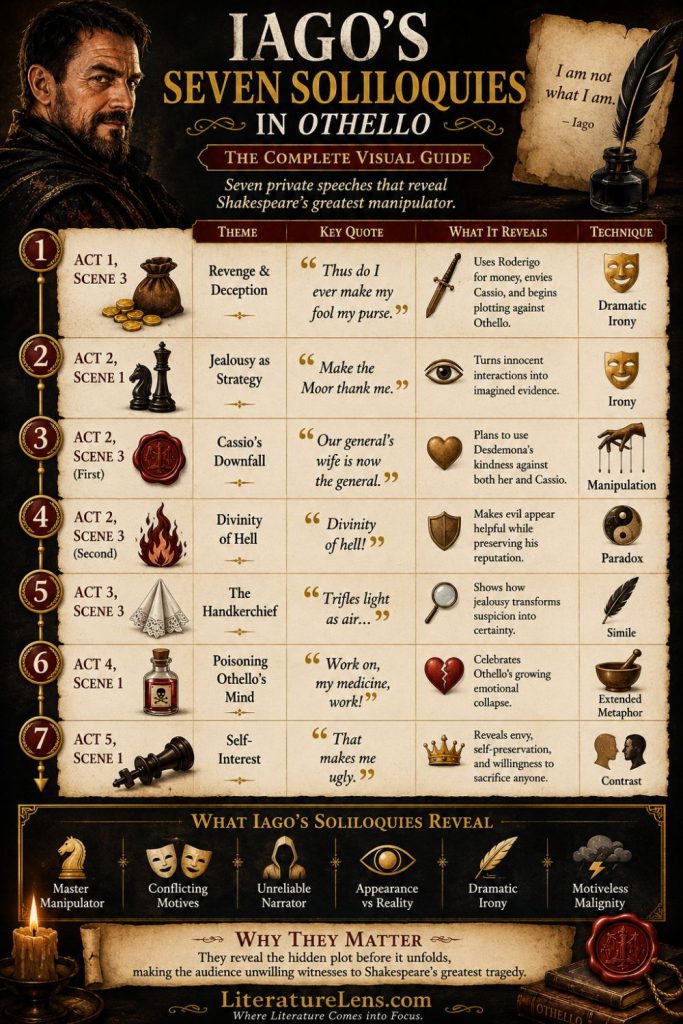
The generally accepted sequence includes Act 1, Scene 3; Act 2, Scenes 1 and 3; Act 3, Scene 3; Act 4, Scene 1; and Act 5, Scene 1. Act 2, Scene 3 contains two major passages that are often treated separately.
This list provides a practical guide for students, but the classification is not universally fixed. The table below summarises the main idea and dramatic function of each soliloquy.
| Act & Scene | Main Idea | Dramatic Function |
| 1.3 | Revenge and deception | Launches Iago’s master plan |
| 2.1 | Jealousy and manipulation | Builds suspicion |
| 2.3 | Cassio’s downfall | Removes Cassio from favour |
| 2.3 | Divinity of hell | Explains deceptive strategy |
| 3.3 | The handkerchief and jealousy | Turns suspicion into “proof” |
| 4.1 | Cassio conversation | Deepens Othello’s jealousy |
| 5.1 | Roderigo and self-interest | Completes Iago’s manipulation |
Iago’s Seven Soliloquies in Othello Explained
In this section, I’ll examine Iago’s soliloquies through the same lens: context, a key quotation, meaning, technique, motive, and dramatic function. This consistent approach shows how Iago’s private words steadily shape the tragedy.
Iago’s Soliloquy in Act 1, Scene 3
Context: After securing Othello’s trust, Iago considers how he can profit from the situation.
Key quotation: “Thus do I ever make my fool my purse.”
Meaning: Roderigo is useful because his money can finance Iago’s schemes, while Cassio’s promotion fuels resentment. Iago also suspects Othello may have slept with Emilia, adding further bitterness to his anger.
Technique: Dramatic irony is central because the audience hears the truth behind his seemingly loyal behaviour. His claim that “I am not what I am,” spoken earlier in Act 1, Scene 1, captures his self-conscious deception, though it is not part of the Act 1, Scene 3 soliloquy.
Motive: revenge and advantage.
Dramatic function: The speech establishes Iago as the architect of deception.
Iago’s Soliloquy in Act 2, Scene 1
Context: After watching Cassio interact with Desdemona and Othello, Iago turns what he has observed into material for his scheme.
Key quotation: “Make the Moor thank me.”
Meaning: Iago intends to make Othello believe that his warnings are acts of friendship, which allows suspicion to grow while he appears helpful.
Technique: Irony shapes the speech because the audience knows his service is designed to destroy Othello.
Motive: Iago wants to exploit Othello’s trusting nature and manufacture jealousy around Cassio and Desdemona.
Dramatic function: The speech shows strategic thinking before the accusation gains momentum. Rather than acting impulsively, Iago studies relationships, anticipates reactions, and transforms ordinary interactions into evidence.
Iago’s Soliloquies in Act 2, Scene 3
Context: After engineering Cassio’s drunken involvement in the fight, Iago considers how to exploit the damage.
Key quotation: “Divinity of hell!”
Meaning: Iago recognises the power of making evil appear beneficial, especially when victims interpret his actions as help.
Technique: The paradox joins moral opposites, capturing the play’s conflict between appearance and reality.
Motive: Iago wants Cassio removed from Othello’s favour while keeping his own reputation for honesty intact. He also manipulates Roderigo into helping continue the scheme.
Dramatic function: These soliloquies connect Cassio’s downfall with Iago’s method: create disorder, then appear to offer the solution. By hiding the design behind each incident, Iago ensures that others mistake manipulation for chance.
Iago’s Soliloquy in Act 3, Scene 3
Context: As Othello grows suspicious of Desdemona, Iago sees a chance to turn uncertainty into proof.
Key quotation: “Trifles light as air / Are to the jealous confirmations strong / As proofs of holy writ.”
Meaning: To a jealous mind, even the smallest detail can seem like undeniable proof.
Technique: The simile contrasts the lightness of a “trifle” with sacred authority, which shows how jealousy makes belief replace evidence.
Motive: Iago wants jealousy to become self-sustaining, so every small detail seems significant.
Dramatic function: The speech marks a turning point in his manipulation. The handkerchief becomes useful because Othello no longer needs evidence. He needs something convincing.
Iago’s Soliloquy in Act 4, Scene 1
Context: Iago arranges for Othello to watch Cassio laughing while Bianca is discussed, making the conversation appear sexually incriminating.
Key quotation: “Work on, / My medicine, work!”
Meaning: Iago celebrates the effect of his performance as Othello’s jealousy intensifies.
Technique: The metaphor of “medicine” casts Iago as a false physician whose treatment deepens, rather than cures, Othello’s emotional illness.
Motive: He wants Othello’s suspicion to become rage.
Dramatic function: Dramatic irony is powerful because the audience understands the joke while Othello interprets it differently. In some editions or stagings, however, this speech is treated as an aside rather than a strict soliloquy because Othello may remain onstage.
Iago’s Soliloquy in Act 5, Scene 1
Context: As Roderigo prepares to attack Cassio, Iago weighs what happens if Cassio survives.
Key quotation: “If Cassio do remain, / He hath a daily beauty in his life / That makes me ugly.”
Meaning: Iago admits that Cassio’s existence threatens his position and sense of self.
Technique: The contrast between Cassio’s “beauty” and Iago’s “ugly” turns envy into a vivid image of self-comparison.
Motive: Self-interest dominates his plan. He is willing to sacrifice Roderigo if that protects him.
Dramatic function: The speech brings his manipulation to its climax. Roderigo has served as a source of money, but Iago is prepared to discard him when inconvenient. Personal gain now outweighs loyalty, revealing that even his closest accomplice is expendable.
What Do Iago’s Soliloquies Reveal About His Character?
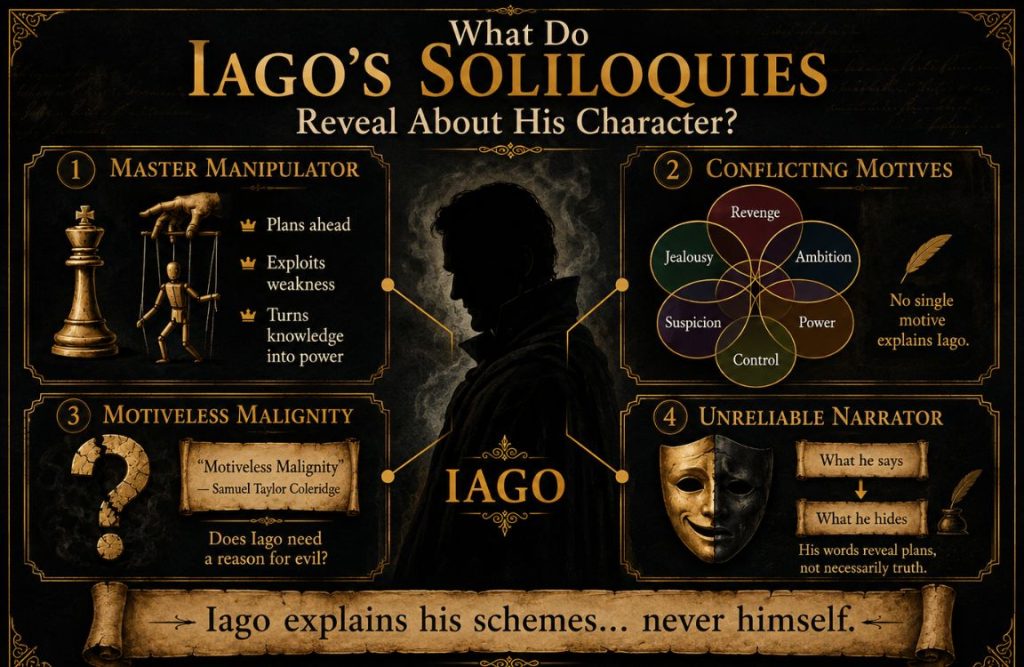
Iago’s soliloquies reveal more than his schemes. They expose his shifting motives, calculated manipulation, unreliable storytelling, and the enduring critical puzzle of whether his villainy has any single, stable cause. Together, they reveal a villain whose words explain his plans without ever fully explaining himself.
i) Iago as a Master Manipulator
Iago rarely speaks privately without advancing the next stage of his plot. His soliloquies show him testing possibilities, reading weaknesses, and turning ordinary events into weapons. His greatest skill is transforming knowledge into power.
ii) Iago’s Conflicting Motives
Iago’s motives never settle into one simple explanation. Revenge, blocked promotion, jealousy, suspicion, and the desire for power all contribute to his actions.
Yet he also seems to enjoy the act of manipulation itself, making control both his method and his reward.
iii) The Question of “Motiveless Malignity”
Samuel Taylor Coleridge famously described Iago’s villainy through the idea of “motiveless malignity,” which suggests evil that seems to exceed rational motive.
Yet Iago’s motives remain debated: revenge, ambition, jealousy, suspicion, power, and even enjoyment overlap without producing a single convincing explanation. The more he explains himself, the less certain we become about what truly drives him.
vi) Iago as an Unreliable Narrator
Iago tells the audience his thoughts, but openness does not equal truthfulness. As an unreliable narrator, he can reveal genuine plans while distorting motives, exaggerating suspicions, or inviting us to accept explanations that may hide deeper impulses behind his character.
Why Are Iago’s Soliloquies Important?
Iago’s soliloquies perform crucial dramatic work beyond revealing his character. First, they create dramatic irony in Othello: the audience knows Iago’s plans while Othello, Desdemona, Cassio, and Roderigo remain deceived.
Second, this knowledge creates audience complicity. We become unwilling witnesses to a plot we understand but cannot stop.
Third, the speeches organise plot development, allowing Shakespeare to move from Iago’s private intention to public action.
Finally, they create foreshadowing and anticipation that makes us watch anxiously as each announced scheme approaches its consequences.
In this sense, Iago and the audience share privileged knowledge, while the other characters remain trapped inside his deception. The purpose of the soliloquy in Othello is therefore partly structural: it turns private intention into dramatic momentum.
Othello’s Soliloquies: How Do They Differ From Iago’s?
Although this guide focuses on Iago, Othello also has important moments of private reflection. Unlike Iago’s soliloquies, which reveal calculated plans before events unfold, Othello’s private speeches expose the emotional collapse caused by those plans.
Together, they create one of Shakespeare’s most powerful dramatic contrasts: one man engineers deception, while the other gradually becomes its victim.
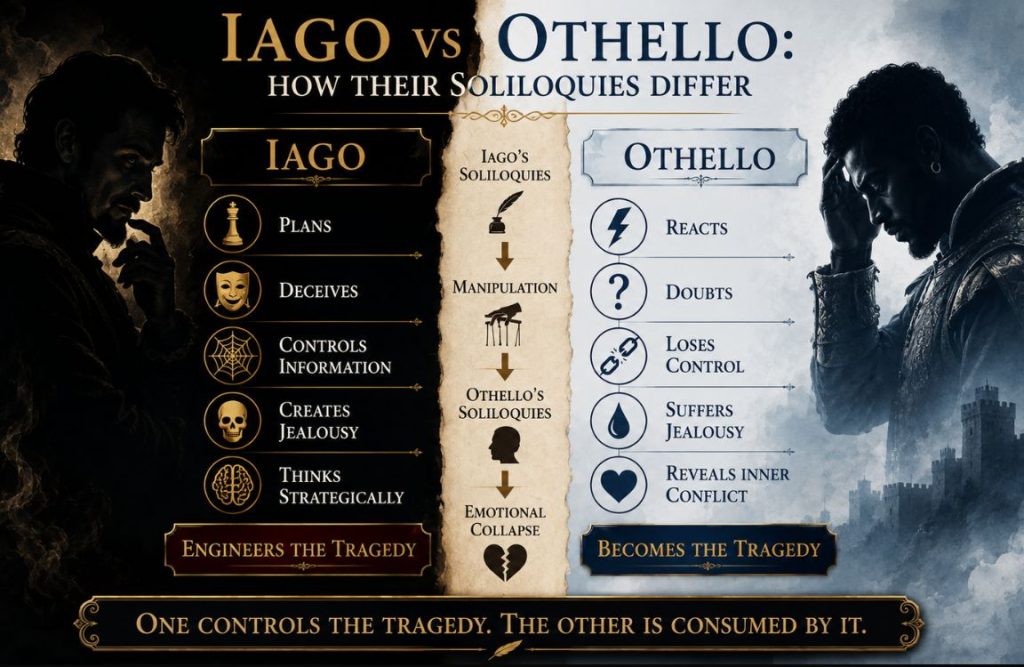
The table below shows why Iago’s soliloquies drive the tragedy, while Othello’s reveal its emotional cost.
| Iago | Othello |
| Plans | Reacts |
| Deceives | Doubts |
| Controls information | Loses control |
| Creates jealousy | Suffers jealousy |
| Talks strategically | Reveals inner conflict |
This contrast lies at the heart of Shakespeare’s tragedy. Iago’s speeches often orchestrate the action, while Othello’s inner thoughts reveal a mind gradually overwhelmed by jealousy and manipulation. One controls the tragedy. The other is gradually consumed by it.
Soliloquy vs Monologue vs Aside in Othello
These terms are related but not interchangeable. Understanding soliloquy vs monologue and soliloquy vs aside helps explain why discussions of Iago’s speeches can become technically complicated.
i) Soliloquy vs Monologue
A soliloquy presents a character’s private thoughts made audible to the audience. A monologue is an extended speech by one speaker, often addressed to other characters.
Therefore, an Iago monologue is not automatically a soliloquy, even when it reveals his thoughts.
ii) Soliloquy vs Aside
An aside is conventionally a brief or private remark that other characters onstage are not meant to hear.
A soliloquy is more sustained and inward. However, staging and performance can complicate this boundary, making the distinction between a soliloquy and an aside less absolute than textbook definitions suggest.
FAQs:
Why does Iago speak to the audience so often in Othello?
Iago’s frequent addresses create an unusual relationship with the audience. We become his privileged listeners and unwilling witnesses, understanding his deception while watching Othello, Desdemona, Cassio, and Roderigo remain unaware.
Are Iago’s soliloquies always truthful?
No. Iago can reveal his genuine plans while still manipulating interpretation. A private speech gives access to his thinking, but it does not guarantee complete truth. He remains an unreliable narrator.
Why is Iago’s Act 2, Scene 1 soliloquy important?
Iago’s Act 2, Scene 1 soliloquy is important because he turns uncertain suspicion into deliberate strategy. He begins linking Cassio, Desdemona, and Othello within a scheme designed to produce jealousy and destruction.
Are all private speeches by Iago technically soliloquies?
No. The distinction depends partly on staging and editorial interpretation. Some private remarks may function as asides rather than full soliloquies, making the boundary difficult to define precisely in performance.
Why does Shakespeare make the audience know Iago’s plans?
Shakespeare creates dramatic tension by letting spectators understand Iago’s deception while his victims do not. This knowledge makes the audience feel trapped, unable to intervene as Othello, Desdemona, Cassio, and Roderigo suffer.
Conclusion:
Iago’s soliloquies are not merely Shakespearean speeches. They are the mechanism through which the audience watches deception being designed, tested, and carried out.
Like the opening invitation to watch a villain at work, these speeches place us beside Iago from the beginning, and make us witnesses to villainy before its victims understand it.
Now read one of Iago’s soliloquies aloud. Listen not only to what he says, but also to what he avoids saying. Shakespeare’s greatest villain is often most revealing in what he leaves unsaid.