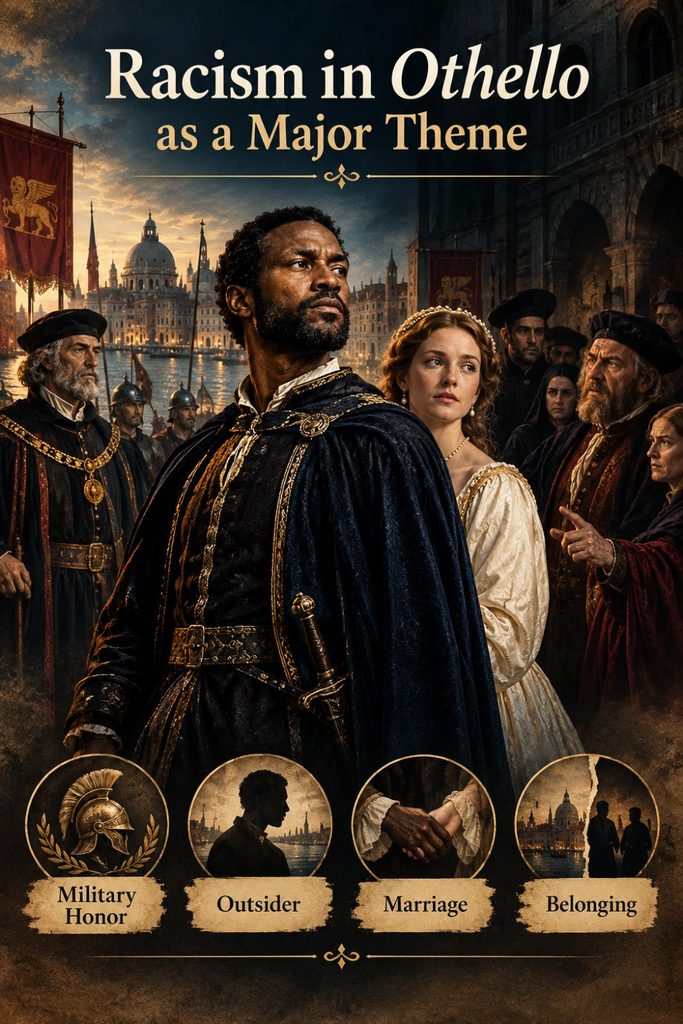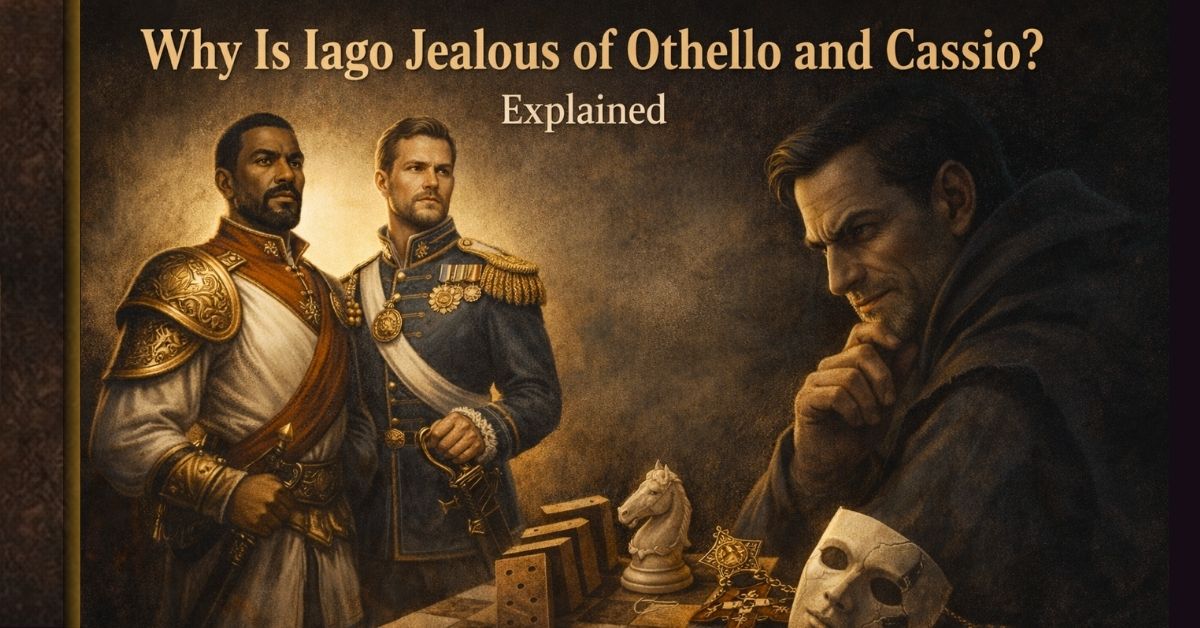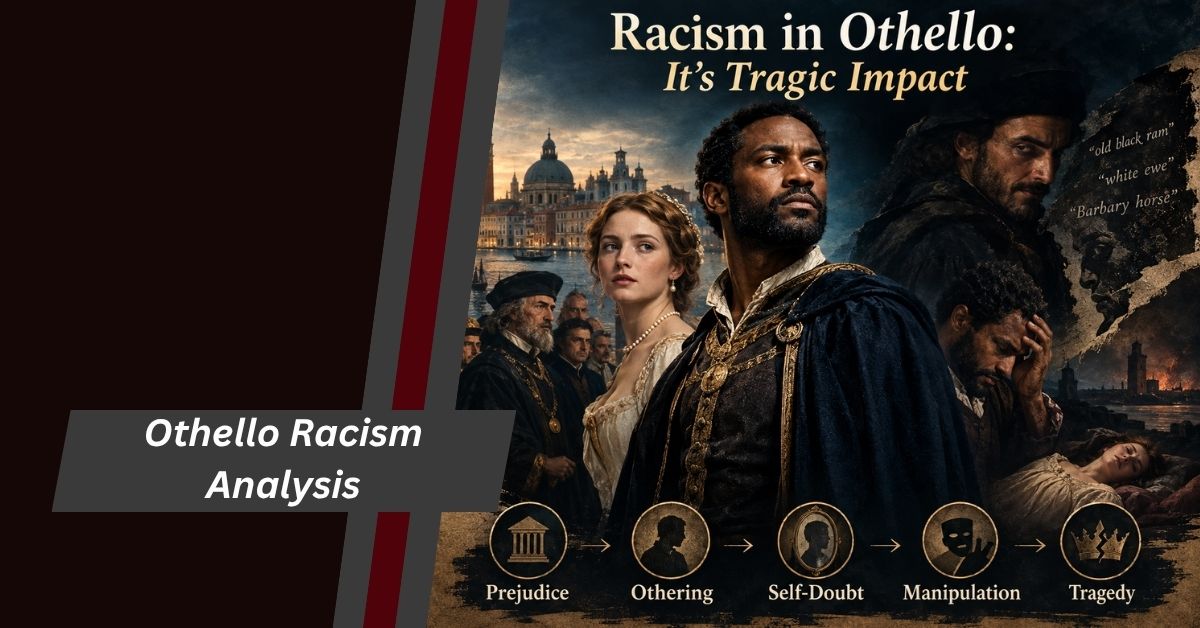
I tell my students this every year: Othello is not just a tragedy about jealousy. It’s a tragedy about race wearing a mask. Yes, there is racism in Othello, and it quietly steers the entire play like a hidden hand on the wheel. From the very first insult, “an old black ram,” we see racial prejudice in Othello operating openly in Venetian society. Iago spits it out with venom. Others nod in silence.
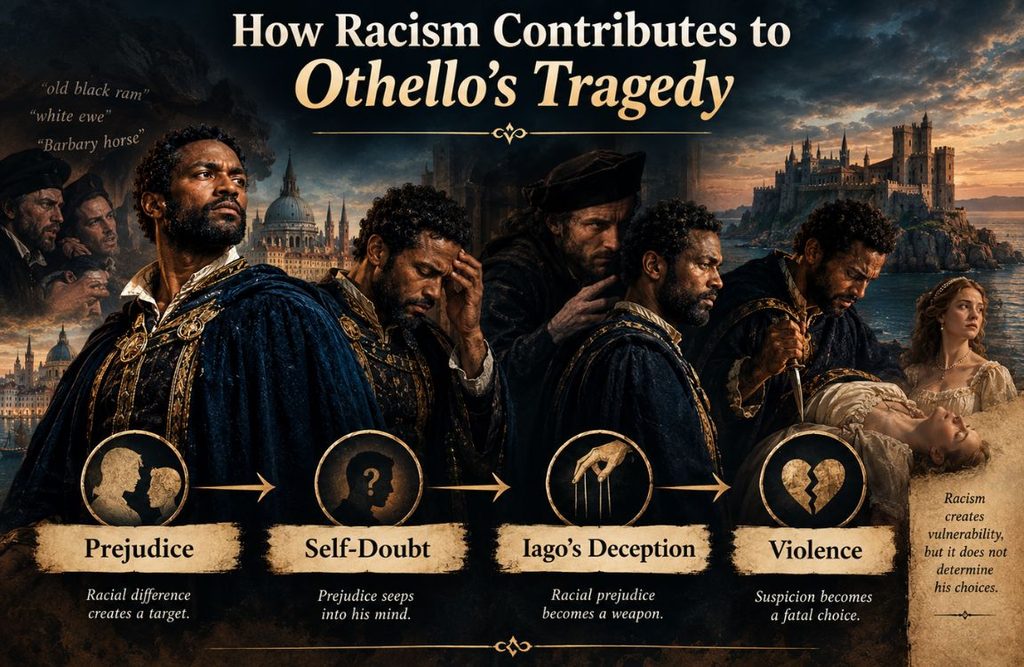
But here’s the twist I always pause for in class. Racism doesn’t only attack Othello from the outside. It seeps inside him. As ink dropped into water, it slowly clouds his self-belief until he begins to see himself through his enemies’ eyes.
That is why racism matters to Othello’s downfall. It doesn’t shout. It whispers. And by the time Othello listens, tragedy has already sharpened its knife. If you think this play is only about jealousy, stay with me. Shakespeare has more to confess.
Table of Contents
Theme of Racism in Othello
When I teach this play, I’m very clear: the racism theme in Othello isn’t decorative wallpaper. It’s the framework holding the tragedy together. These racial issues in Othello shape fear, identity, and power, quietly steering the play toward catastrophe long before jealousy takes the stage.

i) Racism as a Central Tragic Theme:
Here’s the moment I pause in class and lower my voice: racism in Othello doesn’t roar. It leaks. It seeps into conversations, assumptions, and glances until it becomes structural.
Shakespeare builds the tragedy on racial thinking that turns difference into danger. Racism feeds mistrust, mistrust breeds fear, and fear erodes reason. By the time Iago spits out “an old black ram,” the damage isn’t just insult. It’s architecture.
That language shapes how Othello is seen, and eventually how he sees himself. Racism doesn’t cause one bad decision. It bends the entire arc of the play, quietly guiding Othello toward collapse like a warped compass.
ii) Race and Otherness in Othello:
Now let me share my favourite classroom metaphor. Othello is Venice’s borrowed umbrella. When the storm hits, everyone grabs him gratefully. When the sky clears, they don’t quite know where to put him.
As a Moor, Othello is the “necessary outsider”- essential, admired, yet never fully accepted. Venice trusts his sword, not his belongings. He can lead armies, but he can’t escape the label “the Moor.”
And the tragedy deepens when that otherness turns inward. When Othello says, “Haply, for I am black,” I tell my students: that’s not Venice speaking. That’s Venice living rent-free in his mind. Otherness becomes vulnerability.
iii) Public Honour vs Private Prejudice:
This is where Shakespeare gets especially cruel and clever. Publicly, Othello is praised as the “valiant Moor.” Privately, he is doubted, whispered about, and watched.
I ask my students a blunt question: What kind of respect only lasts while you’re useful? Othello’s honour depends on service, not acceptance. The moment suspicion creeps in, that honour proves fragile. Political praise masks private prejudice, and beneath the applause lies fear.
Shakespeare shows us how quickly admiration collapses when it was never rooted in equality. Othello’s status looks solid, but it’s built on sand, and racism is the tide pulling it away.
Racism and Prejudice in Othello
When we reach this part of the lesson, I usually stop pacing, grab the board marker, and say, “Let’s untangle two ideas students love to knot together. Race and prejudice in Othello are related, but they’re not twins. And that difference matters more than it first appears.

i) Difference Between Racism and Prejudice:
Here’s my classroom shortcut: prejudice is an attitude; racism is the system that gives that attitude power. Shakespeare shows them working together, not separately.
Prejudice appears as the snap judgment, the raised eyebrow, the surely this can’t be right. Racism is what makes those reactions feel reasonable, even natural. It supplies the logic, the history, and the authority that allow personal bias to pass as truth.
This distinction is crucial to understanding Othello’s downfall. He does not collapse because someone dislikes him. He collapses because prejudice is reinforced by a worldview that tells him he should be doubted. Racism turns suspicion into expectation.
By the time Othello wonders aloud whether he is “fit” for Desdemona, we are no longer watching a man responding to individual opinions. We are watching him wrestle with an entire belief system stacked against him- one that has taught him to measure his worth through the eyes of others.
ii) Social Prejudice in Venetian Society:
Now imagine Venice holding its breath. That’s how the city reacts to Othello’s marriage. Brabantio’s outrage, “thou hast enchanted her,” isn’t about secrecy. It’s about disbelief. Love, in his mind, needs a supernatural explanation when race enters the room.
Even the senators, polite and political, tolerate Othello more than they trust him. This is social prejudice at work: not always loud, often well-dressed, and deeply anxious about boundaries. Othello is allowed in the room, but he’s never quite allowed to relax there.
iii) Personal Prejudice and Internal Conflict:
Here’s the moment I let silence do the teaching. Othello says, “Haply, for I am black,” and I stop talking. Because that line doesn’t come from Venice. It comes from inside him.
Social prejudice has crossed the border and set up camp in his mind. What began as external judgment becomes internal belief. Othello starts questioning his worth, his attractiveness, and his right to be loved.
This is racism at its most dangerous: psychological, quiet, self-sustaining. Society plants the idea, but Othello nurtures it with doubt. And once that happens, tragedy no longer needs enemies shouting outside the door. It’s already moved in.
Racist Language in Othello & Dehumanisation
This is the moment in class when I pause and warn my students: “Now watch Shakespeare turn language into a weapon.” The racist language in Othello doesn’t explain. It wounds. Through animal imagery, words strip Othello of humanity, showing how dehumanisation in Othello prepares cruelty long before violence appears.

i) Racist Language as a Weapon:
I like to tell my students that arguments use logic, but racist language uses shortcuts. In Othello, speech replaces reason with imagery so brutal it silences debate. No one argues that Othello is unworthy. They simply name him as something less. That’s verbal violence.
When Iago hurls images instead of ideas, language becomes an instrument of power. It doesn’t persuade. It dominates. Words act like blows, landing again and again until dignity buckles.
This is why racist speech is so effective in the play: it bypasses thought and hits instinct. Shakespeare shows us how language can harm without ever needing proof, turning metaphor into a kind of invisible assault.
ii) Animal Imagery and Racial Degradation:
Here comes the line I always write on the board: “an old black ram is tupping your white ewe.” I ask my students to read it, and then read it again. Notice what’s missing? Othello.
The man disappears, replaced by animals. These racist quotes from Othello, the “old black ram,” the “Barbary horse,” don’t just insult. They sexualise and degrade. Love is twisted into something wild and predatory. Marriage becomes breeding.
These images frame Othello’s desire as unnatural and dangerous, training the audience to feel fear rather than empathy. Shakespeare isn’t subtle here, and that’s the point. He forces us to see how easily language can redraw moral boundaries.
iii) The Psychological Effect of Dehumanisation:
Now imagine hearing this language repeatedly. Not once. Not in anger. But casually. That’s how dehumanisation works. Each phrase chips away at identity until cruelty feels normal.
Over time, Othello absorbs a world where his humanity is questioned, negotiated, and diminished. Language doesn’t just label him. It reshapes belief. I tell my students this is the scariest part: when words are repeated often enough, they stop sounding extreme. They start sounding true.
Shakespeare exposes how racist language erodes the self from the inside out, proving that before a person is destroyed onstage, they are first dismantled by words.
Examples of Racism in Othello & Plot Influence
This is the point in my lesson where I grin a little and say, “Now watch racism pick up the pace.” The evidence of racism in Othello isn’t decorative. It’s kinetic. It fuels action, shortens patience, and turns suspicion into certainty, driving racism and Othello’s downfall with ruthless efficiency.
i) Racism as a Catalyst for Jealousy:
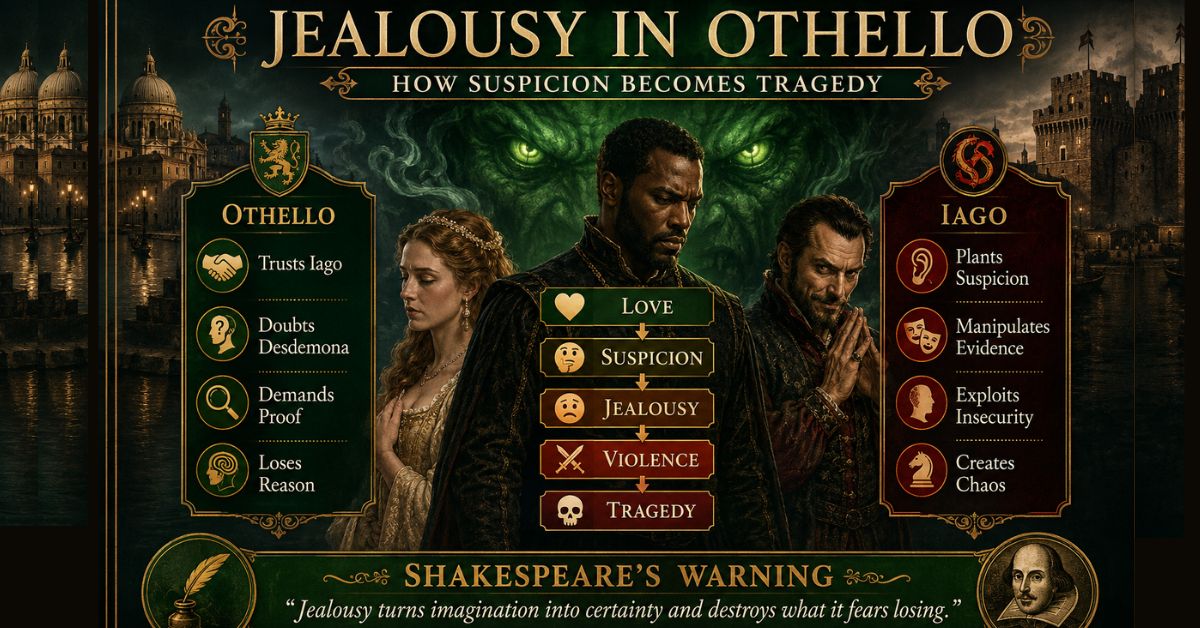
Jealousy in Othello doesn’t arrive out of nowhere. It arrives pre-packed with racial insecurity. When Othello admits, “I am black and have not those soft parts of conversation,” I tell my students this isn’t modesty. It’s fear talking. Racism has already taught him that love is fragile when you don’t quite belong.
So, when Iago whispers doubt, jealousy doesn’t sound outrageous. It sounds reasonable. That’s the danger. Racism creates the emotional conditions where suspicion feels sensible.
Othello’s mind fills in the gaps before evidence ever appears. Jealousy grows not because of what he sees, but because of what he’s been conditioned to believe about himself.
ii) Internalised Racism and Othello’s Downfall:
Here’s the quiet tragedy I always slow down for. Racism and Othello’s downfall intersect the moment belief replaces proof. Othello begins to measure himself through Venice’s eyes.
When he reflects, “She never yet was foolish that was fair,” the judgment isn’t aimed at Desdemona. It circles back to him. Internalised racism whispers that her love must be temporary, borrowed, or mistaken. Once that idea settles in, Othello stops demanding evidence. He starts assuming guilt.
Shakespeare shows us how racism doesn’t just wound pride. It rewires decision-making, turning imagination into authority.
iii) How Racism Accelerates the Tragic Plot:
This is where I tap the desk and say, “Notice how fast everything collapses now.” Racism acts like narrative acceleration. Once doubt takes hold, the plot no longer needs logic or proof.
Accusations outrun facts. Decisions outpace reflection. The tragedy speeds forward because racism has already cleared the road. Othello believes the worst before testing the truth.
Shakespeare uses racism as narrative momentum: a force that removes friction, silences reason, and propels the story toward catastrophe. The fall feels sudden, but only because the ground was prepared long before the fall began.

Othello Racism Quotes Explained
When revision season hits, I tell my students: don’t memorise quotes. interrogate them. These quotes that show racism in Othello reveal how language reshapes thought, identity, and action. Let’s pause, unpack six, and watch racism do its quiet damage.
1. “If she be black, and thereto have a wit, / She’ll find a white that shall her blackness fit.” (Iago)
I always smile grimly when we reach this line, because it pretends to be clever. Here, black becomes shorthand for moral and intellectual inferiority. Iago isn’t insulting Othello directly. He’s normalising racist logic. The effect?
Racism sounds reasonable. This racism quote in Othello trains the audience to hear prejudice as wit, not cruelty, and that makes it dangerous.
2. “The sooty bosom of such a thing as thou.” (Brabantio)
I stop the class here and ask, “Did you notice the word ‘thing’?” Othello isn’t even a man in this sentence. Brabantio’s language reduces him to an object, stained and unclean.
This is one of the clearest racist quotes in Othello, where racial difference equals moral pollution. The effect is exclusion- swift, absolute, and chillingly polite.
3. “Your son-in-law is far more fair than black.” (Duke of Venice)
Students often mistake this for praise. I gently correct them. The Duke defends Othello by denying his blackness- as if fair is the only acceptable currency.
This quote reveals a subtle form of racial prejudice: acceptance that depends on erasure. It reassures, but it also reinforces the idea that blackness itself is the problem.
4. “Her name, that was as fresh as Dian’s visage, is now begrimed and black.” (Othello)
When Othello speaks this line, the room usually goes quiet. Blackness here becomes a metaphor for corruption. What hurts most is who is speaking. Racist language has travelled inward.
This is one of the most painful quotes about racial prejudice in Othello because it shows how racism rewires imagination and poisons love.
5. “I am glad I am black.” (Othello)
This line always sparks debate. Is it defiance? Or resignation? I tell my students it’s both, and that tension matters. Othello claims his identity, yet the context suggests emotional exhaustion.
Racism has forced him to confront himself constantly. This quote reveals the psychological weight of being made other again and again.
6. “She never yet was foolish that was fair.” (Othello)
On the surface, this isn’t obviously racist. That’s why it’s brilliant, and dangerous. Fairness equals worth. Darkness equals doubt. Othello has absorbed society’s values and turned them into self-judgment. This is how racism completes its work: not with insults, but with belief.
If you remember one thing for exams, remember this: racism in Othello lives in the language, and language lives in the mind.
Iago and Racism in Othello
When students ask me, “Why does Iago hate Othello?” I lean on the desk and say: Iago doesn’t just hate. He uses. His view of Othello mixes envy, opportunity, and racism sharpened into a weapon.

i) Is Iago Racist or Opportunistic?
This is where I pause the class and play devil’s advocate. Is Iago a committed racist, or just an emotional pickpocket stealing whatever works?
The uncomfortable answer is: both, but strategy comes first. Iago understands the social weather of Venice. He knows racial prejudice exists, like damp in the walls, so he pushes where it already cracks.
When he mutters lines like “I hate the Moor”, the hatred feels casual, almost lazy. That’s your clue.
Unlike Brabantio, Iago doesn’t panic about race. He calculates with it. Racism isn’t his belief system. It’s his toolbox. He’ll use professional jealousy one minute, sexual fear the next, and race whenever it promises speed.
I tell my students: Iago isn’t shouting slurs for passion. He’s whispering stereotypes for efficiency.
ii) How Iago Weaponises Racial Stereotypes?
Now imagine Iago as a verbal chemist. He takes old, ugly stereotypes and distills them into suggestions. He doesn’t need to prove anything. He only needs to remind.
When he hints that Othello is “of a free and open nature”, he’s feeding the myth of the naïve outsider. When he implies Desdemona will seek someone “of her own clime,” he leans on racial fear already stored in the mind.
In class, I describe this as psychological graffiti. Iago doesn’t paint a new idea. He traces over what society has already scribbled. His brilliance, if we dare call it that, is knowing which prejudice to activate, and when. Racism becomes a silent accomplice.
iii) Racism as a Tool, Not Just Belief
Here’s the final twist I leave my students with. If racism were removed from Venice, Iago would still be dangerous, but slower. Racism accelerates his plot. It shortens explanations. It replaces evidence with an assumption. That’s why it matters.
Iago treats racism the way a lock-picker treats a weak hinge. He doesn’t care why it’s weak, only that it opens doors. And tragically, it works. His manipulation proves something chilling: racism doesn’t need true believers to cause destruction. It only needs people willing to use it.
And that, I remind my class quietly, is what makes Iago terrifyingly modern.
Othello’s Race and Identity
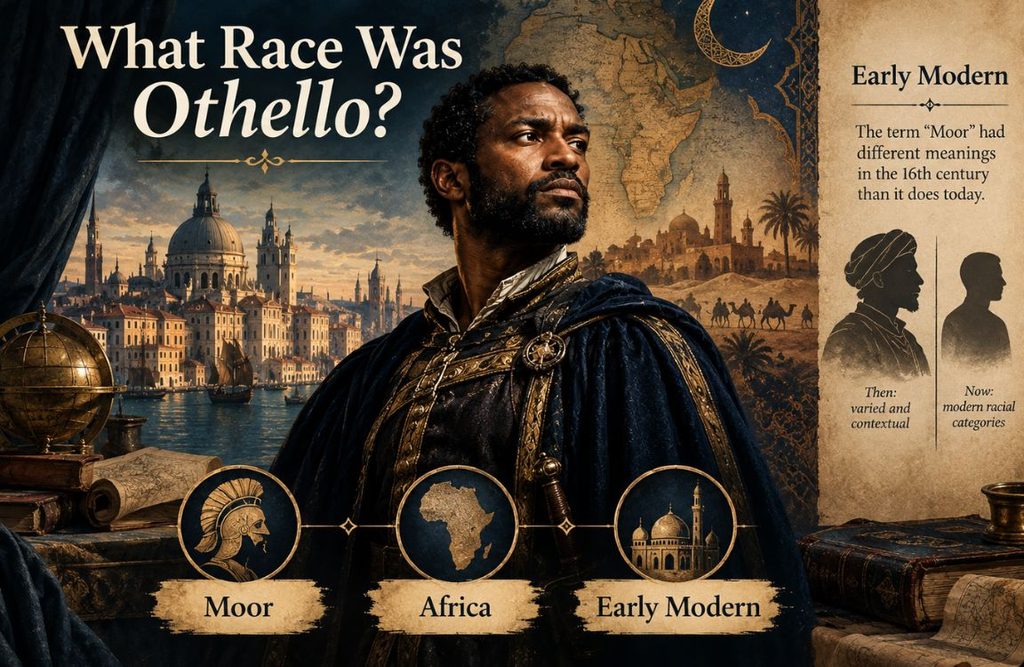
When students ask me about Othello’s race, I smile and say, “Shakespeare left us a puzzle on purpose.” Whether Othello was Black, Arab, or North African matters, but not as much as why the answer stays unsettled.

i) What Race is Othello?
Here’s the honest classroom answer: Shakespeare never gives us a passport. Many readers ask, “Was Othello black?” and the text strongly suggests he was dark-skinned and visibly different from Venetian society. Characters in Othello react to his appearance before they react to his rank.
I tell my students to notice this: Othello’s race is seen before it is explained. That visibility makes him legible to prejudice, and unforgettable to us.
ii) Is Othello a Moor?
Now, pause, because “Moor” is a slippery word. In Shakespeare’s time, it could refer to people from North Africa, Arabs, or Black Africans. It wasn’t a precise label. It was a broad, exotic brushstroke.
When characters call him “the Moor,” they reduce a man to a category. I tell my class: this word functions less like a name and more like a label stuck to his back.
iii) Ambiguity and Scholarly Debate:
This uncertainty is why scholars still argue. Some emphasize African origins. Others stress cultural identity over skin color. And here’s my teaching trick: I let students disagree.
Shakespeare invites debate by refusing clarity. Othello’s identity floats between geography, appearance, and perception. The debate itself mirrors the play’s tension: identity shaped not only by who you are, but by who others think you are.
iv) Why Shakespeare Keeps It Complex?
Finally, the big question: why doesn’t Shakespeare just tell us? Because certainty would shrink the tragedy. By keeping Othello’s race complex, Shakespeare makes the play universal.
Othello becomes every outsider, anyone defined by difference. I tell my students this is no accident. Ambiguity forces us to confront our assumptions. And that, quietly, is where the play still unsettles us today.
Historical & Social Context of Racism
When I teach the historical context of Othello, I ask my students to time-travel with me to Elizabethan England, an inward-looking world where difference felt dangerous. Understanding the racism in Othello’s context explains why Othello’s presence unsettled audiences before he even spoke.

i) Race in Shakespeare’s Time:
Let’s clear the fog first. Race in Shakespeare’s time wasn’t discussed with modern language, but it was absolutely felt. Elizabethans often linked skin colour to climate, character, and morality- ideas inherited from half-science, half-superstition. Dark skin was wrongly associated with emotional excess or moral difference.
England’s limited contact with non-Europeans meant fear filled the gaps where knowledge should have lived. I tell my class, “When people don’t understand something, they mythologise it.” These Elizabethan views on race shaped how audiences read Othello before judging his actions.
ii) Moors and Foreignness in Renaissance Europe:
Now for the loaded label. The meaning of ‘Moor’ in Othello wasn’t precise. It could suggest African, Arab, Muslim, or simply foreign. In Renaissance imagination, Moors were exotic and impressive, yet unsettling. They represented military strength, unfamiliar customs, and religious differences. Fascination sat beside suspicion.
I often say Othello walks onstage carrying Europe’s anxieties in his pockets. His foreignness makes him admirable and threatening at once, which explains why Venice both needs and mistrusts him.
iii) Why Othello Shocked the Original Audience:
Here’s the real jolt. Shakespeare made a Moor the tragic hero. Not a villain. Not a stereotype. A noble general who speaks poetry. For the first audience, admiration and fear collided. That discomfort was the point.
Shakespeare forced them to confront their assumptions, not escape them. Racism wasn’t just staged. It was exposed. And that challenge is exactly why Othello still makes us squirm today.
Is Othello a Racist Play?
This is the moment in class when someone finally blurts it out: “Miss/Sir… is Shakespeare being racist here?” And I love that question, because Othello refuses to sit quietly in one moral chair.
On one hand, the play is soaked in racism. Venice’s language toward Othello is brutal and animalistic. Brabantio doesn’t see a son-in-law. He sees witchcraft: “She is abused, stol’n from me, and corrupted.”

Iago goes further, reducing Othello to grotesque imagery, “an old black ram / Is tupping your white ewe.” If Shakespeare wanted us to notice racism, he turned the volume all the way up.
But here’s the twist I point out to my students: those lines don’t belong to heroes. They belong to characters we are trained to distrust. Shakespeare consistently places racist language in morally rotten mouths.
Othello himself, by contrast, speaks with dignity, restraint, and poetry. When he says, “Rude am I in my speech,” the tragedy is that he believes the lie Venice has whispered into him.
So is Shakespeare endorsing racism? Or staging it under harsh lighting so we can’t look away?
Modern critics increasingly argue the latter. Shakespeare doesn’t present racism as harmless prejudice. He shows it as a slow poison- one that warps love, identity, and self-worth. Othello doesn’t fall because he is Black. He falls because he lives in a society that never lets him forget it.
And that’s why the play still stings today. Othello asks us an uncomfortable question, I leave hanging in the classroom air: when racism speaks fluently and often enough, who eventually starts believing it?
FAQ:
Is Emilia racist in Othello?
This is where I stop the class. Emilia isn’t consistently racist, but under shock, she reaches for racist language, calling Othello the “blacker devil.” That moment matters. It shows how deeply Venice’s racism lives in people, even the honest ones.
Is Roderigo racist in Othello?
Yes, quietly and conveniently. I tell my students that Roderigo borrows racism when it suits his jealousy. He echoes slurs without reflection. He doesn’t invent prejudice; he rents it. That’s what makes him dangerous, and painfully believable.
Is the Duke of Venice racist in Othello?
This is my favourite “polite racism” moment. The Duke defends Othello by saying he’s “far more fair than black.” Sounds kind, until you notice it erases blackness. Acceptance here comes with conditions, and that’s racism in velvet gloves.
Is Lodovico racist in Othello?
Lodovico isn’t loudly racist, but he’s revealing. When Othello falls, Lodovico is shocked, not just by violence, but by who commits it. I tell students: his surprise exposes expectations. Even sympathy can carry prejudice when faith was never equal.
What is the critical race theory in Othello?
I explain it simply: race in Othello isn’t biology. It’s power. Critical race theory helps us see how language, authority, and institutions shape Othello’s identity. Racism isn’t a personal insult alone; it’s the structure whispering who belongs.
Conclusion:
When I close my book at the end of Othello, I always tell my students this: racism isn’t just a theme in the play. It’s the engine quietly driving the tragedy forward. The racial prejudice in Othello doesn’t shout from the stage. It seeps in, sentence by sentence, until it rewires how Othello sees himself.
This is the live-teaching moment I love. I tap the desk and ask: What happens when a man starts measuring himself using his enemies’ ruler? Othello’s downfall isn’t sudden madness. It’s erosion. Each insult chips away at his identity until he finally echoes the world’s cruelty back at himself: “Haply, for I am black…” That line breaks my heart every time.
The theme of racism in Othello shows us how prejudice turns inward, how identity becomes a battleground, and how love collapses under that weight. My final takeaway for students is simple but unsettling: tragedies don’t always begin with villains. They begin with voices we hear too often and believe too deeply.