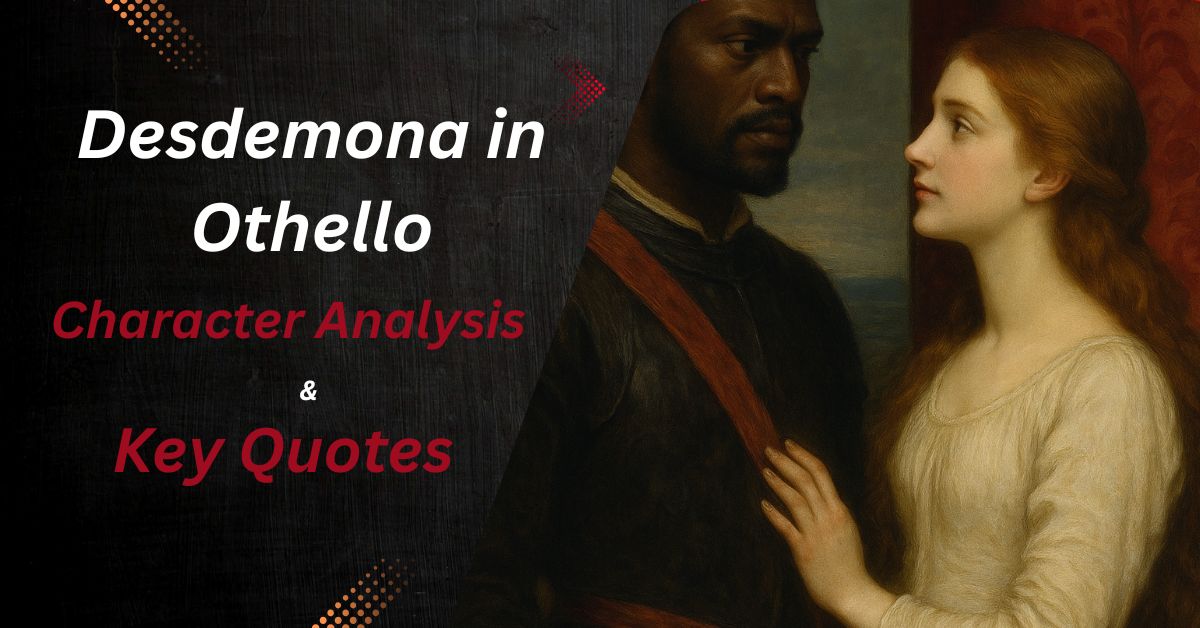
When I teach Othello, many students first see Desdemona as the hero’s wife. Yet Desdemona in Othello is far more than that. She chooses her own husband despite social convention, forgives cruelty that few people could forgive, and never abandons her integrity, even in her final moments.
A close Desdemona character analysis introduces a woman whose kindness, courage, and unwavering integrity shape the tragedy as deeply as Iago’s deception or Othello’s jealousy.
Who Is Desdemona in Othello?
Desdemona in Othello is the wife of Othello and the daughter of Brabantio, a respected Venetian senator. She surprises Venetian society by secretly marrying Othello for love instead of wealth or family approval.
Although Shakespeare never states Desdemona’s age, she is generally understood to be a young noblewoman. Her name, derived from Greek, carries the meaning of Desdemona as “ill-fated” or “unfortunate,” quietly foreshadowing her destiny.
More than a noble lady, she represents compassion, independence, and moral purity, qualities that make her one of Shakespeare’s most memorable female characters.
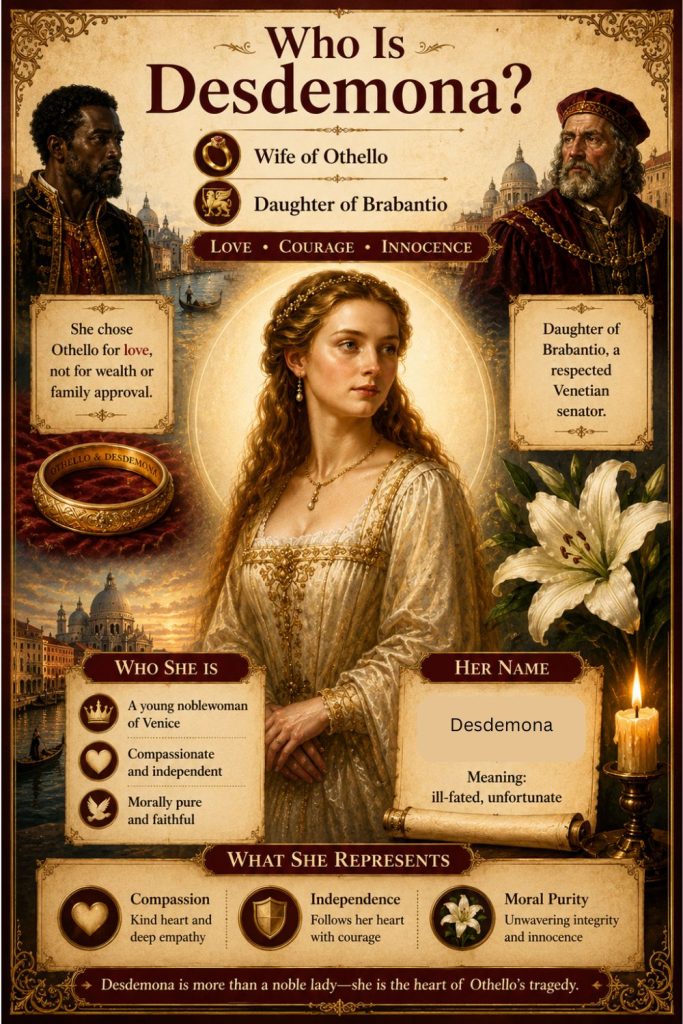
Table of Contents
Desdemona Character Analysis in Othello
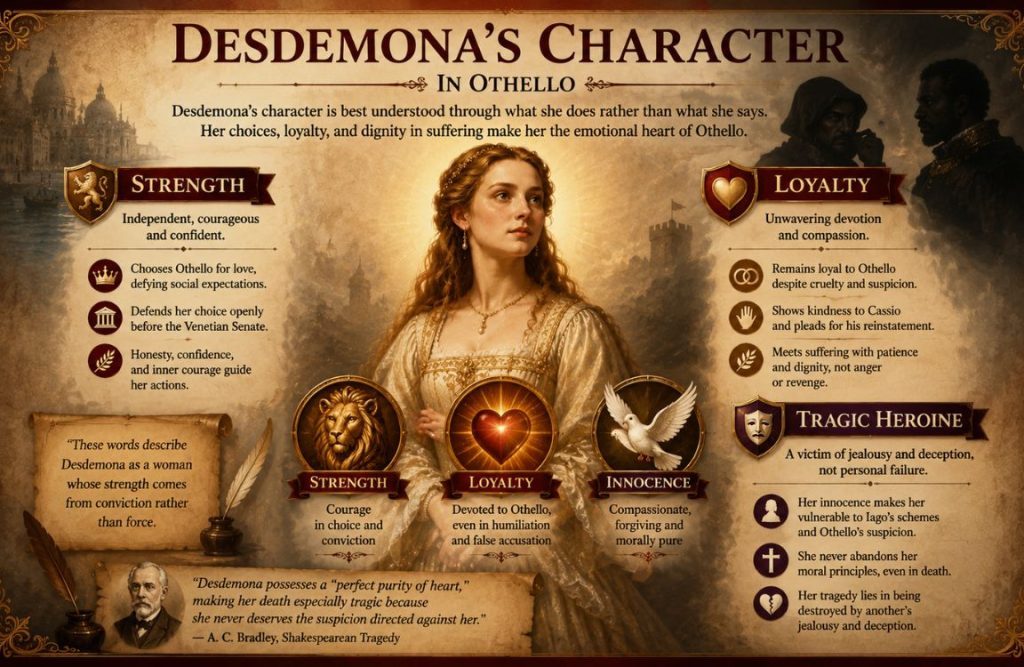
Desdemona’s character is best understood through what she does rather than what she says. Her choices, her loyalty, and the dignity she preserves even in suffering explain why she stands at the emotional centre of Othello and remains one of Shakespeare’s most memorable tragic heroines.
i) Desdemona’s Strength
A thoughtful character sketch of Desdemona begins with her remarkable independence. She chooses her own husband despite social expectations and openly defends that decision before the Senate.
Desdemona’s finest personality traits are honesty, confidence, and inner courage. These words describe Desdemona as a woman whose strength comes from conviction rather than force.
ii) Desdemona’s Loyalty
Among the defining Desdemona traits, loyalty stands above all. She remains devoted to Othello even after public humiliation and false accusations. Her compassion extends to Cassio, while her forgiving nature prevents bitterness from replacing love.
She responds with patience and dignity instead of anger or revenge. It reveals an inner strength that endures even through suffering.
iii) Is Desdemona a Tragic Heroine?
I certainly regard Desdemona as Shakespeare’s tragic heroine, though not in the traditional heroic sense. Her innocence becomes the very quality that leaves her exposed to Iago’s schemes and Othello’s growing suspicion.
She never abandons her moral principles, even in the face of death. Her tragedy lies not in personal failure but in becoming the victim of another person’s jealousy and deception.
Literary critic A. C. Bradley argues that Desdemona possesses a “perfect purity of heart,” making her death especially tragic because she never deserves the suspicion directed against her.
His view reminds us that Shakespeare builds the tragedy not around Desdemona’s mistakes but around Othello’s fatal loss of judgment.
Reference:
A. C. Bradley, Shakespearean Tragedy
Othello and Desdemona’s Relationship
The relationship between Othello and Desdemona begins with mutual admiration, trust, and emotional understanding. Following its development from sincere affection to heartbreaking misunderstanding shows how deception gradually destroys a marriage built on genuine love.

i) Why Does Desdemona Fall in Love with Othello?
Desdemona falls in love with Othello because she sees the man beneath the celebrated soldier. His resilience, honesty, and extraordinary experiences move her deeply, while his openness creates a genuine emotional bond.
Their love grows from shared experience instead of physical attraction, making emotional understanding the foundation of their marriage.
ii) How Did Othello Win Desdemona’s Love?
Othello wins Desdemona’s heart by sharing the story of his remarkable life. His tales of hardship, captivity, and survival awaken her admiration and compassion.
Their marriage rests on trust, emotional equality, and sincere understanding, not on wealth or reputation. It also demonstrates that honest communication creates a stronger foundation than outward appearance.
Desdemona’s Role in Othello
Desdemona’s role in Othello reaches far beyond that of the heroine or loving wife. She drives the plot because her marriage provokes Brabantio’s anger, her kindness towards Cassio fuels Iago’s deception, and her tragic death brings the play to its devastating conclusion.
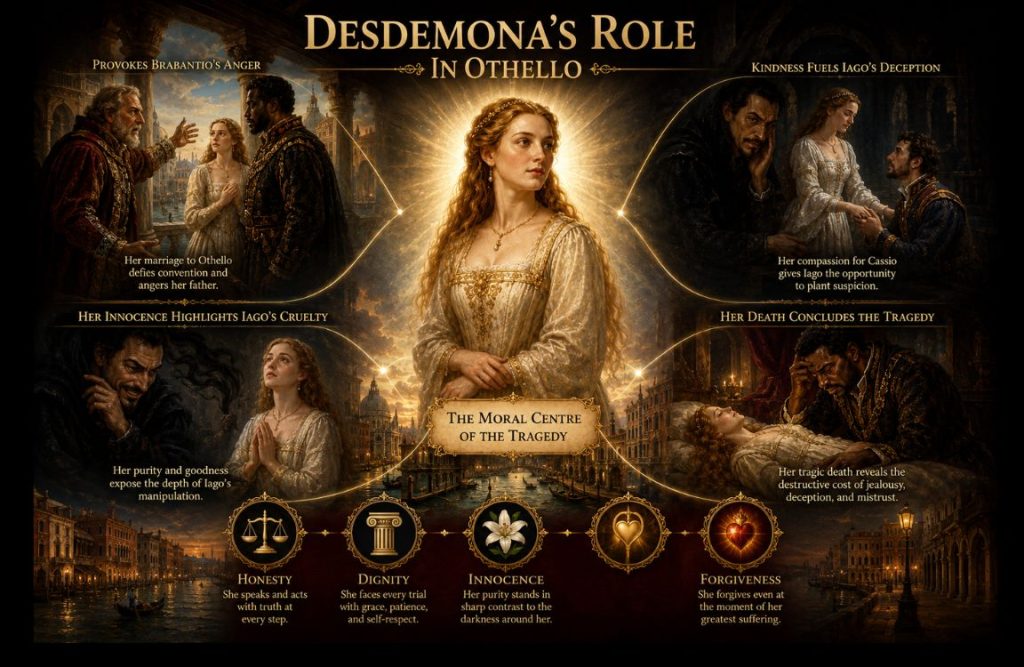
As the importance of Desdemona becomes clearer, she emerges as the moral centre of the drama, consistently choosing compassion over revenge and truth over suspicion. Her innocence throws Iago’s calculated cruelty into even sharper relief, while her unwavering love exposes the terrible cost of Othello’s misplaced trust.
Ultimately, Desdemona in the tragedy represents everything jealousy seeks to destroy: honesty, dignity, forgiveness, and the possibility of love built on mutual respect.
Critic Harold Bloom describes Desdemona as one of Shakespeare’s most luminous moral presences. Her goodness does not weaken the tragedy. Instead, it intensifies the audience’s sense of injustice as innocence is destroyed by deception.
Reference:
Harold Bloom, Shakespeare: The Invention of the Human
Desdemona and Other Characters
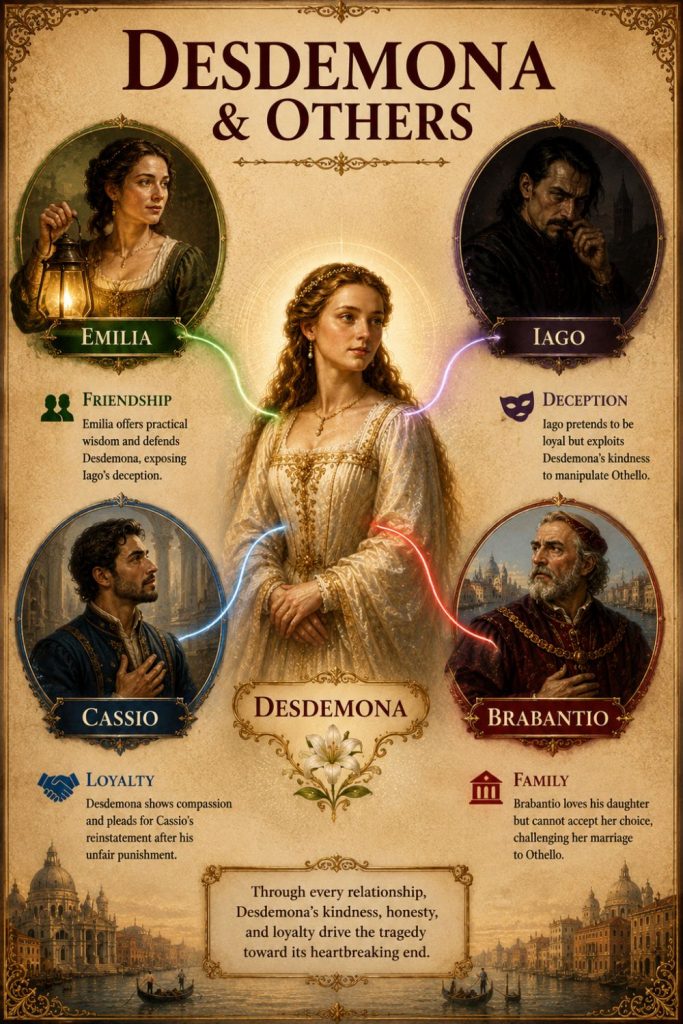
Desdemona’s character becomes even clearer through her relationships with Emilia, Iago, Cassio, and Brabantio. Each connection demonstrates a different side of her personality while advancing the tragedy toward its heartbreaking conclusion.
i) Desdemona and Emilia
The relationship between Desdemona and Emilia develops from mistress and attendant into one of the most moving female friendships in Shakespeare.
Emilia offers practical wisdom, while Desdemona remains hopeful and trusting. Their contrasting views of marriage deepen the play, and Emilia’s defence of Desdemona finally exposes Iago’s deception.
ii) Desdemona and Iago
The relationship between Desdemona and Iago is marked by painful irony. She never suspects his dishonesty and treats him with courtesy and respect.
Iago exploits her kindness to manipulate Othello, proving that innocence alone cannot protect someone from calculated malice.
iii) Desdemona and Cassio
Desdemona’s friendship with Cassio reflects her generous and compassionate nature. She pleads for his reinstatement because she believes he has been treated unfairly, not because of romantic feelings.
Iago deliberately twists this innocent act into false evidence of adultery, transforming kindness into the foundation of Othello’s growing suspicion.
iv) Desdemona and Brabantio
Brabantio deeply loves his daughter but struggles to accept her independence. By secretly marrying Othello, Desdemona chooses personal conviction over parental authority.
Although her decision hurts her father, Shakespeare presents it as an act of maturity rather than rebellion that reveals her steady determination.
Desdemona’s Death Explained
Desdemona’s death is the emotional climax of Othello and arguably one of the most devastating scenes in Shakespeare. If readers ask, does Desdemona die? The answer is tragically YES
Believing Iago’s lies, Othello convinces himself that his innocent wife has betrayed him. This explains why Othello kills Desdemona despite the absence of real evidence.
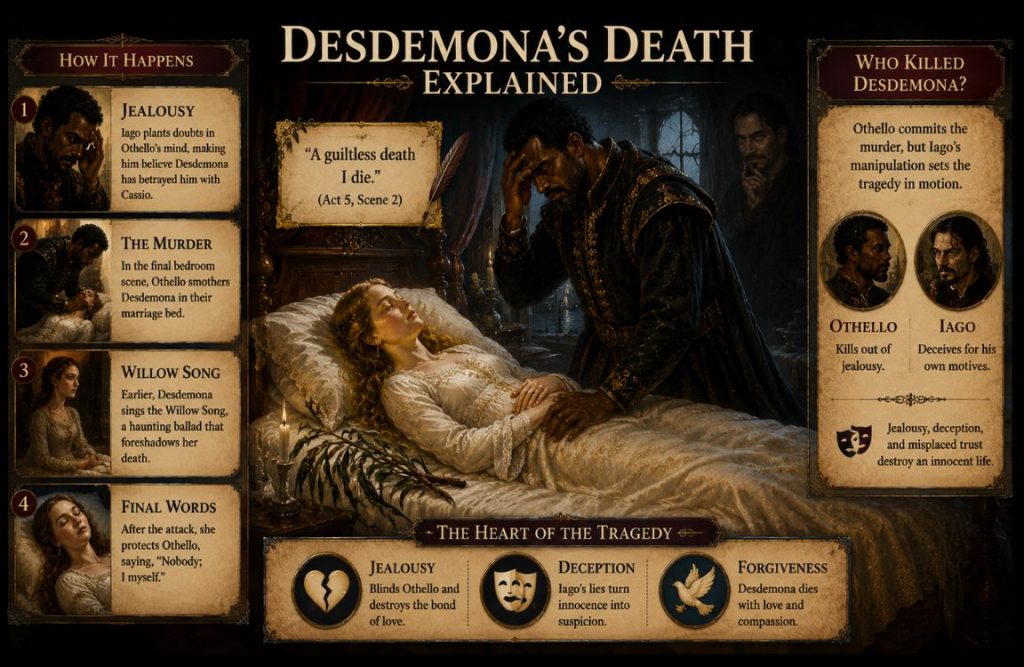
In the final bedroom scene, how did Desdemona die? Othello smothers her in their marriage bed, turning a place of love into the setting of murder. The scene is filled with tragic irony because the audience knows she is completely innocent.
Earlier, Desdemona sings the Willow Song, a haunting ballad that quietly foreshadows her approaching death.
After the attack, her final words are equally moving. Instead of accusing her husband, she tries to protect him, saying, “Nobody; I myself.” That act of forgiveness uncovers the depth of her compassion.
So, who killed Desdemona? Othello commits the murder, but Shakespeare also makes clear that Iago’s manipulation sets the tragedy in motion. Together, jealousy, deception, and misplaced trust destroy a life that deserved far better.
Best Desdemona Quotes with Analysis
These Desdemona quotes in Othello reveal her courage, loyalty, compassion, and dignity. Together, they trace her journey from confident bride to tragic heroine while reflecting Shakespeare’s deeper ideas about love, trust, and innocence.
1. “I do perceive here a divided duty.” (Act 1, Scene 3)
Speaking before the Venetian Senate, Desdemona respectfully explains that her loyalty is now shared between her father and her husband. Rather than rejecting Brabantio, she honours both relationships before choosing married life. The speech reflects remarkable maturity, quiet courage, and independence.
2. “My noble father, I do see me here your daughter.” (Act 1, Scene 3)
Here, Desdemona carefully acknowledges her father’s love before explaining why her first duty now belongs to Othello. Following her mother’s example, she chooses marriage without disrespecting her family. Her decision feels thoughtful, measured, and deeply sincere rather than impulsive.
3. “His unkindness may defeat my life, / But never taint my love.” (Act 4, Scene 2)
Even after suffering humiliation, Desdemona refuses to answer cruelty with bitterness. Her unwavering love reflects forgiveness instead of weakness, reminding us that compassion often demands greater strength than anger. Few Othello quotes about Desdemona capture her character with such emotional clarity.
4. “Beshrew me, if I would do such a wrong.” (Act 4, Scene 2)
Calmly and truthfully, Desdemona rejects Othello’s accusation of adultery because she knows she has remained faithful throughout their marriage. Her honesty stands in sharp contrast to Iago’s relentless deception, making the audience feel the tragic injustice even more intensely.
5. “A guiltless death I die.” (Act 5, Scene 2)
At the moment of death, Desdemona’s final declaration confirms her innocence without bitterness or revenge. She does not curse Othello or demand justice. Instead, her remarkable dignity exposes the terrible cost of jealousy and reminds us who the tragedy’s true victim is.
6. “Nobody; I myself.” (Act 5, Scene 2)
With her final breath, Desdemona shields Othello instead of accusing him. Whether readers interpret these words as forgiveness, unconditional love, or heartbreaking devotion, they deepen the emotional impact of the ending and leave one of Shakespeare’s most unforgettable final moments.
Why Desdemona Still Matters Today
Desdemona continues to speak to modern readers because her story raises questions that remain painfully relevant. She faces gender expectations, racial prejudice, emotional abuse, and the consequences of broken trust. Even under unbearable pressure, she refuses to surrender either compassion or integrity.
Whenever I discuss her with students, they are often surprised by how contemporary her struggles feel. Shakespeare reminds us that respect, honest communication, and forgiveness are still essential if relationships are to survive misunderstanding and fear.
Her story also reminds us how easily a person’s voice can be silenced when prejudice and suspicion are accepted as truth.
Why Is Desdemona Different from Other Shakespeare Heroines?
Desdemona stands apart from many of Shakespeare’s heroines because her strength is expressed through kindness rather than cleverness or ambition. Unlike Juliet, whose love defies family conflict, Desdemona continues to love even after trust has been broken.
Portia overcomes obstacles through wit and legal intelligence, whereas Desdemona has no such power to alter her fate.
Lady Macbeth, by contrast, pursues ambition at any cost, while Desdemona remains guided by compassion and forgiveness. These qualities make her one of Shakespeare’s most deeply human and tragic female characters.
FAQs:
Is Desdemona a tragic heroine in Othello?
Yes. Desdemona is a tragic heroine because she remains innocent and morally courageous while becoming the victim of jealousy, manipulation, and false accusations. Her suffering creates the emotional centre of Shakespeare’s tragedy.
What does Desdemona symbolize in Othello?
Throughout the play, Desdemona symbolizes innocence, faithful love, compassion, and moral integrity. Her character also represents the tragic consequences of prejudice, misplaced trust, and the destructive power of deception.
What are Desdemona’s greatest character traits?
Desdemona’s greatest strengths are courage, honesty, compassion, loyalty, forgiveness, and steady determination. These qualities shape her decisions throughout the play and distinguish her from almost every other character.
What is the significance of Desdemona’s Willow Song?
The Willow Song foreshadows Desdemona’s approaching death and reflects her growing sadness. It also creates a moving moment by revealing her emotional sensitivity before the tragedy reaches its climax.
Why are Desdemona’s final words so important?
Desdemona’s final words reveal extraordinary compassion because she protects Othello instead of accusing him. They deepen the tragedy by showing that forgiveness survives even after trust has been fatally betrayed.
Conclusion:
Desdemona stands at the heart of Othello through her innocence, courage, loyalty, and unwavering compassion. Although she becomes the victim of jealousy and deception, her inner strength outlives the tragedy itself. Her story still reminds us that trust, not suspicion, gives love its strength.
Enjoyed this character analysis? Explore our complete Othello Study Guide for character analyses, major themes, and important quotes.