Cassio in Othello: Character Analysis & Key Quotes

cassio in othello

Every year when I teach Othello, my students tend to brush past Cassio in Othello as if he’s just the polite extra standing in the corner. But here’s the plot twist. He’s the good guy who accidentally lights the tragic match. Cassio doesn’t scheme, doesn’t manipulate, and wouldn’t hurt a fly. Yet Shakespeare places him right at the center of the emotional hurricane.

And that’s exactly why Cassio’s character analysis is so much fun. He’s the charming, well-mannered lieutenant who walks into the play with good intentions and walks out, leaving Othello, Iago, and half of Cyprus emotionally burnt. Honestly, if Cassio realized how much drama followed him, he’d request hazard pay.

In this guide, I’ll break down why Cassio matters- his role, his personality, and the most important Cassio quotes that reveal how a kind-hearted man becomes the spark of a tragedy. After this, you’ll never overlook him again.

Who Is Cassio in Othello?

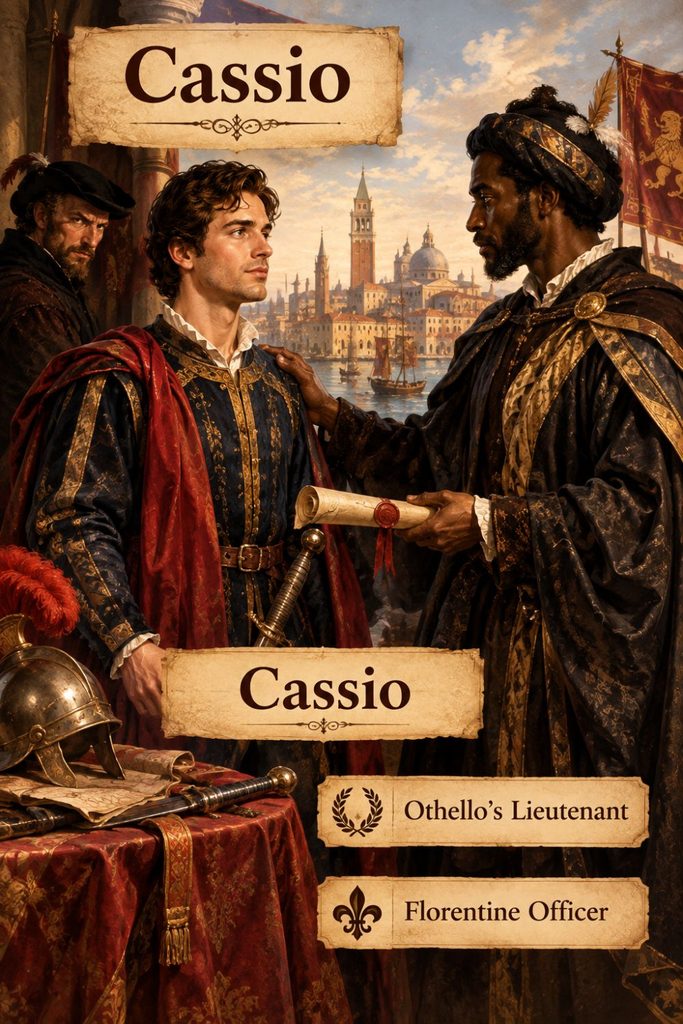
Whenever a student asks me, “Who is Cassio in Othello?” I tell them to look beyond the polished uniform. Cassio from Othello is Shakespeare’s portrait of cultivated virtue placed in a battlefield of ego and envy. A young Florentine lieutenant, he is educated, eloquent, and, crucially, promoted over Iago. That single decision ignites the fuse.

Who is Cassio in Othello

In Othello, Michael Cassio enters praising Othello with courtly grace, speaking like a man shaped by books rather than bloodshed. I often tell my students: Cassio is the honors student accidentally enrolled in a survival course. His flaw? Not ambition, not cruelty, but innocence. He underestimates Iago.

And that innocence becomes combustible. In a world obsessed with reputation and masculinity, Cassio’s refinement looks suspicious. Shakespeare uses him to ask a sly question: what happens when decency walks into a room ruled by insecurity?

So, Cassio isn’t just a side character. He’s the spark that exposes resentment, the gentleman whose very goodness unsettles darker men.

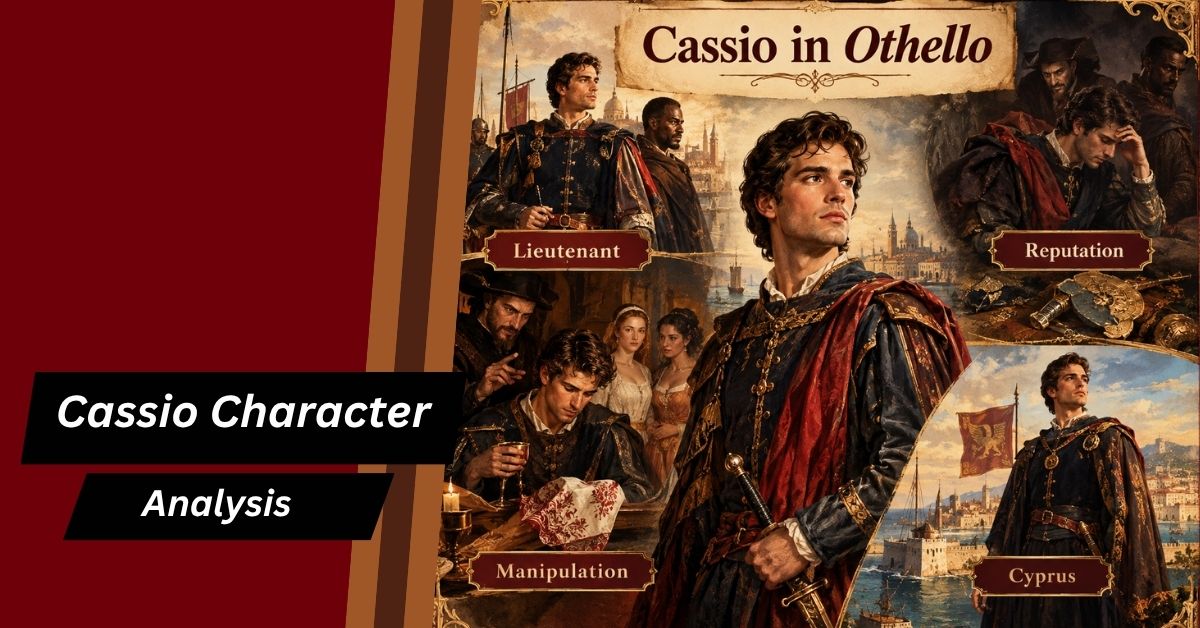
Cassio Character Analysis

Let me warn you upfront: once you dive into Cassio’s character traits, you start realizing he’s both the dream student and the kid who would accidentally set off the fire alarm during a lesson on safety. That’s the joy of Cassio- his strengths and weaknesses walk hand-in-hand like two students who refuse to stop talking.

Cassio Character Analysis

1. Cassio as the Ideal Renaissance Courtier:

When Shakespeare created Michael Cassio, he practically dipped his quill into a bucket labeled “Perfect Renaissance Gentleman.” Cassio is polite, educated, eloquent, and- much to Iago’s disgust- a theoretical soldier. 

He knows military strategy the way my students know exam tips: brilliantly in theory, somewhat shakier in action.

One of my favorite teaching moments is comparing Cassio’s smooth, almost musical rhetoric with Iago’s blunt, gravelly speech. Cassio speaks like he’s been practicing charm in a mirror. Iago speaks like he chews cynicism for breakfast.

2. Cassio’s Naivety:

Now, here’s where Cassio’s characteristics take a turn. Behind the polished manners is a man with the street smarts of a golden retriever. He is painfully blind to Iago’s manipulation- smiling, trusting, and handing over emotional access like someone agreeing to every terms-and-conditions pop-up without reading it.

His overtrusting nature is one of Cassio’s weaknesses in Othello that fuels the tragedy. He simply cannot imagine malice where he sees friendliness.

3. Cassio’s Honor & Reputation:

If Cassio had a religion, it would be Reputation. When Othello demotes him, Cassio’s breakdown is almost spiritual:

“Reputation, reputation, reputation!”

It’s the crisis of a man whose identity is woven entirely from public respect.

Then comes his carnivalesque fall- getting drunk, brawling, losing his job. It’s Shakespeare’s version of watching the class prefect accidentally start a cafeteria riot. Painful… but revealing.

4. Cassio’s Respect for Women:

Students often ask me, “So, how does Cassio describe Desdemona?” And I always smile, because Cassio’s words reveal more about his character than his polished shoes ever could. He speaks of her with reverent admiration, calling her “The divine Desdemona” and praising her as a woman of kindness, virtue, and gracious strength

To him, Desdemona isn’t just Othello’s wife. She’s the gold standard of goodness in a world rapidly sliding downhill.

Cassio treats women through the lens of courtly love tradition- elegant, respectful, and almost ceremonially gentle. His admiration for Desdemona is never flirtatious. It’s deeply respectful, the way you’d praise a lighthouse for guiding ships through a storm. 

And this makes a delicious contrast with Iago’s sour worldview, which drips with cynicism like stale coffee no one asked for.

Ironically, Cassio’s gentleness- his greatest virtue- is the very thing Iago twists into a weapon. In Shakespeare’s world, even kindness has consequences.

5. Cassio’s Emotional Intelligence:

Here’s the paradox: Cassio is kind, empathetic, compassionate- emotionally empathetic in every way except politics. He understands people’s feelings but not their agendas.

And that, ultimately, is the tragic complexity of Cassio: a good man in the wrong story, too soft-hearted for the world he walks through.

Cassio’s Role in the Plot

When I map the structure of Othello on the board, I tell my students this: Cassio is not the villain, not the hero, but the catalyst. If the play were a row of dominoes, he’s the first tile Iago flicks with surgical precision.

From the moment Iago is passed over for promotion, Cassio becomes the polished symbol of everything Iago resents- education, courtesy, advancement. That resentment turns strategic. Cassio’s staged drunken brawl in Act 2 leads to his humiliating demotion by Othello, and suddenly, the tragedy has oxygen.

Cassio's role in othello

I always pause at Cassio’s cry: “Reputation, reputation, reputation!” It sounds dramatic, even naïve, but that desperation drives him to seek Desdemona’s help. And that innocent request becomes the lens through which Othello misreads reality.

Here’s the irony I love pointing out: Cassio does nothing malicious. He simply moves through the plot like a lit match in dry grass. His role isn’t to scheme. It’s to be misinterpreted. And in Shakespeare’s world, misunderstanding is deadlier than intent.

Cassio and Iago’s Relationship: Jealousy & Manipulation 

Let me tell you a secret I often share with my students: if you really want to understand Othello, just watch how Iago and Cassio orbit each other. Their dynamic is like sunlight and shadow- one cannot appear without making the other more painfully obvious.

Cassio and Iago relationship in othello

1. Why Iago Hates Cassio (The Rival of Cassio):

Whenever I reread Othello, I can almost feel Iago seething. His jealousy isn’t just a spark. It’s a bonfire fueled by insecurities. Cassio’s education, polished manners, and recent promotion to lieutenant are everything Iago secretly craves.

No wonder Iago resents him so deeply. As I show my students, the text practically hums with his bitterness. Lines like Iago sneering at Cassio’s “bookish theoric” or muttering, “I know my price, I am worth no worse a place,” reveal how envy twists into obsession. These quotes show that Iago’s hatred isn’t random. It’s strategic, simmering, and ultimately dangerous.

Cassio represents the world that rewards refinement, while Iago- the battle-worn pragmatist- watches from the sidelines, plotting how to turn virtue itself into a weapon against him.

2. Cassio as a Foil to Iago:

Cassio is the bright, courtly gentleman. Iago is the whispering storm cloud. When I teach this, I tell my class it’s like Shakespeare planted a lantern (Cassio) in a cave (Iago) just to show us how deep the darkness goes. 

Where Cassio’s speech is graceful, Iago’s is coarse. Where Cassio seeks honor, Iago seeks opportunity. Their contrast isn’t just stylistic. It’s moral.

3. How Iago Manipulates Cassio?

Now, here’s the part where Iago becomes the puppeteer, the master manipulator. First, he gets Cassio drunk, knowing the slightest loss of control will ruin his reputation. Then, he engineers a fight between Cassio and Roderigo, pushing Cassio into a public scandal. 

Iago’s next move is pure genius (or villainy): he convinces Cassio to speak to Desdemona for help, knowing Othello will misinterpret the interaction. Every step is carefully calculated to exploit Cassio’s honesty, courtesy, and good intentions- turning his strengths into vulnerabilities.

In the classroom, I always pause here and tell my students, “Notice how Iago weaponizes everything that makes Cassio admirable. Shakespeare isn’t just showing jealousy. 

He’s showing strategic cruelty in its finest form.” By the end, Cassio’s fall is not because he lacks skill or morality, but because Iago’s manipulative genius turns virtue itself into a trap.

Cassio and Desdemona’s Relationship in Othello

When I teach this scene, I hear the classroom murmur: “Sir… wasn’t Cassio a little too charming?” Perfect, that’s the bait William Shakespeare sets. Cassio’s praise of Desdemona- his courtly “divine Desdemona”- is etiquette, not romance. The man flatters like a mirror polishes light.

Cassio and Desdemona relationship in othello

While teaching Desdemona and Cassio’s relationship, I draw a candle beside a curtain on the board. Their bond is clean; the setting is combustible. Enter Iago, the nudge with a match. Cassio trusts Desdemona as an advocate. She acts from kindness, not chemistry.

Tragedy here grows from misread virtue. Innocent gestures become incriminating when filtered through jealousy.

Then Othello steps in with a cracked mirror for a mind- every reflection warped. Witty truth: goodness in bad lighting looks like guilt. Shakespeare’s cruel lesson? The softest gestures can detonate the loudest misunderstandings.

Cassio and Bianca’s Relationship

When we zoom out from the grand tragedy of Othello, I tell my students to watch the smaller boat rocking at the edge of the storm: Bianca and Cassio. Their relationship may seem minor, but dramatically, it’s dynamite wrapped in silk.

Bianca loves openly. Cassio loves cautiously. When he calls her a “bauble,” I see my students flinch. That single word shrinks her into something decorative- pretty, disposable. 

Cassio and Bianca relationship in othello

And here’s the uncomfortable truth I press in class: the same Cassio who reveres Desdemona speaks lightly of Bianca. Shakespeare quietly exposes a gendered double standard. Respect, it seems, depends on social rank.

Yet Bianca is no narrative extra. Iago twists her presence into false evidence, feeding Othello’s suspicion. A private romance becomes a public catastrophe.

I often ask: what if Bianca had been believed rather than dismissed? Suddenly, the subplot feels central. Their fragile, imperfect bond reminds us that even sidelined relationships can ripple outward- altering the course of tragedy in ways no one expects.

Cassio’s Significance in Othello

When I teach Cassio, I call him the clean white shirt at a paintball match. He never aims to get messy, yet the splatter tells the story. Watch how Shakespeare lets two ideas collide in him. 

I project the lines on the board: Iago shrugs, “Reputation is an idle and most false imposition,” while Cassio cries, “I have lost my reputation!” One treats honor like a rumor. The other carries it like a pulse.

Cassio embodies order and civility in a violent setting where trust meets manipulation, innocence becomes evidence.

I tell my students: politeness can be a paper shield in a storm. Cassio’s courtesy shines, and that shine attracts fingerprints. His moral compass points north in a world of magnets. 

So of course, it wobbles when pushed. The twist Shakespeare leaves us with? Goodness doesn’t fail because it’s weak; it fails because it believes the room is lit when the lights are already out.

Cassio's significance in othello

Key Cassio Reputation Quotes Analysis

When I teach Othello, I pause at Cassio’s anguished cry, “Reputation, reputation, reputation!” In that moment, the polished lieutenant fractures. His words reveal a man exposed, reminding us that in tragedy, reputation in Othello is fragile armor, and once cracked, identity trembles.

i) “I have lost my reputation! I have lost the immortal part of myself, and what remains is bestial.”

This line lands like a dropped trophy. Cassio isn’t mourning a demotion. He’s grieving his reflection. I tell my students: when your identity is glued to applause, silence feels like erasure. 

Calling the remainder “bestial” shows how shame dehumanizes- one mistake, and he feels reduced to instinct. Tragic irony? The most disciplined man imagines himself a beast. That’s the wound talking.

ii) “Reputation, reputation, reputation! O, I have lost my reputation!”

The repetition thumps like a racing pulse. In class, I hear a meltdown in rhythm- panic looping because the mind can’t move forward. Cassio isn’t tallying facts. He’s drowning in a single word. 

Here’s my live lesson: reputations are mirrors we borrow from others. When the mirror cracks, we forget who we are without it.

iii) “My reputation, Iago, my reputation!”

This whisper reaches for comfort and grabs the wrong hand. The cruelty of the moment makes my students wince: he pleads with the architect of his fall. It’s like asking the storm for an umbrella. Cassio’s tragedy isn’t just loss; it’s trusting the smoke to explain the fire.

Cassio Drunk Quotes: 

Whenever I teach Cassio’s drunken stumble in Othello, I warn my students: this is what happens when the straight-A kid says, “Just one sip.” The scene is comic on the surface, tragic underneath- like watching a careful man step onto a banana peel placed by a smiling friend. Let’s lean into three lines where resistance softens, boundaries blur, and humanity trips.

i) “I’ll do’t, but it dislikes me.”

This is consent with a wince. I pause here in class and say: hear the conscience clearing its throat? Cassio’s “dislikes me” is a yellow light, not a green one. 

Tragedy often begins with polite surrender- tiny yeses that invite big storms. Iago doesn’t shove. He nudges. And Cassio, elegant even in reluctance, steps into the nudge.

ii) “I have very poor and unhappy brains for drinking.”

I call this Cassio’s self-diagnosis- brave, honest, and tragically insufficient. He knows the edge he walks, names the cliff, and still drifts closer. 

The metaphor I offer my students: knowing your shoes are slippery doesn’t make the floor less wet. Self-awareness without self-command is a map you refuse to follow.

iii) “I am unfortunate in the infirmity, and dare not task my weakness with any more.”

This sounds like a knight bowing to a goblet. The language is noble. The timing is late. I love the sincerity here, boundaries spoken aloud, yet the trap is already sprung. 

The lesson lands hard: limits announced after the fall don’t break the fall. Cassio’s grace makes his collapse ache, and that ache keeps my classroom leaning forward, wondering where our own polite yeses might lead.

Cassio Quotes About Desdemona: 

Whenever I teach Cassio speaking about Desdemona in Othello, I tell my students: this is praise that walks into a courtroom wearing innocence, and gets cross-examined by malice. Cassio’s language is moonlight, not heat. But Iago loves turning moonlight into “evidence.” Let’s watch three gentle compliments get misread into crimes.

i) “The divine Desdemona!”

When I read this aloud, I pause on “divine.” Cassio lifts Desdemona into the moral sky, admiration without appetite. I tell my class to hear the reverence: this is how you praise a sunrise, not how you flirt with it. 

The tragedy is procedural: Iago reframes worship as want. One holy adjective becomes a forged motive.

ii) “Indeed, she is a most fresh and delicate creature.”

I call this Cassio’s soft-focus lens. “Fresh” and “delicate” describe spirit, not seduction- like complimenting the quiet courage of a student who helps others. 

Then I flip the lens: in Iago’s hands, tenderness becomes testimony. Same sentence, different narrator- truth bends when the storyteller lies.

iii) “She is indeed perfection.”

Here’s Cassio naming moral excellence in a world allergic to it. I ask my students: What does “perfection” mean inside a play powered by suspicion? 

The irony bites. Cassio’s clean praise becomes dirty currency. The lesson lands with a sting: integrity glows brightest where envy hunts shadows. And that glow, in this play, draws arrows.

Cassio Quotes About Bianca: 

When I teach Cassio and Bianca in Othello, I warn my students: this subplot is a quiet mirror. It reflects how tenderness can coexist with class snobbery. Cassio wants warmth without winter- borrowed comfort, no long-term weather. Watch how his language both reaches for Bianca and pushes her away.

i) “Alas, poor rogue, I think i’faith she loves me.”

I hear fondness wrapped in a flinch. “Poor rogue” pets the truth and then pats it away. In class, I call this emotional side-stepping: Cassio enjoys being loved, but he treats Bianca’s feelings like a mild inconvenience, not a claim. The metaphor I use? He leans on her umbrella- then complains about the rain.

ii) “I marry her? What! A customer!”

This line lands like a slammed door. Cassio’s shock exposes a social ladder he’s happy to climb down for comfort, but refuses to descend for commitment. I pause here and let the room feel the chill: honor can be selective. He respects noble virtue elsewhere, yet with Bianca, he lets prejudice write the rules.

Cassio Quotes About Iago: 

When I teach Cassio’s faith in Iago in Othello, I tell my students it’s like lending your spare key to someone who compliments your curtains a little too much. Cassio hears lullabies; we hear alarm bells. Shakespeare turns trust into the softest snare- silk threads that still hold.

i) “Good night, honest Iago.” (Act 2, Scene 3)

I pause here and let the class groan. That single word, “honest,” is a tragic nickname that sticks like glue. Cassio offers gratitude to the very hand that tipped him into disgrace. 

Lesson: Deception thrives on our need for steadiness. When life wobbles, we cling to whoever sounds calm. Irony doesn’t shout; it smiles and tucks you in.

ii) “You advise me well.” (Act 2, Scene 3)

This line teaches how villains wear therapist voices. Advice lands best when it feels kind. Cassio, bruised by shame, accepts guidance the way a cold body accepts a blanket. 

I tell my students: manipulation is empathy with a hidden invoice. The more tender the tone, the easier the trap.

iii) “But, honest Iago, I’ll do’t.” (Act 2, Scene 3)

Here’s the hinge of tragedy: a small “yes” that swings a big door. Cassio repeats “honest” like a charm against fear, and steps forward anyway. Trust, in this moment, isn’t foolishness. It’s goodness walking into shadow. That’s the ache Shakespeare wants us to feel, and the caution he leaves us to carry.

What Happened to Cassio in Othello?

When we reach the final act of Othello, my students always look shell-shocked. Then comes the inevitable question: “Does Cassio die in Othello?” In a tragedy where innocence is strangled, and truth arrives too late, it feels logical to assume he does. But here’s the twist. He survives.

Cassio is wounded in Iago’s failed ambush, stabbed in the leg, yet not silenced. While Desdemona and Emilia pay with their lives, Cassio endures. That survival is no accident. 

When he laments, “Reputation, reputation, reputation!” he reveals a man who believes honor defines existence. Shakespeare lets that belief limp forward into the future.

And what a future- it’s Cassio who is appointed governor of Cyprus. The irony makes my classroom smile: the man once undone by wine now entrusted with rule. Yet beneath the humor lies design. 

Cassio becomes the quiet proof that integrity can outlive manipulation. His story doesn’t roar. It steadies. And sometimes, in tragedy, steadiness is revolutionary.

What happened to Cassio in othello

FAQ:

What does Cassio symbolize?

Cassio represents integrity, youthful idealism, and the fragility of reputation. I often tell students he’s like a glass ornament- brilliant, admired, but easily shattered by jealousy and deceit. Shakespeare uses him to explore honor’s delicate balance.

Why did Othello demote Cassio?

Othello demotes Cassio after a drunken brawl damages his reputation. I explain to my students: it’s a lesson in perception versus reality. One slip, one moment of poor judgment, and a career can crumble.

Does Cassio love Desdemona?

Cassio admires Desdemona deeply but with respect and innocence, not romantic desire. In class, I highlight how Shakespeare contrasts Cassio’s genuine admiration with Iago’s malicious misinterpretation, creating tension that drives the tragedy forward.

Is Cassio responsible for Othello’s downfall?

Not at all. I teach students that Cassio is a pawn, not a player. His only “crime” is being honorable and human- qualities Iago exploits to manipulate Othello into jealousy and rage.

Is Cassio a good soldier?

Absolutely. I tell students Cassio is disciplined, strategic, and admired by Othello. Yet Shakespeare shows that battlefield skill doesn’t protect you from personal vulnerability- a lesson in human complexity and tragic irony.

Final Thought:

Whenever I finish teaching Othello, I ask my students one last question: “Who actually survives with his conscience intact?” And every time, someone whispers it like a plot twist- Cassio

And honestly, if you look closely at Cassio in Othello, he’s the play’s accidental hero: the guy who never tries to be heroic yet somehow ends up holding the moral compass everyone else dropped.

Cassio remains the untouched conscience of the play- not because he’s perfect (trust me, his drinking résumé is questionable), but because he consistently chooses courtesy over cruelty. 

While others explode, scheme, or self-destruct, Cassio quietly keeps believing in goodness, like that one student who still says, “Sir, may I?” even when the entire class forgets manners exist.

And that’s why I tell my students never to underestimate the so-called “nice guy.” In Shakespeare’s world- and ours- kindness has surprising staying power. Cassio doesn’t shine the brightest, but he’s the light left on when the tragedy goes dark.

Leave a Comment

Your email address will not be published. Required fields are marked *

Scroll to Top