Emilia may not dominate the stage in Othello, but her words become increasingly important as the tragedy unfolds. She begins as a wife who tries to satisfy Iago, yet she ends by exposing his lies at the cost of her life.
Emilia quotes from Othello therefore reveal more than a movement from obedience to courage. They show how a woman who understands injustice gradually becomes willing to act on what she knows.
Her significance lies in the gap between what she sees, what she tolerates, and what she finally dares to say aloud.
Best Emilia Quotes from Othello
These lines trace her changing ideas, relationships, and moral courage.
| Quote | Act & Scene | What it reveals |
| “They are all but stomachs, and we all but food.” | 3.4 | Gender and male appetite |
| “But jealous souls will not be answer’d so.” | 3.4 | The nature of jealousy |
| “What he will do with it / Heaven knows, not I.” | 3.3 | Early obedience to Iago |
| “I durst, my lord, to wager she is honest.” | 4.2 | Trust in Desdemona |
| “But I do think it is their husbands’ faults / If wives do fall.” | 4.3 | Unequal marital standards |
| “Let husbands know / Their wives have sense like them.” | 4.3 | Women’s equality |
| “Moor, she was chaste; she loved thee, cruel Moor.” | 5.2 | Defense of Desdemona |
| “O, the more angel she, / And you the blacker devil!” | 5.2 | Condemnation of Othello |
| “You told a lie, an odious, damned lie!” | 5.2 | Rejection of Iago |
| “I will not charm my tongue; I am bound to speak.” | 5.2 | Moral courage |
| “I will speak as liberal as the north.” | 5.2 | Freedom to speak |
| “I’ll make thee known, / Though I lost twenty lives.” | 5.2 | Willingness to expose Iago |
When I teach Emilia, I ask students to read the quotations in sequence. Her words move from private observations about marriage and jealousy to public resistance, making her character development easier to understand.
Emilia Quotes About Men, Marriage and Women
Emilia’s comments on marriage provide some of the strongest feminist quotes in Othello by Emilia. They are often read through a feminist lens because they challenge unequal expectations placed on husbands and wives.
In Act 3, Emilia compares women to food:
“They are all but stomachs, and we all but food; / To eat us hungerly, and when they are full, / They belch us.”
The image is deliberately unpleasant. Men become consumers, while women become objects to be desired and discarded. Emilia suggests that marriage can leave women vulnerable to male control.
Her argument becomes more direct in Act 4:
“But I do think it is their husbands’ faults / If wives do fall.”
Emilia is not simply approving infidelity. She questions the unequal standards applied to men and women, especially the tendency to blame wives for marital failure.
That idea becomes clearer in:
“Let husbands know / Their wives have sense like them.”
The word “sense” matters. Emilia insists that women possess the same capacity for thought and feeling as men. Her argument therefore goes beyond marriage and challenges assumptions about women’s humanity.
Emilia Quotes About Jealousy and the Handkerchief
Emilia recognizes the self-feeding nature of jealousy without understanding the full deception Iago is constructing around Desdemona:
“But jealous souls will not be answer’d so; / They are not ever jealous for the cause, / But jealous for they are jealous: ’tis a monster / Begot upon itself, born on itself.”
Jealousy does not always depend on real evidence. Once suspicion takes hold, it can feed upon itself. Calling it a “monster” makes it seem almost independent of the person who experiences it.
When Emilia finds Desdemona’s handkerchief, she says:
“What he will do with it / Heaven knows, not I.”
She knows Iago wants the handkerchief, but not why. Her willingness to obey him without questioning his purpose becomes a tragic mistake. Emilia can recognize jealousy’s danger before she recognizes Iago’s. Her insight is ahead of her courage.
Emilia Quotes About Desdemona
Emilia’s relationship with Desdemona reveals her loyalty and independent judgment. When Othello suspects his wife, Emilia trusts Desdemona even when powerful men do not. Emilia says in Act 4:
“I durst, my lord, to wager she is honest.”
Her confidence matters because Othello has already accepted Iago’s version of events. Emilia relies on her own knowledge rather than male authority.
In the final scene, she becomes Desdemona’s defender after Desdemona can no longer defend herself:
“Moor, she was chaste; she loved thee, cruel Moor.”
She then condemns Othello:
“O, the more angel she, / And you the blacker devil!”
The contrast places Desdemona’s innocence against Othello’s violence. Silenced by death, Desdemona now needs Emilia’s voice.
Emilia Quotes About Iago and Truth
The final scene contains Emilia’s most important lines about Iago because she connects his lies, the handkerchief, and Desdemona’s death.
When Iago’s deception becomes clear, Emilia answers:
“You told a lie, an odious, damned lie!”
Earlier, she obeys Iago without understanding his purpose. Now she openly condemns him. Obedience has become judgment. When Iago orders her to be silent, she refuses:
“I will not charm my tongue; I am bound to speak.”
The word “bound” is powerful. Emilia is bound to Iago as a wife, yet morally bound to tell the truth. The line places marriage against conscience.
She then declares:
“I will speak as liberal as the north.”
Here, “liberal” means free or unrestricted. The comparison with the north wind suggests speech that cannot easily be contained. The woman who once helped Iago in silence now threatens to expose him.
Her determination becomes clearer:
“I’ll make thee known, / Though I lost twenty lives.”
Iago has controlled what others know and believe throughout the play. Now Emilia turns knowledge against him by making his deception known.
Finally, she says:
“So come my soul to bliss, as I speak true.”
Truth is now more important than survival. Emilia chooses to speak when silence would be safer.
What Do Emilia’s Quotes Reveal About Her?
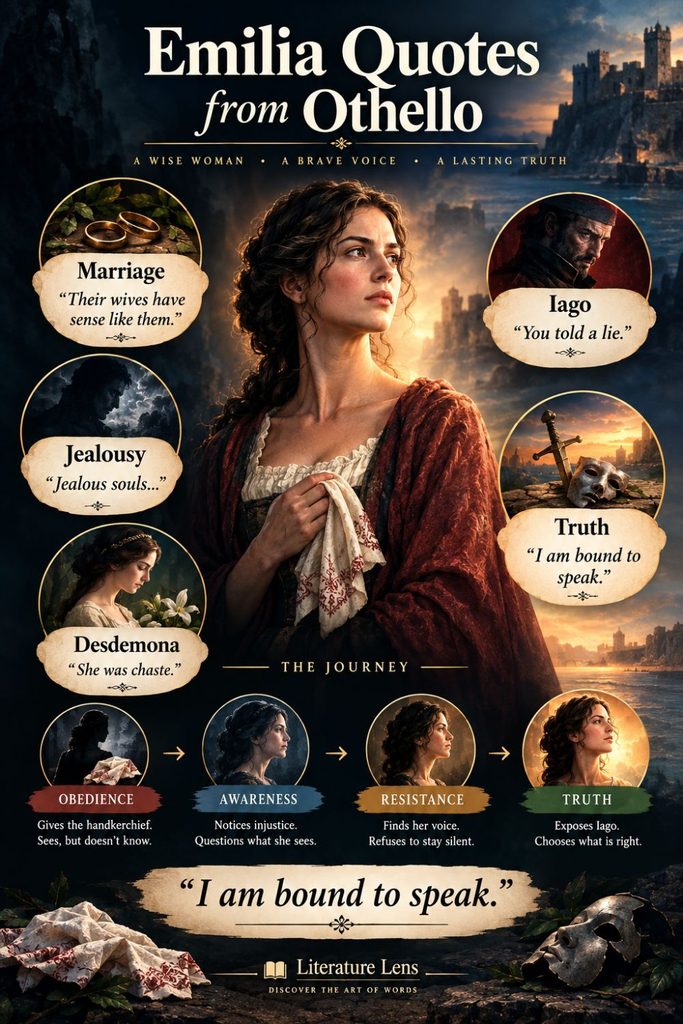
Emilia’s quotes in Othello reveal a more complex development than a simple movement from weakness to strength. Her journey can be understood as:
Obedience → Awareness → Questioning → Resistance → Truth
Emilia is not intellectually passive at the beginning. Shakespeare shows her independent judgment through her comments on marriage and jealousy. What changes is what she is willing to do with that knowledge.
You see, at first, she gives Iago the handkerchief without understanding the harm it will cause. Later, she questions unequal rules within marriage. Finally, she chooses truth over obedience and exposes her husband.
Emilia does not suddenly become a different person. She finally acts on the moral intelligence she has shown throughout the play.
Emilia Quotes: Quick Revision Guide
For exams, connect these quotations with five ideas:
Marriage → Jealousy → Desdemona → Iago → Truth
- Feminism: “Let husbands know / Their wives have sense like them.”
- Jealousy: “But jealous souls will not be answer’d so.”
- Desdemona: “Moor, she was chaste; she loved thee, cruel Moor.”
- Truth: “I will not charm my tongue; I am bound to speak.”
- Courage: “I’ll make thee known, / Though I lost twenty lives.”
FAQs:
What is Emilia’s most famous quote in Othello?
“I will not charm my tongue; I am bound to speak.” is one of her most memorable lines because it captures her refusal to remain silent after discovering Iago’s deception.
Which Emilia quote is best for an essay on feminism?
“Let husbands know / Their wives have sense like them” is a strong choice because Emilia challenges the assumption that women are less capable of feeling, thinking, and judging than men.
Which Emilia quote shows her changing attitude toward Iago?
“You told a lie, an odious, damned lie!” marks her decisive break with Iago. Earlier, she obeys him without understanding his purpose. Here, she recognizes his deception and openly condemns him.
What is Emilia’s final line in Othello?
Emilia’s final words are “So speaking as I think, alas, I die.” She continues to speak honestly until death, uniting thought, truth, speech, and sacrifice.
Conclusion:
The key Emilia quotes from Othello reveal a woman whose moral voice becomes stronger as the tragedy progresses. Her comments on marriage and jealousy, her loyalty to Desdemona, and her confrontation with Iago show that her transformation is not simply from silence to speech. It is from private understanding to public moral action.
For a fuller character study, explore Emilia in Othello to examine her development and dramatic significance.
You can also read Iago Quotes and Analysis.