Every year, a student asks me a question that makes the class pause: “How can a man who does something so terrible still be called a tragic hero?” I tell students this is the right question.
Othello as a tragic hero becomes clearer when we see him as a respected general who makes a fatal error of judgment and recognises it only after his choices destroy what he loves. His fall, however, cannot be blamed on jealousy alone.
Iago knows where to press, while Othello’s insecurity and misplaced trust leave him vulnerable to manipulation.
Othello as a Tragic Hero: Why Is He One?
Othello enters the play with many qualities associated with a tragic hero. He is a celebrated general whose military service has earned him authority in Venice. Before the Senate, he remains calm and confident, even declaring, “Keep up your bright swords,” when confronted by Brabantio. That dignity makes his later collapse more painful.
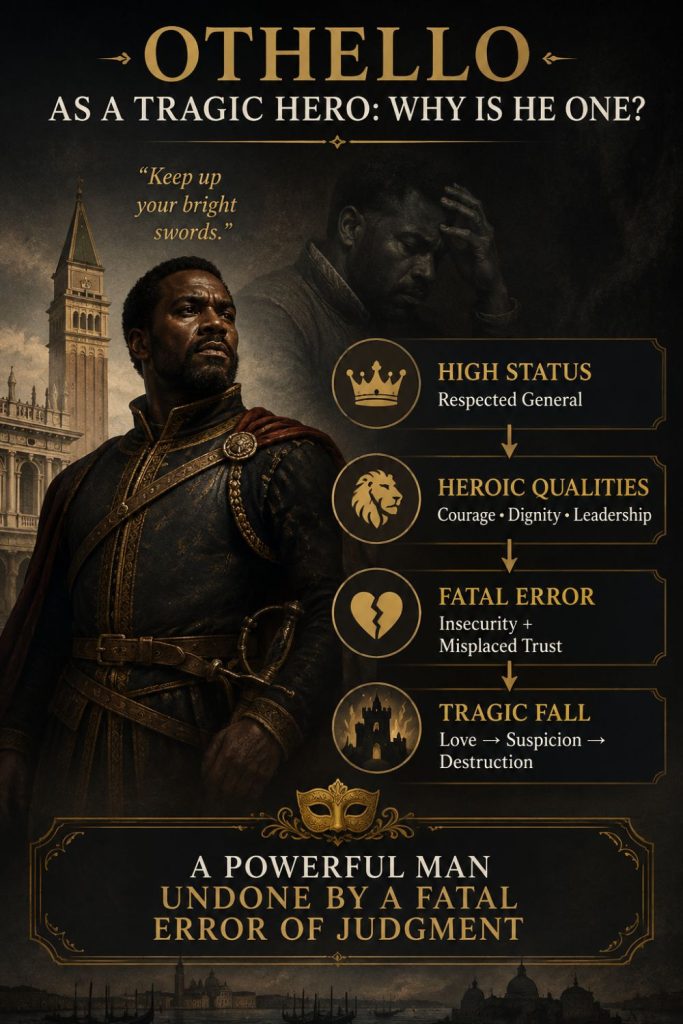
His greatness, however, does not make him invulnerable. Othello is deeply devoted to Desdemona and places considerable faith in those around him. This openness becomes dangerous when Iago begins to plant suspicion. The general who once relied on reason gradually loses control of his judgment until he cries, “Farewell! Othello’s occupation’s gone!”
Aristotle’s Poetics describes the tragic protagonist as someone of high status, but the popular claim that the tragic hero must be a king is often an oversimplification. He is a powerful military commander rather than a king, while his position as a Moor leaves him socially apart from Venetian society.
Taken together, these qualities and weaknesses explain why Othello broadly fits the tragic-hero model, while his position also reveals where Shakespeare departs from the classical pattern.
| Tragic Hero Element | Othello |
| Elevated status | A respected and successful military general |
| Heroic qualities | Courage, dignity, leadership, and love for Desdemona |
| Hamartia | Fatal error of judgment shaped by insecurity and misplaced trust |
| Peripeteia | The reversal from marital happiness and trust to suspicion and revenge |
| Anagnorisis | He recognises Iago’s deception and his own fatal error |
| Responsibility | He is manipulated but remains responsible for his choices |
| Catastrophe | He kills Desdemona and then takes his own life |
Table of Contents
Othello’s Tragic Flaw: What Is His Hamartia?
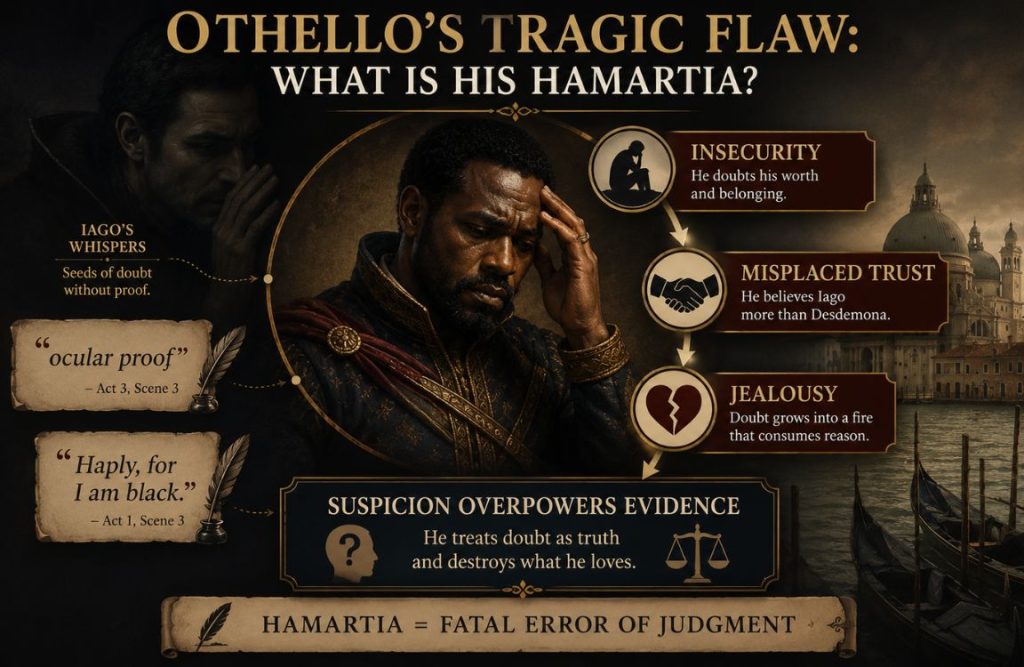
If we call jealousy Othello’s tragic flaw and stop there, we miss the deeper issue. Jealousy drives his behaviour, but it grows from deeper weaknesses. Rather than reducing his hamartia to jealousy, it is more useful to see it as a fatal error of judgment shaped by insecurity and misplaced trust.
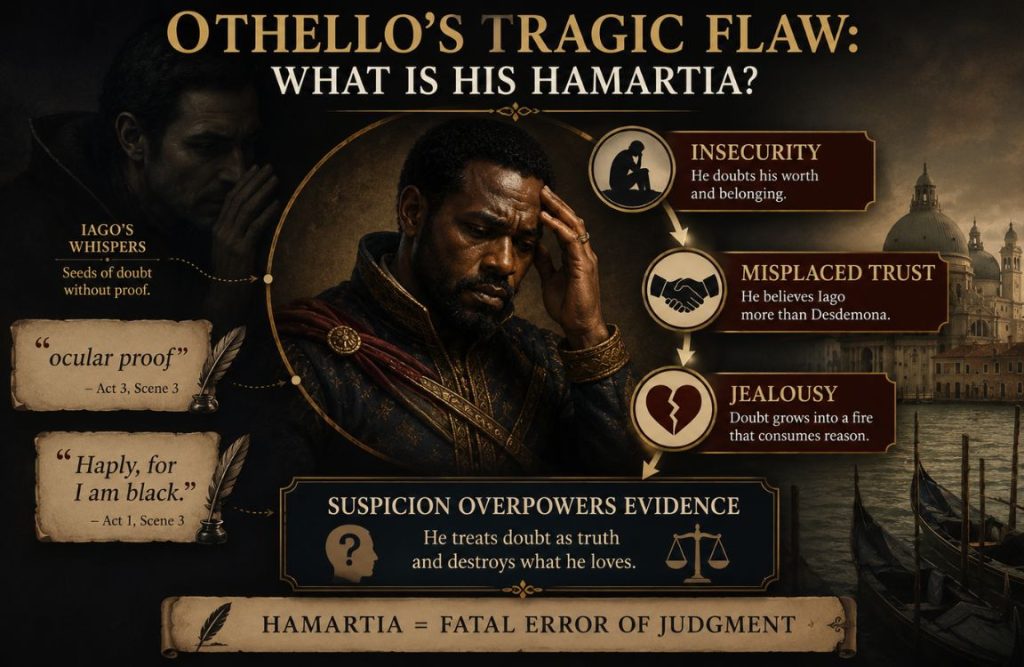
Jealousy becomes powerful because Iago gives Othello reasons to imagine betrayal without genuine evidence. Even Othello’s demand for “ocular proof” cannot save him because he soon treats doubtful signs as certainty.
His insecurity also matters. When Othello says, “Haply, for I am black,” he reveals a fear that his race and outsider position may make him less worthy of Desdemona.
Trust completes the pattern. Othello believes Iago while giving Desdemona’s defence far less weight. Jealousy is therefore central, but his deeper weakness lies in the judgment that allows suspicion to overpower evidence.
A. C. Bradley offers a useful perspective on this vulnerability. He argues that Othello is not naturally suspicious or jealous. His intense emotional nature makes him particularly vulnerable once jealousy takes hold. His tragedy thus grows from a weakness closely connected to his capacity for passionate love.
How Does Othello’s Downfall Make Him a Tragic Hero?
Othello’s downfall becomes tragic because his choices carry him further from the man he was. Iago’s suggestions turn doubt into suspicion, suspicion into jealousy, and jealousy into revenge.
The handkerchief intensifies this process. Othello treats it as proof of Desdemona’s betrayal, although Iago has manipulated its meaning.
Yet, Iago’s deception does not erase Othello’s responsibility. Iago supplies the poison. Othello chooses what to do with it. He could question the accusation or listen to Desdemona, but instead he accepts Iago’s version of events and eventually kills his wife.
His declaration, “It is the cause, it is the cause, my soul,” shows how he convinces himself that the murder is necessary.
That choice is crucial to his tragic status. Othello is deceived, but he is not merely a helpless victim. He acts, suffers the consequences, and finally understands his mistake. His recognition comes only after the damage is beyond repair.
Peripeteia and Anagnorisis in Othello
Aristotelian tragedy highlights two crucial moments: peripeteia, or reversal of fortune, and anagnorisis, or recognition of truth. Othello contains both, and their timing intensifies the tragedy.
i) Peripeteia in Othello
Othello’s peripeteia marks the movement from love and honour to suspicion and revenge. It develops gradually as Iago undermines Othello’s trust and turns doubt into certainty. The handkerchief becomes an important piece of manipulated evidence within this process.
Othello begins to treat suspicion as proof. His marriage, once a source of happiness, becomes the centre of his rage.
ii) Anagnorisis in Othello
Othello’s anagnorisis comes only after he has committed the fatal act. Once Emilia exposes Iago’s deception, Othello finally understands how he was ensnared, asking, “Why he hath thus ensnared my soul and body?”
His later admission, “one that loved not wisely but too well,” shows painful self-recognition. The truth arrives when nothing can be repaired. That delay is central to the tragic effect.
Is Othello a Traditional or Unconventional Tragic Hero?
At first glance, Othello fits the traditional tragic-hero pattern: he holds an elevated position, possesses heroic qualities, makes a fatal error, suffers a reversal, recognises his mistake, and dies. Yet his position complicates that pattern.
Aristotle’s Poetics describes the tragic protagonist as someone of high status, but the popular claim that the tragic hero must be a king is often an oversimplification.
He commands respect in Venice, but as a Moor, he remains an outsider within the society he serves. His public authority therefore exists alongside a private sense of insecurity.
His downfall grows from both personal weakness and social prejudice. Jealousy and poor judgment are central to his fall, but Shakespeare also places those weaknesses within a society where Othello’s racial difference affects his sense of belonging.
Othello can consequently be read as both a classical tragic hero and an unconventional tragic hero.
Is Othello a Tragic Hero or a Villain?
Othello commits a terrible act, but that does not make him a conventional villain. His violence grows from corrupted judgment, jealousy, manipulation, and emotional collapse rather than from a deliberate desire to do evil.
He remains accountable for killing Desdemona, yet his remorse complicates our judgment of him.
F. R. Leavis offers a less forgiving reading of Othello’s final speech, questioning whether it is entirely noble or selfless. Leavis suggests that Othello’s concern with how others remember him may make his final self-presentation seem partly self-dramatising.
This interpretation complicates the view of Othello as a purely sympathetic victim. He is neither innocent nor a straightforward villain. He is a tragic figure whose judgment is manipulated by Iago while remaining responsible for choices that lead to irreversible destruction.
FAQs:
Why does Othello trust Iago so completely?
Othello trusts Iago because his reputation for honesty appears well established. Their military relationship also creates familiarity, making Iago’s warnings seem like concern from a dependable companion.
Why does Othello kill Desdemona?
Othello kills Desdemona after becoming convinced that she has been unfaithful. Iago’s suggestions and the handkerchief strengthen this belief until Othello mistakes suspicion for certainty.
What does Othello’s final speech mean?
Othello’s final speech shows his attempt to shape how others remember him. He asks listeners to judge his actions fairly while acknowledging that his love and judgment failed.
Why is Othello still relevant today?
Othello remains relevant because it explores trust, reputation, prejudice, communication, and emotional manipulation. These pressures still affect human relationships.
Conclusion
So, how can Othello still be called a tragic hero after killing Desdemona? Because his tragedy lies not in innocence but in a fatal mixture of greatness, weakness, responsibility, and late recognition. He contributes to his own destruction, yet understands the truth only when it can no longer save him.
That painful combination is what makes Othello as a tragic hero such a powerful subject of Shakespearean tragedy. Explore our guide to the ending of Othello to see how his final moments bring the tragedy to its full conclusion.