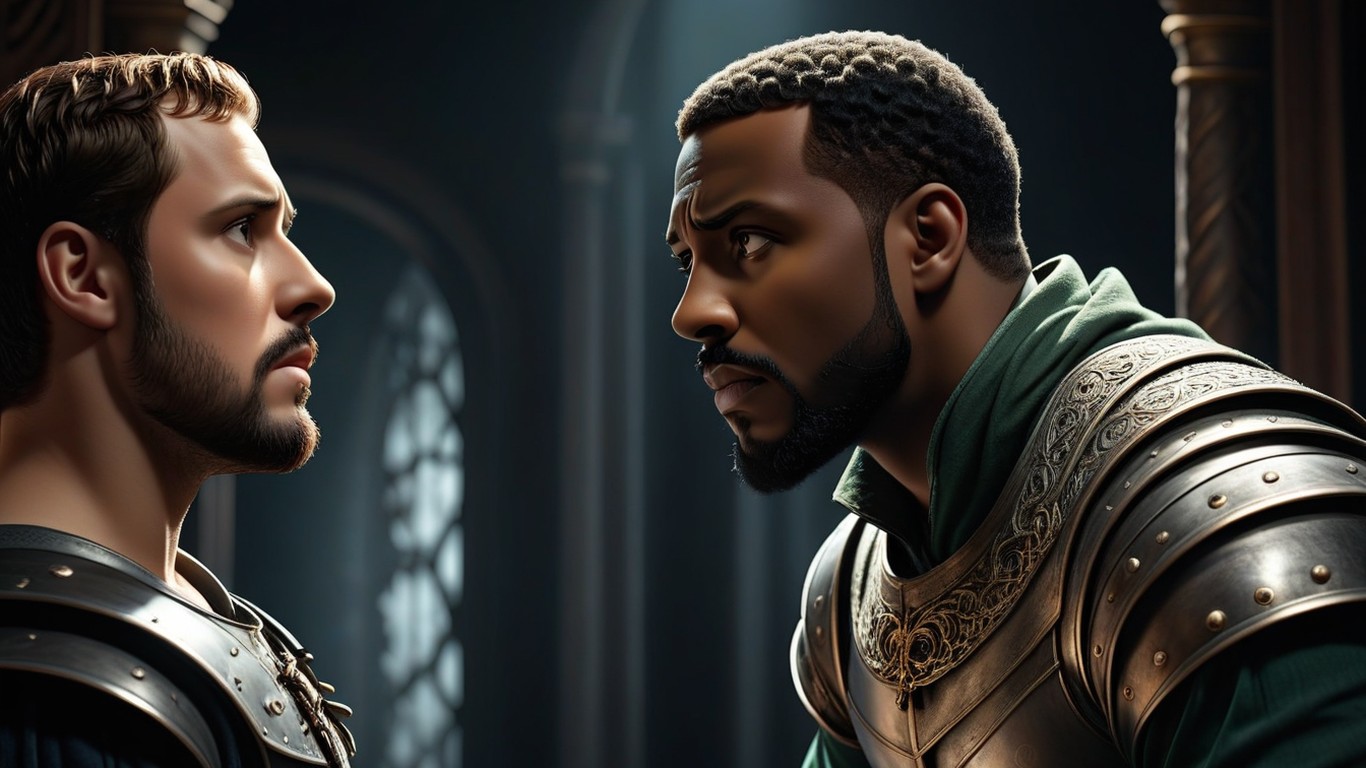
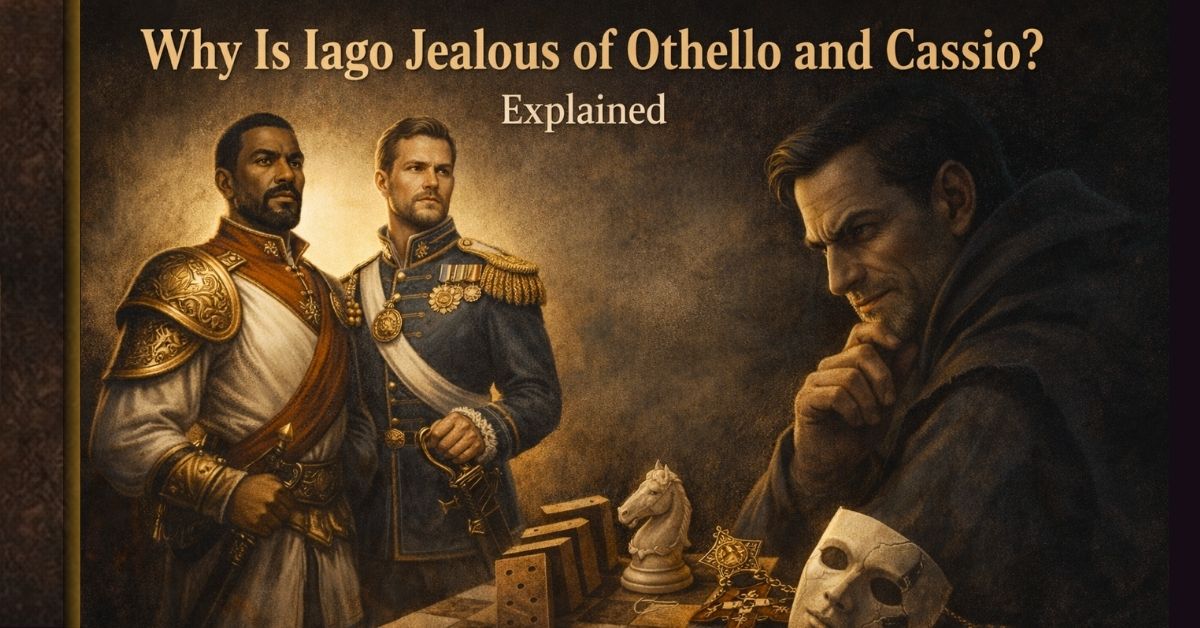
In Othello, four major characters die: Roderigo, Desdemona, Emilia, and Othello. Most deaths happen in Act 5, and Othello ends his life after realizing Iago’s deception.
I always tell my students that Othello isn’t tragic because people die. It’s tragic because every death feels preventable… until it isn’t. Shakespeare uses death like a final exam for human flaws, testing jealousy, pride, love, and manipulation all at once.
When we reach Othello’s ending, I see that moment of realization on my students’ faces: this play isn’t just about who dies in Othello, but how lies quietly build a body count.
In class, I pause and ask, “Who ends up paying for Iago’s deceit?” The room goes still. Then names start surfacing, one by one, like ghosts being called to roll. That’s when it clicks- death becomes Shakespeare’s loudest truth, exposing what words alone can’t.
Stick with me, and I’ll break down each death in clear order, so the tragedy feels powerful, not confusing.
Quick Summary: Who Dies in Othello?
Let’s cut to the chase and tally the tragic body count. I like to do this with my students as a live “who’s left standing?” game. It helps them visualize Shakespeare’s chaos without losing their sanity. Here’s everyone who dies in Othello:
i) Desdemona: Smothered by Othello; a victim of jealousy and tragic misunderstanding. “I will not die yet…” she whispers, powerless.
ii) Emilia: Stabbed by Iago for revealing the truth about the handkerchief; courage costs her life.
iii) Othello: Suicide by knife; his own judgment and remorse end his life. “I kissed thee ere I killed thee.”
iv) Roderigo: Killed by Iago in a failed scheme; ambition and gullibility meet a swift end.
That’s the main cast of casualties- each death a puzzle piece in Shakespeare’s moral and emotional mosaic. I often tell my students: imagine a classroom where every gossip, mistake, and misunderstanding explodes at once- that’s Act 5 of Othello.
Keeping this list handy is like carrying a compass through the storm: it helps us track consequences, understand motives, and marvel at Shakespeare’s precision.
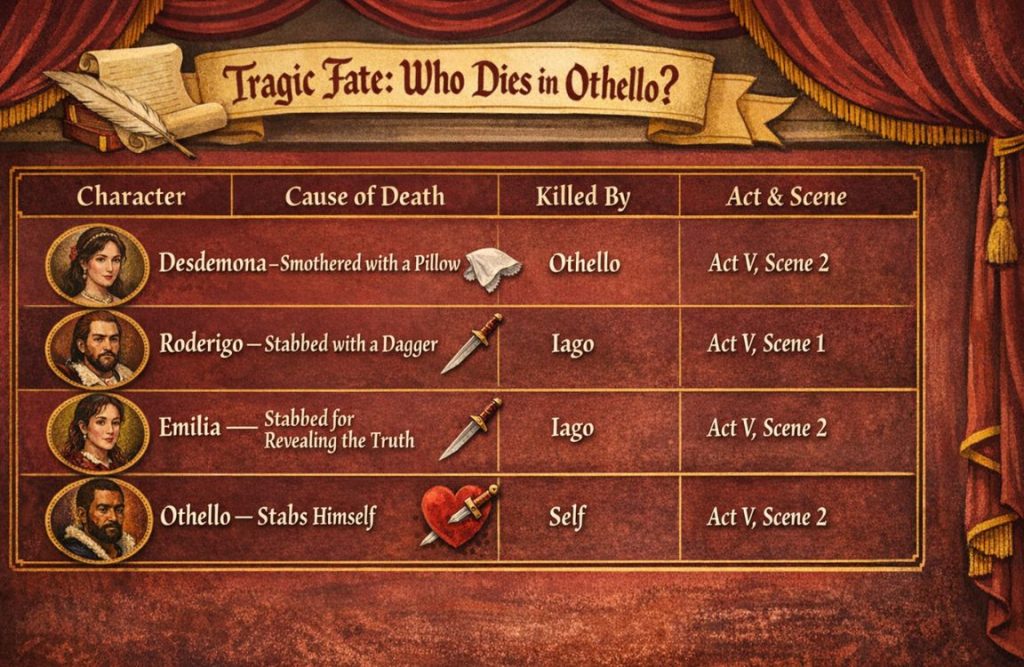
Table of Contents
Who Dies in Othello in Order?
When students ask who dies first in Othello, I tell them to imagine Shakespeare lining up dominoes. One small push, and everything else follows. The deaths aren’t random. They’re carefully sequenced, each one tightening the tragic knot until it snaps in Act 5.
1. Roderigo: The First Death
Roderigo’s death often shocks students because it feels sudden, almost careless. But that’s the point. He is the first casualty of Iago’s schemes, proof that in this play, gullibility is fatal and loyalty is a weapon used against the innocent.
i) Who Dies First in Othello?
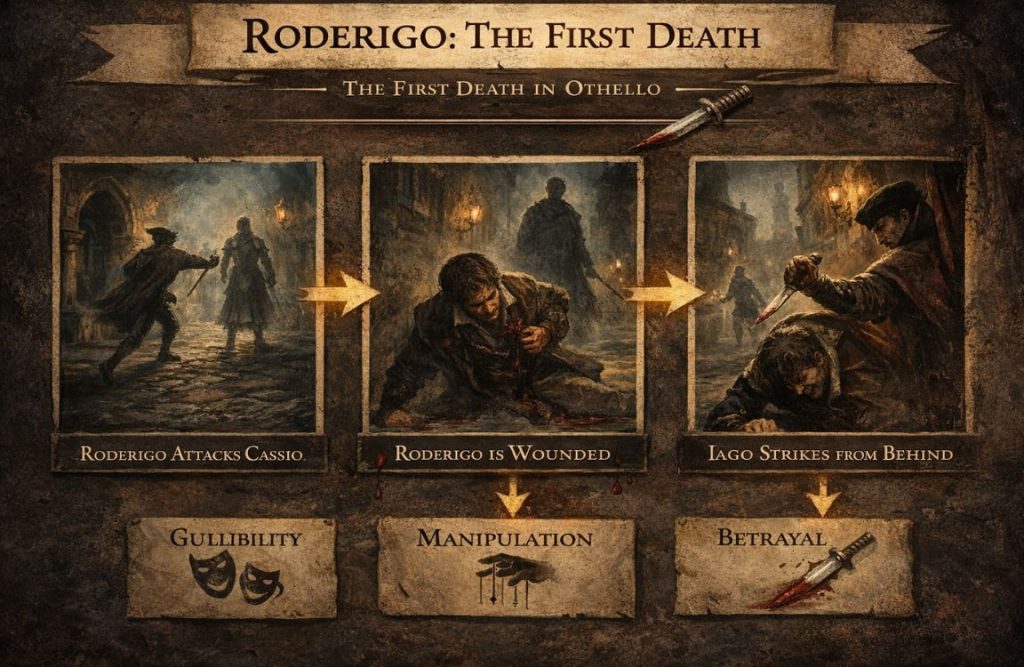
Roderigo is the first character to die in Othello. His death occurs in Act 5, Scene 1, and it signals that Iago’s manipulation has crossed from plotting into bloodshed. From this moment on, the tragedy cannot be stopped, only completed.
ii) How Does Roderigo Die in Othello?
In Act 5, Scene 1, Roderigo is lured into attacking Cassio, believing it will win him Desdemona. Instead, the plan collapses. Cassio wounds him, and as Roderigo lies helpless, Iago steps in and stabs him.
I tell my students this is betrayal made literal. Roderigo dies not in battle, but confused, used, and discarded.
iii) Who Kills Roderigo in Othello?
Although Cassio injures him, Iago is the one who kills Roderigo. He silences the very man who could expose him.
As I remind my class, Iago doesn’t just manipulate people. He erases evidence. Roderigo’s death proves that in Othello, knowing the truth can be deadly.
Watch my YouTube tutorial to uncover why Iago really kills Roderigo- Shakespeare’s dark strategy revealed.
2. Desdemona: Murder in the Bedchamber
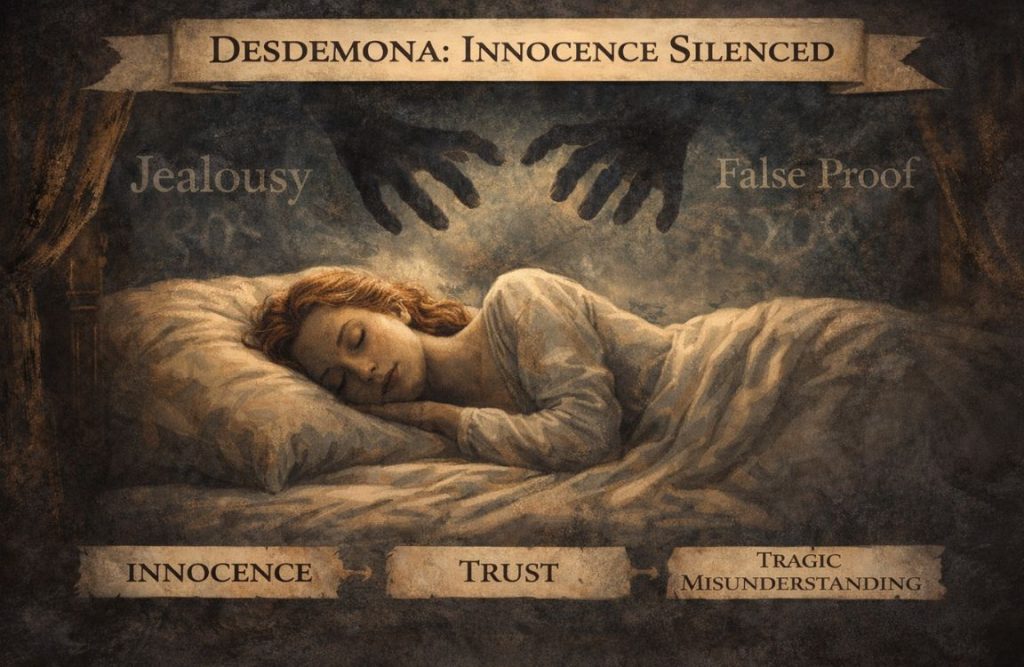
Whenever we reach this scene, I warn my students: this is where Othello stops being loud tragedy and becomes quiet horror. The death of Desdemona happens in a space meant for love and rest, not judgment and execution. Shakespeare turns the bedchamber into a courtroom, and Desdemona never gets a fair trial.
i) Does Desdemona Die in Othello?
Yes, Desdemona does die in Othello, and that fact never stops hurting. In class, someone always whispers, “But she didn’t do anything wrong.” Exactly.
Her death matters because it exposes how innocence offers no protection in a world ruled by suspicion. Desdemona dies believing in love, even as it turns against her.
ii) How Does Desdemona Die?
Desdemona is smothered by Othello while she sleeps. There’s no duel, no defense, just breath slowly taken away as she insists, “A guiltless death I die.”
I tell my students this isn’t passion; it’s misplaced certainty. A false accusation replaces evidence, and jealousy tightens like a pillow pressed too long. Her death is quiet, intimate, and devastating.
iii) Who Killed Desdemona?
Othello kills Desdemona with his own hands, convinced he is delivering justice. Yet Shakespeare makes us ask a harder question: who truly bears the blame?
Iago never enters the room, but his lies do. Desdemona’s tragic innocence reveals the play’s darkest truth: when trust is poisoned, love can become the weapon.
Watch my YouTube tutorial on Desdemona’s death here and see why Shakespeare turns love’s bedchamber into a stage for horror- the full story behind Othello’s tragic choice revealed.
3. Emilia: Truth and Consequences
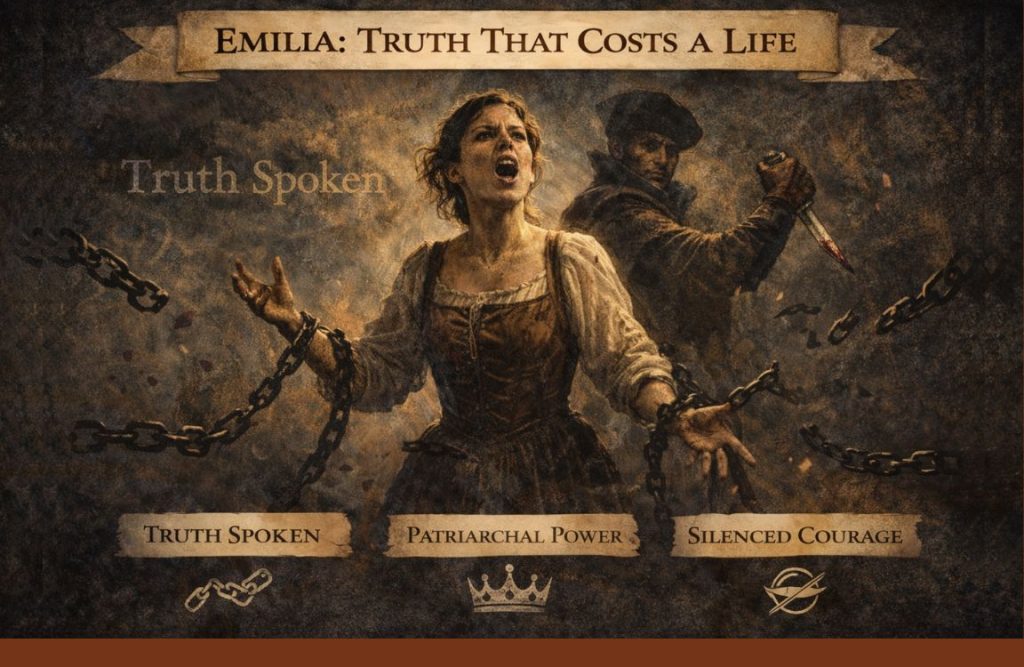
This is where I pause mid-lesson and say, “Watch who becomes brave when it’s already dangerous.” Emilia’s story isn’t about innocence lost; it’s about truth spoken too late, and the cost of refusing silence in a violent, patriarchal world.
i) Does Emilia Die in Othello?
Yes, Emilia does die in Othello, and her death feels brutally unfair, because it follows an act of moral courage.
When she realizes the truth about Desdemona’s death, she refuses to protect her husband’s lies. I tell my students: Emilia dies not because she’s weak, but because she finally becomes strong.
ii) How Does Emilia Die in Othello?
Emilia is stabbed after publicly exposing Iago’s manipulation. She names his lies, unmasks his motive, and dismantles the false narrative holding the tragedy together. Even when warned to be silent, she insists, “I will speak as liberal as the north.”
Her death isn’t accidental. It’s the punishment for truth in a system that fears outspoken women.
iii) Who Kills Emilia in Othello?
Iago kills Emilia himself. The man who thrived on secrecy cannot survive exposure. I remind my class that this is patriarchal violence at its clearest: a husband silencing a wife for refusing obedience.
The death of Emilia proves that in Othello, truth doesn’t just disrupt power. It threatens it. And power strikes back.
Watch my YouTube tutorial on why Iago kills Emilia here and see how truth spoken too late turns courage into tragedy- the full story behind Iago’s final act revealed.
4. Othello: Death by Suicide
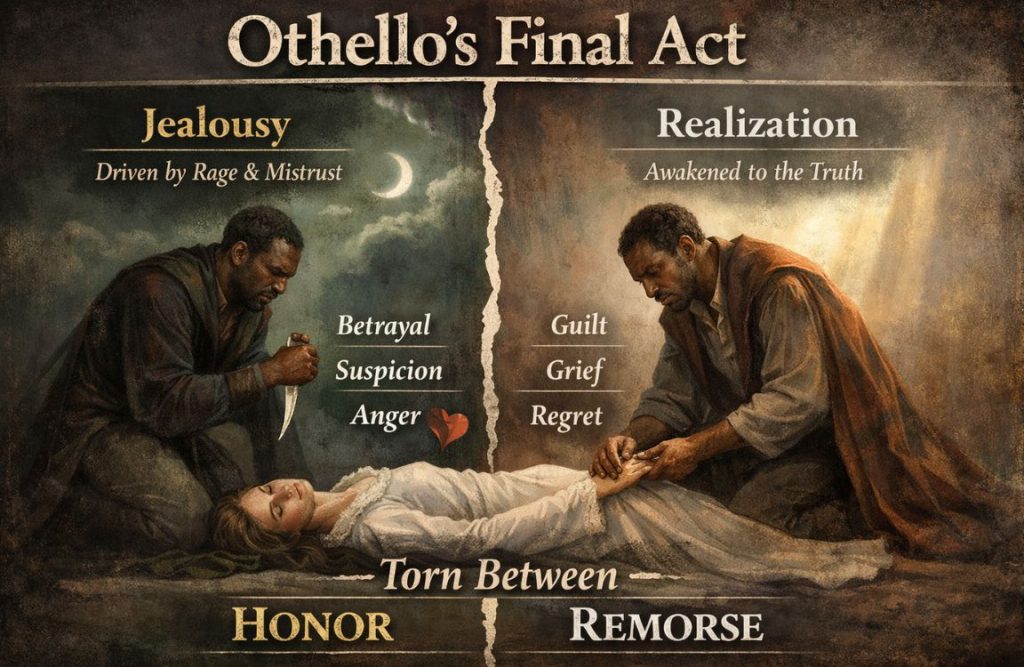
Othello’s death is the tragic punctuation to a life unraveling through jealousy, betrayal, and misguided honor. In his final act, he becomes both judge and victim of his own heart, taking his life in a desperate bid for justice and redemption.
i) Does Othello Die?
Yes, Othello dies at the end of Shakespeare’s play, but not before a storm of self-judgment.
In class, I often ask students, “Did he really die, or was it his honor that finally collapsed?” His death is as much a statement as it is a surrender.
ii) How Does Othello Die?
Othello dies by his own hand, a knife serving as grim punctuation to his tragic tale. Standing over Desdemona, stricken with guilt and heartbreak, he whispers, “I kissed thee ere I killed thee.”
It’s Shakespeare at his cruelest, showing that sometimes the weapon of choice is self-inflicted, fueled by tragic recognition and remorse. In teaching, I compare it to a student erasing their own masterpiece in panic, devastating, but painfully human.
iii) Does Othello Kill Himself?
Yes. Othello kills himself after realizing the irreversible damage caused by his jealousy and Iago’s manipulations.
His final speech, filled with reflection and dignity, turns his suicide into an act of self-judgment, leaving us with a haunting meditation on honor, love, and the price of misunderstanding.
How Does Othello End?
Ah, the final curtain of Othello, the moment I love to pause with my students and whisper, “This is Shakespeare’s mic-drop.” By the end, the stage is a chilling tally: Desdemona lies dead, smothered by Othello’s hands. Emilia, the ever-loyal truth-teller, is murdered by Iago. And, of course, Othello himself dies, his life’s story ending with a knife and a heart full of remorse.
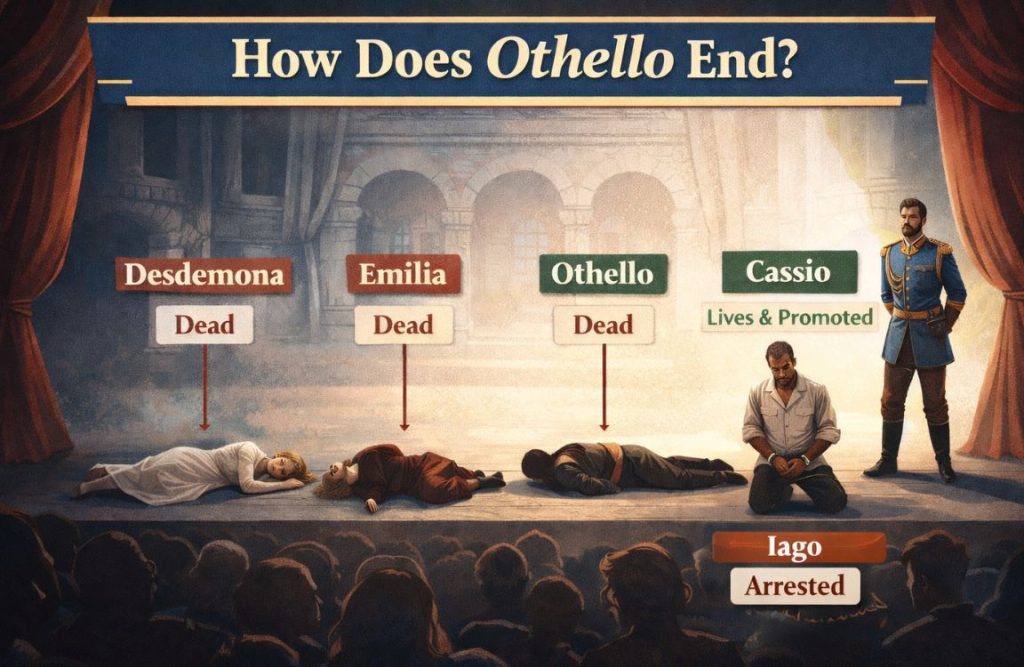
Yet amidst the tragedy, order tiptoes back into Venice. Cassio is promoted, the government restores authority, and Iago, well, he faces justice, though not without leaving scars.
I often ask my students to picture the aftermath: it’s like a classroom after a glitter bomb- messy, shocking, but with lessons that stick.
Shakespeare doesn’t just tally deaths. He teaches about consequences, honor, and human frailty. Othello’s final words, “I kissed thee ere I killed thee,” linger in the air, a haunting reminder of love, regret, and the heavy price of jealousy.
By the play’s end, Venice survives, but the audience leaves wiser, hearts slightly bruised, pondering what might have been if trust had outshone suspicion.
Does Iago Die in Othello?
If you’ve ever asked your students, “Does Iago get his just desserts?” you know the room fills with hopeful anticipation. Spoiler: Iago doesn’t die. At the end of Othello, He is arrested, not executed. Shakespeare leaves him alive, a walking, scheming reminder that evil sometimes escapes full justice.
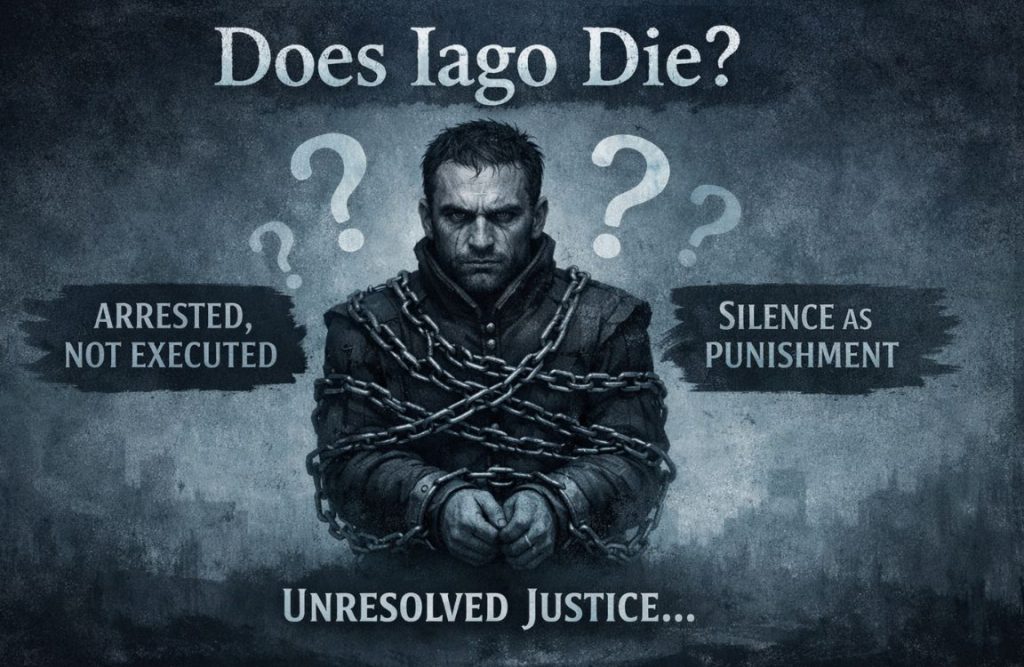
I love pausing here and asking my students, “Why do you think he gets to live?” His chilling final words, “Demand me nothing: what you know, you know. From this time forth I never will speak word,” hang in the air like a frozen classroom moment- silence, heavy with menace.
This ambiguous punishment sparks endless debates. Is it mercy, oversight, or a deliberate twist by Shakespeare to unsettle us?
Teaching this scene, I compare it to leaving a smoke alarm beeping after a fire- you hear it, you know danger lingers, but the immediate threat is gone. Iago’s survival keeps the tension alive and leaves us questioning justice long after the curtain falls.
Who Does NOT Die in Othello?
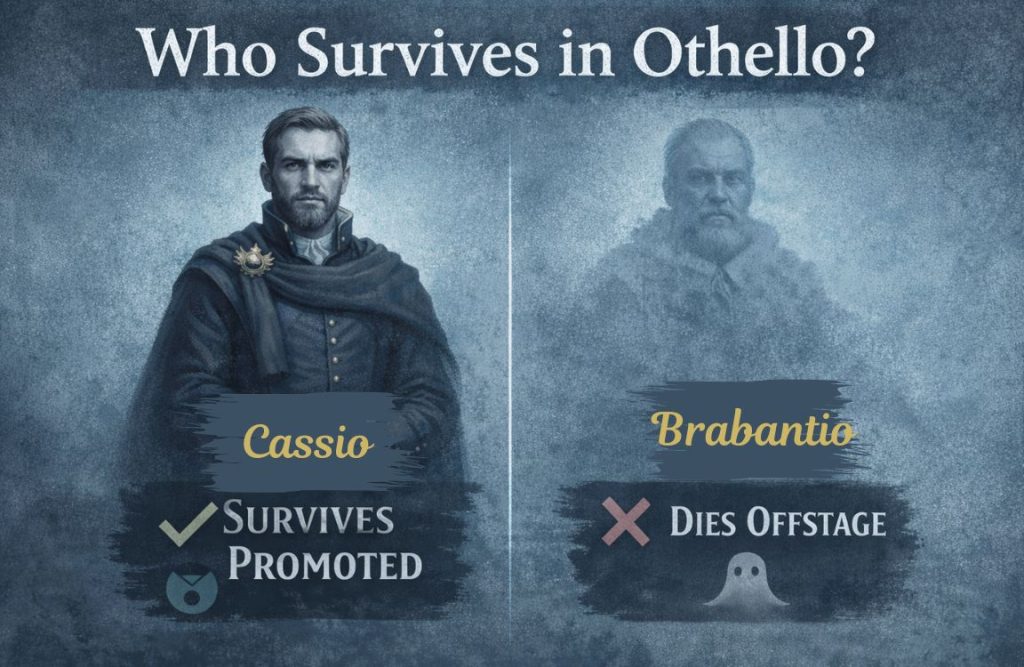
Not everyone on stage meets a tragic end. Some survive the chaos- like Cassio, who walks away with his life (and a promotion), while others, like Brabantio, leave us puzzled because their deaths happen offstage. Let’s untangle the confusion.
i) Does Cassio Die in Othello?
Nope, Cassio survives! In fact, he inherits the practical aftermath of the tragedy: Venice restores order, and he earns a promotion. I often tell my students, “Think of Cassio as the student who studied quietly while chaos erupted in the classroom. He survives, learns a lot, and benefits in the end.”
His survival underscores the contrast between action-driven tragedy and the quiet endurance of reason.
ii) Does Brabantio Die in Othello?
Brabantio’s death? Offstage, like a whisper, we barely hear it when Gratiano, a Venetian noble and Desdemona’s unclee carries the news of Brabantio’s death to Cyprus in the final scene.
Shakespeare never dramatizes it, leaving students confused. I like to explain it as “the background hum of a story,” where consequences exist but don’t demand our attention. His death signals that not all tragedies unfold in plain sight- some, like life itself, occur beyond the stage.
Why Are So Many Deaths in Act 5 of Othello?
Ah, Act 5- the tragic fireworks finale of Othello. If you’ve ever taught or studied this scene, you know it’s a battlefield of bodies and heartbreak. But why does Shakespeare pack so many deaths into this single act?
Here’s my take, and the one I share with my students while dramatically pointing at the stage: it’s all about structure, collapse, and moral reckoning.
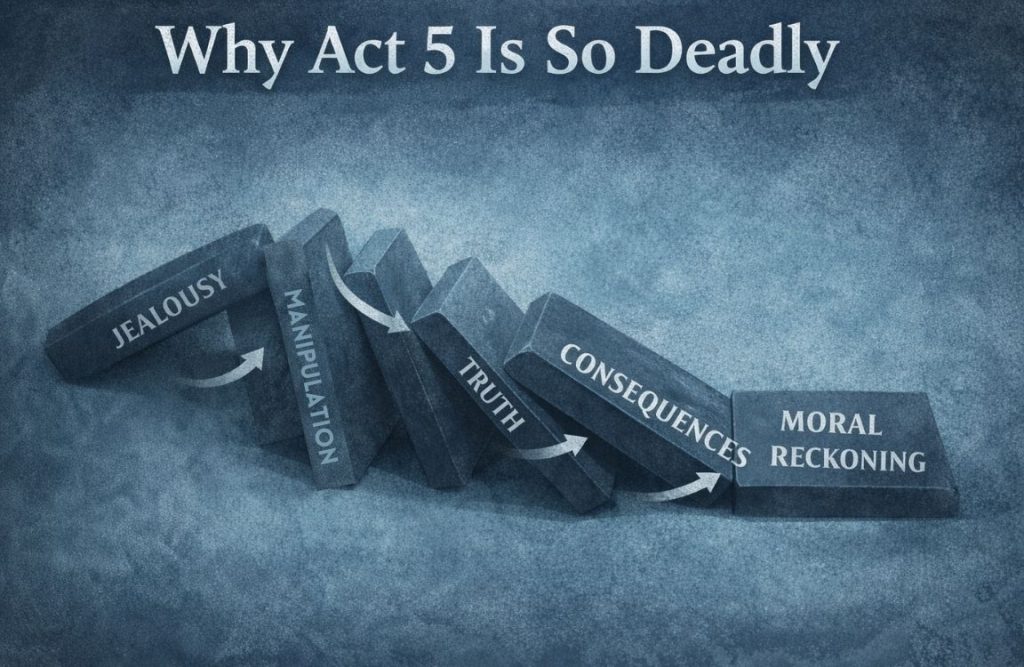
First, the deaths give Othello its tragic punch. Shakespeare doesn’t sprinkle them randomly. Each death is a domino in a meticulously designed moral maze. Othello’s killing of Desdemona isn’t just a crime of passion. It’s the ultimate consequence of jealousy twisted by Iago’s manipulations.
Then Emilia dies for speaking the truth, and finally, Othello kills himself, whispering, “I kissed thee ere I killed thee.” I pause here with my students and ask, “Who is punishing whom?” The answer is both simple and heartbreaking: the tragic hero punishes himself.
Meanwhile, Iago’s carefully spun web collapses spectacularly. Every death unmasks his treachery, leaving him exposed yet still alive- an unsettling reminder that evil sometimes survives to be judged later.
The pile-up of deaths is Shakespeare’s way of balancing chaos with moral clarity: wrongs are revealed, justice (partial or full) is served, and the audience leaves with both shock and reflection.
In short, Act 5’s carnage isn’t gratuitous. It’s a moral symphony. Every death, from Desdemona to Othello, strikes a chord that teaches, haunts, and lingers, reminding us why Othello remains the ultimate study in love, jealousy, and consequence.
Conclusion:
By now, we’ve tallied every tragic end in Othello– from Desdemona’s heartbreaking smothering to Othello’s own final act of remorse. As I often tell my students, keeping track of who dies in Othello, how, and why is like mapping a storm: each death is a gust that drives the story forward, exposes character, and delivers Shakespeare’s moral lessons.
Some deaths hit us with raw emotion, others teach through shock, and a few, like Iago’s survival, leave us unsettled. Understanding this web of tragedy isn’t just exam prep. It’s a lens into human nature, jealousy, honor, and consequence. In Othello, every death matters, and every life left standing tells its own story.