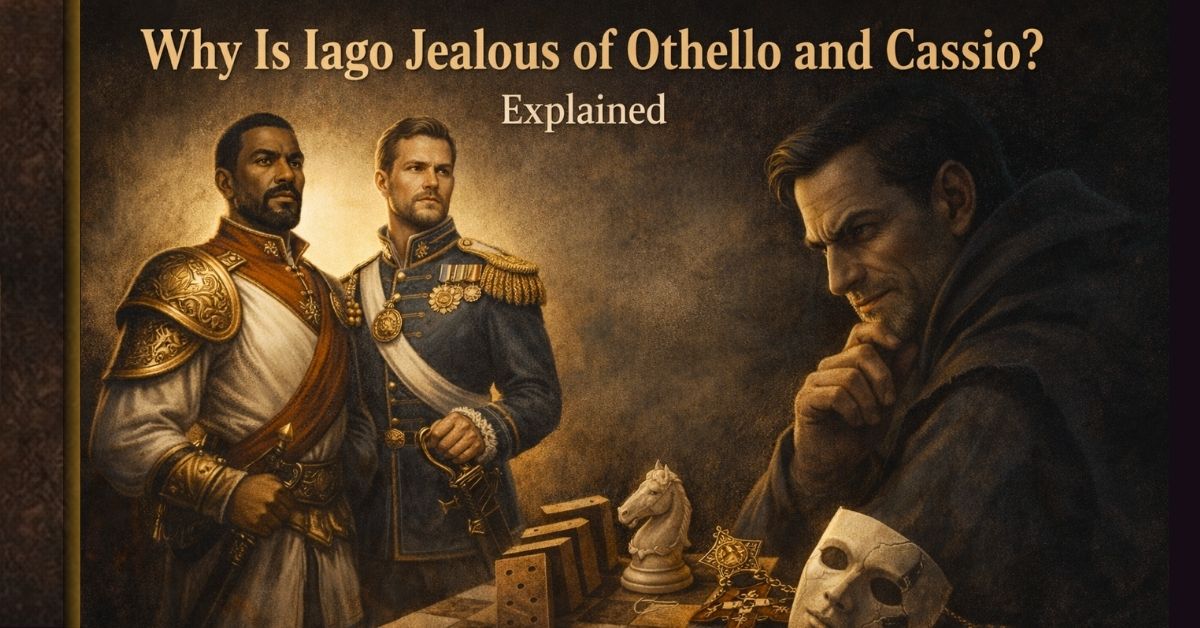
Jealousy in Othello is the force that drives the tragedy and destroys every major character and relationship. When I introduce Othello in class, I always warn my students: this isn’t jealousy that flares up and fades. It’s a slow, corrosive poison.
Shakespeare doesn’t treat jealousy as a passing feeling. He presents it as a process of moral corrosion. Iago’s jealousy grows from envy and emptiness, while Othello’s grows from love tangled with insecurity. One manipulates. The other believes. Together, they reveal how jealousy eats away at judgment, trust, and identity.
I often pause mid-lesson and say, “Notice, no one dies in Othello because of fate.” They die because jealousy keeps nudging every decision, whispering doubt, demanding proof. By the final act, reason collapses, and violence follows.
Now, stay with me, because from here, we dive deep into who is jealous, why they are jealous, and how that emotion destroys everything it touches.
Table of Contents
Key Aspects of Jealousy in Othello
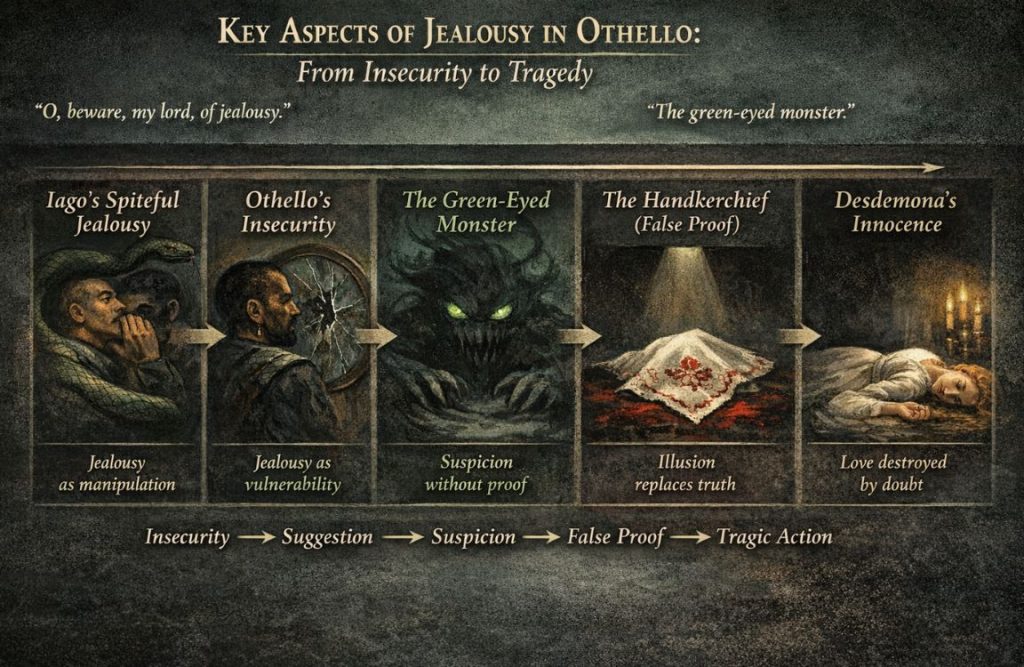
When I teach the key aspects of jealousy in Othello, I always warn my students not to oversimplify it. Jealousy here isn’t a single burst of emotion. Shakespeare shows it as a quiet, acidic force that eats away at judgment. It begins with insecurity, grows through suggestion, and finally hardens into deadly certainty.
It starts with Iago’s spite. His jealousy over Cassio’s promotion fuels a carefully planned desire for revenge. Unlike Othello, Iago’s jealousy is cold and calculated. He never openly accuses. Instead, he whispers, hints, and uses language and symbols to let suspicion take root and spread.
Othello’s insecuritymakes him dangerously vulnerable. As a Moor in Venetian society, he already feels like an outsider. His passionate love for Desdemona slowly twists into possessive fear. I often ask my students, “Who controls the story?” In this play, the answer is clear: the one who controls doubt.
Iago even names the poison he spreads, the “green-eyed monster.” It feeds on suspicion and distorts reality long before proof exists. The handkerchief completes the illusion, becoming false “ocular proof.”
The tragedy deepens through Desdemona’s innocence. By the end, jealousy’s ruinous descent strips Othello of reason and compassion, leading him to destroy the very love he seeks to protect.
How Jealousy Drives the Plot in Othello
When I teach Othello, I tell my students that jealousy isn’t just a theme. It’s the engine of the plot. Every major event happens because suspicion replaces trust.
Iago plants doubt, Othello accepts it, and each decision pushes the story forward. No jealousy, no manipulation. No manipulation, no tragedy. From whispered hints to murder, jealousy keeps the action moving until there’s nowhere left to go.
A neat formula for disaster in Othello: Jealousy → manipulation → tragedy.
Who Is Jealous in Othello More?
When my students ask who feels jealousy in Othello, I tell them this: jealousy doesn’t belong to one villain here. It slips into different characters for different reasons, and each version teaches us something unsettling.
i) Othello: Jealousy Born from Love
When I teach Othello, I always say his jealousy doesn’t come from suspicion. It comes from devotion. He loves loudly, absolutely, without a safety net. So when doubt appears, it hits him like betrayal, not curiosity.
In class, I describe it as love running downhill with no brakes. He doesn’t investigate. He believes. And that emotional speed is what turns affection into catastrophe, right in front of our eyes.
ii) Iago: Jealousy Without Emotion
Iago’s jealousy is the one that makes my classroom go quiet. There’s no heartbreak here, no wounded pride. This is jealousy stripped of feeling and powered by comparison. He sees others rise and decides the world owes him more.
I often tell students: This is envy with a spreadsheet. Precise. Strategic. And far more dangerous because it doesn’t need anger to function.
iii) Bianca: Jealousy from Insecurity
Bianca’s jealousy always pulls sympathy from my students. Hers is rooted in fear- the fear of being disposable. She loves without protection, status, or certainty, so suspicion feels like survival.
I remind the class that jealousy doesn’t always roar. Sometimes, it trembles. Bianca in Othello shows how emotional vulnerability can make even small doubts feel unbearable.
iv) Roderigo: Jealousy as Obsession
And then there’s Roderigo. I usually sigh before teaching him. His jealousy isn’t sharp or clever. It’s desperate. He mistakes fixation for love and hope for entitlement.
In a live lesson, I call him a cautionary tale: what happens when desire refuses to accept reality. His jealousy doesn’t destroy others first. It ruins him.
Othello’s Jealousy: Love Turned Poison
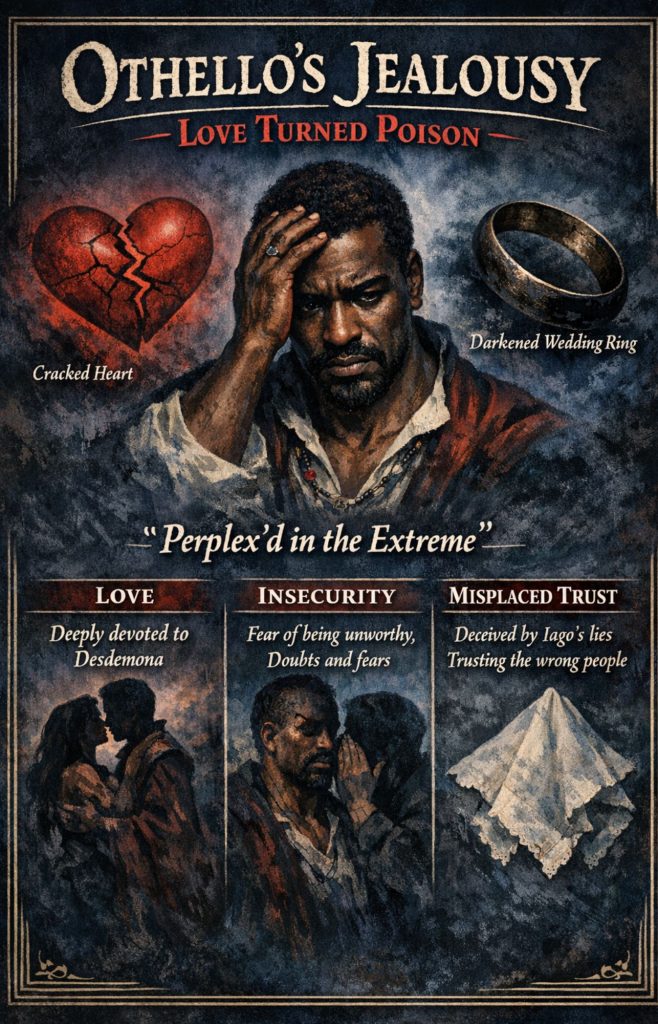
When I explain Othello’s jealousy to my students, I describe it as love that’s been tampered with. Nothing changes overnight, but once poison enters the bloodstream, even devotion starts behaving like a threat.
i) Why Is Othello Jealous?
Here’s the live teaching moment I always pause on: Othello doesn’t discover betrayal. He accepts it. His jealousy is triggered, not proven. Iago never brings evidence. He brings tone, pauses, and “honest” concern, hinting darkly that “men should be what they seem.”
And Othello, tragically, is ready to believe. When he admits, “This honest creature doubtless/Sees and knows more, much more, than he unfolds,” we see gullibility at work- not stupidity, but emotional trust misplaced.
Then comes vanity. Othello’s pride in his honour and public reputation sharpens the jealousy. The idea of being mocked hurts him more than the idea of being wrong.
When he cries, “My name, that was as fresh / As Dian’s visage, is now begrimed,” I tell my class this: he believes the story because it threatens his self-image, and he’d rather confront imagined shame than sit with uncertainty.
Remember, jealousy mixed with pride and credulity doesn’t need proof. It only needs permission.
ii) Love for Desdemona: The Emotional Root
This is the moment in class when I lower my voice and tell my students something uncomfortable: Othello’s jealousy grows out of love, not lack of it. His love for Desdemona is intense, idealised, and almost sacred. He doesn’t just love her. He leans on her emotionally.
When he says, “My life upon her faith,” that’s not romance. That’s emotional dependence. And dependence quietly sharpens his fear of loss.
Here’s the twist I ask them to sit with. Deep love doesn’t always create security. Sometimes, it multiplies anxiety. The more perfect Desdemona becomes in Othello’s mind, the more unbearable the idea of losing her feels.
When he admits she is “of so free, so kind, so apt,” admiration turns into fear. I compare it to holding a glass too tightly- the pressure meant to protect is what causes the crack.
So, when students ask why Othello becomes jealous, I remind them: he doesn’t doubt Desdemona because his love is weak. He doubts her because his identity, happiness, and sense of worth are wrapped up in her. When love carries that much weight, even a whisper of loss can feel like collapse.
iii) Insecurity and Otherness in Venetian Society:
This is where I ask my students to stop blaming jealousy alone and start listening to Othello’s silences. Beneath the confidence of the general lives a quieter fear: I don’t quite belong here.
In class, I point to the moment he admits, “Haply, for I am black,” and suddenly the room stills. That line isn’t about anger. It’s about internalised doubt. Venice applauds him on the battlefield, but never fully invites him into its heart.
Add age to that insecurity; he calls himself “declined into the vale of years, and outsider status does the rest. I tell my students to imagine standing in a room where they’re praised but never mirrored. That breeds vigilance. Othello’s fear isn’t that Desdemona is unfaithful. It’s that he might not be enough.
This is the psychological backbone of his jealousy. Because he already doubts his place, he’s quicker to believe betrayal. When insecurity whispers long enough, even lies start to sound reasonable.
iv) When Trust Becomes Vulnerability:
This is the point in class where I gently remind my students that trust, when misplaced, can be dangerous. Othello’s tragedy isn’t that he trusts. It’s who he trusts. Over and over, he leans on the phrase “honest Iago,” and each time I pause and ask the room: honest according to whom? That repeated label becomes a shortcut for thinking, a substitute for judgment.
Here’s the bitter irony I love unpacking. On the battlefield, Othello is a man who demands proof, strategy, and verification. Yet in love, he accepts rumor dressed as concern. When Iago says, “I speak not yet of proof,” Othello hears restraint as integrity. That’s not stupidity. It’s tragic trust.
I tell my students this is where jealousy completes its work. Trust turns into vulnerability, and vulnerability into surrender. The general who weighs evidence in war hands his heart to hearsay and never checks the source.
Why Is Othello Jealous of Cassio?
When students ask me why Cassio becomes the target of Othello’s jealousy, I tell them this isn’t about what Cassio does. It’s about what Othello imagines. Cassio becomes a screen onto which fear, doubt, and insecurity are projected.
i) Cassio as the Imagined Rival:
In class, I often joke that Cassio commits the crime of being polite. He’s handsome, articulate, courteous- everything Othello notices once jealousy has sharpened his vision.
When Othello mutters, “He hath a person and a smooth dispose,” I pause and ask my students to hear the tone: admiration curdling into suspicion. Cassio becomes the imagined rival not because of evidence, but because he fits the picture Othello’s fear has drawn.
Jealousy doesn’t look for facts. It looks for types. Cassio’s grace becomes proof, his silence becomes guilt. I remind students that this is how jealousy works. It edits reality until one character carries all the threat, whether he deserves it or not.
ii) Professional vs Sexual Jealousy:
Here’s where I slow the lesson down. Othello’s jealousy toward Cassio isn’t purely sexual, and that’s crucial. There’s professional envy tangled up with romantic fear. Cassio holds the lieutenancy Othello once chose for merit, not charm, and now that choice feels risky.
When Othello imagines Cassio “steal[ing] away so guiltily,” rank and romance blur. I tell my students: this is not just a husband afraid of betrayal. It’s a leader afraid of replacement. This contrast also helps clarify Othello’s jealousy vs Iago’s jealousy. Othello feels loss emotionally, while Iago resents loss strategically. One aches; the other calculates.
iii) The Handkerchief: Jealousy Made Visible
And then comes the handkerchief, my favourite teaching prop. I always say Shakespeare knew jealousy needed something students could see. This small object becomes emotional evidence.
When Othello calls it “ocular proof,” I underline the irony: jealousy finally gets something physical, and logic exits the room. The handkerchief doesn’t prove guilt. It satisfies suspicion.
This moment crystallises handkerchief and jealousy in Othello– fear demanding an object to cling to. Once jealousy has a symbol, it stops listening. From here on, Othello isn’t reasoning; he’s reacting.
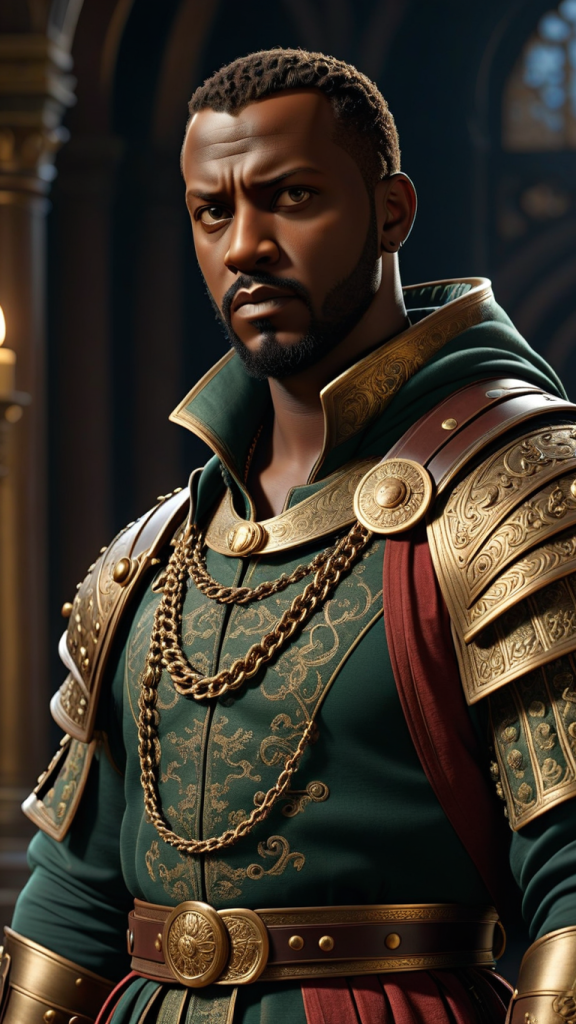
Iago’s Jealousy: Envy Without Love
When I introduce this section in class, I warn my students not to expect heartbreak. Iago’s jealousy doesn’t ache or plead. It watches, measures, and waits. If Othello’s jealousy burns hot, Iago’s runs cold, like a calculation pretending to be emotion.
i) Jealousy vs Envy: Understanding Iago
This is a live teaching moment I always enjoy. I ask the class: Does Iago actually love anything enough to be jealous? The answer usually lands in silence. What drives him isn’t jealousy rooted in affection. It’s envy rooted in comparison.
Jealousy fears loss. Envy resents possession. Iago doesn’t fear losing Othello’s love or trust. He resents Othello having status, authority, and ease.
When he sneers, “I know my price, I am worth no worse a place,” we hear envy dressed up as fairness. I tell my students this is crucial for understanding Iago’s jealousy in Othello. He doesn’t want what Cassio or Othello have because he cherishes it. He wants it because they have it.
This is why asking “Is Iago jealous of Othello?” matters. The answer isn’t emotional rivalry. It’s a corrosive comparison. Envy doesn’t need intimacy to thrive. It feeds perfectly well on distance and resentment.
ii) Wounded Pride and Ambition:
Here’s where I lean in and lower my voice. Iago’s pride has been bruised, and bruised pride loves revenge. Cassio’s promotion wounds him not because Cassio is unworthy, but because Iago feels overlooked. He reduces Cassio to a “great arithmetician,” dismissing competence as theory, and I tell my students to listen for the bitterness underneath the joke.
Ambition curdles into grievance. Iago believes the world owes him advancement, and when it doesn’t deliver, he decides to take payment in destruction. His line, “I hate the Moor,” sounds blunt, but it’s actually evasive. It hides a deeper truth. He hates being passed over. He hates being unseen.
In class, I describe Iago as someone who turns disappointment into entitlement. That’s the engine behind Iago’s jealousy. It’s not passion denied. It is recognition withheld. And wounded pride, once armed with intelligence, becomes ruthless.
iii) Hatred of Success and Happiness:
This is the part my students find unsettling. Iago isn’t just threatened by success. He’s offended by happiness. Othello’s confidence, Desdemona’s love, Cassio’s charm: these don’t inspire him. They provoke him.
When Iago mutters that Othello “has a daily beauty in his life that makes me ugly,” I pause and ask the class to unpack that word ugly. It’s not about looks. It’s about comparison.
Iago experiences other people’s joy as a personal insult. That’s why his manipulation targets marriages, friendships, and reputations. I explain it like this: jealousy wants what you have. Envy wants you not to have it. This distinction sharpens our understanding of Iago’s jealousy.
He doesn’t want Desdemona. He wants Othello to lose her. He doesn’t want Cassio’s job. He wants Cassio humiliated. Happiness, to Iago, is something that must be corrected.
iv) Emotional Emptiness Behind Manipulation:
This is where I tell my students the most chilling truth: Iago’s manipulation works because there’s nothing inside him to interrupt it. No guilt. No affection. No inner resistance. When he boasts, “I am not what I am,” he isn’t confessing a mask. He’s admitting a void. Everything he does is performance, not passion.
In a teaching moment, I compare Iago to an echo chamber. He reflects others’ emotions but generates none of his own. That emotional emptiness allows him to weaponise language with surgical precision. He doesn’t feel jealousy the way Othello does. He studies it, then deploys it. This is why Iago’s jealousy is so dangerous. It isn’t clouded by feeling. It’s clear-eyed, strategic, and patient.
So, when students ask again, is Iago really jealous of Othello or not?
I answer carefully. He doesn’t want Othello’s love. He wants his position, his confidence, his sense of belonging, and most of all, he wants to prove that those things are fragile. Iago doesn’t burn with jealousy. He freezes it, sharpens it, and hands it to others to do the damage for him.

Why Does Iago Hate Othello and Cassio?
Iago’s hatred isn’t born in a single moment. It grows quietly, like mold in a dark room. It feeds on wounded pride, bruised ambition, and the unbearable sight of others being trusted, promoted, and admired.
i) Cassio’s Promotion and Iago’s Resentment:
Let me take you into a live classroom moment. I ask my students: “If you believe you deserve a job, and someone else gets it, what happens inside you?”
Most smile nervously. That’s where Iago lives.
Iago hates Cassio because Cassio gets the promotion he desperately wanted. Othello chooses Cassio as lieutenant, and Iago explodes inwardly. Cassio, he sneers, is a “great arithmetician,” not a seasoned soldier. In Iago’s mind, experience should beat education every time. Instead, merit seems to reward polish over practice.
Here’s the bitter irony: Cassio isn’t even trying to compete with Iago. That makes it worse. Iago’s jealousy isn’t just professional. It’s humiliating. Cassio in Othello represents a system that overlooks Iago, and Iago cannot forgive that.
So, when students ask why Iago is jealous of Cassio, I say: Because Cassio’s success feels like a public announcement of Iago’s failure.
ii) Othello’s Trust and Reputation:
Now let’s turn to Othello. Iago doesn’t just work for him. He studies him. And what Iago hates most is Othello’s trust.
Othello calls Iago “honest.” Pause there. Imagine being labeled honest so often that you realize it gives you power. Othello’s faith becomes the key that unlocks his downfall. Iago resents this trust because it highlights Othello’s authority and moral stature, everything Iago lacks.
So, why does Iago hate Othello? Because Othello stands tall without scheming. He commands respect naturally. Even worse for Iago, Othello promotes others based on judgment, not manipulation. That offends Iago’s worldview.
In class, I tell my students: Iago is furious not because Othello is cruel, but because he is fair. And fairness is unbearable to someone who survives by deceit.
iii) Social, Racial, and Professional Grievances:
Finally, we step into the uncomfortable layers- race, status, and social insecurity. Iago never lets us forget that Othello is an outsider. His language drips with resentment, reducing Othello to stereotypes rather than seeing him as a leader.
Iago is extremely jealous of Othello because Othello has crossed boundaries Iago believes should be closed. A Moor respected in Venice. A general admired by senators. A man confidently married to Desdemona. Each success feels like an insult to Iago’s sense of order.
Professionally, socially, emotionally- Iago feels eclipsed. And when someone feels invisible, they don’t always shout. Sometimes, they whisper poison instead.
That’s Iago’s hatred: quiet, clever, and devastating.
Jealousy Rooted in Rumor: Emilia and Sexual Suspicion
Iago’s jealousy sharpens when rumor enters the room. With no proof and plenty of imagination, he turns whispered suspicion into emotional fuel- showing us how jealousy, once personal, becomes a destructive force in Othello.
i) The Rumor of Emilia and Othello:
Here’s a moment I often pause on in class. I lower my voice and read: “It is thought abroad that ’twixt my sheets / He has done my office.” No evidence. No witness. Just thought abroad. And yet, for Iago, that’s enough.
This rumor, that Othello may have slept with Emilia, cuts deeper than professional insult ever could. Why? Because it attacks Iago’s private world. His marriage becomes a crime scene with no investigation, only suspicion. Emilia, a woman with her own voice and mind, is reduced to a rumor in her husband’s imagination.
Notice the emotional sleight of hand. Iago doesn’t say, “I know.” He says, “I fear.” That fear breeds resentment, and resentment becomes revenge. In this moment, jealousy and betrayal in Othello shift from public ambition to intimate paranoia. Iago’s hatred now feels personal, raw, and dangerously justified to himself.
ii) Imagination Replacing Evidence:
When facts disappear, imagination takes over like an unruly student who won’t sit down. Iago fills the silence with stories. He admits it himself: “I know not if’t be true.” Yet he proceeds as if it is.
This is where jealousy as a destructive force in Othello truly flexes its muscles. Iago’s mind becomes a courtroom where he is judge, jury, and executioner. Suspicion replaces proof. Emotion overrules reason.
I tell my students: this is Shakespeare warning us. Once imagination replaces evidence, truth doesn’t stand a chance.
iii) Moral Corruption Through Self-Deception:
The most chilling part? Iago knows he may be wrong, and acts anyway. That’s moral decay, not ignorance.
He convinces himself that suspicion equals justification. Betrayal, in his mind, has already happened, so revenge feels righteous. This self-deception allows Iago to sleep at night while destroying others by day.
In teaching this, I remind students: evil doesn’t always begin with certainty. Sometimes, it begins with a rumor we refuse to question, and a jealousy we choose to believe.
Bianca’s Jealousy: The Overlooked Victim
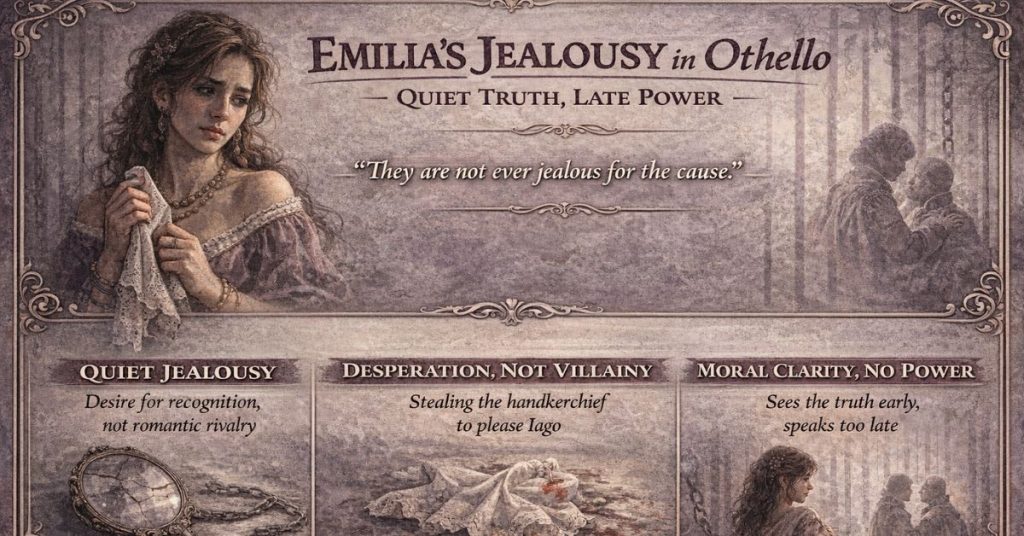
When I reach Bianca in class, I slow down. Her jealousy is quiet, dismissed, and painfully human. In a play of generals and villains, Bianca shows how love bruises those with the least power.
i) Bianca’s Love and Insecurity:
Let me recreate a classroom moment. I ask, “Who loves more here- Cassio or Bianca?” The answer is obvious and uncomfortable. Bianca does. And that imbalance is where her jealousy grows.
Bianca’s jealousy in Othello is not strategic or cruel. It’s emotional. She waits for Cassio. She worries when he disappears. And when he casually hands her Desdemona’s handkerchief, asking her to copy it, her hurt spills over: “This is some token from a newer friend.” That line matters. It’s not anger alone. It’s fear.
Why is Bianca angry with Cassio? Because he treats her love like a convenience. Cassio keeps her at a distance in public, yet expects devotion in private. Bianca senses she is replaceable, and jealousy becomes her alarm system.
In teaching this, I remind students: jealousy doesn’t always mean mistrust. It often means vulnerability exposed.
ii) Class-Based Jealousy and Social Power:
Now we zoom out. Bianca’s jealousy is sharpened by class. She is labeled, whispered about, and easily blamed. When chaos erupts, Cassio instantly pushes suspicion onto her: “Go to, woman! Throw your vile guesses in the devil’s teeth.” Watch how fast power speaks.
Bianca lacks social protection. Her jealousy is mocked because she is already judged. Unlike others, she cannot afford anger. It costs her credibility. That’s what makes her tragic.
I tell my students: Bianca isn’t dangerous because she’s jealous. She’s endangered because she’s powerless. Shakespeare uses her to show how love looks when society refuses to take you seriously.
In a play obsessed with reputation, Bianca loses hers simply by caring too much. And that, I think, is the quiet heartbreak we almost miss.
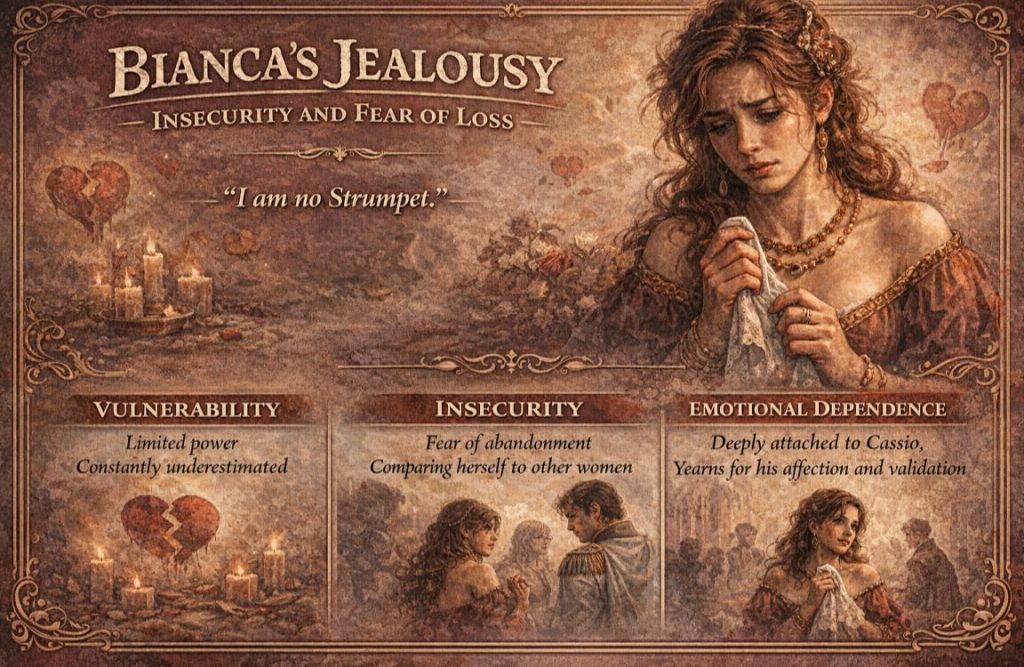
Roderigo’s Jealousy: Obsession Without Power
When I teach Roderigo, I call him jealousy without muscles. He has desire but no direction, emotion without authority. His envy burns loudly, yet it never builds, only bankrolls someone else’s scheme.
i) Romantic Jealousy Turned Obsession:
Let me stage this like a classroom confession. I ask, “Is this love, or fixation?” Roderigo answers without speaking. He is obsessed with Desdemona, not connected to her. His jealousy begins the moment she chooses Othello.
Why does Roderigo hate Othello? It’s because Othello represents the life Roderigo thinks he deserves: status, marriage, and admiration. When Desdemona marries the Moor, Roderigo feels robbed. His jealousy turns romantic disappointment into rage. He calls Othello a “thicklips,” revealing how envy quickly dresses itself in cruelty.
Roderigo’s jealousy in Othello is shallow but intense. He doesn’t love Desdemona’s mind or voice; he wants possession. Like a student who mistakes memorizing notes for understanding, Roderigo mistakes desire for devotion, and it ruins him.
ii) Why Jealousy Makes Roderigo Easy to Control:
Here’s the teaching moment: I never rush. Iago doesn’t force Roderigo. He guides him, because jealousy has already loosened the door.
Roderigo believes suffering earns reward. Every ducat he gives Iago feels like an investment in love. That’s the trap. Jealousy narrows his thinking until hope replaces logic. Iago feeds him promises, and Roderigo swallows them whole.
I tell my students: jealousy makes Roderigo useful. It strips him of judgment and turns him into a tool. He acts, not because plans make sense, but because emotion demands movement.
In the end, Roderigo isn’t evil. He’s empty. His jealousy gives him purpose, but never power. And Shakespeare reminds us: obsession doesn’t just break hearts. It hands control to whoever whispers next.
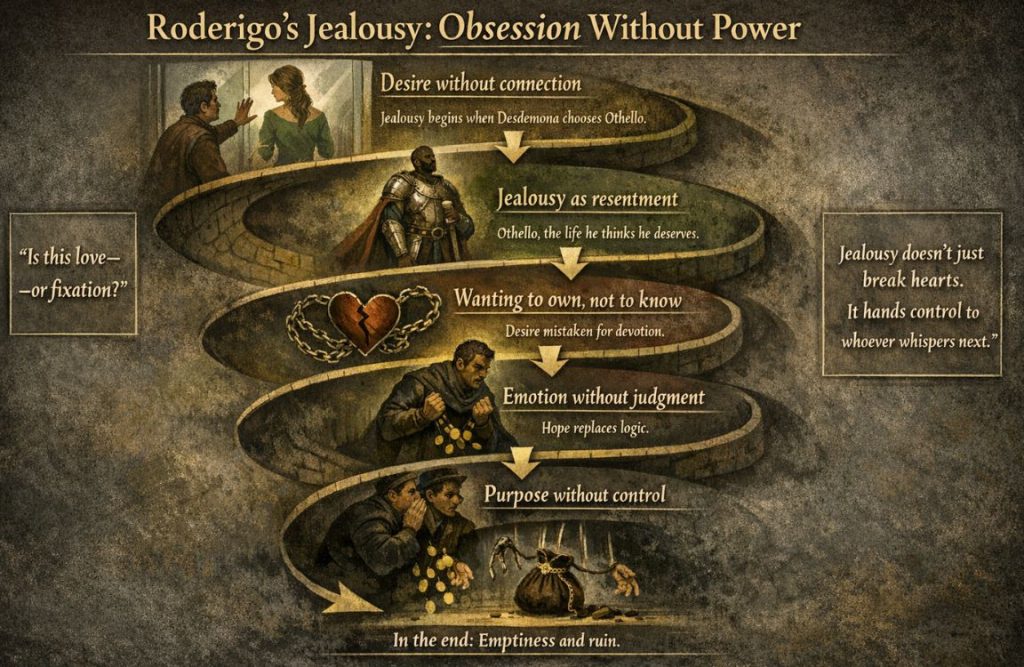
Emilia’s Jealousy in Othello
When I teach Emilia’s jealousy in Othello, I tell my students this isn’t the loud, explosive jealousy we see in Othello. This is quiet jealousy- the kind that sits, observes, and aches. Emilia isn’t jealous because she wants another woman’s love. She’s jealous because she wants recognition. A better life. A husband who notices her. And yes, that matters.
Here’s the live classroom moment: when Emilia steals the handkerchief, students gasp. I always say- this isn’t villainy. It’s desperation. She hopes, foolishly and heartbreakingly, that pleasing Iago might earn her a crumb of affection. Instead, she feeds the very monster she later names so clearly.
What makes Emilia tragic is her moral clarity trapped inside a patriarchal cage. She understands how men misuse jealousy, how women suffer in silence, yet she’s conditioned to obey. Her jealousy grows from neglect, misplaced loyalty, and emotional injustice. Emilia sees the truth early, but power arrives late. And in Shakespeare, late truth is the most dangerous kind.
Brabantio’s Jealousy in Othello Over Desdemona’s Loyalty
When I teach Brabantio from Othello, I tell my students to picture a father who has just realised the ground beneath him has shifted. His jealousy isn’t romantic. It’s territorial. What stings isn’t only Desdemona’s marriage, but the loss of authority.
The loyalty he once commanded has moved elsewhere, and to a man he sees as an outsider. I pause when he accuses Othello of witchcraft and ask the class, “Does this sound like evidence, or panic?”
When Brabantio warns, “She has deceived her father, and may thee,” I hear bruised pride masquerading as moral wisdom. He cannot imagine Desdemona choosing freely. Love beyond his control feels impossible. His jealousy exposes a patriarchal mindset where obedience passes for affection.
This outrage reflects racial anxiety as much as parental fear. Brabantio’s envy is the play’s first emotional crack- quiet, proud, and deeply dangerous, we can see.
Cassio’s Jealousy in Othello Toward His Lost Reputation
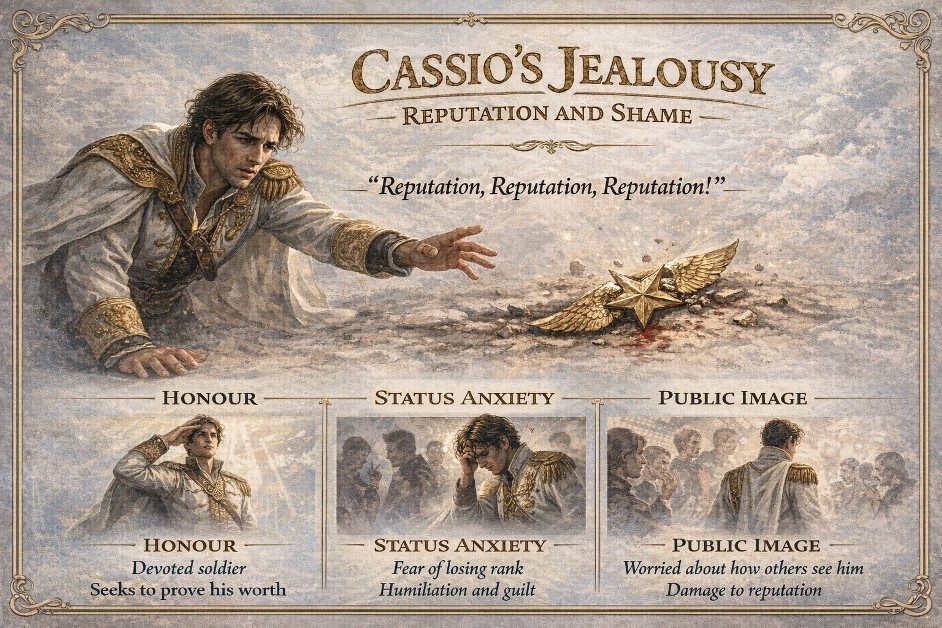
Cassio’s jealousy is softer, but it still aches. When he cries, “Reputation, reputation, reputation!” I always stop and let the words hang. He isn’t jealous of another man. He envies his former self. What he’s lost isn’t rank, but identity. Cassio measures his worth through Othello’s approval, so demotion feels like erasure.
I tell my students this is jealousy turned inward: pride grieving its own reflection. Cassio’s pain comes less from guilt than wounded self-esteem. His envy never destroys others, but it quietly dismantles him.
How Does Shakespeare Present the Theme of Jealousy in Othello
When I teach jealousy in Othello, I tell my students this: Shakespeare doesn’t describe jealousy. He stages it. He lets us hear it, see it, and feel it tightening around the characters until it becomes impossible to escape.
i) Language and Imagery of Jealousy:
Let’s begin with the words themselves. Shakespeare gives jealousy a voice long before it has proof. Iago famously warns Othello of the “green-eyed monster which doth mock / The meat it feeds on.” I pause here in class. A monster that laughs while eating you? That image alone should set off alarms.
This is how jealousy is presented in Othello: not as a feeling, but as a living thing. It “gnaws,” “feeds,” and “works.” The language is active, restless, predatory. Even before Othello believes anything, jealousy has already learned how to speak in his ear.
I tell my students: notice how calm the sentences look, and how violent they feel. Shakespeare knows jealousy doesn’t shout at first. It whispers politely, using beautiful metaphors, until it sounds reasonable. That’s what makes it dangerous.
ii) Dramatic Irony and Audience Awareness:
Here’s where Shakespeare turns us into uncomfortable witnesses. We know Iago is lying. But Othello doesn’t. And that gap, that cruel space between knowledge and ignorance, is where jealousy thrives.
Every time Iago says, “I speak not yet of proof,” my classroom groans. We want to shout, Don’t listen! But Shakespeare won’t let us interfere. Instead, he makes us watch jealousy unfold in slow motion.
This dramatic irony teaches a sharp lesson: jealousy doesn’t need facts when fear is already in control. Othello trusts the wrong voice because we, the audience, are forced to hear both sides. Shakespeare makes us complicit. We understand how jealousy works, even as we hate it.
I often tell my students: This is emotional suspense, not action. The tragedy grows not through events, but through belief.
iii) Symbols: Poison, Disease, Animals, Darkness
Now let’s talk symbols, Shakespeare’s visual shortcuts to emotion. Jealousy is repeatedly linked to poison. Iago promises to “pour this pestilence into his ear.” No swords. No bruises. Just words, administered like venom.
Then comes disease. Jealousy “infects,” “spreads,” and “consumes.” It behaves like an illness that begins unseen and ends fatally. By the time symptoms appear, it’s already too late.
Animal imagery lowers human behavior to instinct. Characters are described as goats, monkeys, and beasts, suggesting jealousy strips away reason and dignity. When jealousy takes over, people stop thinking like humans and start reacting like creatures.
And finally, darkness. Scenes of jealousy are filled with night, shadows, and blindness. Othello repeatedly loses “light,” both literal and moral. In class, I say: jealousy hates clarity. It prefers half-seen gestures and misunderstood silences.
So, how is jealousy presented in Othello? As a monster, a poison, a disease, and a darkness, all working together. Shakespeare doesn’t argue that jealousy destroys. He shows it happening, step by step, until we can’t look away. And that, I tell my students, is why the play still hurts.
Jealousy in Othello by Act
When I track jealousy in Othello, act by act, with my students, it feels like watching a slow chemical reaction: invisible at first, then bubbling, then, suddenly, dangerously explosive before anyone can step back.
i) Act 1: The Seeds of Jealousy
When we open jealousy in Othello Act 1, I tell my class, “Relax, Othello isn’t jealous yet.” And they look confused. But that’s the point. Shakespeare plants jealousy quietly, as a rumor whispered behind a classroom door. Iago doesn’t accuse. He suggests.
His warning, “I am not what I am, is my cue to pause and look up at my students. This is emotional foreshadowing. Othello still trusts, still loves, still believes.
Yet jealousy is already stretching its roots underground, fed by insecurity, outsider status, and Iago’s casual poison. Nothing explodes here, but something has definitely been planted.
ii) Act 2: Manipulation Takes Root
By jealousy in Othello, Act 2, I can almost see my students leaning forward. This is where jealousy learns how to walk. Iago sharpens his tactics, staging scenes like a crooked director. Cassio’s demotion becomes the perfect prop, and I remind my class: jealousy thrives on half-truths.
When Iago says, “Men should be what they seem,” I usually hear a nervous laugh. They know better now. Othello begins trusting Iago’s interpretations more than his own experience. Jealousy isn’t loud yet, but it’s learning how to sound convincing.
iii) Act 4: Jealousy Explodes
Then comes jealousy in Othello, Act 4, and the room always goes quiet. This is jealousy fully grown- irrational, humiliating, and cruel. Othello collapses, strikes Desdemona, and speaks in broken images.
I point to his language and say, “Look, his mind is fractured.” The man who once reasoned calmly now reacts like a storm with no pause button. Jealousy has rewritten his identity. At this moment, Shakespeare forces us to confront an uncomfortable truth: jealousy doesn’t just hurt others. It dismantles the self.
Key Quotes About Jealousy in Othello (With Analysis)
When my students ask for jealousy quotes in Othello, I tell them this: Shakespeare doesn’t decorate jealousy. He weaponizes it. These quotes about jealousy in Othello aren’t ornaments; they’re pressure points that reveal how minds unravel.
1. “O, beware, my lord, of jealousy! / It is the green-eyed monster which doth mock / The meat it feeds on.” (Act 3, Scene 3)- Iago
This is the line my students never forget, and for good reason. Iago gives jealousy a face, a personality, and a warning label, all while secretly unleashing it. The genius lies in the irony: he pretends to protect Othello from jealousy while actively feeding it. Shakespeare shows us that jealousy often enters disguised as concern, not accusation.
2. “Trifles light as air / Are to the jealous confirmations strong / As proofs of holy writ.” (Act 3, Scene 3)- Iago
When I teach this quote, I tell my class it’s Shakespeare’s psychology lesson. Jealousy doesn’t need facts. It creates them. Once suspicion exists, even the smallest detail feels like sacred truth. This perfectly explains why the handkerchief matters so much. Jealousy doesn’t sharpen judgment. It lowers the standard of proof until anything will do.
3. “But jealous souls will not be answered so; / They are not ever jealous for the cause, / But jealous for they are jealous.” (Act 3, Scene 4)- Emilia
I always pause here and say, “Listen- this is clarity.” Emilia exposes jealousy as self-generating. It doesn’t need evidence, logic, or reason. This line is powerful because it comes from outside Iago’s manipulation. Shakespeare lets Emilia diagnose jealousy as a habit of mind, not a reaction to wrongdoing- making it feel disturbingly familiar.
4. “Villain, be sure thou prove my love a whore… / Give me the ocular proof.” (Act 3, Scene 3)- Othello
This is the moment I circle in red on the board. Othello thinks he’s being rational, but jealousy is already in charge. His demand for “ocular proof” sounds logical, yet it shows fear masquerading as reason. I remind students: when jealousy speaks, it often borrows the language of justice to justify cruelty.
5. “Yet she must die, else she’ll betray more men.” (Act 5, Scene 2)- Othello
This line is chilling because jealousy has fully rewritten morality. Othello believes murder is mercy. I tell my students this is jealousy’s final form- not rage, but certainty. He no longer doubts. He decides. Shakespeare’s warning is brutal and clear: when jealousy replaces judgment, love turns lethal, and tragedy becomes inevitable.
Jealousy and the Tragedy of Othello
When I step back with my students and ask why Othello ends in tragedy, the answer isn’t fate or villains alone. It’s jealousy, quietly reshaping judgment, until love, reason, and mercy collapse under its weight.
i) Jealousy as Othello’s Tragic Flaw:
When we discuss jealousy as a tragic flaw in Othello, I tell my class to forget the stereotype of the hot-headed hero. Othello’s flaw isn’t anger. It’s credulity under pressure. He values honor, reputation, and certainty, and jealousy slips in by promising all three.
I point to his desperate demand for “ocular proof,” and pause the lesson. This isn’t logic. It’s fear wearing logic’s coat. Othello cannot sit with doubt. Jealousy exploits that impatience, convincing him that swift judgment equals strength. In tragedy terms, this is textbook hamartia: a noble quality, decisiveness, tilted just enough to become destructive.
I tell my students, “Shakespeare doesn’t ruin Othello with evil. He ruins him with urgency.” Jealousy narrows his vision until the world feels simple again, and tragically wrong.
ii) From Moral Collapse to Death:
Now we trace how jealousy leads to tragedy in Othello, and the room always grows still. Jealousy doesn’t push Othello off a cliff. It dismantles the guardrails first. His moral language changes- justice replaces compassion, certainty replaces listening.
When he insists he must act to preserve honor, I ask my students to underline the irony. Jealousy convinces him that love must be policed. By the time truth surfaces, the damage is irreversible, not because Othello lacks feeling, but because he has already surrendered mercy.
His final speeches matter here. He tries to tell his story carefully, as if words can restore balance. I tell my class this is Shakespeare’s final lesson: tragedy isn’t just death. It’s the moment you realize too late that your values were hijacked. Jealousy doesn’t kill Othello’s love first. It kills his judgment. And once that’s gone, the tragedy writes itself.
How to Write an Essay on Jealousy in Othello
When exams loom, I remind my students that markers don’t want panic. They want clarity. A strong essay on jealousy in Othello shows confident thinking, smart structure, and precise quotation, not a desperate retelling of the plot.
i) How to Structure a Jealousy Essay
This is where I do my “board choreography” in class. Introduction first: define jealousy and state how it operates in the play- psychologically, morally, or socially. Then build clear paragraphs, each driven by one idea.
For A Level or GCSE, I suggest a simple rhythm: point, evidence, analysis, link. Drop in short quotes, “ocular proof” or “beware… jealousy”, and unpack the language. I tell them, “Quotes are seasoning, not the whole meal.”
Finish with a conclusion that zooms out to tragedy, not plot. Examiners love seeing the big picture.
ii) Planning Strong Arguments
When teaching how to plan an essay on jealousy in Othello, I ban highlighters for five minutes. Instead, we brainstorm arguments, not scenes. Ask: What does jealousy do to judgment, language, or power?
Choose two or three angles and commit. I remind them that strong essays argue, they don’t narrate. A sharp plan saves time and keeps analysis focused, especially under exam pressure.
iii) Common Student Mistakes to Avoid
Here’s my gentle warning list. Don’t summarise the story. Don’t blame only one character without analysis. Don’t drop long quotes and run. And please, don’t forget context.
For GCSE, clarity beats complexity every time. I tell my class, “If your argument is clear enough to explain aloud, it’s strong enough to write.”
Conclusion:
When the play closes, I always tell my students this: the theme of jealousy in Othello isn’t about suspicion alone. It’s about corrosion. Jealousy eats away at trust, language, and judgment until nothing solid remains. It turns love into evidence, loyalty into surveillance, and doubt into certainty.
Shakespeare’s final warning feels painfully clear: jealousy doesn’t need truth to survive. It only needs fear. Othello’s tragedy reminds us that once jealousy takes control, it doesn’t just target others. It dismantles the self.
And that, I tell my class, is why jealousy is never a small emotion. It destroys everything it touches, including the person who believes they are using it to protect themselves.