The first time I taught Act 5 of Othello, the classroom went strangely quiet. No one joked. No one checked their phones. Because Shakespeare does something terrifying in the final moments, he turns jealousy into a weapon that destroys love itself.
Students often ask me, “Does Othello die too, or only Desdemona? And if yes, how does Othello die?” And honestly, that question matters because Othello’s ending is not just about murder. It is about guilt arriving too late, like a fireman after the house has already burned down.
By the end of the play, Desdemona is dead, Emilia exposes the truth, and Othello finally understands that he was manipulated by Iago from the very beginning. That realization crushes him emotionally and spiritually.
So yes, Othello dies, but the way he dies reveals the full tragedy of Shakespeare’s heartbreaking ending.
Table of Contents
Does Othello Die?
YES, Othello dies at the end of Shakespeare’s Othello. After realizing he wrongly killed Desdemona because of Iago’s manipulation, Othello kills himself in Act 5, Scene 2 beside Desdemona’s body. His death comes from overwhelming guilt, shame, and horror after discovering Desdemona was innocent all along.
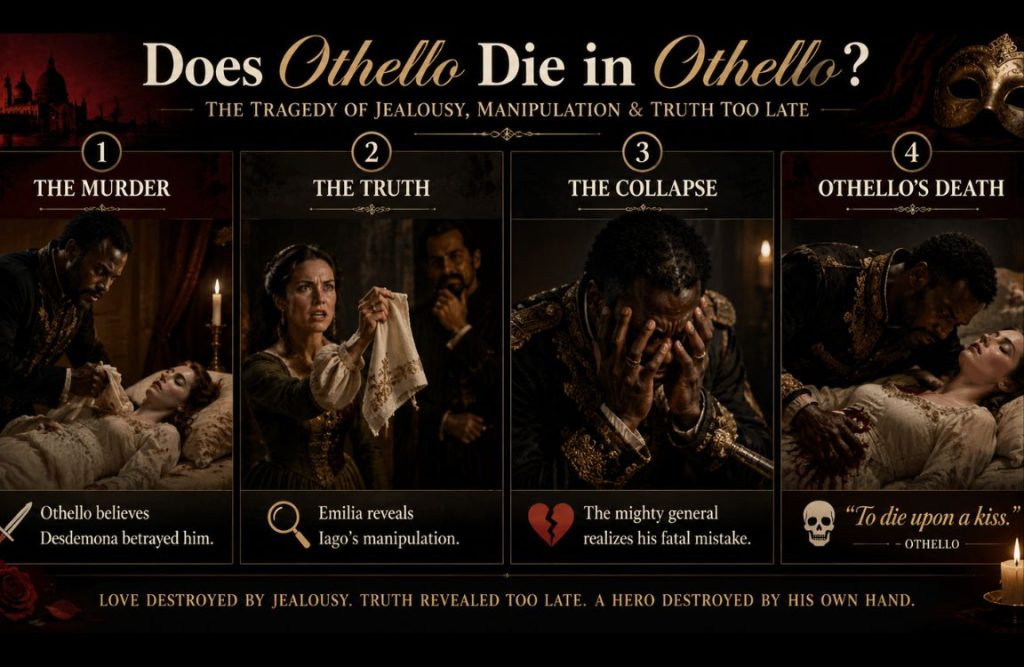
Whenever students ask me whether Othello dies in the end, I tell them Shakespeare gives us a tragedy where the hero becomes both executioner and victim. Othello first murders Desdemona, believing she betrayed him with Cassio.
But moments later, Emilia reveals the truth about the handkerchief and exposes Iago’s lies. Suddenly, the confident general collapses emotionally.
This is why Othello’s death feels so devastating. He does not die in battle like a glorious soldier. Instead, he dies broken by his own mistake. Shakespeare carefully turns the mighty warrior into a man destroyed by jealousy and manipulation.
In Act 5, Scene 2, Othello stabs himself after giving his final speech. He falls beside Desdemona and dies kissing her. That final image is painfully ironic: the man who claimed to love her most becomes the very cause of her death.
How Does Othello Die in the Play?
By the final scene, Othello is emotionally shattered. The proud military hero who once controlled armies can no longer control his own guilt, and Shakespeare lets that emotional collapse lead directly to his tragic death.
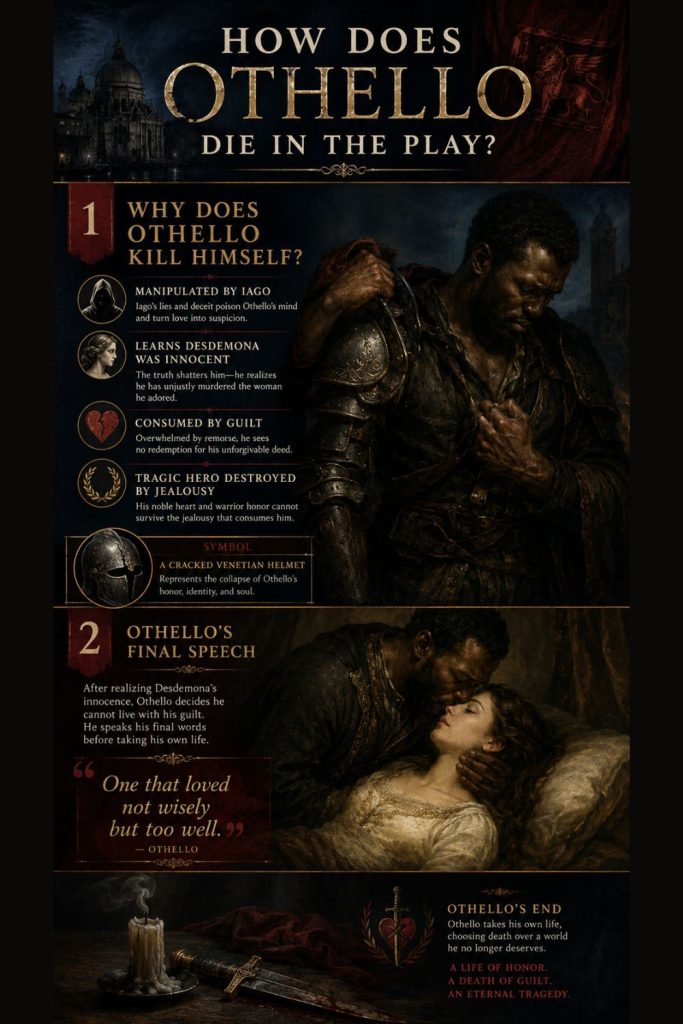
i) Why Does Othello Kill Himself?
Othello kills himself because he finally realizes that Iago manipulated him into murdering an innocent woman. When Emilia reveals the truth about the handkerchief, the illusion breaks instantly.
In class, I often compare this moment to someone waking from a nightmare only to discover the damage is real. Desdemona is gone, and no apology can revive her.
The tragedy is not simply that Othello was jealous. The deeper tragedy is that he trusted suspicion more than love. That flaw transforms him into what Aristotle would call a tragic hero— a great man destroyed by a fatal weakness.
His suicide becomes a form of self-punishment. Othello believes he deserves death because he betrayed both Desdemona and his own moral honor. Shakespeare shows that guilt can become heavier than armor, and Othello can no longer carry it.
ii) Othello’s Final Speech Before Death
Before dying, Othello delivers one of Shakespeare’s most emotional final speeches. He asks others to remember him as “one that loved not wisely but too well.” Every year, students pause at that line because it sounds both honest and heartbreaking. Othello admits he loved deeply, but his love lacked wisdom, trust, and balance.
His speech also shows a desperate attempt to recover some honor before death. He reminds everyone of his past bravery and service, almost like a fallen king trying to gather the broken pieces of his identity. Yet Shakespeare does not let him fully escape responsibility. The blood of Desdemona still shadows every word.
Then comes the devastating ending: Othello kisses Desdemona and says, “to die upon a kiss.” He stabs himself and dies beside her. Love and death finally meet in the same tragic moment.
What Happens in Othello, Act 5, Scene 2?
Act 5, Scene 2 is Shakespeare’s emotional explosion. Secrets collapse, innocence is destroyed, and truth arrives too late to save anyone. It is the moment when jealousy stops whispering and starts killing.
i) How Does Othello Kill Desdemona?
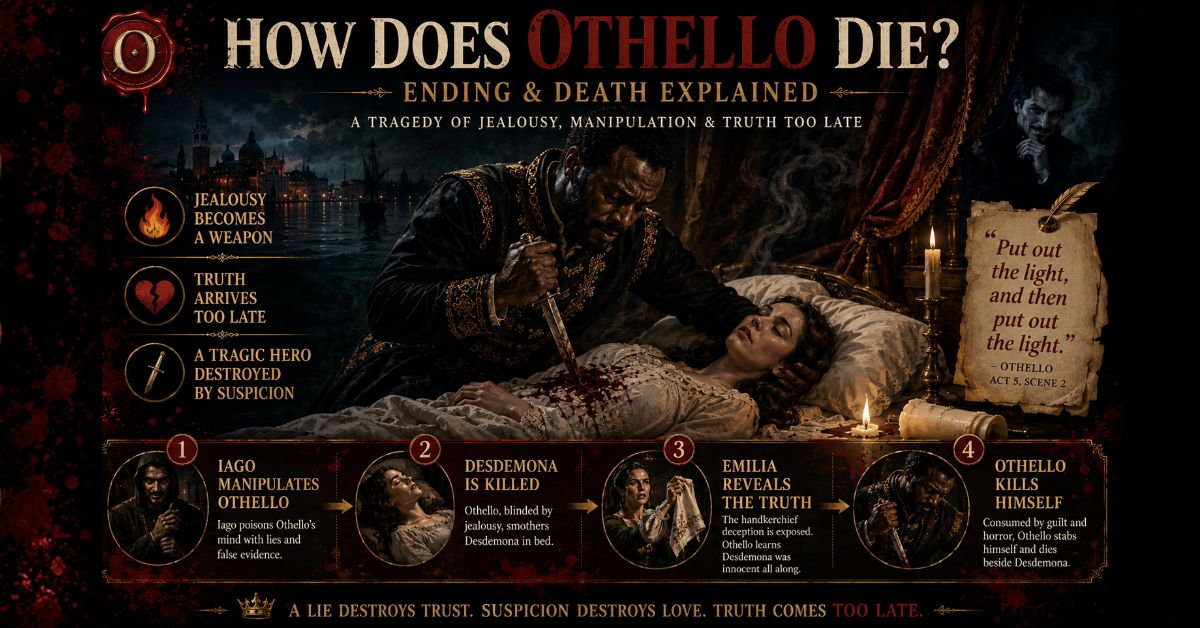
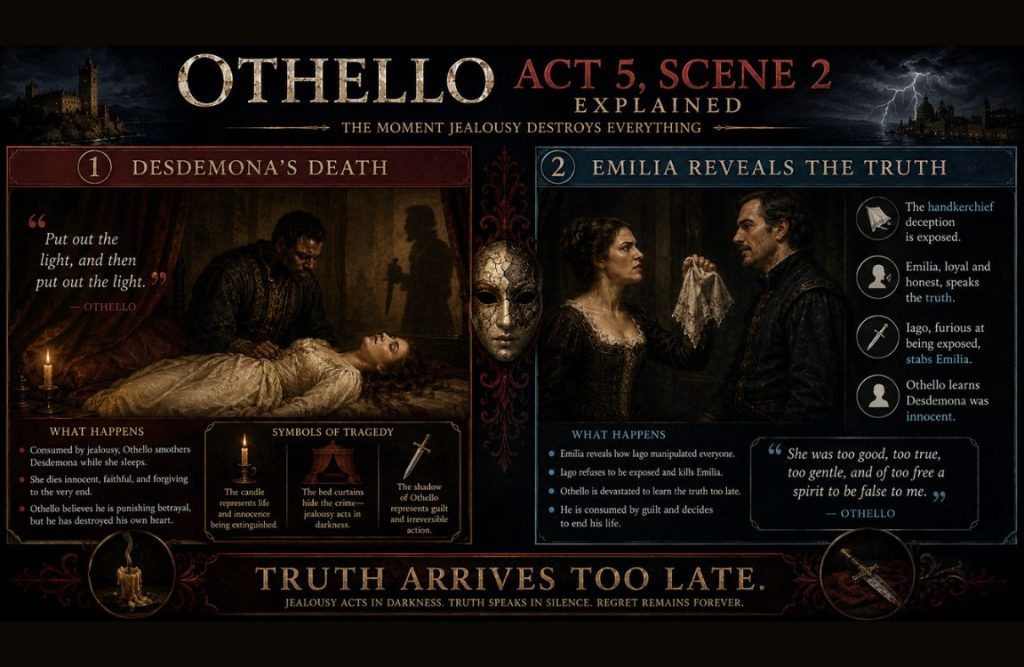
Othello kills Desdemona by smothering her in bed during Act 5, Scene 2. Before the murder, he says the haunting line, “Put out the light, and then put out the light.”
I always tell my students that Shakespeare uses the candle as a metaphor here. Blowing out a candle is easy; restoring its flame is harder. Human life works the same way.
Othello believes Desdemona betrayed him with Cassio because Iago poisoned his mind with lies and false evidence. Desdemona, however, remains innocent until the very end. Even while dying, she tries to protect Othello instead of blaming him. That detail shocks many readers because her love survives longer than his trust.
The murder scene feels painfully intimate rather than heroic. Shakespeare traps the audience inside a bedroom where jealousy destroys tenderness. The warrior who once defended Venice becomes the destroyer of his own happiness.
ii) Emilia Reveals the Truth Too Late
After Desdemona’s death, Emilia enters the room and uncovers the horrifying truth about the handkerchief. She reveals that she gave it to Iago without knowing he planned to use it against Desdemona. Suddenly, the entire deception becomes clear.
In one of the bravest moments in the play, Emilia openly accuses Iago of manipulation and lies. I often remind my students that Emilia becomes the moral voice of the ending because she chooses truth even when it endangers her life. Tragically, Iago responds by killing her to silence her revelation.
At that moment, Othello finally understands his terrible mistake. The realization destroys him emotionally. Desdemona was faithful, innocent, and loving all along. But Shakespeare’s tragedy offers no rescue at the final hour. Truth arrives, yet it arrives carrying a coffin.
Who Dies in Othello?
By the end of Othello, Shakespeare leaves the stage crowded with death, guilt, and silence. Desdemona is murdered by Othello after Iago convinces him she was unfaithful.
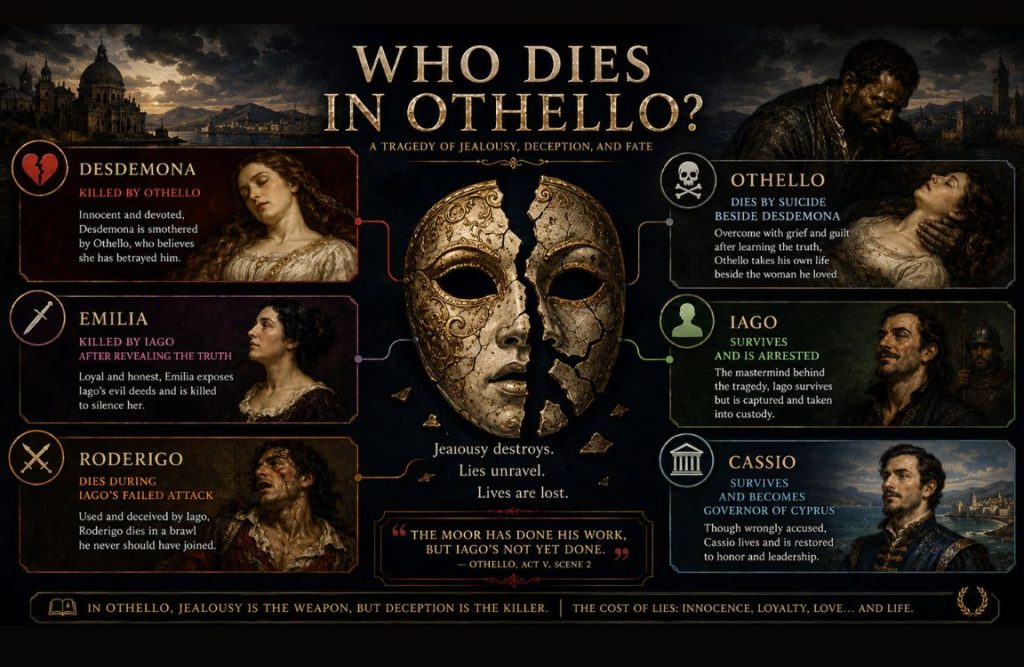
Emilia then exposes the truth about the handkerchief and is stabbed by Iago for revealing his lies. Roderigo also dies during Iago’s failed attack on Cassio, becoming yet another victim of manipulation.
Meanwhile, Iago survives but is arrested and taken away for punishment, while Cassio survives his injuries and becomes governor of Cyprus after Othello’s death.
I often tell students the Othello ending feels like a storm finally passing, only to reveal the wreckage underneath. Shakespeare closes the tragedy by showing how jealousy destroys not just one life, but nearly everyone caught inside its shadow.
Why Is Othello’s Death So Tragic?
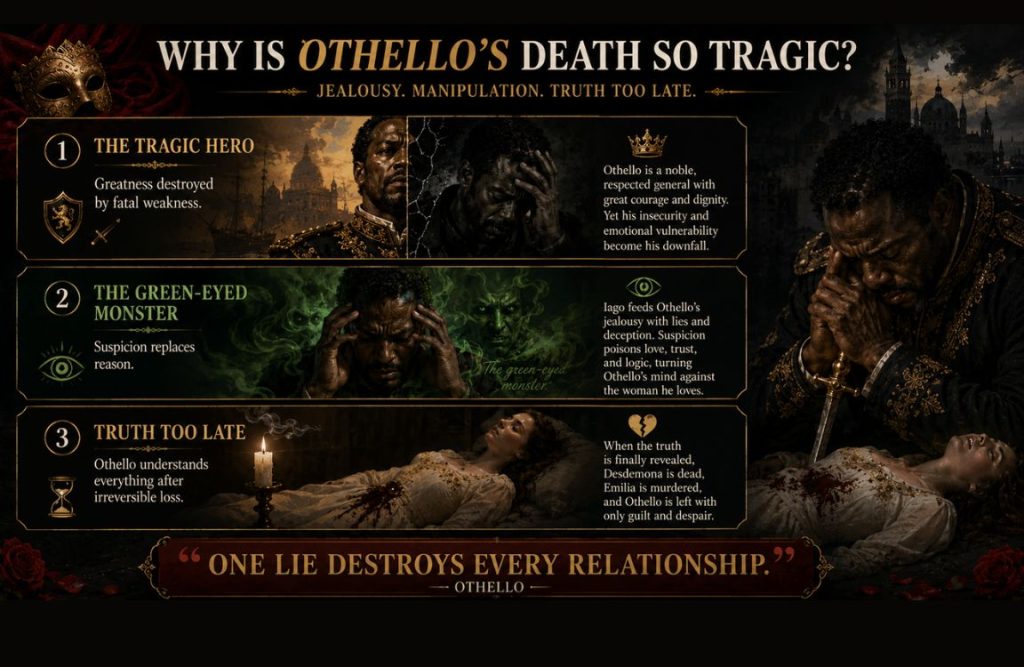
Othello’s death feels tragic because understanding reaches him only after everything is lost. By the end of the play, Desdemona is dead, Emilia is murdered for telling the truth, and Othello is forced to confront the damage caused by his own jealousy.
i) Othello as a Tragic Hero
Othello is considered a tragic hero because he begins as a noble and respected man, but falls because of his fatal flaw. In Aristotle’s sense, he possesses greatness, courage, and dignity. Yet beneath that strength hides insecurity and emotional vulnerability.
When I teach this play, I compare Othello’s mind to a magnificent fortress with one cracked gate. Iago finds that weakness and slips through it with poisonous whispers. Jealousy slowly replaces reason, and suspicion overwhelms trust.
What makes the tragedy powerful is that Othello is not naturally evil. He genuinely loves Desdemona. However, his inability to balance emotion with judgment destroys him. Shakespeare reminds us that heroic qualities alone cannot save someone whose fears begin steering the mind like a reckless captain during a storm.
ii) Shakespeare’s Warning About Jealousy
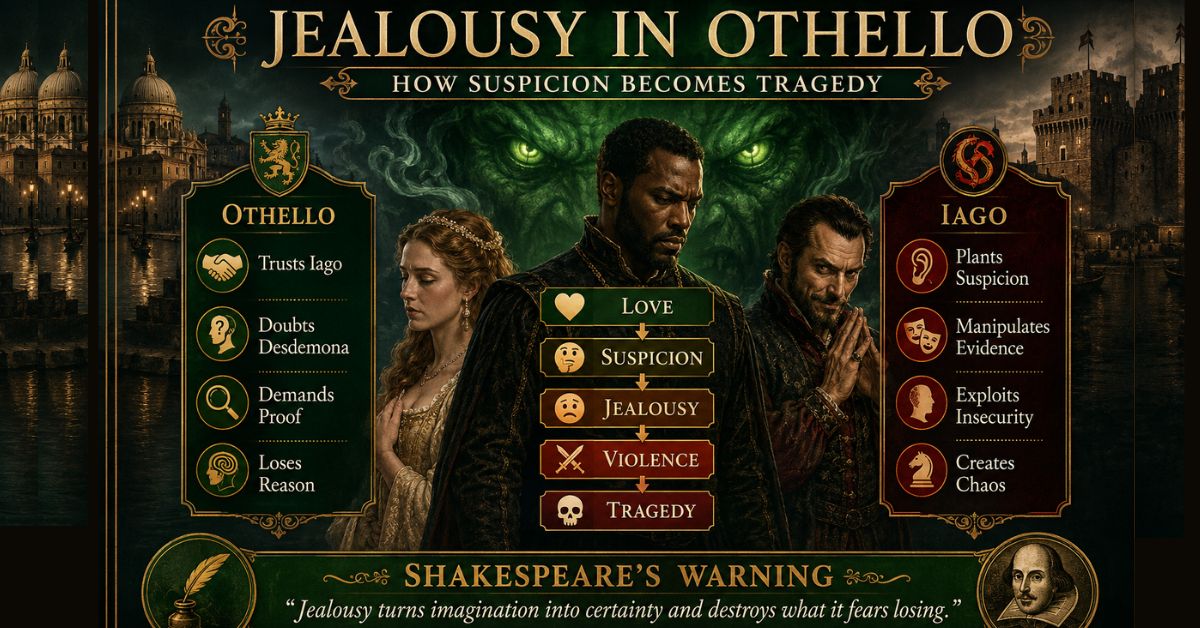
Shakespeare presents jealousy in Othello as a destructive force that poisons love, trust, and logic. Iago even calls it the “green-eyed monster,” and honestly, that metaphor still feels painfully accurate today. Jealousy feeds on imagination more than facts.
The tragedy grows through dramatic irony because the audience knows Desdemona is innocent while Othello believes the opposite. That gap between truth and belief creates unbearable tension.
In many classrooms, students blame only Iago, but Shakespeare’s warning is deeper than one villain. Manipulation succeeds when trust collapses. Once suspicion replaces communication, love begins suffocating long before any character physically dies.
FAQs:
What is Othello’s fatal flaw?
Othello’s fatal flaw is his jealousy mixed with insecurity. Although noble and intelligent, he trusts Iago’s manipulation too easily. His inability to balance emotion with reason ultimately destroys his marriage, reputation, and life.
Why does Iago hate Othello so much?
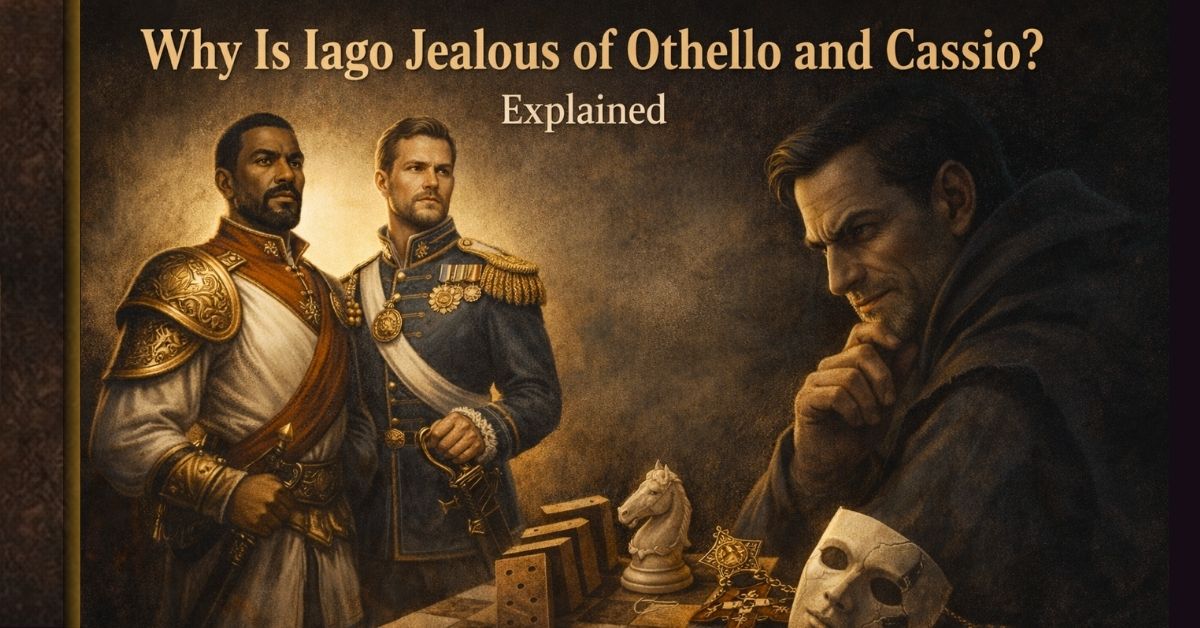
Iago hates Othello because he resents being passed over for promotion and suspects Othello of sleeping with his wife. Shakespeare also suggests Iago enjoys manipulation itself, making his hatred disturbingly personal and psychologically complex.
What does “Put out the light” mean in Othello?
“Put out the light” refers both to extinguishing a candle and ending Desdemona’s life. Shakespeare uses the metaphor to show how easily life can be destroyed, while reminding audiences that innocence cannot simply be restored afterward.
Is Othello based on a true story?
Othello is not directly based on a true story. Shakespeare adapted it from an Italian tale by Giraldi Cinthio. However, the emotions, jealousy, and manipulation feel painfully realistic even centuries later.
Why is Othello considered a tragedy?
Othello is considered a tragedy because a noble hero falls from greatness due to a fatal flaw. The play ends with death, suffering, and irreversible loss, while truth arrives only after innocent lives are destroyed.
Conclusion
Yes, Othello dies by suicide at the end of Othello, but Shakespeare makes his death far more than a shocking finale. It becomes the tragic result of jealousy, manipulation, and truth discovered too late.
After learning Desdemona was faithful, innocent, Othello can no longer live with the guilt of murdering the woman he deeply loved.
What always strikes my students is how quickly trust collapses once doubt enters the mind. One lie from Iago grows like poison through every relationship in the play, leaving Desdemona, Emilia, Roderigo, and finally Othello dead.
The ending feels heartbreaking because the tragedy could have been avoided with honesty, patience, and trust.
Want more simple but deep Shakespeare explanations? Explore our character analyses of Othello.