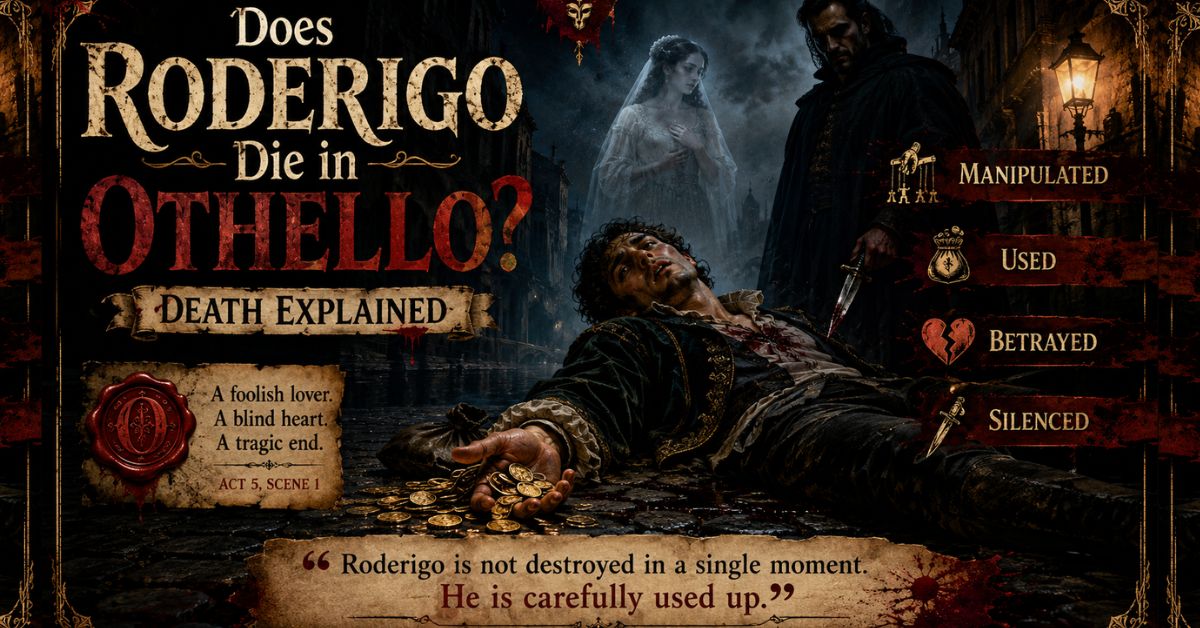
“Roderigo begins as a foolish lover, but Shakespeare slowly darkens him into one of the play’s quietest tragedies.” Whenever my students ask, “Does Roderigo die in Othello?” I pause for a moment because the answer is simple, but the meaning is not.
Yes, he dies. But what happens to Roderigo in Othello is not just a death. It is the gradual collapse of a man who mistakes illusion for love.
I often tell my class: Roderigo is not destroyed in a single moment. He is carefully used up. His wealth, his trust, and even his courage are borrowed by Iago and never returned. And when his usefulness ends, so does his life.
But here’s the unsettling truth: Roderigo’s death reveals Iago’s darkest betrayal, and perhaps Shakespeare’s sharpest warning.
Does Roderigo Die in Othello?
Yes, Roderigo is killed in Othello, and he is killed not by an enemy, but by the very man he trusts most: Iago. If you’re wondering, does Roderigo die in Othello? The answer is clear and tragic. He is murdered in Act 5, Scene 1.
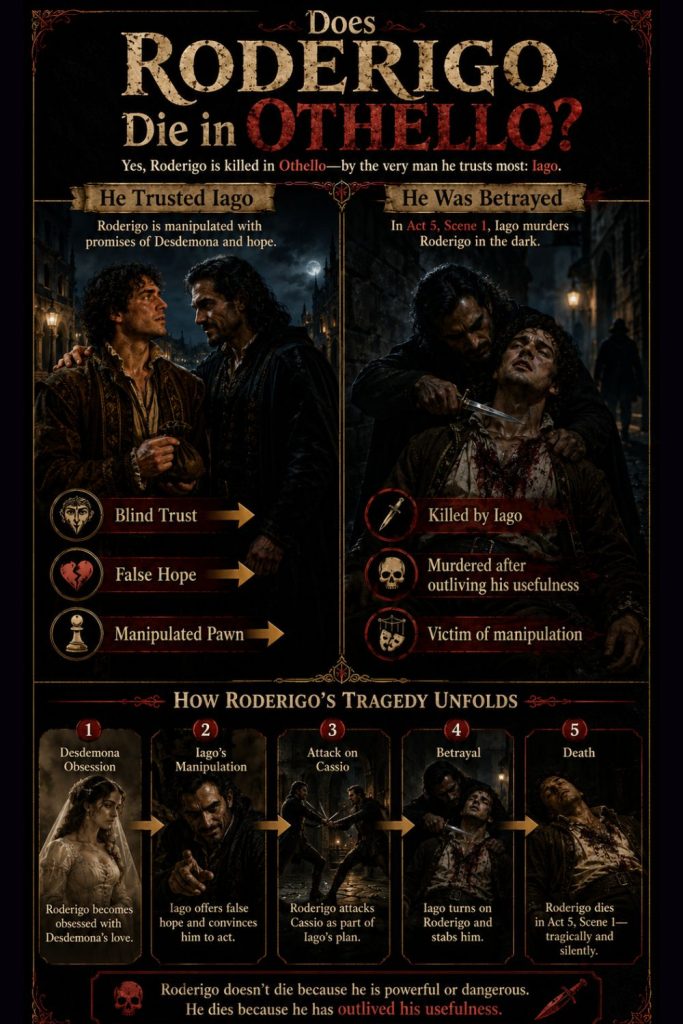
In live class, I like to frame it this way: Roderigo doesn’t die because he is powerful or dangerous. He dies because he has outlived his usefulness. Iago, ever the strategist, sees him not as a person but as a disposable tool. Once Roderigo begins to question him, his fate is sealed.
This moment is not isolated. It connects directly to the wider tragedy. His death exposes how manipulation operates at its most ruthless level: not just deceiving others, but erasing them when they become inconvenient.
In that sense, Roderigo’s end is both personal and symbolic, a quiet but chilling step toward the play’s catastrophic conclusion.
Table of Contents
How Does Roderigo Die in Othello?
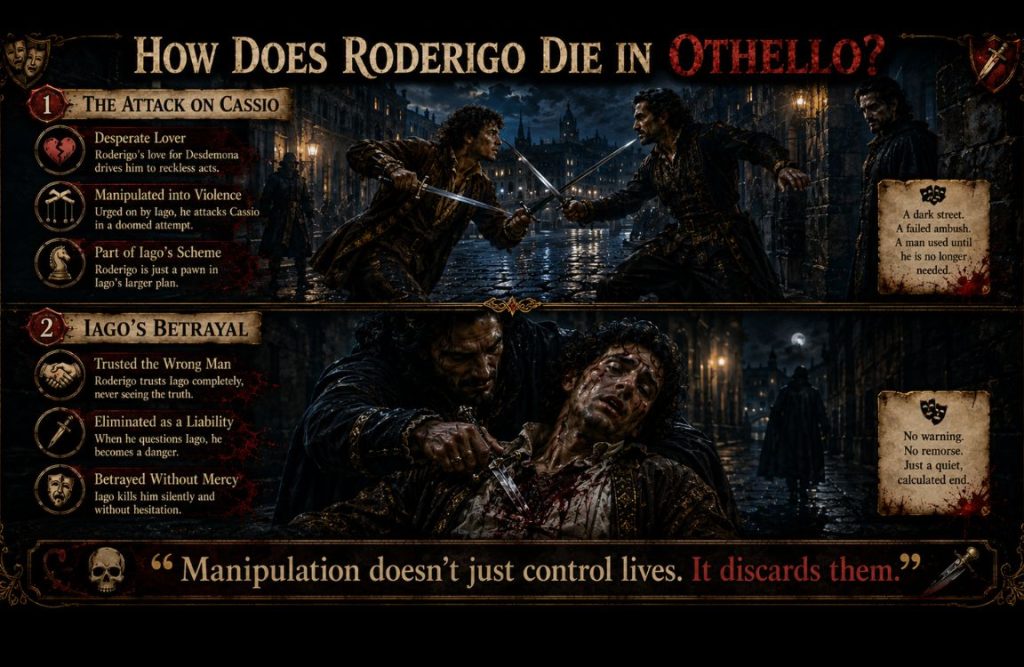
Roderigo’s death unfolds with brutal irony in Othello. During the failed ambush on Cassio, he is first wounded in the chaos, then secretly stabbed by Iago, the very man he trusted most. What begins as part of Iago’s scheme quickly becomes an execution designed to silence him forever.
i) The Attack on Cassio
Picture the scene as I describe it in my class (you can see it in the above image): a dark street, tension thick as fog, and Roderigo stepping into a role he is not built for. Urged on by Iago, he attempts to ambush Cassio. But here’s the tragic irony. Roderigo is no villain, no skilled fighter. He is a desperate lover playing a part written by someone else.
His attack is clumsy, uncertain, almost hesitant. Cassio fights back, and the situation quickly spirals out of control. What fascinates me is how Shakespeare crafts this moment: Roderigo is both attacker and victim at once. He believes he is advancing his love for Desdemona, yet he is actually stepping deeper into Iago’s trap.
In that confusion, we begin to see it clearly. Roderigo is not acting freely; he is being directed.
ii) Iago’s Betrayal
And then comes the moment I always emphasize to my students, the betrayal. As chaos unfolds, Iago enters, not as a rescuer, but as a silent executioner. He wounds Cassio publicly, but what he does next is far more revealing.
He turns on Roderigo. Quietly. Efficiently. Without hesitation.
I often ask: Why kill a man who trusts you completely? The answer is chilling, because trust, for Iago, is merely a tool. Roderigo has served his purpose. Worse, he has started to doubt. That makes him dangerous.
So Iago eliminates him, as one would erase a mistake. There is no grand speech, no dramatic confrontation— just a swift, calculated act. And in that quiet violence, Shakespeare shows us the true depth of manipulation: it doesn’t just control lives. It discards them when they are no longer useful.
When and in What Scene does Roderigo die in Othello?
Students often ask me when Roderigo meets his end in Othello, and the answer takes us to one of the play’s most tense and shadow-filled moments: Act 5, Scene 1.
Set at night, the scene feels almost theatrical in its darkness. I tell my class to imagine it like a stage where truth hides in shadows. You can look through your eyes at the image.
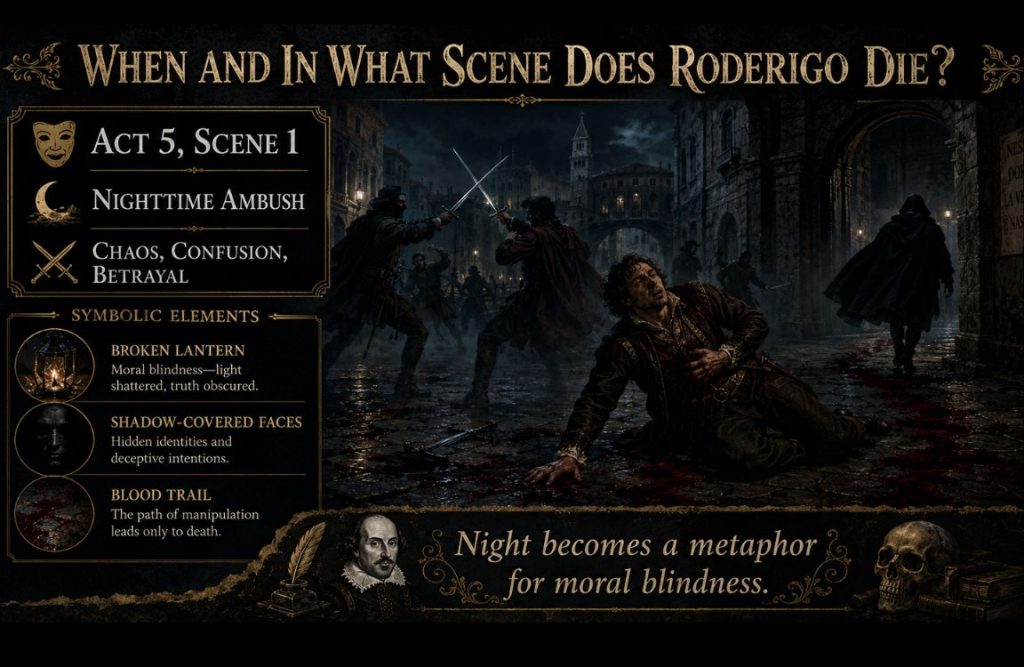
Nothing is fully visible- intentions, identities, even loyalties blur. This is where Roderigo’s fate unfolds.
The confusion is deliberate. Cries are heard, swords clash, and characters misread what is happening around them. In this chaos, Iago thrives. He manipulates the situation so skillfully that even violence appears accidental.
Roderigo’s death, then, is not just about timing. It is about setting. Night becomes a metaphor for moral blindness. And in that darkness, a man who failed to see clearly in life meets his end without ever fully understanding why.
Why Does Iago Kill Roderigo?
If we ask why Iago kills Roderigo, the answer lies in control. By the final stages of Othello, Roderigo is no longer a useful pawn; he is becoming a dangerous witness. Iago has manipulated him with promises of Desdemona, drained his money, and pushed him into reckless actions.
But eventually, Roderigo begins to question the deception. And in a tragedy built on manipulation, awareness becomes a threat.
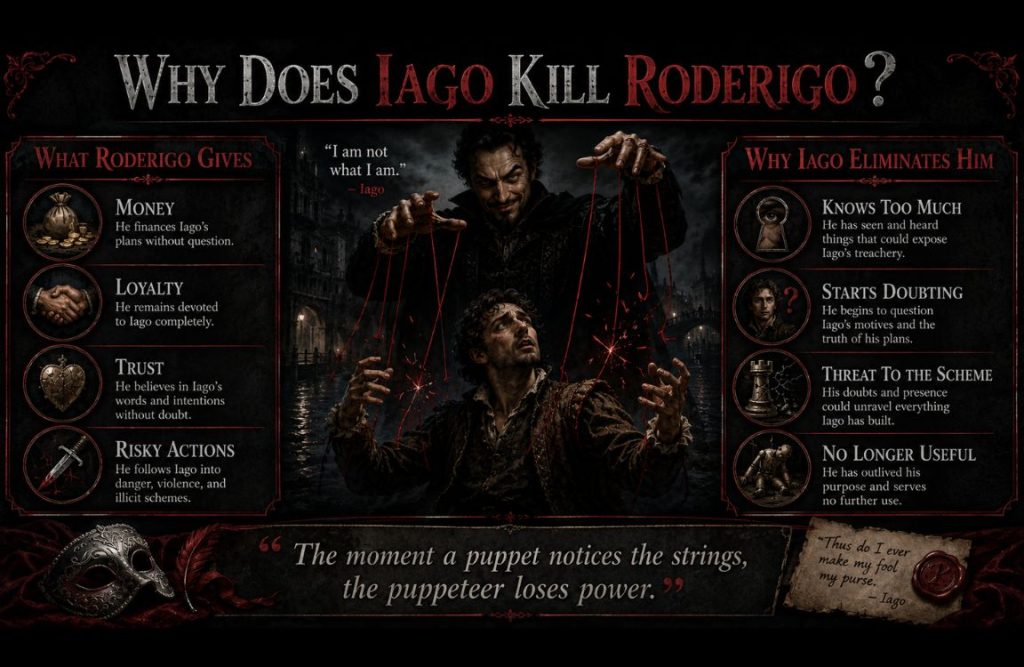
I often tell my students: the moment a puppet notices the strings, the puppeteer loses power. Roderigo starts realizing that he has sacrificed his wealth, reputation, and dignity for an illusion. His growing suspicion creates a crack in Iago’s carefully controlled scheme. At this point, Iago no longer sees him as valuable. He sees him as a liability.
What makes this moment especially disturbing is Iago’s cold efficiency. He does not kill Roderigo out of passion or anger. He eliminates him strategically. Roderigo knows too much about the plot and could expose the truth behind the manipulation. In Iago’s ruthless logic, people are tools to be used and discarded once they stop serving a purpose.
Before his death, Roderigo’s journey reflects the tragedy of emotional blindness. His obsession with Desdemona clouds his judgment, allowing Iago to control him through false hope and constant promises. Emotionally manipulated, financially exploited, and psychologically trapped, he slowly loses control over both his choices and his fate.
By the end of the play, Roderigo is not simply murdered; he is destroyed by the very illusion he trusted.
Roderigo’s Death as a Turning Point in Othello
When I teach Othello, I pause at Roderigo’s death and tell my students: This is where the play quietly shifts from deception to exposure. The moment of Roderigo’s death in Othello may seem minor beside Desdemona’s fate, but structurally, it is crucial.
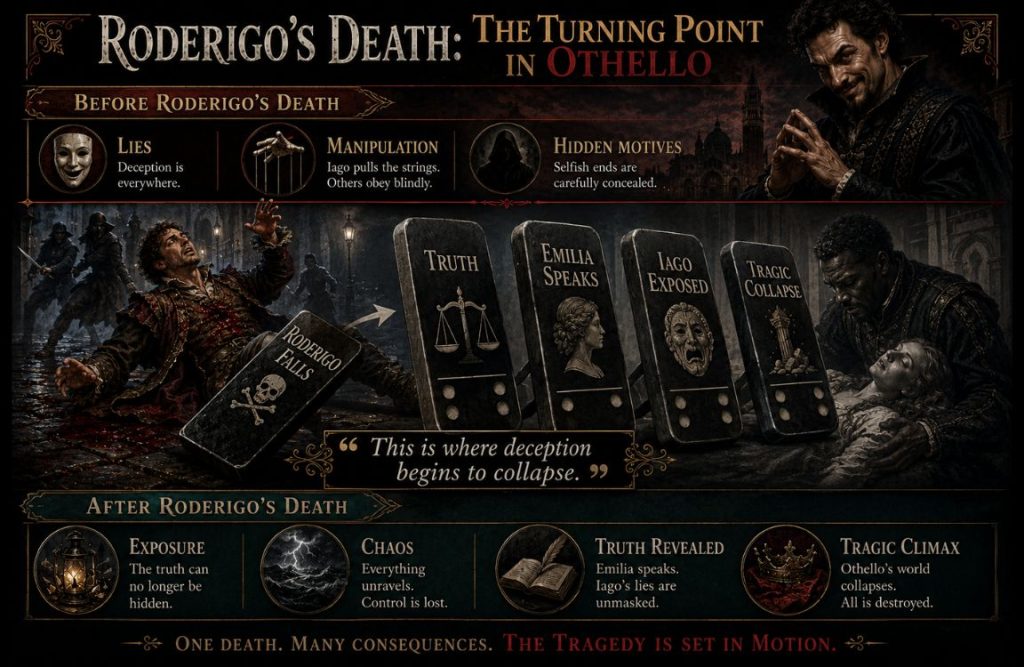
First, it reveals Iago’s cruelty in its purest form. Up to this point, he manipulates from the shadows; here, he destroys directly. There is no disguise left, only calculation. Roderigo’s death shows that Iago is not merely a schemer; he is an eliminator.
Second, it marks the collapse of deception. Like a thread pulled from a woven cloth, Roderigo’s removal begins to unravel the entire design. Emilia will soon speak, the truth will surface, and the carefully built illusion cannot hold.
Finally, it propels the play toward its tragic climax. I often describe it as a domino effect; once Roderigo falls, the rest must follow. In any Othello ending explanation, this moment stands as a pivot: the point where manipulation stops growing and starts collapsing under its own weight.
Character Analysis: Roderigo in Othello
In any serious Rodrigo’s character analysis, we must resist the temptation to dismiss him as merely foolish. Yes, he is weak, naive, and undeniably desperate, but that is precisely what makes him dramatically significant.
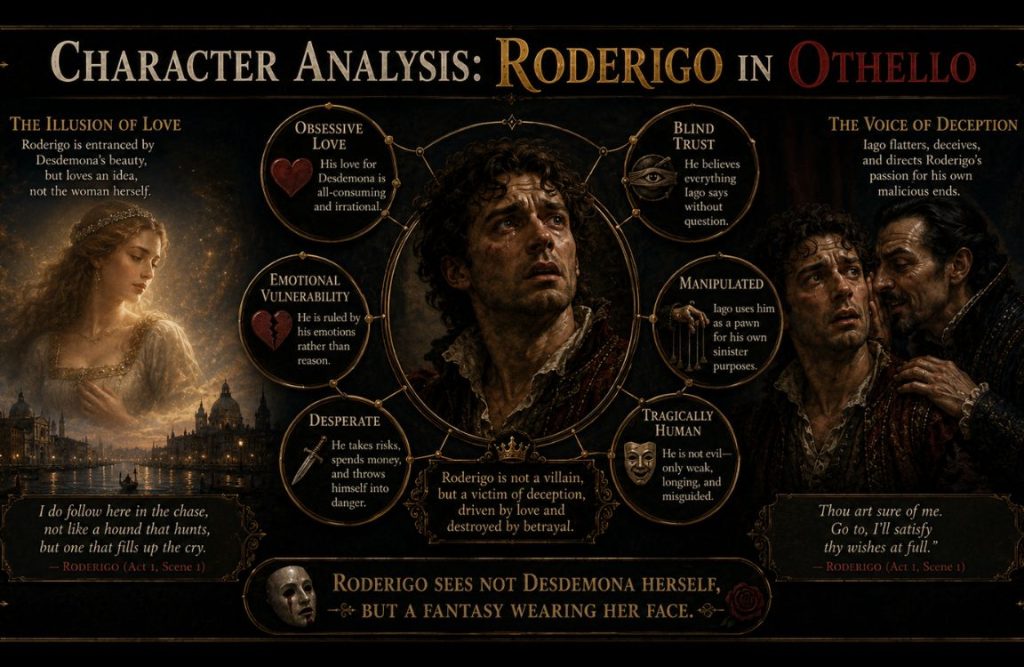
Roderigo represents what happens when desire outruns judgment. His love for Desdemona is less romance and more obsession, a kind of emotional tunnel vision. I sometimes tell my students: he sees not Desdemona herself, but a fantasy wearing her face.
He is also a symbol of blind trust. While others are deceived gradually, Roderigo surrenders almost instantly. This makes him the perfect subject for manipulation. Iago does not need to persuade him deeply, only to promise him hope.
Yet, there is something tragically human about him. He wants love, meaning, fulfillment. And that is the cruel twist. His very longing becomes the weapon used against him. In this sense, Roderigo is not just weak; he is painfully relatable.
FAQs:
Does Roderigo die before or after Desdemona in Othello?
Roderigo dies before Desdemona. His death occurs in Act 5, Scene 1, while Desdemona is killed later in Act 5, Scene 2, making his death an early signal of the unfolding tragedy.
Why does Roderigo trust Iago so easily?
Roderigo trusts Iago because he is emotionally vulnerable and desperate for Desdemona’s love. Iago exploits this weakness, offering false hope and guidance, which Roderigo accepts without critical thinking or skepticism.
Is Roderigo responsible for his own death?
Partly, yes. While Iago manipulates him, Roderigo’s poor judgment, blind trust, and obsessive desire lead him into dangerous situations. His lack of awareness contributes significantly to his tragic end.
What role does Roderigo play in Iago’s plan?
Roderigo serves as a tool in Iago’s scheme. He provides money, creates distractions, and carries out risky actions like attacking Cassio, helping Iago advance his larger plan without exposing himself.
Could Roderigo have survived in Othello?
Yes, if he had questioned Iago earlier or acted independently. His survival depended on awareness and resistance, but his blind trust and emotional dependence made escape from manipulation unlikely.
Conclusion:
So, does Roderigo die in Othello? Yes, he dies, quietly and brutally, at the hands of the worst man he trusted most. But his death carries a larger lesson. In Shakespeare’s tragic world, manipulation does not strike the strongest first. It consumes the most vulnerable.
Roderigo’s fate reminds us that unchecked desire and blind trust can be fatal combinations. He is not simply a victim of Iago. He is a warning to us all.
👉 Want to understand how Iago manipulates everyone in Othello? Explore our full breakdown and uncover the mind behind the tragedy.