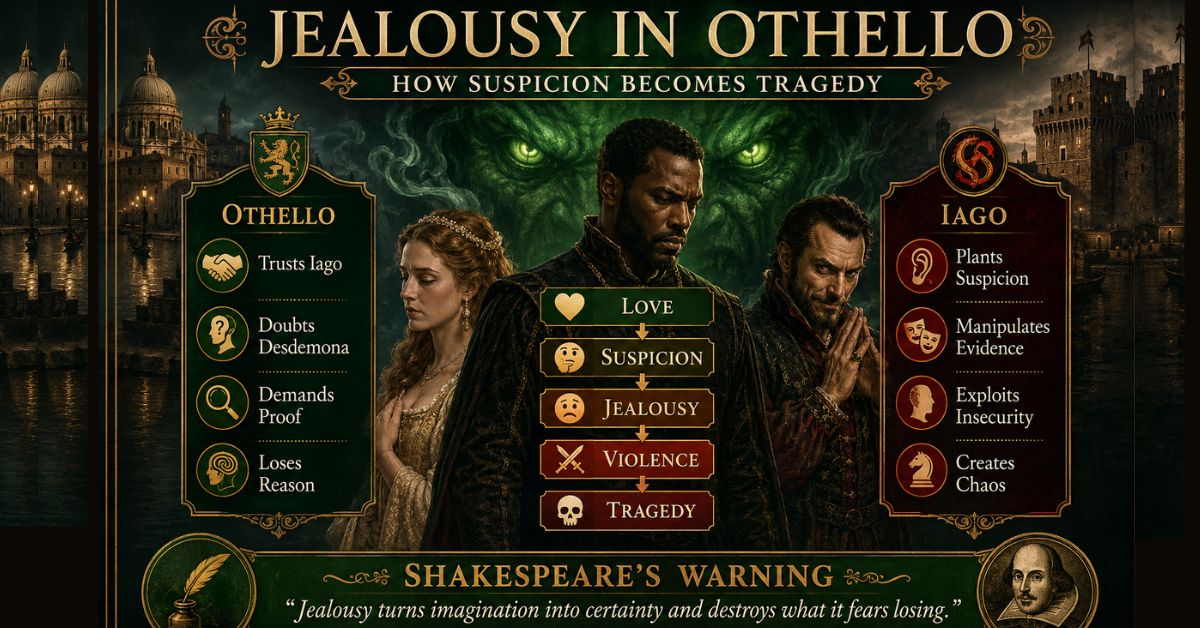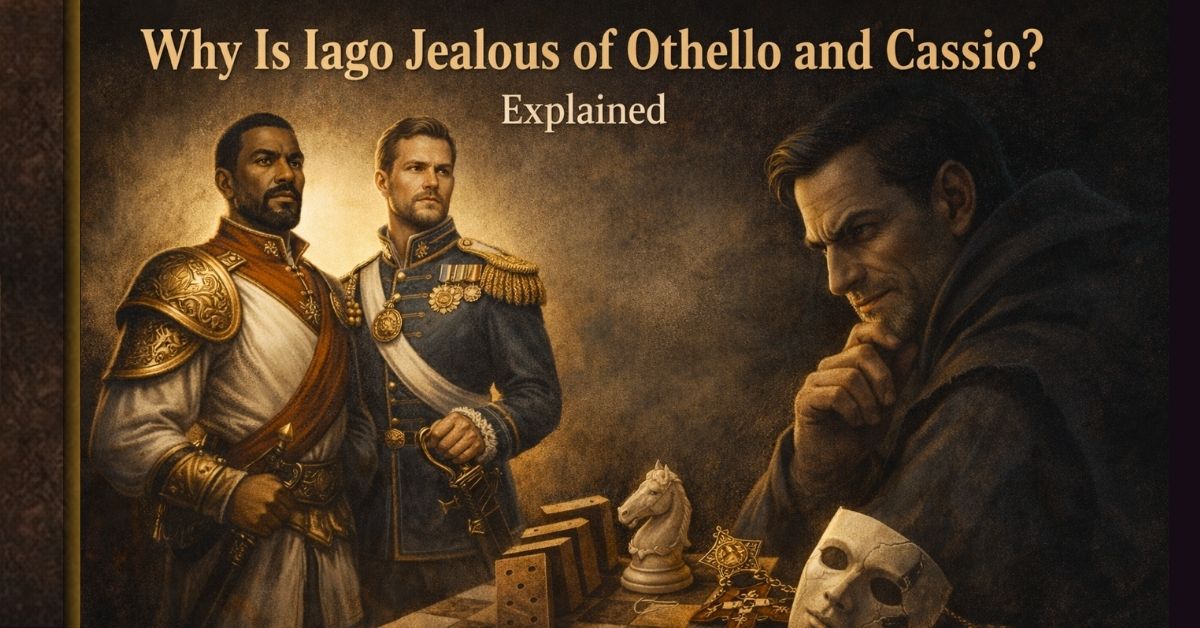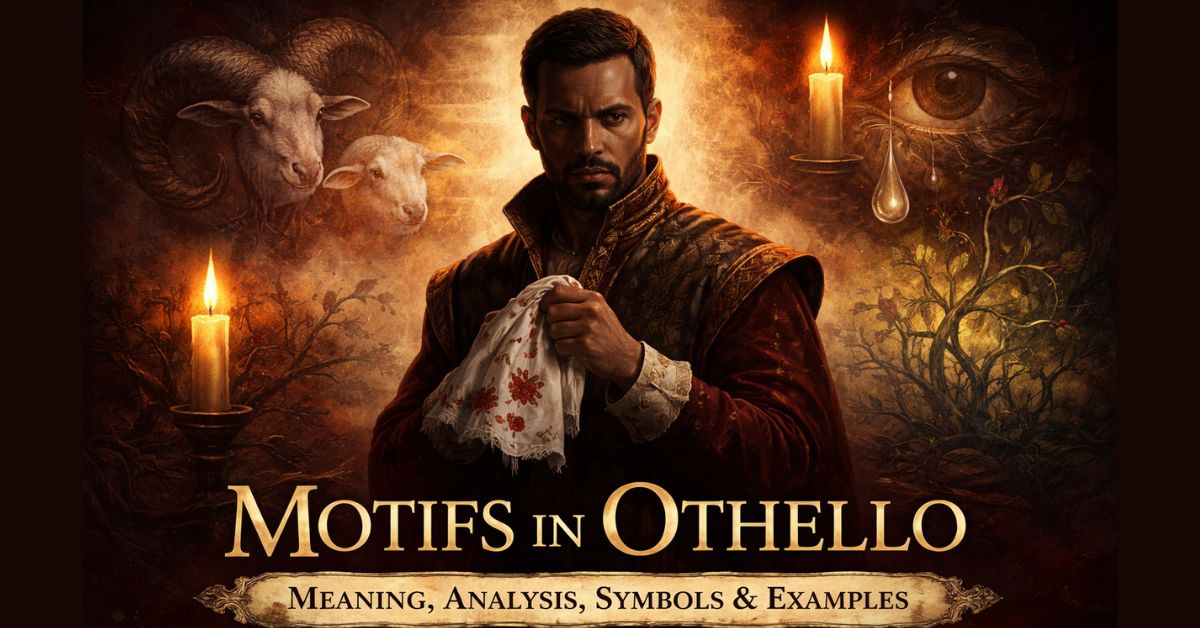
The power of Othello’s imagery comes from repetition. An image appears, returns, and changes meaning as Othello’s judgment deteriorates. Animals reduce people to creatures; gardening turns manipulation into cultivation; poison makes suspicion feel like infection.
The seven major motifs in Othello- sight and blindness, animal imagery, plants and gardening, poison and disease, monsters and demons, light and darkness, and black-and-white imagery— chart the tragedy.
What Is a Motif in Othello?
A motif is a recurring image, word, idea, or pattern that gathers meaning through repetition and variation. A theme is a central concern; a motif is one recurring way the play develops it.
Symbolism can overlap with motif. The handkerchief, for instance, is a symbol whose repeated appearances connect love, fidelity, proof, and deception. Jealousy is a theme, while the “green-eyed monster” gives jealousy a memorable imaginative form.
I ask students to track patterns because an image may begin as rhetoric and later become part of Othello’s way of understanding the world.
Motifs in Othello at a Glance
| Motif | Key image | Main function |
| Sight and blindness | “ocular proof” | Perception |
| Animal imagery | “old black ram” | Dehumanization |
| Plants and gardening | “gardens” | Manipulation |
| Poison and disease | “pestilence” | Corruption |
| Monsters and demons | “green-eyed monster” | Jealousy |
| Light and darkness | “put out the light” | Life and uncertainty |
| Black-and-white imagery | “black” / “white” | Race and judgment |
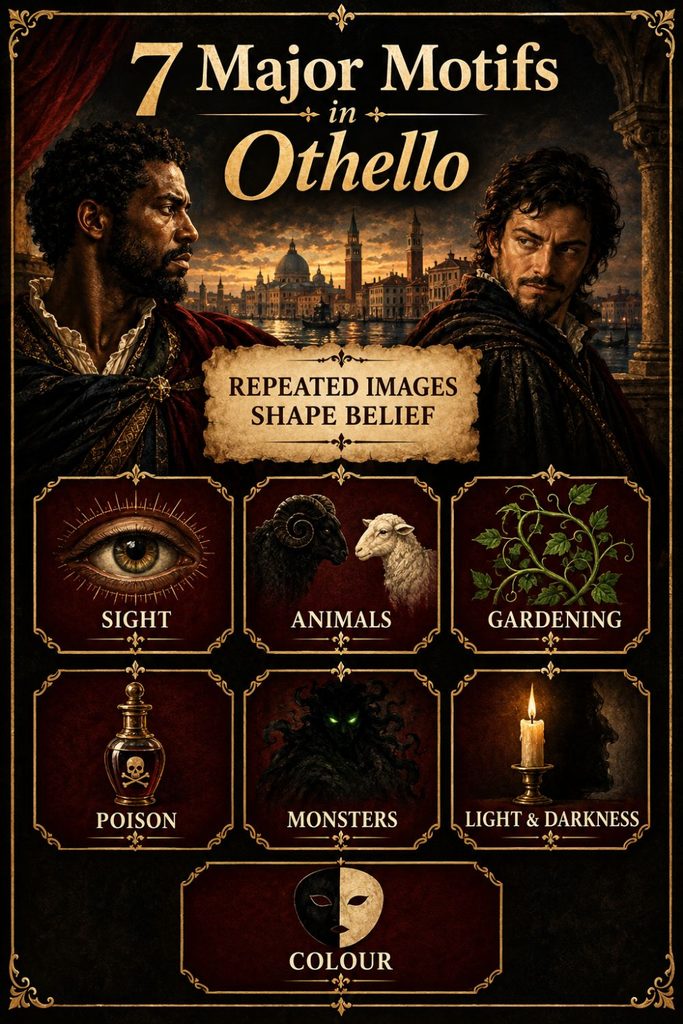
Table of Contents
Sight and Blindness in Othello
The sight-and-blindness motif makes perception dangerous. Desdemona says, “I saw Othello’s visage in his mind,” suggesting that genuine understanding can move beyond outward appearance.
Othello later loses that ability. Iago trains him to treat gestures, objects, and silences as evidence. His demand for “ocular proof” sounds reasonable, but the evidence has already been manipulated.
Othello’s blindness is interpretive, not literal: he sees things without understanding what they mean. The motif questions whether seeing guarantees knowledge when another person controls interpretation.
Animal Imagery in Othello
Iago calls Othello “an old black ram” and Desdemona a “white ewe,” reducing their marriage to an animal encounter. He also describes them as “making the beast with two backs” and calls Othello a “Barbary horse.” These comparisons connect racial prejudice with sexuality and dehumanization.
Later, Othello cries, “Goats and monkeys!” The language he has absorbed from Iago now shapes his imagination. Animal imagery traces more than insult: it shows how dehumanizing language can be absorbed and turned into a way of seeing.
Plants and Gardening in Othello
Iago explains human character through gardening: “Our bodies are our gardens, to which our wills are gardeners.” He applies this logic maliciously, planting suspicion in Othello’s mind and returning to it until it grows.
His claim that “The Moor already changes with my poison” brings cultivation close to corruption. The gardening motif emphasizes process: an idea is planted, encouraged, and allowed to produce a destructive harvest.
Unlike poison, which suggests infection, gardening stresses the deliberate cultivation of an idea.
Poison and Disease Imagery in Othello
Poison and disease imagery makes Iago’s manipulation feel like infection. He plans to “pour this pestilence into his ear,” imagining harmful suggestions entering Othello through language. Iago feeds Othello an interpretation and encourages him to treat it as truth.
The poison motif connects speech with corruption, while disease imagery suggests that suspicion can spread beyond its original source.
Together, these images make psychological damage seem bodily and show how a destructive idea can move through the mind.
Monsters and Demons in Othello
Iago warns Othello,
“It is the green-eyed monster which doth mock / The meat it feeds on.”
The warning is ironic because Iago is helping create the jealousy he claims to fear.
Emilia later calls jealousy a “monster / Begot upon itself, born on itself,” giving the emotion a self-feeding quality.
The monster motif makes jealousy seem predatory. Once suspicion dominates Othello, fear begins generating its own evidence. Hell and demon imagery extend the pattern toward spiritual corruption.
Light and Darkness in Othello
Othello’s final declaration, “Put out the light, and then put out the light,” moves from a candle to Desdemona’s life. The repetition makes murder sound like extinction. Yet a candle can be relit, whereas a human life cannot.
Darkness can suggest secrecy and concealment, but brightness does not guarantee truth. Othello seeks certainty in what he thinks he sees, while his judgment has already been distorted.
The motif links physical light with the limits of moral vision and makes the final murder both literal and symbolic.
Black-and-White Imagery in Othello
Black-and-white imagery matters because racial language shapes how Othello is perceived. Iago’s “old black ram” and “white ewe” create a crude colour contrast that links race with sexuality.
The play exposes the prejudice behind these assumptions without making racial identity a simple measure of moral character. Othello is a respected military leader, while socially respectable characters can behave cruelly and dishonestly.
The recurring black-and-white imagery exposes the gap between racial stereotypes and moral character.
The Handkerchief: An Important Symbol That Works Like a Motif
The handkerchief is a symbol that participates in recurring patterns of proof, fidelity, and deception. It begins as a love token, becomes a lost object, and then becomes supposed evidence of infidelity. Othello treats it as confirmation even though its meaning has been manipulated.
Its repeated appearances matter, but calling it only a motif understates its symbolic role. The handkerchief demonstrates how an object can gain destructive authority when symbolic meaning is mistaken for factual proof.
How Do the Motifs Build Othello’s Tragedy?
Their force emerges when the images overlap. Gardening describes how suspicion grows; poison describes how it spreads; and monster imagery describes how jealousy feeds itself.
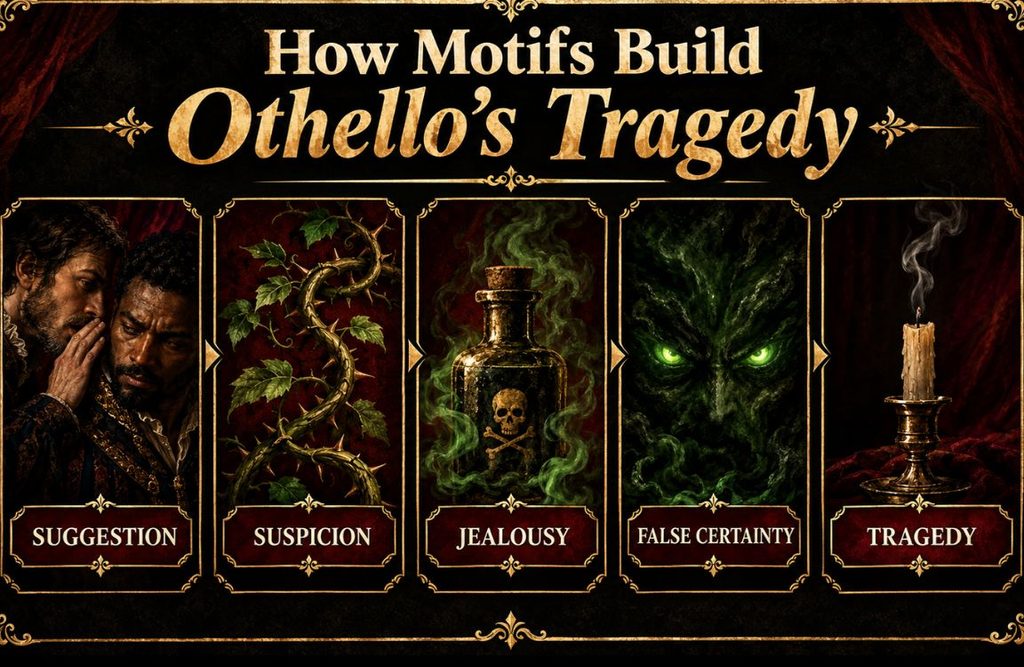
Sight and blindness show the failure of interpretation, animal imagery reveals dehumanization, colour exposes racial assumptions, and light and darkness deepen the tragedy of Othello’s final act.
The pattern is a movement from language to belief. A suggestion gains force, suspicion begins to resemble certainty, and certainty authorizes violence. The motifs chart Othello’s downfall as a gradual transformation of perception, not a sudden collapse.
For an exam answer, trace one motif across scenes. Name the image, explain its context, and show how its meaning changes.
This pattern explains why the imagery feels cumulative: each new image echoes an earlier one but adds pressure to Othello’s interpretation. Shakespeare turns recurring language into a dramatic structure, so the motifs become part of the tragedy’s psychological movement.
FAQs:
How should students use motifs in an Othello essay?
Name the recurring pattern, use a quotation, explain its meaning in context, and show how its significance changes as the tragedy develops.
Can a symbol also become part of a motif?
Yes. A repeated symbol can contribute to a motif when its associations develop a recurring theme.
Which motif is most important in Othello?
Sight, animal imagery, poison, and colour are especially powerful because they shape perception and judgment.
How can motifs improve an exam answer?
Use motifs as analytical evidence. Explain what recurs, how it changes, and what that change reveals about character, conflict, or theme.
Do motifs keep the same meaning throughout Othello?
Not always. Their images remain recognizable, but their meanings shift as suspicion intensifies and Othello’s understanding becomes distorted.
Conclusion:
The motifs in Othello do more than decorate the tragedy with memorable images. As they return, their meanings shift with Othello’s changing perception.
Animals become signs of dehumanization, poison becomes a language of corruption, and light becomes inseparable from death.
By following these recurring patterns, readers can see how Shakespeare turns imagery into psychological movement. The tragedy lies not simply in what Othello sees, but in what repeated images teach him to believe.