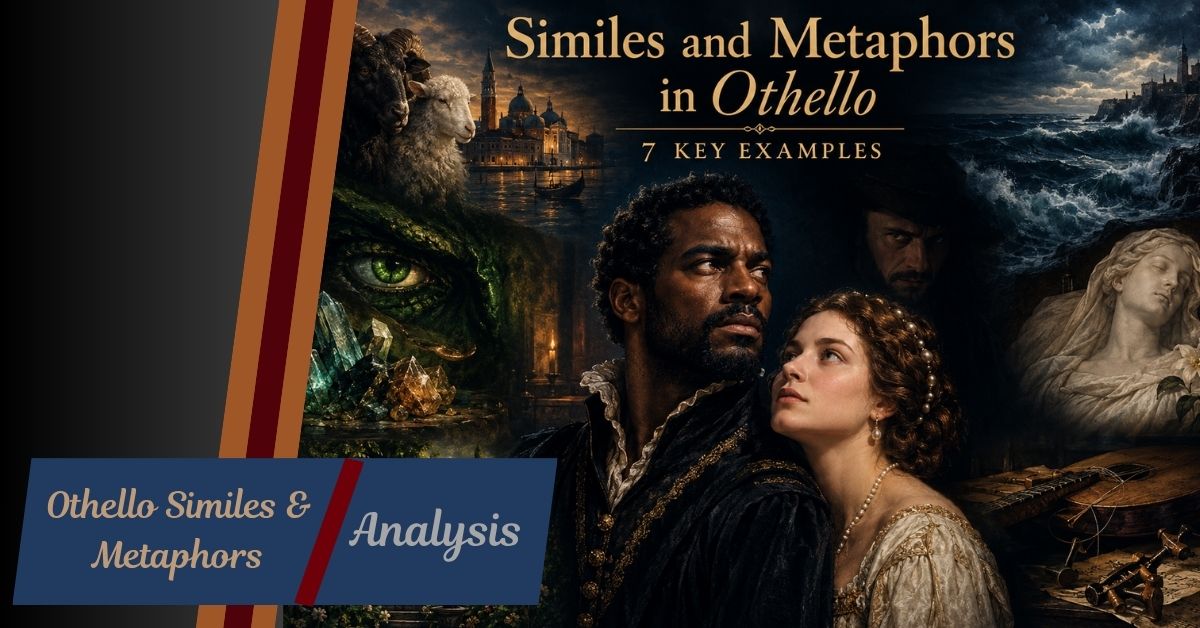
A comparison can shape judgment before evidence appears in Othello. Iago turns marriage into an animal image, describes jealousy as a monster, and imagines harmony as music he can ruin. These similes and metaphors in Othello influence how characters interpret what they see and hear.
The seven examples show how figurative language expresses prejudice, disguises manipulation, and charts Othello’s movement towards revenge.
Their significance emerges from the speaker’s immediate aim, the listener’s response, and the consequences that follow across the whole dramatic play.
What Are Similes and Metaphors in Othello?
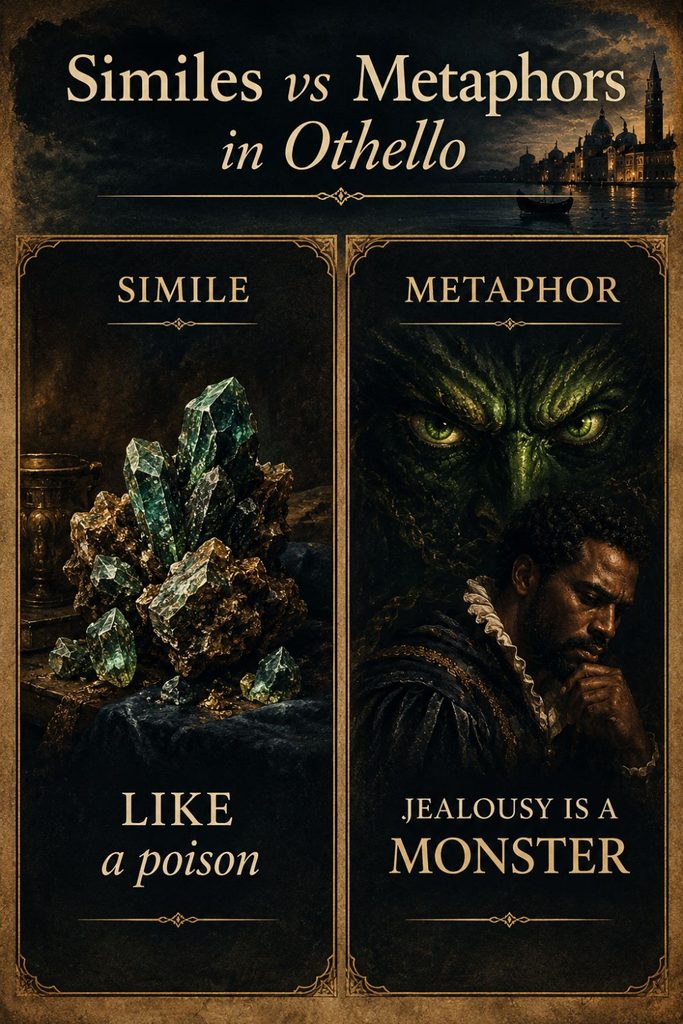
A simile compares unlike things using “like” or “as.” Iago’s “like a poisonous mineral” makes suspicion seem physically destructive.
A metaphor makes a comparison directly: the “green-eyed monster” presents jealousy as a dangerous creature.
A comparison may reveal a speaker’s state of mind or manipulate another person’s response. Identifying the device is only the first step. Close reading asks why the image appears.
For a better understanding of similes and metaphors in Othello, watch my video tutorial below.
Table of Contents
7 Key Similes and Metaphors in Othello
These quotations show how Shakespeare’s comparisons work within the drama, revealing speakers’ motives and influencing how audiences interpret their words and actions.
1. “An old black ram” and “white ewe”
At night, Iago tries to provoke Brabantio with a degrading picture of his daughter’s secret marriage. He declares, “An old black ram / Is tupping your white ewe” (Act 1, Scene 1).
The animal metaphor reduces Othello and Desdemona’s relationship to a crude sexual image. The contrast between “black” and “white” exploits racial prejudice and encourages Brabantio to see the marriage as shameful.
Iago chooses language designed to shock before Brabantio can hear Desdemona’s account. Animal imagery strips the couple of individuality, which replaces their relationship with a degrading picture.
His words make prejudice do the work of evidence, helping turn a private marriage into a public crisis.
2. “The green-eyed monster”
Iago warns Othello to “beware, my lord, of jealousy; / It is the green-eyed monster” (Act 3, Scene 3). The metaphor gives jealousy a threatening life of its own, suggesting that it can devour the person who gives it room to grow.
The warning is ironic: Iago appears to protect Othello while encouraging jealousy. The image proves nothing about Desdemona, but its vividness makes emotion seem like a force already in control. The audience sees the gap between Iago’s concern and his purpose.
3. “Like a poisonous mineral”
Iago says that the thought of Othello supposedly sleeping with Emilia “doth, like a poisonous mineral, gnaw my inwards” in Act 2, Scene 1. The simile compares suspicion to a toxic substance that eats away at the body.
Resentment becomes physical pain, which gives Iago’s grievance the appearance of an injury he cannot escape.
The alleged affair is not established as fact. Iago turns suspicion into a reason for revenge, presenting himself as a sufferer rather than a schemer. The comparison lends emotional weight to his claim without making it true.
4. “Our bodies are our gardens”
Iago tells Roderigo in Act 1, Scene 3, “Our bodies are our gardens, to which our wills are gardeners.” The metaphor compares human life to a garden shaped by deliberate care. In Iago’s argument, willpower can cultivate one desire and restrain another, just as a gardener chooses what to grow.
The advice sounds practical, but Iago’s conduct contradicts it. He knows people can influence their choices, yet cultivates their fears and weaknesses. The garden image suggests both self-discipline and manipulation: his words advocate control while his actions seek control over others.
5. “Like to the Pontic Sea”
In Act 3, Scene 3, Othello compares his “bloody thoughts” to the Pontic Sea, whose icy current continues towards the Propontic and Hellespont without retreating. The simile presents his intention as relentless.
The sea cannot reverse its course, just as Othello claims his thoughts will not return to “humble love.” This marks a turning point.
Othello speaks as if revenge is inevitable, although he remains responsible for choosing it. The comparison makes a decision sound like nature’s law, exposing his dangerous belief that he cannot turn back.
6. “Smooth as monumental alabaster”
Othello says he will not scar Desdemona’s skin, describing it as “smooth as monumental alabaster” (Act 5, Scene 2). The simile compares her skin to polished stone associated with a monument. Its smoothness and stillness become chilling as Othello prepares to kill her.
Admiring Desdemona’s beauty does not restore Othello’s trust. He accepts Iago’s false account while the vulnerable woman remains before him. The comparison heightens the horror of a murder he believes justified.
7. “The pegs that make this music”
In Act 2, Scene 1, Iago watches Othello and Desdemona together and declares, “O, you are well tuned now! / But I’ll set down the pegs that make this music.” The musical metaphor presents their relationship as a harmonious instrument.
Iago imagines himself loosening its tuning pegs so that the music will fall into discord. The image reveals Iago’s calculation: he intends to damage the conditions that sustain the marriage.
Their joyful reunion sharpens the contrast. Music becomes a picture of trust that can be damaged deliberately.
How Figurative Language Changes Across the Play
Early on, Iago’s images provoke Brabantio and disguise his motives. Later, Othello treats jealousy as a threat and revenge as an unstoppable course. The change lies in his willingness to accept suggestion as knowledge.
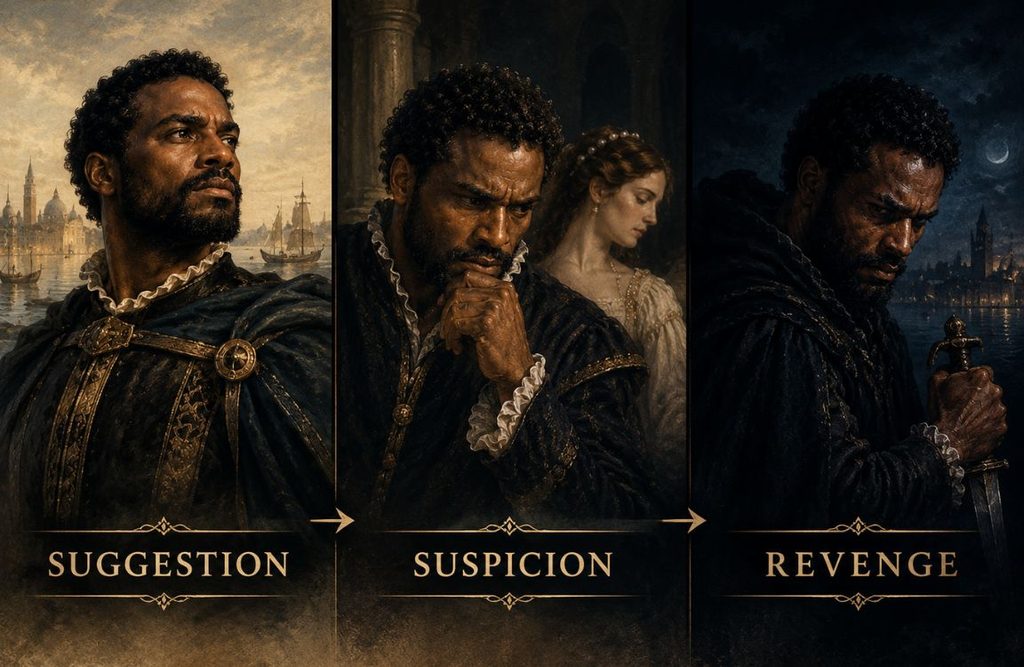
Figurative language does not force Othello to act. It shapes his thinking, but his choices turn that thinking into tragedy. Certainty is not proof.
Why Do Similes and Metaphors Matter in Othello?
Animal imagery activates racial prejudice. The monster makes jealousy predatory. The sea makes revenge seem inevitable. The images also invite readers to question their speakers.
To analyse a comparison, identify its meaning, examine its dramatic context, and ask what response it seeks. This goes beyond naming a device.
FAQs:
What is the most famous metaphor in Othello?
The “green-eyed monster” is a famous metaphor. Iago represents jealousy as dangerous while concealing his role in encouraging Othello’s suspicion.
How does Iago use figurative language to manipulate Othello?
He makes uncertain events appear incriminating, influencing Othello without proving Desdemona’s guilt.
How does animal imagery contribute to the tragedy?
Animal imagery dehumanises people. Iago’s “black ram” and “white ewe” exploit Brabantio’s racial hostility.
Conclusion
The similes and metaphors in Othello are central to the play’s power. They reveal prejudice and show how false interpretations harden into decisions.
Shakespeare’s comparisons influence choices without removing responsibility. Read each image in context and ask whether it clarifies reality or distorts it.
For students, the key is to connect each quotation to a dramatic moment rather than memorise a label. That habit produces more precise literary analysis and stronger exam answers.