Emilia in Othello begins as a woman expected to obey, yet she ends as the character brave enough to expose the truth. She is much more than Iago’s wife or Desdemona’s attendant.
Through her relationships and connection to the handkerchief, Emilia gradually finds a voice of her own. Her final decision to speak makes her a strong moral figure.
Who Is Emilia in Othello?
Emilia is Iago’s wife and Desdemona’s attendant and companion in Shakespeare’s Othello. Her position connects her to Desdemona and Iago.
At first, Emilia is cautious and used to her husband’s authority. She tries to please him without understanding why he wants the handkerchief. As the plot develops, her observations about marriage and women’s treatment reveal a sharper understanding of the world around her.
By the final act, Emilia is no longer simply part of someone else’s story. She becomes the person who recognizes the truth and refuses to hide it.
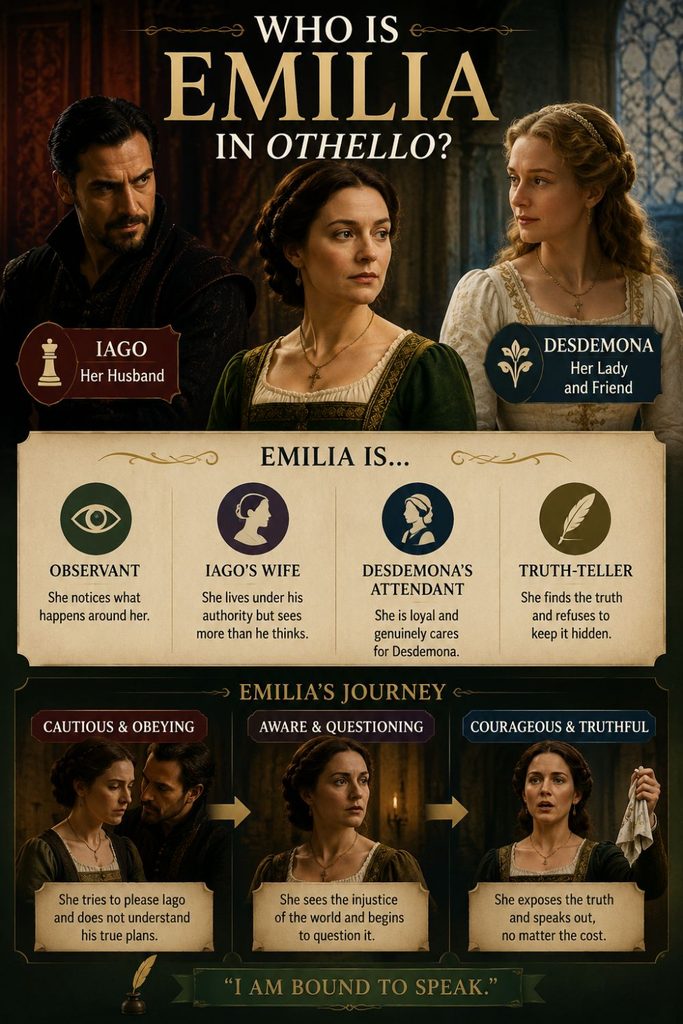
Table of Contents
Emilia’s Character Traits
Emilia is practical, observant, loyal, outspoken, and courageous, and her strength develops throughout the play.”
Pragmatic: She sees marriage less romantically than Desdemona and understands that love does not always prevent selfishness or betrayal.
Observant: She notices what happens around her, even when she misses its significance.
Loyal: Her affection for Desdemona is genuine, and ultimately matters more than protecting Iago.
Outspoken: Emilia questions the unequal expectations placed on husbands and wives.
Courageous: Her courage appears when she discovers Iago’s role and speaks despite the danger.
These traits make Emilia a developing character whose strength grows as she learns to trust her judgment.
Emilia’s Role in Othello
Emilia serves both a dramatic and moral purpose. As Desdemona’s attendant and Iago’s wife, she becomes an unwitting link in Iago’s scheme.
Iago asks Emilia to obtain Desdemona’s handkerchief. She gives it to him without understanding his larger purpose. Her action helps the deception, but she is not a willing conspirator against Desdemona.
The irony is sharp: Emilia helps Iago’s deception succeed, then becomes the person who exposes it. When the truth emerges, she explains how the handkerchief came into his possession.
Emilia and Iago’s Relationship
Emilia and Iago have an unequal marriage. Iago treats her as useful to his plans rather than as an equal partner. Early on, Emilia accepts his authority.
Her comments about marriage suggest that she understands relationships in which men expect obedience from women. She may not see Iago’s full cruelty, but she has learned that a husband is not automatically deserving of trust.
The handkerchief exposes this tension: her attempt to please Iago becomes part of the scheme that destroys Desdemona. Once she understands it, she refuses to protect him.
Emilia and Desdemona’s Relationship
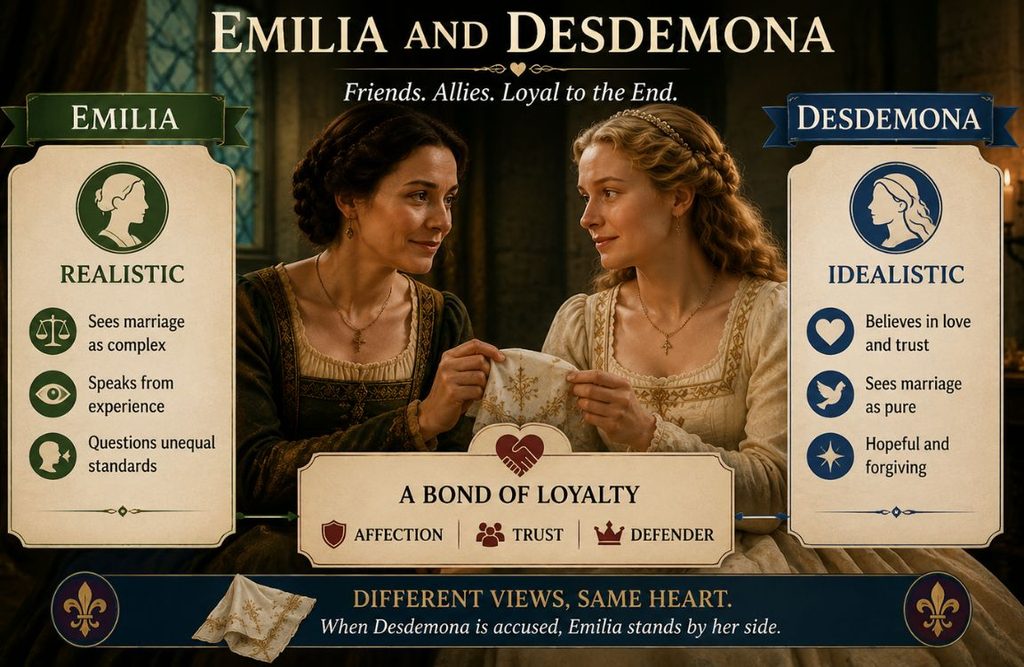
Emilia’s relationship with Desdemona is based on affection as well as duty.
Shakespeare uses the two women to present different attitudes toward marriage. Desdemona approaches love with trust and idealism, while Emilia speaks from experience. She knows marriage can involve unequal power and sexual double standards.
Their different views do not prevent friendship. Emilia does not need to share Desdemona’s idealism to care about her. When Desdemona is accused, Emilia refuses to accept the men’s version simply because they hold greater power.
Emilia and the Handkerchief
The handkerchief connects Emilia directly to Iago’s deception. Desdemona drops it, Emilia finds it, and she gives it to Iago because he has wanted it.
She does not know that he intends to use it as false evidence against Desdemona. Iago turns a private object associated with love into a weapon that feeds Othello’s suspicion.
Emilia’s small act has enormous consequences. Yet the handkerchief also gives her the information she needs to expose Iago. When she realizes what has happened, she publicly explains its history and destroys the lie.
Emilia’s Character Development
Emilia’s development is one of the clearest movements in Othello. She begins within a marriage where male authority carries considerable weight, but experience strengthens her independent judgment.
Her discussion of marriage shows that she has begun questioning the rules surrounding women. She argues that wives have desires and weaknesses just as husbands do, rejecting the double standard that gives men freedoms denied to women.
Her growth becomes complete when she discovers that Iago has used the handkerchief against Desdemona. She must choose between protecting her husband and telling the truth. She knows speaking may cost her life, but does it anyway.
As I see it, Emilia’s courage feels earned because it grows from the doubts and questions she has expressed throughout the play.
Is Emilia a Feminist Character?
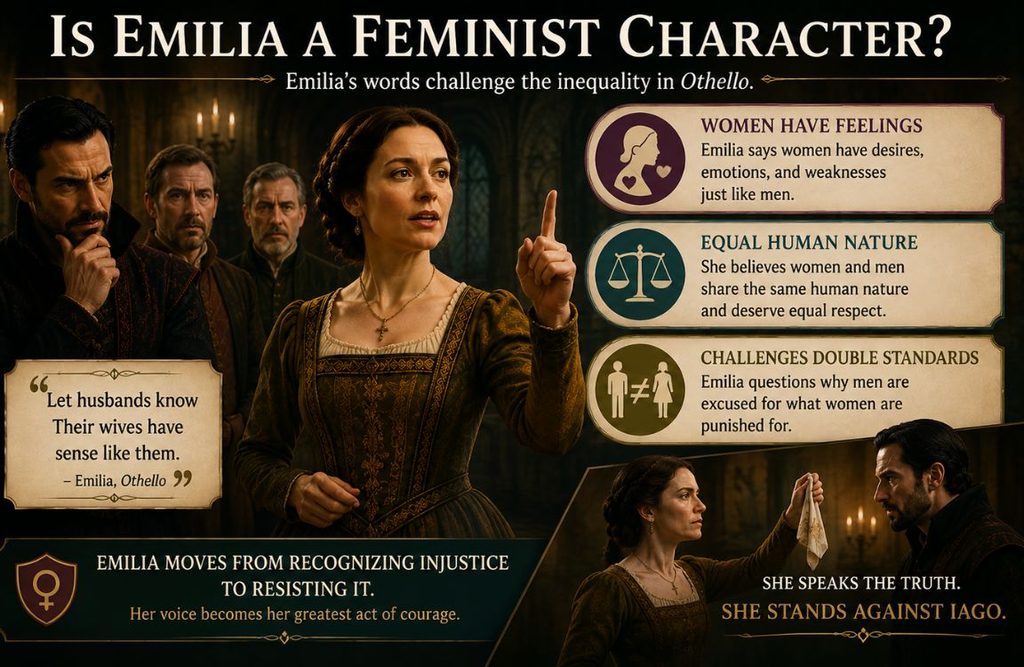
Calling Emilia a feminist character is a modern critical interpretation, but her words clearly challenge the gender inequality presented in the play.
In her famous discussion of marriage, Emilia argues that women have feelings, desires, and weaknesses just as men do. She questions the double standard surrounding male and female infidelity.
Her argument is especially striking because she lives within the inequality she criticizes. She knows women are expected to obey, yet she does not immediately escape that system. Her development lies in moving from recognizing injustice to resisting it.
By the end, she refuses to let Iago silence her. I find her feminist significance most convincing in the decision she makes when her words carry real consequences.
Emilia’s Key Quotes in Othello
Emilia’s important lines reveal her ideas about marriage, gender, and truth.
“Let husbands know / Their wives have sense like them.”
This challenges the assumption that women are less rational than men.
“The ills we do, their ills instruct us so.”
Emilia suggests that harmful behavior can be shaped by the treatment people receive.
“I am bound to speak.”
It expresses the moral position she reaches at the end. Once she knows the truth, silence is no longer acceptable.
How Does Emilia Die in Othello?
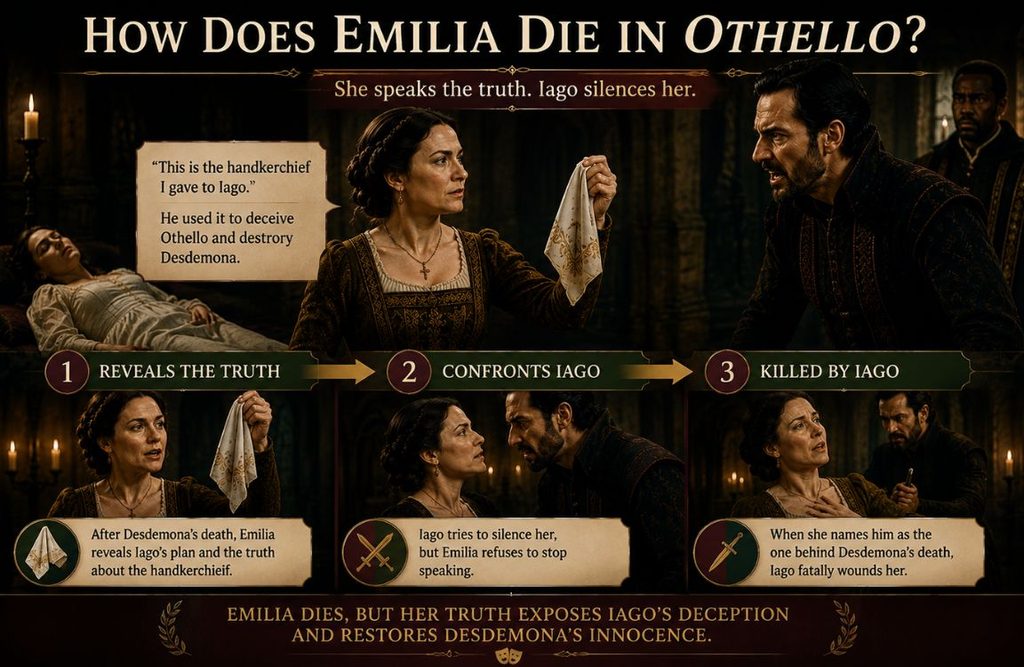
Emilia dies near the end of Othello, killed by Iago after she exposes his deception.
After Othello kills Desdemona, Emilia reveals the truth about the handkerchief and Iago’s plan. Iago tries to silence her, but she refuses to stop speaking. When she identifies his role in Desdemona’s death, he fatally wounds her.
Her death is tragic because she learns the truth too late to save Desdemona, yet exposes Iago’s lie.
Why Emilia Matters in Othello
Emilia matters because she becomes the tragedy’s moral voice. She cannot undo Desdemona’s death, but she can expose the deception that led to it.
She also gives the play a female perspective on marriage and power. Her final resistance feels meaningful because she has lived within the system she challenges.
Most importantly, Emilia shows that truth can come from someone overlooked. She begins close to Iago’s scheme, yet helps bring it into the open.
FAQ:
Why does Emilia not realize Iago’s plan?
Emilia knows Iago wants the handkerchief, but she does not understand that he intends to use it against Desdemona. She realizes its importance only after seeing the damage it causes.
Is Emilia responsible for Desdemona’s death?
Emilia contributes unintentionally by giving Iago the handkerchief, but she never intends to harm Desdemona. Once she learns the truth, she exposes Iago’s deception.
Why is Emilia’s speech about women important?
Her speech challenges unequal standards between husbands and wives.
Why is Emilia’s death important?
Her death shows the cost of confronting Iago and completes her moral development.
How does Emilia differ from Desdemona?
Desdemona views love more ideally, while Emilia approaches marriage with greater realism. Despite their differences, Emilia genuinely cares for her.
Conclusion:
Emilia’s journey in Othello moves from obedience toward awareness and finally to moral courage. She begins as Iago’s wife and Desdemona’s attendant, but Shakespeare gradually gives her an independent voice. Her understanding of marriage prepares her to question authority, while the handkerchief reveals the consequences of Iago’s actions.
For me, that makes Emilia memorable. She does not begin as the most powerful voice. She becomes powerful when speaking the truth matters more than protecting herself. Her courage cannot save Desdemona, but it ensures Iago’s deception is exposed.
Want to understand the mind behind the deception Emilia exposes? Explore our guide to Iago’s character and role in Othello to see how his manipulation drives the tragedy from beginning to end.