Iago in Othello is Othello’s ensign and the play’s chief villain. Angry over Cassio’s promotion, he engineers the downfall of those around him through lies, suspicion, and psychological manipulation, ultimately causing the tragedy.
Few literary villains disturb readers as deeply as Iago. Unlike murderers who rely on swords, this villain in Othello uses words as weapons. Behind the reputation of “Honest Iago” hides a mind that thrives on deception.
Whenever students encounter him for the first time, they are often surprised that someone without magical powers or royal authority can destroy so many lives.
Shakespeare seems to remind us that evil sometimes arrives with a smile, not with a dagger. That unsettling truth explains why audiences still fear and study Iago centuries later.
Iago at a Glance
| Character | Iago |
| Role | Othello’s Ensign |
| Position | Main Antagonist |
| Wife | Emilia |
| Closest Target | Othello |
| Main Motivation | Revenge, Envy, Control, Status Anxiety |
| Famous Quote | “I am not what I am.” |
| Fate | Arrested and Punished |
Table of Contents
Who Is Iago in Othello?
Iago serves as both Othello’s ensign and the architect of the tragedy. Unlike villains who oppose heroes openly, he operates from within Othello’s inner circle and transforms friendship into a weapon. His military position allows him to observe, influence, and exploit the network of relationships that shapes the action of the play.
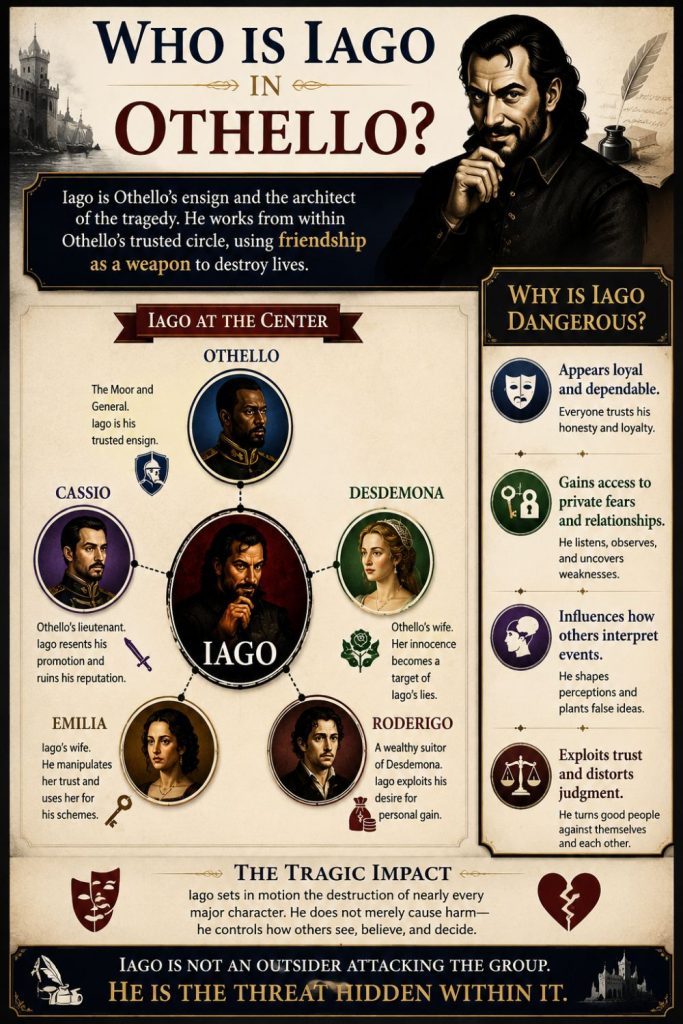
Iago’s position within Othello’s circle makes him far more dangerous than an open enemy. Since he appears loyal and dependable, few characters question his motives. Shakespeare, therefore, places the threat within the very structure meant to provide support and stability.
As the play’s central antagonist, Iago sets in motion the destruction of nearly every major character, including Othello, Desdemona, Cassio, Roderigo, and Emilia. His significance lies not simply in causing harm but in controlling how others interpret events and people around them.
By exploiting trust and distorting judgment, he becomes the driving force behind the tragedy’s catastrophic outcome.
Iago Character Analysis
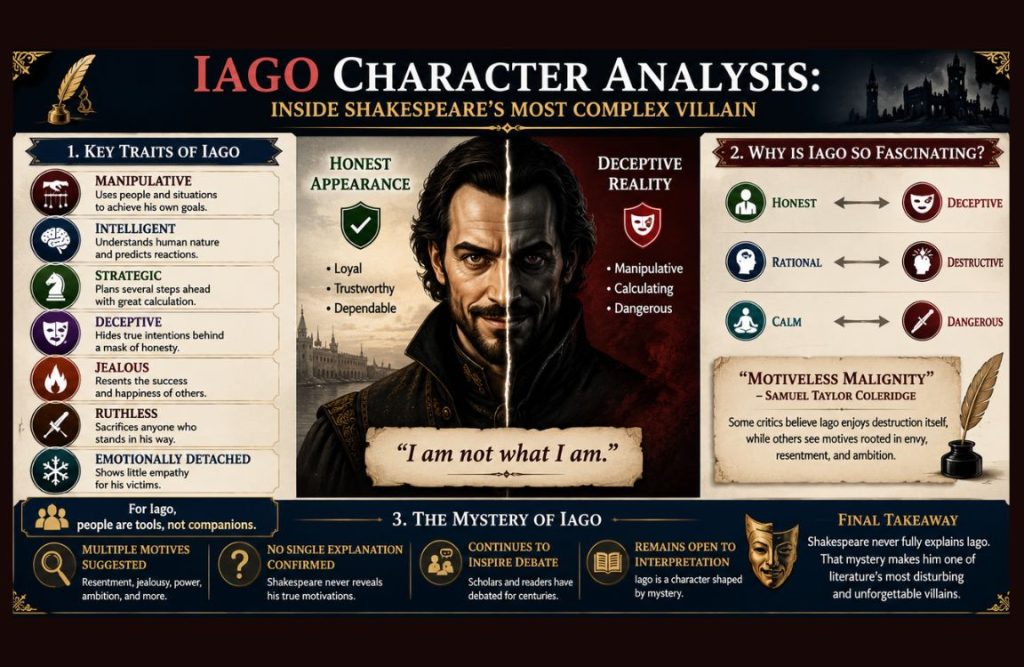
Understanding Iago requires more than calling him evil. His intelligence and self-control, combined with a striking emotional detachment, create a character whose complexity continues to attract critical attention.
i) Key Traits of Iago
Important Iago character traits reveal why he remains unforgettable:
- Manipulative: uses situations for personal advantage.
- Intelligent: understands how people think and behave.
- Strategic: plans actions several steps ahead.
- Deceptive: conceals his intentions behind a trustworthy image.
- Jealous: resents the success of others.
- Ruthless: sacrifices anyone who stands in his way.
- Emotionally detached: shows little sympathy for his victims.
Together, these traits create a personality governed by calculation rather than compassion. For Iago, human relationships are resources, not sources of affection.
ii) Why Is Iago So Fascinating?
Part of Iago’s fascination lies in his contradictions. He presents himself as honest while practising deception. He appears calm and rational, yet his actions produce extraordinary destruction. These tensions give the character unusual psychological depth.
Samuel Taylor Coleridge famously described his wickedness as “motiveless malignity,” suggesting that Iago may enjoy causing harm for its own sake. Yet Shakespeare never confirms a single explanation for his behaviour.
Like a locked room with several possible keys, Iago remains open to interpretation. The mystery surrounding his motives continues to generate debate and helps explain his enduring fascination.
What Motivates Iago?
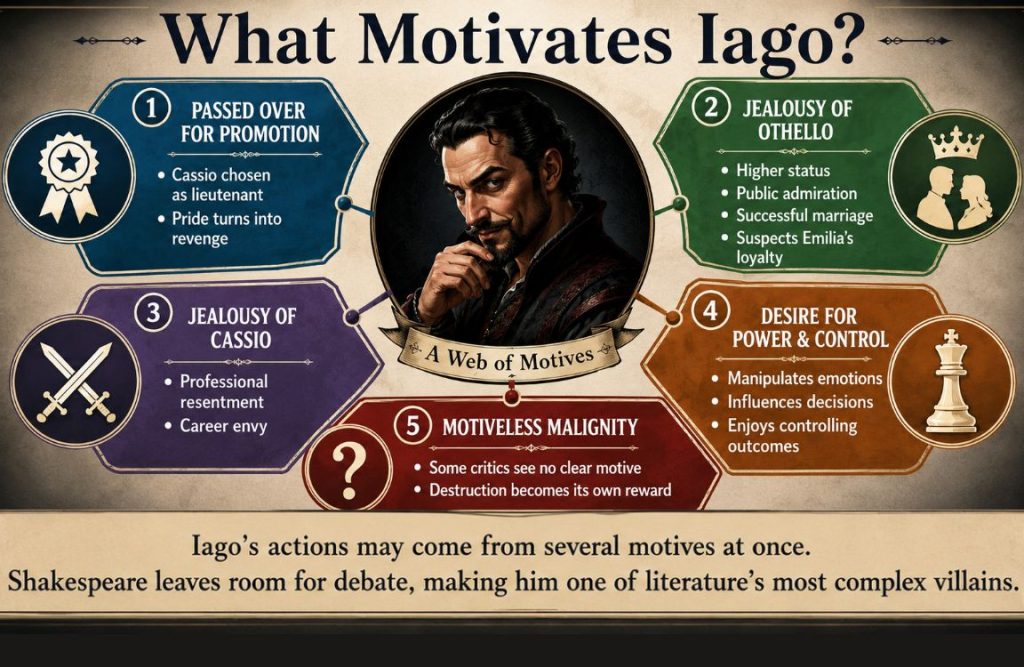
Iago’s actions stem from a mixture of resentment and ambition, reinforced by his desire for control. Rather than providing a single motive, Othello presents several possibilities that together help explain his destructive behaviour.
- Passed Over for Promotion: Iago resents Othello for promoting Cassio to lieutenant. Feeling that experience has been ignored in favour of education, he turns wounded pride into revenge.
- Jealousy of Othello: Iago hates Othello because the general possesses status and admiration, along with a seemingly successful marriage
- Iago also suspects, without evidence, that Othello has been involved with Emilia, deepening his hostility.
- Jealousy of Cassio: Cassio’s professional success intensifies Iago’s bitterness, making him a natural target.
- Desire for Power and Control: Iago enjoys steering emotions and influencing decisions. For him, power lies in controlling others.
- “Motiveless Malignity”: Some critics argue that Iago’s cruelty goes beyond practical motives, suggesting that destruction itself brings him satisfaction.
Is Iago Racist?
Many critics argue that racial prejudice contributes to Iago’s hostility toward Othello. Throughout the play, he uses racist language when describing the Moor and repeatedly draws attention to racial differences.
However, Shakespeare portrays race as only one possible motive. Professional resentment, envy, and the pursuit of power also shape Iago’s hostility.
How Does Iago Manipulate Major Characters?
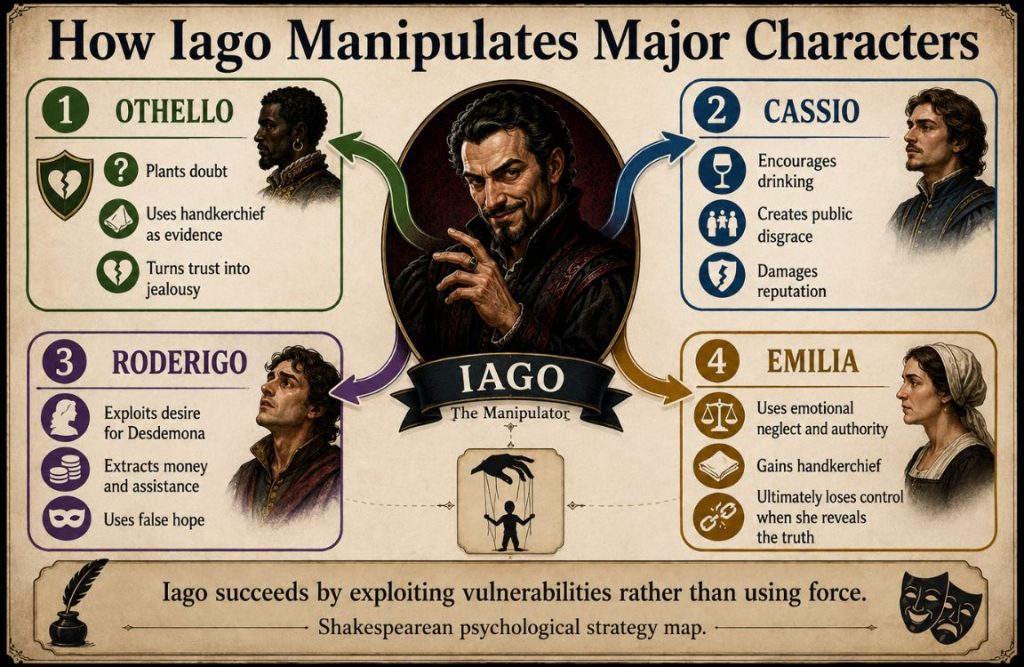
Iago rarely forces people to act. Instead, he identifies each victim’s vulnerabilities and quietly guides them toward decisions they believe are their own. By planting doubts and leveraging weaknesses, he turns his victims into agents of their own downfall. His methods vary depending on the target:
i) How Iago Manipulates Othello
Iago relies on suggestion rather than direct accusation. By planting doubts about Desdemona’s loyalty and using the handkerchief as apparent proof, he transforms Othello’s confidence into jealousy.
Even his warning, “O, beware, my lord, of jealousy,” fuels the emotion it pretends to restrain. I often tell my students that Iago’s greatest success lies in persuading Othello to distrust his own judgment.
ii) How Iago Engineers Cassio
Iago attacks reputation. By encouraging excessive drinking, he engineers a public disgrace that damages Cassio’s standing.
Shakespeare shows how a single mistake can become a lasting weakness when placed in the hands of a skilled abuser.
iii) How Iago Manipulates Roderigo
Iago exploits Roderigo’s desire for Desdemona. Blinded by obsession, Roderigo ignores obvious warning signs and allows himself to become a source of money, assistance, and risk-taking.
Hope repeatedly overrides judgment, which makes him one of Iago’s easiest victims.
iv) How Iago Uses Emilia
Iago takes advantage of Emilia’s desire to please him, using authority and emotional neglect to maintain control over her. Unaware of his intentions, she gives him Desdemona’s handkerchief, providing the evidence he later twists against Othello.
Their marriage reveals the damage caused when loyalty exists without mutual respect. Treating Emilia more as a possession than a partner, Iago underestimates her conscience.
Once she learns the truth, Emilia courageously exposes his treachery, revealing the moral limits of his influence.
Iago and Othello’s Relationship
The relationship between Iago and Othello reveals how misplaced confidence can become a source of vulnerability. Othello sees Iago as loyal, honest, and dependable, which gives him extraordinary influence within both his personal and professional life.
More than any other relationship in the play, this one demonstrates Iago’s ability to convert confidence into power. He does not control Othello through force but through credibility.
The tragedy emerges when a bond that should provide support becomes the means of destruction. By the end of the play, trust has collapsed completely, leaving irreversible consequences behind.
Why Is Iago Called Honest Iago?
Iago is called “Honest Iago” because nearly every character believes him to be reliable and trustworthy. The phrase becomes deeply ironic because the audience knows that his reputation rests entirely upon deception.
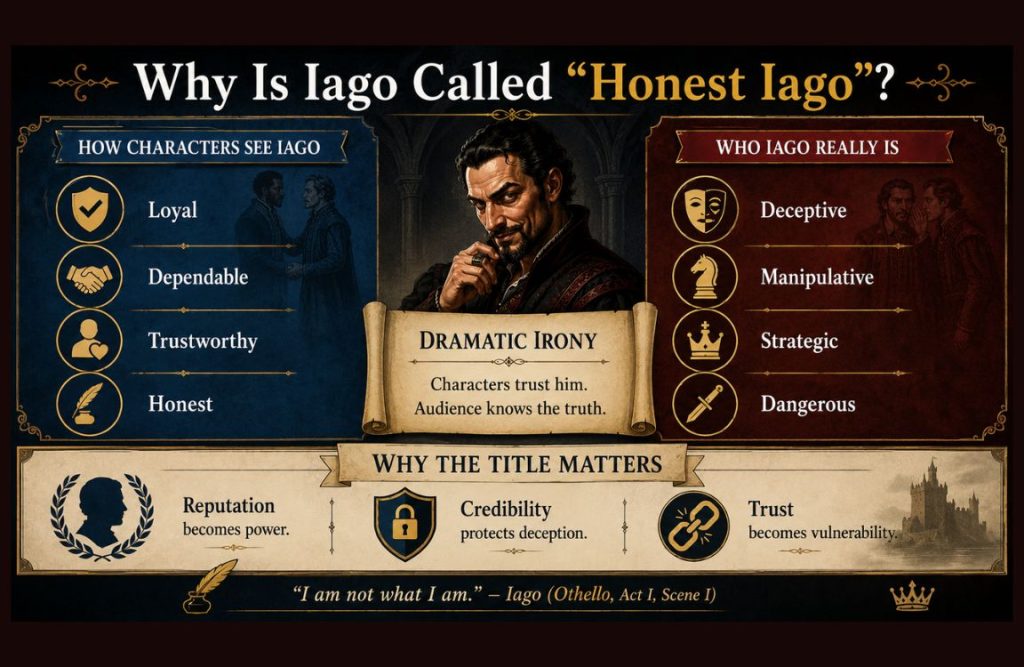
More importantly, the repeated title creates one of Shakespeare’s most powerful examples of dramatic irony. While characters accept Iago’s words without question, the audience recognises the danger hidden beneath his respectable image. Each repetition widens the gap between appearance and reality.
The title also demonstrates how reputation can become a form of power. Because others assume Iago is truthful, they stop examining his claims critically. Shakespeare, therefore, presents trust not only as a virtue but also as a potential vulnerability.
Iago as Shakespeare’s Ultimate Villain
Critics often regard Iago as Shakespeare’s most terrifying villain because of the way he combines intelligence with moral emptiness. He does not rely on force or official authority. Instead, he reshapes how others perceive reality.
i) Iago as a Machiavellian Villain
Iago is frequently described as a Machiavellian villain because he values success above morality. Every action serves a strategic purpose, and ethical concerns rarely persuade his decisions.
His ability to adapt to changing circumstances makes him especially dangerous. When obstacles appear, he adjusts his plans rather than abandoning them. This flexibility allows him to retain influence even when events threaten to move beyond his expectations.
ii) What Makes Iago Evil?
Iago’s evil lies not simply in the harm he causes but in the deliberate nature of his choices. He understands the consequences of his actions, yet repeatedly chooses deception, manipulation, and cruelty.
Unlike tragic heroes who fall through error or weakness, Iago acts with clear intention. Shakespeare presents a form of evil rooted not in uncontrolled passion but in conscious moral corruption.
iii) Iago vs Othello
The contrast between Iago and Othello helps explain the tragedy’s power.
| Iago | Othello |
| Manipulates | Trusts |
| Deceives | Believes |
| Creates Jealousy | Suffers Jealousy |
| Controls Others | Loses Control |
Their differences drive the conflict. Iago actively constructs false appearances, while Othello accepts them as reality. The tragedy emerges when calculated deception collides with genuine confidence.
Iago’s Most Important Relationships
Examining Iago’s relationships reveals different aspects of his character. Rather than simply advancing the plot, these connections expose his attitudes toward trust, power, ambition, and human nature.
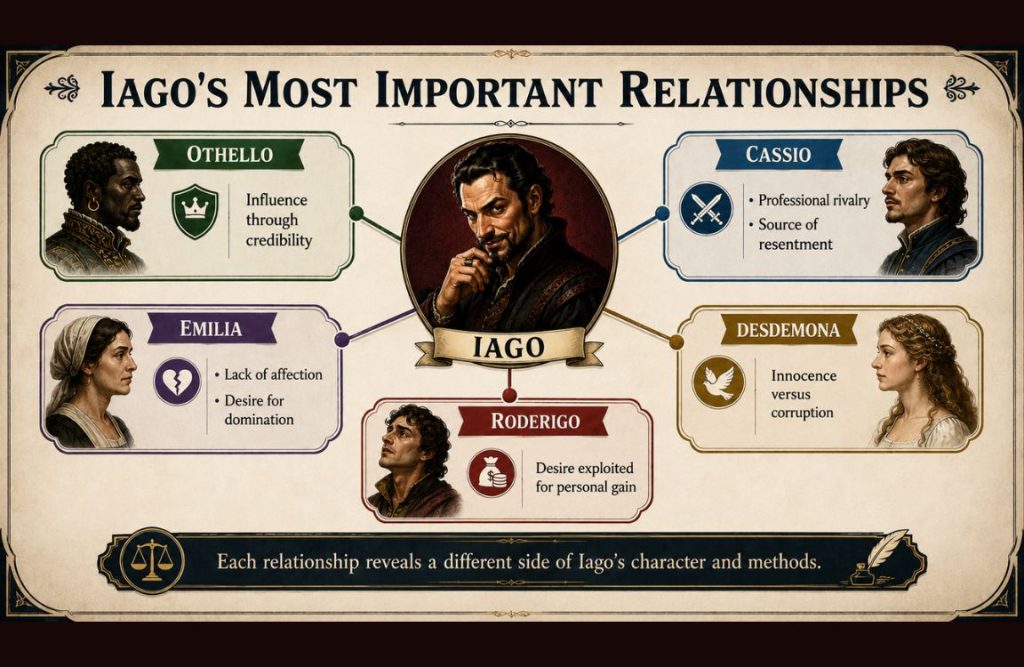
i) Iago and Othello
This relationship demonstrates how completely Iago relies upon credibility as a source of influence. Othello’s confidence in him allows influence to succeed without threats or coercion.
ii) Iago and Cassio
Professional rivalry defines their connection. Cassio’s promotion becomes a constant reminder of Iago’s wounded pride and exposes the depth of his resentment.
iii) Iago and Emilia
Their marriage reveals Iago’s inability to value genuine human connection. His contempt extends even to the person closest to him, suggesting that domination matters more to him than affection or loyalty.
iv) Iago and Desdemona
Desdemona represents the innocence and integrity that stand in sharp contrast to Iago’s deceit. Their relationship highlights one of the play’s central conflicts: goodness confronted by corruption.
v) Iago and Roderigo
Roderigo illustrates how easily desire can be exploited. Their relationship exposes Iago’s tendency to treat people as instruments rather than individuals.
What Happens to Iago at the End of Othello?
At the end of Othello, Iago’s deception is finally exposed when Emilia reveals the truth about the handkerchief. In response, Iago kills her, is arrested by the authorities, refuses to explain his actions, and is taken away to face punishment.
Unlike Othello, Iago does not die. Instead, he survives to endure disgrace and the consequences of the tragedy he created.
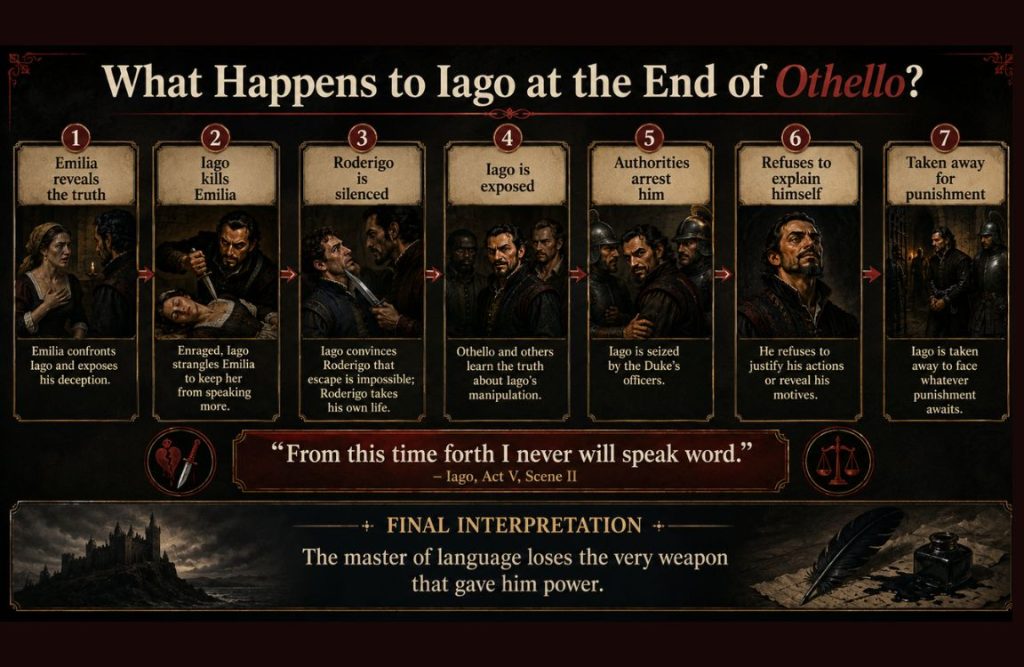
As the plot unravels, Iago also kills Roderigo to silence a dangerous witness who could reveal his involvement in the conspiracy against Cassio and Othello. When Emilia exposes the source of the handkerchief, she appears as an even greater threat, prompting Iago to murder her as well.
His final words, “From this time forth I never will speak word,” are especially striking. The play’s greatest manipulator ends in silence, refusing explanation and leaving his motives partly unresolved.
The moment is particularly significant because Shakespeare removes the very tool that has given Iago power throughout the play: language.
Major Quotes by Iago and Their Meaning
Iago’s language is one of his greatest weapons. These famous quotations reveal his deceptive mindset, his understanding of human weakness, and the methods he uses to influence others throughout Shakespeare’s tragedy.
“I am not what I am.”
This declaration functions as a warning to the audience. Long before other characters recognise the danger, Iago openly admits that appearance and reality do not match. The line establishes him as a character defined by performance and concealment.
“Men should be what they seem.”
The irony here is delicious. The least trustworthy character in the play lectures others about honesty. The statement highlights the gap between public reputation and private reality, one of the drama’s central concerns.
“Trifles light as air
Are to the jealous confirmations strong
As proofs of holy writ.”
Here, Iago demonstrates a sophisticated understanding of human psychology. Small details gain enormous significance when viewed through the lens of jealousy. The quote explains why weak evidence can be persuasive when emotions overwhelm reason.
“Thus do I ever make my fool my purse.”
Spoken about Roderigo, this line exposes Iago’s cynical view of relationships. He values people according to their usefulness and sees confidence as something to abuse. The remark offers a glimpse into his contempt for those around him.
However, more than any weapon, Iago relies on language. Shakespeare turns conversation itself into a source of danger and shows how words can reshape reality.
Why Iago Still Matters Today
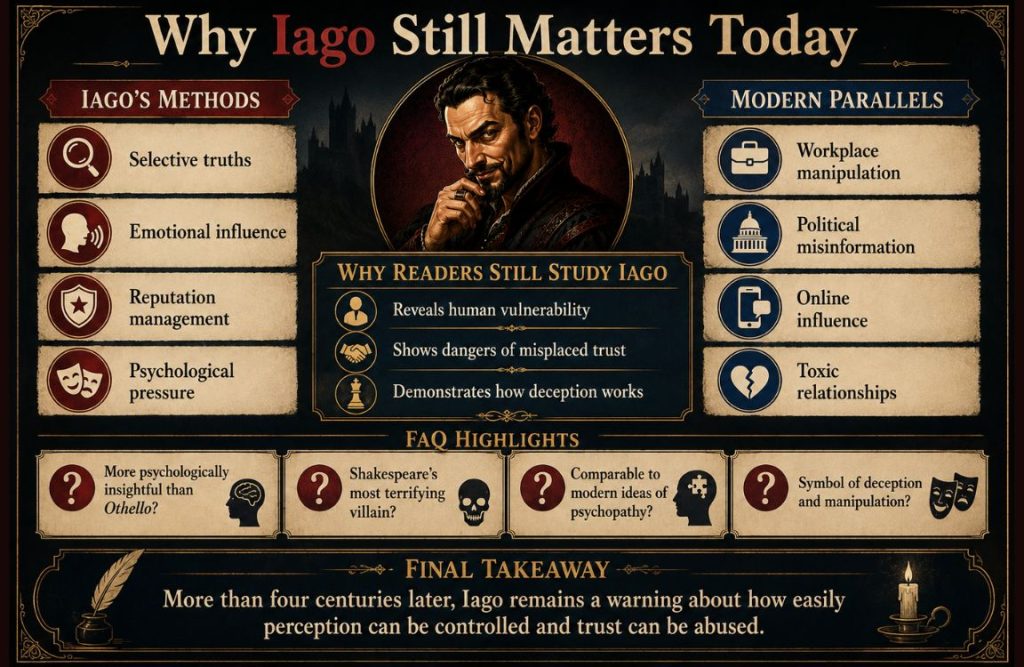
Iago belongs to the early seventeenth century, yet his methods feel surprisingly modern. Misinformation spreads through selective truths. Gaslighting encourages people to question their own perceptions. Emotional engineering often succeeds without threats or authority.
Many readers are surprised to discover that Iago rarely relies on obvious lies. Instead, he encourages others to reach damaging conclusions for themselves. Similar tactics appear in workplaces, politics, online spaces, and personal relationships.
His story endures because it exposes vulnerabilities that remain deeply human. More than four centuries later, Iago continues to serve as a warning about manipulation and the dangers of misplaced trust.
FAQs:
Is Iago more intelligent than Othello?
Iago displays greater psychological insight and strategic thinking, but intelligence takes many forms. Othello possesses courage, leadership, and considerable experience. The tragedy emerges because one man understands how to misuse human weakness while the other struggles to detect it.
Why is Iago considered Shakespeare’s most terrifying villain?
Many villains use force, but Iago works through credibility and psychological pressure. He enters minds rather than battlefields. His ability to steer decent people toward self-destruction creates a form of evil that feels disturbingly realistic and timeless.
Is Iago a psychopath?
Shakespeare wrote centuries before modern psychology, so no clinical diagnosis is possible. However, Iago’s lack of remorse and emotional detachment, combined with his apparent enjoyment of suffering, have led many readers and critics to compare him to a psychopath.
What Does Iago Symbolize?
Iago symbolizes the destructive power of deception and manipulation. He demonstrates how appearances can conceal dangerous intentions and how emotional leverage, when combined with credibility, can alter the meaning people attach to ordinary events and destroy lives.
Conclusion:
As a teacher, I find that students rarely forget Iago because Shakespeare never allows him to become entirely understandable. Throughout the play, Iago destroys lives not through force but through psychological insight, identifying weaknesses and turning ordinary doubts into devastating consequences.
Shakespeare supplies possible explanations for Iago’s behaviour but carefully avoids settling on a single answer. Yet no explanation fully accounts for the scale of his cruelty. That uncertainty is part of what makes Iago so disturbing.
More than four centuries later, he continues to force readers to confront one of literature’s most unsettling questions: how much evil can be explained, and how much remains beyond explanation?