When students ask me why Iago is jealous of Othello and Cassio, I tell them that Iago envies Cassio’s promotion, resents Othello’s authority, suspects Othello of sleeping with Emilia, and gradually turns wounded pride into calculated revenge.
No single grievance fully explains his hatred. Shakespeare deliberately layers several motives, leaving Iago’s jealousy open to debate. That complexity makes him one of literature’s most fascinating villains.
In this guide, we’ll explore why Iago is jealous of Othello and Cassio through close analysis of the play, key quotations, and critical interpretations to understand how jealousy develops into manipulation, revenge, and tragedy.
Why Is Iago Jealous of Othello and Cassio?
There is no simple answer to this question. Iago resents Othello for promoting Cassio, suspects him of sleeping with Emilia, envies his authority, and exploits his trusting nature. Each grievance contributes something, but none fully explains his behaviour.
As the play unfolds, these grievances accumulate rather than replace one another. Most critics therefore see Iago’s jealousy as a mixture of professional resentment, wounded pride, revenge, and an increasing appetite for power.
Together, these forces explain why Iago is jealous of Othello and Cassio, even though they never remove the mystery surrounding his character.
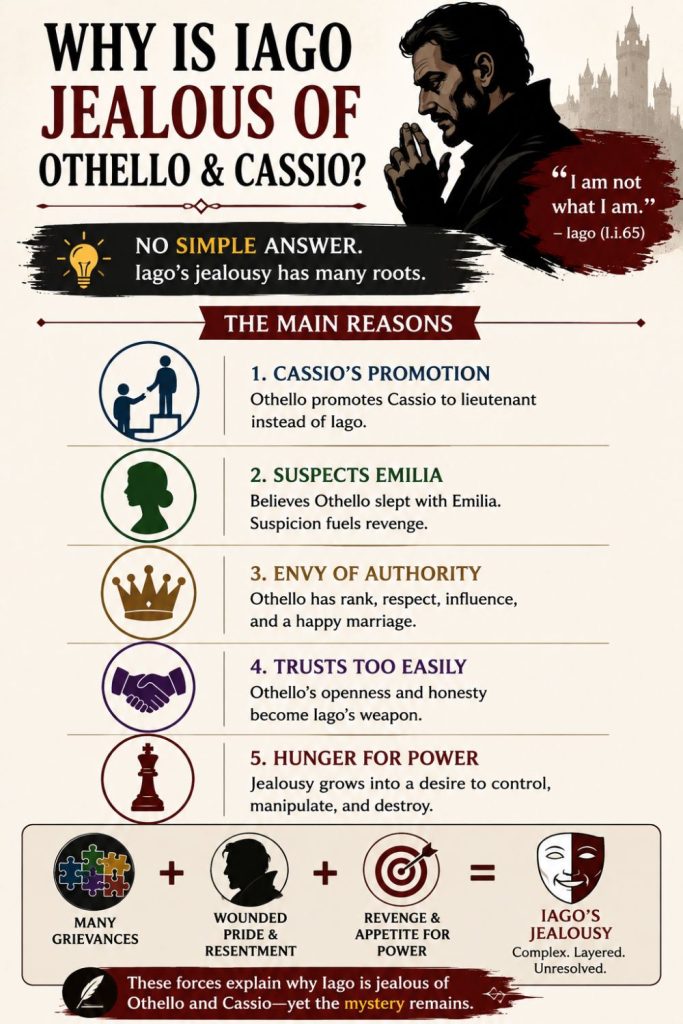
Table of Contents
Is Iago Really Jealous?
Yes, but jealousy is only the beginning. His resentment begins with Cassio’s promotion, deepens through suspicions about Emilia, and expands into envy of Othello’s authority, reputation, and marriage.
By the middle of the play, those feelings have developed into something more destructive than ordinary envy.
Professional, sexual, social, and psychological jealousy all shape Iago’s thinking. Yet bitterness gradually gives way to a desire to control other people’s lives. Jealousy sparks his revenge, but manipulation soon becomes its own reward.
Why Is Iago Jealous of Othello?
Iago’s hatred of Othello cannot be traced to any one cause. Shakespeare presents several overlapping grievances, each revealing a different aspect of Iago’s jealousy. Together, they explain why Iago is jealous of Othello.

i) Othello Promotes Cassio Instead of Iago
Iago’s bitterness first surfaces after Othello appoints Michael Cassio as lieutenant. Feeling passed over, he protests, “I know my price; I am worth no worse a place.”
He dismisses Cassio as a man of “mere prattle without practice,” arguing that military experience has been overlooked in favour of theory. To Iago, the promotion is not just a career setback but a public insult to his worth.
ii) Iago Suspects Othello Slept With Emilia
Iago next claims, “It is thought abroad…” that Othello has been intimate with Emilia. Although he admits he has no proof, he chooses to believe the rumour.
Whether genuine or convenient, this suspicion gives Iago another excuse for revenge. Shakespeare shows how imagined betrayal can become as powerful as real betrayal.
iii) Othello Possesses Everything Iago Wants
Othello commands authority, respect, loyalty, and a happy marriage. To Iago, he embodies everything he believes he deserves.
His hostility therefore extends beyond the lost promotion. Othello’s success, reputation, and influence deepen Iago’s envy, helping explain why his hatred grows so intense.
iv) Othello Trusts Too Easily
Iago also recognises Othello’s greatest weakness: his trusting nature. As he observes, “The Moor is of a free and open nature,” believing people to be honest because they appear so.
Where others see generosity, Iago sees opportunity. Othello’s openness becomes the weakness Iago exploits, turning jealousy into calculated manipulation.
Why Is Iago Jealous of Cassio?
Although Othello becomes Iago’s ultimate target, Cassio is the immediate cause of his grievance. Understanding why Iago is jealous of Cassio reveals how personal disappointment develops into a larger plan for revenge.

i) Cassio Receives the Promotion
Cassio’s appointment as lieutenant ignites Iago’s envy. He believes years of loyal military service have been ignored in favour of someone whose strengths lie in theory rather than battlefield experience.
Every success Cassio enjoys reminds Iago of the recognition he believes was unfairly denied.
ii) Cassio Represents Everything Iago Lacks
Cassio is educated, courteous, respected, and socially polished. Iago, by contrast, depends on manipulation rather than reputation to achieve his goals.
His wounded pride therefore extends beyond the promotion. Cassio’s effortless popularity highlights the qualities Iago envies but cannot naturally command.
iii) Cassio Becomes the Perfect Scapegoat
Iago rarely suggests that Cassio has personally wronged him. Instead, Cassio is valuable because he is useful.
By placing him at the centre of fabricated accusations, Iago turns him into the perfect pawn for destroying Othello’s marriage and reputation.
Cassio is less a personal enemy than a strategic victim, showing that calculation, not hatred alone, drives Iago’s actions.
Who Is Iago More Jealous of: Othello or Cassio?
Iago is jealous of both men, but in different ways. Cassio becomes the target of his professional humiliation because he receives the promotion Iago wanted.
Othello, however, represents everything Iago envies: authority, respect, influence, and a happy marriage.
While Cassio sparks Iago’s jealousy, Othello becomes its ultimate target, making his hatred far deeper and more destructive.
Are Iago’s Motives Consistent?
One reason Iago’s character analysis continues to fascinate readers is that his motives refuse to stand still. As the play progresses, he adds new explanations for his hatred without abandoning the earlier ones, making it impossible to identify one decisive cause.
| Motive | Evidence | Convincing? |
| Promotion | High | ✔ |
| Emilia | Medium | ? |
| Cassio | High | ✔ |
| Desdemona | Low | ? |
| Power | Very High | ✔ |
Rather than presenting one fixed motive, Shakespeare allows Iago’s explanations to accumulate throughout the play. That shifting pattern helps explain why Iago’s jealousy remains one of the most debated questions in Othello.
What Does “Motiveless Malignity” Mean?
The Romantic critic Samuel Taylor Coleridge famously described Iago’s wickedness as “motiveless malignity.” By this, he meant that Iago’s evil ultimately exceeds any explanation the play provides.
Many modern critics take a different view. They argue that Iago does have recognisable motives- promotion, jealousy, revenge, and ambition- but none fully explains his actions.
The real puzzle is not the absence of motives but their insufficiency. Shakespeare offers several possibilities while refusing to make any single one completely satisfying.
Is Jealousy Iago’s Real Motivation, or Just an Excuse?
Jealousy undoubtedly fuels Iago’s actions, but it may not be the whole story. Throughout his soliloquies, he repeatedly introduces fresh grievances, almost as if he is searching for reasons to justify what he already intends to do.
Seen this way, jealousy becomes less a complete explanation than a convenient justification.
Beneath it lies an even stronger impulse: the satisfaction of directing other people’s lives, reshaping their relationships, and controlling events from the shadows.
Shakespeare’s Message About Jealousy
Shakespeare contrasts Iago’s calculated jealousy with Othello’s manipulated jealousy. Iago deliberately creates suspicion to control others, while Othello tragically believes the lies and loses self-control.
The play shows that jealousy is not merely an emotion but a destructive force that deceives, corrupts, and destroys those who place trust in false appearances.
Key Quotes About Iago’s Jealousy
These quotations capture the major stages of Iago’s thinking and provide strong textual evidence for essays.
| Quote | Meaning |
| “I know my price” | Wounded ambition after Cassio’s promotion |
| “It is thought abroad” | Bases revenge on suspicion rather than proof |
| “Make the Moor thank me” | Manipulation disguised as loyalty |
| “Trifles light as air” | Jealousy turns small details into convincing proof |
| “Divinity of hell!” | Evil disguised as goodness |
FAQs:
Does Iago ever express regret for his actions?
No, Iago doesn’t express regret. Even when his plans are exposed, he remains cold, defiant, and silent, refusing to explain his motives. This lack of remorse proves his sociopathic nature.
What does Iago’s jealousy reveal about human nature?
Iago’s jealousy reveals the darker side of human nature, like insecurity, envy, and the desire for power. It also warns us, telling how unchecked emotion leads to all destruction.
What modern psychological concepts apply to Iago’s jealousy?
Iago’s jealousy embodies narcissism, Machiavellianism, and malignant envy. His lack of empathy, manipulative tactics, and need for control align with dark psychology and show how insecurities can lead to destruction.
Is Iago jealous or simply evil?
He is undoubtedly jealous, yet envy alone cannot explain his behaviour. Shakespeare combines resentment, calculation, revenge, and psychological manipulation to create a villain of unusual complexity.
Conclusion:
Answering why Iago is jealous of Othello and Cassio means recognising that Shakespeare deliberately resists a simple explanation. Cassio’s promotion, suspicion about Emilia, envy of Othello’s authority, and wounded pride all contribute to his hostility, yet none fully explains his cruelty.
Jealousy ignites his revenge, but his desire for power and control ultimately drives the tragedy.
That unresolved complexity is precisely why Iago remains one of Shakespeare’s most compelling, disturbing, and endlessly debated villains.