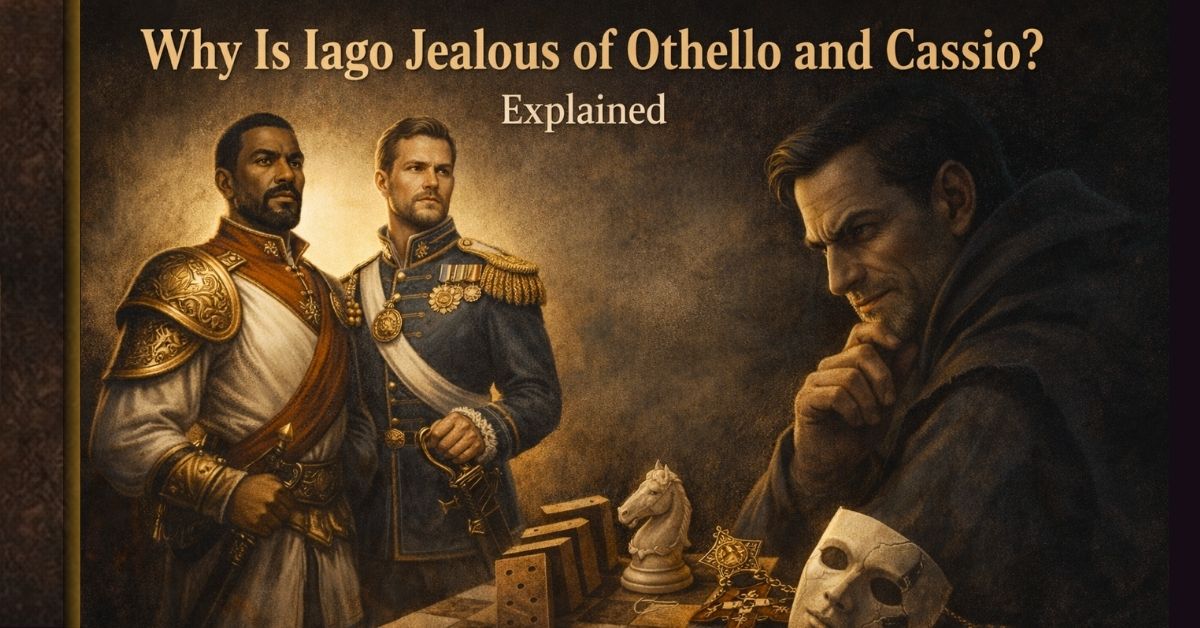
Jealousy, that infamous “green-eyed monster,” doesn’t just creep into Shakespeare’s Othello. It devours it from the inside out. Every time I teach this play, I remind my students that jealousy isn’t a side note in the story; it’s the beating heart of Othello’s tragedy. In this essay on jealousy in Othello, I’ll explore how this emotion grows from quiet suspicion into full-blown destruction.
What fascinates me most is how Shakespeare turns a noble general- respected, rational, and in love- into a man consumed by insecurity. Othello’s jealousy isn’t born overnight; it’s planted by Iago’s cunning lies, watered by societal prejudice, and fueled by Othello’s own doubts. Each deceit tightens the noose around his reason until love turns to rage, and trust turns to tragedy.
By the end, jealousy isn’t just Othello’s weakness. It’s the weapon that unmakes him. So, let’s dive deeper into how Shakespeare uses jealousy to unravel character, power, and identity, and see what this “green-eyed monster” teaches us about human vulnerability.
Table of Contents
Understanding Jealousy in Othello: Insights from an Essay on Jealousy in Othello
Before we dissect the causes and consequences, it’s worth asking: why jealousy? Shakespeare could have chosen any flaw, but jealousy offers the perfect stage for human weakness. It’s irrational yet relatable, a feeling we justify even as it destroys us. In this essay on jealousy in Othello, we uncover how Shakespeare transforms a passing emotion into a consuming force that reshapes identity, turning strength into fragility and love into ruin.
Feelings of Insecurity and Vulnerability in Othello: The Root of Jealousy
Whenever I teach Othello, I tell my students that jealousy doesn’t simply appear. It’s born from fear, from that quiet voice whispering, “I’m not enough.” And Othello hears that voice loudly. Despite being a celebrated general, he’s constantly reminded that he’s different, a Moor in a white Venetian world. In this essay, we see how that difference becomes both his pride and his curse.
Othello’s race makes him an outsider, but his marriage to Desdemona, a white noblewoman, magnifies that sense of not belonging. As scholar Ania Loomba explains in Shakespeare, Race, and Colonialism, Othello’s love is sincere, but it’s shadowed by fear: the fear that he isn’t “good enough” for her, that her love might not endure the judgment of society.
And then comes Iago, that expert puppeteer of insecurity. When Iago slyly suggests that Desdemona might prefer someone of “her own clime, complexion, and degree” (3.3), he doesn’t plant jealousy out of nowhere. He waters what was already there. Othello’s mind, disciplined by war but vulnerable in love, starts to spiral. His jealousy becomes less about proof and more about self-doubt.
Philosopher Stanley Cavell, in The Claim of Reason, puts it beautifully: Othello’s jealousy isn’t only about Desdemona’s supposed betrayal. It’s about his belief that he could never truly deserve her love. That’s what makes his fall so heartbreaking.
In the end, Othello’s tragedy isn’t just that he’s deceived by Iago. It’s that he’s already deceived by his own insecurities, a man who conquers nations but can’t conquer the fear that he’s unworthy of being loved.

How Othello’s Military Identity Fuels His Jealousy and Downfall
While teaching Othello, I like to remind my students: you can take the soldier out of the battlefield, but you can’t always take the battlefield out of the soldier. In this essay, that’s exactly what we see Othello’s soldier’s mind waging war where love should live.
As a general, Othello has been trained to act decisively, to see threats clearly, and to eliminate them without hesitation. That kind of thinking saves lives in war, but it ruins them in love. When Iago whispers poison into his ear, presenting Desdemona’s supposed infidelity as an attack on his honor, Othello doesn’t stop to question motives or evidence. He reacts as a warrior would to an ambush: swiftly and absolutely. “Farewell the tranquil mind! Farewell content!” (3.3), he cries, and with those words, we watch a man surrender his peace before the real battle even begins.
Scholar Carol Thomas Neely, in Broken Nuptials in Shakespeare’s Plays, notes that Othello’s rigid, soldierly logic leaves him unequipped for love’s gray areas. He lives in a world of orders and obedience, not whispers and emotions. So when confusion strikes, he falls back on what he knows- control, authority, and certainty- all of which crumble when applied to the human heart.
And then, there’s the deeper layer: race and belonging. As Ania Loomba points out in Shakespeare, Race, and Colonialism, Othello’s military success doesn’t erase his outsider status in Venetian society. Beneath his armor lies a man painfully aware that victory on the battlefield doesn’t guarantee acceptance at home. That awareness feeds his insecurity, making Iago’s lies sound less like deceit and more like confirmation of what he already fears.
In the end, Othello’s greatest strength, his disciplined soldier’s identity, becomes his greatest vulnerability. He fights for honor when he should have fought for understanding. And in doing so, he proves a haunting truth: even the bravest warriors can lose the quiet battles within their own hearts.
Gender and Jealousy in Othello: What Emilia and Desdemona Reveal
Whenever I take a class on Othello, I always pause at the women. Because while everyone rushes to talk about Othello’s rage or Iago’s cunning, I like to ask my students, what about Desdemona and Emilia? Their voices might be softer, but their truths cut far deeper. In any essay on jealousy in Othello, it’s impossible to ignore how Shakespeare uses these two women to expose the gendered face of jealousy- one shaped by patriarchy, silence, and power.
Let’s start with Emilia- the truth-teller, the realist, the woman who’s seen too much and is tired of pretending otherwise. When she calls jealousy a “monster / begot upon itself” (3.4), she’s not just describing Othello. She’s describing an entire system that feeds on male insecurity and control. Emilia’s wisdom feels almost modern, like the friend who hands you a cup of tea and says, “It’s not you, it’s definitely him.” She knows that men’s mistrust often says more about their egos than about women’s behavior. And when she declares, “It is their husbands’ faults / If wives do fall” (4.3), she’s shaking the foundation of every double standard her world rests on.
Desdemona, on the other hand, breaks our hearts precisely because she doesn’t fight the system. She believes in love so deeply that she can’t see its corruption. Her words, “I never did / Offend you in my life” (5.2), are both a plea and a tragedy, innocence speaking to madness. And when she whispers “Nobody; I myself” (5.2) in her final breath, it’s as if Shakespeare lets her die with grace but also with the weight of every silenced woman in literature.
Scholars like Carol Thomas Neely argue that Shakespeare is using these women to critique a world where women’s loyalty is prized but their voices are dismissed. And Ania Loomba goes further, showing how Desdemona’s purity and Emilia’s defiance reveal the limited agency women have in both love and society. Together, they teach us that jealousy in Othello isn’t just personal. It’s political. It’s a mirror held up to a patriarchal world where men’s fear of losing control becomes women’s loss of life and liberty.
So, when I look at Emilia and Desdemona, I don’t just see victims. I see visionaries, two women separated by personality but united by courage. Through them, Shakespeare turns jealousy into something far more complex than emotion. He turns it into a lens that reveals the imbalance of power, love, and truth.
How Othello’s Military Identity Breeds Jealousy
Every time I revisit Othello with my students, I can’t help but see the general not just as a tragic hero but as a man trained for war, trapped in the wrong battlefield, the battlefield of love. In this essay, I would like to ask: what happens when a soldier, built for command and clarity, faces the murky world of emotion and trust? The answer, of course, is Othello- torn apart by the very discipline that once made him great.
Othello’s entire worldview is forged in the military. He trusts authority, values loyalty, and acts decisively in crises. On the battlefield, those traits make him a hero. At home, they make him vulnerable. When Iago begins his whisper campaign, he doesn’t just spin lies. He stages a tactical attack. He frames Desdemona’s supposed betrayal as a breach of honor, something a soldier can’t ignore. And Othello, unable to see shades of gray, reacts as a general would to a threat: swiftly, completely, and tragically. “Farewell the tranquil mind! Farewell content!” (3.3)- that line always feels like the sound of armor cracking.
Scholar Carol Thomas Neely, in Broken Nuptials in Shakespeare’s Plays, captures this perfectly. She argues that Othello’s soldierly logic, so effective in war, fails him in love, where ambiguity reigns and certainty is dangerous. Love, after all, doesn’t follow rank or rulebooks. It demands vulnerability, something Othello’s uniform never taught him to handle. His military discipline, his emotional restraint, and his obsession with control leave him defenseless against Iago’s chaos.
And there’s another layer, one that makes his downfall even more painful. As Ania Loomba reminds us in Shakespeare, Race, and Colonialism, Othello’s identity as a Moor and an outsider compounds his insecurities. No matter how many wars he wins, he’s never fully at home in Venetian society. Beneath the medals and titles, there’s a quiet fear: I don’t belong. Iago doesn’t create that fear. He weaponizes it.
So, when jealousy strikes, it’s not just about love or betrayal. It’s about identity. Othello’s military mindset, his racial isolation, and his emotional repression collide to form the perfect storm. And what began as the discipline of a soldier ends as the downfall of a man- proving that even heroes can lose the war within their own hearts.
The Seed of Jealousy: Iago’s Manipulation
Every time, I would like to ask my students in class while teaching Othello, “Who really destroys Othello- Iago or jealousy itself?” And without fail, someone says, “Both.” They’re right. Iago doesn’t create jealousy out of thin air. He simply waters the seed that was already there. In this essay, we see how Shakespeare turns Iago into the perfect gardener of doubt, planting suspicion so carefully that Othello ends up nurturing it himself.
Iago is one of those characters who seems to enjoy destruction for its own sake. As critic Harold Bloom once said in Shakespeare: The Invention of the Human, Iago doesn’t need a reason to ruin lives. Chaos is his art form. Sure, he grumbles about Cassio’s promotion, but his real motive runs deeper: he loves watching the world burn, especially when he’s holding the match.
What makes Iago so chilling is his precision. He doesn’t shout lies. He whispers half-truths. He plays with timing, tone, and trust like a seasoned actor. When Othello demands “ocular proof” (3.3), Iago is ready. He’s already turned the innocent handkerchief into Exhibit A of betrayal. That handkerchief, once a token of love, becomes a trap of illusion. It’s as if Iago reaches inside Othello’s mind and paints over reality itself.
I often tell my students that Iago isn’t just manipulating Othello. He’s directing a play inside Othello’s imagination. Every glance, every silence, every missing object becomes part of Iago’s twisted script. And by the time Othello believes what he sees, it’s already too late. Jealousy has blurred the line between truth and invention.
So, when we look at Iago, we’re not just studying villainy. We’re studying how language itself can destroy trust. Shakespeare gives us a terrifying reminder: sometimes the most dangerous weapon isn’t a sword, but a well-placed whisper.
The Handkerchief: Symbolism and the Proof of Love and Betrayal
Ah, the handkerchief- Shakespeare’s tiniest prop with the loudest consequences! Whenever I discuss it in class, I like to hold up a tissue and ask, “Can this really destroy a marriage?” My students laugh, but that’s exactly what happens in Othello. This delicate piece of cloth becomes the smoking gun of jealousy, the so-called “ocular proof” that blinds Othello to reason.
In this essay, the handkerchief deserves its own spotlight. It isn’t just a love token. It’s the symbol of everything Othello fears: loss, betrayal, and unworthiness. Given to Desdemona as a sign of his affection, it’s embroidered with strawberries, representing purity and passion intertwined. But once Iago steals it from Desdemona (through the unsuspecting Emilia), that same symbol of love turns into evidence of infidelity. It’s poetic irony at its cruelest- he proves Othello demands become the weapon that destroys him.
What I find fascinating, and what I love pointing out to students, is how Othello’s obsession with the handkerchief mirrors our human need for certainty. We all want something we can hold- proof that love is real, faith is returned, trust is justified. But Shakespeare reminds us that love doesn’t live in objects; it lives in understanding. Othello’s tragedy lies in his confusion between the two.
When Othello cries, “Give me the ocular proof!” (3.3), it’s not just a demand. It’s desperation speaking. He wants logic to explain emotion, evidence to justify fear. But jealousy doesn’t work that way. It’s the monster that grows in the absence of proof, not because of it.
So, the handkerchief isn’t just a prop. It’s the perfect metaphor for the human heart- fragile, easily stained, and disastrously misplaced. And that, dear students, is why Othello remains timeless: it shows us how something as small as a handkerchief can unravel a man, a marriage, and a mind.
Jealousy as a Catalyst for Othello’s Downfall
Whenever I teach this part of Othello, I like to pause and ask my students: At what point does love stop being love and start becoming obsession? That’s exactly what we see unravel before our eyes in Othello.
Othello begins the play as a man of poise- the calm commander, the respected general, the loving husband. But once jealousy creeps in, it’s as if a fog settles over his reason. The very qualities that made him noble- decisiveness, confidence, passion- turn inward, corroding him from the inside. When Desdemona pleads on Cassio’s behalf, Othello’s heart twists her kindness into proof of betrayal. “O, hardness to dissemble!” (3.4) he cries, already convinced of her deceit.
And then comes the infamous handkerchief- that tiny thread that unravels everything. Once a token of love, it becomes the “ocular proof” he clings to like a drowning man clutching driftwood. Even when Desdemona swears her innocence, Othello can no longer hear the truth through the roaring voice of jealousy.
Scholar Carol Thomas Neely, in Broken Nuptials in Shakespeare’s Plays, offers a brilliant insight: Othello’s downfall is not just personal. It’s cultural. Venetian society divides women into saints or sinners, leaving no space for human complexity. So, when Othello doubts Desdemona’s perfection, his world collapses.
By the time Othello whispers, “I kissed thee ere I killed thee” (5.2), he’s not merely confessing his guilt. He’s exposing the twisted knot of love and destruction that jealousy ties within him. His suicide feels inevitable, not as punishment, but as tragic proof of how jealousy devours everything- reason, love, identity- until nothing remains but silence.
Jealousy, in Othello, isn’t just a feeling. It’s a contagion. It spreads from Iago’s whispers to Othello’s soul, turning a hero into his own executioner. And that’s why, even centuries later, Shakespeare’s green-eyed monster still chills us- because we recognize its shadow in ourselves.
The Destructive Power of Jealousy in Othello
When I ask my students, “Who’s the most jealous character in Othello?”, someone always blurts out, “Othello, obviously!” And yes, that’s true, but I always smile and say, “Look closer.” Because jealousy in Othello spreads like a fever. No one walks away untouched.
Let’s start with Iago, Shakespeare’s smooth-talking villain, who doesn’t just feel jealousy. He feeds on it. He’s envious of Cassio’s promotion and bitter about being overlooked, but that’s only the surface. As Harold Bloom once put it, Iago doesn’t need much of a reason to destroy. He loves chaos for its own sake. And, just like Othello, he too swallows rumors without proof, convinced that Othello has been “too familiar” with Emilia. See the pattern? In Othello, jealousy thrives on imagination more than evidence.
Then there’s poor Roderigo- forever lovesick, forever jealous. He’s so blinded by his longing for Desdemona that Iago can lead him around like a puppet. Even Emilia, often overlooked, harbors her own resentment- not over romance, but over how cruelly men treat women. She sees the unfairness of it all and finally, heartbreakingly, speaks truth to power.
Othello’s jealousy, however, burns deeper and darker. It’s not just personal. It’s social. As scholar Edward Said argues in Orientalism, Othello’s identity as an outsider in a racially prejudiced Venice makes him painfully insecure. Every whisper of doubt cuts twice as deep. His jealousy is laced with centuries of bias, feeding on the fear that he doesn’t truly belong.
And who suffers most from all this? The women. Desdemona and Emilia become casualties of male pride, insecurity, and a world that judges them by impossible standards. Through their silence and suffering, Shakespeare shows us that jealousy doesn’t just destroy love. It destroys justice, trust, and humanity itself.
So when Othello falls, he’s not falling alone. He’s dragging down everyone caught in jealousy’s orbit- proving that, in Shakespeare’s world and ours, jealousy isn’t just an emotion. It’s a weapon.
Conclusion: What Othello Teaches Us About the Fire of Jealousy
Every time I close my copy of Othello, I can’t help but sit with the silence that follows. Because Shakespeare doesn’t just end a play. He ends a man. Othello’s downfall reminds us that jealousy isn’t born in a vacuum. It’s shaped by everything- race, gender, pride, and power. His tragedy begins not in Desdemona’s supposed betrayal, but in his own quiet fear of not being enough- a fear that Iago simply fans into flame.
I often tell my students that jealousy in Othello works like fire: it starts with a single spark- a whisper, a doubt- but once it catches, it consumes reason, love, and even identity. Othello, the calm and noble general, becomes a storm of suspicion and rage. And that transformation isn’t just personal. It’s societal. It’s what happens when prejudice and insecurity go unspoken for too long.
Iago may light the match, but Othello supplies the fuel- his insecurities, his outsider status, and the crushing pressure of a world that sees him as different. Shakespeare shows us how easily fear can masquerade as certainty, how love can curdle into obsession when trust collapses.
So, what’s the modern lesson? For me, Othello is more than a tragedy about jealousy. It’s a mirror. It asks us to confront the hidden fears that twist our perception of others and ourselves. If jealousy in Othello destroys a marriage and a man, unchecked jealousy in our own lives can quietly do the same.
Maybe the real takeaway is this: before we accuse, doubt, or spiral, we must pause, breathe, and question whether the monster is truly in front of us or quietly growing within.
“Want to see how jealousy affects every character in the play? Read my full analysis on Jealousy in Othello.
| Reference | Link |
| Shakespeare: The Invention of the Human by Harold Bloom (Riverhead Books, 1998) | Wikipedia summary (Wikipedia) Google Books preview (Google Books) |
| Broken Nuptials in Shakespeare’s Plays by Carol Thomas Neely (Yale University Press, 1985) | Open Library entry (Open Library) JSTOR listing (JSTOR) |
| Shakespeare, Race, and Colonialism by Ania Loomba (Oxford University Press, 2002) | Oxford University Press page (Oxford University Press) Google Books preview (Google Books) |
| A Grammar of Motives by Kenneth Burke (University of California Press, 1969) | UC Press page (University of California Press) PhilPapers catalog (PhilPapers) |
| The Claim of Reason: Wittgenstein, Skepticism, Morality, and Tragedy by Stanley Cavell (Oxford University Press, 1979) | Google Books entry (Google Books) PhilPapers listing (PhilPapers) |
| Edward W. Said ‘Orientalism’ (1979 pdf) Monoskop | Edward W. Said ‘Orientalism’ (1979 pdf) Monoskop |
| Orientalism- Edward W. Said Google Books | Orientalism – Edward W. Said Google Books |
| Penguin Random House- Orientalism PenguinRand | Penguin Random House – Orientalism PenguinRand |