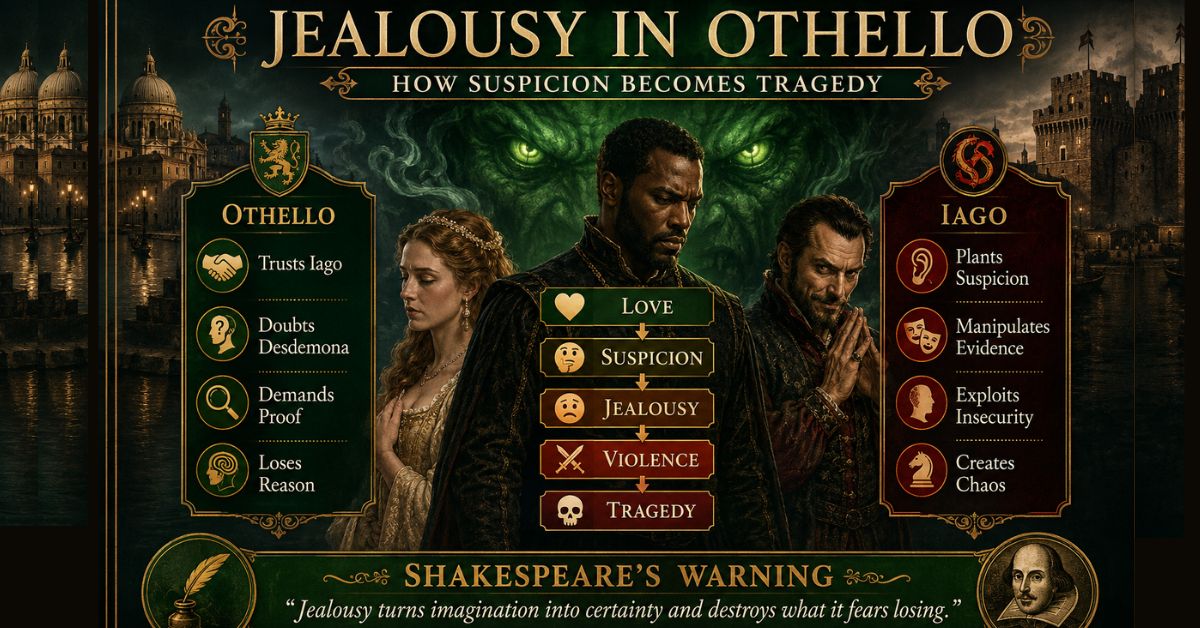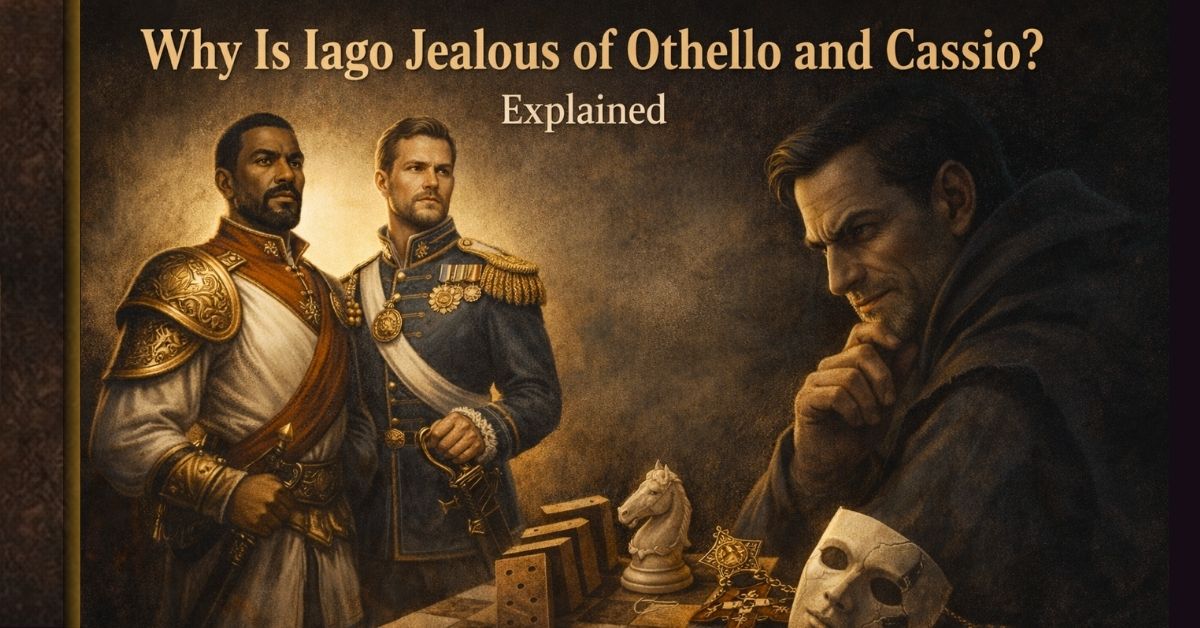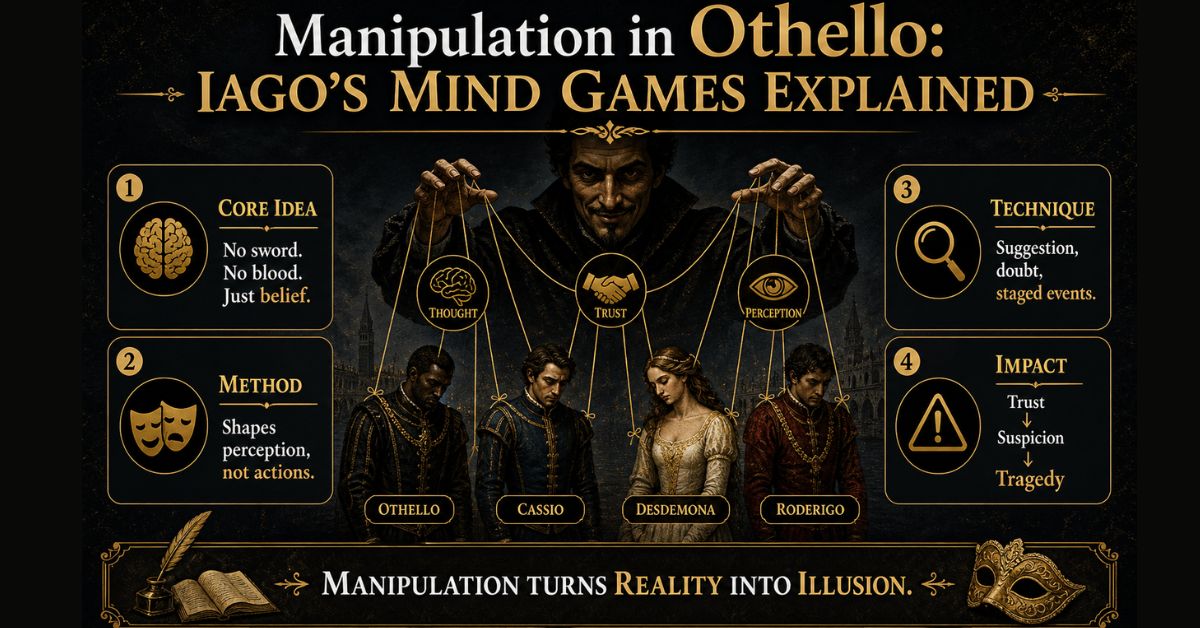
Iago never lifts a sword. He rewrites reality. That’s the line I give my students, and it usually earns a pause. Because in Othello, the real weapon is not steel. It is a suggestion.
The tragedy unfolds not through visible violence, but through invisible influence. No blood. No blade. Just belief. This is why the manipulation in Othello matters so deeply: it turns trust into vulnerability and love into suspicion.
At the center stands Iago, not just a villain, but an architect of perception. His genius lies in making others believe they are thinking for themselves, while he quietly scripts their choices. When we examine Iago’s manipulation in Othello, we are not just studying a character. We are studying how easily reality can be bent.
And here’s the disturbing reality: the theme of manipulation in Othello is not confined to the stage. It reflects how fragile human judgment can be when guided by the wrong voice.
Table of Contents
What Is Manipulation in Othello?
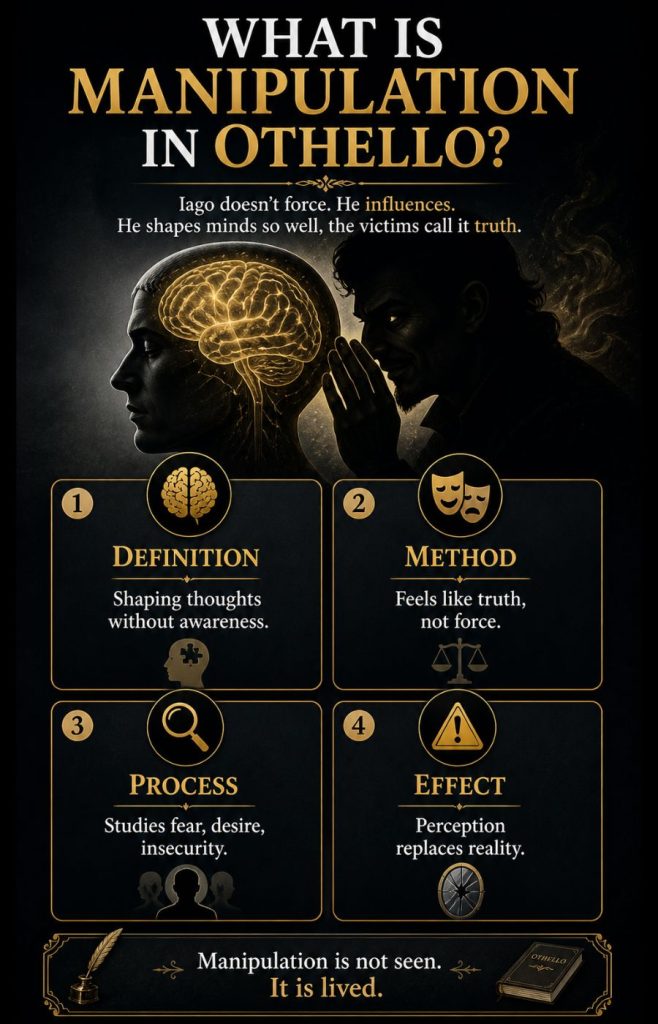
Let’s answer this the way examiners love, clearly and precisely. The manipulation in Othello is the deliberate shaping of another person’s thoughts, emotions, and actions without their awareness. It is not force. It feels like the truth. That’s the danger.
But here’s where the play becomes fascinating. The meaning of manipulation in Othello goes further. It operates through trust and exploitation. Iago studies insecurities, desires, and fears, then redirects them with subtle precision, all while maintaining his image as “honest Iago.”
Here’s the key insight I stress in my class: manipulation feels like self-discovery. Othello believes he uncovers the truth, guided by false “ocular proof.” Cassio believes he restores honor. Roderigo believes he pursues love. Each acts freely, yet each is controlled.
This is why the manipulation theme in Othello drives the tragedy. Emotions are weaponized, and meaning is reshaped until perception replaces reality.
And once perception changes, the outcome is no longer in the character’s hands.
Iago’s Character and Motivation
To understand manipulation, we must first understand the manipulator. This section explores Iago’s character, his psychology, and the uncomfortable question that haunts readers: why does he do what he does?
i) Iago as a Villain in Othello
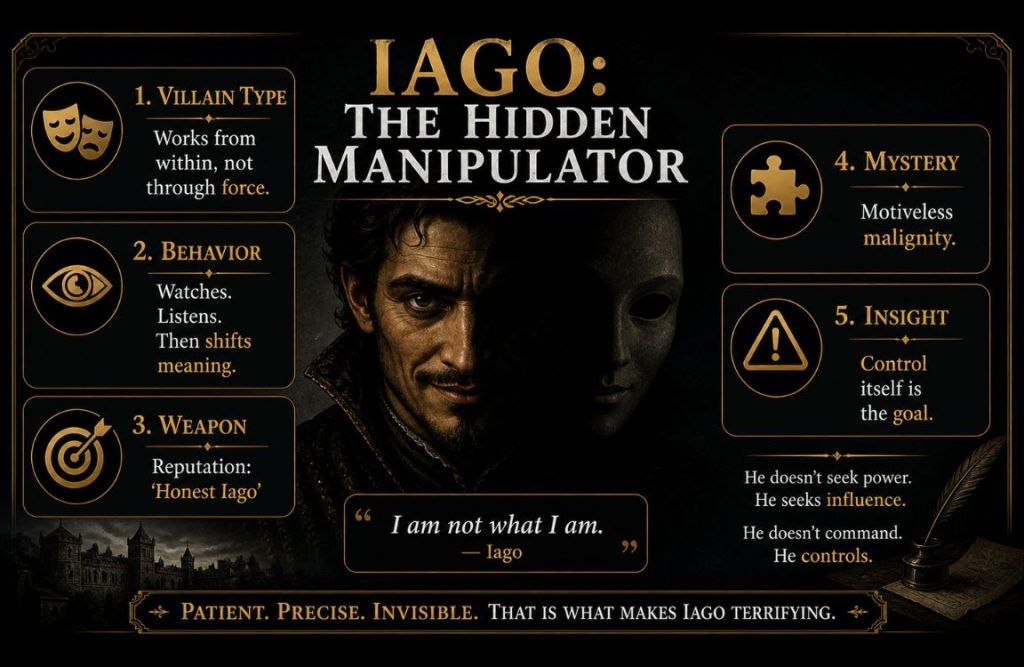
In any Iago character analysis, one thing becomes immediately clear: he is not a conventional villain. He does not rely on power or force. Instead, he operates with Machiavellian precision, manipulating from within.
What makes him dangerous is his patience. He watches. He listens. And when he speaks, who notices the shift?
As I often tell students, Iago doesn’t enter conversations. He adjusts them. A hint here, a question there, and suddenly, interpretation shifts.
His greatest weapon is his reputation as “honest Iago.” Others trust him completely, allowing him to exploit insecurities, especially Othello’s, without suspicion.
Here’s the unsettling truth: Iago is a puppet master who rarely appears controlling.
He destroys not through action, but through influence.
And that is what makes him terrifying, because the danger never looks like danger at all.
ii) Iago’s Motiveless Malignity
Now we reach one of the most debated ideas in Shakespearean criticism: Iago’s motiveless malignity, a term coined by Samuel Taylor Coleridge. It suggests that Iago’s evil lacks a clear, sufficient cause.
At first glance, this feels unsatisfying. Students often ask, “But what’s his reason?” Jealousy? Professional resentment? Suspicion? Yes, he offers all of these. But none fully explain the scale of destruction he creates.
Coleridge calls this “motive-hunting.” Iago invents reasons, not because they drive him, but because he needs to justify what he already desires.
Here’s the teaching insight: his motives do not lead to his actions. His actions generate motives.
That’s what makes him truly frightening. His pleasure lies in control itself, in reshaping interpretation.
A villain with a clear cause can be understood. One without it becomes limitless.
Iago’s Manipulation Techniques
Now we turn to the method. Iago’s success is not accidental. It is strategic. This section breaks down how he manipulates minds, language, and viewpoint, revealing the techniques that make his influence so devastatingly effective.

i) Iago’s Psychological Manipulation
At the core of psychological manipulation in Othello lies a powerful technique: planting ideas rather than imposing them. Iago never says, “Believe this.” Instead, he suggests, withdraws, and lets the mind complete the thought.
This is where my students pause in class. A hesitation, a careful “I may be mistaken…”, and suspicion begins. This is close to what we now call gaslighting: shaping interpretation until victims doubt their own judgment.
He studies emotional pressure points. With Othello, insecurity. With Roderigo, desire. With Cassio, reputation. He even weaponizes virtue, turning loyalty and trust into tools of destruction.
What’s most disturbing is this: his victims feel autonomous. They believe the conclusions are theirs.
That is manipulation at its highest level, control of thought itself.
ii) Iago’s Language and Deception
Language is Iago’s sharpest instrument. In Othello, language and manipulation are inseparable. Words do not describe reality. They construct it.
From the start, he signals this: “I am not what I am.” It is less a confession than a method. He speaks in fragments, questions, and suggestions, creating space others fill with fear.
While teaching, I ask my students to track what he says versus what is heard. The gap is where deception lives.
He also uses vivid, often crude imagery to provoke emotion and distort perception. Tone shifts constantly- loyal, cynical, sympathetic- depending on the listener.
Remarkably, he rarely lies outright. He rearranges truth.
And that is far more dangerous, because once half-truths are believed, they begin to feel like reality itself.
iii) Dramatic Irony in Othello
Dramatic irony in Othello occurs when the audience knows Iago’s true nature, while other characters trust him as “honest.” This gap creates powerful tension and deepens the tragedy.
We watch Othello misread events, believing the handkerchief proves betrayal, while we know it is staged. Desdemona’s innocence becomes heartbreaking because the audience sees the truth she cannot prove.
This becomes a key idea in my live session: manipulation depends not only on words, but on knowledge. The audience sees the whole picture; the characters see fragments.
So every action feels inevitable. We witness the truth clearly, yet remain powerless to stop the tragic consequences.
How Does Iago Manipulate Othello?
Let’s face the central question directly: how does Iago manipulate Othello? Not by attacking his strength, but by quietly weakening his certainty.
Othello begins composed, rational, and deeply trusting. That stability becomes Iago’s entry point. Using his reputation as “honest Iago,” he gains complete trust, then introduces doubt through subtle insinuations, “I like not that,” never accusing openly, but letting suspicion grow.
This is where jealousy and manipulation in Othello fuse into something dangerous. Iago exploits Othello’s insecurities, his outsider status, age, and fear of losing Desdemona’s love. Jealousy in Othello is not planted fully formed. It is nurtured slowly, fed by ambiguity rather than proof.
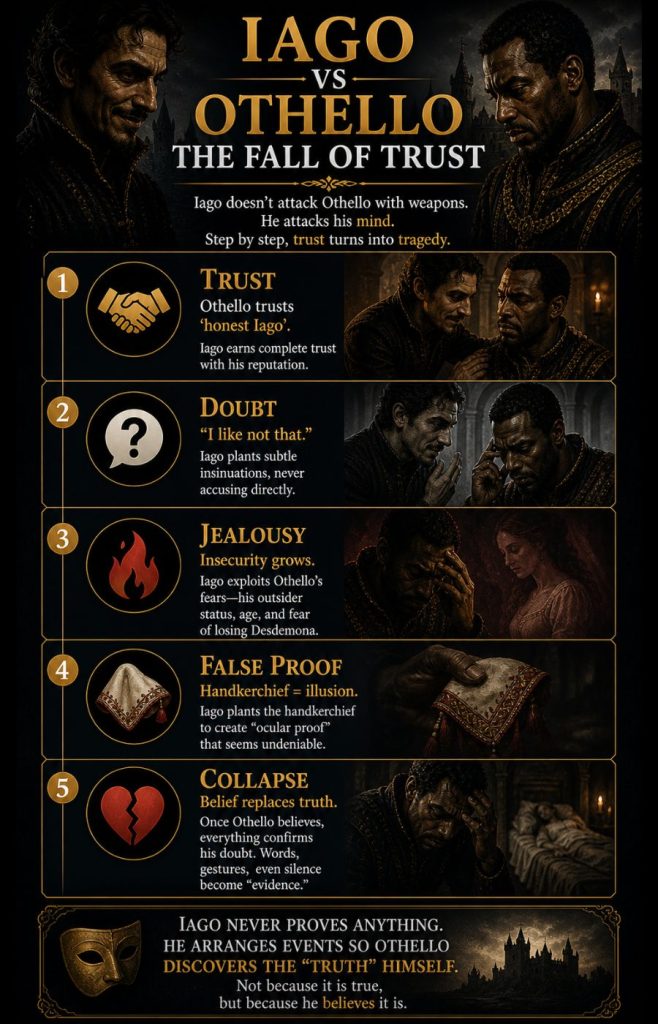
Then comes the handkerchief. In the classroom, I call it “evidence manufactured from innocence.” Once it leaves Desdemona’s possession, it stops being a token of love and becomes what Othello desperately seeks: confirmation. Iago plants it strategically, creating false “ocular proof” that seems undeniable.
Here’s the brilliance. Iago never proves anything. He arranges events, so Othello believes he discovers the truth himself. Each hint, each coincidence, reinforces the illusion.
And once Othello accepts that meaning, everything bends to fit it. Not because it is true, but because he believes it is. Words, gestures, even silence become evidence.
So the manipulation succeeds not because Othello is weak, but because he is human, seeking certainty in a world carefully distorted.
And Iago offers him something more dangerous than lies: a truth he cannot question.
How Does Iago Manipulate Cassio?
Now shift the focus. Iago manipulates Cassio not through jealousy, but through reputation.
Cassio’s identity rests on honor. He is polished, courteous, and respected. Iago sees this clearly and targets that image. Instead of attacking straightforwardly, he creates a situation where Cassio damages himself.
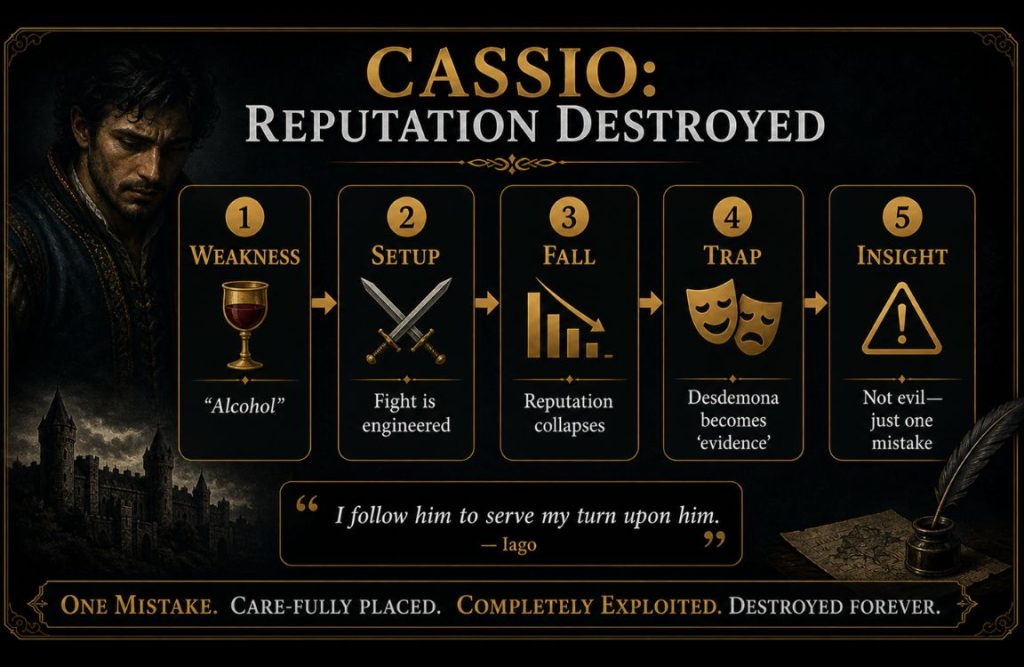
The method is calculated. In Act 2, Scene 3, Iago exploits Cassio’s weakness for alcohol, using social pressure to make him drink despite knowing his limits. With Roderigo’s help, he engineers a conflict, pushing the intoxicated Cassio into a fight with Montano. What appears as chaos is carefully designed.
Here’s the teaching moment: manipulation often works by nudging someone slightly off balance. Not into evil, but into error.
Once Cassio’s reputation collapses, Iago changes roles. He becomes the helpful advisor, urging Cassio to seek Desdemona’s support. This seems like recovery, but it is the trap.
Because Cassio’s attempts to regain honor become the very “evidence” Othello misreads.
Cassio believes he is fixing a mistake. He isn’t. He’s tightening the trap.
That is Iago’s precision— turning virtue into vulnerability, and recovery into ruin, without ever appearing responsible.
How Does Iago Manipulate Roderigo?
How does Iago manipulate Roderigo? He does it not through force, but through desire, turning hope into currency.
Roderigo wants one thing, Desdemona, and that single longing blinds his judgment. Iago feeds the fantasy, offering promises that keep him emotionally invested in an impossible outcome. That illusion becomes the lens through which he interprets every decision Iago suggests.
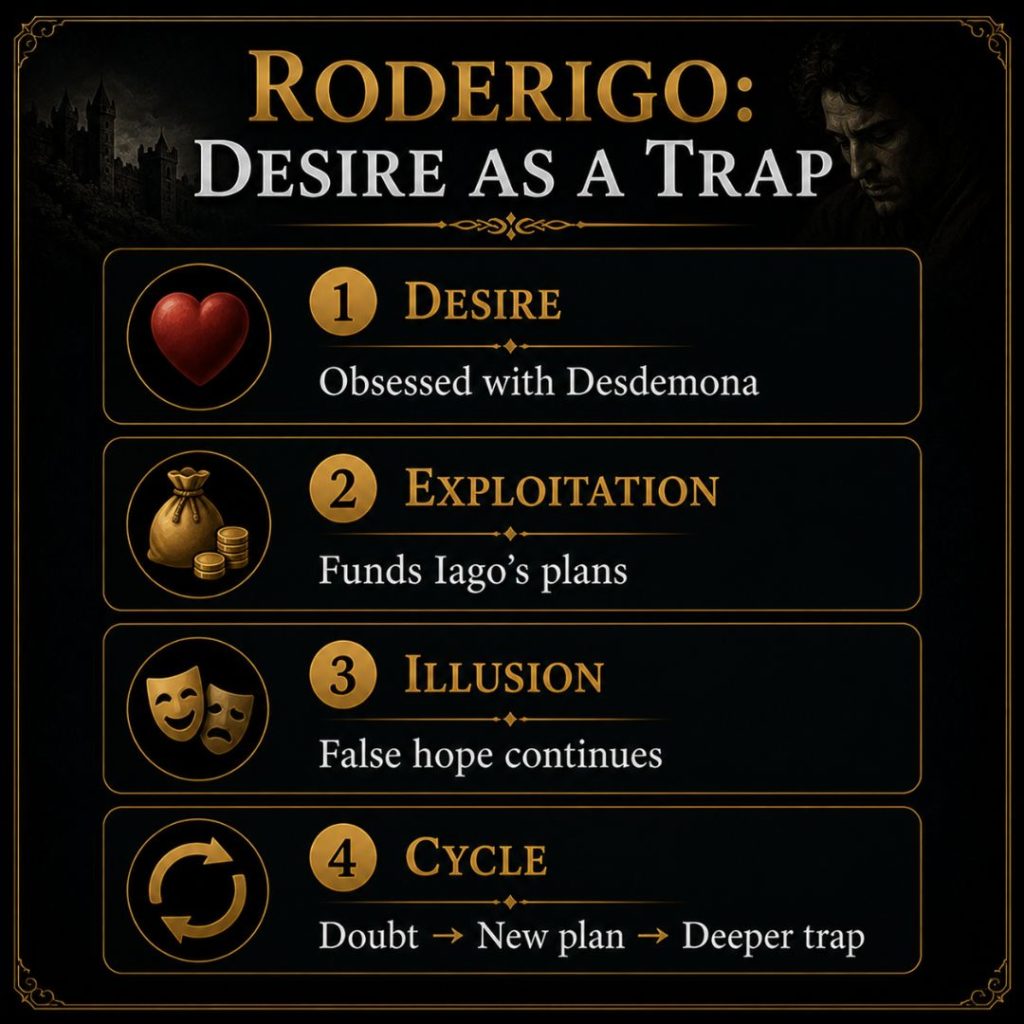
But the manipulation is not only emotional. It is financial. Iago repeatedly urges him to “put money in thy purse,” convincing Roderigo to fund schemes that never bring him closer to Desdemona. In my class, I stress this: manipulation thrives when desire outweighs reason.
When doubts surface, Iago redirects them with fresh plans- wake Brabantio, challenge Cassio, act again. Each step pulls Roderigo deeper into the plot, making him both victim and participant.
What makes this tragic is his complicity. By the end, Iago silences him to hide the truth.
How Does Iago Manipulate Desdemona?
Iago manipulates Desdemona not by controlling her actions, but by controlling how those actions are perceived. Desdemona operates from innocence, trust, and duty. When Cassio seeks her help, she responds with genuine kindness, believing she is restoring fairness. Yet within Iago’s design, this very goodness becomes dangerous.
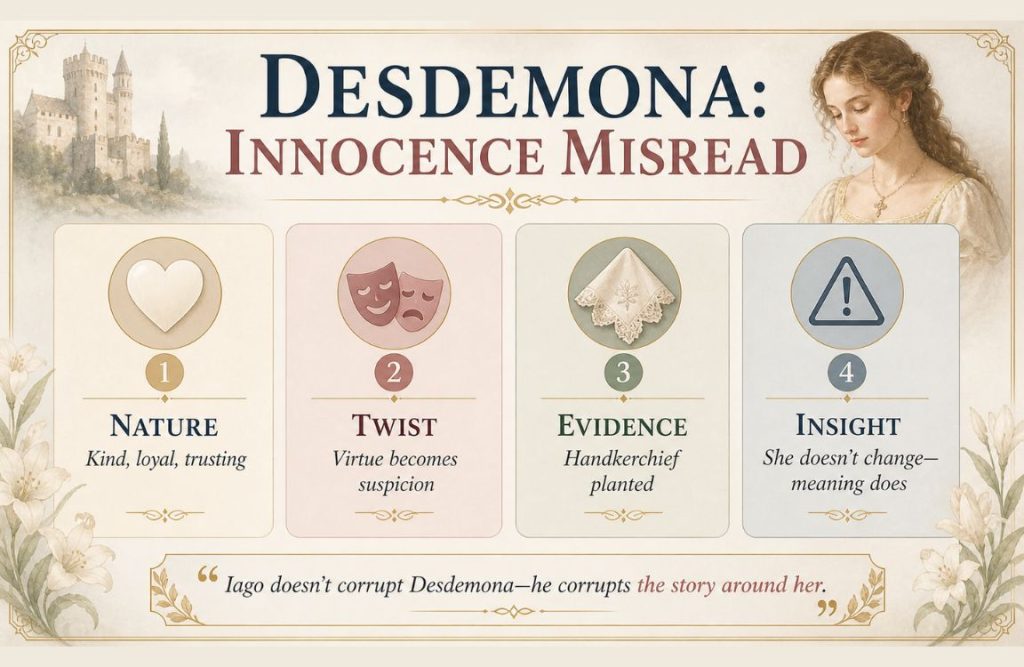
Here is the paradox I stress in live class: Desdemona does nothing wrong. And that is exactly why everything she does is misread.
Iago plans to “turn her virtue into pitch,” using her compassion as the very net that traps her. By urging Cassio to seek her support, he ensures she will plead his case, which Othello later interprets as proof of intimacy.
The manipulation deepens with the handkerchief, planted as false evidence, turning confusion into guilt. Even her honesty begins to sound rehearsed under suspicion.
This is what I emphasize in class: manipulation does not always alter the person; it alters the narrative around them. Desdemona remains constant, but meaning shifts around her.
And in that shift, innocence itself becomes evidence— without her ever knowing she has been rewritten inside Iago’s story.
How Does Iago Manipulate Emilia?
Now we come to a quieter, more subtle case. How does Iago manipulate Emilia? Not through grand schemes, but through everyday authority.
Emilia lives within a structure where obedience is expected. Iago understands this and never needs to force her. Instead, he relies on habit, expectation, and emotional distance.
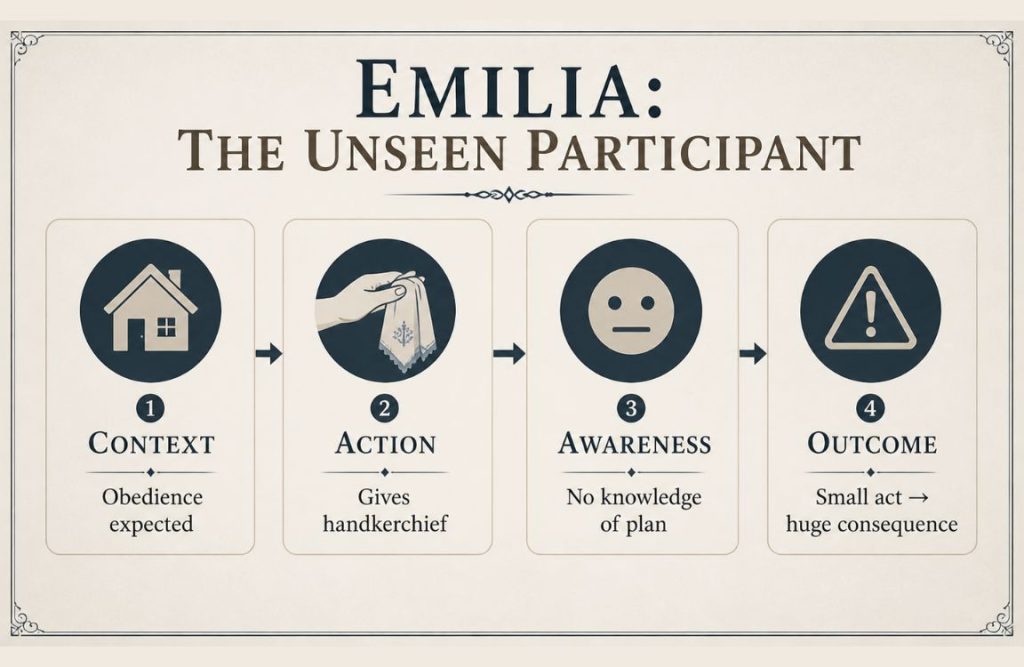
When she finds the handkerchief, her decision feels small. She gives it to him not out of suspicion, but out of a desire to please. That moment, so ordinary, so unremarkable, becomes catastrophic.
Here’s the teaching moment: manipulation often hides in routine. It does not always look like control. Sometimes, it looks like cooperation.
Iago never explains his intentions. He doesn’t need to. Emilia acts without seeing the larger design.
And that is what makes her role so tragic. She participates without understanding, contributes without intending, and only later recognizes the weight of her action.
By then, the consequences are already in motion.
And what once seemed like a simple act reveals itself as part of something far more destructive.
How Does Iago Manipulate Brabantio?
I often tell my students that Iago never argues. He precisely engineers reactions. He manipulates Brabantio by exploiting fear, racial prejudice, and paternal anxiety, turning a private marriage into a public crisis. In short, he scripts a drama where emotion outruns judgment completely.
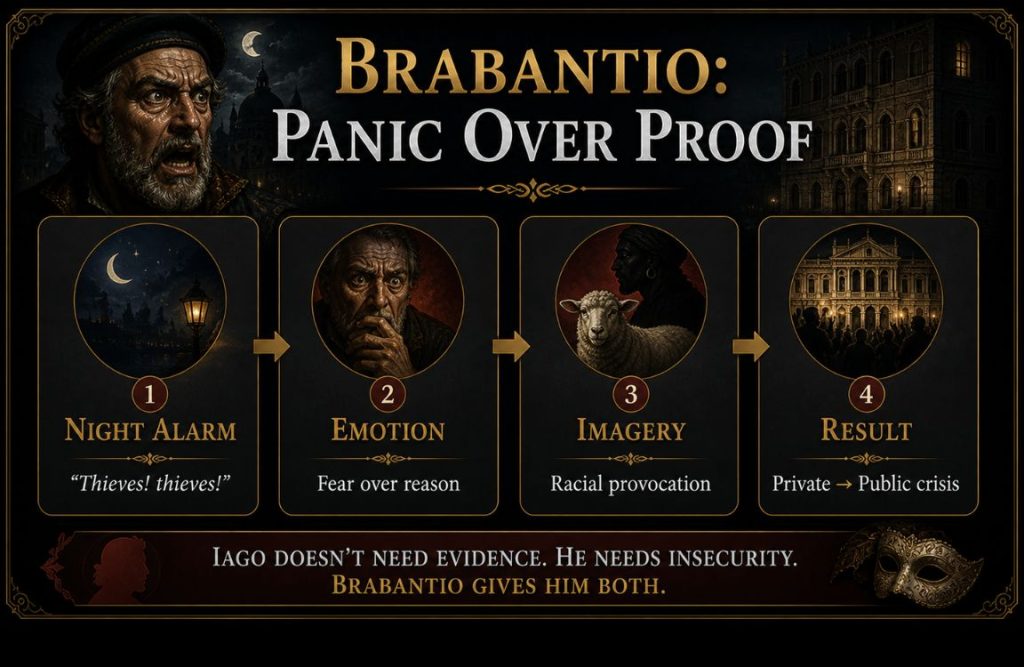
Picture the scene: a quiet Venetian night shattered by urgent cries. Brabantio, half-awake, hears “Thieves! thieves!” and is pushed into panic before he can think. This is deliberate. Why argue when panic works faster than proof?
Then comes the infamous imagery: “an old black ram is tupping your white ewe.” This is not a description; it is provocation. Race, sexuality, and disgust collide, ensuring Brabantio feels violated rather than informed.
Iago also works indirectly, hiding behind Roderigo. This distance protects him while intensifying urgency, making the accusation seem spontaneous and credible.
Finally, he targets Brabantio’s pride. By framing Desdemona’s elopement as a theft of honor and control, he pressures Brabantio to act publicly.
Brabantio abandons reason, suspects witchcraft, and escalates the issue.
Iago doesn’t rely on outright lies. He reshapes how events are understood, and that is far more dangerous.
How Does Iago Manipulate Montano?
I always remind my students that Iago’s genius lies in staging events, not issuing orders. Iago manipulates Montano by carefully staging Cassio’s downfall through alcohol, suggestion, and reputation. Rather than issuing commands, he shapes circumstances so that Montano believes he is acting responsibly, while actually stepping into a conflict Iago has already engineered from behind the scenes.
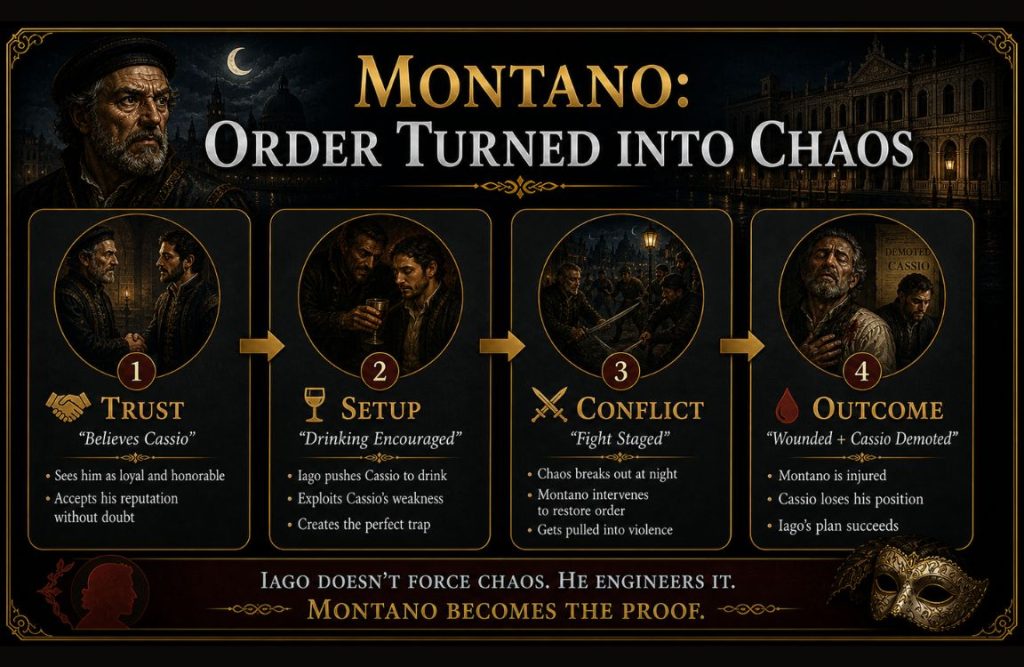
Shift to Cyprus: a military setting where order matters. Montano, the voice of authority, trusts Cassio’s professionalism- at least, at first glance.
Watch closely. This is manipulation through the environment.
Iago first plants doubt, feigning reluctance: Cassio is capable, he says, yet perhaps “has an infirmity.” Notice the tactic: hesitation makes the lie sound honest.
Then comes the setup. Cassio is encouraged to drink beyond his limit, not forced, just nudged, like a domino gently tipped. Meanwhile, Roderigo is positioned to provoke him.
What follows feels like chaos, but it’s carefully choreographed.
Montano steps in, believing he’s restoring order, unaware he’s walking into a trap. This is Iago at his most dangerous: he doesn’t control people explicitly; he controls the stage on which they act.
Montano is wounded, Cassio disgraced and demoted. A reputation collapses in minutes, clearing the path for deeper manipulation.
Iago controls outcomes by controlling situations, not people.
Key Quotes on Manipulation in Othello
Let’s step into the text, because exam answers breathe through evidence. When exploring quotes on manipulation in Othello, one line always earns a pause: “Men should be what they seem.” The irony is striking.
The speaker himself violates this principle, which quietly erodes our sense of trust and prepares us for a world where appearance cannot be believed.
Another moment worth holding onto: “I am not what I am.” This paradox does more than sound clever. It unsettles the idea of identity itself, suggesting that truth is unstable and that deception is not an exception, but a method.
Then comes the subtle warning: “O, beware, my lord, of jealousy.” It sounds protective, almost caring. Yet the phrasing plants the very fear it claims to resist, guiding Othello toward suspicion while making it feel self-generated.
And consider the cold efficiency of “A good wench; give it me.” The bluntness strips away emotion, reducing the moment to control and possession, revealing how easily people become tools within Iago’s design.
The pattern is clear: words do not just describe reality. They reshape it. And once thought is reshaped, action follows without resistance.
Deception, Jealousy, and Power in Othello
To fully grasp the play, we must connect its forces. Deception and manipulation in Othello do not exist in isolation. They work hand in hand with jealousy and power.
Think of it as a chain reaction. Deception introduces doubt. Manipulation guides that doubt. Jealousy intensifies it. And power determines who suffers from it.
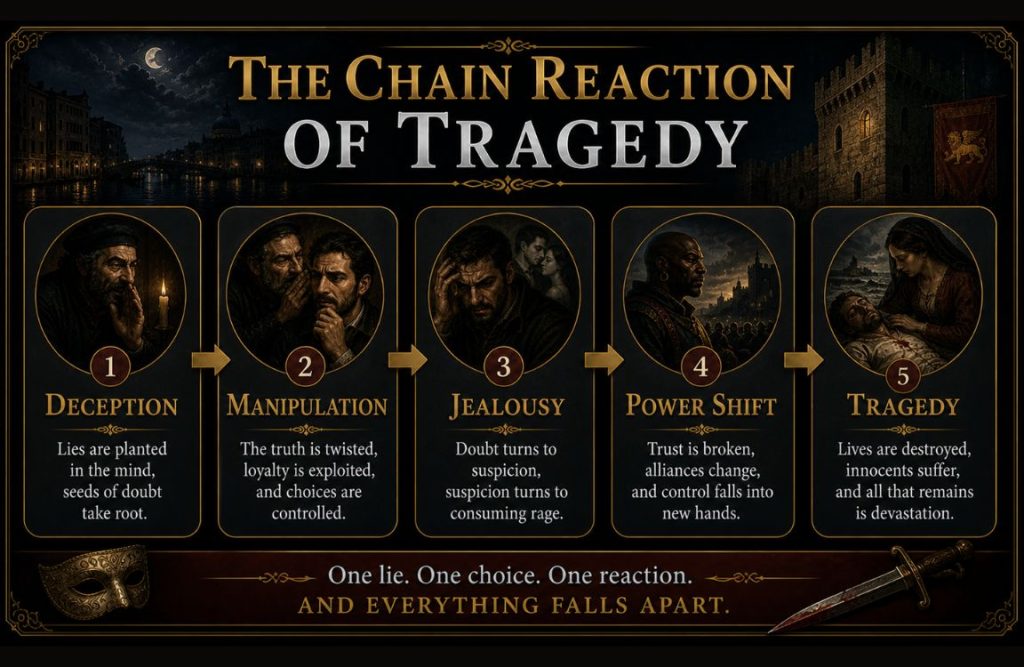
What fascinates students most is how invisible this process is. No one announces, “Now I will deceive.” Instead, it unfolds through ordinary interactions, conversations, gestures, silences.
Power and control in Othello are equally complex. Authority does not always belong to the highest-ranking character. In fact, the one with the least official power often exerts the greatest influence.
Here’s the key lesson I highlight to students: true control lies not in command, but in influence. The ability to shape the understanding outweighs the ability to give orders.
And when deception fuels jealousy, that influence becomes unstoppable.
What we witness is not just a personal downfall, but a system collapsing under distorted meaning, where truth is no longer recognized, and power shifts quietly into dangerous hands.
Why Manipulation Leads to Tragedy in Othello
Let’s confront the final question: why does manipulation inevitably lead to tragedy?
To explore the theme of manipulation, we must recognize its cumulative effect. A single lie may not destroy, but layered deception does. Each misinterpretation builds upon the last, until reality itself becomes unstable.
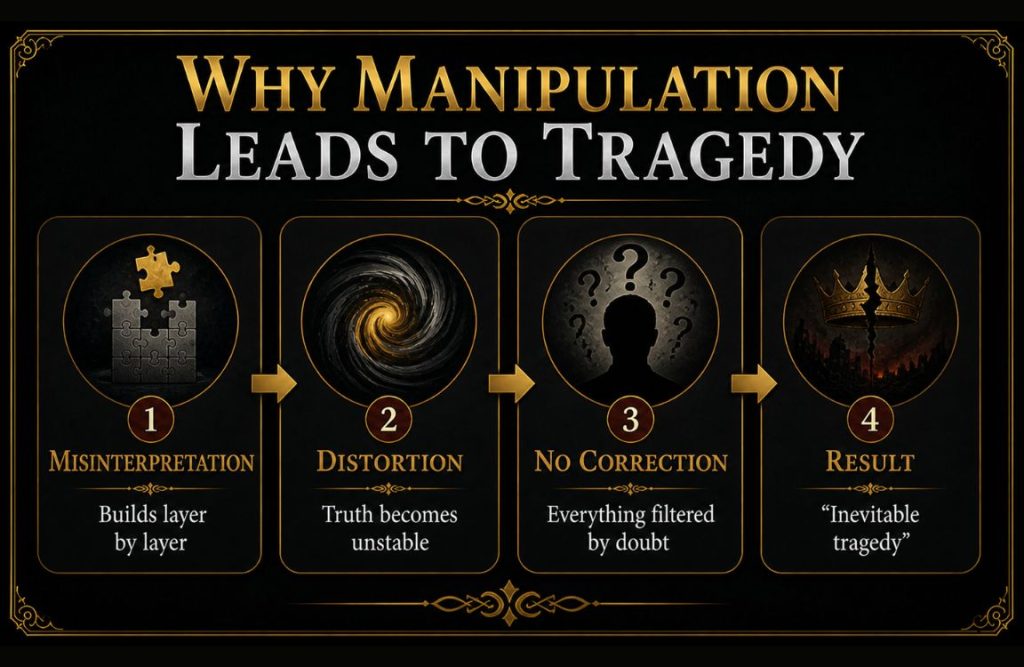
In teaching, this becomes a moment of clarity. Tragedy is not triggered by one decision, but by a sequence of distorted understandings. Characters act logically based on what they believe to be true. The problem is, the truth has been altered.
And once perception is compromised, correction becomes nearly impossible. Every attempt to restore clarity is filtered through suspicion.
So the tragedy unfolds not because characters choose wrongly, but because they are guided wrongly.
And when guidance itself is corrupted, the outcome is no longer within their control.
FAQs:
Is Iago aware of his manipulation techniques in Othello?
Yes, Iago demonstrates full awareness of his manipulation. He carefully plans each step, anticipates reactions, and adjusts strategies. His control is intentional, not accidental, making his actions calculated rather than impulsive or emotionally driven.
How does Shakespeare use language to show manipulation?
Shakespeare uses indirect speech, questions, and ambiguity. Characters interpret meanings beyond the words themselves. This gap between speech and understanding allows manipulation to operate subtly, shaping perception without direct statements or obvious lies.
Why is manipulation more powerful than violence in Othello?
Manipulation reshapes thought before action occurs. Violence ends conflict quickly, but manipulation controls decisions over time. In Othello, destruction happens because characters believe false realities, making manipulation more enduring and psychologically effective than force.
Does any character resist Iago’s manipulation successfully?
Emilia comes closest. Although initially unaware, she ultimately recognizes the deception and speaks out. Her resistance arrives late, but it proves that manipulation can be challenged once truth becomes clear and courage overrides fear.
How would Othello change without manipulation as a theme?
Without manipulation, the play would lose its psychological depth. Conflict would rely on direct action rather than perception. The tragedy would become simpler, removing the complex exploration of trust, influence, and human vulnerability that defines the play.
Conclusion:
By the end of Othello, what lingers is not just loss, but realization. The tragedy does not erupt from chaos. It is built. Quietly. Step by step through influence.
As a teacher, this is a moment where the conversation shifts. The play stops being distant and becomes uncomfortably familiar. Because manipulation in Othello is not loud or dramatic, it is subtle, persuasive, and often invisible.
We leave the play asking not only what happened, but how it happened so completely.
So here’s the thought to carry forward: Next time you read Othello, don’t ask who is guilty, ask who is being guided.
If this perspective changed how you see the play, share it. Discuss it. Challenge it.
And more importantly, keep reading closely, because in literature, as in life, the smallest suggestion can reshape everything.