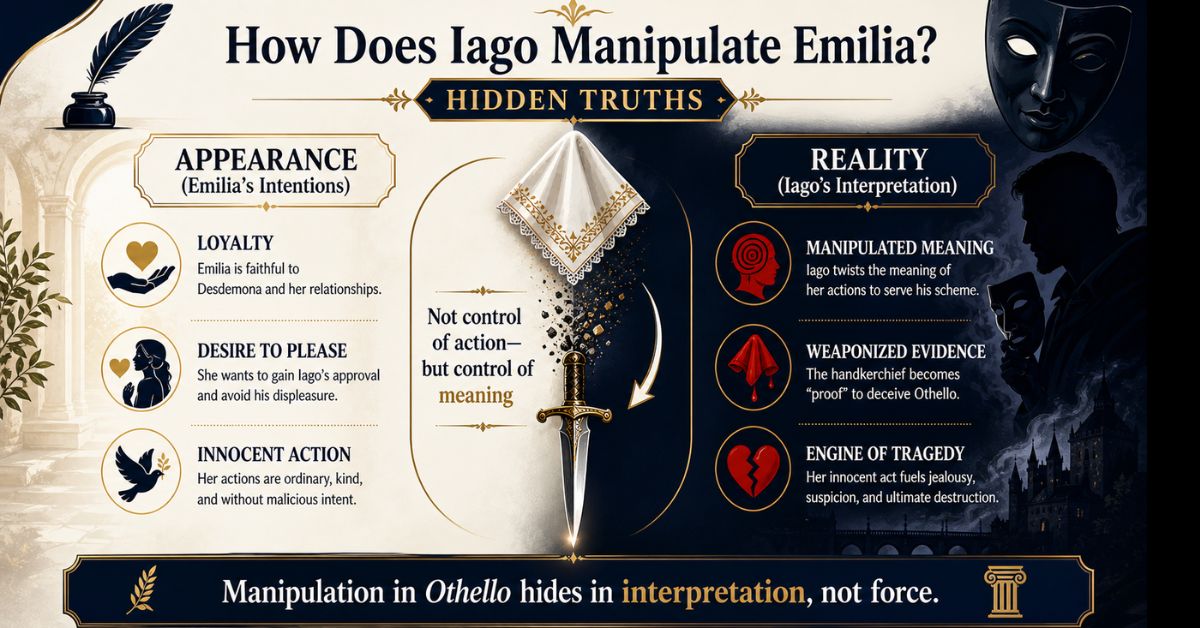
“What if the most dangerous manipulation isn’t control of actions, but control of meaning?”
Pause there for a second because that question unlocks Othello. When we ask, How does Iago manipulate Emilia, we expect dramatic commands, maybe threats, maybe force. But Iago is far more unsettling. He barely touches Emilia’s decisions. He reshapes how those decisions are understood.
Here’s the twist I tell my students: Emilia doesn’t change. Not at first. Her intentions remain ordinary, even kind. What changes is the interpretation of her actions, first in Iago’s mind, then in Othello’s, and finally in the tragic chain reaction we witness.
This is where Iago’s manipulation in Othello becomes almost surgical. He uses silence like a weapon, patriarchy like a shield, and suggestion like poison. No loud commands. No obvious control.
Just a quiet redirection of meaning. And that, as we’ll see, is far more dangerous than force.
Table of Contents
Who Is Emilia in Othello?
Let’s ground ourselves before judging her. Who is Emilia in Othello?
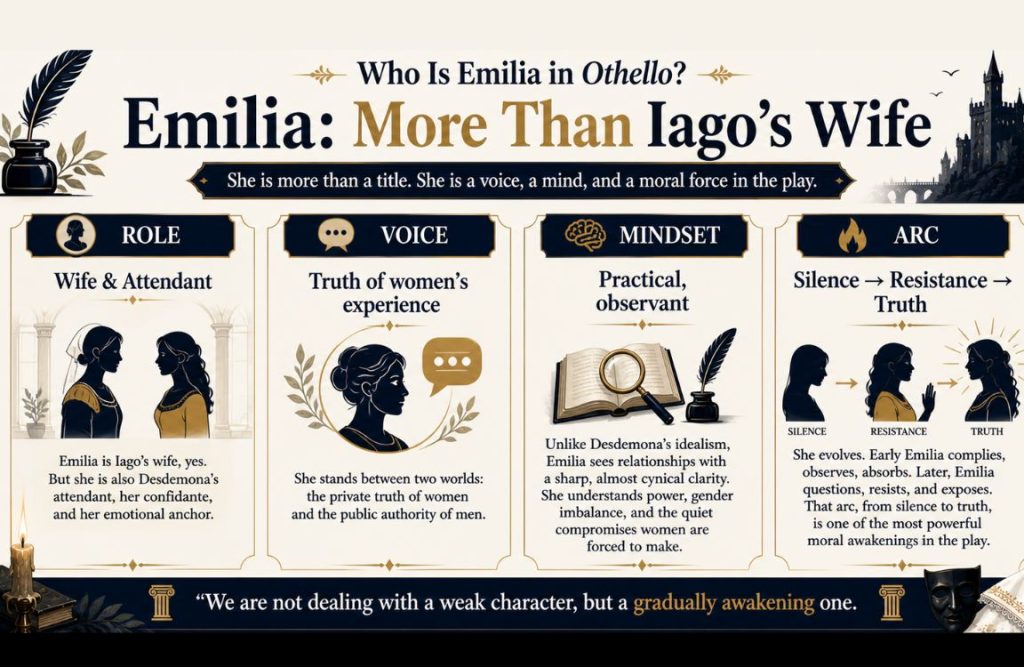
She is Iago’s wife, YES. But reducing her to that alone is like calling a storm “just wind.” Emilia is also Desdemona’s attendant, her confidante, her emotional anchor. In many ways, she stands between two worlds: the private truth of women and the public authority of men.
From an Emilia character analysis perspective, she is strikingly practical. Unlike Desdemona’s idealism, Emilia sees relationships with a sharp, almost cynical clarity. She understands power, gender imbalance, and the quiet compromises women are forced to make.
Yet here’s where it gets interesting. She evolves.
Early Emilia complies, observes, absorbs. Later, Emilia questions, resists, and exposes. That arc, from silence to truth, is one of the most powerful moral awakenings in the play.
So when we discuss manipulation, we are not dealing with a weak character, but a gradually awakening one.
How Does Iago Manipulate Emilia in Othello?
Let’s answer this directly, the way examiners love: Iago manipulates Emilia indirectly by exploiting her loyalty, belittling her emotionally, and using marital authority, most crucially in the handkerchief incident.
Notice what’s missing: direct force.
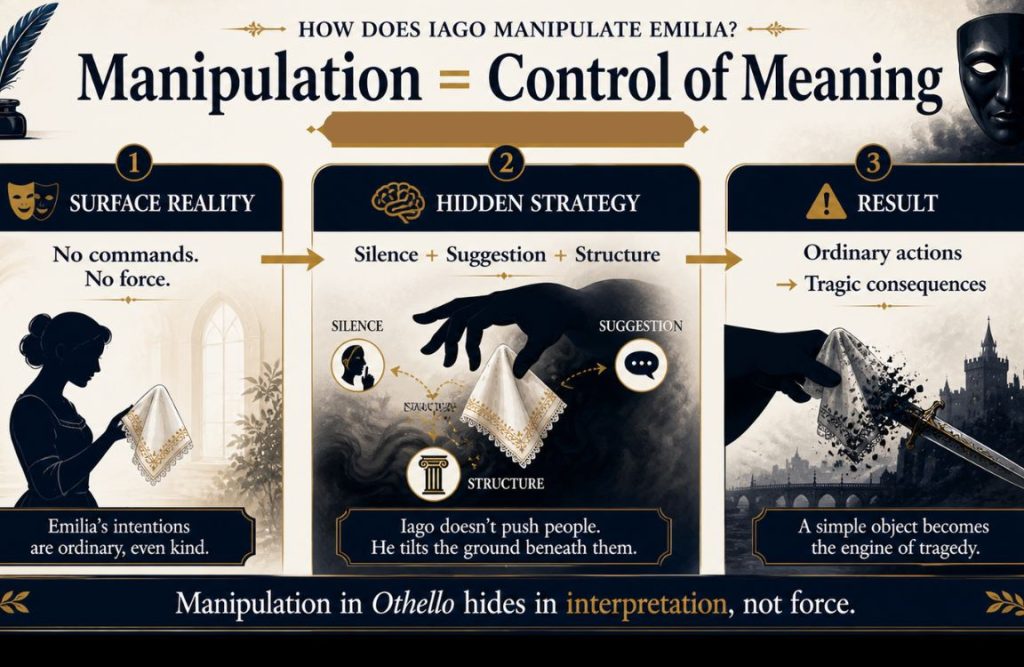
He rarely commands outright; instead, he creates pressure. As I tell my students, Iago doesn’t push people. He tilts the ground beneath them. With Emilia, he understands three things:
- She wants recognition from her husband
- She is conditioned to obey him
- And she cannot see his full plan
He reinforces this through subtle coercion, calling her a “good wench” when she complies, yet degrading her elsewhere to keep control.
So, when Emilia steals the handkerchief to please him, she believes it harmless. Iago, however, turns it into deadly evidence. This is manipulation at its most dangerous: not control of actions, but control of consequences.
To see how this works, we need to look at three layers: emotional control, social authority, and finally, the handkerchief incident.
i) Emotional Neglect and Control
To understand how does Iago treat Emilia, we have to look at what he withholds.
He doesn’t nurture. He doesn’t appreciate. He barely acknowledges her unless she becomes useful. This emotional neglect creates a quiet imbalance, one that many students initially overlook.
Imagine constantly speaking into a void, hoping for approval that never arrives.
That’s Emilia’s position.
And here’s the psychological edge: when recognition is scarce, even the smallest approval feels valuable. Iago knows this. His indifference becomes a form of control over Emilia, because it keeps her subtly seeking his validation.
He doesn’t need to persuade aggressively. Her emotional hunger does part of the work for him.
This isn’t loud manipulation. It’s quieter. Colder.
He creates a space where Emilia’s actions lean toward pleasing him, not because she is forced, but because she is unseen.
And sometimes, being unseen is the most powerful form of control.
ii) Use of Authority and Marriage Power
Now let’s widen the lens. The Iago and Emilia relationship doesn’t exist in isolation. It sits inside a rigid patriarchal structure.
In that world, a husband’s authority is not questioned. It is assumed.
So when Emilia obeys Iago, it isn’t simply personal. It’s social conditioning. The power dynamics are already tilted long before any manipulation begins.
Here’s how I explain it in class: Iago doesn’t build power from scratch. He inherits it.
That inherited authority allows him to influence Emilia without effort. A suggestion from him carries the weight of expectation. A request sounds like a duty.
And Emilia, aware of her role as a wife, operates within those boundaries, even when she senses discomfort.
This is where Shakespeare becomes painfully realistic. Manipulation doesn’t always require intelligence alone. It often relies on systems already in place.
Iago simply uses the rules of his society as tools.
And Emilia, like many in that world, is shaped by those rules before she can resist them.
iii) Manipulating Emilia into Stealing the Handkerchief
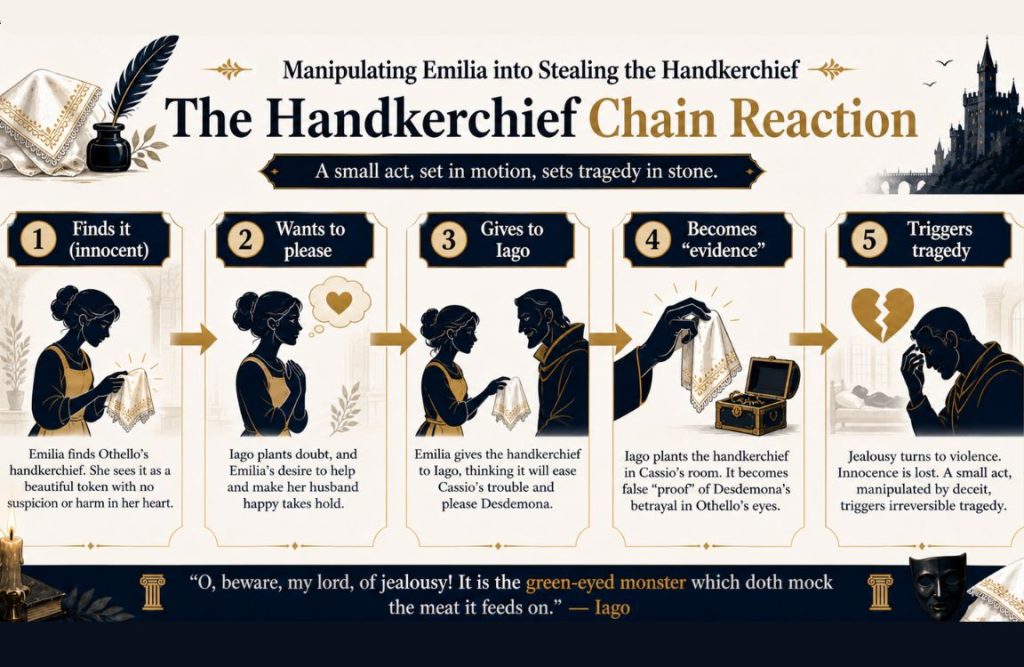
Now we arrive at the most crucial moment: the handkerchief. This is where Emilia’s role in Iago’s plan becomes dangerously clear.
She finds the handkerchief by chance. No scheme. No intent. Just an ordinary moment, Desdemona drops it, and Emilia picks it up. Simple.
But literature loves these “simple” moments because they are never simple for long.
Emilia knows Iago has asked for it before. Not why. Not how he’ll use it. Just that he wants it, and here’s the key. She gives it to him, hoping to please him.
That’s it.
No conspiracy. No awareness of consequences.
And yet, that small act becomes the foundation of Othello’s jealousy.
This is where I pause with students and ask: Who is responsible, the one who acts, or the one who assigns meaning to the act?
Iago takes the handkerchief and transforms it into “proof.” He injects it into Othello’s imagination, turning an innocent object into emotional evidence.
The tragedy doesn’t begin with Emilia’s action.
It begins with Iago’s interpretation.
And just like that, a token of love becomes a weapon of destruction.
Key Quotes Showing Iago’s Manipulation of Emilia
Let’s move into the textual evidence, because exam answers breathe through quotes. When exploring quotes on Iago manipulating Emilia, one line always stops my students: “A good wench; give it me.” No gratitude. No explanation. Just possession.
Notice the imbalance. Emilia offers, and Iago takes.
Now turn to Emilia’s quotes in Othello: she admits she acts “to please his fantasy.” That word, please, matters. Her intention is loyalty; his response is utility.
But Iago’s manipulation goes further. He silences her, “Speak within doors” and belittles her, “You are a fool, go to.” Even in public, his insults reduce her voice and confidence.
Here’s the teaching insight: Emilia speaks emotionally; Iago operates strategically.
And that contrast reveals manipulation at its core, not forcing action, but controlling meaning, until truth itself becomes a weapon.
Is Emilia Aware of Iago’s Manipulation?
So, is Emilia aware of Iago’s manipulation? Initially, NO, and that’s what makes the tragedy so painfully human. She operates within trust, habit, and social expectation, even becoming complicit when she steals the handkerchief to please him.
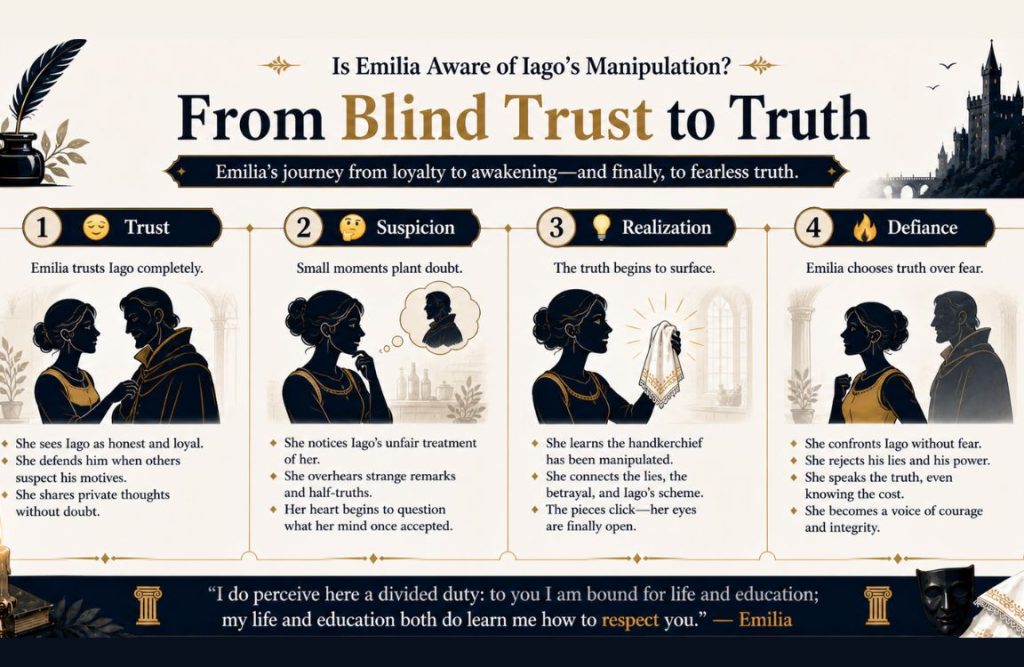
At this stage, she does not see the larger scheme. Yet interestingly, she suspects that some “villainous knave” has misled Othello, just not Iago himself.
Then comes the shift. As truth surfaces, Emilia’s awareness sharpens rapidly. She connects the deception, recognizes Iago’s role, and refuses silence.
In that moment, Emilia transforms from a manipulated participant to a fearless truth-teller, choosing truth over obedience.
How Emilia Contributes to the Tragedy
Let’s confront an uncomfortable question: how does Emilia contribute to tragedy? Not through malice, but through misjudgment shaped by loyalty and silence.
Her role is indirect, yet essential. When she gives Desdemona’s handkerchief to Iago, she believes it harmless, done only to “please his fantasy.” Yet that object becomes Othello’s “ocular proof,” triggering his catastrophic jealousy.
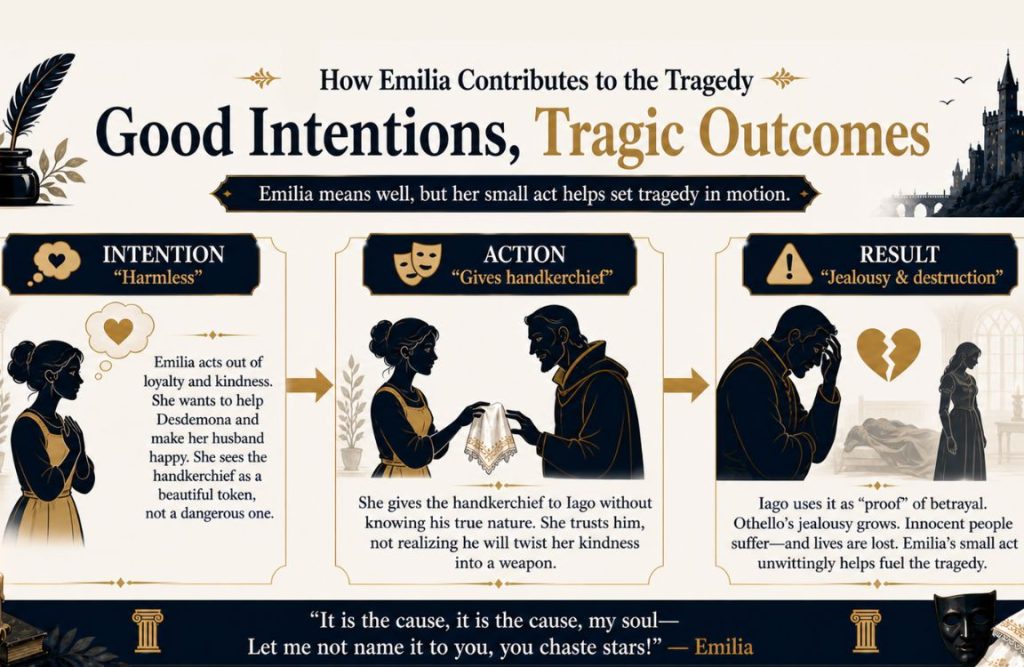
Here’s where Shakespeare complicates morality. Good intentions do not guarantee good outcomes. Emilia does not question Iago, and her silence allows the deception to deepen.
In class, I frame it this way: Emilia is neither villain nor fool, but a participant in a system where meaning is stolen and weaponized.
Her small act becomes tragic because Iago reshapes its significance, proving that innocence cannot prevent destruction when interpretation itself is corrupted.
Why Does Iago Kill Emilia?
Now the inevitable question: why does Iago kill Emilia, and does Emilia die in Othello? Tragically, yes.
Her death is not random. It is necessary for Iago.
By the final act, Emilia sees clearly and speaks boldly, exposing the truth of the handkerchief and Iago’s manipulation. She refuses to stay silent, even rejecting his authority.
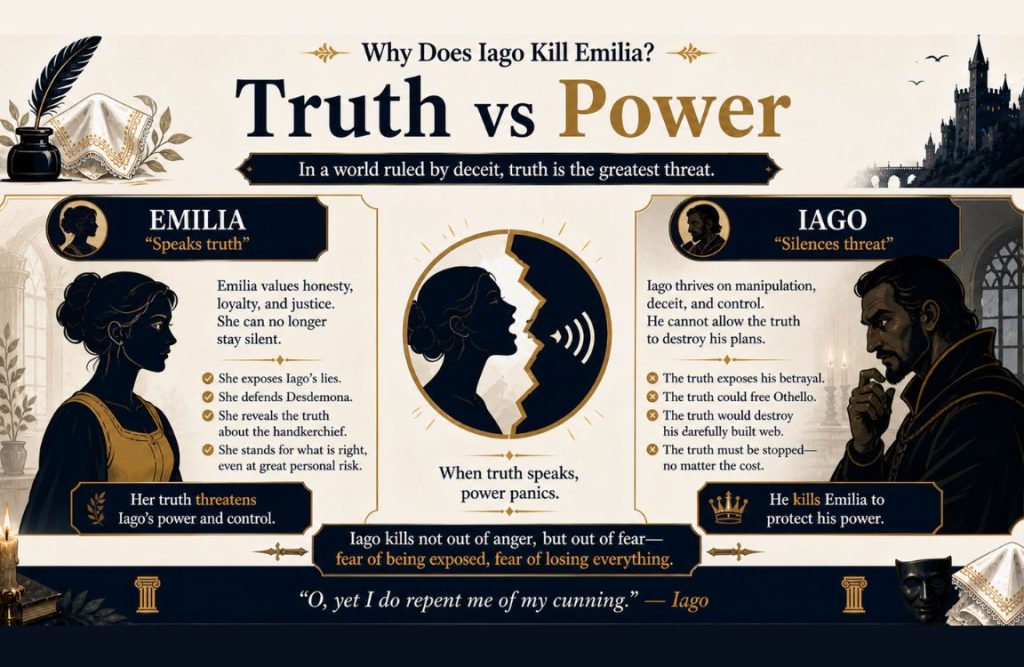
In that moment, she is no longer useful. She is a threat. And Iago, consistent to the end, removes threats.
There is brutal symbolism here. Emilia represents truth breaking through deception, and her murder is an attempt to silence it.
Yet the irony remains: even in death, her truth survives, while Iago’s power collapses into silence.
Iago vs Emilia: Moral Contrast
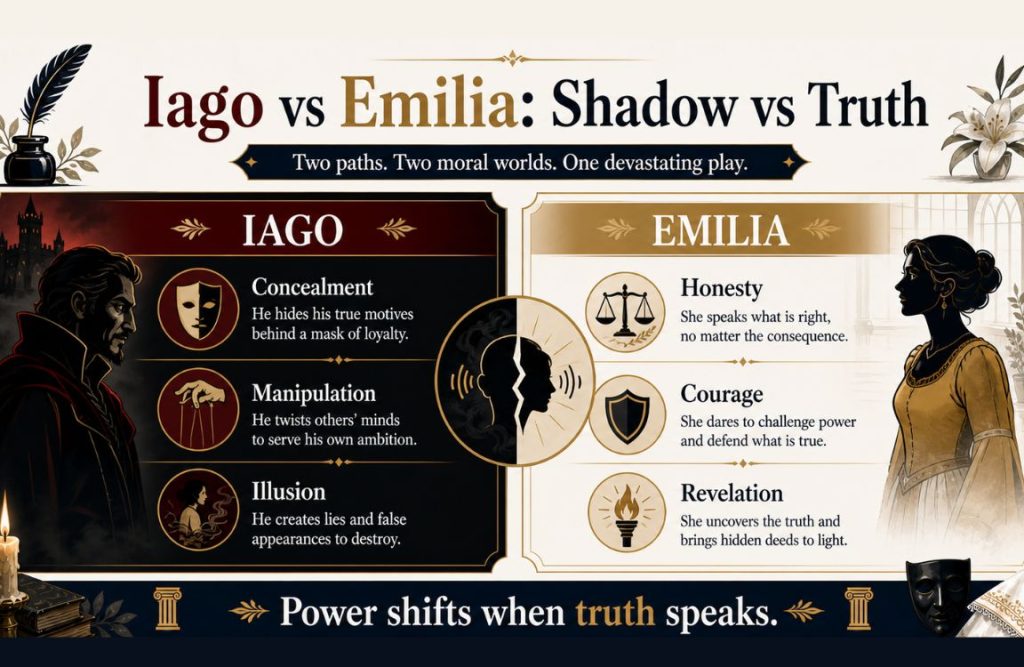
If we place them side by side, the moral contrast between Iago and Emilia becomes striking.
Iago operates through concealment. He thrives in shadows, bending perception, crafting illusions. For him, language is a tool of distortion.
Emilia, by contrast, moves toward clarity. By the end, she speaks plainly and fearlessly, declaring, “I will not charm my tongue.” Where Iago hides, she reveals.
This contrast also exposes gender dynamics. Emilia begins constrained by silence but ultimately breaks it, while Iago exploits that same system to dominate.
So we witness a reversal. The man with power becomes morally empty; the woman with limited power becomes morally authoritative.
And in that shift lies one of Shakespeare’s quiet, radical revolutions.
FAQs:
Why does Emilia give the handkerchief to Iago?
Emilia gives the handkerchief to Iago mainly to gain his approval. She knows he desires it but doesn’t understand its purpose, making her action innocent in intention but devastating in consequence.
Does Emilia trust Iago throughout the play?
Emilia initially trusts Iago as her husband and does not question his motives. However, by the end, she recognizes his deception and openly challenges him, breaking that trust completely.
How is Emilia different from Desdemona?
Emilia is more realistic and experienced, while Desdemona is idealistic and trusting. Emilia questions societal norms, especially about men and women, whereas Desdemona remains loyal and innocent throughout.
What role does gender play in Emilia’s manipulation?
Gender roles limit Emilia’s independence and encourage obedience to her husband. This social structure allows Iago to influence her actions subtly, showing how patriarchy enables manipulation without direct force.
At what point does Emilia realize Iago’s true nature?
Emilia realizes Iago’s true nature in the final act when she uncovers the truth about the handkerchief. This moment transforms her into a truth-teller, even at the cost of her life.
Conclusion:
So, returning to our central idea, how does Iago manipulate Emilia? The answer is unsettlingly subtle.
Emilia is not controlled through lies or force. She is shaped by silence, structure, and expectation. Iago doesn’t command her mind. He redirects the meaning of her actions.
And that’s where the tragedy truly begins.
Not in what people do, but in how those actions are interpreted.
That’s the final lesson I leave with my students: manipulation isn’t always visible. Sometimes, it hides in meaning itself. If you want to master Othello for exams, explore more breakdowns like this on Literature Lens.