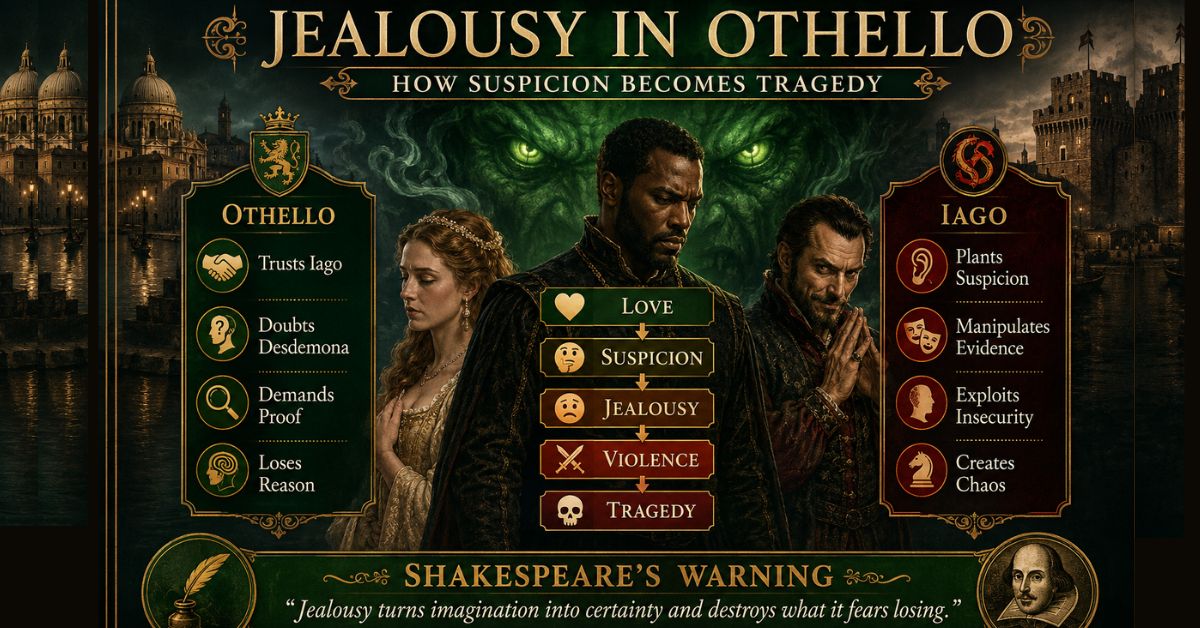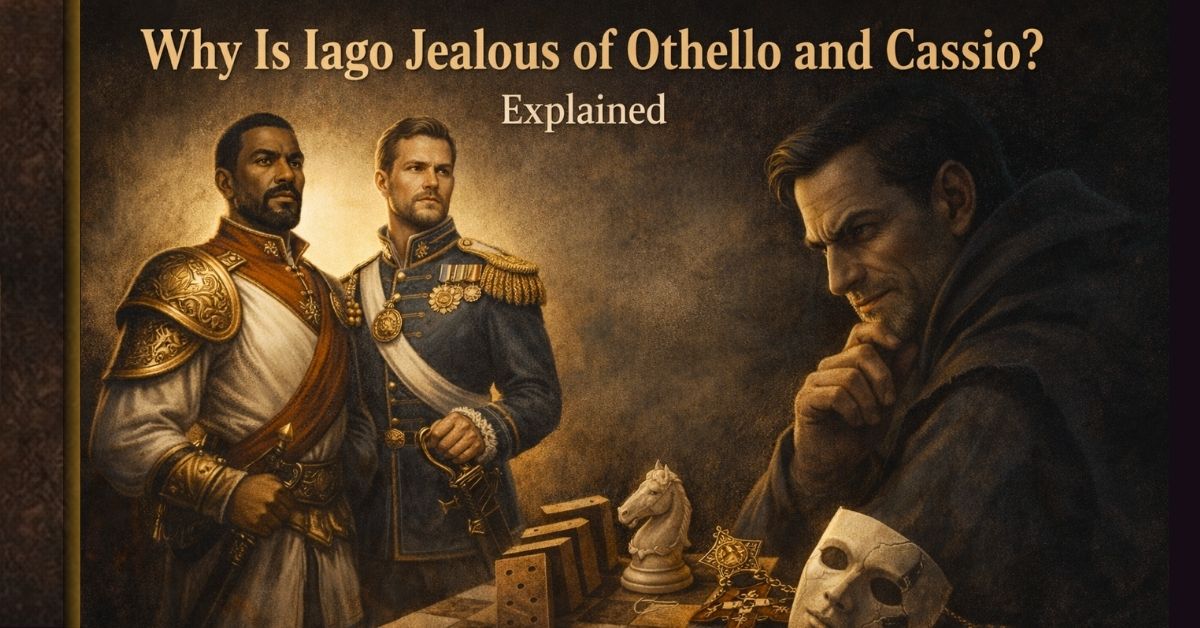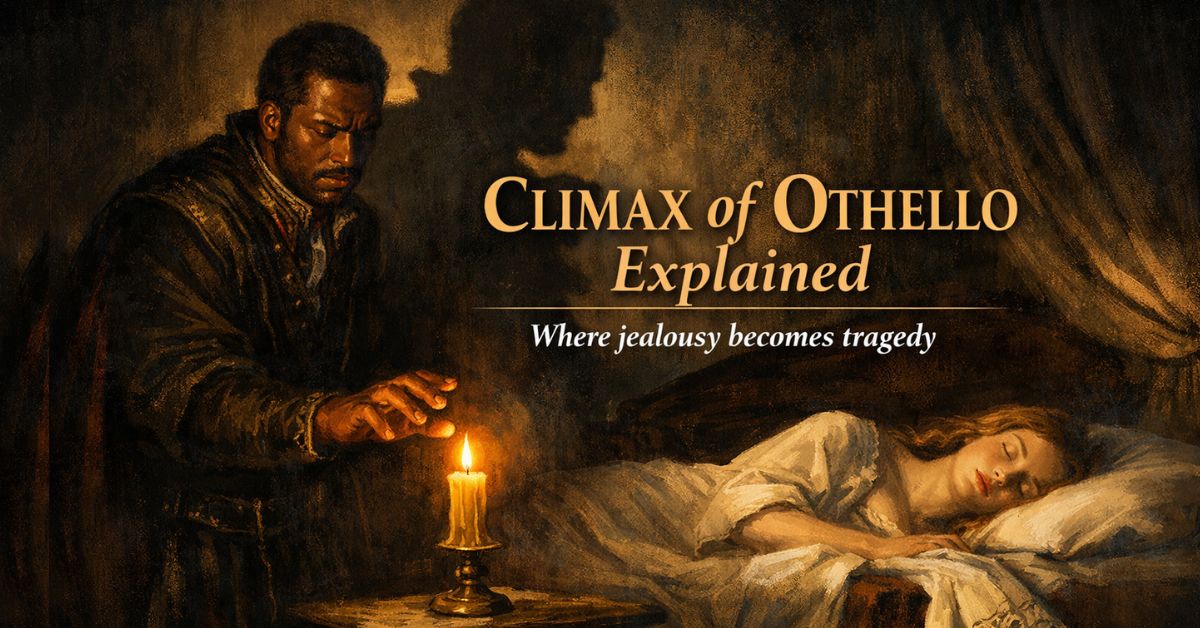
The climax of Othello occurs in Act 5, Scene 2, when Othello kills Desdemona after believing Iago’s lies. Moments later, Emilia exposes the truth, triggering the tragic reversal that drives the play toward its devastating conclusion.
When I introduce this moment to my students, I usually ask a simple question: Where does the tragedy finally break open? By the time we reach the final act, jealousy has already done its quiet work. Suspicion has replaced trust, and Othello’s confidence in Desdemona has slowly collapsed.
Yet I also remind my class that some critics locate the true turning point earlier in the play. In Act 3, Scene 3, the famous temptation scene, Iago carefully poisons Othello’s mind with doubt. The handkerchief becomes false “proof,” and Othello kneels beside Iago to swear revenge. From a structural perspective, this moment marks the psychological point of no return.
By the time Act 5 arrives, the tragedy is no longer about suspicion. It is about consequences. Emilia’s revelation exposes the deception, but the truth comes only after the catastrophe has already been set in motion.
What Is the Climax of Othello?
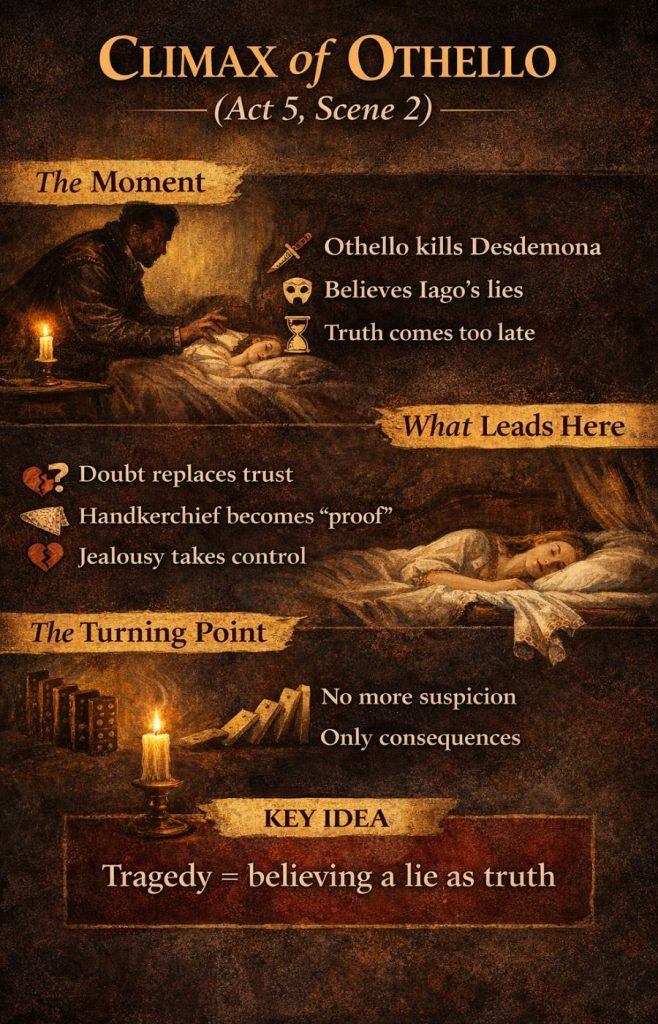
The climax of Othello takes place in Act 5, Scene 2, when Othello carries out the fatal decision he had formed earlier in the play. Believing Desdemona has betrayed him, he kills her in their bedroom, only to learn moments later that he has been deceived by Iago.
When I explain this scene to students, I often compare it to the final crash of a wave that has been rising throughout the entire drama. All the doubts, whispers, and manipulations carefully planted by Iago now converge in a single irreversible act.
The scene unfolds with unsettling calm. Othello enters Desdemona’s chamber at night while she sleeps. For a brief moment, he hesitates, struggling between love and the terrible conviction that he must punish betrayal. In his mind, he imagines himself carrying out justice rather than committing murder.
But tragedy in Shakespeare often lies in mistaken certainty. When Desdemona pleads her innocence, Othello cannot hear the truth anymore.
Only after the act is done does Emilia reveal Iago’s manipulation and the truth about the handkerchief, forcing Othello to confront the devastating reality of what he has done.
Key Quotes from the Climax of Othello
The climax in Othello contains some of the most haunting lines ever written by William Shakespeare. In Act 5, Scene 2, language becomes the emotional pulse of the tragedy. When I teach these quotes from Othello, Act 5 Scene 2, I remind my students that Shakespeare’s words don’t just describe the climax. They create their devastating power.
i) “Put out the light, and then put out the light.”
When I reach this line in class, I often pause and ask my students: Which light does Othello mean? First, he literally extinguishes a candle. But the second “light” is far more chilling. It is Desdemona’s life.
The metaphor is simple yet terrifying. Othello imagines himself as someone merely blowing out a flame. In his mind, he is not committing murder but restoring order. Shakespeare shows us how jealousy can disguise cruelty as justice.
ii) “O, falsely, falsely murdered!”
This cry comes from Emilia, and it strikes the scene like thunder. When she realizes Desdemona has died innocent, the truth finally erupts.
I sometimes tell my students that Emilia becomes the moral voice of the play at this moment. Her words expose Iago’s plot and shatter the illusion that trapped Othello. In tragedy, truth often arrives late, and here it arrives with heartbreaking force.
iii) “I kissed thee ere I killed thee.”
Few lines capture remorse so brutally. Othello confesses that he kissed Desdemona before killing her, a moment of love tangled with destruction.
The irony is devastating. The same lips that once expressed devotion have now sealed tragedy. When students read this line, they suddenly see the full weight of Othello’s realization: love survived, but only after he destroyed it.
Climax in Othello: Analysis of the Tragic Turning Point
The climax of Othello in Act 5, Scene 2, marks the decisive moment when jealousy turns into irreversible tragedy. Othello murders Desdemona, misled by Iago’s scheme, and moments later, the truth is revealed. This moment represents the analysis of the climax in Othello because it transforms suspicion into catastrophic action and seals the hero’s downfall.
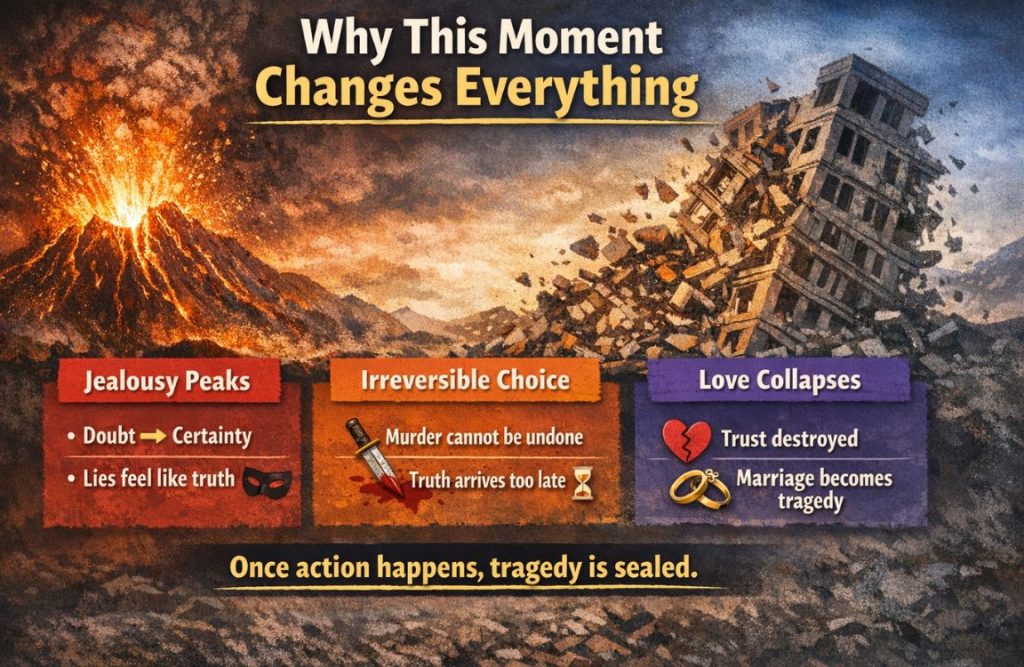
i) Jealousy Reaches Its Peak
If Shakespeare’s tragedy were a volcano, this scene would be the eruption. Othello’s jealousy, patiently nurtured by Iago’s manipulation, has finally reached its most dangerous form.
In the Othello tragic climax, Othello no longer questions the story he has been fed. Suspicion has hardened into certainty. The handkerchief becomes “proof,” rumors become facts, and love becomes betrayal.
I often tell my students that jealousy here behaves like a fog. At first, it blurs the view, then it completely hides the truth. By the time Othello enters the bedroom, he believes he is defending honor rather than destroying innocence.
ii) The Irreversible Decision
This moment becomes the true turning point in Othello because the central action, Desdemona’s murder, cannot be reversed.
Before this scene, there was still the possibility of truth saving the characters. A conversation, a confession, even a moment of patience might have changed everything. But tragedy rarely waits for patience.
Once Othello suffocates Desdemona, the play crosses a dark threshold. Even when Emilia reveals the truth seconds later, it changes nothing about the terrible reality already created.
iii) The Collapse of Trust and Love
At its heart, the tragedy of Othello is painfully domestic. The battlefield may frame the story, but the disaster unfolds inside a marriage.
Suspicion poisons love until trust collapses completely. A husband no longer believes his wife; a symbol of fidelity, the handkerchief, becomes evidence of betrayal.
This is why many critics call Othello a domestic tragedy. The greatest catastrophe in the play is not political defeat or military loss. It is the destruction of love inside the most intimate space of all, a marriage.
Plot Structure of Othello
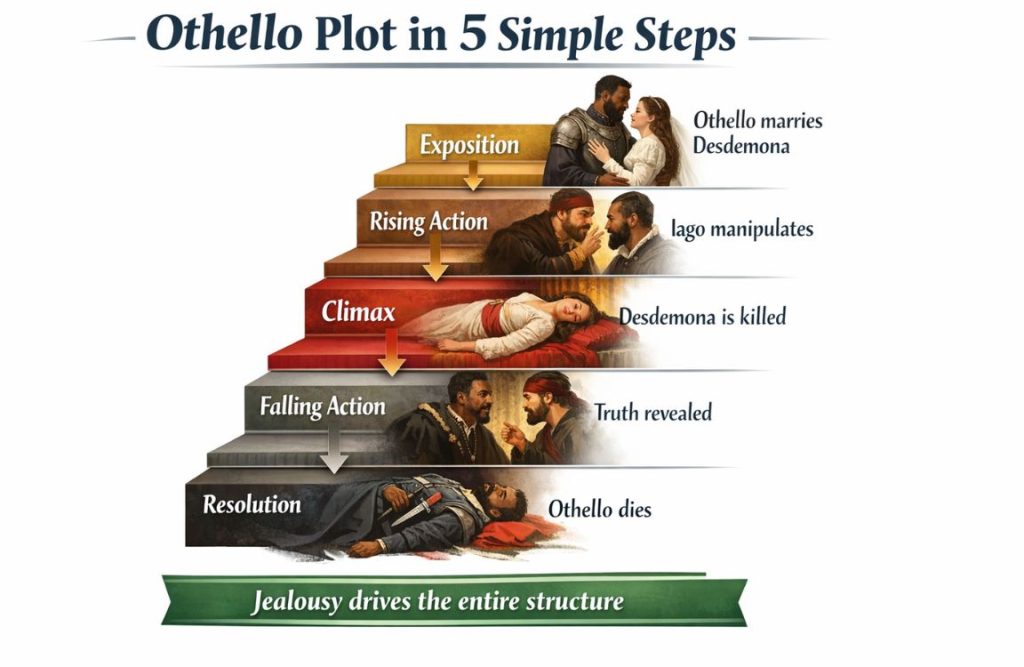
The plot structure of Othello follows the classic five-part dramatic pattern: exposition, rising action, climax, falling action, and resolution. Shakespeare carefully builds tension through Iago’s manipulation, reaches the tragic peak in Act 5, Scene 2, and ends with justice and moral reckoning.
i) Exposition
The exposition introduces us to the world of the play and its central characters. I usually tell my students to imagine the stage lights slowly brightening.
We meet Othello, the respected Moorish general of Venice, and his devoted wife Desdemona. Cassio appears as the loyal lieutenant, while Iago quietly stands nearby, already nursing resentment.
In these early moments, Shakespeare plants the seeds of conflict that will later grow into tragedy.
ii) Rising Action
Soon, the tension begins to climb. The rising action in Othello unfolds as Iago carefully manipulates events and people. I often describe him to students as a chess player moving pieces across the board.
His most famous trick involves Desdemona’s handkerchief, which he turns into false evidence of betrayal. Slowly, suspicion enters Othello’s mind, and the noble general begins to doubt the woman he loves.
iii) Climax
The emotional peak arrives in Act 5, Scene 2. When I read this scene with students, the room often becomes very quiet.
Convinced of Desdemona’s guilt, Othello kills her in their bedroom. This terrible act marks the climax of the play, the moment when jealousy fully transforms into irreversible tragedy.
iv) Falling Action
Immediately after the murder, the falling action of Othello unfolds rapidly. Emilia exposes Iago’s deception, revealing the truth about the handkerchief and the manipulation behind the tragedy.
Othello realizes the horrifying mistake he has made. The hero who once commanded armies now stands crushed beneath the weight of guilt.
v) Resolution
Finally, the resolution of Othello restores moral order, though at a devastating cost. Iago is arrested and condemned, while Othello, overwhelmed with remorse, takes his own life beside Desdemona.
When I discuss this ending with my students, I remind them that Shakespeare’s tragedies rarely offer happy endings, but they always leave powerful lessons about trust, jealousy, and human weakness.
Plot Structure of Othello at a Glance
| Plot Stage | Event |
| Exposition | Othello marries Desdemona |
| Rising Action | Iago manipulates Othello |
| Climax | Othello kills Desdemona |
| Falling Action | Emilia reveals the truth |
| Resolution | Othello dies |
Why the Climax of Othello Is So Powerful
Othello’s tragic climax is powerful because it combines psychological tragedy, dramatic irony, and the heartbreaking destruction of innocence. The audience knows Desdemona is faithful, yet they must watch Othello destroy the very love he believes he is protecting.
When I teach this scene, I often tell my students that Shakespeare is not simply staging a murder. He is staging the collapse of a human mind. By the time we reach the bedroom in Act 5, jealousy has quietly taken control of Othello’s judgment. What makes the moment so painful is that Othello still believes he is doing the right thing. He says, “Yet she must die, else she’ll betray more men.” In his mind, this is justice. For the audience, it is pure tragedy.

This is where dramatic irony in Othello becomes almost unbearable. We know Desdemona is innocent. We know Iago is lying. Yet we cannot stop the disaster. I sometimes pause in class and ask my students: Have you ever watched someone make a terrible mistake you could not prevent? That helpless feeling is exactly what Shakespeare creates here.
The scene is also powerful because innocence is destroyed in the most intimate place possible, a marriage. Desdemona’s bedroom should represent love and safety. Instead, it becomes the stage for betrayal and death.
By the end of the scene, my students usually reach the same realization: this tragedy was avoidable. One honest conversation, one moment of patience, might have saved everything. And that painful possibility is what makes the climax unforgettable.
Is the Climax of Othello Act 3 or Act 5? (Critical Debate)
Some critics argue that the play’s dramatic peak occurs in Act 3, Scene 3, the “temptation scene”, when Othello fully believes Iago’s lies. However, most scholars identify Act 5, Scene 2 as the true climax because Desdemona’s murder represents the final and irreversible tragic action.
When I introduce this debate to my students, I usually begin with a mischievous question: What if the tragedy actually explodes long before the murder happens? That idea leads us to Act 3, Scene 3.
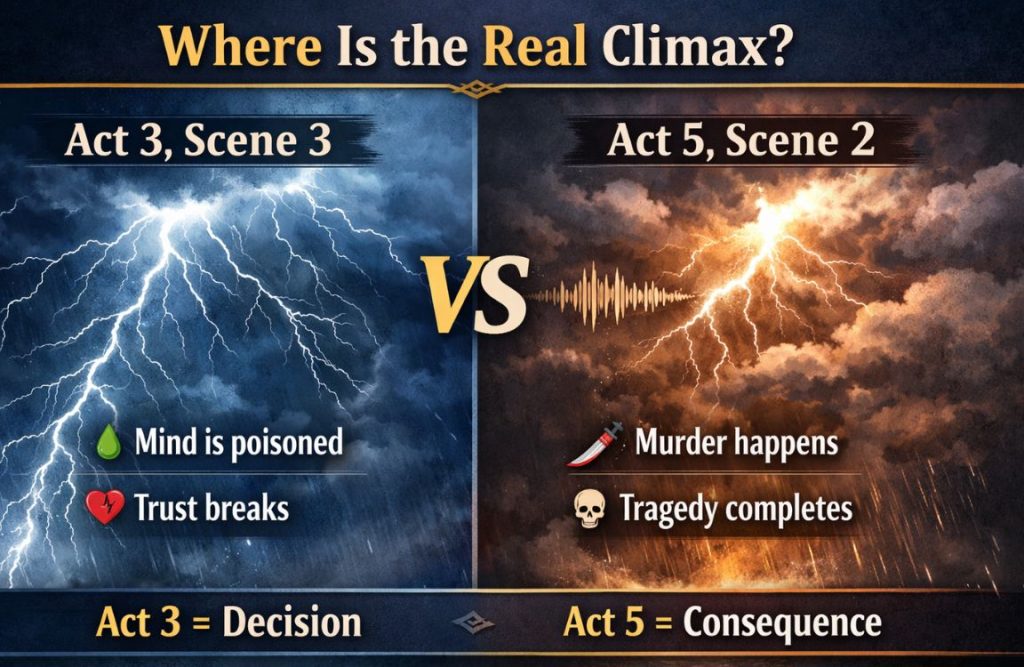
In this famous temptation scene, Iago carefully poisons Othello’s mind with suspicion. The handkerchief becomes “proof,” and Othello kneels beside Iago to swear revenge. Many critics argue that this is the real turning point because Othello’s trust is finally broken. From that moment onward, the tragedy seems almost unstoppable.
But there is another view, and it is the one most scholars support. They place the climax in Act 5, Scene 2, when Othello murders Desdemona. Here, the tension reaches its absolute peak, and the central action of the tragedy is completed.
When I explain this in class, I compare it to lightning and thunder. Act 3 is the lightning flash, the moment the storm begins. Act 5 is the thunder that finally shakes the world.
And in Shakespeare’s tragic design, that thunder is the moment we can never undo.
Themes Revealed in the Climax
The final catastrophic moment of Othello reveals the play’s central themes- jealousy, manipulation, appearance versus reality, trust and betrayal, and the destructive power of suspicion. In Act 5, Scene 2, these themes collide in the bedroom scene, transforming doubt into irreversible tragedy.
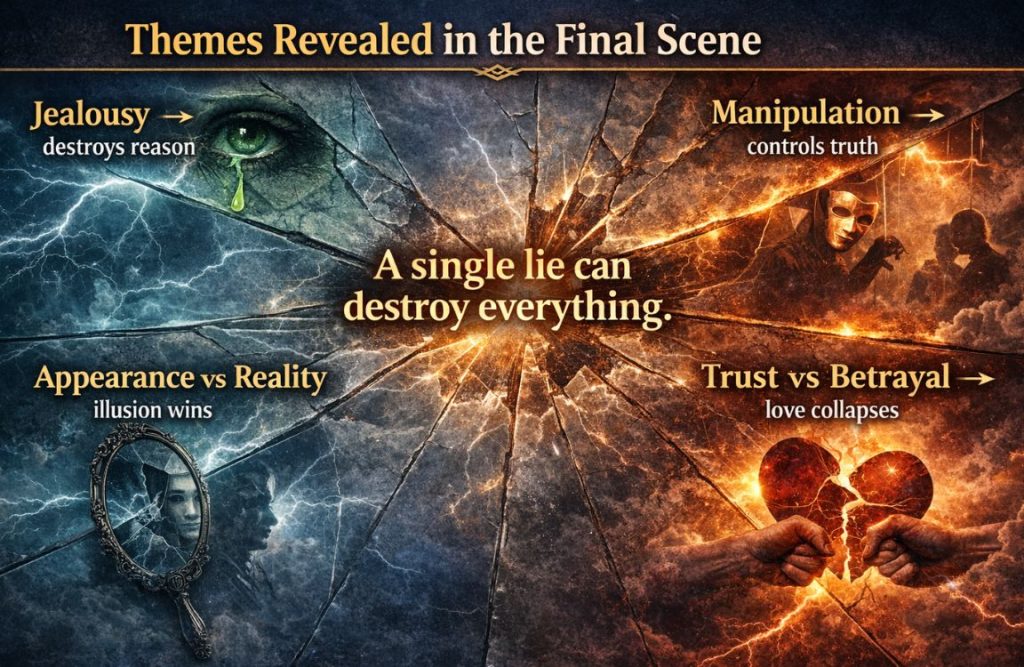
When I guide my students through this moment, I often tell them to imagine the entire play as a tightly coiled spring. Throughout the story, Shakespeare quietly winds that spring with jealousy, lies, and suspicion. In the climax, it finally snaps.
Jealousy stands at the center of this explosion. Othello, once calm and rational, now sees betrayal everywhere. The tragedy is that his anger grows not from truth but from manipulation. Iago has carefully arranged every illusion, turning a simple handkerchief into deadly “evidence.”
This leads us to another theme Shakespeare exposes: appearance versus reality. What seems real to Othello is entirely false. Desdemona appears guilty in his eyes, yet the audience knows she is innocent.
Trust and betrayal collide in the most painful way possible. A husband no longer believes his wife, and suspicion replaces love. I sometimes pause here and ask my class: How powerful must a lie be to destroy a marriage?
In that quiet bedroom, Shakespeare answers the question- showing how a single whisper of doubt can grow into a devastating tragedy.
What Happens at the End of Othello?
At the end of Othello, Emilia exposes Iago’s lies and reveals Desdemona’s innocence. Othello realizes his terrible mistake and kills himself in remorse. Iago is arrested, and Cassio becomes governor of Cyprus, while the truth arrives only after tragedy is complete.
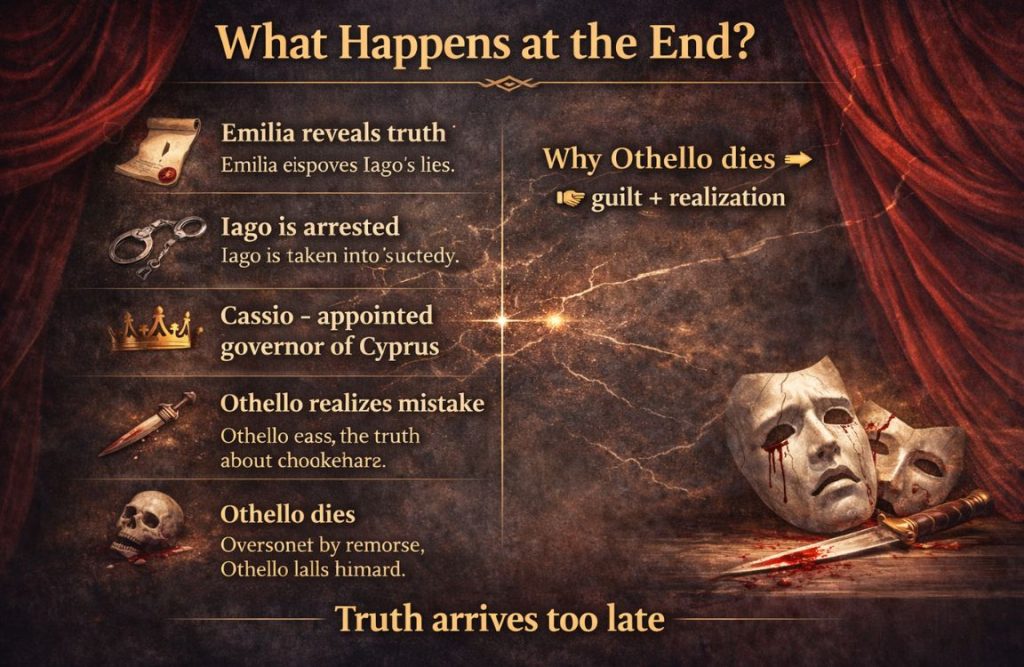
What Happens to Iago, Cassio, and Othello at the End?
Once Emilia reveals the deception, chaos erupts. Iago, desperate to silence the truth, kills his own wife. When I read this moment aloud to students, the room usually gasps, because betrayal has now devoured even the villain’s closest relationship.
But justice quickly follows. Iago is captured and arrested, destined for punishment. Shakespeare deliberately leaves his exact fate uncertain, which I often tell my students makes the ending feel even more haunting.
Cassio, the loyal lieutenant who was unfairly disgraced earlier in the play, is restored and appointed governor of Cyprus. It is one of the few moments of order in an otherwise tragic landscape.
As for Othello, he stands shattered by the truth he once refused to see.
Does Othello Die? Why Did Othello Kill Himself?
Yes, Othello dies at the end of the play. His final act is driven by overwhelming guilt and tragic realization. When the truth becomes clear, he understands that he has murdered an innocent wife.
I sometimes tell my students that Othello’s death is both punishment and confession. Overcome with remorse, he takes his own life beside Desdemona, hoping in some way to restore the honor he destroyed.
This moment of Othello’s death completes the tragic arc. The once-great general recognizes his blindness too late, and in Shakespearean tragedy, that realization is often the most devastating ending of all.
FAQs:
Why does Shakespeare place the climax in a bedroom rather than a battlefield?
Shakespeare places the climax of Othello in a bedroom rather than a battlefield to show the shift from public heroism to private tragedy. The real conflict is not war but marriage, where jealousy destroys trust, love, and Othello’s judgment.
How does dramatic irony intensify the climax of Othello?
Dramatic irony intensifies the climax of Othello because the audience knows Desdemona is innocent while Othello trusts “honest Iago.” Watching him misinterpret the handkerchief as proof of betrayal makes the tragedy painfully inevitable and emotionally devastating.
What role does the handkerchief play in the climax?
In Othello, the handkerchief becomes the “ocular proof” that convinces Othello of Desdemona’s supposed betrayal. Once a symbol of love and fidelity, Iago manipulates it into false evidence that triggers jealousy and leads directly to the tragic climax.
How does Emilia contribute to the turning point of the play?
Emilia shapes the turning point of Othello in two ways. She unknowingly gives Iago the handkerchief that fuels Othello’s jealousy, then bravely reveals the truth after Desdemona’s death, exposing the deception and forcing Othello to face his tragic mistake.
Why is Othello often called a domestic tragedy?
Othello is often called a domestic tragedy because its central conflict unfolds inside a marriage rather than in politics or war. The play shows how jealousy, manipulation, and mistrust can destroy the most intimate human relationship.
Conclusion:
The climax of Othello marks the emotional summit of Shakespeare’s tragedy, where jealousy finally destroys love and trust. In Act 5, Scene 2, Othello kills Desdemona, deceived by Iago, only to discover the truth moments too late.
When I end this lesson with my students, I often remind them that tragedy is not just about death but about recognition.
The hero realizes the truth after the damage is done. Shakespeare constructs this moment with chilling precision- every doubt, every lie, and the fatal handkerchief leading to the bedroom scene.
That is why the climax in Othello remains unforgettable: it reveals how fragile judgment becomes when jealousy replaces trust.