One afternoon in class, while we were reading Othello, a student paused and asked, “Sir, why does Shakespeare suddenly talk about gods, heaven, and ancient stories?” I smiled, because that small question opens the door to a fascinating literary device: allusion.
In simple terms, an allusion is a brief reference to something outside the text- a myth, a biblical story, or a well-known historical idea. Shakespeare rarely explains these references. Instead, he trusts his audience to recognize them.
When we examine the allusions in Othello, we discover that Shakespeare quietly borrows images from Roman or Greek mythology and religion to deepen meaning. These Othello allusions act like hidden doors in the play- once opened, they reveal layers of symbolism, emotion, and cultural memory behind the dialogue.
What Is an Allusion in Othello? (Definition & Meaning)
In Othello, Shakespeare enriches the drama through subtle references to Greek and Roman mythology, religion, and classical culture. These brief hints, called allusions, allow the audience to connect the play’s emotions and conflicts with familiar stories from history and tradition.
i) Definition of Allusion in Literature
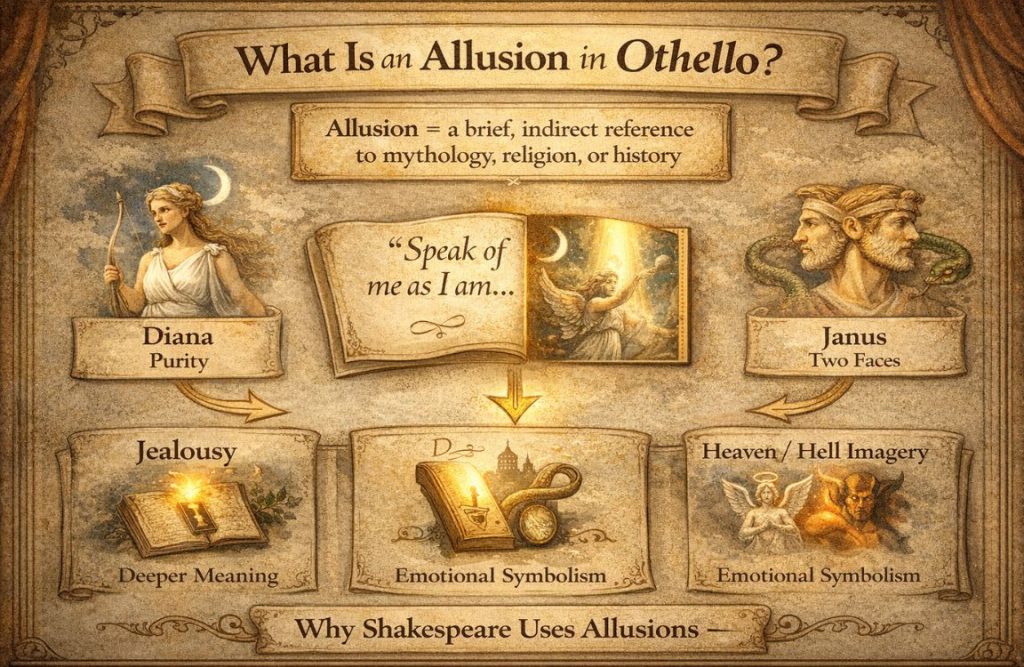
Allusion in literature is a brief, indirect reference to a well-known person, story, place, or idea that relies on the reader’s shared knowledge to create deeper meaning without explanation.
When I explain allusion to my students, I often describe it as a quiet wink between writer and reader: one quick reference, and suddenly an entire story echoes behind the line.
A common definition of mythological allusion involves referencing figures like Diana, the Roman goddess, to suggest purity or chastity. Writers use these shortcuts to compress large cultural ideas into a single phrase.
We see this especially in Shakespeare’s allusions, where a single myth, history, or biblical reference instantly adds emotional and cultural depth.
ii) How Allusions Work in Shakespeare’s Othello
Allusions in Othello are brief references to biblical stories and classical mythology that deepen the play’s emotional and moral meaning. When we explore the meaning of Othello allusions, we see that Shakespeare uses them as symbolic shortcuts. Renaissance audiences immediately recognized references to heaven, hell, or Roman gods, allowing a single phrase to carry powerful associations.
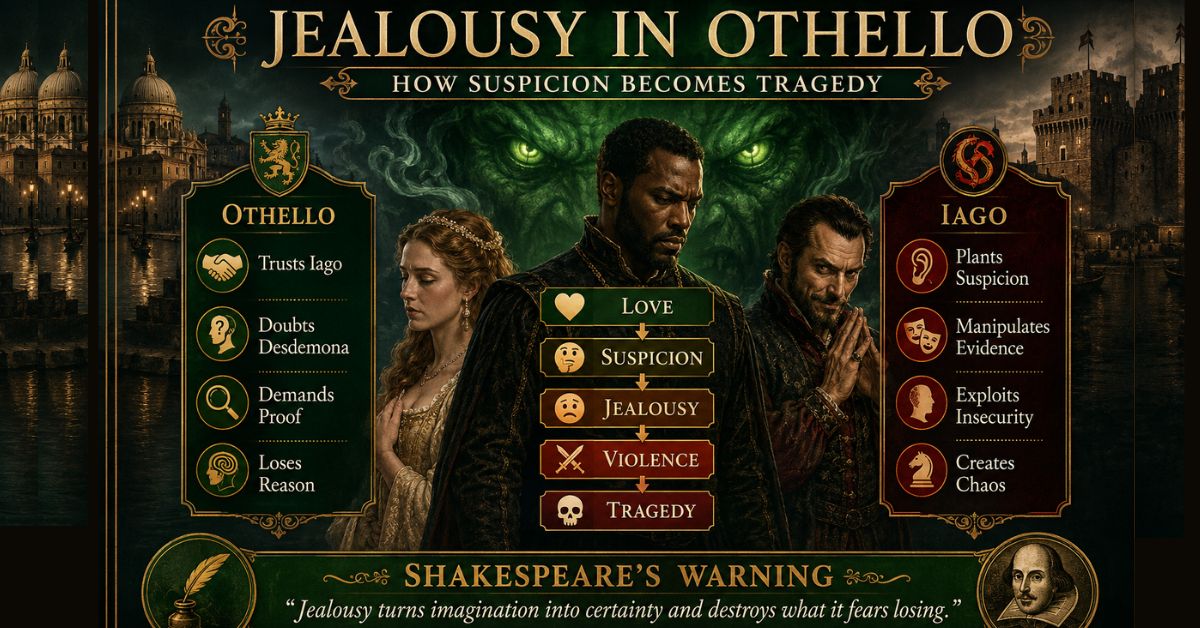
For example, allusions in Othello often frame characters through larger cultural images: Iago is linked to Satan or the serpent of Eden, highlighting his deception, while Desdemona appears with angelic or saint-like purity. Mythological references such as Venus and Mars emphasize the tension between love and war in Othello’s marriage, and Janus, the two-faced god, reflects Iago’s duplicity.
I often tell my students that these references work like background details in a painting- subtle at first, but once noticed, they make the entire tragedy richer and far more dramatic.
Table of Contents
Types of Allusions in Othello
When I guide students through Shakespeare’s language, I often say that Othello is not built from one cultural thread but from many. Shakespeare draws on religion, mythology, and classical history. These varied references create classical allusions in Othello and powerful religious allusions in Othello, enriching the tragedy’s emotional and symbolic depth.

i) Biblical Allusions in Othello
Biblical allusions in Othello are references to stories and imagery from the Bible that deepen the play’s moral and emotional conflict. Shakespeare uses this religious language to frame the tragedy as more than a domestic dispute. It becomes a struggle between innocence and corruption.
One day in class, while reading a tense scene between Othello and Iago, a student noticed how often the dialogue echoes heaven and hell. That observation opens the door to the powerful religious allusions in Othello. Words like soul, heaven, hell, and damnation appear repeatedly, giving the characters’ emotions a spiritual intensity.
Some references are strikingly specific. Iago’s line “I am not what I am” reverses God’s declaration in Exodus (“I am that I am”), suggesting a devil-like figure built on deception. Later, Othello calls himself the “base Judean,” recalling Judas and his tragic betrayal. Even Othello’s final kiss of Desdemona echoes the infamous kiss of Judas.
When I explain this to students, I often say Shakespeare turns jealousy into a theological drama, where suspicion feels like temptation, betrayal like sin, and love itself falls from paradise.
ii) Mythological Allusions in Othello
Mythological allusions in Othello are references to figures and stories from classical myth that Shakespeare uses to intensify the play’s emotional and symbolic meaning. Through these references, the tragedy connects private jealousy with the larger world of legend.
One famous example appears when Othello laments that “Dian’s visage is now begrimed and black.” Diana, known from Greek mythology in Othello as the goddess of chastity, symbolizes purity. By invoking her name, Othello expresses his belief that Desdemona’s supposed betrayal has destroyed something sacred.
Shakespeare also draws on other classical figures. Iago swears by Janus, the two-faced Roman god, subtly revealing his duplicity, while references to Cupid, the Roman god of love, highlight the passionate love between Othello and Desdemona.
When I explain this moment to students, I often say Shakespeare paints with myth. Instead of simply describing emotions, he invokes gods and legends- turning personal jealousy into something almost epic.
iii) Classical and Cultural Allusions
Classical allusions in Othello are references to figures, stories, and ideals from ancient Greek and Roman culture that deepen the play’s themes of honor, jealousy, and tragic downfall. Shakespeare uses these references to connect the personal drama of the characters with the grand traditions admired in the Renaissance.
Beyond myth and scripture, these classical allusions in Othello evoke heroic ideals and historical imagination. Othello himself often speaks with the dignity of a classical hero, sometimes compared to powerful figures like Hercules, symbolizing strength and noble reputation. At the same time, Iago swears by Janus, the two-faced Roman god, subtly revealing his deceptive nature.
I sometimes tell my students that these references act like architectural columns in the play. They give the tragedy a grand historical structure, reminding us that even the most heroic reputation, like Othello’s, can collapse under the pressure of jealousy and manipulation.
Famous Allusions in Othello (With Quotes & Explanation)
In this section, I guide my students through several memorable examples of allusions in Othello. By examining key Othello allusions quotes, we will see how Othello’s Greek and Roman mythology, religion, and culture deepen the tragedy. This brief list of allusions in Othello reveals hidden meanings behind Shakespeare’s language.

i) Dian’s Visage (Mythological Allusion)
Dian’s visage in Othello refers to Diana, the Roman goddess of chastity, whose moon-like face symbolizes purity and untouched innocence. When Othello laments, “Her name, that was as fresh as Dian’s visage, is now begrimed and black”(Act 3, Scene 3), he suggests that Desdemona’s once-perfect reputation has been stained by supposed betrayal.
Diana, in Roman mythology, represents radiant purity. By invoking her image, Othello reveals how highly he once idealized his wife. Yet the moment is deeply ironic: the audience knows Desdemona remains innocent, while Othello’s jealousy distorts reality.
When I explain this moment to students, I often compare it to a shattered mirror. Iago’s manipulation fractures Othello’s vision of truth. Instead of seeing Desdemona clearly, he imagines the fall of something divine- turning love into a tragic misunderstanding.
ii) Janus (Roman Allusion to Deception) in Othello
The Janus allusion in Othello refers to Janus, the Roman god with two faces, symbolizing duality and hidden intentions. In Act 1, Scene 2, Iago swears “By Janus” while pretending loyalty to Othello, even as he secretly plots betrayal.
In Roman mythology, Janus looks in two directions at once- toward the past and the future. Shakespeare uses this image to mirror Iago’s character. Outwardly, he appears trustworthy, earning the nickname “honest Iago.” Inwardly, however, he manipulates everyone around him.
During discussion, I sometimes ask my students to imagine the god standing behind Iago like a shadow- one face smiling at Othello, the other quietly orchestrating deception.
iii) Heaven and Hell Imagery
Among the most striking biblical allusions in Othello are the repeated images of heaven, hell, angels, and damnation. Shakespeare uses this religious language to transform a private marriage conflict into a spiritual battle between good and evil.
At first, Desdemona is often described with heavenly imagery, an “angel” or pure soul, while Iago is linked with devils, darkness, and hellish deception. As Iago’s manipulation spreads, Othello’s language changes dramatically. The noble general who once spoke of love and honor begins invoking “fire,” “perdition,” and “devils.”
I sometimes tell my students that Shakespeare raises the emotional temperature through this imagery. A jealous suspicion no longer feels ordinary. It becomes a moral catastrophe where innocence, temptation, and damnation collide.
iv) Barbary Horse Allusion
One of the most disturbing examples of allusions in Othello appears when Iago crudely warns Brabantio that “an old black ram is tupping your white ewe.” In the same scene (Act 1, Scene 1), he also claims Desdemona will be “covered with a Barbary horse,” reducing Othello to an animal.
The term Barbary horse refers to the North African region associated with the Moors, but Iago twists the image into a racist insult. By using breeding imagery normally applied to animals, he attempts to shock Brabantio and portray Othello as savage and hypersexual.
When I discuss this moment with students, the room often falls silent. Shakespeare uses this brutal language not merely to provoke outrage but to expose the racism and fear that shape Venetian society’s reaction to Othello’s marriage.
v) Additional Famous Allusions in Othello
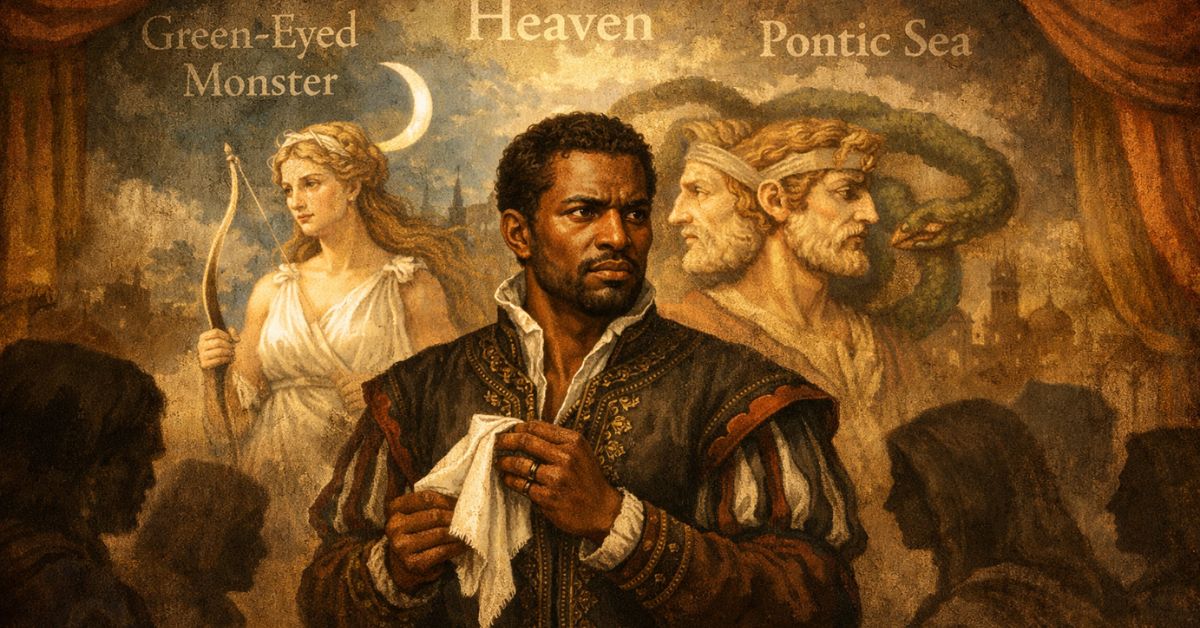
In Othello, the allusions to the green-eyed monster, Pontic Sea, Anthropophagi, and the Egyptian charmer deepen Shakespeare’s tragedy by turning emotions like jealousy, revenge, and love into vivid cultural images drawn from myth, geography, and legend.
One day in class, I asked my students a simple question: Why does Shakespeare describe jealousy like a monster? Silence… then someone read Iago’s warning: “O, beware, my lord, of jealousy; it is the green-eyed monster.” Suddenly, the idea clicked. Jealousy isn’t just a feeling. It’s a creature that feeds on the person who nurtures it.
Shakespeare pushes the image further when Othello compares his resolve to the Pontic Sea, whose powerful current never turns back. At that moment, I tell my students, Othello’s mind begins to flow like that sea- relentless, dark, and irreversible.
Earlier, Othello captivates Desdemona with tales of the Anthropophagi, mythical man-eaters from distant lands. These stories make him appear both heroic and strangely exotic in Venetian eyes.
Then comes the tiny object that changes everything: the handkerchief, said to come from an Egyptian charmer. I like to tell students Shakespeare hides a spell inside this cloth- one that quietly turns love into suspicion.
While these famous examples help us understand how allusion works, Shakespeare’s play contains many more subtle references scattered across different acts. Let’s quickly map some of them.
More Allusions in Othello (Act-Wise List with Meanings)
In class, I often tell my students, “Shakespeare never throws in a reference by accident- each one is doing quiet, powerful work.” And Othello is full of such layered allusions.
- Sagittary (Act 1, Scene 1)– a nod to Sagittarius, the centaur, subtly reflecting Othello’s heroic yet “outsider” identity.
- Jove (Acts 2 & 3)– the king of Roman gods, evoking authority and divine power in moments of uncertainty.
- Muses (Act 2, Scene 1)– symbols of inspiration, reminding us that language itself can become poetic and elevated.
- Mount Olympus (Act 2, Scene 1)– the home of the gods, lifting emotions to a grand, almost epic scale.
- Hydra (Act 2, Scene 3)– a many-headed monster, suggesting problems that grow the more you fight them.
- Chaos (Act 3, Scene 3)– the void before creation; here, it signals Othello’s complete emotional collapse.
- Prometheus (Act 5, Scene 2)– the giver of fire, symbolizing life and its tragic extinguishing.
Shakespeare also weaves in history and religion:
- Julius Caesar & King Stephen– figures of authority and leadership.
- Saint Peter (Act 4, Scene 2)– a symbol of judgment.
- Diablo (Act 2, Scene 3)– reinforcing evil and temptation.
- Spartans (Act 5, Scene 2)– representing brutality and warrior strength.
And I always remind my students: the more allusions you notice, the deeper Othello wounds you.
Why Shakespeare Uses Allusions in Othello
Shakespeare uses allusions in Othello to deepen characterization, strengthen themes, and connect the tragedy to familiar biblical and classical stories. These references allow the playwright to compress complex ideas into a few powerful words, giving the dialogue emotional and cultural depth.

One afternoon in class, while we were untangling Iago’s schemes, a student leaned forward and asked, “Sir, why does Shakespeare keep bringing in gods and Bible references?”
I smiled because that question goes straight to the heart of Othello.
First, Shakespearean allusions reveal character. Othello often speaks through sacred or mythological imagery, showing how deeply he values honor and moral order. Iago, by contrast, twists those same references. His line “I am not what I am” echoes and reverses a biblical declaration from Exodus, subtly framing him as a devil-like deceiver.
Second, allusions reinforce the play’s central themes. References to figures such as Janus, the two-faced Roman god, highlight deception, while classical myths about Venus and Mars echo the tension between love and conflict in Othello’s marriage.
And references to figures like Jove, Prometheus, and Hydra lift personal emotions into mythic struggles- jealousy becomes monstrous, love becomes sacred, and betrayal feels almost cosmic.
Third, and this is something I love pointing out, these allusions create dramatic irony. Shakespeare’s audience would have recognized these references instantly. They could sense the tragedy forming long before Othello himself realizes it.
Ultimately, the significance of allusions in Othello lies in their cultural power. They transform a private story of jealousy into a universal tragedy that resonates with myth, religion, and history.
Table: Key Allusions in Othello
Before my students dive into long explanations, I like to pause and map the references visually. This short list of allusions in Othello highlights how mythology, religion, and culture quietly shape meaning in the play.
| Allusion | Source | Meaning |
| Dian’s visage | Roman mythology | purity, chastity |
| Janus | Roman mythology | deception, duality |
| Jove | Roman mythology | power, authority |
| Hydra | Greek mythology | uncontrollable problems |
| Prometheus | Greek mythology | life, knowledge, lost hope |
| Heaven / Hell | Bible | morality, good vs evil |
| Saint Peter | Bible | judgment, divine authority |
| Caesar | Roman history | leadership, authority |
| Barbary horse | Cultural | racial prejudice, dehumanizing |
When I present this table in class, something interesting happens. Suddenly, the scattered references in the play begin to look like pieces of a puzzle. Each allusion connects a character’s words to a larger cultural story.
How Allusions Strengthen the Themes of Othello
Allusions in Othello strengthen the play’s themes by connecting the characters’ personal emotions- jealousy, deception, and prejudice- to larger mythological, biblical, and cultural ideas. Through these references, Shakespeare turns a private tragedy into a universal story about human weakness and moral conflict.

Whenever I teach Othello, I remind my students that Shakespeare rarely wastes a word. Even a small reference can carry enormous meaning. That is exactly how allusions in Othello deepen the play’s themes.
Consider deception. Iago chillingly declares, “I am not what I am,” a dark inversion of a biblical phrase. In one line, Shakespeare frames Iago as a figure of moral corruption. His oath “by Janus,” the Roman god with two faces, reinforces the theme of appearance versus reality.
Jealousy grows through similar imagery. Iago warns Othello about the “green-eyed monster,” transforming jealousy into a devouring creature. When Othello imagines Desdemona’s lost purity through references like “Dian’s visage,” the fear becomes mythic rather than merely personal.
Even racism appears through brutal cultural allusions in Othello, such as the insult “Barbary horse,” which exposes Venetian prejudice.
Step back, and the pattern is clear: Shakespeare uses myth, religion, and culture to magnify emotion. Through these Othello allusions, jealousy becomes legendary, innocence sacred, and deception almost timeless.
FAQs:
Why did Shakespeare frequently use allusions in his plays?
Shakespeare used allusions because Renaissance audiences were familiar with mythology, religion, and classical history. A single reference could instantly communicate complex ideas, emotions, and moral conflicts without lengthy explanation.
Do readers need to recognize every allusion in Othello?
Not necessarily. The play still works emotionally, even if some references are missed. However, recognizing the allusions allows readers to understand deeper symbolism and appreciate Shakespeare’s layered storytelling.
Are allusions more common in tragedy than comedy?
They appear in both, but tragedies like Othello often use allusions more seriously. References to myth, religion, and history help elevate personal conflict into a universal moral struggle.
How can students easily identify allusions while reading Shakespeare?
Students can look for unusual names, mythological figures, biblical language, or references to famous places and stories. These clues often signal that the line points to something beyond the immediate scene.
Why are allusions important for literary analysis?
Allusions reveal how literature connects with wider culture and history. By studying them, readers can see how writers transform familiar stories into new meanings within a different narrative.
Conclusion:
At the end of our discussion, I often remind my students that an allusion is never decorative in Shakespeare. It works like a small window opening toward a larger story. When we notice an allusion in Othello, the tragedy suddenly expands beyond the stage.
A single mythological hint can transform jealousy into a legendary struggle. A biblical echo can frame innocence as something sacred and fragile. Even a harsh cultural reference can expose the racism surrounding Othello’s world.
This is why studying allusion in Othello still matters today. These references invite readers to think, connect, and question. Shakespeare trusted his audience to recognize echoes from mythology, religion, and history.
Then the tragedy speaks with astonishing clarity to modern readers everywhere.