
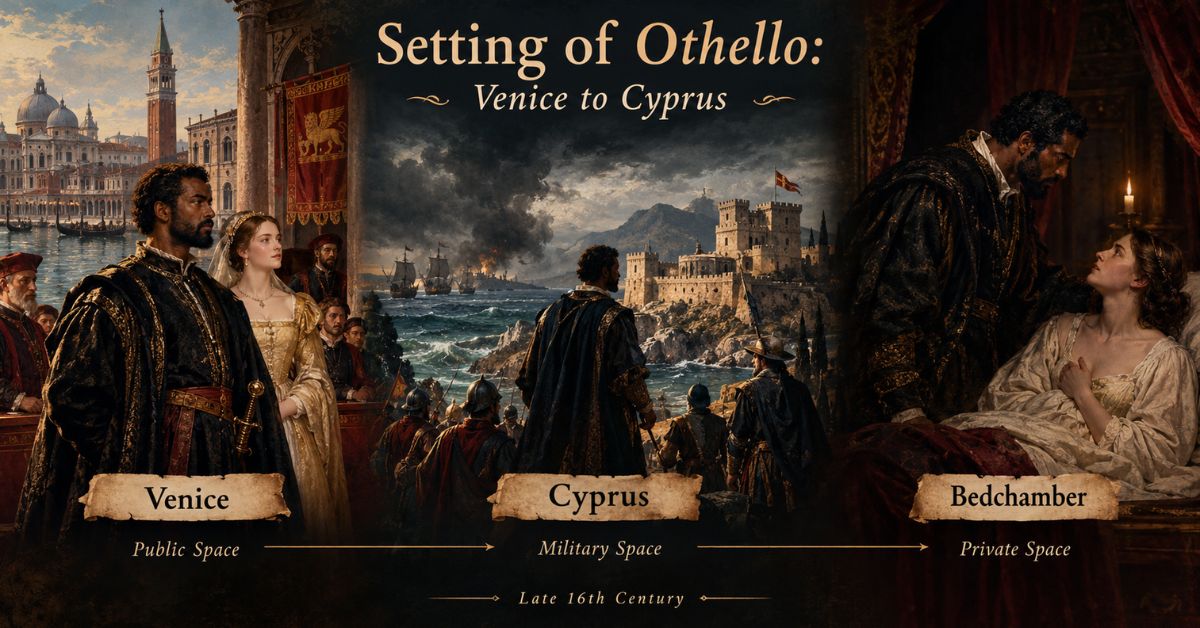
What changes when a tragedy moves from a powerful city to a military island? The setting of Othello is shaped by this movement from Venice to Cyprus, changing the conditions in which Othello, Desdemona, and Iago act.
Venice is a world of civic authority and public reputation. Cyprus is a Venetian military outpost, geographically removed from the civic institutions of Venice.
The play begins in Venice, moves to Cyprus in Act 2, and finally narrows into Desdemona’s bedchamber.
This shift from public space to military space to private space follows the tragedy’s growing intensity, as tensions surrounding power, race, and marriage become increasingly personal and confined.
What Is the Setting of Othello?
Setting means the time and place in which a literary work occurs. The principal locations are Venice and Cyprus in Othello. Act 1 takes place in Venice, while Acts 2–5 take place mainly in Cyprus. The play is associated with the late sixteenth-century Mediterranean and the conflict between Venice and the Ottoman Empire.
The War of Cyprus provides historical context rather than a precise date for the fictional action. The first act moves through Venetian streets, Brabantio’s house, and the Senate, where Othello and Desdemona must publicly answer Brabantio’s accusation. Othello can defend himself, and Desdemona can confirm her choice.
From Act 2, the action moves to Cyprus. A storm scatters the Turkish fleet, removing the immediate external military threat and leaving Iago’s manipulation and Othello’s suspicion at the centre of the action.

| Element | Answer |
| Main locations | Venice and Cyprus |
| Act 1 | Venice |
| Acts 2–5 | Mainly Cyprus |
| Historical background | Late-sixteenth-century Mediterranean conflict |
| Main spatial movement | Public city → military outpost → private bedroom |
Want a quick explanation of the setting of Othello? Watch our video tutorial to understand Venice, Cyprus, and how the change of setting shapes the play.
Table of Contents
Venice in Othello
Venice establishes Othello’s public identity within a world of law and public authority, especially the importance of reputation. He is a respected general whose military service is valuable to the Venetian state, yet his position as an outsider remains visible.

The Senate illustrates Venice’s institutional order. When Brabantio accuses Othello of winning Desdemona through enchantment, Othello is given an opportunity to speak, and Desdemona confirms that she married him freely. The episode shows that Venetian authority can test accusations through public hearing rather than simply accepting personal prejudice.
Venice is also presented as a wealthy, cosmopolitan trading centre where people from different backgrounds meet. Yet this apparent openness does not remove racial prejudice. Othello’s military value earns him respect, while his marriage to Desdemona exposes attitudes that place limits on his social acceptance.
This makes Venice a contrast with Cyprus. Once Othello leaves the Senate and Venetian society behind, Iago has greater freedom to manipulate private information and suspicion. Venice therefore represents institutional order without complete social acceptance, establishing tensions that become more dangerous in Cyprus.
Cyprus in Othello
Cyprus changes the dramatic conditions of Othello. It is a Venetian possession and military outpost, removed from the civic institutions of Venice. Once Othello and the others arrive, however, the Turkish fleet has been scattered by the storm, so the immediate external threat recedes.
This shift is important. The historical conflict with the Ottoman Empire provides the reason for the journey, but the real danger soon comes from within the Venetian group. Iago no longer needs a battlefield enemy. He can focus on Othello, Cassio, and Desdemona.

Cyprus also creates a form of psychological isolation. Away from the Senate and Venetian society, Othello becomes increasingly dependent on what he hears and sees through Iago. Cassio’s drunken brawl, Desdemona’s attempts to help him, and the handkerchief all become material for manipulation.
The island therefore changes from a military setting into a stage for private conflict. Shakespeare turns the external threat of war into an internal crisis of trust that gradually becomes entangled with jealousy and betrayal.
Why Does Othello Move from Venice to Cyprus?
Othello moves to Cyprus because the Venetian Senate believes the island is threatened by a Turkish invasion. The senators discuss the approaching fleet and send Othello, an experienced general, to defend the strategically important Venetian outpost. Desdemona is permitted to accompany him.
The journey also changes the nature of the conflict. In Venice, Othello can defend his marriage before the Duke and Senate, where accusations receive public scrutiny. In Cyprus, he is removed from that civic environment and becomes increasingly dependent on private conversations and apparent evidence. This gives Iago greater freedom to manipulate his interpretation of events.
The move therefore serves both a military purpose and a dramatic one: it places Othello in an environment where suspicion can grow without the same public checks.
When Is Othello Set?
Othello does not provide a precise fictional year, but the play is generally associated with the late sixteenth century, particularly the 1570s. Its historical background connects with the Ottoman-Venetian conflict over Cyprus, known as the War of Cyprus. The Ottoman invasion began in 1570, and Venice lost Cyprus in 1571.
Shakespeare does not reproduce these historical events exactly. In the play, the Turkish fleet is scattered by a storm before the main action in Cyprus develops.
The historical conflict therefore provides context rather than a precise timeline for the drama. It is safer to describe Othello as set broadly in the late sixteenth-century Mediterranean than to assign the fictional action one exact year.

How Does Setting Shape the Tragedy in Othello?
The setting of Othello becomes most meaningful when we notice how the physical space gradually narrows.
Venice begins with streets and public institutions. Brabantio can raise an accusation, the Senate can hear it, and Othello can answer. Civic authority provides a structure for competing claims.
Cyprus is different. Othello remains the military commander, but he is now operating outside the civic environment represented by Venice and the Senate. Suspicion grows through what people say, what Othello thinks he sees, and the objects Iago uses against him rather than formal public accusation.
The action has narrowed into Desdemona’s bedchamber by Act 5. The political and military world has been brought into the private space of marriage. Othello, once the general defending Venetian interests, now brings the authority of his military identity into his marriage, with devastating consequences.
The setting does not cause Othello’s downfall. Iago’s deception, Othello’s jealousy, his misplaced trust, and his own choices remain essential. Once Othello is away from the Senate, suspicion no longer has to survive public scrutiny. Iago can shape it privately.
The movement can therefore be understood as public judgment → private suspicion → private violence. That progression gives the locations a dramatic function beyond scenery.
Key Settings and Scenes in Othello
| Act/Scene | Setting | Dramatic function |
| 1.1 | Venice streets | Iago begins his plot and informs Brabantio |
| 1.3 | Venetian Senate | Othello defends his marriage publicly |
| 2.1 | Cyprus | The characters arrive after the storm |
| 2.3 | Cyprus | Cassio loses his position after the brawl |
| 3.3 | Cyprus | Iago deepens Othello’s suspicion |
| 5.2 | Desdemona’s bedchamber | The private tragedy reaches its climax |
These locations show how Shakespeare moves the tragedy steadily away from public scrutiny and toward private action.
FAQs:
Is Cyprus the same place as modern Cyprus?
Yes. Shakespeare’s Cyprus refers to the Mediterranean island known today as Cyprus, though its political context belongs to the early modern conflict between Venice and the Ottoman Empire.
Why is Venice important in Othello?
Venice establishes Othello as a respected military commander while also revealing prejudice surrounding his marriage. The Senate provides a public setting where he and Desdemona can answer Brabantio’s accusation.
How does the setting narrow by the end of Othello?
The action moves from Venetian streets and the Senate to Cyprus and finally to Desdemona’s bedchamber. This narrowing accompanies the movement from public conflict to private violence.
Conclusion:
The setting of Othello shapes the tragedy’s dramatic movement. Venice establishes a civic world where Othello holds authority yet faces prejudice, while Cyprus removes him from that public setting and creates space for Iago’s manipulation.
Shakespeare draws on the historical conflict between Venice and the Ottoman Empire but reshapes it around a marriage threatened by suspicion and deception. By the final act, the world narrows into Desdemona’s bedroom.
The movement from Venice to Cyprus to the bedchamber mirrors Othello’s journey from public authority to private violence.


In Othello, Shakespeare engineers a stark spatial dialectic in which Venice embodies the Apollonian—law, ceremony, daylight reason—while Cyprus unleashes the Dionysian—storm, night, revel, and unruly passion. In Venice’s council chamber, Othello’s identity is secured by public discourse and due process (“My parts, my title, and my perfect soul”; Desdemona’s “divided duty”): reputation is audited under civic light, and language functions as rational proof. The sea‑passage and tempest form the liminal hinge that transfers the action from public war to private chaos, so that on Cyprus—an exposed military outpost with thin institutions—desire, drink, and darkness saturate the drama: Cassio’s fall in revels, Iago’s insinuations (“I like not that”), the fetishising of “ocular proof” in the bedchamber, and the final extinguishing of the candle (“Put out the light…”). Thus, setting is not backdrop but catalyst: Venice’s Apollonian architecture sustains Othello’s Cortegiano poise, while Cyprus’s Dionysian climate strips that scaffolding, compresses time, and converts suspicion into action, staging the tragedy’s passage from public reason to private unreason.
Hey Carolyn, Brilliant reading! Your Apollonian–Dionysian lens clarifies how Othello engineers psychology through space. I especially like the liminal storm as a structural hinge and the shift from civic rhetoric to “ocular proof.” William Shakespeare turns Venice into a reputation, Cyprus into an impulse- tragedy ignites when language loses jurisdiction. Beautifully argued and illuminating for students.