Roderigo in Othello: Character, Role, Quotes & Analysis

roderigo in othello

If there’s one character my students consistently underestimate in Othello, it’s Roderigo. They wave him off as “the desperate guy with the purse,” and then Act V hits them like a chalkboard falling off the shelf. Suddenly, the room gets quiet. They realize this foolish, love-struck Venetian gentleman is actually the key to understanding jealousy, manipulation, and the dangers of unrequited love.

That’s exactly why I love teaching Roderigo in Othello. His role may look small, but his choices- his quotes, his blind faith in Iago- unlock the emotional architecture of the entire play. 

And trust me, once you look closely, Roderigo stops being a side character and becomes Shakespeare’s most painful cautionary tale.

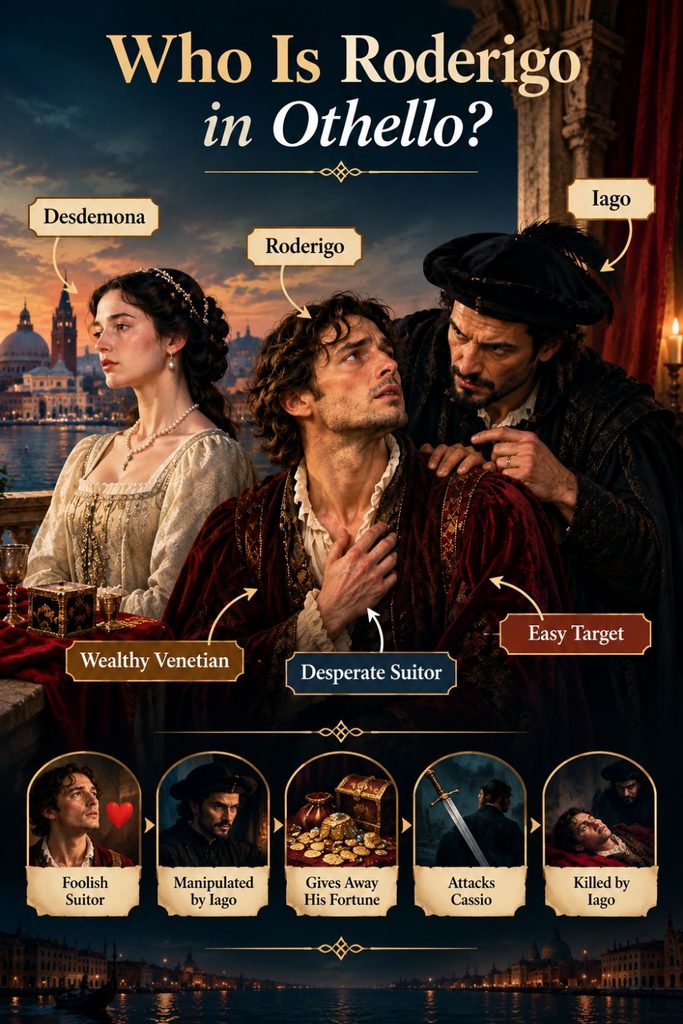
Who Is Roderigo in Othello? (Character Overview)

In this section, I want to walk you through who Roderigo truly is- not just the “poor guy with a wallet problem,” but a character whose weaknesses shape the entire plot. By the end, you’ll see why Shakespeare needs Roderigo every bit as much as he needs Othello or Iago.

i) Roderigo’s Background and First Appearance

Every year when I introduce Roderigo, my students squint at the page like, “Wait, who is this guy again?” And honestly, it’s fair. Shakespeare doesn’t give him a dramatic entrance- no storm, no military title, not even a poetic line to his name. 

Instead, Roderigo slips into Act I as a wealthy Venetian gentleman who’s already knee-deep in heartbreak and poor decisions.

He’s part of the upper class, which makes his desperation even more striking. Here’s a man with money, privilege, and social standing… yet completely undone by love. And his link to Desdemona? 

Simple: he wants to marry her. Or at least, he thinks he does. I always tell my students that Roderigo is the Elizabethan equivalent of that friend who believes one text message from their crush is “a sign from the universe.” 

Shakespeare knew exactly what he was doing when he introduced Roderigo first through heartbreak- because it sets the emotional tone for everything that follows.

ii) What Roderigo Wants (His Core Motivation)

If I had to sum up Roderigo’s motivation in one sentence, it would be this: he wants Desdemona so badly that he stops wanting anything else. His desire doesn’t just cloud his judgment. It replaces it entirely.

What does he want? Desdemona’s love.

What does he get? A masterclass in being manipulated.

Roderigo is gullible, yes, but not because he’s stupid. He’s gullible because he’s hopeful. Painfully, desperately hopeful. And hope, when mixed with insecurity, becomes Shakespeare’s favorite recipe for disaster. 

When I teach this part, I ask my students: “Have you ever wanted something so badly that you ignored every warning sign?” That’s Roderigo. A walking red flag factory who keeps handing his flags to Iago.

His longing makes him impulsive. His insecurity makes him easy prey. And his blind trust in Iago? Well… that’s the tragic cherry on top.

iii) Words to Describe Roderigo (Fast Adjectives List)

When students ask me for quick adjectives for their essays, this is the list I give- short, sharp, and painfully accurate:

Jealous, naïve, hopeful, foolish, passionate, and manipulated.

And honestly? That combination is exactly why Roderigo becomes one of the most quietly tragic figures in Othello.

roderigo in othello

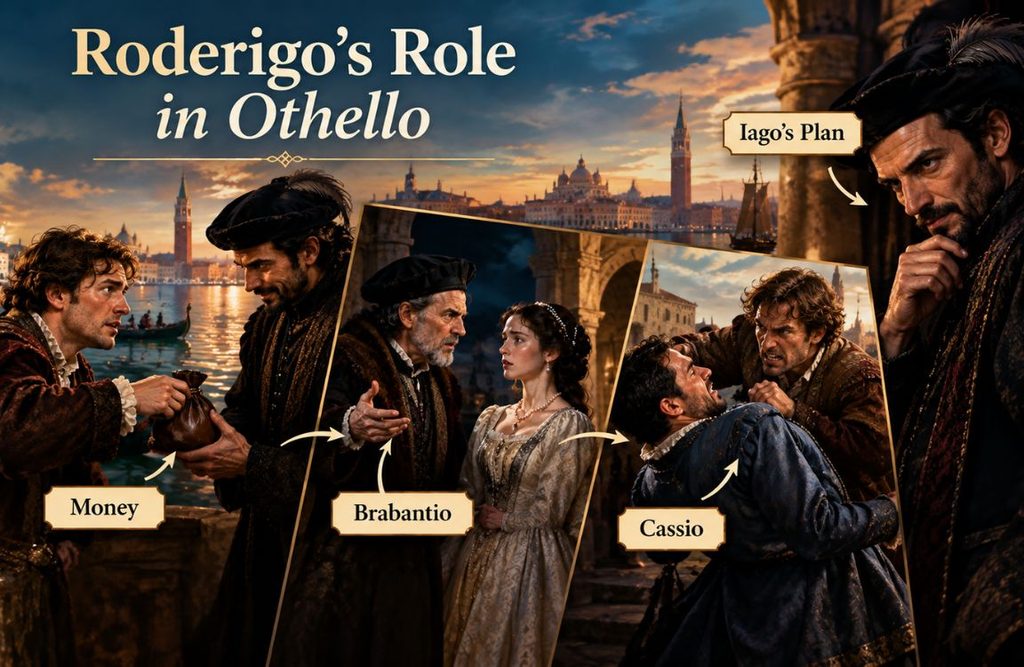
Roderigo’s Role in Othello (Why Shakespeare Included Him)

In this section, I want to walk you through why Shakespeare didn’t just toss Roderigo into the play for comic relief. His role- though often brushed aside- is the engine that keeps Iago’s wicked machine running. 

And honestly, once you see how Roderigo functions in the story, you’ll never call him “minor” again.

i) Roderigo as Iago’s Pawn

Every year, when I introduce Iago’s grand web of manipulation, I ask my students: “What’s a spider without a fly?” 

Roderigo is that fly- buzzing, hopeful, and tragically unaware he’s flying straight into poison. Shakespeare uses Roderigo as the perfect pawn, someone whose weaknesses fuel Iago’s most destructive schemes.

Roderigo gives Iago money, trust, loyalty- and, unintentionally, opportunities. He becomes the emotional battery that powers Iago’s evil. Without Roderigo’s desperation for Desdemona, Iago wouldn’t have half the leverage he enjoys. 

In other words, Roderigo is the walking, talking example of what happens when you want something so badly that you let someone else think for you.

Thematically, Roderigo embodies the “perfect prey.” He is eager, naïve, and blinded by passion- three traits that make manipulation not just possible, but effortless. 

Shakespeare uses him to show that villains don’t need magical powers. They only need someone who believes in them too easily.

ii) Roderigo as a Mirror to the Audience

Here’s a little teaching moment: whenever my students laugh at Roderigo’s decisions, I pause and ask, “Are you sure you’ve never believed a lie because you wanted it to be true?” Suddenly, the laughter fades into thoughtful silence.

That’s Roderigo’s real dramatic power. His gullibility isn’t just a character flaw. It’s a reflection of how manipulation works in real life. We see ourselves in his confusion, his longing, his misguided hope. 

Shakespeare uses Roderigo to remind us that deception thrives not because villains are brilliant, but because humans are hopeful. And hope, unguarded, is a dangerous thing.

iii) Roderigo as a Catalyst for Plot Movement

If you track the major plot shifts in Othello, you’ll see Roderigo quietly kicking each one forward like a backstage crew member who never gets credit.

1) Act I- The Brabantio Incident:

Roderigo joins Iago in waking Brabantio, setting off the chain reaction that drags Othello into public conflict. Without Roderigo’s presence, the father would never have stormed into the streets looking for justice.

2) Act II- The Fight with Cassio:

Roderigo’s foolish attempt to provoke Cassio leads to the lieutenant’s downfall. And if Cassio never fell, Iago’s plan would have unravelled. Roderigo is essential here. He turns Iago’s whispers into action.

3) Act V- The Attempted Murder:

In the final act, Roderigo becomes both weapon and victim. His attempt to kill Cassio- and his subsequent death- exposes just how monstrous Iago truly is. His fall is the moment when the cost of manipulation becomes painfully undeniable.

Roderigo may not shine like Othello or scheme like Iago, but he is the thread that quietly binds the tragedy together. Shakespeare included him not as decoration, but as a warning: the easiest souls to destroy are the ones who never realize they’re in danger.

Roderigo Character Analysis (Traits, Motivations & Flaws)

In this section, I want to take you inside Roderigo’s emotional world- the traits that shape him, the motivations that push him, and the flaws that ultimately destroy him. If you’ve ever wondered why he keeps making the same terrible choices, this is where everything finally clicks into place.

i) Jealousy:

Whenever I teach Othello, I tell my students that jealousy comes in different intensities. Othello’s is volcanic, Iago’s is icy, and Roderigo’s? 

It’s more like a kettle that never stops whistling. His jealousy simmers constantly, especially whenever Desdemona’s or Othello’s name is mentioned. It doesn’t explode dramatically, but it pushes him into reckless decisions over and over again.

ii) Emotional Impulsiveness:

If Shakespeare wrote a handbook titled How Not to Make Decisions, I’m convinced Roderigo would be the cover model. He acts first and thinks later- usually with disastrous results. 

Sell his land? Sure. 

Follow Iago into the dark? Why not. 

Try to fight Cassio (a trained soldier)? Perfect idea. 

His impulsiveness isn’t comic. It’s tragic.

iii) Blind Trust:

Here’s where students always sigh and say, “Sir, how can someone trust Iago this much?” And I always respond, “Because Roderigo needs to believe him.” 

His trust isn’t earned. It’s wishful. He clings to Iago because Iago feeds his fantasies. Shakespeare paints this blind faith so convincingly that we almost want to shake Roderigo by the shoulders.

iv) Idealistic Desperation:

Roderigo lives in a dream world where love conquers all except when it doesn’t. He imagines Desdemona as his destined partner and interprets every hint, whisper, or rumor as a sign of hope. 

This desperate idealism makes him tender but also terribly vulnerable. Shakespeare turns that vulnerability into tragedy.

v) Roderigo’s Biggest Flaw- His Naïve Love for Desdemona

Roderigo’s downfall begins and ends with one truth: he loves Desdemona not as a person, but as a fantasy. His love is entirely one-sided- unrequited from the start. 

Yet he convinces himself that she “should have” chosen him. This is projection at its finest.

He builds an imaginary version of Desdemona who is waiting for him, longing for him, maybe even secretly unhappy with Othello. 

Every time I read these scenes with students, they can practically feel how painfully unrealistic this thinking is. Roderigo falls in love with what he wants Desdemona to be, not who she is.

This flaw blinds him. It’s why he obeys Iago. It’s why he sells his property. It’s why he stands in dark alleys holding a weapon he doesn’t know how to use. His love becomes an illusion that guides every tragic step.

vi) How Does Roderigo View Othello?

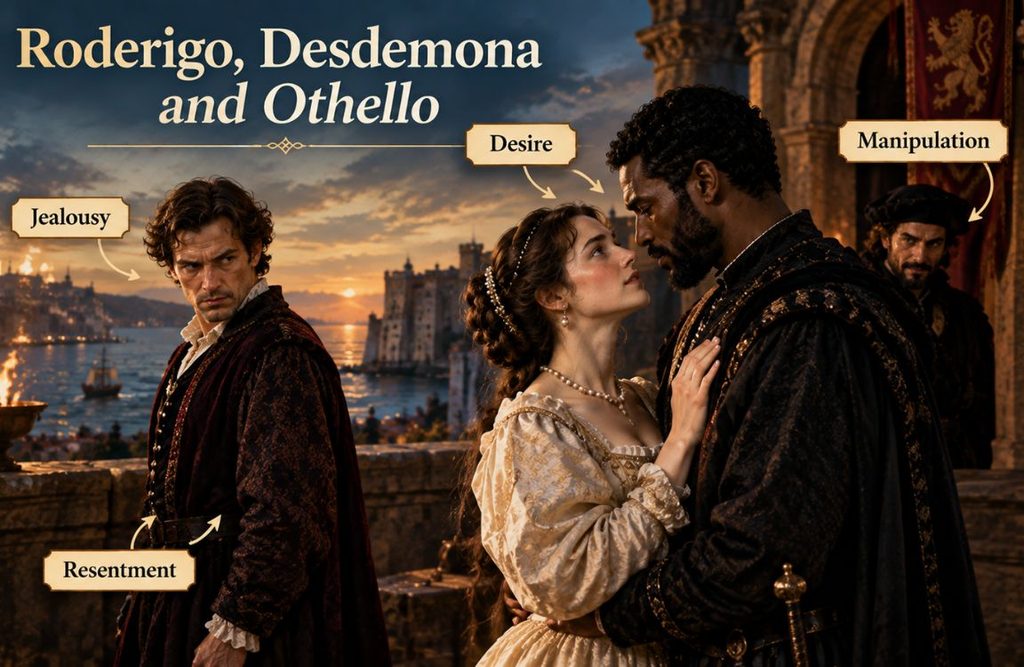
To Roderigo, Othello is the obstacle, the wall, the problem. In his mind, Othello “stole” Desdemona- an idea that reveals more about Roderigo than Othello. This tells us:

  • He views Desdemona as a possession, not a person.
  • He believes he was entitled to her affection.
  • He sees Othello as an undeserving outsider standing in the way of his fantasy.

His hatred for Othello is based on entitlement, insecurity, and jealousy- not reality. Shakespeare wants us to see how dangerous a wounded ego can be.

vii) Is Roderigo Jealous of Othello? (Yes, and Here’s How Shakespeare Shows It)

Absolutely. Roderigo’s jealousy is woven into every scene he enters. We see it when he whines to Iago about Desdemona’s marriage. We hear it when he reluctantly confronts Cassio. We feel it when he agrees to murder.

Shakespeare doesn’t show Roderigo shouting or raging like Othello. Instead, his jealousy trickles out in self-pity, bitterness, and desperation. It is a quiet jealousy, but one that corrodes him from within.

And that’s what makes Roderigo so compelling. He’s not the loudest character, but he’s one of Shakespeare’s clearest warnings: jealousy doesn’t need to roar to ruin you. It only needs to whisper.

Roderigo and Iago: A Toxic Partnership

In this section, I want to unpack one of the most dangerously entertaining pairings in Othello: Roderigo and Iago. I call them the “OG toxic duo” because their relationship teaches my students more about manipulation than any modern drama ever could.

i) Why Iago Chooses Roderigo?

Every time I reintroduce Iago’s schemes in class, I remind my students that villains rarely pick strong, confident targets. They pick the soft, shaky ones- the ones who want to believe. And Roderigo is exactly that person.

First, he’s easy to manipulate. Iago doesn’t even need complicated lies. A sprinkle of confidence and a dramatic whisper are enough to convince Roderigo that he still has a chance with Desdemona. 

Second, he’s wealthy- a perk Iago exploits with Olympic-level skill. Roderigo becomes a walking ATM, handing out coins like gifts in hopes of winning love.

And finally, he’s emotionally unstable. His feelings for Desdemona twist him into knots, making him reactive, desperate, and simply incapable of thinking logically. In other words, he’s the perfect piece on Iago’s chessboard.

ii) How Does Iago Manipulate Roderigo?

Whenever I teach this part, I tell students to watch how Iago plays Roderigo like an instrument- press a button here, pull a string there, and suddenly Roderigo is making all the wrong moves.

Iago’s famous strategy?

“Put money in thy purse.”

This line becomes his anthem. Iago repeats it not because Roderigo needs financial advice, but because repetition builds obedience. It’s psychological conditioning disguised as a friendly suggestion.

Next comes flattery and misinformation. Iago constantly tells Roderigo what he wants to hear: that Desdemona is attainable, that Othello’s relationship is crumbling, and that one more payment will surely “do the trick.” 

I can almost see students roll their eyes, and then slowly realize they, too, have believed something because they wished it were true.

Finally, Iago pushes Roderigo toward violence, especially against Cassio. He convinces him that every reckless act is just a necessary step toward winning Desdemona’s love. 

The irony? 

Each step only destroys Roderigo further.

iii) Why Is Roderigo Angry with Iago?

There’s a moment when even Roderigo- sweet, confused Roderigo- finally snaps. This is his breaking point. After giving money, taking risks, and bruising both body and pride, he realizes he has gained nothing. 

Desdemona is still married, Cassio is still alive, and Iago’s promises are still promises.

This leads him to something shockingly brave: his decision to expose Iago. For once, he sees beyond the illusions. For once, he threatens to tell the truth. And for a brief second, my students always think, “Maybe Roderigo will finally win.”

But Shakespeare isn’t that generous.

iv) Why Does Iago Kill Roderigo?

Iago eliminates Roderigo for two chillingly practical reasons.

First, to protect himself. Roderigo is the only person who knows the full extent of Iago’s manipulations. If Roderigo talks, everything falls apart. So, Iago does what villains often do. He removes the risk.

Second, he kills Roderigo to silence the evidence. Roderigo’s death ties up the loose ends of his schemes… or so Iago believes. The tragic irony is that in killing Roderigo, he exposes himself even more.

The Iago-Roderigo dynamic is one of Shakespeare’s sharpest lessons: the most dangerous villains don’t destroy us with swords. They destroy us by using our own desires against us.

Roderigo and Desdemona: Love, Obsession & Illusion

In this section, I want to walk you through the emotional hurricane that Roderigo calls “love.” Spoiler: it’s not love. It’s an obsession with wearing a Shakespearean costume, and it shapes everything he does in the play.

i) Does Roderigo Love Desdemona?

Every time we reach this topic in class, I ask my students a simple question: “Is Roderigo in love with Desdemona, or is he in love with the idea of Desdemona?” And without fail, half the room looks suddenly unsure.

Roderigo claims to be passionately in love, but when we look closely, what he feels is less like genuine affection and more like obsession. It’s the kind of obsession that makes someone forget logic, dignity, and even basic safety precautions. His heart leaps, but his thinking plummets.

His so-called love is steeped in misguided devotion. He doesn’t know Desdemona. He idealizes her. He projects fantasies onto her like she’s a blank canvas designed for his imagination. 

Shakespeare doesn’t paint their connection as a romance. He paints it as a delusion. And Roderigo clings to that delusion with both hands, even as it drags him off a cliff.

Whenever I see students sympathizing with him, I gently remind them: “Admiration becomes obsession the moment you stop seeing the real person.” Roderigo never sees Desdemona- only the dream version he has built inside his mind.

ii) How Roderigo’s Obsession Shapes the Plot?

If Roderigo weren’t obsessed with Desdemona, Iago’s entire villainous business model would collapse instantly. Roderigo isn’t just lovesick. He’s the fuel Iago pours into his engine.

First, his obsession makes him willing to follow Iago anywhere. Across Venice, into Cyprus, into danger, into debt. Roderigo keeps chasing the promise that Desdemona will one day be his. 

It’s tragic, but it’s also the reason Iago’s schemes gain momentum. Without Roderigo tagging along like a hopeful puppy, many key events wouldn’t unfold.

Then there are his irrational decisions, which become plot gold for Shakespeare.

  • He wakes Brabantio at night.
  • He picks fights he cannot win.
  • He tries (and fails) to kill Cassio.

All because he believes one good deed- one reckless act- will earn Desdemona’s love.

Whenever I tell my students that Roderigo is the domino that keeps tipping the next crisis into motion, they suddenly see him differently. He’s not just background noise. He’s the heartbeat of chaos.

Roderigo’s obsession doesn’t just define his character. It shapes the tragedy itself. His longing becomes Iago’s weapon, and his illusions become the cracks through which disaster pours.

Roderigo’s Jealousy & Thematic Significance

In this section, I want to show you how Roderigo’s jealousy isn’t just a side note in Othello. It’s one of Shakespeare’s clever teaching tools. Through Roderigo, we get a smaller, more fragile version of the emotional storms that tear the play apart.

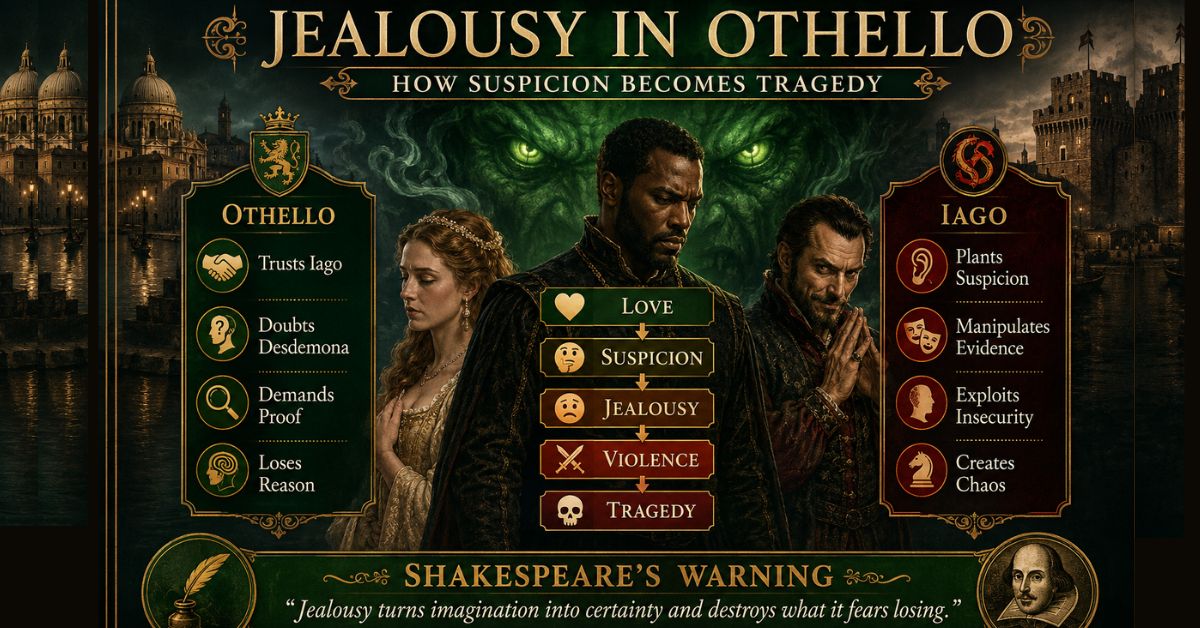
i) Roderigo and the Theme of Jealousy

Whenever I talk about jealousy in Othello, students immediately jump to Othello himself- grand, tragic, heartbreaking jealousy. But Roderigo? 

He represents the starter pack version of that same emotion. A lighter, shakier model. The one you’d find in someone who’s not quite ready for the full-scale tragedy but still insists on trying it out.

Roderigo’s jealousy is softer than Othello’s, but no less destructive. While Othello’s jealousy erupts into rage and violence, Roderigo’s jealousy trickles in through insecurity. 

It’s the kind of jealousy that makes you think, “If I just listen to one more bad suggestion, everything will work out.” Spoiler: it doesn’t.

I often tell my students that jealousy is Shakespeare’s favorite stepping-stone emotion. No one leaps straight into tragedy- jealousy leads them there. 

For Roderigo, jealousy feeds his desperation for Desdemona, fuels his bitterness toward Othello, and blinds him to Iago’s manipulation. It’s the quiet poison that keeps him obedient, hopeful, and helpless.

ii) Roderigo as a Warning Example

Shakespeare rarely lets a character suffer without turning them into a lesson- and Roderigo might be the clearest warning sign in the play. His story whispers, “This is what happens when you let emotions do your thinking for you.”

Through Roderigo, Shakespeare teaches us about emotional blindness- the kind that makes you trust the wrong people, chase the wrong dreams, and ignore every red flag waving right in front of your face. 

I always tell my students: if Roderigo had paused just once to think instead of feel, the entire play would look very different.

His downfall mirrors the dangers of emotional tunnel vision. He sees only Desdemona. Only jealousy. Only Iago’s promises. And that narrow focus becomes a trap he never escapes.

When students ask me why Shakespeare spends so much time on a character who seems “minor,” I smile and answer: Because Roderigo shows us how tragedy begins- quietly, subtly, inside the mind of someone who wants too much and questions too little.

Roderigo’s jealousy doesn’t roar like Othello’s, but it matters just as much. It’s Shakespeare’s reminder that even the smallest emotions can push us toward the biggest consequences.

Key and Important Roderigo Quotes with Explanations

Ah, here comes my students’ favorite part- the juicy quotes section! You know that moment when you realize a side character’s lines actually reveal the entire psychology of the play? That’s Roderigo for you. Below are 12 important Roderigo quotes from Othello, each like a breadcrumb leading us through his foolish, emotional, and utterly human downfall. 

Let’s walk through them- together, like a live class unpacking Shakespeare line by line.

1. “That thou, Iago, who hast had my purse…” (Act 1, Scene 1)

Ah, this line, “That thou, Iago, who hast had my purse…”, is where Roderigo’s tragedy begins, and honestly, every time I teach it, I imagine him waving his wallet like a white flag of surrender. Let’s unpack it together.

Here, Roderigo complains to Iago for taking his money, but the irony is delicious. He doesn’t realize he’s not just losing coins. He’s funding his own downfall.

This line exposes Roderigo’s dangerous mix of gullibility and obsession. He trusts Iago not because Iago deserves it, but because he wants to believe in him- the way desperate people cling to anyone who promises hope. I often remind my students, “He’s not paying Iago. He’s paying for an illusion.”

The quote captures the play’s larger theme of manipulation. Iago weaponizes trust the way a spider spins silk- delicate, invisible, deadly. Roderigo becomes Shakespeare’s warning about misplaced faith: when emotion rules reason, even a full purse can’t buy wisdom.

2. “Tush! Never tell me; I take it much unkindly that thou, Iago, who hast had my purse…” (Act 1, Scene 1)

Ah, the play begins not with Othello himself, but with Roderigo’s outburst, “Tush! Never tell me. I take it much unkindly that thou, Iago, who hast had my purse…” Poor Roderigo! From the very first line, Shakespeare paints him as both gullible and grumbling- the perfect bait for Iago’s trap.

When Roderigo snaps at Iago for keeping secrets despite being paid, we instantly sense his emotional blindness. He’s not just lovesick for Desdemona. He’s financially foolish, too, trusting a man whose honesty is only skin-deep.

Thematically, this moment sets the tone for Othello’s world- a stage ruled by manipulation, self-interest, and illusion. Shakespeare cleverly teaches us (and I remind my students often) that when money mixes with emotion, reason quietly leaves the room. Roderigo’s wallet opens the play, and unknowingly, it also opens the door for Iago’s grand deception to begin.

3. “I will incontinently drown myself.” (Act 1, Scene 3)

Ah yes, Roderigo- the eternal drama king of Othello! When he moans, “I will incontinently drown myself,” after Desdemona’s rejection, I can almost hear my students sigh and say, “Sir, he’s giving full-on tragic hero vibes- minus the hero part!”

Meaning? He’s heartbroken, but in the most theatrical way possible. Instead of facing rejection with dignity, Roderigo threatens to end it all. It’s Shakespeare’s way of blending comedy and tragedy- showing us how love can make fools of men long before Iago does.

Thematically, this line captures the play’s obsession with emotional excess. Roderigo’s despair isn’t noble. It’s naïve. He mistakes lust for love, heartbreak for depth. And I always remind my students- in Othello, emotions don’t just drown people metaphorically. They literally sink them. Poor Roderigo, he’s ready to jump into the water, while Iago’s already swimming in manipulation.

4. “It is silliness to live, when to live is torment.” (Act 1, Scene 3)

Ah, Roderigo again- the patron saint of overreaction! When he sighs, “It is silliness to live, when to live is torment,” I always imagine him rehearsing for a tragedy that only exists in his own head. Meaning-wise, he’s declaring that life isn’t worth living after Desdemona’s rejection. But let’s be honest. This isn’t profound despair; it’s performative heartbreak.

As I keep telling my learners, Roderigo mistakes self-pity for passion. He thinks suffering proves love, when really, it only proves he’s easy prey for Iago’s manipulation. His words sound poetic, but beneath that rhythm lies emotional immaturity. He’d rather wallow than grow.

Thematically, this line captures one of Othello’s biggest lessons: emotions without wisdom lead to destruction. Shakespeare gently mocks Roderigo here- showing how foolishness often wears the mask of romance. In the world of Othello, even self-pity can sound like poetry- until it drowns you.

5. “I will sell all my land.” (Act 1, Scene 3)

Ah, here comes Roderigo again- Shakespeare’s walking cautionary tale for every lovesick fool! When he declares, “I will sell all my land,” I can’t help but picture him as the Elizabethan version of someone maxing out their credit card for love. 

Meaning? He’s ready to sacrifice everything- wealth, security, dignity- all for a woman who doesn’t even notice him.

As I often point out to my students, this line exposes the sheer madness of obsession. Roderigo treats love like an investment, but the market crashes instantly. He sells his land to fund Iago’s schemes, not realizing he’s trading real value for empty dreams.

Thematically, this moment captures one of Othello’s cruel ironies: love and greed often wear the same mask. Shakespeare shows how blind desire can bankrupt both the heart and the mind. Roderigo’s wallet opens, and his downfall begins, one coin of foolishness at a time.

6. “I cannot believe that in her; she’s full of most blessed condition.” (Act 2, Scene 1)

Ah, finally- a rare moment where Roderigo’s heart outshines his foolishness! When he says, “I cannot believe that in her. She’s full of most blessed condition,” he momentarily steps out of Iago’s shadow and defends Desdemona’s purity. Meaning-wise, he refuses to believe the lies- a spark of moral clarity in a mind usually clouded by lust and gullibility.

I often pause here in class and share with my students, “See? Even the foolish can recognize goodness- briefly, before chaos resumes.” This line reveals a tender flicker of conscience in Roderigo, the man who usually follows his wallet, not his wisdom.

Thematically, Shakespeare gives us a glimpse of hope- that truth and virtue can still be seen, even through the fog of deception. But in Othello, good instincts rarely last long. Roderigo’s brief decency is like candlelight in a storm- noble, fragile, and soon snuffed out by Iago’s lies.

7. “I do follow here in the chase, not like a hound that hunts, but one that fills up the cry.” (Act 2, Scene 3)

Ah, Roderigo- the man who knows he’s foolish and yet keeps proving it! When he says, “I do follow here in the chase, not like a hound that hunts, but one that fills up the cry,” I always pause in class and smile- because here, Roderigo actually gets it. 

Meaning-wise, he admits he’s not the hunter in this love game but merely the noise following behind. He’s self-aware, but not self-saving.

I always remind my students that this line drips with tragic irony. Roderigo recognizes his role as Iago’s sidekick, yet he continues the chase anyway- like someone who sees the trap and still steps in “just to check.”

Thematically, this moment exposes one of Shakespeare’s cruel truths: awareness without action is useless. Roderigo becomes a symbol of helpless devotion- the man who mistakes movement for progress. He’s in the chase, yes, but he’s running in circles while Iago holds the leash.

8. “I will find some means to draw the Moor out of the way.” (Act 2, Scene 1)

Ah, this is the moment when poor Roderigo officially loses his moral compass! When he declares, “I will find some means to draw the Moor out of the way,” it’s no longer the voice of a heartbroken lover. It’s the sound of jealousy dressed as justice. 

Meaning? He wants Othello gone, not for Desdemona’s happiness, but for his own twisted hope.

I always tell my learners this is where love curdles into poison. Roderigo’s obsession, once merely pitiful, now turns predatory. He begins to echo Iago’s tone, proving how easily evil can disguise itself as a “solution.”

Thematically, Shakespeare exposes the dark alchemy of jealousy- how it transforms weakness into wickedness. Roderigo, the harmless fool, now becomes an accomplice to villainy. And I like to joke in class, “When you start taking dating advice from Iago, you know it’s time for an emotional detox!” His heart breaks, and his humanity follows.

9. “My money is almost spent.” (Act 2, Scene 3)

Ah, Roderigo’s sad little wallet finally speaks! When he says, “My money is almost spent,” it’s more than a financial complaint. It’s a cry from a man emotionally bankrupt. Meaning-wise, he’s drained in every possible way: his purse is empty, his hope is fading, and yet, he still clings to Iago’s lies like a gambler chasing one last win.

I often tell my students this line captures the perfect blend of tragedy and irony. Roderigo has invested everything- money, trust, and self-respect- into a dream sold by a conman. Shakespeare cleverly turns currency into a metaphor for the human soul: once you spend it on deceit, there’s no refund.

Thematically, this moment exposes Iago’s psychological grip. He’s not just stealing Roderigo’s gold. He’s draining his willpower. It’s Shakespeare’s timeless warning: beware of anyone who profits from your pain. Poor Roderigo, the fool who mistook manipulation for mentorship.

10. “I have no great devotion to the deed.” (Act 5, Scene 1)

“I have no great devotion to the deed.” Ah, there it is- the one tiny spark of humanity left in poor Roderigo before Iago snuffs it out. When he says this in Act 5, Scene 1, he’s hesitating, caught between his craving for Desdemona and his dread of doing wrong. It’s that awkward pause before a bad decision- like when you know you shouldn’t hit “send,” but your emotions do it anyway.

This moment shows how Shakespeare toys with moral hesitation. Roderigo’s doubt hints at a conscience still beating, however faintly, beneath Iago’s manipulation. The line exposes one of Othello’s haunting themes: how evil doesn’t always roar; sometimes it whispers us into action. 

As I tell my class, this is where tragedy tightens its grip- not because Roderigo is wicked, but because he’s weak. And in Shakespeare’s world, weakness is often the deadliest sin.

11. “O damned Iago! O inhuman dog!” (Act 5, Scene 1)

Roderigo finally sees the monster behind the mask. Too late, of course. It’s that tragic Shakespearean moment when truth arrives just after the curtain’s about to fall. 

As I often tell my students, this isn’t just Roderigo’s death scene. It’s his awakening.

The words explode with raw emotion. “Inhuman dog” strips away Iago’s charming disguise and shows us the beast beneath the wit. Shakespeare doesn’t just give us a villain here. He gives us betrayal in its most personal form. 

Roderigo’s outcry captures the theme of deception- how evil can wear a friendly face until it bites. 

And I can’t help but feel for him. The poor fool finally learns his lesson, but as in many of life’s great tragedies, wisdom comes only at the edge of death.

12. “I have wasted myself out of my means.” (Act 5, Scene 1)

Roderigo finally realizes what we’ve known all along. He’s been played, drained, and discarded. It’s not just about money here (though, yes, he’s broke). It’s about the deeper loss- his dignity, his purpose, his very sense of self. 

As I often remind my class, this is Shakespeare’s version of a financial and emotional bankruptcy notice.

The phrase “wasted myself” is painfully ironic. He’s not just lost wealth. He’s spent himself chasing a dream built on lies. The theme of deception and self-delusion shines here like a cruel mirror. 

Shakespeare reminds us that love without reason becomes self-destruction. And honestly, haven’t we all had a “Roderigo moment”? That sickening flash when you realize your loyalty, energy, or heart went to the wrong person? Tragic, yes- but oh, so human.

When I teach these Roderigo key quotes from Othello, I love pointing out to my students this: Roderigo isn’t just foolish. He’s painfully familiar. In him, Shakespeare holds up a mirror to every person who’s ever mistaken obsession for love or trust for truth.

What Happens to Roderigo? (Full Plot Breakdown)

In this section, I want to guide you through Roderigo’s entire journey- scene by scene- because understanding his path is like watching a slow-motion heartbreak unfold. 

By the end, you’ll see exactly how Shakespeare builds him up, uses him, and ultimately destroys him.

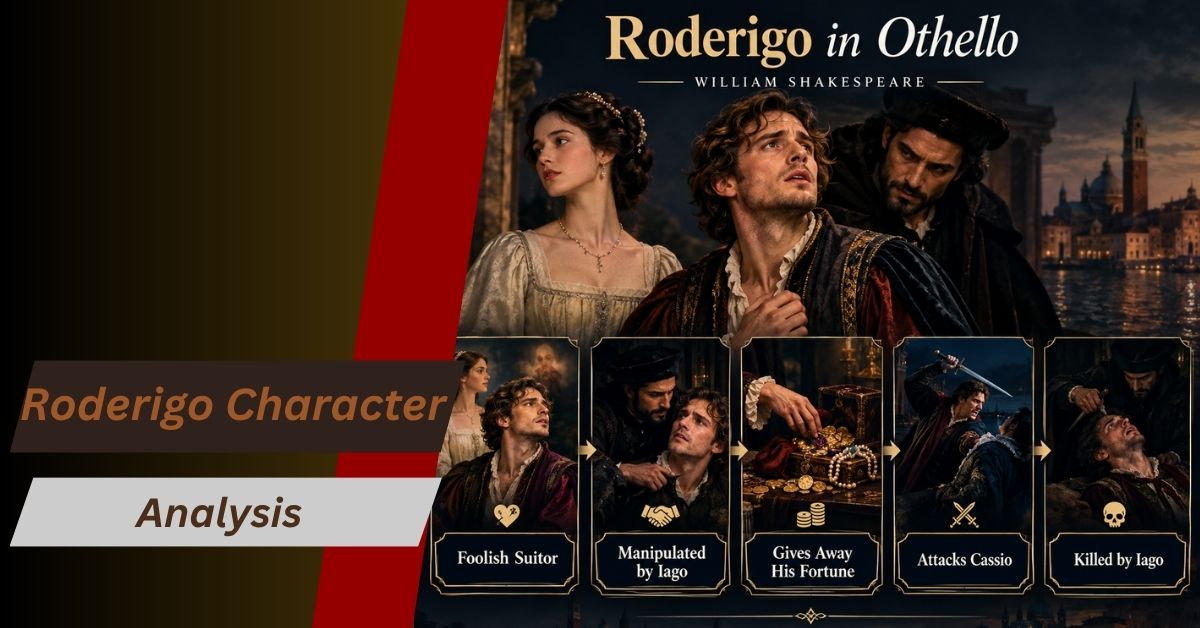
I) Roderigo’s Key Scenes: Act I to Act V

Roderigo may not hold a sword like Othello or spin poetry like Cassio, but wow, does Shakespeare keep him busy. Let’s walk through his major moments—the ones my students always gasp at (or groan at, depending on how many bad decisions he makes).

ii) Act I: The Brabantio Scene

We meet Roderigo already heartbroken and already manipulated. Iago drags him to wake up Brabantio with the worst midnight announcement of all time: “Your daughter eloped with Othello.”

Every year, I tell my students this is the moment Roderigo officially becomes Iago’s sidekick… though “victim” might be a more accurate job title.

ii) Act II: The Cassio Fight

Fast-forward to Cyprus. Iago whispers poison into Roderigo’s ear until he’s convinced that picking a fight with Cassio is his best romantic strategy.

Spoiler: It’s not.

Cassio beats him easily, and Roderigo limps away, bruised in both body and dignity.

iii) Act V: The Murder Attempt

This is where Shakespeare turns up the tragedy dial. Iago urges Roderigo to ambush Cassio in a dark street- because apparently, Roderigo hasn’t suffered enough bad advice yet.

Roderigo tries to stab Cassio… and fails. Again.

iv) Iago Turns Against Him

And here’s the twist students always gasp at: the moment Roderigo becomes inconvenient, Iago decides he must go. Loyalty? Never heard of it. Iago uses Roderigo one last time and then eliminates him.

II) How Does Roderigo Die?

Roderigo’s death is one of those tragic moments that remind us how ruthless Othello really is.

i) Who kills him?

Iago. The person he trusted the most. The person he funded. The person he followed like a desperate puppy.

ii) Why does Iago kill him?

Simple: Roderigo knows too much.

And Iago loves only one thing- self-preservation.

iii) What does this moment mean in the tragedy?

Roderigo’s death is Shakespeare’s chilling reminder that emotional blindness can be fatal. He dies not because he’s evil, but because he’s gullible. Because he wanted love so badly that he let someone else do his thinking for him.

Whenever we reach this scene in class, I tell my students: “Roderigo is the kind of tragedy that happens quietly- one bad decision at a time- until it’s too late to turn back.”

His end may be small compared to Othello’s or Desdemona’s, but thematically? It strikes just as deeply.

Why Roderigo Matters in the Tragedy of Othello

In this section, I want to pull back the curtain and show you why Roderigo- yes, the gullible, purse-opening, hope-clinging Venetian gentleman- actually plays a crucial role in Shakespeare’s tragic machinery. He’s not just a side character. He’s one of the play’s emotional anchors.

i) His Narrative Function:

When I teach Othello, I often joke that Roderigo is Shakespeare’s “plot delivery service.” He keeps things moving- sometimes stumbling, sometimes whining- but always pushing the story forward.

He’s the one who helps Iago stir up Brabantio in Act I. He sparks the brawl that gets Cassio demoted. He even becomes the shaky-handed assassin in Act V.

Without Roderigo, Iago’s schemes would limp along. With him? They sprint. Roderigo is the fuel that keeps Iago’s evil engine running.

ii) His Moral Function:

Roderigo is also Shakespeare’s quiet moral lesson wrapped in a fancy Venetian cloak.

Through him, we see the cost of jealousy in its most desperate form- not explosive like Othello’s, but lingering, nagging, slowly eroding judgment. And his fate screams a clear warning: when you let someone else shape your insecurities, manipulation becomes effortless.

Every time Roderigo hands Iago another bag of money, I tell my students, “This is what emotional vulnerability looks like when you trust the wrong guide.”

iii) His Symbolic Role:

Symbolically, Roderigo is the embodiment of emotional blindness. He sees Desdemona not as a person but as a fantasy. He sees Iago not as a threat but as a savior. And he never sees the truth- not even in his final moments.

Roderigo matters because he shows us that tragedy doesn’t always roar. Sometimes, it whispers. And sometimes, it looks like a man who wants love so badly that he loses everything else along the way.

Roderigo vs Other Characters (Comparative Insights)

When I teach Othello, I love showing students how Roderigo becomes a mirror- sometimes a cracked one- for the other characters. Put him beside Othello, Cassio, or Iago, and suddenly Shakespeare’s emotional architecture becomes clearer… and sharper.

i) Roderigo vs Othello:

Let me tell you a classroom secret: every time I ask, “Who in this play gets manipulated the most?” half my students say Othello… and the other half say Roderigo. And honestly? They’re both right.

Both men get caught in Iago’s psychological spiderweb. Both are fueled by jealousy- Othello by imagined betrayal, Roderigo by hopeless love. But here’s the twist I love unpacking: their outcomes are wildly different.

Othello’s jealousy explodes outward, destroying his marriage and his identity. Roderigo’s jealousy collapses inward, making him surrender his money, his dignity, and eventually his life.

So while they share emotional vulnerabilities, Othello is a tragic hero undone by passion, and Roderigo is the tragic bystander who never even gets to center stage. Same poison, different dosages.

ii) Roderigo vs Cassio:

If you ever want to see Shakespeare’s definition of “foils,” just hold Roderigo and Cassio side by side. Cassio represents discipline, charm, reputation- basically everything Roderigo wishes he could be on his best day.

And that’s exactly why Roderigo targets him. When I explain this to students, I describe Roderigo as that classmate who studies hard but still feels overshadowed by the naturally gifted kid. 

Cassio becomes the obstacle in his fantasy love story with Desdemona. Iago knows this and weaponizes Roderigo’s insecurity, turning Cassio into a convenient punching bag- literally and figuratively.

iii) Roderigo vs Iago:

And now we come to the most lopsided duo in the entire tragedy: the puppet master and the puppet who doesn’t even realize he has strings attached.

Iago manipulates everyone in the play, but Roderigo is his easiest victim. While Iago plots with icy precision, Roderigo feels with reckless intensity. One thinks. The other reacts. One lies. The other believes.

Their comparison teaches one powerful lesson I remind my students of often: in Shakespeare, intelligence without morality is dangerousbut passion without judgment is deadly.

And Roderigo, tragically, never learns that until it’s too late.

FAQs:

What makes Roderigo different from other minor characters in Othello?

Roderigo stands out because he’s emotionally transparent in a play full of masks. While others hide motives behind eloquence, he wears his feelings like an open-page diary- messy, impulsive, and painfully honest.

Does Roderigo ever make a smart decision in the play?

Surprisingly, yes- right at the end. When he finally questions Iago’s motives, it’s his one moment of clarity. But like most last-minute realizations in Shakespeare, it arrives with tragic timing.

Why doesn’t anyone take Roderigo seriously?

Because he leads with emotion, not logic. I tell my students he’s like that friend who always means well but shows up to a debate armed with feelings instead of facts.

What does Roderigo reveal about love in Othello?

He shows the naïve side of love- the part that leaps before it looks. His storyline proves that love without boundaries can turn from devotion into disaster.

How would Roderigo behave in modern times?

Honestly? He’d be the guy sending long paragraphs at 2 AM, accidentally funding a scammer, and still believing “maybe this time things will work out.” Shakespeare would’ve adored writing him into a modern tragedy.

Why do students often relate to Roderigo?

Because he represents the universal human moment: wanting something so badly that you stop seeing warning signs. His struggle feels real—even when his choices feel reckless.

What can actors highlight when performing Roderigo?

His emotional immediacy. Roderigo isn’t calculated. He reacts in real time. Actors can lean into his awkward earnestness, making him both funny and heartbreakingly sincere.

What does Roderigo teach us about trusting others?

That trust without discernment is dangerous. He shows how quickly admiration can turn into dependence, and how easily dependence becomes manipulation.

Does Roderigo ever realize he’s being manipulated?

He does, but painfully late. When he finally pieces together Iago’s deception, it’s like watching a student understand the lesson just as the bell rings. Brilliant insight, terrible timing.

What emotion defines Roderigo the most?

Longing. Not just romantic longing, but the deep, aching desire to feel chosen, important, and seen. His actions aren’t driven by malice but by a heart that wants more than it knows how to handle.

Conclusion:

Roderigo may not be the star of Othello, but Roderigo in Othello reveals some of the sharpest lessons about human vulnerability. Every time I teach this play, students see pieces of themselves in him- the impulsive decisions, the desperate crushes, the moments where the heart sprints ahead long before the brain catches up. It’s why Roderigo character analysis always hits a little too close to home.

His downfall isn’t driven by wicked intent but by longing, insecurity, and the naïve belief that the world will hand him what he yearns for. When we look closely at Roderigo’s quotes, especially his frustrated pleas of “I will incontinently drown myself,” we don’t just hear self-pity. We hear a young man completely overwhelmed by emotion.

And that’s what makes his story feel so modern. Jealousy in Othello doesn’t always explode like Othello’s rage; sometimes it tiptoes quietly, nudging characters like Roderigo toward disaster. His journey becomes a cautionary tale I love sharing with my students: guard your emotions, challenge convenient advice, and don’t let a smooth talker steer the ship of your life.

Because in Shakespeare’s world- and ours- jealousy doesn’t only topple generals. It crushes the quiet dreamers, the hopeful lovers, and the Roderigos who never realized they were standing in the center of someone else’s plot.

Leave a Comment

Your email address will not be published. Required fields are marked *

Scroll to Top