Whenever I teach Bianca in Othello, I can almost hear the quiet confusion ripple through the room. She’s the character my students often skip past, the one who makes them whisper, “Wait… who exactly is she again?”
And every time, it tugs at my teacher-heart. Bianca may not stride across the stage like Othello or Desdemona, but Shakespeare hides in her a quiet emotional shockwave, the kind you only notice when you stop and really listen.
In this guide, I walk you through a character analysis of Bianca that feels like we’re sitting together in class, flipping open her brief scenes and asking, “What is she truly trying to tell us?”
Along the way, we’ll break down her most important quotes- the lines that expose her vulnerability, her jealousy, her love, and the injustice woven around her.
By the end, I promise. You’ll never call Bianca a “minor character” again. You’ll see her as one of Othello’s most misunderstood hearts.
Table of Contents
Who Is Bianca in Othello?
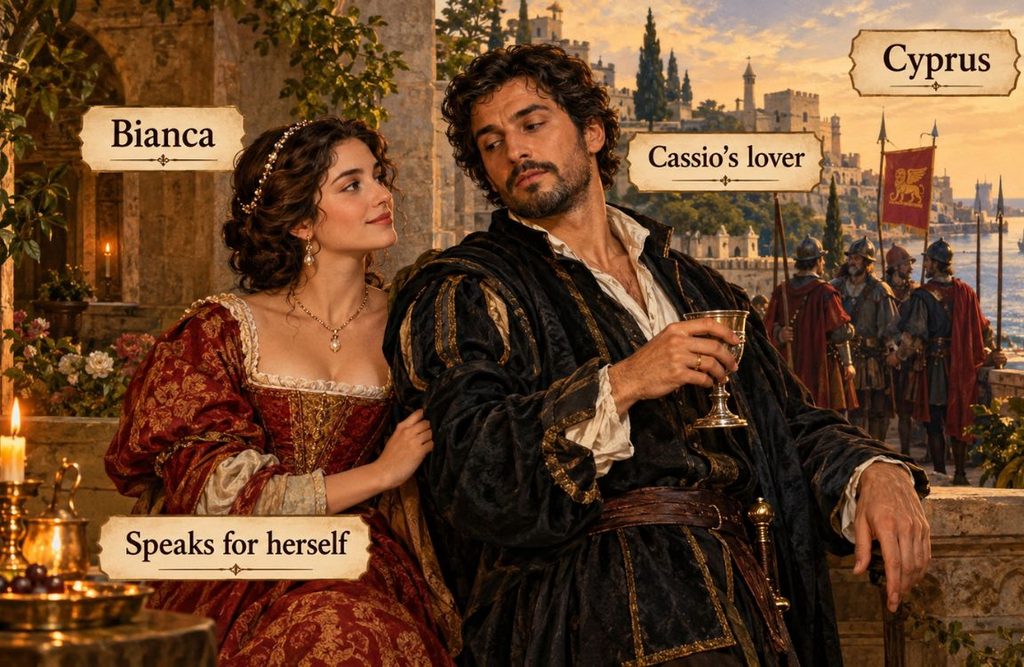
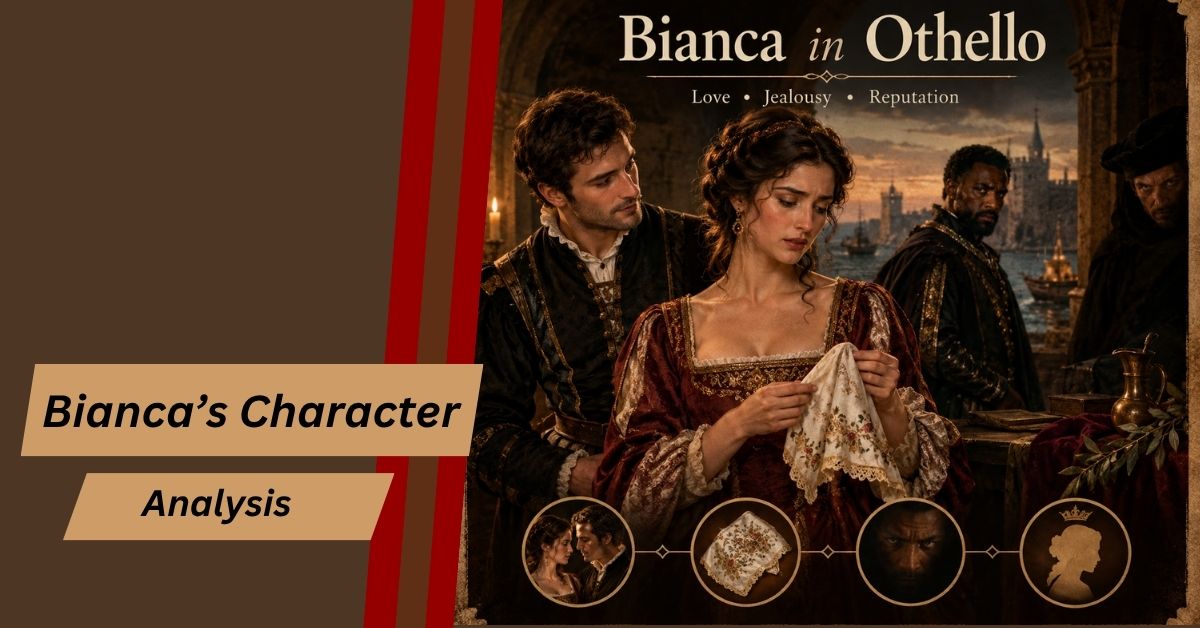
Bianca from Othello is a Venetian courtesan who loves Cassio deeply. Though she appears briefly, she exposes social hypocrisy, reflects alternative models of womanhood beside Desdemona and Emilia, and unintentionally intensifies the handkerchief plot that drives Othello’s jealousy.

Now, let me say this to my students: never underestimate the “minor” character. Bianca may have only a handful of lines, but emotionally? She carries weight.
When I introduce Bianca, I call her Shakespeare’s social mirror. As a courtesan, she is “visible” yet unseen- desired but dismissed. When she cries, “This is some token from a newer friend,” her jealousy feels painfully human. But the men laugh. Why? Because society has already labeled her.
Here’s the live classroom moment: I ask, “If Desdemona said the same words, would we judge her differently?” The room goes quiet.
Shakespeare creates Bianca to stand beside Desdemona and Emilia as a third lens on womanhood- love mixed with insecurity and social vulnerability. And plot-wise? The handkerchief lands in her hands like a spark in dry grass. Suddenly, suspicion spreads. Bianca doesn’t just appear in the tragedy of Othello. She quietly accelerates it.
Bianca’s Character Analysis
Bianca in Othello is emotionally expressive, socially vulnerable, and unjustly judged. Through brief yet revealing moments, Shakespeare crafts her as a symbol of marginalized womanhood, exposing gender bias and class prejudice embedded within Venetian society.

i) Key Traits: Loyal, Tender, Emotional, Misjudged
When I teach Bianca, I slow the class down. “Listen carefully,” I tell my students. “Who defines her- her words or other people’s whispers?”
Bianca’s loyalty feels raw. When she confronts Cassio over the handkerchief, her jealousy is not scheming. It is fear. Fear of replacement. Fear of being disposable. In that moment, she is not a stereotype; she is heartbreak walking onstage.
Yet here’s the painful irony: the louder her sincerity, the quicker she is dismissed. The men treat her emotions as excess. I often say, in a society that prizes silent obedience, Bianca’s honesty sounds like rebellion.
ii) Words to Describe Bianca:
For exam clarity, I guide my students toward precise language: passionate, vulnerable, self-aware, anxious, courageous. She dares to question, dares to feel, dares to demand answers. But Shakespeare ensures that these qualities, admirable in theory, become liabilities in practice.
iii) Feminist Reading:
Through a feminist lens, Bianca becomes a quiet protest inside Othello. Her profession overshadows her personhood. Cassio enjoys her devotion yet avoids public association. Iago manipulates her reputation. Venice reduces her to a label.
And here’s my classroom twist: “If reputation defines Desdemona’s fall, doesn’t it define Bianca’s struggle too?”
Suddenly, students see it. Bianca is not marginal. She is Shakespeare’s critique- soft-spoken, sharp-edged, unforgettable.
Bianca’s Role in Othello
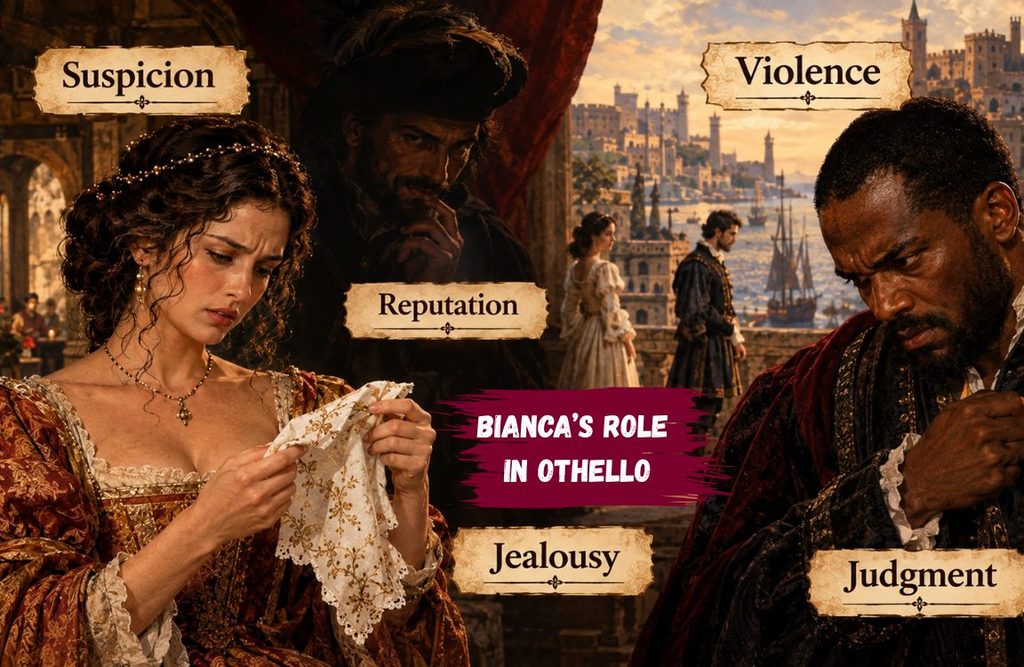
The role of Bianca in Othello is structural and symbolic. She functions as a foil to Desdemona and Emilia, intensifies the handkerchief plot, and becomes an unwitting instrument in Iago’s manipulation, ultimately heightening Othello’s jealousy and tragic misjudgment.

i) Bianca as a Foil to Desdemona and Emilia
In class, I sometimes draw three circles on the board- Desdemona, Emilia, Bianca- and ask, “Which woman is allowed dignity?” The silence answers me.
Bianca disrupts the moral hierarchy. Unlike the noble Desdemona or the pragmatic Emilia, she occupies a socially vulnerable space. Yet emotionally, she is fearless.
When she speaks, she does not whisper. Her presence exposes a society that praises purity publicly but negotiates desire privately. I tell my students: Bianca is the uncomfortable truth Venice tries to ignore.
ii) Bianca’s Role in the Handkerchief Plot
Now comes my dramatic classroom reenactment- the handkerchief. That embroidered square, described as “dyed in mummy,” becomes theatrical dynamite. Bianca receives it casually, unaware she’s holding narrative TNT.
Here’s the irony I love highlighting: she treats it as a lover’s token; others treat it as courtroom evidence. In that gap between intention and interpretation, tragedy grows. She never plots, yet she is plotted against.
iii) Bianca’s Unintentional Impact on Othello’s Jealousy
In Othello, Iago engineers perception like a stage director. When Othello sees Cassio laughing with Bianca, he reads betrayal. Bianca becomes visual “proof” in a drama of suspicion.
And I ask my students: What happens when jealousy confuses coincidence for certainty?
In Shakespeare’s world, even innocence can look guilty under the wrong light.
Bianca and Cassio: Relationship Analysis
In this section, I’m slipping into that teacher-mode where I lean on the desk and say, “Okay, let’s talk about messy relationships.” We’re diving into Bianca and Cassio- not the love story you’d ship, but the one you need to understand to see Shakespeare’s social commentary in action.

i) Does Cassio Love Bianca?
I’ll be honest with you- every time I reread Othello, Cassio makes me want to shake him like a misbehaving student. He enjoys Bianca’s affection, yes, but love? That’s where the hypocrisy kicks in.
Cassio wants her warmth without the responsibility, her loyalty without the label. The irony is delicious: the man who worships social reputation like it’s a fragile glass sculpture is embarrassed to be seen with the very woman who genuinely cares for him.
His “gentlemanly” image matters more to him than emotional honesty, and poor Bianca becomes the secret he likes but doesn’t acknowledge. Cassio’s affection feels convenient, not committed, and he hides behind politeness to avoid confronting his own cowardice.
Read “Cassio in Othello: Character Analysis & Key Quotes“
ii) Why Bianca Is Angry With Cassio?
If you’ve ever watched someone realize they’re being used, you’ll understand Bianca’s explosion of frustration. She’s angry because she can feel Cassio’s half-heartedness- like she’s holding onto someone who keeps slipping through the door. There’s also fear beneath her fury: fear that Cassio will betray her, fear that she is just a temporary placeholder in his glamorous military life.
Her anger is really a scream for clarity, a plea to be seen as more than a pastime. Bianca wants truth, not breadcrumbs.
iii) The Handkerchief Misunderstanding
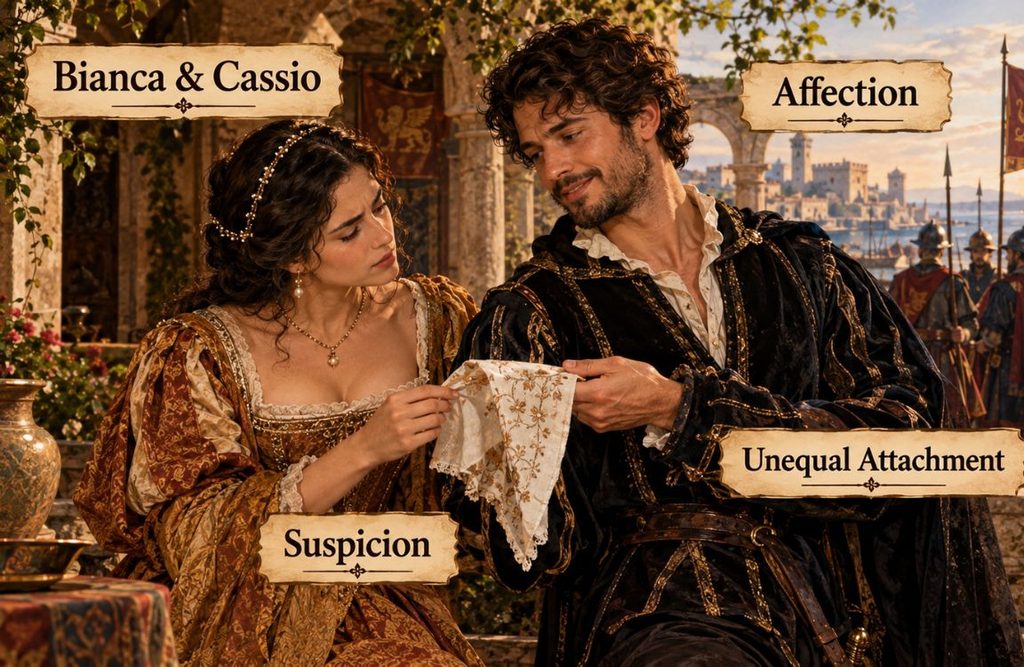
When Cassio hands Bianca the handkerchief, she reacts the way anyone would if their partner suddenly produced unfamiliar “evidence”. She assumes it belongs to another woman.
And in that moment, the handkerchief becomes a symbol of every insecurity she’s been swallowing. To Bianca, it feels like proof that Cassio’s heart is wandering. Shakespeare turns this simple piece of fabric into a mirror of her deepest fear: that she is replaceable in Cassio’s world.
Themes Connected to Bianca
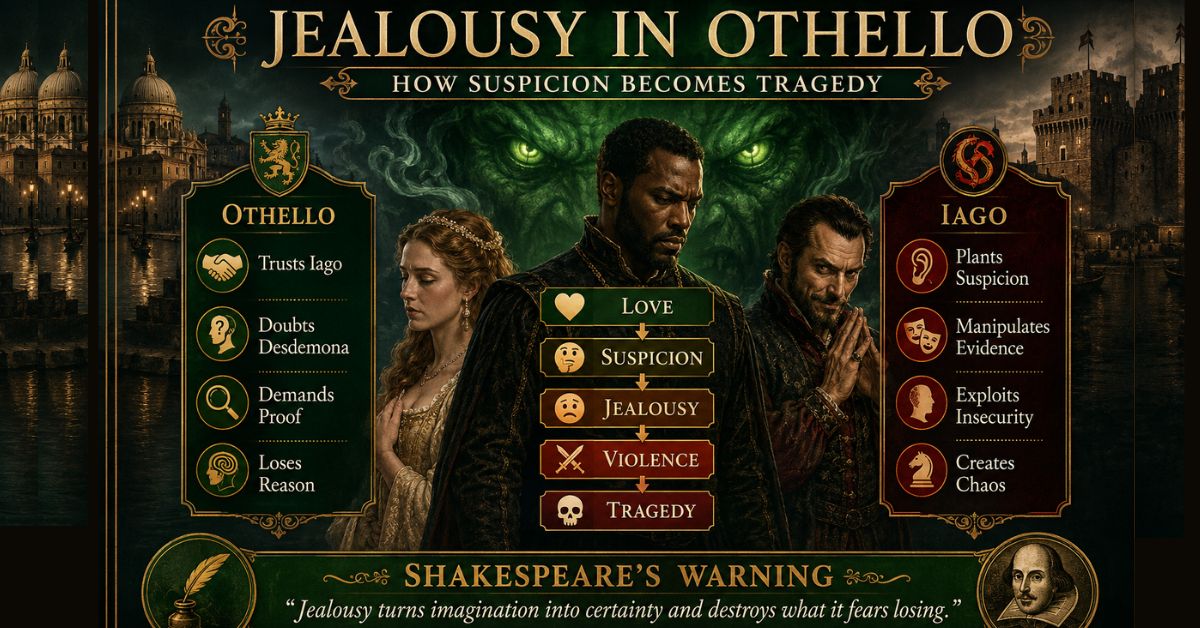
Bianca strengthens key themes in Othello– jealousy, authentic love, and social prejudice- by reflecting emotional vulnerability, exposing double standards, and revealing how class and gender bias shape perception and tragedy.
When I teach Bianca, I call her Shakespeare’s thematic whisper. She doesn’t dominate the stage, but she sharpens its meaning.
Take jealousy. Bianca admits her insecurity openly. When she questions Cassio, her fear is transparent, almost tender. I pause and ask my students: “What if Othello had spoken his doubts this honestly?” Jealousy, before it curdles, looks like Bianca- human, not monstrous.
Then there’s love. Bianca loves without strategy. No rank to protect, no public image to polish. Her affection is messy, but real. In a play obsessed with reputation, that rawness feels almost rebellious.
And prejudice? Watch how Venice treats her. She is judged before she speaks. In Othello, status decides credibility. Bianca’s emotions are doubted because of who she is, not what she does.
That’s the quiet tragedy I want my students to notice: sometimes the smallest voice carries the sharpest truth.
Key Bianca Quotes in Othello
Here, I slow us down to listen to Bianca- the lines we skim are the ones that bruise the deepest. I’ll unpack what she says, why it matters, and how her words pulse with a life the play keeps trying to quiet.
Quote 1: “I am no strumpet, but of life as honest as you.”- Act 5, Scene 1
I watch students straighten in their chairs when Bianca says this. It’s a spine-tingling moment. She refuses the lazy label and replaces it with lived ethics. Not purity-pageantry- integrity in motion.
In class, I call this “standing your ground without shouting.” Her grammar is her shield; her certainty, the blade. When reputation becomes gossip’s playground, Bianca builds a fence and names the boundary.
The line teaches this: dignity isn’t bestowed by the room. It’s authored by the speaker. If the men won’t credit her honesty, she invoices them with it.
Quote 2: “This is some minx’s token, and I must take out the work?”- Act 3, Scene 4
Jealousy gets the spotlight, but the real drama is the workload. Bianca clocks the handkerchief and the imbalance in one breath. I tell my class: This is emotional accounting. She’s tired of being the unpaid intern of affection- doing the stitching while excuses clock overtime.
Her sarcasm is a smoke alarm, not a tantrum. It signals a system on fire: one partner invests care; the other invests charm. Shakespeare hides a seminar on relational equity in a single question mark. Linger there. The punctuation is doing labor.
Quote 3: “Why, whose is it?”- Act 3, Scene 4
Four words. A flashlight in a dark hallway. Bianca doesn’t spiral. She investigates. Live teaching moment: I ask students to circle “whose.” Ownership matters. So does “why.” Motive matters. This is curiosity with a backbone.
In tragedies, silence feeds monsters. Bianca starves them with questions. She’s seeking a story before she writes her own ending. The ache here is that clarity is requested, and deferred. The smallest lines often carry the heaviest furniture.
Quote 4: “I was a fine fool to take it so.”- Act 4, Scene 1
This line laughs with a cracked rib. Bianca names her softness without flogging herself for it. In my classroom, we call this recalibration, not self-betrayal. She updates her expectations after discovering the map was drawn in disappearing ink.
Witty metaphor for the day: hope wore roller skates on a gravel road. The wisdom is bruised but intact. Emotional maturity isn’t about trusting. It’s learning where trust trips. Bianca learns and keeps her heart open without leaving it unattended.
Quote 5: “Let the devil and his dam haunt you!”- Act 5, Scene 1
Her language turns gothic because her wound turns seismic. This curse isn’t theatrics. It’s pressure release. When betrayal traps you in a corner, words grow claws.
I ask students to hear the scale of the imagery: haunting isn’t momentary anger. It’s consequences that echo. Bianca’s rage mirrors the play’s moral weather: broken promises leave storms behind.
She refuses to compress her pain into politeness. Sometimes the honest thing is to thunder.
Quote 6: “This same is a most notable contempt.”- Act 3, Scene 4
Diagnosis over drama. Bianca names the illness. Contempt is not confusion wearing a coat. It’s disrespectful in posture. Naming harm clearly disrupts self-gaslighting and reframes power in relationships.
Live teaching moment: Write the word “contempt” on the board. Notice how precision steadies the hand. When we label the wound accurately, we stop treating it with sugar water. Bianca models emotional literacy- clean, unsentimental, brave.
Quote 7: “’Tis very good; I must be circumstanced.”- Act 3, Scene 4
This is realism without romance. Bianca bends so she doesn’t break. I tell my students: adaptation is not capitulation. It’s engineering for survival. Witty image, she tightens her laces before walking the rocky path.
She knows explanations won’t bloom where honesty won’t water. The line teaches restraint as a strategy. Sometimes you pocket your protest to protect your pulse. That’s not weakness; that’s triage with dignity.
Quote 8: “Save you, friend Cassio!”- Act 5, Scene 1
Notice the word “friend.” Compassion outruns status. In chaos, Bianca moves first- heart-first, questions later. I pause the reading and ask: Who runs toward danger when the room runs away?
Often, it’s the character the room underestimates. Empathy here is reflex, not calculus. Courage doesn’t always carry banners; sometimes it carries a first-aid kit.
Quote 9: “I am no strumpet, but of life as honest as you that thus abuse me.”- Act 5, Scene 1
This is integrity in declarative sentences. I pause before reading it aloud because rooms deserve the weight of earned clarity. Bianca refuses decorative language. She chooses clean steel.
Teacher’s twist to take home: your name is not a rumor’s toy. You don’t need the room’s permission to keep your core when underestimated voices speak plainly, the air changes.
What Bianca’s Language Reveals
Bianca’s language is emotionally charged- alive in a way that many characters’ speech is not. Her word choices reflect vulnerability and courage, often shifting between tenderness, sarcasm, and fiery indignation.
She doesn’t cloak her emotions in poetic metaphors like Desdemona or weaponize them like Iago. She expresses them plainly, honestly.
And that authenticity gives her lines a pulse. Through her tone, we see a woman who feels deeply but lives in a society determined to shame her for it.
Bianca’s Scenes in Othello & Dramatic Function
I dive into Bianca’s scenes like a teacher who’s found the secret lever under the desk- the one that tilts the whole classroom awake.
In Acts 3 and 4, she steps into the emotional crossfire, handing the handkerchief like a live wire. Live teaching moment: I pause and tell my students, “This prop is a plot grenade- watch who gets blamed when it goes off.” Her brief refusal isn’t filler. It’s a hinge that swings a heavy door in the story.
Bianca’s scenes function as narrative accelerators- small appearances that trigger misreadings, intensify suspicion, and expose how innocence becomes collateral damage.
When Cassio is wounded, Bianca runs in without armor- just fear and care. While the men posture, she humanizes the chaos, then gets accused anyway. That’s Shakespeare’s cruel math: the honest witness pays for lies she didn’t write.
Symbolism Connected to Bianca in Othello
I tell my students that Bianca is a mirror the play pretends not to look into. She reflects the cracks- bias, fear, and the habit of judging before listening. Live teaching moment: when the handkerchief appears, I say, “This cloth is a mood ring.” To Bianca, it blushes suspicion, not romance- a soft fabric that carries hard truths about fragile trust.
Bianca symbolizes misinterpretation- objects and people alike become evidence when prejudice does the reading.
Her reputation is a symbolic courtroom where verdicts arrive before testimony. While others are idealized or excused, Bianca is pre-sentenced by class and rumor.
Finally, Bianca stands for how innocence gets misfiled as guilt. Tragedy grows when we read people like riddles we refuse to solve.
What Happens to Bianca at the End of Othello
I tell my students Bianca survives the wreckage the way a lighthouse survives storms- upright, scraped by salt, still standing. In the final swirl of accusations, she’s treated like the spare key everyone misplaces and then blames for the locked door.
While teaching, I often pause the scene and ask, “Who here actually caused the chaos?” Hands shoot up- because the answer is never the nearest, noisiest person.
Bianca’s ending exposes scapegoating in crisis- visibility and emotion become substitutes for guilt when truth is inconvenient.
She’s innocent, yes, but innocence doesn’t come with courtroom privileges in this world. Witty metaphor: Bianca is the small boat blamed for the storm. Her story lingers because she walks away misjudged, teaching us how easily the honest get drafted as villains when lies need cover.
Bianca vs Desdemona vs Emilia (Comparative Study)
When I line up Bianca, Desdemona, and Emilia on the board, the class finally sees the spectrum. I draw three windows- one gilded (Desdemona’s idealized virtue), one smudged but sturdy (Emilia’s seasoned realism), and one cracked yet open to the street (Bianca’s outsider truth). Each window shows the same city, different weather.
The three women in Othello map Shakespeare’s social optics- idealization, endurance, and marginalization reveal how power shapes whose pain is believed.
Jealousy is the storm cloud. It rains on all three, but the roofs differ. Bianca’s frank emotion throws Desdemona’s silent suffering into relief and spotlights Emilia’s hard-won clarity.
Then there’s Iago- his contempt treats them as instruments, not people. Irony twist: their honesty, kindness, and courage outplay his schemes by telling truths he can’t edit.
FAQ:
Write 3 words to describe Bianca in Othello.
If I had to pick just three, I’d tell my students: determined, intuitive, overlooked– three qualities that quietly redefine her presence in a play where subtle strength often gets ignored.
How is Bianca portrayed?
She’s portrayed as passionate, vulnerable, and judged far too quickly. Shakespeare paints her with raw emotion- no courtly filters, no elegant disguises- just a woman trying to love in a world determined to misunderstand her.
Where is Bianca from in Othello?
Bianca lives in Cyprus, where her connection with Cassio places her close to the military circle yet still outside its power structure- giving her a sharp, observant vantage point on unfolding tensions.
Is Bianca in Othello Black?
Shakespeare never specifies Bianca’s race. Productions interpret her differently- sometimes Black, sometimes not. Her identity shifts depending on how directors want to highlight themes of sexuality, class tension, or outsider status.
Does Bianca die in Othello?
No, Bianca doesn’t die- and I always tell my students she survives Shakespeare’s emotional roller coaster like a quiet superhero. She walks out alive, bruised by judgment, not violence, reminding us that surviving a tragedy is its own plot twist.
Is Bianca a foil character in Othello?
Absolutely- Bianca becomes a foil because her unfiltered reactions sit in sharp contrast to the calculated scheming around her. She reveals what honesty looks like when everyone else is performing a strategy.
Conclusion:
Whenever I wrap up a lesson on Othello, I always tell my students this: if you ignore Bianca, you miss a crucial heartbeat of the play. She may appear briefly, but her character slices straight through the themes of jealousy, misjudgment, and emotional vulnerability.
In a world of polished nobility and dangerous manipulation, Bianca is the only one who loves openly, reacts honestly, and speaks without fear of consequence.
That’s exactly why she’s so important. Her raw humanity exposes the hypocrisy around her- Cassio’s superficial charm, Othello’s spiraling insecurity, and the society eager to judge women by reputation alone. Through Bianca’s struggles, Shakespeare gives us a mirror reflecting the emotional truths everyone else is too proud or too frightened to admit.
So, when we talk about Bianca in Othello, her character analysis, Bianca’s quotes, or the themes she carries, we’re really uncovering the play’s quiet, unfiltered truth: honesty often survives longest in the people the world chooses to overlook.