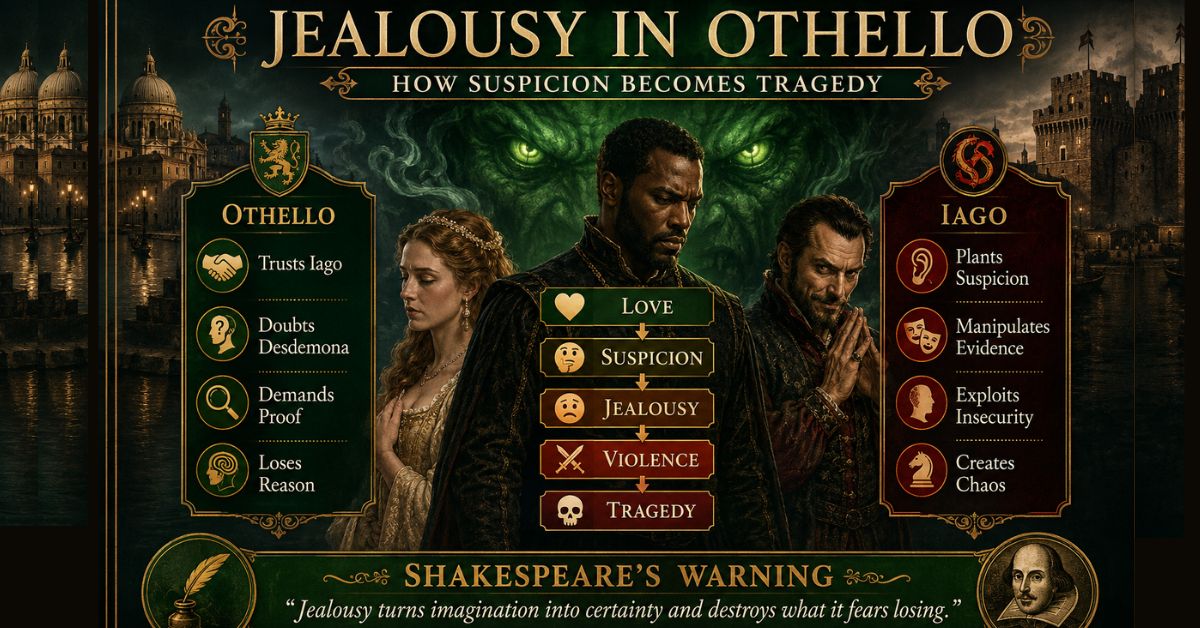
Every time I teach Othello, I find myself returning to one simple truth: no one does emotional precision like Shakespeare. When people search for Othello quotes, they’re not just looking for lines to memorize. They’re looking for emotional ammunition. The play is packed with language that burns with jealousy, faith, loyalty, and the quiet ache of betrayal.
In this guide, you’ll find the most famous quotes in Othello, explained with meaning, emotion, and insight. From Othello’s thunderous self-doubt to Desdemona’s calm dignity, each line cuts deeper than drama. These aren’t just Elizabethan soundbites. They’re emotional fingerprints showing how love, pride, and insecurity can destroy us from within.
So, let’s explore the most powerful quotes in Othello– from Othello himself to Desdemona, Iago, Emilia, and Cassio- the lines that define its characters, shape its themes, and still make us whisper, “Was that written yesterday?”
Table of Contents
Key Quotes in Othello
If there’s one thing I tell my students, it’s this: Othello doesn’t fall because he’s foolish. He falls because he feels too much. His words are an X-ray of love turning to obsession, confidence to chaos.
Each quote reveals a stage of that descent- the slow unraveling of a heart that wanted to love purely but lived in a world too poisoned for innocence. Let’s start with the man at the center of it all: the Moor himself.
Othello’s Quotes: The Hero’s Heart and Downfall
Let’s dive into Othello’s own words, from the heights of his noble heart to the depths of his tragic downfall. In this section, we’ll explore some of the most famous Othello quotes that reveal his courage, love, jealousy, and the fatal flaws that seal his fate.
These powerful quotes in Othello show how Shakespeare transforms love into obsession and strength into self-destruction, turning the noble hero’s heart into the stage of his own undoing.
1. “Rude am I in my speech, and little blessed with the soft phrase of peace.” (Act 1, Scene 3) (Trust and Betrayal Quotes in Othello)
Here’s Othello before the Venetian Senate- not the jealous husband yet, but the composed commander trying to speak a language that isn’t his own. “Rude am I in my speech” sounds like humility, but it’s layered with quiet pride and insecurity.
He’s a soldier who conquers through courage, not charm. Yet, in this single line, Shakespeare lets us glimpse the paradox that will undo him: a man of power who feels unworthy of peace.
When Othello says he’s “little blessed with the soft phrase of peace,” he’s really saying, I can fight battles, but not feelings. He’s disarming his audience- and himself- with honesty.
Ironically, the very thing he claims not to possess, eloquence, flows effortlessly from his mouth. This is Shakespeare’s trick: showing us that Othello’s greatest strength (his sincerity) is also his greatest danger.
Interpretive Lens:
i) Psychological Insight: His self-doubt makes him human but also vulnerable to Iago’s poison. The crack is there. Iago just widens it.
ii) Cultural Reading: Othello’s humility is also racial- the outsider reminding the Senate he’s earned his place through merit, not birth.
iii) Teaching Reflection: I tell my students this is Othello’s “humble flex.” He claims he’s no poet, but this line sings.
Thematic Thread: Insecurity → Identity → Manipulation.
Before Othello loses Desdemona, he’s already losing faith in his own voice.
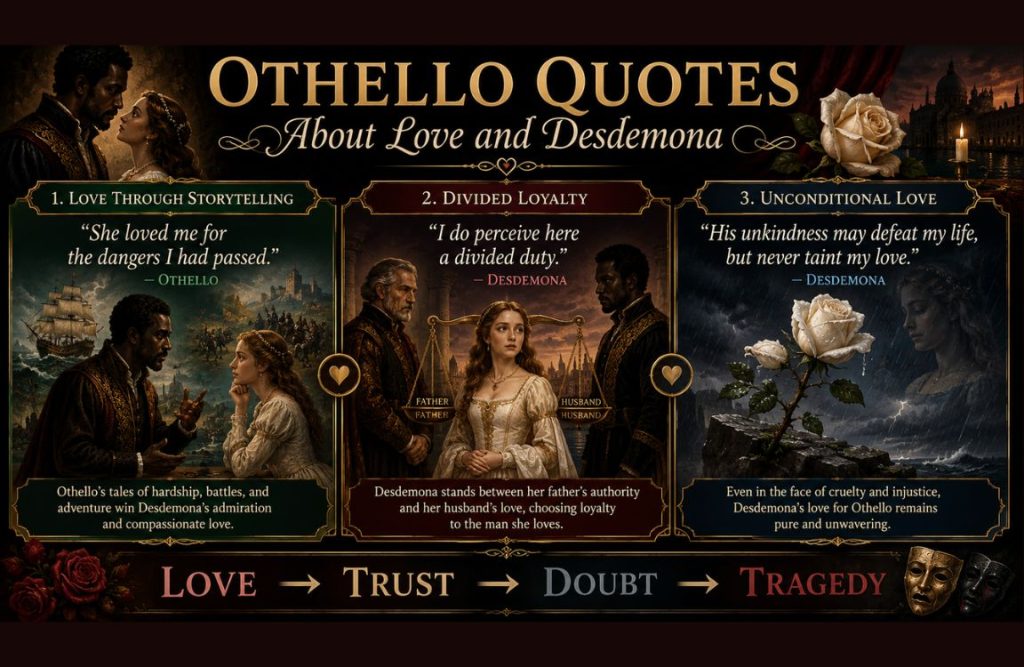
2. “She loved me for the dangers I had passed, and I loved her that she did pity them.” (Act 1, Scene 3) (Trust and Betrayal Quotes in Othello)
Every time I reach this line, I tell my class- this is where Shakespeare disguises tragedy as tenderness. Othello believes he’s describing love, but he’s actually describing performance.
Desdemona falls for the story of Othello’s life- his scars, his courage, his survival. Othello, in turn, falls for her pity, mistaking compassion for connection. It’s love born not from equality but admiration, and that imbalance will echo through the play.
There’s sweetness here, yes, but also shadow. Theirs is a love told in the past tense, “she loved me,” “I loved her”, as if the memory itself already aches with loss.
Their romance begins in words, not in shared experience, and Shakespeare, ever the dramatist, ensures it will end in silence.
Interpretive Lens:
i) Psychological Reading: Othello’s need to be seen as heroic meets Desdemona’s need to nurture- a dynamic doomed by idealization.
ii) Feminist View: Desdemona’s empathy is radical but dangerous. Her compassion is her rebellion in a world where women are meant to obey, not feel deeply.
iii) Modern Reflection: It’s like falling for someone’s story on social media- beautiful, curated, but not the full truth.
Thematic Thread: Storytelling → Illusion → Disillusionment.
Shakespeare warns us: when love begins with a tale, it may end with a misunderstanding.
3. “Excellent wretch! Perdition catch my soul, but I do love thee! and when I love thee not, chaos is come again.” (Act 3, Scene 3) (Love Quotes from Othello)
Every time I reach this line in class, I pause, because this is the moment love in Othello turns volatile. It’s not yet jealousy, not yet madness, but the emotional weather is shifting.
Othello’s love, once calm and self-assured, now trembles on the edge of obsession. When he says, “when I love thee not, chaos is come again,” he doesn’t realize he’s writing his own prophecy.
This is Shakespeare’s genius: he lets Othello define his love as the world’s balance point. Desdemona isn’t just a woman to him. She’s gravity. Lose her, and the universe spins out.
Love, here, isn’t affection. It’s architecture. And when love cracks, everything- reason, faith, selfhood- collapses in domino fashion.
Interpretive Lens:
i) Psychological Tragedy: Othello’s declaration exposes how absolute love can blur into self-annihilation. He cannot imagine a self without her; therefore, the threat of doubt feels like cosmic disorder.
ii) Theological Undercurrent: “Chaos” echoes the biblical void before creation. Othello’s love gives his life divine structure; to lose it is to fall back into spiritual nothingness.
iii) Modern Reflection: It’s that moment when someone says, “If we ever break up, I’ll lose my mind,” and they mean it, then actually do. Shakespeare just dresses the heartbreak in thunderclouds.
From a teaching standpoint, I often call this line Othello’s “emotional weather forecast.” The skies are still blue, but the pressure is dropping fast. He’s unknowingly predicting Act 5; the storm within will destroy him long before Venice’s gossip does.
Thematic Thread: Love → Dependency → Disorder.
In Othello, the line between passion and peril is a single heartbeat, and Shakespeare lets us hear it breaking in real time.
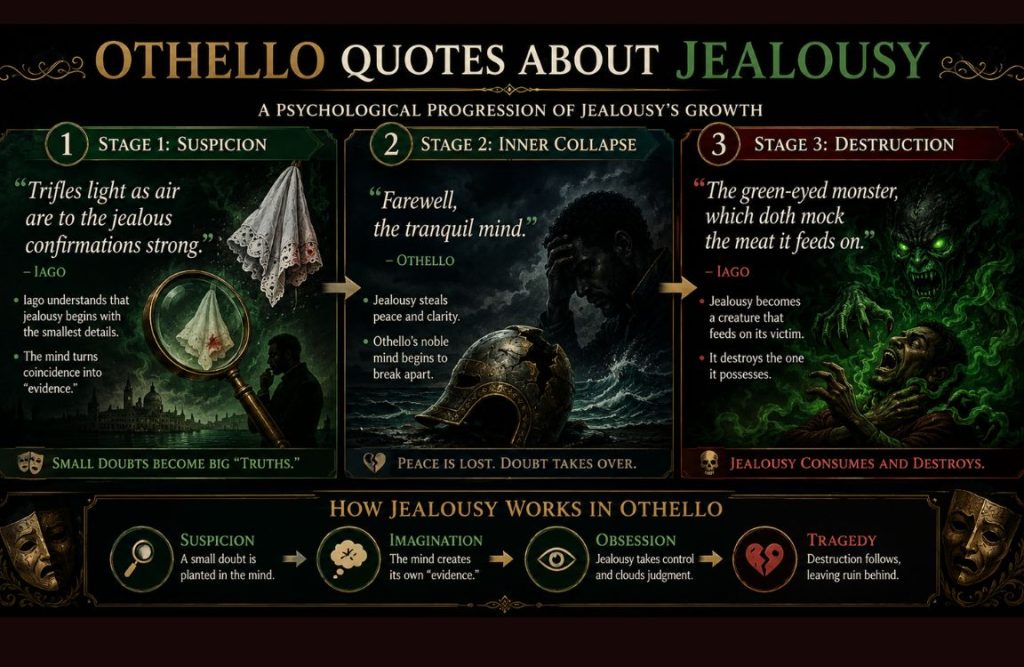
4. “Farewell the tranquil mind! farewell content!” (Act 3, Scene 3) (Quotes in Othello about Jealousy)
This is the moment Othello’s inner war begins. Until now, he’s been the soldier who commands storms, not surrenders to them.
But when he cries, “Farewell the tranquil mind! farewell content!” we hear the crack- the sound of order breaking. The repetition tolls like a funeral bell, not just for his peace, but for the man he used to be.
Othello realizes, perhaps dimly, that the true battle is no longer fought with swords. It’s waged within, between reason and imagination, trust and fear. Jealousy is whispering its first lines, and Othello is already answering back.
In these two short sentences, Shakespeare captures a mind imploding under suspicion. The general who once ruled his world with logic and discipline now feels powerless before emotion.
Interpretive Lens:
i) Psychological Reading: This is Othello’s first real breakdown, a soldier losing command of his own thoughts. The battlefield has moved inward.
ii) Theological Undertone: “Tranquil mind” echoes a soul at peace. Its loss hints at a fall from grace, from divine order to emotional chaos.
iii) Teaching Reflection: When I read this aloud, I ask my students, “What’s Othello really saying goodbye to?” Most eventually realize- it’s his sanity.
Thematic Thread: Order → Doubt → Disintegration.
This “farewell” is not to peace alone but to selfhood. From here on, Othello becomes both victim and weapon of his unraveling mind.
5. “It is the cause, it is the cause, my soul.” (Act 5, Scene 2) (Best Quote in Othello about Jealousy)
By the time Othello utters this, his love has curdled into delusion. The repetition, “It is the cause”, is chilling, ritualistic, as though he’s trying to hypnotize himself into righteousness.
The phrase “my soul” adds false sanctity; Othello casts murder as justice, sin as sacrifice. It’s one of Shakespeare’s cruelest ironies: he prays for purity even as he prepares to kill innocence.
This is not the Othello of Act 1- open, vulnerable, noble. This is the Othello forged by Iago’s lies and his own desperate need for control.
He uses moral language like armor, shielding himself from the unbearable truth that he is wrong. Shakespeare turns religious diction into psychological defense- every repetition of “cause” deepens his self-deception.
Interpretive Lens:
i) Moral Lens: Othello mistakes judgment for justice, transforming personal jealousy into divine command.
ii) Psychological Lens: He’s no longer reasoning. He’s rationalizing. This line is not conviction but panic disguised as purpose.
iii) Modern Reflection: It’s the moment when someone convinces themselves they’re “doing the right thing,” even as they destroy what’s good.
Thematic Thread: Faith → Justification → Tragedy.
In trying to give his act meaning, Othello robs it of humanity. The “cause” he invokes isn’t divine. It’s despair wearing moral robes.

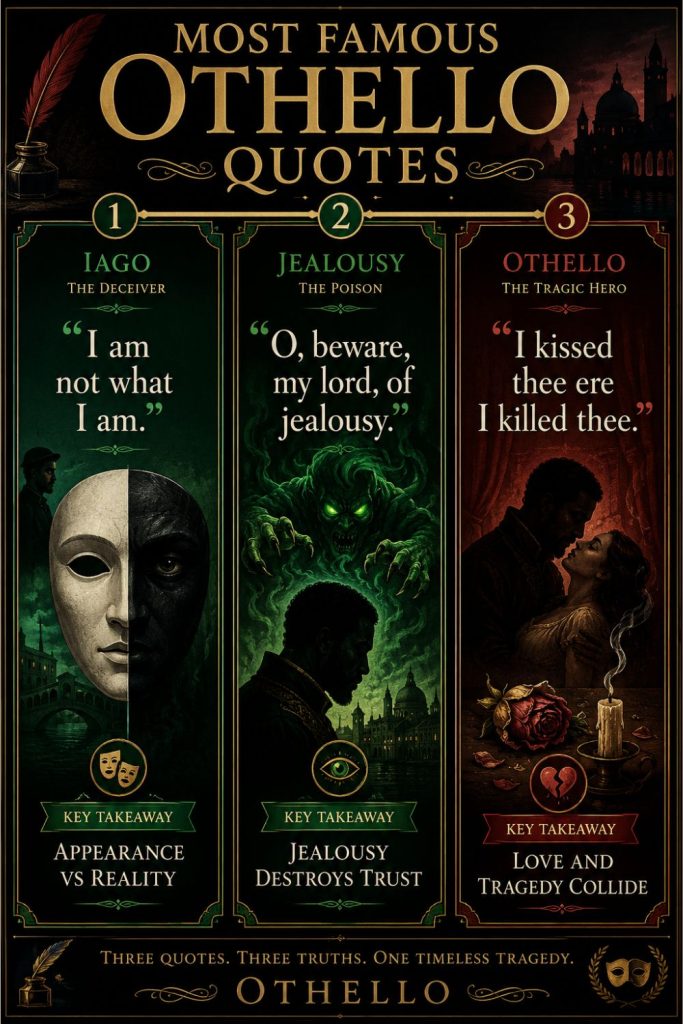
6. “I kissed thee ere I killed thee: no way but this; killing myself, to die upon a kiss.” (Act 5, Scene 2) (Love and Tragic Redemption Quotes in Othello:)
This is Othello’s last attempt at balance- love and death in one breath. The symmetry of “kissed” and “killed” is devastating: the words almost rhyme, as if Shakespeare wanted us to hear how close affection and destruction can sound.
The soldier who once conquered nations can’t conquer his own passion. And so, he folds both tenderness and guilt into one final act- a kiss that closes the circle.
The rhythm is deliberate, ceremonial- like a confession. Othello can no longer separate justice from love, or sin from devotion. His tragedy is not that he stopped loving Desdemona, but that he turned love into something lethal.
By the time he says, “no way but this,” he has surrendered completely to fatal beauty- the belief that death can purify what jealousy has poisoned.
Interpretive Lens:
i) Structural Reading: The parallel verbs “kissed” and “killed” compress the entire play, desire and destruction, into a single heartbeat.
ii) Psychological Reading: Othello seeks redemption through self-punishment; he kills himself not only out of grief, but to restore moral symmetry.
iii) Teaching Reflection: I often ask my students, “Is this justice, or escape?” The quiet that follows is the sound of the play’s weight landing.
Thematic Thread: Love → Guilt → Redemption.
In dying upon a kiss, Othello finally reunites what he had torn apart- love and innocence- but only through tragedy. It’s Shakespeare’s cruelest mercy: Othello’s peace returns only after everything else is lost.
Quick Recap for Essays
| Quote | Act | Theme |
| “Rude am I in my speech” | 1.3 | Modesty and self-awareness |
| “She loved me for the dangers…” | 1.3 | Storytelling and emotional attraction |
| “Excellent wretch!” | 3.3 | Love and instability |
| “Farewell the tranquil mind” | 3.3 | Collapse of peace and rationality |
| “It is the cause…” | 5.2 | Self-deception and moral blindness |
| “I kissed thee ere I killed thee” | 5.2 | Tragic love and poetic closure |
How to Use These Othello Quotes in Essays
When using these Othello quotes in your essays, don’t just drop them in- connect them. Show how each line reveals emotion, theme, or transformation. Shakespeare’s language in quotes in Othello turns love into obsession, trust into tragedy, and courage into downfall.
Always explain what the words do, not just what they mean. For example, highlight how repetition shows tension, or how imagery exposes Othello’s shifting state of mind.
When you connect the quote’s emotion to the play’s bigger message, your analysis won’t just sound smart. It’ll feel alive.
Iago’s Quotes: The Master of Manipulation
If Othello is the storm, Iago is the wind that stirs it. He’s one of those characters I love to teach because every line he utters feels like a psychological experiment. Iago doesn’t just speak. He plays. His words test, twist, and taunt.
I often tell my students: Iago is Shakespeare’s first psychologist, except he uses that insight for destruction, not healing. His quotes reveal a chilling mix of intelligence, envy, and dark comedy. You can’t help but shiver and admire his craft.
Here are the key Iago quotes that define him as both villain and playwright-in-disguise.
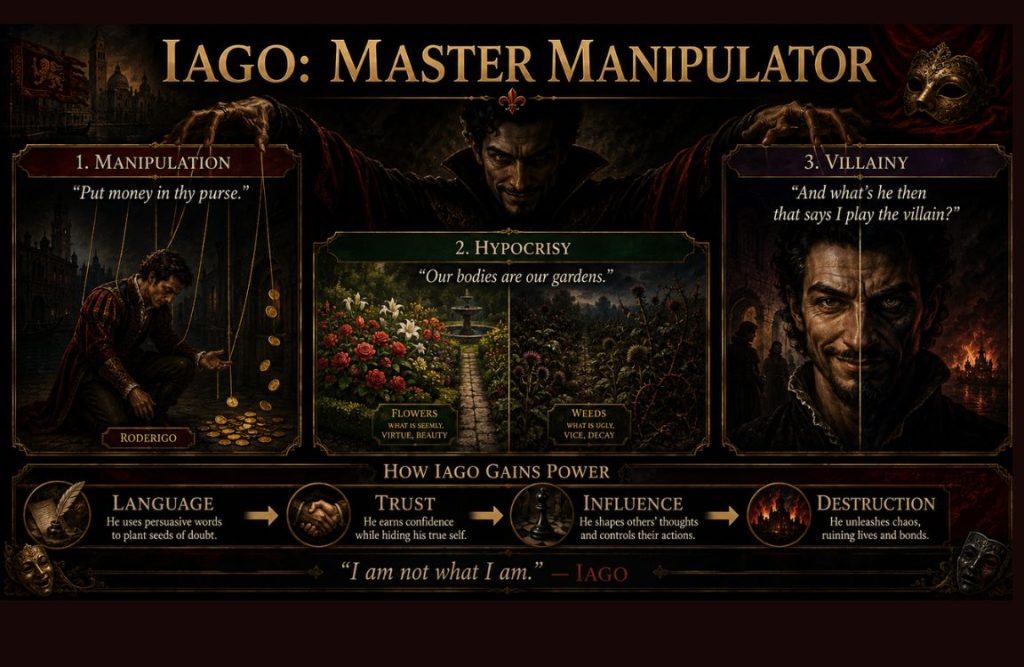
1. “I am not what I am.”- Othello, Act 1, Scene 1 ( Manipulation and Deception Quotes in Othello)
Every time I teach this line, I pause and let my students feel the chill that follows. Then I grin and say, “Well, Iago just gave us his evil résumé in six words.” It’s Shakespeare’s version of “I’m toxic, and I know it.”
But beneath that dark humor lies a profound statement on human nature and deceit.
Thematically, this line is the heartbeat of Othello. While God in Exodus declares “I am that I am,” defining Himself through truth, Iago twists it into “I am not what I am.”
He’s the anti-creator- a man who constructs his power through lies and illusion, where divine speech gives life, Iago’s words corrupt it.
Structurally, Shakespeare lets him open the play, a deliberate choice. Before Othello even enters, the moral atmosphere is poisoned. It’s as though Shakespeare warns us: “Don’t trust what you see.”
From a psychological perspective, Iago’s words expose a fragmented self one who finds meaning only in manipulation. He’s the original gaslighter, deriving pleasure from control and chaos.
And here’s my teaching reflection: every time I discuss this line, my students go silent, not out of confusion, but recognition. Because this isn’t just Iago’s confession, it’s a mirror. We all wear masks, perform roles, and sometimes hide behind them.
So when Iago whispers, “I am not what I am,” I tell my class, “Listen carefully. Shakespeare isn’t describing a villain. He’s diagnosing humanity.”
2. “I follow him to serve my turn upon him.”- Othello, Act 1, Scene 1 (Power and Control Quotes in Othello)
Ah, Iago again- Shakespeare’s smooth-tongued serpent. When he says, “I follow him to serve my turn upon him,” I always pause in class and ask, “Now, who admits their betrayal so proudly?” This isn’t just deceit. It’s hypocrisy sharpened into an art form.
Thematically, this line distills Iago’s moral code- self-interest as religion. His “following” isn’t loyalty. It’s camouflage. He bows only to ambition and bends service into self-service.
The phrase “serve my turn” brims with double meaning: to assist, to manipulate, to twist. It’s as if Iago’s very soul runs on the axis of convenience.
Structurally, Shakespeare plants this confession early, allowing the audience an exclusive pass into Iago’s private motives. We know the storm that Othello doesn’t, and that’s what makes the tragedy so painfully intimate.
From a psychological lens, Iago fascinates me endlessly. He isn’t guided by principle or passion but by the sheer pleasure of motion- of turning people inside out just to prove he can.
He follows Othello not out of duty, but out of dark curiosity: how far can a man fall if I keep pulling the strings?
And here’s my teaching reflection: whenever I read this line aloud, I remind my students- manipulation rarely begins with hatred. It often begins with strategy.
So, class- beware of those who “follow” too closely. Some hands help you rise; others are just measuring how far you’ll fall.
3. “Put money in thy purse.”- Othello, Act 1, Scene 3 (Power and Control Quotes in Othello)
Ah, here it comes- Iago’s favorite sales pitch. He repeats “Put money in thy purse” like a mantra, hypnotizing poor Roderigo into funding his own downfall.
Every time I teach this scene, I tell my students, “This isn’t financial advice. It’s emotional manipulation disguised as motivation.”
Thematically, this line isn’t about wealth. It’s about control. Money becomes Iago’s metaphorical leash. Each repetition tightens his grip on Roderigo’s mind, convincing him that Othello’s downfall and Desdemona’s love can be bought, if only he keeps investing. Shakespeare brilliantly turns economic language into the currency of deceit.
Structurally, Iago’s repetition works like propaganda. It’s rhythmic, persuasive, almost musical. The phrase echoes throughout the scene, not to convince Roderigo of the truth, but to numb him into obedience. It’s an Elizabethan “Trust the process”, except the process is chaos.
From a psychological lens, Iago plays the role of the modern scammer- reading desires, exploiting weaknesses, and promising reward through submission. He sells dreams, not with logic, but with rhythm and confidence.
And here’s my teaching reflection: I tell my students, “Listen to the voice that repeats too much. It’s rarely wisdom, usually persuasion.” Iago’s speech reminds us that manipulation often sounds like motivation.
So, class, the next time someone says, “Put money in thy purse,” ask yourself- are you investing in hope, or in someone else’s lies?
4. “Our bodies are our gardens, to the which our wills are gardeners.”- Othello, Act 1, Scene 3 (Iago’s Free Will and Control Quote in Othello)
Every time I reach this line, I smile and tell my students, “Be careful- when a Shakespearean villain starts sounding like your life coach, trouble’s coming.” Iago, of all people, delivers one of the most empowering metaphors in the play- and then uses it to destroy someone’s will.
Thematically, this line celebrates human agency. It suggests that reason should govern passion, that we can cultivate our desires like gardeners tending soil.
But here’s the bitter twist- Iago preaches self-control only to manipulate Roderigo’s emotions. He’s the serpent teaching Eden philosophy- whispering about discipline while planting weeds of chaos.
Structurally, this moment is disarming. In a play drenched in deceit, Iago sounds almost noble, positioning himself as the voice of reason. Shakespeare lets the devil speak truth, and that’s what makes him so dangerous.
From a psychological lens, Iago represents the cynical modern mind- the kind that reduces love to chemistry, loyalty to leverage, and emotion to weakness. His “garden” isn’t a place of growth. It’s a laboratory for manipulation.
And here’s my teaching reflection: I often tell my students- words can sound wise even when the heart behind them is rotten.
So, class, tend your own garden, but keep an eye on anyone offering to “help” with the pruning.
5. “O, beware, my lord, of jealousy: It is the green-eyed monster which doth mock the meat it feeds on.”- Othello, Act 3, Scene 3 (Iago’s Jealousy Quote in Othello)
Ah, irony so thick you could drown in it, the man creating jealousy warns against it. Every time I read this line in class, I can’t help but smirk and tell my students, “Here’s Shakespeare’s ultimate red flag- the manipulator posing as a mentor.”
Thematically, this line captures the very heartbeat of Othello: how love can turn inward and consume itself. Shakespeare personifies jealousy as a cruel, living thing- a monster that mocks even as it devours its victim. It’s not a passing emotion. It’s a parasite of the soul.
Structurally, the warning is poetic, musical, almost tender- which makes it doubly cruel. Iago’s voice trembles with false empathy, making his manipulation sound like moral wisdom.
Shakespeare lets evil speak beautifully, reminding us that corruption often hides behind elegance.
From a psychological lens, this is textbook gaslighting. Iago pretends concern to plant suspicion, feeding the very monster he warns against. He’s not a moralist. He’s the zookeeper of jealousy, quietly opening the cage.
And here’s my teaching reflection: I tell my students, “Never trust the person who warns you of danger while quietly holding the match.”
So, class, the next time you see a quote from Iago on a motivational poster- remember, even monsters can sound wise before they bite.
6. “Men should be what they seem.” (Act 3, Scene 3) (Truth, Illusion, and the Mask of Evil Quote)
If hypocrisy could generate electricity, Iago could light up all of Venice. Here, the world’s most deceitful man delivers a moral lesson on honesty, and Othello, tragically, buys it. This is Shakespeare’s dark joke: the liar lectures on truth.
Iago’s line sounds noble, even reasonable, and that’s exactly why it’s terrifying. He’s weaponizing virtue. Shakespeare shows how morality, in the wrong mouth, becomes manipulation.
Iago’s genius lies not in lies alone, but in coating them with fragments of truth. Every honest word he utters sharpens the blade of his deceit.
This single sentence distills Othello’s haunting theme: the tension between appearance and reality. What happens when “seeming” replaces “being”?
When words no longer reveal, but conceal?
In this world, language itself becomes treacherous, and Othello’s tragedy is that he cannot tell performance from sincerity.
From a psychological lens, Iago represents the modern manipulator- someone who thrives on moral camouflage. He mirrors what society wants to hear, and that’s how he controls it.
When I teach this line, I love pairing it with his earlier confession: “I am not what I am.” Together, they form the two poles of Iago’s philosophy- one public, one private.
Between them lies the entire tragedy. And I remind my students, smiling: Always be wary of the person preaching honesty too loudly.
7. “Trifles light as air / Are to the jealous confirmations strong / As proofs of holy writ.”- Othello, Act 3, Scene 3 (Iago’s Manipulation and Jealousy Quote in Othello)
Ah, this is Iago’s gospel of deception, and class, let’s pause to admire how chillingly brilliant it is. Whenever I teach this line, I tell my students, “Here lies Shakespeare’s prophecy about human insecurity, and, let’s be honest, social media.”
Thematically, it’s the anatomy of jealousy. Iago knows that once suspicion infects the heart, even “trifles light as air”, a dropped handkerchief, a half-heard whisper, become divine proof.
The man weaponizes imagination, turning air into “holy writ.”
Structurally, that contrast between air and writ is poetry’s sleight of hand- spiritual language used for emotional corruption. Shakespeare crafts Iago not just as a villain but as a theologian of lies.
From a psychological lens, this line is a study in cognitive bias: when emotion overwhelms reason, truth no longer matters. From a modern lens, it’s the algorithm of envy- rumors retweeted into reality. Iago would’ve thrived on Twitter, now X, hashtags and all.
And when I discuss this in class, I lean back and say, “Notice how evil doesn’t shout. It whispers.” Shakespeare teaches us that destruction rarely storms in. It seeps through, disguised as insight.
So next time you hear gossip dressed as gospel, remember Iago’s sermon: the devil quotes scripture when he needs a retweet.
8. “Demand me nothing; what you know, you know. From this time forth I never will speak word.”- Othello, Act 5, Scene 2 (Iago’s Silence and Defiance Quote in Othello)
Every time I read this line in class, a chill runs down my spine. After five acts of manipulation, Iago, Shakespeare’s chatterbox of evil, suddenly goes mute. I tell my students, “Here’s where the devil slams the door and lets silence do the screaming.”
Thematically, this moment is a dark inversion of confession. We crave an explanation- some moral unpacking, a final “why.” But Shakespeare denies us that comfort.
Structurally, this silence is Shakespeare’s cruelest punctuation mark. No soliloquy, no closure- just a void where meaning should be.
From a psychological lens, Iago’s refusal to speak is dominance in disguise. He withholds truth not out of guilt but out of power. It’s the final act of control- language itself becomes his last weapon, and he simply refuses to use it.
Critically, some scholars note the twisted symmetry: Desdemona’s silence is innocence crushed. And Iago’s silence is guilt calcified. Both are silenced by the same patriarchal machinery- one by death, the other by defiance.
And when I teach this, I pause, really pause, and let the silence hang. “This,” I tell my students, “is what evil looks like when it’s done talking.”
So if words built Iago’s empire, silence becomes his crown. Shakespeare leaves us in the echo of that final refusal, and we realize, sometimes the scariest sound in tragedy is the one that never comes.
9. “I hate the Moor, and it is thought abroad that ’twixt my sheets he’s done my office.” (Act 1, Scene 3) (Iago’s Jealousy Quotes in Othello)
Every time I unpack this line with students, there’s a hush- that moment when they realize jealousy isn’t just green-eyed. It’s calculating.
Iago isn’t burning with passion like Othello. He’s simmering with envy that feels cold, almost professional. “’Twixt my sheets” and “my office”- such casual, bureaucratic phrasing- make betrayal sound like paperwork. Even his jealousy wears a uniform.
This is Shakespeare showing us the monster before the mask. The rumor may be false, but Iago doesn’t need truth- only suspicion to justify destruction. His hatred is a self-made fire, kindled by pride and paranoia.
Structurally, this line plants the play’s poison seed. One whisper, one baseless “thought abroad,” becomes the chain reaction that burns the world.
From a psychological lens, Iago’s jealousy isn’t about love lost. It’s about control threatened. His entire sense of self depends on superiority; Othello’s success feels like theft.
From a social lens, the line taps into Elizabethan anxieties- racial, sexual, hierarchical- all condensed into one venomous thought.
And in a modern reflection, I tell my students: “This is how jealousy sounds before it learns to lie. It starts as envy, then dresses itself up as justice.”
So if Othello’s jealousy destroys him, Iago weaponizes his. His envy doesn’t weep. It plots. Shakespeare’s brilliance lies in showing that the same emotion that unravels one man builds another’s empire of deceit.
Quick Recap for Essays
| Quote | Act/Scene | Theme / Function |
| “I am not what I am.” | 1.1 | Identity, hypocrisy, anti-God inversion |
| “I follow him to serve my turn upon him.” | 1.1 | Manipulation and deceit |
| “Put money in thy purse.”- | 1.3 | Greed, manipulation, exploitation of desire |
| “Our bodies are our gardens…” | 1.3 | Reason vs. passion (twisted) |
| “O, beware, my lord, of jealousy…” | 3.3 | Jealousy as self-devouring monster |
| “Men should be what they seem.” | 3.3 | Appearance vs. reality |
| “Trifles light as air…” | 3.3 | Evidence, illusion, manipulation |
| “Demand me nothing…” | 5.2 | Silence, refusal, unresolved evil |
| “I hate the Moor…” | 1.3 | Envy, racism, motive fabrication |
Classroom Reflection:
Iago’s words remind me of something I tell my students at the end of the term: Shakespeare teaches us how language can both heal and harm. Othello’s tragedy isn’t only about jealousy. It’s about persuasion.
Iago’s every sentence is a lesson in rhetoric gone rogue. He takes trust, twists it into poetry, and leaves us wondering: how safe is speech, really?
Desdemona’s Quotes: The Voice of Innocence and Defiance
If Iago is Shakespeare’s devil, Desdemona is his saint, but one with courage enough to walk straight into hell for love. She’s not a decorative damsel. She’s a woman who chooses. That choice, in her world, is radical.
Here are the lines where her heart, and her quiet rebellion, shine brightest.
1. “My noble father, I do perceive here a divided duty.”- Othello, Act 1, Scene 3 (Loyalty, Love, and Independence Quotes in Othello)
Every time I read this line aloud, I find myself smiling, not because it’s sweet, but because it’s quietly revolutionary. Here stands Desdemona, in the grand hall of Venice, surrounded by men who speak in laws and lineage, and she, with a voice soft as reason, rewrites the script.
Thematically, this is Desdemona’s awakening. Her “divided duty” isn’t a confession of guilt. It’s a philosophical declaration. She honors her father’s love yet claims the right to choose her own, a balance between obedience and autonomy that women in Shakespeare’s world were rarely granted.
Structurally, the line pivots like a bridge: one foot in tradition, the other in independence.
From a feminist lens, I call this her first act of authorship. She writes herself into moral adulthood with calm clarity, no shouting, no defiance- just logic armed with love.
From a psychological lens, it’s the moment where affection meets identity.
When I teach this scene, I often pause and tell my students, “This is how courage speaks when it doesn’t need to roar.” Shakespeare gifts us a heroine who doesn’t overthrow the patriarchy. She out-reasons it.
And that’s Desdemona’s real power: her silence isn’t submission. It’s strategy. Even in silk, she stands like steel.
2. “That I did love the Moor to live with him.”- Othello, Act 1, Scene 3 (Love and Courage Quotes in Othello)
Every time I read this line aloud, I feel a quiet tremor in the room- the kind that happens when truth refuses to flinch. Desdemona’s words are simple, yes, but they carry the weight of rebellion wrapped in grace. Nine plain words, yet they shatter centuries of silence.
I often tell my students, “Here’s Shakespeare’s version of a mic drop.” Desdemona doesn’t plead or perform. She declares. Before the Duke, her father, and an entire council of men, she stands steady and says she chose love- not as an ornament, but as an equal.
Structurally, this line is astonishing in its clarity: no metaphor, no hesitation, just moral precision.
Thematically, it’s love as self-definition. She loves to live with him, not to be admired from afar. That “to live with” holds worlds- partnership, domesticity, shared life. From a feminist lens, it’s radical agency; from a psychological one, it’s emotional integrity in its purest form.
And when I teach this, I pause and smile, telling my students, “Desdemona doesn’t whisper about love, she wields it.” In a world where women’s voices were often footnotes, she speaks like the main text.
So, class, the next time someone calls her naïve, remember this moment: Desdemona isn’t love’s victim. She’s its author, writing her truth in a room full of men who never saw the ink coming.
3. “If I be left behind, a moth of peace…”- Othello, Act 1, Scene 3 (Love, Devotion, and the Role of Women Quotes in Othello)
This line always gets me. Every time I read it aloud, I can almost see Desdemona- luminous, calm, yet unyielding- standing in a room full of men planning war, quietly saying, “I’m coming too.” That’s not a plea; that’s purpose wrapped in poetry.
Desdemona calls herself “a moth of peace,” and I always tell my students, “Don’t let that softness fool you.” Yes, a moth is delicate, drawn to light- but it’s also relentless. It doesn’t retreat from flame; it flies into it. That’s Desdemona’s love: not decorative, but daring.
Thematically, this line overturns the Elizabethan expectation that women should stay behind and wait. Her love is participatory. She doesn’t just adore Othello, she joins him, body and spirit, even if the road leads to danger.
Structurally, Shakespeare weaves fragility and fire together, “moth” and “peace” in the same breath, creating a paradox of gentle bravery.
From a feminist lens, this is Desdemona’s soft rebellion. She chooses action over absence, intimacy over propriety. From a psychological lens, it’s love seeking presence- a refusal to fade into the background of someone else’s story.
And when I teach this line, I lean forward and tell my students, “Real love isn’t about waiting in safety. It’s about walking beside someone, even when the light burns.”
4. “His unkindness may defeat my life, but never taint my love.”- Othello, Act 4, Scene 2 (Faithfulness and Forgiveness Quotes in Othello)
Every time I read this line aloud, I feel the classroom go quiet. Desdemona isn’t just speaking. She’s surrendering, and yet, somehow, she’s winning a moral war no one else in the play even sees.
Here, her love faces its greatest test: cruelty. Othello’s tenderness has turned violent, his faith corroded by lies, but Desdemona refuses to let his corruption define her heart.
Thematically, this is love as resistance- a refusal to let hatred echo back.
Structurally, Shakespeare balances destruction and purity in one breathtaking line: “defeat my life”- a body undone; “never taint my love”- a soul unbroken.
From a psychological lens, this is the anatomy of emotional endurance. Desdemona separates self from circumstance, choosing integrity over reaction.
From a feminist lens, she exposes how a woman’s quiet moral strength can shame the violence of men. Her love is not submission; it’s transcendence.
When I teach this line, I tell my students, “Don’t mistake stillness for weakness.” Desdemona’s grace isn’t compliance. It’s defiance in its gentlest form. In a world that glorifies revenge, she teaches mercy.
And that’s why this line still stings. It’s the ache of someone who loves without armor, and still refuses to let the wound make her cruel. Shakespeare, hrough Desdemona, reminds us: true love doesn’t die cleanly. It glows, even as it’s burned.
5. “Kill me tomorrow; let me live tonight!”- Othello, Act 5, Scene 2 (Fear, Innocence, and Tragic Plea Quotes in Othello)
Every time I reach this line, I pause, and so do my students. “Kill me tomorrow; let me live tonight.” It’s such a small sentence, but it carries the entire tragedy of Othello in its trembling breath. Desdemona isn’t bargaining with death. She’s pleading for love’s memory to last one heartbeat longer.
From a thematic lens, this is Shakespeare’s cruelest paradox: a woman begging mercy from the man she still calls “my lord.” The line stretches time- “tomorrow” feels like hope, “tonight” feels like heartbreak.
Structurally, it’s musical in its simplicity, yet each beat cuts deep. That “let me live” is both command and prayer- Desdemona’s last act of agency before silence claims her.
From a feminist perspective, I tell my students this isn’t submission. It’s courage wrapped in vulnerability. She’s facing death without anger, choosing dignity over defiance.
From a psychological view, it’s the purest form of denial- the human instinct to believe love might still save us.
And here’s my teaching reflection: I remind my class that Shakespeare doesn’t write victims; he writes witnesses. Desdemona witnesses the death of trust, and still forgives.
Modern readers might ask, “Why doesn’t she fight back?” But that’s the point. Her resistance is spiritual, not physical. She doesn’t raise her voice. She raises the moral stakes. In that single plea, “let me live tonight”, Desdemona teaches us how love lingers, even when life won’t.
6. “Nobody; I myself.”- Othello, Act 5, Scene 2 (Women’s Silence and the Power of Forgiveness Quotes in Othello)
Ah, the line that feels like a whisper, and yet it roars through centuries. Every time I teach this scene, I see students’ faces freeze. Desdemona’s dying words, “Nobody; I myself”, are both confession and absolution.
She lies to protect the man who killed her. Imagine that: love defending its own destroyer.
From a thematic lens, this is the final tragedy of Othello: innocence shielding guilt. Shakespeare turns silence into moral thunder.
Structurally, it’s almost cruel how gentle the rhythm is- two short clauses, a pause, and eternity follows. In those four words, Desdemona rewrites martyrdom. She becomes both victim and saint, both silenced woman and moral victor.
From a feminist angle, I often ask my students: Is this weakness, or the ultimate strength? To me, it’s radical grace- the choice to die without bitterness. She refuses to let Othello’s violence define her last act.
From a psychological lens, it’s tragic self-effacement, the internalized love that consumes even self-preservation.
But here’s my teacher’s reflection: Shakespeare knew the quietest lines echo longest. Desdemona’s voice, fading into “Nobody,” still haunts the play’s moral center. In her dying breath, she teaches what Othello forgot- that love without ego is divine, and forgiveness is the final rebellion.
And when I read it aloud in class, I always tell my students: “This is the moment the tragedy stops being about jealousy, and starts being about humanity.”
7. “Commend me to my kind lord.”- Othello, Act 5, Scene 2 (Forgiveness and Unconditional Love Quotes in Othello)
Every time I read this line aloud in class, I pause. Not for drama- for heartbreak. Desdemona’s dying breath isn’t rage or accusation. It’s love. “Commend me to my kind lord,” she says- the man who just killed her. The sheer moral grace of that moment could silence a room.
From a thematic angle, this is Shakespeare at his cruelest and most compassionate. Desdemona’s final act of forgiveness exposes both her purity and Othello’s fall.
Love, here, isn’t blind. It’s boundless. She chooses mercy over revenge, even as her body betrays her.
Structurally, the line is soft, rhythmic, and heartbreakingly brief- a whisper that feels like a benediction. Shakespeare gives her the last moral word, even as death claims her.
From a feminist lens, this moment sparks fierce debate. I often tell my students: “Yes, you’re right to want her to fight back- but see what she’s doing.
She’s refusing to let a corrupt world dictate her spirit.” Desdemona’s forgiveness isn’t weakness. It’s moral rebellion. It’s her final power move- to leave the stage unstained by bitterness.
And from a modern perspective? We ache because we recognize her- the person who loves too purely in a world that punishes sincerity.
So when I teach this line, I tell my students: Desdemona doesn’t just die; she teaches. Even in her silence, she wins the last word — not with noise, but with nobility.
Quick Recap for Study
| Quote | Act | Theme |
| “Divided duty” | 1.3 | Autonomy and courage |
| “Love the Moor to live with him” | 1.3 | Defiance and love |
| “Moth of peace” | 1.3 | Loyalty and partnership |
| “Never taint my love” | 4.2 | Faith and endurance |
| “Kill me tomorrow…” | 5.2 | Desperation and innocence |
| “Nobody; I myself.” | 5.2 | Forgiveness and sacrifice |
| “Commend me to my kind lord.” | 5.2 | Grace and tragedy |
Desdemona, through her words, gives Othello its emotional pulse. If Iago speaks the play’s intellect, Desdemona speaks its conscience. Her language, gentle as it is, reveals strength- a strength that refuses to become bitter.
Classroom takeaway: Desdemona reminds us that goodness isn’t weakness- but in Shakespeare’s world, it’s rarely rewarded.
Emilia’s Quotes: The Voice That Refuses to Stay Silent
When I teach Emilia, I often tell my students: she’s every woman who finally stops holding her tongue. At first, she jokes, deflects, tolerates. But by Act 5, she’s spitting truth like fire, and Shakespeare, bless him, lets her burn the house down with her words.
Below are some of Emilia’s most powerful quotes- each one tracing her evolution from servant to speaker, from bystander to moral revolutionary.
1. “They are all but stomachs, and we all but food.”- Othello, Act 3, Scene 4 (Gender Inequality and Cynicism Quotes in Othello)
Ah, Emilia- the truth-teller in a world that rewards silence. Every time I teach this line, I can’t help but grin at her savage wit. “They are all but stomachs, and we all but food.” It’s funny, it’s painful, and it’s brutally accurate. She’s describing more than marriage. She’s describing a system.
Thematically, this line distills centuries of gender imbalance into one perfect metaphor: men consume; women sustain, until they’re spent. Emilia’s words cut sharper than any dagger in Othello. Her cynicism isn’t cold. It’s survival. She’s learned that humor is the last weapon left when power has been stripped away.
Structurally, Shakespeare gives her the language of the kitchen- domestic, mundane, and therefore explosive. In a play obsessed with appetite (jealousy, lust, ambition), Emilia exposes its gendered anatomy. The men’s hunger is endless; the women’s worth, disposable.
From a feminist lens, this line is revolutionary. Long before hashtags and manifestos, Emilia is naming what Desdemona can’t yet see- emotional labor, exploitation, and the myth of “perfect wives.” She’s the working woman of the tragedy, wise enough to laugh before she burns.
When I read this in class, I often tell my students: “If Desdemona speaks of love, Emilia speaks of reality.” And here’s the sting. She’s not wrong.
Modern translation? Swap “stomachs” for “users,” and you’ve got a viral tweet. Shakespeare’s women have always known the game. They just played it in verse.
2. “Let husbands know / Their wives have sense like them.” – Othello, Act 4, Scene 3 (Feminist Awakening and Equality Quotes in Othello)
Every time I reach this line in class, I feel like standing up and clapping for Emilia, the unsung feminist of Othello. I usually tell my students, “If this isn’t Shakespeare’s secret TED Talk on gender justice, I don’t know what is.”
Here, Emilia drops her fan and picks up a mic. Her words slice through centuries of silence: women think, feel, and crave just as men do. There’s no flowery poetry, no timid phrasing- just clear, muscular truth.
Structurally, the rhythm is almost sermonic, as if she’s preaching equality from the kitchen floor. It’s raw, it’s grounded, and it’s revolutionary for 1603.
Thematically, she flips the moral lens. If women fall, she argues, perhaps they’ve been tutored by the very men who betray them. It’s not revenge. It’s recognition. Through this, Emilia exposes the hypocrisy that props up patriarchy, turning domestic banter into political critique.
From a feminist lens, this speech is seismic. Scholars like Lisa Jardine and Carol Neely call it one of Shakespeare’s rare acts of female theorizing- a woman daring to analyze her own condition before “feminism” even had a name.
When I perform this in class, I can’t help but laugh and sigh, because four hundred years later, Emilia’s frustration still echoes in staff rooms, boardrooms, and dinner tables.
So, class, the next time someone says Shakespeare’s women were silent, point them here. Emilia wasn’t whispering. She was roaring, elegantly.
3. “I nothing but to please his fantasy.”- Othello, Act 3, Scene 3 (Obedience, Silence, and Patriarchal Control Quotes in Othello)
This line always stops me mid-reading, not because it’s loud, but because it’s devastatingly quiet. Emilia drops it like a side note, almost apologetically: “I nothing but to please his fantasy.” Just a small favor for her husband. Just a handkerchief. Just the moment the tragedy begins.
When I teach this, I tell my students: here lies the heartbreak of obedience. Emilia isn’t plotting evil. She’s simply trying to be a “good wife” in a world that punishes women who aren’t.
Structurally, Shakespeare gives the line a kind of weary simplicity. No poetry. No protest. Just duty disguised as devotion.
From a feminist lens, it’s brutal. Her act of pleasing, a survival skill learned under patriarchy, becomes the very engine of destruction. She helps Iago not out of malice, but out of exhaustion. Out of the ancient fear of not being enough.
And that, I remind my students, is how oppression sustains itself: not through villains, but through silence, through women told to serve before they see.
Psychologically, it’s textbook conditioning, love bent into submission. Yet the irony burns: the same Emilia who obeys here will later defy the world to tell the truth.
So, class, the next time someone says “It’s just a handkerchief,” pause. In Othello, that “just” carries the full weight of gender history. Emilia didn’t light the fire. She only passed the match, believing it would warm her marriage.
4. “’Tis proper I obey him, but not now.”- Othello, Act 5, Scene 2 (Moral Defiance and Female Rebellion Quotes in Othello)
Ah, finally, Emilia takes off the mask. Every time I read this line aloud in class, I can feel the electricity shift. Here stands a woman who has obeyed all her life, and suddenly, she says no. It’s not shouted, not dramatic. But it’s the most revolutionary “not now” in Shakespeare.
When Emilia declares this, the play’s moral tide turns. Structurally, it’s deliciously ironic- the woman who once said, “I nothing but to please his fantasy,” now refuses to play by his rules.
Shakespeare gives her the rhythm of rebellion: short, sharp, defiant. You can almost hear centuries of silenced women inhaling through this single breath.
From a feminist lens, this line is liberation in miniature. Emilia claims moral authority not through power, but through conscience. It’s as if she’s saying, “I was taught obedience, but truth taught me disobedience.” That shift, from pleasing to protesting, is Shakespeare’s quiet revolution.
When I teach this scene, I pause and ask my students: “Can obedience ever be moral when the command is wrong?” Emilia answers it here. Her rebellion isn’t chaos; it’s clarity. She obeyed Iago as a wife, but now she defies him as a human being.
And here’s my reflection, sometimes, the bravest word in literature isn’t love or revenge, but no. Emilia’s “not now” is more than defiance; it’s the rebirth of her soul.
So, class, when the world tells you it’s “proper” to stay silent, remember Emilia. Sometimes, not now means never again.
5. “O, the more angel she, and you the blacker devil!”- Othello, Act 5, Scene 2 (Courage, Truth, and Moral Judgment Quotes in Othello)
Every time Emilia storms into this scene, I want to stand up and clap. The quiet, dutiful wife who once fetched handkerchiefs now walks straight into a murder scene, and calls the killer what he is. This isn’t just a servant speaking truth to power; this is Shakespeare letting a woman become the moral thunderbolt of the play.
Structurally, it’s poetic justice wrapped in biblical rhythm,“angel” and “devil,” “white” and “black.” The imagery slices clean and deep.
Emilia reclaims the very language that society used to suppress her. Othello’s “blackness,” once coded as otherness and danger, now becomes moral, not racial, a deliberate reversal that exposes how evil wears many shades.
From a feminist lens, this is Emilia’s apocalypse- a revelation, not destruction. She’s no longer Iago’s echo; she’s his undoing. I tell my students, “This is what happens when silence finally finds its voice. It doesn’t whisper. It roars.”
Through a modern lens, this scene still hits raw. A woman naming injustice without apology? Still revolutionary. Emilia’s courage reminds us that truth-telling is never polite. It’s often dangerous.
Teaching reflection: I often pause here and ask, “When does truth become worth the cost?” Emilia answers it with her life.
So, class, remember, when Shakespeare gives a woman fire, it’s never for light alone. It’s to burn down the lies.
6. “I will not charm my tongue; I am bound to speak.”- Othello, Act 5, Scene 2 (Voice, Truth, and Female Empowerment Quotes in Othello)
Ah, here it is, the feminist mic drop of the 17th century. Every time I read this line aloud in class, I feel the air shift. Emilia, who has spent most of the play fetching things and tolerating things, suddenly refuses silence. I like to pause here and tell my students, “This is not just a line. It’s an awakening.”
Structurally, the sentence is tight, rhythmic, and defiant. “Charm my tongue”, what a phrase! It sounds almost magical, as if silence itself has been a spell cast on her.
But with this declaration, Emilia breaks it. That word “bound” does double duty. It means both obligation and release. She must speak, and in speaking, she’s finally free.
From a feminist lens, this is the moment Shakespeare lets a woman claim moral authority in a world that has dismissed her as background noise. Emilia, once complicit in Iago’s schemes, now becomes the voice of justice, the one who drags truth into the light.
From a thematic angle, this line reverses everything the play has built, deception collapses before truth, patriarchy trembles before conscience. And yes, from a modern lens, it feels painfully current.
How many Emilias still sit quietly in boardrooms, classrooms, or homes, waiting for the courage to say, “I will not charm my tongue”?
Teaching reflection: I often tell my students. Emilia doesn’t whisper truth. She roars it. And sometimes, in literature as in life, speaking up is the bravest kind of poetry.
7. “So come my soul to bliss, as I speak true.”- Othello, Act 5, Scene 2 (Truth, Integrity, and Redemption Quotes in Othello)
Every time I reach this line, I have to pause. Emilia, bleeding, betrayed, and dying, still clings to truth as her final act of faith. I tell my students, “This is not a cry of despair; it’s a declaration of victory.” Because for once, a woman in Shakespeare doesn’t die for silence. She dies for speech.
Structurally, this line is brief, almost whispered, yet it echoes louder than Iago’s entire vocabulary of deceit. The rhythm feels like a prayer, but it’s no longer for divine forgiveness. It’s for moral justice.
Emilia knows her soul’s peace depends not on obedience but on honesty. In a play dripping with lies, she ends it with truth, and that’s Shakespeare’s quiet rebellion.
Through a feminist lens, it’s the final undoing of patriarchy’s script. The woman who once said “I nothing but to please his fantasy” now pleases no one but her conscience. The arc is complete: from complicity to conscience, from silence to speech, from maid to martyr.
Modern connection? This line still feels achingly relevant. In a world that often punishes truth-tellers, Emilia reminds us that integrity can be its own form of grace. She may fall, but she doesn’t fall silent.
Teaching reflection: I often tell my students. Emilia doesn’t die a victim. She dies a truth-teller. And maybe that’s the closest thing to bliss Shakespeare ever offered a woman.
Quick Recap for Study
| Quote | Act | Theme |
| “They are all but stomachs…” | 3.4 | Gender and power |
| “Let husbands know…” | 4.3 | Feminist awakening |
| “I nothing but to please…” | 3.3 | Complicity and consequence |
| “Tis proper I obey him…” | 5.2 | Rebellion and truth |
| “Angel she, blacker devil…” | 5.2 | Justice and moral outrage |
| “I will not charm my tongue…” | 5.2 | Voice and defiance |
| “So come my soul to bliss…” | 5.2 | Truth and redemption |
Final Thought for Class Discussion:
Emilia’s journey is the anti-Desdemona arc. She moves from silence to speech, from shadow to spotlight. While Desdemona dies with love, Emilia dies with truth. Together, they make the tragedy unbearable and unforgettable.
Classroom takeaway: If Desdemona is what patriarchy idealizes, Emilia is what it fears- a woman who finally tells the truth out loud.
Cassio and Reputation Quotes
Cassio is Shakespeare’s model of the “perfect gentleman-soldier”- educated, courteous, ambitious, and utterly obsessed with his reputation. In a world where masculinity and social worth depend on honour, losing your name feels like losing your soul.
When Cassio’s drunken brawl costs him his position, Shakespeare turns what could’ve been a comic hangover scene into a powerful study of male pride and the fragility of public image.
1. “Reputation, reputation, reputation! O, I have lost my reputation! I have lost the immortal part of myself, and what remains is bestial.” Othello, Act 2, Scene 3 (Reputation and Honour Quotes in Othello)
Ah, poor Cassio, the man who could lead an army but not handle a bottle. Every time I teach this moment, I can almost hear the tragic comedy of it all: the honour-obsessed lieutenant waking up to find his public image shattered.
And what’s his first cry? Not remorse. Not reflection. Just: “Reputation, reputation, reputation!” It’s Shakespeare’s way of showing us how ego can masquerade as virtue.
Structurally, that triple repetition feels like a heartbeat gone wild- panic in poetic form. Then comes the gut punch: he calls reputation “the immortal part” of himself.
I love asking my students, “Why immortal?” And the answer always leads us deep, because in Cassio’s world, your honour outlives your flesh. To lose it is a social death. His “bestial” self isn’t just shame. It’s dehumanization.
From a psychological lens, this is the moment identity unravels. Cassio’s self-worth is outsourced- built entirely on others’ opinions.
Sound familiar?
From soldiers to social media users, Shakespeare’s point still bites: when we equate reputation with being, we hand strangers the keys to our soul.
And from a modern lens, yes, this is Shakespeare’s version of being “cancelled.” One mistake, one drunken slip, and boom, reputation gone viral for all the wrong reasons.
Teaching reflection: I always tell my students, “Cassio’s tragedy isn’t the loss of honour. It’s that he forgot honour and humanity aren’t the same thing.”
2. “I will rather sue to be despised than to deceive so good a commander with so slight, so drunken, and so indiscreet an officer.” Othello, Act 2, Scene 3 (Cassio’s Honour and Masculine Ego Quotes in Othello)
Again, Cassio, ever the polished soldier, even in disgrace. I always tell my students, this line is Shakespeare’s mirror for the masculine ego: cracked, yet still preening.
Cassio has just been caught drunk, brawling, and publicly humiliated- but instead of simply saying “I messed up,” he wraps his guilt in the language of honour. He’d “rather be despised” than pretend loyalty after such failure.
Noble? Yes. Tragic? Absolutely.
Thematically, this line slices deep into the culture of masculine performance. Cassio’s whole identity is soldered to soldierly ideals- composure, control, and image. His pride doesn’t just bruise. It bleeds.
Shakespeare here dissects the armour of honour to show the trembling human underneath.
From a psychological lens, Cassio’s remorse isn’t about morality. It’s about self-perception. He’s terrified that Othello, the commander he worships, will see his cracks.
Structurally, the rhythm of “so slight, so drunken, and so indiscreet” feels like self-flagellation- the soldier flogging himself with adjectives. It’s poetry as punishment.
In class, I like to pause here and ask, “What’s really breaking Cassio- his actions or his image?” Most students quickly see the trap: he’s not grieving loss of morality but loss of reputation. Shakespeare nails it- men like Cassio are trained to value appearance over authenticity.
And my reflection?
Cassio’s fall isn’t from grace. It’s from illusion. Honour built on image always shatters at the first stumble.
3. “Reputation is an idle and most false imposition; oft got without merit, and lost without deserving.”- Iago, Othello, Act 2, Scene 3 (Iago’s Manipulation and Reputation Quotes in Othello)
Every time I teach this line, I pause and grin- here’s Iago, the master of deceit, suddenly pretending to be a philosopher. He tells Cassio, “Don’t worry about reputation,” right after ruining his. It’s the Shakespearean version of “Don’t cry while I quietly set your house on fire.”
Thematically, this line slices into the heart of Othello’s social world- where image is everything and virtue means little without a good name.
Iago calls reputation “false,” not because he’s wise, but because dismissing it helps him tighten his grip on Cassio’s guilt. It’s psychological warfare disguised as comfort.
Through a structural lens, Shakespeare crafts the line with calm rhythm and moral authority- Iago’s words sound almost reasonable, which is precisely what makes them venomous. The serpent speaks softly.
From a modern perspective, this hits home in our world of online identities. One wrong tweet, one rumor, and “reputation” evaporates. I tell my students: Shakespeare saw cancel culture coming centuries before Twitter.
In class, I end with this reflection: “When someone downplays your reputation, ask yourself- are they protecting your peace, or their power?” Because Iago’s line still whispers today: truth and image rarely walk hand in hand.
4. “So shall I clothe me in a forced content, and shut myself up in some other course, to fortune’s alms.”- Othello, Act 3, Scene 3 (Emotional Repression and Image Quotes in Othello)
Ah, helpless Cassio- Shakespeare’s poster boy for “I’m fine” when he’s clearly not. Every time I read this line aloud, I imagine him sighing into the Elizabethan equivalent of a pillow, whispering, “It’s okay, I didn’t need emotional validation anyway.” His words sound noble, but they’re soaked in quiet despair.
The phrase “clothe me in a forced content” is genius. Cassio doesn’t say he feels content. He’ll wear it like a costume stitched from duty and pride. Shakespeare’s metaphor of clothing here exposes the tragedy of masculine self-control. Cassio won’t rage, won’t beg. He’ll button up his heartbreak and call it “honor.”
From a thematic lens, this line unpacks the social performance of emotion. In a world where status defines self-worth, Cassio’s politeness becomes a prison. His “forced content” isn’t virtue. It’s survival in a system that punishes vulnerability.
Structurally, the rhythm is slow and heavy, mirroring his emotional exhaustion. Even his syntax seems to sigh.
And here’s what I tell my students: this is what repression looks like when dressed in poetry. Cassio’s tragedy isn’t just losing rank. It’s losing the right to feel.
So, next time someone says “I’m fine,” channel your inner Shakespeare and ask- Are you, though?
Quick Study Table
| Quote | Act/Scene | Theme / Function |
| “Reputation, reputation, reputation!” | 2.3 | Honour, masculinity, public image |
| “I will rather sue to be despised…” | 2.3 | Honourable pride and guilt |
| “Reputation is an idle and most false imposition…” | 2.3 | Irony, manipulation, truth about perception |
| “So shall I clothe me in a forced content…” | 3.3 | Emotional repression, masculinity |
Classroom Reflection:
Cassio’s obsession with reputation is tragic, not shallow. He lives in a world where honour is identity, and one mistake destroys both.
When I teach this scene, I always tell my students: Shakespeare isn’t mocking Cassio. He’s showing us how men are trapped by the armour of masculinity. Cassio’s tragedy is quiet but universal: he loses himself the moment others stop believing in him.
Comparative & Critical Perspectives of Quotes in Othello
Ah, here’s where I love to pull my students out of the text and into the bigger world. Shakespeare didn’t write in a vacuum, and neither should we read him. Othello has been analyzed through multiple lenses, each giving us a fresh perspective.
i) Feminist Reading:
Desdemona and Emilia are more than tragic figures. They are subtle rebels trapped in patriarchy.
Feminist critics like Elaine Showalter and Jane Marcus have argued that their silences and final acts of courage reveal the price women pay for love and loyalty.
I often ask my students: When Desdemona whispers, “Kill me tomorrow, let me live tonight,” is it resignation or resistance?
Feminism gives her that agency.
ii) Postcolonial Reading:
Othello’s identity as a Moor in a Venetian world invites questions of race, belonging, and “the other.” Postcolonial scholars like Ania Loomba have highlighted how racial prejudice intensifies Othello’s insecurities and his tragic fall.
In class, I remind my students: Othello isn’t just jealous. He’s navigating a world that marks him as different, making his heart more vulnerable to Iago’s poison.
iii) Theological/Moral Reading:
Othello’s struggle with sin, guilt, and justice resonates with moral philosophy and theology. Some critics, like E.A.J. Honigmann, see the play as a meditation on divine justice and human fallibility.
Think of Othello’s line: “I kissed thee ere I killed thee”– it’s horror, regret, and moral reckoning rolled into one.
iv) Modern Reading:
From today’s lens, Othello speaks to universal themes: toxic masculinity, social anxiety, betrayal in relationships, and the consequences of unchecked jealousy.
Whether on social media or in personal life, the emotional truths still hit hard.
Why Othello’s Quotes Still Matter Today
Every year, I face that classic student question, “Sir, why memorize Shakespearean quotes when life already gives us drama?”
And I smile, because that’s exactly the point.
Shakespeare’s lines aren’t dusty museum pieces. They’re bottled human experience- concentrated emotion, wisdom, and warning. Each quote from Othello pulses with truths we’re still living today.
i) Jealousy:
Let’s start with jealousy, that green-eyed monster who never really retires. Iago’s chilling warning, “O, beware, my lord, of jealousy; it is the green-eyed monster which doth mock the meat it feeds on.”– still describes every toxic scroll through social media.
It’s the same twisted feeling that turns love into surveillance, trust into paranoia. When I teach this line, I tell my students: jealousy hasn’t evolved- only its Wi-Fi connection has.
ii) Trust:
Then there’s trust– Othello’s fateful line, “My life upon her faith!” It sounds romantic, right? Until it’s tragic. This is the heartbeat of misplaced faith of loving someone so completely that you forget they’re human.
In class, I often say: Othello’s downfall isn’t because he loved too little, but because he loved without question. It’s a warning for anyone who’s ever built castles out of assumptions.
iii) Reputation:
Oh, Cassio’s desperate cry still echoes across centuries: “Reputation, reputation, reputation!”
Today, it’s not about military honor but digital identity. Lose a job, a friendship, or even a tweet, and you’ll feel Cassio’s panic in your bones.
Shakespeare saw long before Instagram that our sense of self is dangerously fragile when tied to public perception.
iv) Love and Innocence:
And then comes love and innocence, embodied in Desdemona. Her gentle defiance, her unshakable faith in love, make her more than a victim. She’s Shakespeare’s quiet moral compass.
I often remind my students that empathy, even when punished, remains radical. Desdemona teaches us that compassion is not weakness. It’s a rebellion against cruelty.
So why do these quotes still matter?
Because Shakespeare was never just writing for Venetians. He was writing for us. Every line in Othello is a mirror we still dare to look into: jealousy that ruins joy, trust that misfires, love that endures, and reputations that vanish with one rumor.
And every time I read it in class, I feel that mirror flicker- ancient words reflecting our modern hearts.
Now tell me, who said Shakespeare isn’t trending anymore?
FAQs:
What is Othello’s tragic-flaw quote?
I usually point to “Excellent wretch! … when I love thee not, chaos is come again.” It’s Othello naming love as his universe; I teach it as the moment devotion becomes dependency- the seed of tragic self-annihilation.
What was Desdemona’s famous quote?
I love that clear, brave line: “That I did love the Moor to live with him.” I teach it as Desdemona’s public act of agency- love as choice and life-partnership, not ornament. It’s simple, radical, and unforgettable.
What was Emilia’s famous quote?
I single out “I will not charm my tongue; I am bound to speak.” It’s Emilia’s moral awakening: blunt, necessary, and fearless. In class we call it the turning point where a servant becomes the play’s conscience.
What quotes reveal Emilia’s bravery?
I point to “’Tis proper I obey him, but not now,” “O, the more angel she,” and “I will not charm my tongue.” Together they trace Emilia’s arc from complicity to fierce, final courage- a lesson in reclaimed voice.
What was Othello’s famous quote?
I often teach “Rude am I in my speech, and little blessed with the soft phrase of peace.” It’s Othello’s self-portrait: soldierly humility masking insecure pride- the quiet fracture that lets Iago slip his poison inside.
What was Othello’s last line?
Othello’s last line, “I kissed thee ere I killed thee… killing myself, to die upon a kiss”, fuses tenderness and ruin. I use it to show how Shakespeare makes redemption sound like punishment, and love become sacrificial language.
Which is the most famous quote in Othello?
Without question: “O, beware, my lord, of jealousy; it is the green-eyed monster which doth mock the meat it feeds on.” I call it Shakespeare’s psychological prophecy- envy dressed in poetry, warning us how self-doubt devours the soul.
What do Othello’s quotes reveal about his character?
His language is a map of his mind- eloquent yet unstable. Lines like “I kissed thee ere I killed thee” show a man who feels deeply but reasons poorly. Othello’s words reveal brilliance haunted by insecurity, love curdled into obsession.
Which quotes show jealousy in Othello?
Beyond the famous “green-eyed monster,” look at “I’ll tear her all to pieces!” or “This honest creature doubtless sees and knows more.” These lines are emotional X-rays- jealousy mutating into violence, and trust collapsing under Iago’s whispering poison.
Which quotes show Desdemona’s innocence?
Try “Kill me tomorrow; let me live tonight,” “I do perceive here a divided duty,” and “My mother had a maid called Barbary.” I tell my students these are Desdemona’s heartbeat moments- tender, truthful, and tragically misunderstood by the men around her.
Conclusion:
Whenever I teach Othello, I’m struck by how Othello’s quotes still breathe as if Shakespeare left little emotional time bombs for every generation to discover. From Othello’s thunderous sincerity to Iago’s silk-tongued malice, from Desdemona’s fragile strength to Emilia’s late-blossoming fury, each of these quotes in Othello feels like a mirror we reluctantly dare to look into.
These aren’t just lines from a 17th-century tragedy. They’re X-rays of the human condition- love, trust, ego, and betrayal- still pulsing beneath our modern skin. I often tell my students, you don’t read Othello. Othello reads you.
And maybe that’s the secret behind the timeless power of Othello’s quotes: they refuse to stay on the page. They echo. They provoke. They whisper truths we’d rather ignore.
So, the next time you meet your own “green-eyed monster” or “handkerchief” moment- pause, just pause. Shakespeare might just be speaking through you.
That’s why Othello’s quotes remain the living heartbeat of Shakespeare’s tragic imagination- eternally modern, endlessly human.