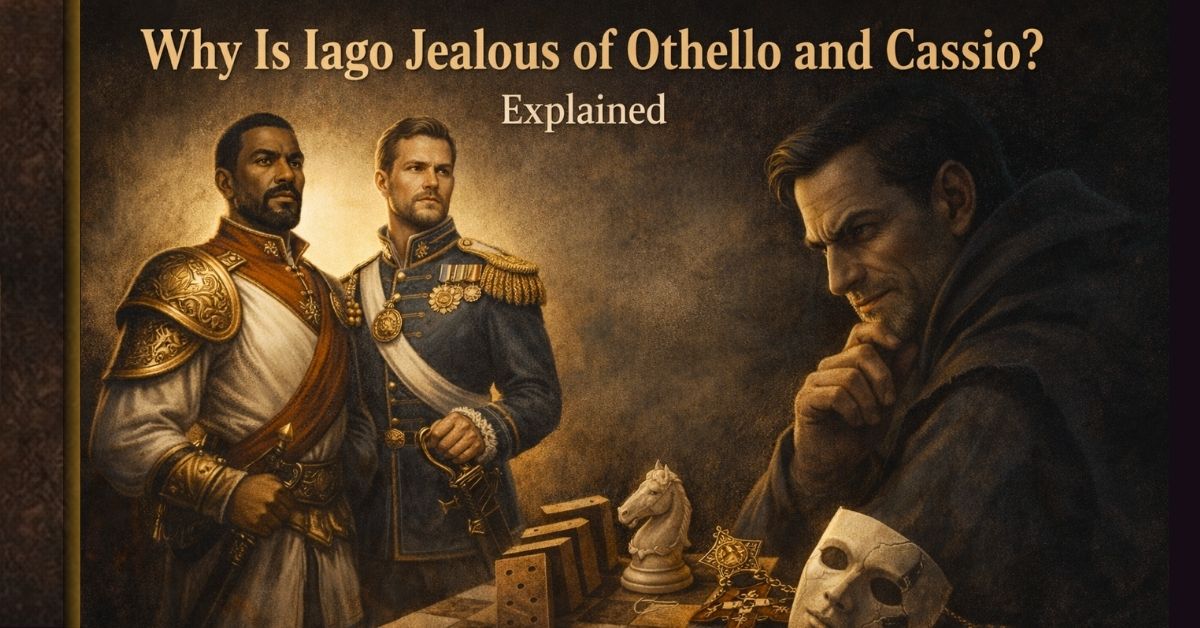
When students ask me Why is Iago jealous of Othello and Cassio? I tell them Iago is jealous because he is denied promotion, resents Othello’s authority, envies Cassio’s advancement, and suspects Othello of infidelity. His bitterness grows from wounded pride, professional rivalry, and deep psychological insecurity.
The reasons seem simple on the surface, but are layered underneath. Iago believes he deserves Cassio’s lieutenant position. When Othello promotes Cassio instead, the decision feels like public humiliation. Cassio becomes the polished symbol of what Iago thinks he earned but did not receive, while Othello stands as the authority who denied him recognition.
The resentment intensifies with suspicion. Iago hints that Othello may have been intimate with Emilia. There is no proof, yet insecurity does not require evidence.
Iago’s jealousy is not explosive. It is calculated. He transforms professional disappointment into strategic revenge, turning bruised ego into deliberate manipulation and ultimately, destruction.
However, this article explores those two targets in order- Othello first, then Cassio– to show how Iago’s strategic jealousy becomes the engine of the tragedy.
Table of Contents
Why is Iago Jealous of Othello and Cassio? A Personal Anecdote
Let me share something I sometimes tell my students. Years ago, I worked with a colleague who reminded me uncannily of Iago. Let’s call him Mikel.
Mikel was intelligent, experienced, and always thinking three steps ahead. On the surface, he was all smiles and supportive nods. But underneath? There was calculation. The kind that waits.
One year, our principal announced a new leadership role. Mikel was certain it was his. After all, hadn’t he “earned” it through years of service?
Instead, the position went to Robert- a newcomer with fresh ideas and a natural rapport with the team. I still remember the shift in Mikel’s expression. The smile didn’t vanish. It hardened.
In meetings, he’d say, “Brilliant suggestion, Robert,” but the sarcasm lingered like smoke.
Soon, whispers followed. Robert was “lucky.” “Overrated.”
Sound familiar?
That’s how jealousy mutates. It stops being hurt and starts becoming a strategy. Like Iago, Mikel didn’t just resent success. He wanted to undermine it.
Thankfully, this story ended without tragedy. But the pattern? Pure Othello.

Understanding Iago’s Jealousy in Othello: It’s Complicated
Jealousy is born when someone struggles with their insecurity, resentment, and obsession. It’s not just about desiring something that belongs to someone else. Sometimes, it arises from a feeling of personal injustice, social undermining, and deep-seated fear of one’s own existence.
In the case of Iago, his jealousy is a toxic cocktail of fear of personal insecurity, professional bitterness, and a maddeningly strong desire for dominance. But here is a question: why are Othello and Cassio the targets of his wrath? Let’s break it down in detail.

Why Is Iago Jealous of Othello or Hates Othello?
Iago is jealous of Othello because everything he craves- rank, respect, love, a beautiful woman- comes to Othello with unsettling ease. Passed over for promotion, insecure, and suspicious of an affair between Othello and Emilia, his jealousy curdles into hate. In class, I tell students this isn’t ambition alone. It’s wounded pride watching another man thrive effortlessly.
i) Professional Resentment and Authority
Let’s begin where I always begin in class: the promotion. Othello promotes Cassio. Iago is passed over. And just like that, the seed is planted. Students often ask, why did Othello promote Cassio instead of Iago? Iago himself sneers at the answer: Cassio is a “great arithmetician,” skilled in theory rather than battlefield experience. Iago, the seasoned soldier, believes rank should be earned through sweat, not study.
Now pause with me here. Imagine working tirelessly, believing you deserve recognition, only to watch someone younger, polished, and socially graceful step into “your” position. That sting, that public denial, shapes everything that follows.
Iago’s jealousy is not distant envy. It is front-row resentment. He salutes the man he resents. He serves inside the very system that denied him.
When students wonder, why does Iago hate Othello? I remind them: Othello represents authority. He has the power to elevate and to overlook. By promoting Cassio, Othello unintentionally wounds Iago’s pride. The Venetian hierarchy is rigid; status is identity. Being passed over isn’t just professional disappointment. It feels like erasure.
So yes, why is Iago mad at Othello? Because authority denied him validation. And for a man whose personal pride thrives on recognition, that denial becomes unbearable. His jealousy hardens into quiet, strategic revenge.

ii) Suspicion About Emilia
Then comes the darker whisper: “For I fear Cassio with my nightcap too.”
Every year, I write that line on the board and let it hang in the air. Students lean forward. Does Iago think Cassio slept with Emilia? He certainly suggests it. He even hints that Othello may have been involved. But notice something crucial: he says “I fear.” Not “I know.”
This is projection psychology at work. Iago’s insecurity creates its own evidence. When students ask, why does Iago want revenge on Othello? I explain that suspicion fuels his anger. Whether Emilia was unfaithful doesn’t matter. What matters is that Iago feels threatened.
Jealous minds do not wait for proof. They manufacture it. Iago’s imagination feeds his resentment, giving him moral permission, at least in his own mind, to strike back.
iii) Racial and Social Undercurrents
Now we step into uncomfortable territory. What does Iago call Othello? Rarely by his name. More often, he says “the Moor.”
Language reveals attitude. I point this out carefully to my students. The repetition distances Othello, reduces him, and marks him as an outsider. Beneath professional resentment lies insecurity about social rank shaped by Venetian hierarchy. Othello is respected, yes, but he is still different.
Scholars such as Ania Loomba argue in Shakespeare, Race, and Colonialism that race and hierarchy intensify Iago’s resentment. Othello’s rise disrupts expectation. His authority unsettles assumptions about who should hold power.
Emma Smith offers a complementary reading in The Cambridge Introduction to Shakespeare: insecurity fuels the hostility. Cassio’s polish and Othello’s authority whisper a relentless question in Iago’s mind- why not me?
When students ask, is Iago jealous of Othello? I point out to my students that Othello holds military authority, social admiration, and Desdemona’s love. For a man already nursing damaged self-regard, that combination feels intolerable.
So, Iago hates Othello because Othello embodies the power Iago lacks. Because he rose above the hierarchy that should have confined him. And because envy, when mixed with insecurity and prejudice, becomes something far more dangerous than simple dislike.
Iago’s jealousy is not loud. It is calculated. And that, I tell my students, is what makes it terrifying.
iv) Othello’s Marriage to Desdemona:
It’s not surprising that Iago is also jealous of Othello’s personal life. Yes, Othello has won the love of Desdemona, a beautiful 18-year-old girl who was born into a noble family. So, she is always out of Iago’s reach.
On the other hand, Iago, who always feels insecure in his own relationship with Emilia, hates Othello. He feels that Othello, who is always inferior in his eyes, has owned something so valuable.
It seems to him that his rival always wins the prize while he is left with nothing but disappointment. And it fuels his hatred and leads him to bring Othello down, not only professionally but also personally.
This connects to the personal dimension of jealousy we saw earlier in the anecdote- jealousy that invades identity and relationships.
Why Is Iago Jealous of Cassio or Hates Cassio?
The moment my students curiously ask why Iago is jealous of Cassio, I tell them this: Cassio embodies everything Iago believes he deserves but does not receive- rank, reputation, and refinement. That imbalance transforms professional rivalry into corrosive envy.
i) The Promotion to Lieutenant
Let me take you into the classroom for a moment. I write one question on the board: What was Cassio promoted to? The answer is simple- Othello’s lieutenant. But simplicity can be explosive.
Cassio becomes Othello’s lieutenant, the second-in-command, the trusted military advisor. And here is where the tension tightens. Iago openly declares, “I know my price…” In other words, he believes his worth is obvious. He measures himself by experience, by time served, by battlefield endurance.
So when students ask me, why does Iago think he should have been promoted instead of Cassio? I guide them to that wounded assertion. Iago sees himself as the practical soldier, while Cassio is, in his view, theoretical- more book than blade. To Iago, the decision feels like an insult disguised as policy.

Now pause. Imagine believing you are next in line, certain of it, only to watch someone else step forward. That is not just a denial of promotion. It is public displacement. And when pride is built on professional identity, displacement becomes humiliation.
This is the moment Cassio turns from colleague to rival in Iago’s private narrative. Not because Cassio attacks him, but because he stands where Iago expected to stand. That expectation, once shattered, reshapes everything that follows.
ii) Why Cassio Becomes the Ideal Instrument
Now we move beyond rank and into psychology. When my students ask me is Iago jealous of Cassio, I tell them yes, but not in a simple, emotional way. Cassio is not just a rival. He is a mirror. And mirrors can be unbearable.
Cassio possesses social grace. He is courteous, polished, and naturally diplomatic. He speaks to Desdemona with warmth and carries himself with an ease that does not beg for approval- it simply receives it. That effortless charm is quietly threatening. Iago calculates; Cassio connects. One scheme for recognition; the other attracts it.
This contrast deepens the wound. Cassio represents more than a lost promotion. He embodies comparison. He is admired in ways Iago is not, and for a man who measures his worth obsessively, visible admiration can feel like displacement.
But here is where intellect turns dangerous. Iago does not attack charisma directly. He studies it. Cassio’s weaknesses- alcohol, pride in reputation, sensitivity to honor- become entry points. Iago engineers situations, stages conflict, and lets consequences unfold so that Cassio’s fall appears self-created.
So when students ask, why does Iago hate Cassio? I answer carefully. Hate is too simple. Cassio is both rival and instrument- the first strategic move in Iago’s larger design of control.
iii) Cassio’s Relationship with Desdemona:
Cassio’s promotion wounds Iago’s pride. Cassio’s popularity unsettles him further. But it is Cassio’s easy, respectful closeness with Desdemona that gives Iago his most dangerous opportunity.
In class, I often ask: What does Iago truly see when Cassio speaks warmly to Desdemona? Not romance, but optics. He sees trust. He sees courtesy. He sees a public image of harmony that he himself cannot command. And for a man already nursing concerns about lost prestige, that image becomes combustible.
Iago understands something crucial about Othello: beneath his confidence lies insecurity, particularly about Desdemona’s loyalty. So Iago does not accuse outright. He insinuates. He plants a suggestion instead of proof. His words move slowly, like poison entering the bloodstream- subtle, patient, corrosive.
Does Iago believe Cassio and Desdemona are lovers? Probably not. Belief is irrelevant. Suspicion is useful.
By exploiting their innocent friendship, Iago accomplishes two things at once: he stains Cassio’s reputation and fractures Othello’s trust. It is strategic devastation. Cassio becomes compromised, Desdemona becomes questioned, and Othello begins to unravel.
This is no longer simple jealousy. It is calculated manipulation- turning virtue itself into evidence of guilt.
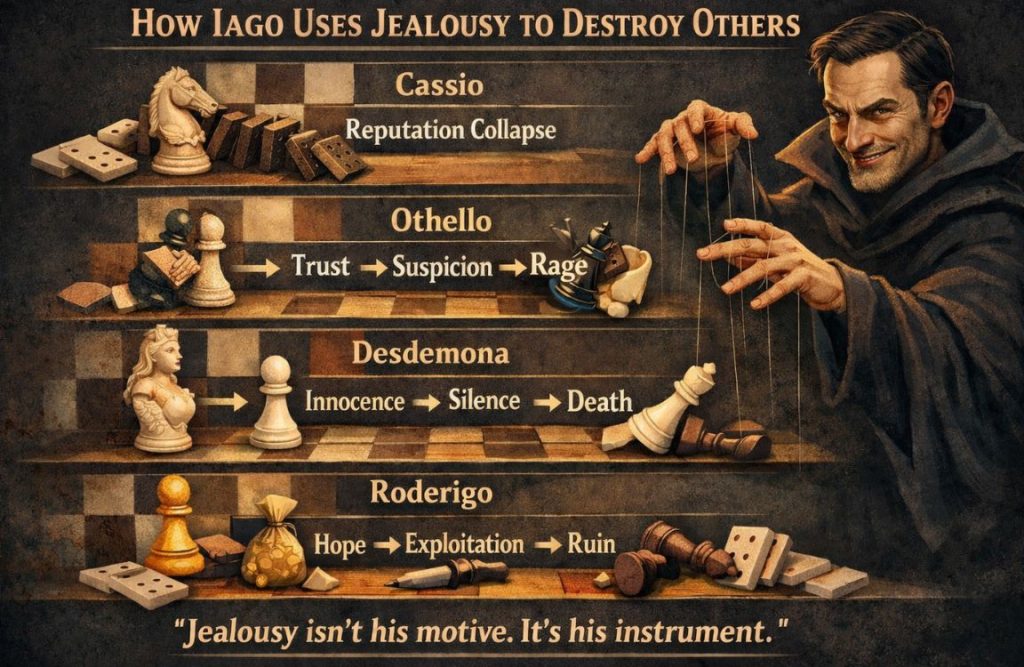
How Iago Uses Jealousy to Destroy Others
In class, I tell students that Iago doesn’t spread jealousy randomly. He engineers it carefully, like a strategist moving pieces. Each action builds pressure until trust fractures, friendships fall, and destruction looks inevitable, not sudden.
i) How Does Iago Manipulate Cassio?
Iago manipulates Cassio by exploiting his trust, pride, and weakness for alcohol. He engineers a drunken fight to cause his demotion, then advises him to seek Desdemona’s help, creating suspicion and planting false evidence to ruin him.
When I teach how Iago manipulates Cassio, I break it into stages. First, he studies Cassio’s weaknesses- courtesy, reputation, and drink. Then he orchestrates chaos, ensuring a drunken brawl costs Cassio his rank.
Finally, posing as an “honest” friend, he advises Cassio to appeal to Desdemona, turning innocence into suspicion. Even the handkerchief becomes planted proof. Iago never forces. He arranges. Cassio walks himself into the trap.
ii) How Does Iago Manipulate Othello?
Iago manipulates Othello by posing as an “honest” friend, planting subtle doubt, exploiting his insecurities about race and age, and turning the handkerchief into false proof of Desdemona’s infidelity.
When I explain how Iago manipulates Othello, I lower my voice. Iago never accuses; he insinuates. He plants suspicion through pauses and leading questions, “I like not that” and lets Othello complete the thought. He exploits Othello’s private insecurities: being older, being an outsider, and fearing he is unworthy of Desdemona’s love.
Then comes staged evidence. A misplaced handkerchief becomes “ocular proof.” A fabricated dream becomes confession. Carefully timed encounters appear damning.
This is psychological warfare. Iago controls information, delays certainty, and allows imagination to poison judgment. By the time truth could intervene, jealousy has already pronounced sentence, and innocence cannot outrun it.
iii) How Does Iago Manipulate Roderigo?
In Othello, Iago manipulates Roderigo by exploiting his desire for Desdemona, convincing him to fund his schemes, provoking him to attack Cassio, and ultimately using him as a disposable pawn.
Every time a student stops me and wonders how Iago manipulates Roderigo, I explain it quietly. Iago feeds jealousy with false hope. “Put money in thy purse,” he repeats, turning love into transaction. Roderigo sells land, funds plots, and waits for promises never meant to be kept.
Step by step, desire replaces reason. Iago convinces him that Desdemona loves Cassio, pushes him into reckless violence, and uses him to spark conflict. Trust becomes a leash.
And when the pawn begins to question the game, Iago removes him entirely.
Why Does Iago Seek Revenge on Both Cassio and Othello?
Iago seeks revenge because he is overlooked for promotion, resents Othello’s authority, envies Cassio’s advancement, and suspects both men of infidelity with Emilia. His revenge becomes a calculated attempt to restore affronted honor and regain control.
When the inevitable questions Why does Iago want revenge against Cassio? Why does Iago want to destroy Othello? comes up in class, I gently explain to my students that revenge begins as injury but evolves into intention.
Cassio’s promotion is the first fracture. Iago believes he deserves the lieutenant position and views Cassio as a “bookish” replacement. Professional displacement hardens into resentment. Othello, as the authority who chose Cassio, becomes equally culpable.
Then suspicion deepens the wound. Iago hints that Othello and perhaps Cassio have been intimate with Emilia. There is no proof, yet insecurity feeds on imagination.
But jealousy alone does not explain the scale of destruction. Revenge becomes ego repair. If Othello’s power and Cassio’s advancement make Iago feel diminished, then orchestrating their downfall restores his sense of dominance. Hurt becomes calculation; calculation becomes strategy.
By manipulating both men, Iago positions himself above them- controlling their perceptions, shaping their actions, and turning private insecurity into public catastrophe.
Iago’s Jealousy in Othello: Psychological Analysis
When I guide students through Iago’s jealousy in Othello, I advise them to look beyond the plot and into the psyche. His envy is not an impulsive emotion. It is structured psychology- pride wounded, identity threatened, and control pursued at any cost.
i) Projection and Narcissistic Injury
Here is where I slow the lesson down. Modern psychology gives us language Shakespeare never used but clearly dramatized: projection and narcissistic injury. Sigmund Freud describes projection as attributing one’s unacceptable feelings to others. Suddenly, Iago’s suspicions look less like evidence and more like mirrors.
Whenever students ask me what motivates Iago, I advise them to examine his fragility. A narcissistic injury occurs when someone’s inflated self-image is punctured. Iago believes himself superior- strategically sharper, socially perceptive, intellectually ahead. When reality fails to confirm that belief, the wound cuts deep.
So, Iago’s motivation in Othello? His sense of self-worth cannot tolerate contradiction. Instead of revising himself, he revises reality. He reshapes perception, plants suspicion, and engineers outcomes.
This is why Iago’s jealousy in Othello feels calculated. It is not emotional overflow but ego defense. Pride, once fractured, demands compensation, and he seeks it through control.
ii) Motiveless Malignity Debate
Now we step into a literary debate. Samuel Taylor Coleridge famously called Iago’s behavior “motiveless malignity,” suggesting Iago is evil without a clear cause. But when I present this idea, students immediately protest. “But he has motives!” they argue.
A. C. Bradley counters that Iago’s motivations are real but insufficient- petty grievances inflated into catastrophe. Harold Bloom goes further in Shakespeare: The Invention of the Human, proposing that Iago enjoys his own mental agility, almost admiring himself as he manipulates others.
So, is Iago a sociopath? That question always sparks discussion. He displays traits: lack of empathy, charm, and emotional detachment. Yet Shakespeare does not give us a medical diagnosis.
When students ask, why is Iago so evil? I often say that perhaps the discomfort lies in this ambiguity. He is not a monster from nowhere. He is unsettlingly human, and that may be worse.
iii) Power, Dominance, and Emotional Detachment
Let me offer one final lens: instrumental jealousy. Iago discovers that shaping perception grants invisible authority. He becomes an architect rather than a participant. In his asides, he confides schemes with composure, not remorse. Dominance itself becomes a reward.
When students ask, what does Iago represent in Othello? I suggest he embodies the danger of an unchecked identity-driven pride fused with intelligence. Emotionally detached, he treats relationships as levers.
Jealousy begins the movement, yes, but power sustains it. And perhaps that is the most disturbing lesson I leave them with: evil here is not chaos. It is precision without conscience.
Iago’s Jealousy Quotes (With Explanation)
When I teach Iago’s jealousy quotes, I gently suggest to my students this: if you want to understand his mind, listen carefully when Iago reveals that he hates Othello. His language leaks insecurity long before his plans unfold.
i) “I hate the Moor.” (Act 1, Scene 3)
The first time I read this aloud in class, I pause after the word hate. It lands like a stone. This is not irritation. It is a declaration. When Iago reveals that he hates Othello, he strips away the mask. The bluntness shocks us. There is no poetry here, only raw hostility. Hatred, I like to remind them that, is rarely born overnight. It grows in silence before it speaks.
ii) “I know my price…” (Act 1, Scene 1)
Whenever we encounter “I know my price,” I ask my students: What does that word price suggest? Worth. Market value. Iago reduces himself to currency. He believes he has been undervalued. That belief feeds resentment. Notice the confidence, almost arrogance. Yet beneath it, I hear insecurity. The louder someone declares their worth, the more I wonder who failed to recognize it.
iii) “For I fear Cassio…” (Act 2, Scene 1)
“For I fear Cassio…” always sparks conversation. Fear is revealing. I ask my students: What kind of fear? Professional? Personal? Imagined? This line trembles with suspicion. Iago does not claim proof. He claims anxiety. That distinction matters. Fear without evidence often tells us more about the speaker than the accused. In this moment, jealousy sounds less like logic and more like restless imagination.
iv) “I do suspect the lusty Moor.” (Act 2, Scene 1)
Suspicion drives this confession. The word lusty carries accusation and projection. I often say to my class that suspicion is powerful because it requires no witness. It grows privately. This line exposes insecurity more than certainty. Whether true or not is irrelevant; what matters is that Iago believes, or convinces himself to believe, it. Jealousy thrives in the space between doubt and proof.
v) “He hath a daily beauty in his life / That makes me ugly.” (Act 5, Scene 1)
This confession feels almost startlingly vulnerable. Iago recognizes contrast: another’s goodness magnifies his own flaws. I ask my students to consider the honesty here. Envy is rarely about possession. It is about comparison. Instead of aspiring upward, Iago chooses to drag downward. The metaphor of beauty and ugliness exposes emotional self-awareness, twisted into resentment rather than reform.
vi) “A great arithmetician.” (Act 1, Scene 1)
When Iago calls Cassio “a great arithmetician,” the sarcasm drips. Arithmetic suggests calculation, theory, and book knowledge. I encourage students to hear the dismissive tone. This is not praise. It is belittlement disguised as description. Jealousy often mocks what it secretly resents. In reducing another’s skill, Iago attempts to elevate himself. Language becomes a weapon long before action does.
Othello’s Jealousy vs Iago’s Jealousy
In Shakespeare’s Othello, Othello’s jealousy is emotional and reactive, rooted in insecurity and possessive love, while Iago’s jealousy is calculated and strategic, driven by envy and ambition. One destroys himself; the other destroys others first.
When I teach Othello, I draw two columns: Othello and Iago. Their jealousies are not twins. Othello’s jealousy erupts like a storm. It grows from doubts about his race, age, and worthiness, then fixates on Desdemona’s supposed betrayal. He reacts, trembles, and ultimately self-destructs.
Iago’s jealousy is colder. Sparked by Cassio’s promotion and suspicion about Emilia, it is less emotion than strategy. He does not unravel. He orchestrates. Where Othello burns, Iago freezes.
One is the victim of the green-eyed monster. The other is its architect.

Comparison Table: Othello’s Jealousy vs. Iago’s Jealousy
| Category | Othello’s Jealousy | Iago’s Jealousy |
| Source of Jealousy | A deep love for Desdemona, fears of losing her & mistrust | Ego, Resentment of Othello and Cassio’s success, suspicion of infidelity |
| Trigger | Iago’s lies about Desdemona’s infidelity | Cassio’s promotion & the rumor about Emilia |
| Emotional vs. Strategic | Othello thinks he’s acting rationally, but actually losing control | Methodical- cold, calculating, and methodically plots revenge |
| Reaction to Jealousy | Falls apart, doubts himself, and lashes out emotionally | Becomes even more manipulative, dangerous, and focused on destruction |
| Driven By | Insecurity about his race, status, and Desdemona’s loyalty | Ego, thirst for power, and a desire for revenge |
| Proof? | Demands proof but believes the flimsiest of evidence (e.g., the handkerchief) | Doesn’t need proof—his suspicions and grudges are enough for him |
| Self-Awareness | Othello thinks he’s acting rationally but actually losing control | Fully knows he’s evil and loves it |
| Final Outcome | Kills Desdemona, then himself—tragedy | Destroys everyone but is ultimately caught—poetic justice |
FAQs:
Does Iago ever express regret for his actions?
No, Iago doesn’t express regret. Even when his plans are exposed, he remains cold, defiant, and silent, refusing to explain his motives. This lack of remorse proves his sociopathic nature.
What role does Emilia play in Iago’s jealousy?
Emilia unknowingly fuels Iago’s schemes by stealing Desdemona’s handkerchief, but ultimately exposes his lies, leading to his downfall and paying the price for his jealousy of her life.
Could Iago’s jealousy have been prevented?
Possibly, if Othello had doubted Iago’s motives or if Emilia had revealed the truth earlier. But Iago’s deep resentment and manipulative nature made his jealousy almost unavoidable.
What does Iago’s jealousy reveal about human nature?
Iago’s jealousy reveals the darker side of human nature, like insecurity, envy, and the desire for power. It also warns us, telling how unchecked emotion leads to all destruction.
What modern psychological concepts apply to Iago’s jealousy?
Iago’s jealousy embodies narcissism, Machiavellianism, and malignant envy. His lack of empathy, manipulative tactics, and need for control align with dark psychology and show how insecurities can lead to destruction.
Conclusion:
So we return to the central question: Why is Iago Jealous of Othello and Cassio? Yes, professional slights, suspicion, wounded pride- all of these matter. Iago’s jealousy is real.
But as I tell my students, jealousy alone feels too small to explain the devastation that follows.
What motivates Iago goes beyond envy. His jealousy does not remain an emotion; it matures into a doctrine. At first, he is hurt. Then he calculates. Finally, he commits. The injury to his ego becomes a philosophy of control. If the world refuses to validate him, he will reorder the world instead. Jealousy may open the door, but Iago builds a system inside it.
If Othello’s tragedy is that he feels too deeply, Iago’s danger is that he intellectualizes feeling until it becomes strategy.
And that is the thesis I leave my students with: Iago’s jealousy is not merely resentment. It is the beginning of an ideology- ambition without conscience, intelligence without empathy, and insecurity sharpened into deliberate destruction.