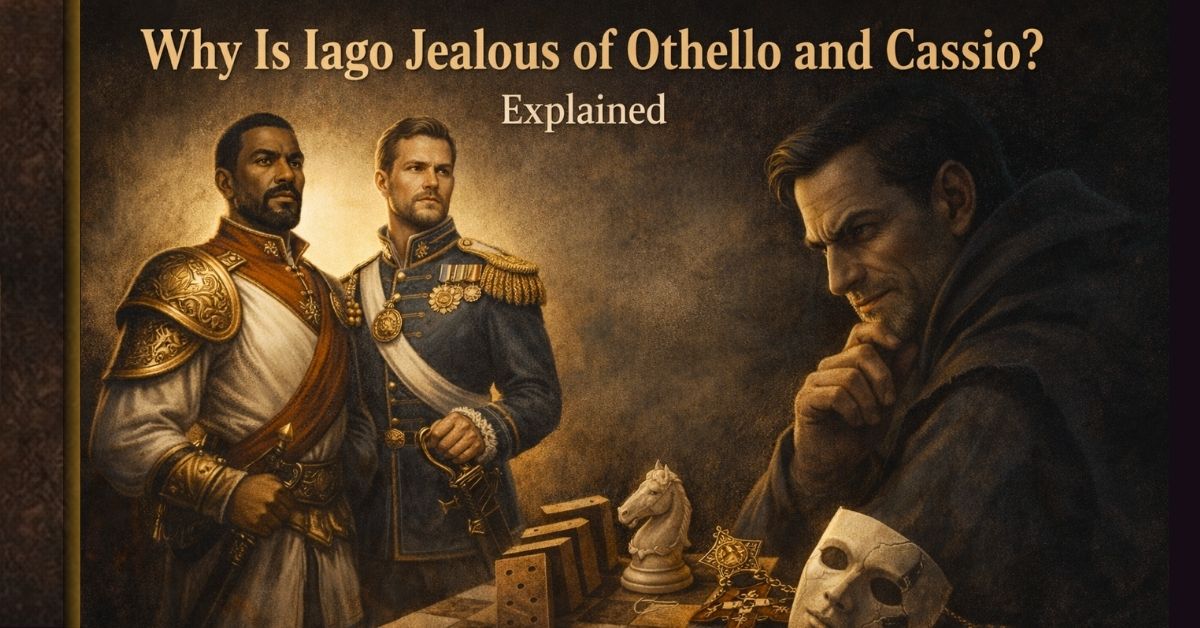
“Alright, folks, grab your notebooks. Today we’re chasing love in Othello, but fair warning: this is not your rom-com kind of love. It’s Shakespeare’s version, where kisses come with daggers.”
When I teach the play, I often remind my students that Shakespeare didn’t just write a tragedy. He staged a messy love story where Cupid shows up with poisoned arrows.
The theme of love in Othello runs through every act, shaping the characters’ choices and sealing their fates.
At the heart of it lies Othello and Desdemona’s love- tender, passionate, and idealized at first, but vulnerable to jealousy and manipulation. Their devotion, once a source of strength, becomes the very ground on which Iago sows doubt and suspicion.
And so we arrive at the essence of tragic love in Othello: a love that begins with beauty and trust but ends with heartbreak and destruction.
As we dig in, you’ll see how love here is both halo and noose- romantic, manipulated, idealized, and devastating. By the end, you’ll understand why Shakespeare makes us blush, ache, and question our own hearts- even 400 years later.
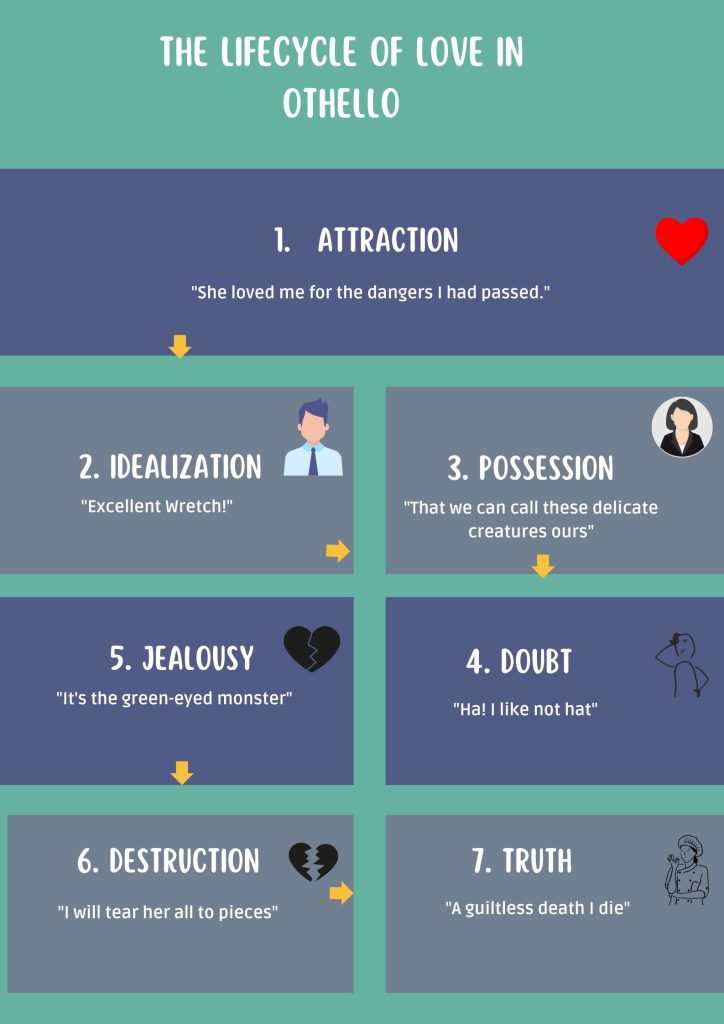
Table of Contents
Love in Othello: An Overview
When I first teach my students Othello, I like to start with a simple truth: love in this play is less about candlelit dinners and more about fireworks, explosive, unpredictable, and sometimes downright lethal.
At its heart, Othello is a love story between a general and his wife, Desdemona. Their love begins with passion and admiration: she loves him for his courage and tales of adventure, he loves her for her purity and wit.
But Shakespeare’s view of love in Othello goes beyond this idealized romance. The play threads in multiple subplots- Roderigo’s hopeless infatuation, Cassio’s flirtations, and Emilia’s practical, sometimes sardonic reflections.
Together, they create the representation of love in Othello as diverse, layered, and often contradictory.
What does this tell us?
Shakespeare presents love as both radiant and fragile, a force capable of inspiring heroism or unleashing tragedy. It is nurturing yet vulnerable, idealized yet terrifyingly human.
Othello’s trust in Desdemona is boundless, but his insecurities and Iago’s poisonous manipulations reveal how quickly love can turn into suspicion, jealousy, and destruction.
As I guide my students through these layers, I like to pause and ask: “Do we love like Othello, or like Desdemona, or do we flirt with Roderigo’s doomed enthusiasm?”
Exploring different forms of love in Othello allows us to appreciate Shakespeare’s genius: he doesn’t give us one simple story. He gives us a mirror to our own hearts.
From this overview, we’re ready to dive deeper into the multiple faces of love- romantic, idealized, manipulated, and tragically flawed, a journey that’s as enlightening as it is heartbreaking.
Themes of Love in Othello [Complete Analysis]
When I introduce my students to the types of love in Othello, I begin with a truth: Shakespeare never paints love as simple. It’s messy, thrilling, heartbreaking, and, let’s be honest, a little dangerous.
To really understand the thematic breakdown of love in Othello, we have to unpack it through different lenses, exploring how it inspires devotion, worship, jealousy, forgiveness, realism, manipulation, and ultimately tragedy.
So, grab your mental notebooks. This is where the real fun begins.
i) Romantic Love: Othello & Desdemona
At first glance, Othello and Desdemona’s love reads like a fairy tale- he, the heroic outsider; she, the devoted Venetian lady. But it’s more than romance. It’s a meeting of admiration, intellect, and courage.
When I point this out in class, I emphasize how Shakespeare portrays love as a force that elevates- Othello’s honor and Desdemona’s innocence shine brighter together.
Yet, romantic love in this play is also perilously fragile, especially when external forces like Iago begin to erode trust.
ii) Idealized Love: Othello Worshipping Desdemona
Othello doesn’t just love Desdemona. He sanctifies her. I often pause here and ask students, “Have you ever loved someone so much you forgot they’re human?”
His idealization is poetic, almost religious, but also dangerous. By elevating Desdemona to perfection, Othello sets himself up for heartbreak, because humans, alas, are gloriously flawed.
iii) Jealous Love: Poisoned by Suspicion
Ah, the volcanic eruption of jealousy. Here is where Shakespeare shows love’s darker side: Othello’s passion twists into obsession.
I like to illustrate this in class by comparing his mind to a mirror fogged by Iago’s lies- what was once clear and reflective becomes distorted and deadly.
Love poisoned by suspicion teaches us that trust is the linchpin of any relationship, even in 17th-century Venice.
iv) Forgiving Love: Desdemona’s Loyalty
Desdemona embodies love as grace. She forgives before being wronged, remains steadfast despite fear, and mirrors the ultimate human capacity for empathy.
I often tell my students, “If Desdemona were alive today, she’d probably win Teacher of the Year for emotional intelligence.” Her forgiving love contrasts sharply with Othello’s jealousy, highlighting love’s moral and emotional spectrum.
v) Realistic Love: Emilia’s Perspective
Emilia brings us back to Earth. Her take on love is pragmatic, witty, and sometimes cynical. She teaches us that love isn’t always poetic. It’s transactional, messy, and socially conditioned.
In class, I encourage students to see Emilia as Shakespeare’s reality check: love is lived, negotiated, and sometimes compromised.
vi) Manipulated Love: Iago’s Exploitation
Here’s the sinister twist: Iago weaponizes love. By exploiting Othello’s insecurities, he transforms affection into suspicion, loyalty into self-doubt, and passion into murder.
Love becomes a battlefield where manipulation reigns, reminding us how fragile human hearts can be under cunning influence.
vii) Tragic Love: The Downfall of Othello & Desdemona
Finally, we arrive at tragedy. Shakespeare doesn’t just tell a sad story. He stages a moral and emotional catastrophe. Love, when combined with jealousy, idealization, and manipulation, can become self-destructive.
As I discuss this with students, I liken it to a candle flame in a windstorm: brilliant, beautiful, and doomed.
By exploring these themes, we uncover Shakespeare’s genius: the love in Othello is not one-dimensional. It’s a prism- multi-faceted, illuminating both human beauty and human folly, challenging us to question how we love, trust, and forgive.
Love as Possession vs. Love as Freedom
One of the things I find most haunting every time I teach Othello is this: Othello and Desdemona’s relationship is not a single shared love story but two different ones colliding. Othello’s love for Desdemona is bound up with possession. He must have her, hold her, and keep her close- too close. His devotion sounds poetic, but it comes with terms and conditions.
I often joke with my students: “Othello’s love comes with an asterisk: terms and conditions apply!” He thinks loyalty can be demanded, not nurtured.
Meanwhile, Desdemona’s love for Othello is of a different nature altogether. She loves with her hands open, giving freely and fearlessly. Her devotion is selfless, trusting, and forgiving, showing us what true love in Othello looks like when it’s not corrupted by pride or jealousy.
When she defies her father to follow her heart, she demonstrates romantic love in Othello as liberation rather than confinement.
And yet, Shakespeare complicates this picture. In their marriage, we see how fragile love and marriage in Othello can be when social prejudice, insecurity, and manipulation seep in.
Othello recalls how Desdemona “loved him for the dangers he had passed,” which sounds like devotion, but beneath it is the idea of love as reward, almost as if she were a trophy he won. That framing becomes fatal.
When Iago whispers poison, Othello doesn’t doubt Iago- he doubts the very foundation of their marriage, and suddenly Desdemona’s devotion is no longer enough.
This is where Shakespeare’s genius lies: in exposing the gulf between love as possession and love as freedom. Othello’s devotion to Desdemona cannot survive unless he controls it.
Desdemona’s love, on the other hand, thrives on choice, vulnerability, and trust. The tragic irony is that these two visions of love cannot coexist.
And so, we arrive at the core truth: the collapse of Othello and Desdemona’s relationship isn’t born from hatred but from the weight of possession disguised as passion.
The tragedy lies in the gap between what love should be, mutual, liberating, forgiving, and what it becomes under the pressure of jealousy and manipulation.
Even today, this conflict speaks loudly. Is your love a cage, or is it an embrace? Shakespeare invites us to reflect not only on romantic love in Othello but also on our own hearts, reminding us that love survives only when it is free, honest, and equal.
The Philosophy of Love in Othello
So, what is Shakespeare really doing with the love in Othello? Let’s be honest: this isn’t just a tragic love triangle gone sideways. It’s messy, provocative, and deeply human.
Love in Othello isn’t a gentle sigh. It’s identity, power, illusion, and sacrifice all rolled into one explosive cocktail. And yes, sometimes it lifts you. Sometimes, it obliterates you.
i) Love as Identity
Here’s a live teaching moment I share with my students every year: for Othello, love isn’t just a part of life. It is life. His love for Desdemona is so tightly bound to his selfhood that the two are almost inseparable.
Romantic? Absolutely.
Terrifying? Without a doubt.
“Then must you speak/Of one that loved not wisely but too well” (5.2) is his final, heart-wrenching reflection.
Othello doesn’t blame fate or Iago. He admits he loved too fully, too blindly. When love becomes identity, its loss doesn’t just break the heart. It shatters the very self.
For modern readers, this is a cautionary tale: tethering your entire identity to another person is an invitation to heartbreak and chaos.
ii) Love and Power
Next up: the tug-of-war between affection and authority. Who actually holds power in love?
Othello wants Desdemona’s heart tightly sealed, possessive, as though affection can be demanded.
Desdemona, in contrast, loves freely, generously, almost fearlessly. Her open-hearted devotion disarms Othello, whose experiences of war and survival make him mistake trust for fragility.
And then there’s Iago, who manipulates love like a Rubik’s Cube, turning affection into poison. Shakespeare shows that love is never just a feeling. It’s a stage for power, control, and vulnerability.
iii) Love vs. Illusion
A question I often throw at my students: is any love in Othello real, or is it all smoke and mirrors?
Iago certainly thinks it’s a scam. Othello wants pure, absolute love, but he confuses illusion for evidence and mistrust for truth.
“O curse of marriage, / That we can call these delicate creatures ours, / And not their appetites!” (3.3.267–269) marks the moment where love slips into obsession and illusion.
Shakespeare warns us: love filtered through fear or fantasy stops being love- it becomes a fragile mirage.
iv) Love and Sacrifice
Finally, the heartbreaking cost. Desdemona loves with purity and loyalty; Emilia loves with defiance and justice.
Both pay the ultimate price. “Nobody; I myself. Farewell” (5.2.125) is Desdemona’s final testament- a love so selfless it destroys her.
Emilia’s courage, on the other hand, reminds us that love can also be active, principled, and transformative, even at great personal cost.

Female Friendship as Love: Emilia and Desdemona’s Quiet Resistance
Amid all the emotional fireworks of Othello, it’s easy to overlook the steady, glowing ember of Desdemona and Emilia’s friendship.
But honestly?
It’s one of the most moving love stories in the play, and no, not the mushy, moonlit kind. I’m talking about love as care, courage, and loyalty under fire.
While the men are off performing their tragic masculinity, these two women are quietly building a bond. They talk. They listen. They hold space for each other in a world that rarely does.
And in the end, it’s Emilia, sharp, brave Emilia, who risks everything to speak the truth for her friend.
“I will not charm my tongue; I am bound to speak.”
Chills, every time.
What Shakespeare gives us here is a different kind of love. Not grand, not tragic, but grounded. Female friendship becomes its own form of rebellion, a counterpoint to all the chaos driven by possessiveness and pride.
It’s love that tells the truth, even when it’s painful. Love that speaks, even when silence is safer.
Takeaway: Love in Othello is layered, powerful, and dangerous. Its identity, power, illusion, and sacrifice are intertwined.
As a teacher, I tell my students: Shakespeare isn’t just telling a love story. He’s staging a masterclass in human emotion, asking us to confront how love defines us, controls us, deceives us, and sometimes destroys us.
And that, my friends, is why love in Othello continues to haunt, educate, and mesmerize modern readers.
Special Dimensions of Love in Othello
Alright, class, buckle up, because love in Othello isn’t just about heartbeats and poetry. Shakespeare teases us with layers, subplots, and perspectives that make this tragedy more than a story of two star-crossed lovers.
When I teach this section, I like to tell my students: if love were a puzzle, Othello hands you a Rubik’s Cube and tells you to solve it while blindfolded.
Let’s dig into the special dimensions of love and see what makes Shakespeare’s exploration so endlessly fascinating.
i) Unrequited Love: Roderigo’s Doomed Obsession
Roderigo is the embodiment of love turned obsessive, and let’s be honest, painfully naive. He throws money, hope, and dignity at Desdemona like confetti, convinced love is transactional.
But here’s the lesson: love without reciprocity is a trap. I often ask my students, “Have you ever loved someone who didn’t love you back?
Welcome to Roderigo 101.” Shakespeare shows us the bitter side of unbalanced love: the longing, the delusion, and, eventually, the tragic consequences of mistaking desire for destiny.
ii) Familial Love: Brabantio’s Paternal Bond
Then there’s Brabantio. He loves Desdemona, yes, but the lens is different. It’s protective, possessive, and politically charged. This isn’t romantic love. It’s familial, tethered to honor, pride, and societal expectation.
As a teacher, I emphasize that this dimension complicates the story: Shakespeare reminds us that love doesn’t exist in a vacuum. It collides with culture, race, and hierarchy.
When Brabantio exclaims about losing his daughter’s allegiance, we see love entwined with control and patriarchal anxiety.
iii) Romantic Realism: Cassio and Bianca
Cassio and Bianca’s subplot offers a refreshing lens. Their love is earthy, messy, and, dare I say, realistic. Bianca loves openly, passionately, and vulnerably.
Cassio, meanwhile, is clueless, flirtatious, and sometimes oblivious. Teaching this, I point out the contrast with Othello and Desdemona: love can be imperfect, flawed, and human, and sometimes that makes it more truthful than the lofty romance of the main plot.
iv) Comradeship and Trust: Othello and Cassio
Finally, we must not forget a non-romantic dimension: the love and loyalty between Othello and Cassio. This is friendship as a form of emotional currency, another lens on how Shakespeare examines affection.
I often highlight to students how Iago exploits this bond, turning trust into a weapon. Here, love is about fidelity, honor, and betrayal, and the play reminds us that love isn’t always about passion. Sometimes, it’s about respect, reliance, and moral responsibility.
Takeaway: These special dimensions of love in Othello– unrequited, familial, realistic, and platonic- reveal Shakespeare’s mastery. Love is not monolithic. It shifts, complicates, and often deceives.
As a teacher, I urge students to see beyond the romantic tragedy: Othello’s world teaches us that love is complex, multi-layered, and profoundly human.
And maybe, just maybe, that’s why we keep coming back to it, because it mirrors our own messy, contradictory hearts in ways no textbook ever could.
5 More Deep-Dive Ideas About Love in Othello to Explore
Think of these as your literary side quests, mini explorations that can pop up as breakout boxes, discussion prompts, or even full-on sections like “The Philosophy of Love.” You can sprinkle them through your lesson or build whole activities around them. Either way, they’ll spark some juicy classroom conversations.
i) Love and Jealousy: Lovers or Enemies?
In Othello, love and jealousy aren’t opposites. They’re dangerously close companions.
Shakespeare doesn’t just suggest that jealousy can creep into love. He shows us what happens when it rents a room in your heart, eats all your trust, and throws a party with your insecurities.
Othello goes from idolizing Desdemona to planning her murder with dizzying speed, not because his love disappears, but because his fear takes over.
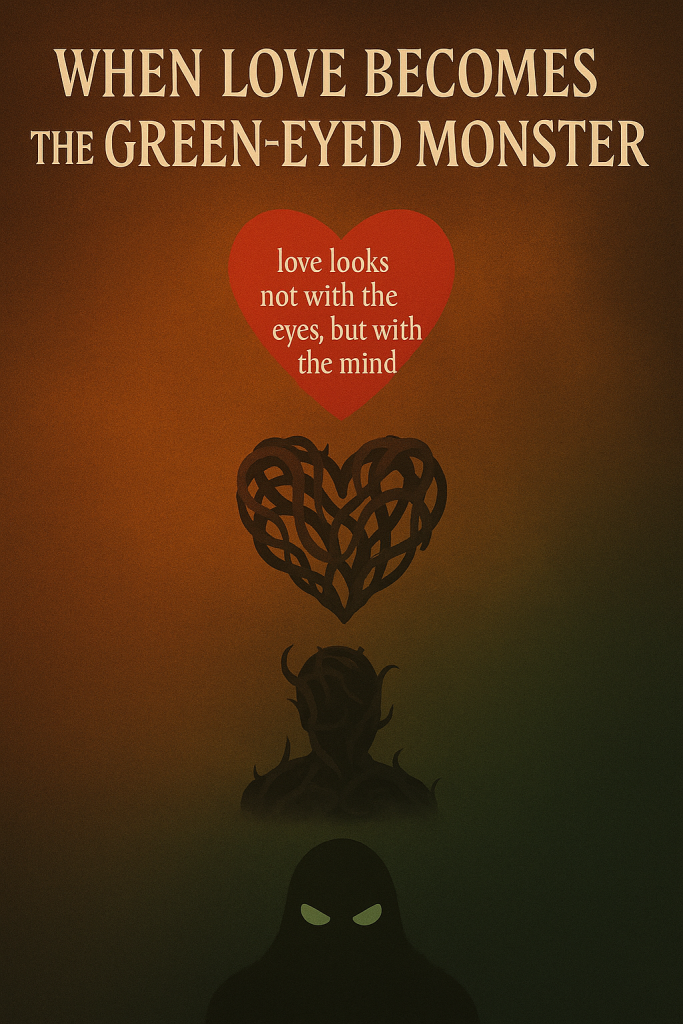
Insight: Shakespeare doesn’t neatly divide love and jealousy. He marries them. In Othello’s world, loving deeply without the backbone of trust is like lighting a match in a fireworks factory. Boom.
ii) Masculinity and the Fear of Love- Why Must Othello Be ‘In Control’?
Let’s talk about Othello, the guy who can face down entire armies without flinching… but falls apart when love enters the picture.
Isn’t that wild?
His love for Desdemona is deep, no doubt. But it’s also terrifying, not for her, at first, but for him. Because love makes him vulnerable. And vulnerability doesn’t exactly fit into the “strong, silent warrior” vibe he’s been living by.
“O, beware, my lord, of jealousy; / It is the green-eyed monster which doth mock…”
Iago’s warning here is a masterpiece of manipulation, a lie wrapped in poetic truth. He knows Othello’s fear isn’t just about betrayal. It’s about losing control, losing face, losing himself.
In the world Shakespeare paints, men aren’t taught to lean into love. They’re taught to master it, conquer it, or mistrust it. So when Othello’s heart starts to waver, he doesn’t open up. He shuts down. Fast.
Here’s what I see: Shakespeare isn’t just spinning a tale of romance gone wrong. He’s poking at something deeper, a version of masculinity where emotion is weakness, and love becomes dangerous when it’s not kept in check. Othello can survive battlefields, but not intimacy. That, to me, is the true tragedy.
iii) Marriage as a Battlefield- Can Trust Survive?
Let’s be honest. The marriages in Othello wouldn’t exactly make it into a relationship advice column. They’re not partnerships. They’re power plays. Othello talks about Desdemona like she’s something he owns, his “fair warrior,” sure, but also his possession. That doesn’t leave much room for trust, does it?
And then there’s Emilia. Oh, Emilia. By Act 4, she’s had enough of the silence. She comes out swinging- bold, sharp, furious. While Desdemona still clings to hope, Emilia’s the one who throws down the truth. She sees the rot behind the romance, and she’s done pretending everything’s fine.
Emilia in Act 4: She’s angry, brilliant, and finally refuses to play by the rules. It’s one of the most satisfying shifts in the play, and one of the most heartbreaking.
Here’s what hits me: Shakespeare isn’t idealizing marriage here. He’s dissecting it. He shows us what happens when marriage is built on control, not connection.
When men dominate and women are expected to obey, love becomes something else entirely: a weapon, a trap, even a trigger. And where trust should be. There’s only suspicion.
So yes, in Othello, marriage is a battlefield. But the real casualties? Honesty, equality, and trust.
iv) Idealism vs. Reality- Is Desdemona Too Perfect?
Let’s talk about love at first story. Othello and Desdemona don’t just fall for each other. They fall for carefully edited, highlight-reel versions of each other. He sees her as the gentle, admiring angel who weeps over his adventures. She sees him as the dashing, noble hero straight out of an epic romance.
“She loved me for the dangers I had passed…”
Ah, yes, the classic “she was into me for my trauma” love story.
But here’s where it gets messy. Real people aren’t made of myths. And once the honeymoon haze clears, Othello starts looking at Desdemona not as a partner, but as a puzzle that doesn’t fit the fantasy. Cue insecurity, jealousy, and, well… we know how that ends.
For me, this is one of Shakespeare’s sharpest observations: love built on perfection is built on sand. Othello loves the idea of Desdemona, not Desdemona herself. And when reality creeps in, that illusion can’t hold. It cracks. Then crumbles.
So what’s the takeaway?
Maybe: Don’t fall in love with the story, fall in love with the messy, human, real person telling it. That’s where the good stuff is.
v) The Performance of Love- Is Othello in Love, or in Roleplay?
Sometimes I wonder: is anyone in Othello actually in love, or are they all just really committed to the roles they’ve been handed?
From the start, love in this play feels like theatre. Iago plays the loyal friend (spoiler: he’s not). Desdemona performs the picture-perfect wife.
And Othello?
He acts out passion, jealousy, and even heartbreak like a man who knows his audience. It’s less romance, more method acting, and nobody breaks character until it’s far too late.
Here’s what gets me: Shakespeare isn’t just writing a love story. He’s pulling back the curtain on love as performance. Everyone is stuck in a script. The “dutiful wife.” The “honorable general.” The “faithful friend.” These roles are so ingrained, so expected, that they start to replace actual connection, honesty, and feeling.
And that’s the tragedy, isn’t it?
These characters are more faithful to their parts than to each other. They love the idea of who someone is supposed to be, not who they really are underneath the costume.
So when we read Othello, we’re not just watching a story of love and betrayal. We’re watching the danger of mistaking roleplay for reality. And let’s face it: in this play, no one gets a standing ovation.
Love and Jealousy in Othello
Alright, students, now we’re stepping into the volcanic core of Othello: where love and jealousy collide. If love is the sugar, jealousy is the spice that can either flavor life or burn it down completely.
And in this play, spoiler alert- it’s mostly the latter. When I teach this, I tell my students: jealousy in Othello isn’t just an emotion. It’s a character, a force, and a slow-acting poison.
i) Iago: The Architect of Jealous Love
Let’s start with Iago, the puppet master. For him, love is never pure. It’s a tool, a weakness to exploit. He watches Othello’s devotion to Desdemona like a scientist studying a chemical reaction, knowing exactly how to introduce the catalyst: suspicion.
This is where we see love and betrayal in Othello most clearly. Iago betrays not only Othello’s trust but also the very idea of love itself, twisting it into a weapon of destruction.
I often ask my students, “Have you ever met someone who manipulates affection for their own gain?”
That’s Iago. His genius and his terror lie in transforming Othello’s love into the very force that ruins him.
ii) Jealous Love: Othello’s Downfall
Othello’s love, originally tender and idealized, becomes entangled with fear and doubt. Here’s a live teaching moment: I make students imagine holding something precious, like a priceless vase, but someone whispers constantly that it’s cracked.
Othello’s love is that vase, and Iago’s insinuations are the whispers. His obsession with Desdemona’s fidelity grows into a volcano of rage. This is the tragedy of love and trust in Othello: when trust is shaken, love itself begins to collapse. The jealousy doesn’t just distort love. It consumes it entirely. Romantic devotion becomes destructive possession.
iii) Love and Marriage in Othello
The tragedy intensifies because Shakespeare ties love directly to marriage. The union of Othello and Desdemona should be a sanctuary, yet it becomes a battlefield.
I remind my students that marriage here isn’t just a legal contract. It’s a societal mirror reflecting trust, power, and vulnerability. When jealousy enters, that mirror cracks, and the reflection is monstrous.
This is where we witness the rise of destructive love in Othello, as devotion turns into suspicion and tenderness hardens into cruelty. Shakespeare shows us how fragile love can be when poisoned by doubt.
iv) Love and Hate: A Dangerous Cocktail
And let’s not forget the terrifying flip side: love turning into hate. I ask my students, “Can love exist without trust? Can passion survive when doubt dominates?”
In Othello, it cannot. This is also the dark lesson of love and obsession in Othello: when passion loses balance, it becomes a dangerous, overwhelming reason and compassion.
Love and hate are like two sides of the same coin; one flip, and devotion becomes violence, care becomes cruelty. Shakespeare presents jealousy as both intimate and universal- personal, yet horrifyingly relatable.
Takeaway: Love in Othello is as thrilling as it is treacherous. Shakespeare demonstrates that jealousy can transform the most tender emotions into destructive forces.
For students and literature lovers, the lesson is clear: love, unchecked by trust and shadowed by suspicion, is vulnerable to corruption. And in that corruption lies the tragedy, the beauty, and the haunting power of Shakespeare’s masterpiece.
Love and Language in Othello: From Poetry to Poison
Ah, language, the real battlefield of Othello. If you think love is only about kisses and candlelight, think again. Shakespeare shows us that words can woo, wound, and even destroy.
As I tell my students, in Othello, language is Cupid’s arrow and Iago’s dagger, sometimes at the same time.
i) From Poetic Wooing to Violent Imagery
Othello’s early declarations of love are lush, poetic, and almost otherworldly.
Remember:
“She loved me for the dangers I had passed,/And I loved her that she did pity them.” (1.3)
I point out to my students how this line mixes romance with ego, a subtle reminder that love can be both tender and transactional. Othello frames Desdemona’s affection as admiration for his adventures, but in reality, love should need no ledger. Shakespeare invites us to question the sincerity behind our own words of affection.
Contrast that with later speeches, like:
“O curse of marriage, / That we can call these delicate creatures ours / And not their appetites!” (3.3)
Notice the shift?
Words turn from celebration to accusation. Poetry becomes paranoia. Language mirrors Othello’s inner turmoil, showing how jealousy can corrupt even the most beautiful declarations of love.
ii) Iago: The Linguistic Puppeteer
Iago, of course, is the master of this dark linguistic magic. He plants doubt using insinuations, half-truths, and loaded questions. When I teach this, I often have students read his lines aloud and ask, “Do you feel yourself doubting too?”
That’s the brilliance and horror: Shakespeare demonstrates that language can be weaponized to twist love into suspicion.
Notable Love Quotes in Othello: Live Analysis
Here we’ll spotlight some of the most striking love quotes in Othello, unpacking their meaning and impact in short. Each quote reveals how Shakespeare weaves tenderness, trust, and tragedy into the fabric of love.
i) “Excellent wretch! Perdition catch my soul / But I do love thee! and when I love thee not / Chaos is come again.” (3.3) Othello, Act 3, Scene 3
👉 Here, I highlight how Othello equates love with cosmic order. Love isn’t just emotional. It’s existential. Lose it, and the universe feels unbalanced.
ii) “Then must you speak / Of one that loved not wisely but too well.” (5.2) Othello, Act 5, Scene 2
👉 A reflective, almost confessional language. Othello acknowledges the danger of passion without prudence. Shakespeare shows us that love expressed in words can be as revealing as actions, sometimes more damning.
iii) “She loved me for the dangers I had passed, / And I loved her that she did pity them.” Othello, Act 1, Scene 3
👉 Othello explains how his love with Desdemona began- rooted in storytelling, empathy, and admiration rather than shallow attraction.
iv) “My life upon her faith!” Othello, Act 1, Scene 3
👉 Othello stakes his very life on Desdemona’s loyalty- showing complete trust, which later tragically collapses under Iago’s lies.
v) “If it were now to die, / ’Twere now to be most happy.” Othello, Act 2, Scene 1
👉 In Cyprus, Othello feels his love is so perfect that even death could not diminish its joy- foreshadowing the tragic end.
vi) “Excellent wretch! Perdition catch my soul / But I do love thee! and when I love thee not / Chaos is come again.” Othello, Act 3, Scene 3
👉 Othello passionately declares his love for Desdemona, but also warns that losing it would plunge him into chaos, a prophecy of his downfall.
vi) “O curse of marriage, / That we can call these delicate creatures ours / And not their appetites!” Othello, Act 3, Scene 3
👉 Here, love turns to suspicion. Othello begins to see Desdemona as unfaithful, reflecting how jealousy poisons genuine affection.
vii) “His unkindness may defeat my life, / But never taint my love.” Desdemona, Act 4, Scene 2
👉 Despite Othello’s cruelty, Desdemona remains loyal, showing the selfless and forgiving side of love.
viii) “Let husbands know / Their wives have sense like them.” Emilia, Act 4, Scene 3
👉 Emilia offers a realistic view of love and marriage, demanding respect and equality for women in relationships.
ix) “Then must you speak / Of one that loved not wisely but too well.” Othello, Act 5, Scene 2
👉 Othello’s final reflection: he admits his overwhelming but misguided love for Desdemona, which destroyed them both.
x) “Nobody; I myself. Farewell.” Desdemona, Act 5, Scene 2
👉 With her dying breath, Desdemona protects Othello, showing tragic, unconditional love even in betrayal and death.
xi) “I am bound to speak… / My mistress here lies murdered…” Emilia, Act 5, Scene 2
👉 Emilia’s fierce loyalty to Desdemona highlights another form of love- friendship and devotion strong enough to challenge Othello.
Takeaway: In Othello, love and language are inseparable. Words can lift hearts, but they can also fracture trust, distort perception, and escalate jealousy. For students and literature lovers, the lesson is clear: in Shakespeare’s world, love isn’t just felt. It’s spoken, twisted, and experienced through every line, every pause, every whisper. And the power of those words? Terrifyingly timeless.
Love and Race in Othello
Ah, race- the silent, simmering undercurrent that turns Othello’s love story into something much more than romance. If you’ve ever wondered why Shakespeare chose a Black man for the central figure in Venice’s predominantly white, elite society, you’re already on the right track.
When I teach this, I often tell my students, “Othello’s skin isn’t just a color. It’s a lens through which love, jealousy, and trust are magnified, and sometimes distorted.”
Othello’s love for Desdemona is fierce, passionate, and genuine. But here’s the twist: society doesn’t exactly roll out the red carpet for him. Venice whispers in every gesture, every sideways glance, and every snide remark.
Iago weaponizes these societal prejudices, feeding Othello’s insecurities: if the world doubts you, even the truest love feels fragile.
Race, in Othello, is inseparable from desire. Desdemona’s love defies convention. She follows her heart across social boundaries, challenging norms and risking ostracism.
Yet Othello internalizes the world’s gaze. His love becomes a mirror of both admiration and fear: he adores Desdemona, but he also worries that she, too, might betray him because of who he is in the eyes of others.
This tension makes the tragedy more than personal. It’s cultural, political, and heartbreakingly human. I tell my students that modern readers can relate: how often do we let society’s judgments shape our insecurities, even in our closest relationships?
Shakespeare is showing us that love is rarely blind; it sees, absorbs, and sometimes bleeds the world around it into the heart.
Ultimately, in Othello, race amplifies love’s fragility. It’s a reminder that passion does not exist in a vacuum. Context, perception, and societal prejudice all color desire, loyalty, and jealousy.
And as a teacher, I always leave my students with this reflection: Othello’s tragedy isn’t just about love lost. It’s about how the world’s gaze can fracture the most powerful, most sincere emotions.
Critical Analysis: Can Love Survive in Othello?
Alright, let’s get real for a moment. As much as I adore teaching the swoony, poetic bits of Othello, the big question lingers: can love actually survive here?
Spoiler alert: it’s complicated. Shakespearean love in Othello isn’t just candlelit romance. It’s passion under pressure, showing us what happens when desire, jealousy, power, and societal norms collide like tectonic plates.
First, let’s talk about Othello himself. His love is intense, yes, but it’s tangled up with insecurity, pride, and identity. I tell my students, “Othello doesn’t just love Desdemona. He needs her to prove his worth to the world.”
That need turns love into possession, and possession, when poisoned by suspicion, is a ticking time bomb.
Desdemona, bless her heart, embodies loyalty and forgiveness. She loves openly, freely, and fiercely, even when it costs her life. This makes Othello not just a play about jealousy but also Othello as a love tragedy, where devotion and trust collapse under pressure.
And Emilia? Her love is pragmatic, loyal, and ultimately courageous- standing up for truth even at the edge of death. Shakespeare shows multiple lenses: romantic, selfless, realistic, and defiant love, all colliding with jealousy and societal pressure.
And then there’s Iago, the ultimate spoiler. His manipulations show how fragile love can be when trust falters. Shakespeare doesn’t just dramatize jealousy; he magnifies how easily lies, prejudice, and ambition unravel even the deepest bonds. This is one more reason why critics often call Othello the ultimate study in the complexity of love.
So, can love survive?
In Othello, love is beautiful, but survival isn’t guaranteed. It survives only when paired with trust, respect, and self-awareness- qualities in painfully short supply here.
For modern readers, the message of Shakespeare’s exploration of love in Othello is crystal clear: love thrives not in isolation but in honesty, equality, and maturity.
In my classes, I challenge students: Are you loving like Othello, clutching and fearing loss, or like Desdemona, giving and trusting?
Shakespeare isn’t just teaching drama. He’s giving a masterclass in human vulnerability, showing how love can uplift, destroy, and teach us about ourselves.
Expanded FAQs on Love in Othello
Conclusion:
What is true love in Othello?
True love in Othello is Desdemona’s devotion- selfless, trusting, and fearless. She chooses Othello freely and remains loyal even when accused. Her love contrasts with Othello’s controlling passion, showing Shakespeare’s vision of love as freedom, trust, and sacrifice against jealousy and pride.
How does Othello’s love for Desdemona appear?
Othello’s love begins as poetic and tender but quickly binds to possession and control. When poisoned by Iago’s lies, it collapses under jealousy. Shakespeare shows how passion without trust turns dangerous, transforming love into obsession, devotion into suspicion, and intimacy into tragedy.
What defines Desdemona’s love for Othello?
Desdemona’s love is open, selfless, and unwavering. She risks family ties to marry Othello and remains loyal despite his doubts. Her forgiving devotion represents true love in Othello- free, generous, and fearless- tragically destroyed by Othello’s mistrust and Iago’s manipulation of vulnerability.
How is romantic love in Othello shown?
Romantic love in Othello begins with admiration and storytelling but unravels under doubt and deception. Shakespeare shows how passion becomes fragile when trust fails, turning beauty into tragedy. The play exposes how romantic love collapses when poisoned by insecurity, pride, and manipulation.
What makes Othello and Desdemona’s love tragic?
Their love is tragic because it collides- Desdemona’s free devotion versus Othello’s controlling passion. Iago exploits Othello’s insecurities, leading him to doubt her loyalty. Shakespeare shows how love in Othello transforms into destruction when suspicion replaces trust, and jealousy corrupts intimacy and marriage.
How are love and marriage in Othello linked?
Love and marriage in Othello start with passion but quickly fracture under cultural prejudice, gender roles, and Iago’s schemes. Othello views marriage as possession, while Desdemona sees partnership. Shakespeare reveals marriage’s fragility when trust erodes, exposing the dangers of control and jealousy.
Why does Othello question Desdemona’s love?
Othello questions Desdemona’s love because Iago manipulates his insecurities about race, class, and fidelity. Instead of trusting her devotion, Othello believes Iago’s lies. This flaw shows how quickly love in Othello collapses when jealousy overshadows honesty, leaving marriage vulnerable to destruction.
What does Shakespeare show about love in Othello?
Shakespeare shows that love in Othello is fragile, easily corrupted by pride, insecurity, and manipulation. Desdemona embodies loyalty, Othello embodies passion, but together they collapse. The tragedy warns us: love without trust becomes obsession, and devotion without equality cannot survive.
How does Iago corrupt love in Othello?
Iago corrupts love in Othello by planting jealousy in Othello’s mind. He twists trust into suspicion and passion into obsession. Through lies, he destroys marriage and love, showing how outside manipulation exposes the fragility of relationships built on insecurity and pride.
What lesson about love in Othello remains?
The lesson is that love survives only with trust, respect, and equality. Desdemona’s free devotion contrasts with Othello’s possessive passion. Shakespeare’s tragedy warns us that love in Othello- and in life- collapses when poisoned by jealousy, pride, or fear of betrayal.=
Is Othello a romantic tragedy?
Yes, Othello is a romantic tragedy. I always tell my students it begins with love and trust, then spirals into jealousy, deception, and heartbreak, making the romance itself the tragedy.
How & why did Othello fall in love with Desdemona?
Othello falls in love with Desdemona through storytelling. She listens deeply and respects his struggles. I tell my students she sees the man behind the tales, offering empathy, admiration, and emotional connection—not mere attraction.
How and why did Desdemona fall in love with Othello?
In class, I explain it this way: Desdemona fell in love with Othello by listening to his stories. Othello’s stories of hardship and courage awaken her empathy, and admiration quietly becomes love rooted in respect, not appearance.
Is Othello a love story?
Yes, but not a simple one. Othello starts as a love story built on trust and admiration, then twists into jealousy and tragedy. It’s love turned inside out, which is what makes it unforgettable.
So, here we are at the end of our messy, beautiful, heartbreaking journey through love in Othello.
What have we learned?
That Shakespeare wasn’t just spinning a tragic romance. He was holding up a mirror to the human heart, showing us how love can be both halo and noose.
The story of love in Othello is layered and complex. Othello teaches us that love tied too tightly to ego and identity can explode. Desdemona reminds us that love given freely, without fear, is revolutionary, but dangerous in a world that doesn’t understand such courage.
Emilia shows that loyalty and devotion aren’t just romantic. They can be acts of justice and defiance.
And Iago……… well, he’s the cautionary tale: love manipulated becomes a weapon, and trust, a liability.
In exploring love in Othello and its nature, we see a spectrum: romantic, idealized, jealous, forgiving, manipulated, and tragic. Shakespeare layers these dimensions with power, race, illusion, and sacrifice, giving us a story that still hits home today.
As a teacher, I love asking my students: Which kind of lover are you? Which kind of love will survive in your life?
Ultimately, love turned tragic in Othello reminds us that love isn’t just about passion or poetry. It’s about trust, freedom, and humanity. And sometimes, the deepest lessons about love come wrapped in tragedy, asking us to reflect, to question, and maybe, just maybe, to love a little wiser ourselves.
Also read “Othello As a Tragic Hero: In-Depth Analysis.”